Showing posts with label obvious questions that I'm still willing to ask. Show all posts

Saturday, November 5, 2022

Can't miss the point. Maybe even three of them

I'm fine with message films. In our current political climate, there should probably be even more of them, despite the fact that they likely wouldn't change the minds of those who need it most. Triangle of Sadness is just such a message film. The dominant theme of the picture is that rich people aren't simply self-absorbed and largely dehumanized by their wealth, but that they're also parasites on what would be an otherwise functional society. Anyone convinced of the concept of "trickle-down economics" or "job creators" or how money defines "success" need only look at the current debacle occurring with Elon Musk and Twitter to recognize that all of those concepts are not only flawed, but usually deliberate lies to cover up the actual reality. Triangle lays this bare in very, uh, pointed terms. The problem is that it doesn't create a very good film, no matter how much the message may be needed.

Similarly to my reaction to Don't Look Up, I tend to like my political films with a bit more subtlety. When they're constantly hitting me over the head with the message, I start losing interest because I want to see more of the "real people" within the characters that are supposed to be carrying said message. The heavy-handed approach often means that the roles become less characters and more caricatures. Triangle basically tells us that rich people are all assholes. HBO's Succession tells us the same thing. But the difference is that all of the assholes in Succession are quirky people with recognizable hang-ups and idiosyncrasies. In other words, they're human, which is what makes them compelling to watch in the same way that many reality TV shows are driven by the very strange, very normal people that they present. No one in Triangle feels like a real person. From the anguish of Carl (Harris Dickinson) remonstrating about escaping gender roles with his girlfriend, Yaya (Charlbi Dean), to Clementine and Winston (Amanda Walker and Oliver Ford Davies) getting wistful about how they made their fortune in the weapons industry, no one seems real. In fact, they're so into their assigned roles that it often becomes tedious waiting for them to get through the obvious cues. There's nothing wrong with absurdist characters. Some of my all-time favorites are the creations of filmmakers like the Coen Brothers. But even over-the-top characters like Ulysses Everett McGill or The Dude have enough humanity within them to make it plausible that you might know someone a lot like them. No one in Triangle fits that mold.

Appropriately enough, the highlight of the film is the one person who not only isn't rich, compared to his passengers, but also speaks out against the people that he's supposed to be entertaining. That's Captain Thomas Smith, played by Woody Harrelson. The funniest moment of the two-and-a-half hours was hearing The Internationale blasting from his cabin loudly enough that the kitchen staff could clearly hear it while they assembled whatever decadent masterpiece was to be presented later. There's a point where irony becomes so thick that it reaches the point of humor and this was one of them; not because it wasn't just as obvious as the rest of the plot (captain of the ship full of wealthy vermin is an ardent Marxist) but because it perfectly suits Harrelson's acting style of the genial, regular guy who seethes with hatred against the people he has to be nice to. The casting, in that respect, was perfect. Given that he was the perfect choice for it, does that make it just as obvious as the rest of the film? Maybe. When we get to the island and enter the Lord of the Flies situation, we've unfortunately lost Harrelson and are returned to the obvious message: Abigail, the only one who works for a living, is also the only one that keeps society running because she knows how to do things like fish and make a fire, while the wealthy parasites can do nothing but enjoy the fruits of her labor, straight out of Das Kapital. Abigail uses this opportunity to take control of the group and not only arrogates the upper end benefits to herself, but reduces Carl to the reversal of gender roles that would seem to be a "careful what you wish for", except that he was arguing for a removal of said roles, so maybe not quite the message that was originally aimed for.

I will say that director Ruben Östlund did a solid job, creating a real sense of chaos when the boat enters a storm that is then interrupted by a puking scene that is straight out of Stand By Me. He also did an excellent job with the ending, which is left to some degree of self-interpretation by the audience, since we aren't shown exactly what happens between Abigail and Yaya, but we can see how fiercely the former is ready to cling to her newfound position against the woman whose mate she's already effectively stolen. Is this where Östlund was trying to say that there aren't really any heroes or that the vermin sitting atop the money pile aren't any worse than those scrabbling for a piece of it? Again, a mixed message in the midst of a film trying to beat you over the head with one seems questionable, although I suppose it could just be my overall dreary feeling about the whole picture that's interfering with my ability to appreciate what he was trying to do. Part of that dreariness is the length. 150 minutes was simply way too long and the counterpoint to my previous thought is that I may have thought the ending was more interesting just because I was glad that it was actually the ending. There's just not enough material here, in addition to the complete void of interesting characters outside of the captain, to justify that running time. Of course, for all of my complaints, it won the Palme d'Or at Cannes, which could just be more one more plank in my disaffection with French cinema and its devotees. Or maybe it's just because I'm a Marxist and already knew all of this.

Tuesday, January 25, 2022

Just pay attention


My friend, Michael, posted recently about having read through Rick Perlstein's series of books about the transformation of American political culture from the latter half of the 20th century onward. The main thesis that Michael drew from those pages is that the Republican perspective is based almost entirely on lies that have more recently manifested in complete departures from reality like QAnon, but have never been based on anything close to reality from the very beginning. My kneejerk reaction to anyone bringing this up is that it's been that way since Barry Goldwater, who realized that the GOP needed a lever to deal with an increasingly urbanized public and a more forward-thinking youth segment of the body politic.

If you read a GOP platform from the 50s, anyone can recognize that it would get utterly shredded on Fox News as the most radical form of communism (Creation of massive federal programs (SBA, Interstate system, Dept. of Health and Welfare), affirming the right for labor to organize, free vaccines(!)) There's the usual routine about tax cuts, but Tucker Carlson would go into conniptions if half the stuff mentioned in that document were to be suggested by a Republican (or anyone) on his show today. In that way, the differences between Democrats and Republicans at the time were more about emphases, which can still be true today. But with the issue of race becoming front and center in the early 60s, Goldwater realized that the way to recruit Southern Democrats was to keep feeding them the same line that they'd gotten since Reconstruction: "It's not the rich, White guys who own all the land that are keeping you poor. It's the even poorer Black guys!", but cranked to 11. That lie became the GOP identity. It didn't work in 1964 against Johnson because he was still carrying the sympathy vote for Kennedy, but it was something to build into and that mindset has gradually infected every policy decision and platform that the GOP has produced ever since. While the Democrats have continued to try to be the "inclusive" party (which always somehow includes very wealthy corporations, typically at the expense of actual people) and fervently moderated their message in the name of doing the right thing and continuing to serve the 1% that dumps money into their campaigns, the GOP has just gotten more and more hardcore and had to continue to invent lies to sustain that narrowing focus. 


You could speculate that the Dems departing from "let's please no one most of the time" and going full bore into their more fervent supporters might have put "moderates" (e.g. people mildly interested in change unless it affects their wallets or might scare the children) on a precipice: Support the Nazis or go along with actual change. But that's speculation because it's hard to know how people will react to those choices until they're actually presented with them. The GOP lies don't just work on actual GOP voters. You can see their effect every time the New York Times prints a story about someone's burrito going up 50 cents and tacitly blames it on whichever Democrat is currently in the White House. Don't think that corporations aren't fully aware of that cultural mindset. Setting up circumstances to blame the "might think about change people" keeps them in line, garners profits, and potentially puts the "won't ever think about change" people in a better position, which is all to the utter benefit of the ownership class. People, including reporters, tend to follow programming, even if a moment's consideration will reveal that it's bullshit and you might consider actually speaking up when your coworkers continue to spread that bullshit, instead of rolling your eyes and walking away silently. Speaking up takes effort and a willingness to pay attention, which is not something people are generally inclined to do. This is the same situation that existed with the original Nazis, when people went along to get along, even if a lot of them were perfectly aware of what was happening to their neighbors. They'd been culturally trained- by the media, by their education, by many of their other neighbors -to think in a way that allowed the fascists to take power.

This is what's happening today. It's not too suspicious a thought to consider that the NYT continues to insist that the only real Americans are people in a small-town diner with opinions that favor either things remaining as they are or even reverting to what they were because the Times is one of those massive corporations that benefits from that perspective. At the very least, it generates clicks from many whom would never admit to reading the Times, as well as the regular readers motivated by outrage. That's money and the pursuit of it, not news. It's basically the plot of Broadcast News, where Holly Hunter and Albert Brooks were objecting to the presentation of their work as "infotainment", used to distract and pacify the public, rather than inform and motivate them. Every time the Times and other entities in the collective media present a story about regular people filling in for what should be a basic public service, the deception that circumstances are what they are because that's the way the world irrevocably works, rather than what the ownership class wants, is perpetuated. That, too, is a central lie to the Republican modus operandi. Witness the regular belligerence of both parties on the world stage and the government's "lethal aid" euphemism and its quick adoption by the media. That is yet another foundational lie perpetuated by the GOP ("Someone, somewhere, is out to get us!") and willingly absorbed by "the news" and, frequently, the Democrats, as well.


But all of this stuff has been present for decades. None of it is a new development. The transition of the Republican party from one obsessed with tax cuts to one determined to kill people (COVID) and return women to being second-class citizens (Texas abortion law) and exclude people based on their skin tone (voting suppression laws) is just a more overt form of the fascism that they've been promoting for decades. We're in the home stretch here and the party unable to govern and represent a majority of the public in a democracy is now unwilling to do so and their sometime opposition on the other side of the aisle is still partially made up of those whose loyalties are divided between keeping quiet and making money or speaking out for the people who need it most. All of this has been written on the wall for a very long time. All it takes to stop it are people willing to pay attention and say something. I was telling Tricia the other day that that's probably going to be the inscription on my tombstone: "Pay attention." That's all it takes to see what's happening in the world. Stop accepting the lies. Point them out. It's either that or more guns in the streets than we already have, as that will be the only way to stop them from completing their goal.

Friday, February 10, 2017

Recriminatory stupidity

Now that was an interesting first three weeks, wasn't it? It's like having a five-year old as leader of the most powerful nation on Earth: "There's no way he'd do that, would he...?" Everyone with that attitude or who actually uttered that statement is the equivalent of a direct challenge to the Idiot. It's like telling said five-year old not to run out into the street. That's immediately the first thing he thinks of doing. Now it just remains to be seen if Nancy Pelosi can find the right angle: "I bet you can't raise the minimum wage to $15 an hour!" (This never works on kids, either.) I said before the election that if the Idiot got elected, this would be non-stop entertainment, and it is (waves tiny flag /mgoblog), even if it's the "shock value" kind of entertainment. More's the pity.

Tangent: I've found no more suitable title for President Trump (snicker) than The Idiot. I'm betting that most people will read that in the conventional sense in which it's intended. Me being one of those untrustworthy and uselessly hyper-educated types, I can only think of Prince Myshkin every time I use that term, which is hilarious because of the genuine irony present in Dostoyevsky's novel (That's right people. Not sarcasm. Not coincidence. Actual irony.) Myshkin, as a character, is everything that Trump is not and someone who would be roundly rejected by both Trump followers and many Democrats as unsuitable for public office. Again, more's the pity. /tangent.

Howevah! One thing that has become increasingly annoying over the past few weeks is the recriminatory bullshit being lobbed from many corners of the Democratic sphere (mixed metaphor!; that's how complex modern politics are.) "Thanks to all those Sanders/Stein/Johnson/insertrandomnon-Clintoncandidatehere voters who said there was no difference between Democrats and Republicans!"


First off: What, exactly, does this accomplish? It lets you vent your spleen at... who?
The Idiot? No.
McConnell? No.
Goldman Sachs? No.
Putin? No.
Millions of Trumpistas? Not them, either.

Instead, you direct your teenage angst and ire against the very people who would otherwise be your allies. I've seen this happen in previous scenarios too many times to count. These are people taking the chance to get Twitter yuks and demonstrate their perceived superiority over other points of view, while the building continues to burn around them. The most important thing to do right now is fight back. I think a great first step would be to alienate the people willing to fight alongside you and who, incidentally, have often been doing it longer and harder than you ever have, especially if you're a Clinton fan. (That, folks, is sarcasm.)

Secondly, they're still using the old boogeyman routine: "If you don't vote for our horrible candidate, you'll get something even more horrible!" They've been stroking that since Kennedy and, since the advent of the DLC and the Clintons, the horrible candidate has gotten (ahem) progressively worse with one exception: Obama, who tried to separate himself from the DLC types and was rather ferociously attacked for it in 2008 by one Hillary Clinton... who no doubt had done a 180 and become a stalwart supporter of the little guy by 2016. Seriously. Just ask her. Yes, I'm putting aside all of the ways that Obama really wasn't for the little guy (especially if said little guy happened to live in, say, rural Yemen) but let's not get into that.


The point is simple: Democrats are not entitled to votes no matter how awful the GOP candidate may be. They have to earn them, just like everyone else. If you want millions of progressives to actually vote for a Democrat, one has to be proffered that isn't on the payroll of Bank of America and Co. If you give people something to vote for, they will. If all you ever talk about is someone to vote against, at some point, they stop caring. They'll stop caring even sooner if your response to their not voting for your candidate is attempting to browbeat them with specious reasoning. Hillary Clinton's husband did more to shape the modern economy for the worse than any Republican going back to Warren Harding. And you're telling me that she would have suddenly abandoned her wealthy donors and decided that the way forward is to help the little guy? Her campaign and extensive history say otherwise.

You just lost an election to the worst candidate who's ever run for president and your response is to blame everyone who didn't vote for your candidate who couldn't win that race. Just think about that for a bit and then wonder if your next tweet should be sniping at people like a rejected teenager or promoting the actual efforts of groups like Rogue NASA.

Tuesday, July 5, 2016

Faceplant of the "outsiders"

Donald Trump's campaign for president has been emblematic of many things: the celebrity nature of modern politics, the phenomenon of more information leading to greater ignorance, and the color orange.


But, in a pragmatic sense, it has been a greater example of another concept: This is what happens when people have no idea what they're doing. Today's moment has been brought to us by The Guardian: https://www.theguardian.com/us-news/2016/jul/04/donald-trump-antisemitic-hillary-clinton-tweet

Right away, depending on your inherent perspective, you're probably thinking one of two things: 1. This is just another example of Trump's/the campaign's/his supporters' obvious biases. or 2. This is 'the media' overreacting. Given the small number of people who read this blog, my bet is that the majority of you are thinking #1. But what you should be thinking is: Who the hell does this in a major political campaign?


Trump's supporters laud the fact that he's a "political outsider". He's never held elected office or even run a campaign for one. Given the Donald's notorious ego, it's not surprising that he'd try to start at the top. But if you are going to go big-time and have generated a substantial amount of support (which he has), the first thing you should think of doing as the presumed outsider is finding people that know how to play the game. You can say that you're not on anyone's payroll and that's a positive thing. But if you're going to run a major campaign, you want people on your payroll that know how to steer the battleship that your effort is going to become (whether you like it or not.) I've kinda been there. When I was chair of GPMI, during our first major election season post-Nader, I pushed the idea that we, as the outsider party, should look for people who didn't seem like the typical political candidates, since that's what people inclined to vote for us would find more appealing. I was wrong. Several of the people that we had on our ticket were simply not suited to the task and the people they had around them to ostensibly help in that task were, likewise, not up to it.

This latest story about Trump's efforts is the primo example to date of why you hire campaign staff with, you know, actual experience running a campaign: 1. So you don't have staffers apparently pulling images from toxic sources (unless you're really interested in promoting your half-assed Nazi connections.) 2. So you don't have said images roll all the way up the chain of approval without someone saying the obvious: "Um, doesn't that look like a Star of David on a pile of money?" 3. So you have enough experienced eyes looking at the image and asking: "Tell me again why you think anyone would assume that's a sheriff's badge and why we'd assume that that would make people think of corruption, especially among GOP voters where law enforcement is usually supported, if not venerated?" This is basic stuff and, even if it was a kneejerk Tweet and, boy, is Donald J. Trump known for kneejerk Tweets (and I don't think it was, since it was a targeted response), you still need someone overseeing ALL external communications by the campaign. Anything. Period. Full stop.


Granted, people are hypersensitive to that kind of imagery.(unless that image actually came from a white supremacist website, in which case, WTF are your staffers doing there?) but, given that, you have to be aware that people are hypersensitive to that kind of imagery. Trump's campaign is already fighting an uphill battle because of his previous (and continuous) statements of idiocy, so you have to know that everything is going to be interpreted through that prism. Everyone knows this, but these people are so out of their depth that this is like watching a David Blaine trick go awry: Man Actually Drowns in Front of Crowd.

It's one thing to be an outsider because you're saying something new. It's another thing to be an outsider because everything you're saying is repellent except to the minor band of crazies that make your public appearances look like a cross between a rock concert and a Klan rally. Good luck winning a national election with that so-called strategy. On the other hand, it is a source of constant entertainment in a period lacking it (which is why I stopped reviewing Preacher; I'll write something about that soon.)

Wednesday, October 14, 2015

The purity of struggle

22-0
I saw my first Michigan football game on November 20th, 1976. Michigan picked off OSU in the end zone to secure a 0-0 tie into halftime and then came out and scored 22, unanswered, to beat the Buckeyes for the first time in 4 years. I remember being fascinated by the helmets early in the game, with a design so unlike the animal pictures or simple letters of other teams that I'd seen; a simple design that implied uniqueness and the power that came with that; yellow wings on a blue field and lines that could be claw marks or simply the streaks of light as the last thing you'd see as they went racing by. I turned to my dad and asked which team it was that wore them. He said: "That's Michigan." I replied: "That's where I'm going to college."

That's actually a game against West Brom.
I saw my first Liverpool game sometime in April, 1979. It was a replay on CBC of the match between LFC and ManU that had taken place on April 14th. Kenny Dalglish scored just before the half and Phil Neal scored just after it to secure a 2-0 win at Anfield. I remember being fascinated by the all-red uniforms of Liverpool, even though that was the diametrically-opposed color of the hated Buckeyes. Of course, by then, I'd only seen 3 straight wins over the Bucks, so I didn't have quite the visceral response that other Michigan fans would have had. To me, the Reds looked glorious, menacing, dominant, flames alive on a field that burned only when and where Liverpool wanted them to. Of course, they were dominant and would go on being so for much of the decade that followed, just as Michigan had and would. My fandom was born in the bonfires of success, like many people. One tends to follow winners because winners are more fun.

Times have changed. Michigan is just now emerging (we hope) from an extended streak of futility and Liverpool hasn't won the Premier League since the top division was renamed to that, 23 years ago. Michigan has been irrelevant to the national scene in football since 2006 and Liverpool has seen its place in the traditional Top Four of the first division usurped by Manchester City, previously not even good enough to be considered an afterthought, and Chelsea. I'd thought before about how similar my main rooting interests are, since they're both entities and fanbases that have great history and expectations to match, despite current struggles on their respective fields, but a great article by Brian Phillips on Grantland the other day kind of crystallized a few things for me.

Happy, happy! Joy, Joy!
In it, he questions whether the Liverpool fanbase, mired in the tradition of their club and the majesty of that tradition, can handle the ebullient, energetic and, yes, happy Jurgen Klopp. The picture is of the brooding fans of LFC, having famously adopted the grudging respect nature of the home city; its port lessened in importance by the Manchester canal, its musical glories long since faded; the only thing left being its football team (Oh, yes. Fine. Teams, if you stoop to including Everton. /LFC fan) and its heroic record from previous decades.

At this point, the easy answer is: Of course we can! [pause] As long as he wins. The piece echoes the many questions surrounding Rich Rodriguez's arrival at Michigan back in 2008. Could he handle Michigan? Could he handle Michigan since he's not a Michigan Man? Could he deal with the expectations of playing real football, as opposed to that spread stuff that won't possibly work in the Big Ten? Uh, yeah, on that last point? Urban Meyer would like a word.

The tone of disgust in that last paragraph probably reveals my attitude toward most of that glory and majesty routine. The last few years have drained a lot of the prototypical "arrogant Michigan fan" out of me, in part because they've been so awful, in part because my distaste for the injustice of the college athletic system has only continued to grow, and in part because I find it really aggravating to be identified with a lot of people who don't know shit about the game even after decades of watching it. I've gone through a similar transformation with LFC, in that even though I still sometimes think of ManU fans as bandwagoners, there's no denying that they've been one of the best teams in football for the past 25 years. That's a long time to be on a bandwagon. But it's more recent to me because I was watching Liverpool dominate the world for over a decade prior to that. I have the same reaction when people talk about Wisconsin "always being good." While I was growing up, Wisconsin was bloody awful and we routinely beat them by 20 or 30 points. So, no, they haven't always been good. But they have been quite good for over 20 years now, so it's easy for people, especially younger people, to think that way. There are probably any number of younger people out there right now who think that Michigan and Liverpool always suck.

I think that's part of what Philipps was referring to, in that (like Rodriguez) Klopp represents a younger, more modern way of approaching the game and Liverpool is so mired in its history that it makes him wonder if people can enjoy a brand of football that doesn't try to overwhelm you with the ominous nature of how "This is Anfield" but tries to shock and bewilder you and score before you realize what's happening and you're already on the way to the next fixture on Monday.


(As a side note, I've always been really disappointed in the appearance of the "This is Anfield" sign. I mean, really. That's it? Just the words and the shield. Shouldn't there be a picture of Shankly melded with Leonidas, roaring at you with the liver bird embedded in gold on one extended fang: "THIS! IS! ANFIELLLLLD!"? Maybe a little OTT...)

But right there is both sides of my mindset, struggling with each other. The expectation is for the grandiose, the glorious, the dominance. But is that just covering for the club's inability to meet those expectations for most of the past couple decades? Should the implied majesty of the simple sign and the simple phrase be enough, akin to the "This is Michigan" tagline that will be Brady Hoke's one positive legacy for much of the fanbase? By the same token, as much as I can acknowledge the failings of Michigan's program for the past decade, when people dismiss them as irrelevant, I can feel my chin starting to stick out. More wins than anyone in the game, man! Biggest stadium in the game! Best fight song! Most recognizable helmets! Huge TV audiences! Everyone wants to see Michigan, whether they suck or not! Because we matter! Same thing with LFC: Most wins! Most points! Highest average finish for the past 50 years! 2nd highest for the 20th century! The only reason I knew they existed as a kid was because everyone wanted to see them and they showed up on the Windsor station! Because they matter! Man!

It's a fight response because it's touching on something that I grew up thinking was worth fighting for. As Philipps notes, there's a kernel of that in the Liverpool fanbase, as well. If the Reds get back to the top of the football world by hopping on the Klopp Joy train, will the purity of the struggle be sidelined? Is it possible to get to that position of dominance while making the struggle... fun? Does that diminish the seeming righteousness of the whole thing? Or is victory enough?

The question has meaning to me because I've spent most of my life in that mode. Most of my major interests have centered around the struggle to change things, whether it was building a political party in the face of the systemic obstacles and massive corruption of the American system or running a tiny business in a market completely dominated by two players who spammed a genre that we weren't interested in. The struggle, for many years, was my life and was always pursued with the idea that we were doing the right thing, if people would only listen; similarly to how many Michigan fans wax poetic about doing things the "right" way, even if it derails pursuit of a national title, but then go on to extol the virtues of the dominance of Michigan's program, anyway. My two major rooting interests are actually the mirror image of my life's other pursuits, in that they have been dominant, whereas consistency would say that I should be rooting for Purdue and West Ham. But winners are more fun. Or is it the struggle that makes it fun? Is there purity in struggle or is it simply a way to spread a salve over the fact that you keep losing, as I have, so often? I wonder sometimes if it's been easier for me to keep struggling in other areas, simply because when I turned to the sports world, I could go back to being a kid when Michigan and Liverpool simply couldn't lose.


In the end, I can't say that I identify very much with the fanbase that Philipps describes for the Reds, in the same way that I don't identify with much of the Michigan fanbase. I like modernization. I like change. I like looking forward. That's what most of my life has been about. The past, in many ways, seems magical, but it's easy to see it that way through eyes that were 6 and 8 years old. Jim Harbaugh is doing a great job of returning Michigan to some of that past, in more ways than one, given the Stone Age roots of his favored form of offense. But there are enough tweaks in it that it's an odd form of back to the future. I think Klopp will do the same for Liverpool, even if his strategic route is more direct; less borrowing from the past, more pushing into the future. At least, that's my hope. It'll be fun to win again, as we return to the flashing helmets and the flames on a field that won't die and, of course, the glory.

That's our guy. And our sign. YNWA.

Monday, June 10, 2013

They already know everything because you let them

Edward Snowden is now being heralded by no less than Daniel Ellsberg. Snowden, of course, exposed the rampant NSA spying program and fled to China in order to escape what will surely be energetic attempts at retribution by the US government. The program is being labeled an attempt at "security". The question that no one is asking is: Security from what?


A "war on terror" is deliberately left wide open to be pursued in any direction. Nameless, stateless; it could be anyone and anywhere and, most importantly, it could be us. The first time government of, by, and for the people was mentioned was the last time it existed. Now the only question is why.

Why would the government be so obsessed with controlling its citizenry? Because people left with no other choices tend to revolt. Revolt would be bad for those in power, not least because it disturbs their carefully crafted image of the land of opportunity/greatest nation in the world/(insert pathetic slogan here.) It's been less than a couple weeks since the last time I was attacked for rejecting the benefits afforded me by being part "of this great nation." People believe this stuff, even when the evidence of rampant inequality, perhaps the highest in the history of said nation, is everywhere. If much of the population is doomed to work low-wage jobs for the rest of their existence, with little prospect of change, what hope do they have other than violence? If the highly educated segment of the population is largely demoralized because that education has been devalued if it doesn't produce instant profits, what message might they deliver to people actually willing to read their books, view their art, and listen to their speeches? Is it hope? Is it opportunity? Or is it "don't bother following me here"?

A populace without choices is a populace without hope. No hope means nihilism. Nihilism means violence. Thus, the control. That control is already so effective that much of the population, urged on by wealthy and compliant media sources, screams for more whenever a violent event occurs. After the Boston Marathon bombing, some of the first responses were complaints about the government not knowing enough and/or acting quickly enough. The only way to know that much and act that fast is with the type of program that Snowden revealed. It's a howl of outrage, not that two men took such actions, but that the government wasn't hovering over them to stop those actions. It's easy to do when it's "crazy Muslims" aka NOT ME. I don't have anything to hide! I don't have anything to answer for! They shouldn't be spying on me! Just the bad people! It's NOT ME!

But it is you.

Just like animals in a very pretty and comfortable enclosure at the zoo, it is you. If you're lucky, you have food and a nice place to stay and despite the fact that you walk the same boring path and look at the same boring plants every day, it's easy to not think about how your entire world is 50 square yards. Until perhaps you lose that nice job of being looked at by the tourists. Or you lose that good food. Or that enclosure isn't so comfortable anymore. And then you realize that they have been watching you, guiding you, controlling you... because, at its root, they're afraid of you.

They're afraid because they know that if enough animals in the zoo that are less equal than others decide to band together and resist the controls, revolt against the keepers, and abandon the enclosures, they might be in trouble. Without doubt, their profit margins would be in trouble and that is, in the end, the most important thing to any member of Congress and any president elected in the past 150 years, at least.

So, should people be outraged about the NSA program? Sure, I guess. It's just one more symptom of how the system is maintained. But what they should really be outraged about is not that the system of control was exposed, but that it exists in the first place. The NSA program is one element of a massive problem that is summed up in one simple phrase: rule by the rich. As long as that exists, you might as well relax and perform for the watchers. Nothing you do will matter until that changes. And, incidentally, if 1/10 of the outrage currently being spewed about the spying were directed at the massive economic and environmental problems in this country, things might actually start to change.

The Man's got a surefire system
An economic prison!
Ya gotta get out!
Ya gotta get out!

Friday, February 17, 2012

Risk

I play a lot of games. That being said, I don't play Risk because it's a little too simplified for me. I'm all about complexity, so that makes me an elitist about my boardgames, my beer (I generally avoid American mass-produced swill; I drink because I like the taste of it, not just because it's there), and my fiction. If you're going to try to hand me something recycled from 20 years ago with 2-dimensional characters and monosyllabic dialogue, but with flashier special effects, you will likely lose. On the one hand, this looks good: Guy Pearce, some witty banter, grim future; I'm all about it. On the other hand, it's Escape from New York in space and I'm betting that it lacks the moody direction of John Carpenter that made the latter rise above its B-movie level. The story overall simply lacks complexity. There's no risk inherent in presenting it because it likely doesn't push the boundaries of anything that's been presented before.

No one will ever be Snake Plissken again. That's probably a good thing.


I like risk-taking because I think it encourages original thought. Game design is a sterling example of how it can be done well and done poorly. Games Workshop is notorious for including minor rules in its games that presumably reward risky play. What they don't get is that, in the framework in which they provide such things (turn-based wargames that already involve a substantial amount of risk known as "dice"), those risks will preclude their participation because they create scenarios that go beyond individual choice. It's not a case of "If I make this move, I could win the game." It's "If I do this, there's a solid chance it could go horribly awry because of a die roll over which I have no control and I could lose what should be a sure win in this fight... or I could just do well in the fight." This is a risk-reward system predicated too heavily on the risk. (Why does a lifelong peace activist play wargames? Dichotomy, baby.)

That guy in front is a good guy. Fer reals.
 
WoW has been the same way over much of its development. Warlocks, historically, have been saddled with many abilities that focused largely on their traditional "attempts to control forces beyond their ken" (this is a recurring theme in GWs approach, as well, as many of the major "drawback" rules appeared in their games for Chaos (read: the bad guys.)) The problem is that, if you're into organized play, like raiding, you don't want random factors or large drawbacks to impede your progress. If that warlock summoning that demon is going to tip the balance against you in a tough encounter, most players will not engage that ability and would rather just work through the problem with abilities they know either won't damage them or will work more reliably. Blizzard, to their credit, has deemed said abilities "not fun" (i.e. no one uses them) and has been gradually weeding them out over the years. GW is a little slower on the uptake...

Should I sacrifice a friend to summon this thing that might attack me... or just grind through it? (rhetorical!)

This whole process is similar in a political vein: risk-taking encourages original thought because it often is original thought. By the same token, it also encourages knee-jerk, reactionary, and often hysteric responses. That's the risky part. Should we continue down a path of ever-dwindling and increasingly-dirty fossil fuel extraction or should we make a serious effort at transforming our economy and our infrastructure into something sustainable, despite the fact that the capitalist model of ceaseless economic growth will likely stall while this development takes place? Should we persist in demonizing (warlock term!) "non-traditional" lifestyles in the name of protecting the sanctity of outdated traditions or should we put all of that aside and pay attention to some problems that really matter? The answer to both of those is both more complex than a one word answer (which is one reason you'll rarely hear them addressed in an honest fashion by major party politicians) and perfectly obvious if approached in a logical and reasonable fashion (which is the other reason.)

Most political figures can't answer them in one word because they'd have to explain them. Explaining things requires context, which opens one up to being misquoted or having things taken out of context and then used against you. The reason that tactic works is the other reason you can't stop to explain things: the American electorate, by and large, is neither logical nor reasonable but, in fact, dumb as a bag of hammers. Containing complex concepts to three word soundbites ("Drill, baby, drill!") is a way of both staying on message (no matter how stupid said message may be) and risk aversion. Why doesn't anyone want to take the risky approach with their Chaos Lord or warlock? Because people are naturally risk averse; even moreso when presented with a bad choice (e.g. where one selection is not clearly more positive than the other(s).) There's a brilliant book on this sort of behavior that we're all subject to called Scorecasting. It contextualizes the concept of risk aversion into sports and makes it clear(er) why officials, coaches, and players often do what they do. Politicians, like most humans (speaking very broadly here...), are subject to the same psychological tendencies.

Are solar, wind, and geothermal sources of energy sustainable? Yes. Are they cleaner than fossil fuels? Yes. Will they create new industries and technological innovation? Yes. Can they be achieved on a national scale quickly? No. (There's risk.) Will it be an easy transition? No (There's risk.) Are there enormous moneyed interests working against it? Of course (biggest risk of all...) From this perspective, the idea that a politician may be abandoned by an enormous source of campaign cash and political influence (the fossil fuel industry) is indeed a warlock's bargain for him or her. It's a good risk for the rest of the world, but a bad risk for the short-term profits of BP and the short-term prospects of most American politicians; not to mention their personal short-term profits that BP would love to pay them as soon as they leave office.

Is fighting against gay marriage a waste of time and money...? Seriously, do I need to go into this? If you're concerned that the sanctity of your marriage might be threatened by the relationship of two other complete strangers, I'm sorry, but you're an idiot.

To be honest, I'm not sorry. You're just an idiot.

Risk and risk aversion are essential concepts in a lot of the things I enjoy. In many cases, I tend to focus on them because I like to see how other people are willing to engage or avoid them. As I said, I appreciate risky behavior because it often means people are thinking "outside the box" (to overuse an aphorism that should probably be killed by now.) Do I engage in it myself? Sure. I even tried using some of those horrible choices presented by GW and WoW; mostly because I just wanted to see what happened. It doesn't make me particularly good at playing said games. As a case example, I just played a couple games of Twilight Struggle (games and politics!) with Brian this past weekend. My risk aversion led to a play in our second game that likely sealed the loss for me. If I'd been willing to be more risky, things might have turned out differently. (The fact that I won the first game because he led the world into a nuclear war will go almost unspoken...) Are you considered more of a success at life if you take the safe path and are good at what you do or if you opt for the less traveled road, as it were?

The final example of risk today goes to the following clip, because it's the most beautiful political rant I've heard or seen in 20 years. Napolitano was already getting cancelled, so the risk is whether he'll ever land a TV job again. Bet he could get a few votes for public office at this point...


Wednesday, February 8, 2012

Getting the most out of it before it's gone

So, I mentioned George Clooney's recent interview with James Lipton on the latter's Inside the Actors Studio. During the discussion, Clooney mentioned his tendency to do the pictures he likes for scale or a little more and to do advertising in order to make real money because that combination allows him to live a "nice life", as he put it, and still enjoy his career by doing the movies that he wants to do. In other words, he doesn't have to put up with typical Hollywood crap in order to pay bills or to live said nice life a la the typical big-time star.

He mentioned that the event that really put him on that course was one time when he was doing a shoot in Europe and he was staying at this nice villa on Lake Como in Laglio, Italy. It was actually undergoing some remodeling at the time and the owner asked Clooney if he liked the place and, if so, would he be interested in buying it. Clooney really liked the area and the villa and then stopped to notice the construction workers on the site walking off for lunch. He said they looked like typical construction workers that you might see anywhere with lunch in hand... but lunch was a loaf of bread and a bottle of wine for each of them and they were singing as they walked down to the water. Right away, he realized, those guys were enjoying life a lot more than he was and he resolved right there to enjoy what he was doing or to not do it. Ever since then, he's avoided dreck like Batman and Robin and turned his career in the direction of major critical and commercial success. He also bought the villa.

There's a man who knew what he wanted and had the talent and drive to get what he wanted and is now enjoying seemingly every moment of every day. I have no idea what that feels like.

I've already mentioned my inability to feel happy about most things. That's not to say that I can't take joy out of events. This past season for Michigan was one of the more enjoyable in recent years, as the team overachieved and the coaching staff put to rest most of the fears of a return to the Carr malaise. The funny thing is that there's one moment from the season that sticks in my mind more than any other and it actually took place right before the season officially started. I had joined a number of Victards on the golf course south of the stadium and we had decided to pack up and head in for the first game against Western Michigan. The south side of the course has a number of rolling rises as the terrain generally elevates to the intersection with Scio Church Road. Upon cresting one of them, I had a perfect view of the stadium, with the monstrous brick luxury boxes and the new oversized scoreboards. I felt positive about the team, the season, and going to see the game at that point. So positive, in fact, that I remember thinking that I was looking at a cathedral of the game. Here was Michigan Stadium and here was the moment in which things were going to return to their historical trend of victories, the joyous throng of 100K, and the team, the team, the team. No matter how insipid it sounds, this truly felt like a communal event where people were gathered in appreciation of the game itself, the great, young players that currently make up the team, and the past glories that the program had enjoyed again and again.

I was inspired enough by the scene and that moment to begin composing a description in my head that could have been verse or could have been an essay akin to one of those that Spencer at EDSBS or Johnny at RBUAS have written so many times; an emotive appreciation of the near-gladiatorial spectacle that many of us likely spend way too much time orbiting. But I never wrote those words because I realized at some point that I don't have the talent that Spencer and Johnny have and I really had no outlet with which to convey them, so it likely would have been a waste of time. Once again, emotion quails in the face of reason and pragmatism.

Would I have done better to have simply grabbed my loaf of bread and bottle of wine and pushed on through to enjoy the process of it all? To enjoy life as it lay before me? I don't know that it would have been enjoyable as soon as I got to that whole "realizing I don't have the talent" moment.

Clooney's life is emblematic of someone that has found his path. He does what he dreamed of doing and he does it the right way, in a manner that he loves, and on projects that speak to him and from him. That's a path that anyone from an engineer to a bureaucrat to an athlete to a construction worker can potentially walk. It's obviously a bit more emotive and obvious coming from an enormously successful (and wealthy) actor, but it's still something that bespeaks joy, regardless of occupation or walk of life. I've often thought that various life events and/or my own failings or poor choices have kept me from finding that path and enjoying that walk. But now I'm not even sure that I could find the path even without any obstacles in my way. I'm not just constrained any longer. I'm basically lost in the woods and so much so that I'm not sure it's worth the effort to try to find my way out.

As kind of a side note, I even started talking to a friend, late of the Michigan theatre department, about acting schools. As I've noted before, I'm fascinated with (good) films and I did some Shakespeare way back in the day (but, as Slim Charles noted: "the problem with back in the day is that it's back in the day.") It's funny because you watch those Lipton interviews and, when they do the crowd shots, you see people of all ages attending the class at Pace University. The vast majority are quite young, but I frequently see people as old or older than I am. So, in that moment of positivity, you think: "It's not impossible to start at this point, is it?" until that wave of reality and reason comes crashing in and you start to wonder if it's not just another pipe dream because no other path seems feasible or worthwhile right now and hasn't for quite some time.

I have three little lives depending on me and that's what keeps me wandering in the woods, I suppose, but it's hard to say for how long or when I simply give up on the idea of ever singing my way down to Lake Como. Of course, Orpheus kept singing even after meeting up with the Maenads. I had a story idea about that once...

Tuesday, November 1, 2011

A job worth having

I stopped into a drugstore today and the clerk behind the counter ran me through his whole spiel on their discount card in a very enthusiastic manner. He struck me as a person who was very happy simply to have a job. Given the overall unemployment figures and especially those in Michigan, it's not unusual for that to be the case among any number of people.

The thought occurred to me to think to myself: "I've been there." I've been unemployed for fairly lengthy stretches at times, struggling to pay the rent on time and putting 1 or 2 dollars into the gas tank; just enough to keep the car moving from one interview to another. But it's not true. I've never been happy simply to have a job. Any job that I've had that has directly contributed to keeping a roof over my head has always been one that I despised. Its sole function was to pay for the necessities of survival and nothing else. Well, that's also not true. The other purpose it served was to make me hate the majority of my existence while I was doing it.

I have had jobs that didn't pay the rent. Those were the ones that I loved and would have gladly continued doing even as financial failures. I did them while I was also working for a paycheck and didn't consider them "work" in the dolorous sense. Of course, they were work and lots of it. They often required more energy and effort, physical and mental, than anything I expended on the tasks that people were paying me for. But I was driven to do them because I loved what I was doing. The people that enjoy those tasks they do for a living are often termed "people that love their jobs". They're defined as a jovial anomaly; someone that, essentially, got away with something in the game of life because they found a way to put food on the table and still be happy while doing it. "Pursuing one's passion" they call it and it often involves a serious expenditure of money on one's own part to get to the point where you can chase those dreams.

Except that it's not such a great idea to make the attempt any longer, as a number of recent reports suggest that unpaid student debt now exceeds $1 trillion (ever notice how no one uses the phrase "that's billion with a 'b'" anymore, because the numbers we talk about in ominous tones now routinely exceed trivial billions?) The sad thing about that is not only that a large share of said student debt is based on people making attempts into the fields that they were encouraged to pursue because they were seen as "sure things" (read: economically viable) but that those things are nowhere near as sure as they used to be.

Time was, you could spend your 4 years in college and come out with an anthropology degree and find a career in research or curating or education or even cultural relations for the nearest oil company wanting to lay waste to Borneo. That's all gone now (except for the oil devastation.) I met a really interesting woman a while back who has just such a degree and further education besides. She's fully trained to maintain and enhance the nearest museum exhibits on what has gone before. But those exhibits might as well be telling the story of the American education system that used to be a byword for opportunity but is now reduced to this simple message:
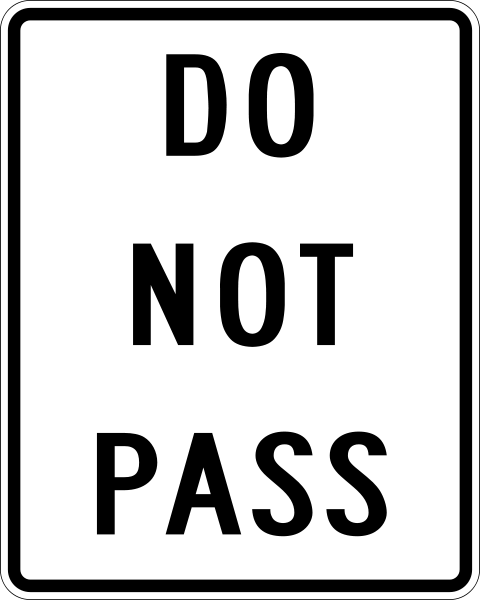
(When I was 5 or 6, I remember thinking that my dad was going to get in trouble for driving past one of these signs...)

Do not attempt to be an art historian. Do not attempt to be a historian. Do not attempt to be a marine biologist (Ghostcrawler promised me a pony!) or a journalist or a practitioner of any number of cultural or geographic arts. And don't even bother to get medieval on anyone's ass. No one else cares. It doesn't serve the drive of the modern society. It's not productive. You can go into business, technology, the law, or medicine. Make your choice.

Except that... well... you can't really go into any of those, either. The vast majority of the aforementioned debt is the (ahem) product of people venturing into those fields in the past decade or so. Those are, after all, the fields that society has deemed truly beneficial. After all, they get paid the most and the most assuredly, right?

A friend of mine started a blog recently, entitled "Inside the Law School Scam", which details the apparent effort by major law schools to recruit students not for the purpose of teaching them to become lawyers, but simply to make money... for the law schools. It is becoming a supposition among lawyers that law school doesn't really teach you about practicing law. You learn that in the real world, when you're making money. After all, that's the point of being "productive", right? To make money? Except that making money often involves being unhappy; something done for the sake of "getting by".

What kind of successful society perpetuates unhappiness for the sake of popular concepts of efficiency? What kind of society deems any activity that does not make an immediate or enormous profit one that is, essentially, a burden to that society? Produce or die. And yet, most of the major works of art and literature that form the foundation of our modern society were the product of patronage or starvation. The very culture that is lionized and revered by the ownership class was created by the kind of people that that class reviles. Most of those people did so because they were driven by passion and, occasionally, assisted by those who had means.

Our means, at the moment, is often directed toward creating more means as an end unto itself. I remember thinking about going back to school a couple years after I had graduated from Michigan. I had thought about getting a master's in education and going into teaching. My father attempted to talk me out of it because "there's no money in it." True enough. Unless you're a big-time law or business or medical professor, I suppose.

What kind of society perpetuates these conditions? Presumably, the one that doesn't care about them and those left to endure them. That, in itself, is an argument for burning said society to the ground and starting over. "There always seems to be money for war but not for education..." Or happiness.

Thursday, June 16, 2011

"Are you happy?"

Said question was put to me a while back by a friend. He's not a close friend, so it's not a topic that I would generally venture into with him. I don't mind communicating personal things to people, but this is a topic that could take some time and I'd be concerned about being soporific. The other half of that assessment is, yes, there are things that I will only talk about with a select few.

The topic came up because I had mentioned to him that a couple people I knew seemed genuinely happy in recent times. They had gotten over some significant hurdles and had reached that point of almost-nirvana; the "life is good/beautiful/perfect" moment. He said he'd known moments like that and then turned the question back to me.

"Are you happy?"

It struck me then that I'm not sure what that means anymore.

It's been so long since I've had one of those "life is good" moments; wherein I'd been content with the route my life was taking, my immediate surroundings, whom I was with, what I was doing, and could genuinely appreciate the positive side of almost everything, that I honestly don't know what it feels like any longer. I can't remember what it felt like in the past. I'm slowly beginning to question whether I've ever been there. Certainly, there are always the self-pitying reflections when times are difficult (as they are now, somewhat), when one becomes convinced that there's no way out of the turmoil and wonders if there ever truly was. There are sincere moments of regret for all of the woulda, coulda, shoulda moments that might have shifted the course just enough to bring at least some joy into the otherwise presumably bleak and Road-like outlook. One's perception is always colored by what's happening right now, so now would probably not be the most advisable time to sit back and wonder if happiness had ever truly been present. It certainly doesn't feel that way now, so how can memories have ever been better? But perhaps I'm thinking too much in the realm of absolutes.

Are there good times? Absolutely. I had a pretty good time last night, in fact. It's easy to be distracted from the overarching sensation by friends and experiences. Copious amounts of alcohol don't hurt, either. Life is not solely a path of misery and never has been. If ever that situation comes about, one can usually be sure that life is either going to take a dramatic change quite soon or be finished equally quickly. I can remember many good moments from the past 20 years. What I can't remember is that feeling of contentment and surety that says "life is good."

My answer to him was: "Probably not." (Evasive much?) So, he turned it back again: "What would make you happy?"

That stumped me for a bit. Again, I feel like I'm operating at a loss here because the sensation is seemingly beyond me. But I could think of several things that would make me happier and I listed off a few and quickly remembered that all of them are circumstances that are either largely beyond my control or situations in which my vote is not the only one that counts. Despite earnest lifetime effort, I cannot simply control all of the people around me and get them to shut up and do what I tell them to do. In a couple scenarios, doing so would at least mildly defeat the purpose, anyway.

He pointed out one scenario and said: "Why don't you pursue that if it would make you happier?"

Two reasons: 1) That was one of those that isn't solely up to me. If there were something out there that didn't resemble fly fishing from a B-52 (for all you non-Cold War kids: here), I surely would have attempted it by now. 2) Since it's not just up to me, it necessarily involves the happiness of people other than me. Diminishing someone else's in favor of mine is something that I may never be able to do.

My parents essentially instilled in me the idea that my personal happiness was secondary to all else. If someone else wanted to do something (usually them) that impinged on my life, then I was simply required to suck it up and accept it. It's a perspective that I still employ on a regular basis in my relationships with others. It's more important to me that my friends are happy than that I am so, as I've vaguely averred to before. It's also contrary to MA's approach, in which the nature of Stoicism is defined by not subsuming oneself in "destructive" emotions, but instead working through everything with reason. Reason, of course, can't account for everything and there's certainly room to question whether the human condition can survive a "pure" Stoic approach in the same way that aspirational Buddhism almost demands a transcendence beyond the consciousness of the human state. There's not really a classical philosophical approach to the idea of dispensing with "constructive" emotions except, perhaps, nihilism, but one wonders if that's a proper summation of the inability to feel genuine happiness any longer.

As noted, this isn't a topic of which I would go into great detail with most people, largely because I'd have to explain a lot of it and/or not be certain that the imposed upon would understand what the hell I was saying in the first place without jumping to any number of conclusions that would invariably be wrong and/or annoying. In my life, I think I've come across all of three people who could always seem to understand what I was saying as I was saying it. That's an incredibly comforting thing. The first is someone whom I haven't seen in almost 20 years and haven't talked to in about half that time. The second is someone that I barely talk to anymore, as she's enormously involved in her own life (as she probably should be.) The third is someone that has become close relatively recently and I still hesitate to impinge (that word again...) upon her because, once again, why douse someone else's day (and presumed happiness) with my own dire proclamations? "Let every action aim solely at the common good..."

So, I suppose I occasionally ramble on about these topics here so that people can choose when to stop while I attempt to gain some perspective on them alone. Effective? I don't know yet.

Tuesday, May 31, 2011

Ethical-type substances

Now that the big news has broken in the college football world that the good Senator Tressel may not be as lily-white as his books proclaim (First page in the Manual: Cheaters win. For a while.), I thought I'd revisit the topic of ethics that I brushed past a few weeks ago on the new national holiday now known as Osama Got His day. (Just for the record, I never believed Tressel was as spotless as his true believers like to think. After all, I knew his name from Youngstown State.)

What exactly are the ethics of an assassination? Under the traditional rules of war, anything goes with regard to figures of strategic importance. In World War II, often referenced by half-assed liberals as "the last good war" (I won't even get into the concept of 'good war' here), the US had broken the Japanese codes and knew which plane Admiral Isoroku Yamamoto was going to be flying in and promptly ambushed it and shot it down; an assassination as sure as one from a single bullet but a wartime act against a soldier and, thus, more easily placed within the realm of 'ethical' combat.

Killing Osama bin Laden, in the midst of our perpetual war (cue Orwell) against an enemy that can come from anywhere and can be identified as anyone; whose status in life can change from "citizen" to "terrorist" to "combatant" to "enemy non-combatant" (my favorite) with the stroke of a key, ended up being just one more example of the plasticity of the ethical code that the US has long touted as what sets it apart from much of the rest of the world.

Big surprise, right? I mean, we're all cynics here. It just amuses me in the same way that watching people fervently believe in US presidential candidates does. After all, think about the killing of this man the next time that people are outraged when a US or allied VIP is killed in a random bombing. It's a horrible crime against humanity! But killing this unarmed guy is somehow 'justice'. On the contrary, a targeted assassination is just what it sounds like (and, incidentally, illegal under US law and multiple international treaties which the US is a signatory to, not least of them the Geneva Conventions), whether you use a SEAL team or and a gun or a block of plastique and a Honda. The phrase "don't stoop to their level" comes to mind.

"Oh, but it's not even the same!", you say. "After all, we just shot one guy who deserved it. They kill innocents with their bombs." In military parlance, innocents are often termed "collateral damage". I won't bore you with the endless stories about collateral damage that currently has the president (read: stooge) of Afghanistan making vague threats against the US as a consequence. Go find them.

Terrorists are often the neighbors of the collateral damage and it's said activity that frequently propels them into that life. Of course, there are still ethical questions even within the framework of terrorism. When the Baader-Meinhof/Red Faction group were active in Germany in the 70s, they committed a number of bombings; at least two that injured the very workers that they claimed to represent. There was, of course, outrage within the organization for having harmed the very people they were fighting for, even though the most notable occurrence was an attempt to assassinate the editor of a prominent German newspaper.

If the RAF or al-Qaeda had the ability to only kill their targets with their bombing attacks, one would think they would exercise said ability (which, incidentally, is not completely beyond the reach of many groups, since Hezbollah has proven to be very adept at this over the years.) After all, why kill or maim the very people you're trying to recruit/protect/serve/inspire? A reasonable person has to assume that some degree of ethical assessment goes into acts like this in the same way that the US government calculates what laws it's willing to break or principles it's willing to abandon to serve its masters' interests.

Of course, it's easier to simply assume that bin Laden and all of his associates are simply inhuman monsters because it's easier to fight and kill people when you dehumanize them. That's been a standard approach of warfare from time out of mind. So, did the inhuman monster deserve to die? Most people would insist that he did because of his supposed role as the planner of the World Trade Center attacks. After all, even though he was only indirectly responsible, the perspective of Nuremberg, that the planners are every bit as culpable as the doers, is still a popular and easily argued stance. It's only mildly hilarious to the historically obsessed among us that the very Conventions that the US has been serially violating for the past half century were written in response to the very acts that took place in the time period of the Good War and to which Nuremberg was the initial response. Irony is fun!

Again, did he deserve to die? I don't know. Does Larry Summers deserve to die for inflicting his economic ideology on the Baltic republics and Russia and indirectly (i.e. like bin Laden) causing what may be thousands of suicides and untold misery? (pleasesayyespleasesayyespleasesayyes) Where do personal ethics, national ethics, and the concept of justice meet? Do they meet? Does national interest trumps ethics or can it be one and the same, in the long-term? "Let every action aim solely for the common good..." Or is it simply impossible to be genuinely ethical in a "wartime" situation?

Let's back up a bit: When the Bill of Rights was first discussed and promoted by George Mason and later Madison and Jefferson, one of the key points that they referenced was "freedom from occupying armies", which became the third amendment that freed civilians from being forced to quarter troops in their homes. Part of that was motivated by people being tossed from their homes by the British in Boston during the revolution. But part of it was motivated by there being a distinction between wartime and peacetime. Most of the writers of the Constitution were very concerned about the concept of a standing army, as it not only represented a drain on resources, but also a government that always had the use of force within easy access. This concern (and confusion) was later eloquently expressed by Einstein, when he said: "You cannot simultaneously prevent and prepare for war."

However, since the end of World War 2, the US has been on a wartime footing and wartime economy, with the "war on terror" only the latest manifestation of the national policy that someone is always out to get us so we'd better be ready to shoot back (cue MacArthur). Does that mean wartime ethics are perpetual, as well? And what defines them? We've already seen the willingness of the US to evade the accepted 'rules' of war., but there's a more pervasive aspect than simply outrageous acts of violence. It's yet another example of the militarization of US society that has created an outlook where nothing can be sufficiently 'solved' without the use of guns; most often in the interest of economic influence or control in other nations (at home, of course, we just use old-fashioned bribery.)

If one decides that we are permanently at war, then any ethical constraints on behavior become that much weaker (after all, "things happen" in war) and the concept of a civilized society becomes that much more distant. If one decides that the previously acknowledged 'rules' of war are no longer applicable because this war is different, it just gets that much worse. So, where do ethics and, for that matter, civility actually come into play, not just in the bin Laden assassination, but US foreign policy in general?