Showing posts with label racism. Show all posts

Friday, September 9, 2022

The political crux emerges


With the introduction of Númenor, we are now fully into the story of the latter part of the Second Age. Most of the key moments of the story of the rings, the return of Sauron, and the creation of what would be the Middle-Earth of the Third Age (where Lord of the Rings is set) is based in, affected by, or fully revolves around the island kingdom of Men that was granted to the Dúnedain by the Valar (aka the gods themselves.) This is where most of the political struggle and upheaval that should be central elements of The Rings of Power will take place. With that in mind, it's not surprising that, with a couple excursions to the captive Arondir and (sigh) the half-halfling nature people, all of the action took place in Armenelos, the capital of Númenor, where we were introduced to the key figures of not only Elendil, but his son, Isildur, who ends up having a bit of history with the most important ring of them all.

The amount of money poured into the series was once again on full display, as Armenelos and the port all looked spectacular, as did all of the ships and pretty much every bit of kiwi scenery, CGI-enhanced or not. The series is a visual treat without question. The issue at hand is whether they'll be able to present a story to match. (Just as a side note: I have absolutely zero concern about the impact of racists "review-bombing" the series. With the positive opinions coming from critics and the non-ignorant, the general audience will soon vastly outweigh the closed-minded keyboard warriors who have spent the last few days accusing Neil Gaiman of having ruined Tolkien.) So far, they seem to be doing well with both "canon" material and the new stuff designed to bridge the gaps and bring Tolkien's myths down to earth to some degree. The presence of characters like Halbrand (Charles Vickers) as the smooth-talking, regular guy with the dark past and occasionally criminal habits does help to break the ice that the presence of people like Galadriel (Morfydd Clark) would otherwise create to keep the entire thing at a distance from viewers; kinda like a legend, one would think. One funny side effect of their interaction on screen is that her Welsh accent makes his name "Halbrand" sound like "Hellbrand", which only serves the current fan theory that he's actually Sauron come to Númenor in disguise to scope out the scene. If you want a long-running series with characters that people can identify with, that's typically the best approach.


The other one is to engage a fan sop about the source material and continue to subject us to stories about the little people that hide from every danger. I'm still not particularly thrilled with the Horfoot material because it's still kind of routine and that makes it kind of tedious. The odd contrast is that those scenes also contain the greatest number of characters that the audience can identify with, as Nori (Markella Kavenagh), Sadoc (Lenny Henry), Largo (Dylan Smith), and Poppy (Megan Richards) are at least somewhat funny and quite believable in a charming, Underhill kind of way. But just like with the first two episodes, I continue to not see the necessity of the Horfoots (Horfeet!) other than to add the LotR shine to a story that could've been told without the clown act constantly running. It's not actively repulsive and tiresome like the court scenes in House of the Dragon, but it's such a step down from what else is happening in the story that it stands out as something of a flaw, overall. In something of a contrast, I can't help but arch an eyebrow at some of Clark's moments. One assumes she's been instructed to be such an absurd hothead to present the starkest possible contrast with the ethereal thousands-of-years-older version of Galadriel in LotR. The confrontation with Elendil (Lloyd Owen) over whether she could kill him, fight her away aboard a tiny skiff, and then pilot said skiff singlehandedly out of the port was just a bit OTT on the acting side. Since we've been given the impression that Elvish immortality extends to limitless endurance, given her willingness to swim from Valinor back to Middle-Earth, I suppose it's not completely unreasonable to the point of stupidity, but it's awfully close.


On a couple other production notes, the revelation of the glyph being a map of Mordor and the (for some reason) written plan to create a place where "evil could thrive" was a bit heavy on the melodrama and orchestral crashes, but that may be my "I know all this stuff already" bias speaking. Along those lines, the Númenorean distaste for elves in general and Galadriel in particular strikes me as a bit overdone. What might have softened it somewhat is a bit more elaboration upon why not just the rulers of the island but the people, in general, hold that opinion with such intensity. Even the real racists in our world complaining about non-White actors try to come up with excuses as to why they're so opposed to the presence of people who don't look like them. On that topic of looks, while almost everything is quite stunning on the visual side, I'm not sure we needed 90 seconds of Elendil and Galadriel riding, along with every shot possible of Galadriel, her perfectly white horse, and her flowing blue robes to drive that home. It's also kind of funny to note that, despite the elaborate use of chains as weapons and the savagery of the orcs driving their prisoners, the direct death scene of one of Arondir's (Ismael Cruz Cordóva) compatriots involved as little visible blood as possible and certainly not the kind of arterial spray you'd normally get from a mortal wound on the neck. I'm not objecting to the lack of blood. It just seems like kind of an odd way to pull your punches a few minutes removed from a warg chewing through people. Also, Arondir's commander pointing out that the rudimentary cover to protect the orcs from the sun being "how they hid from our sight" in the middle of a path of devastation through forested land stretching for miles is, uh, a head-scratcher of a script point.


Regardless, it's still entertaining and has me looking forward to subsequent episodes, although I'm willing to question if that's not more because of my latter-day Tolkien nerdism than whether the story is simply that interesting. Bringing in Isildur (Maxim Baldry) this early is an interesting choice, since it allows plenty of time for him to build into the alternately heroic and tragic character that he becomes. OTOH, creating someone new like Adar- apparently an elf serving the forces of Morgoth, which doesn't seem at all irrational given the Kinslayings and the shame of the Noldor that Galadriel avers to -shows a willingness to strike out in new directions, which is certainly of interest. Is it compelling? Not quite yet. Could it be? Positive signs.

Sunday, August 7, 2022

Milestones past


Back in the early 1990s, the comic industry went through something of a boom cycle. There were enough creators that were eager to escape the work-for-hire dungeons of the big two (Marvel and DC) and enough smaller companies that had been doing largely licensed fare (Dark Horse, etc.) to prove that it was viable to work outside the two colossi. The general feeling was that the only way to do "good" comics was to do "new" comics. The trigger event for much of this, of course, was the departure of some of the biggest artist names in the industry from Marvel to form Image Comics. Around the same time, former Marvel editor-in-chief, Jim Shooter, had found some investors to help him put together Valiant Comics, who picked up a lot of old Gold Key properties from the 1960s, like Solar and Magnus, Robot Fighter. Dark Horse soon followed suit with their first venture into superheroes and their Comics' Greatest World (headlined by Frank Miller's X) and smaller companies like Malibu also recruited veterans like Steve Gerber into their Ultraverse. It was that highly-competitive environment in which Denys Cowan and Dwayne McDuffie, long-time veterans of mostly Marvel books, decided to launch Milestone Comics, which is the subject of HBO's new documentary, Milestone Generations.

Denys, DC publisher Jenette Kahn, and Dwayne

I knew Denys and Dwayne very casually back then because Milestone was set up as an independent studio that happened to have a distribution deal with DC. But because they were independent both editorially and style-wise (or so they thought), they often showed up in the "small press" area of the larger comic shows, which is where we were with our Fifth Panel Comics. At one Motor City show, we had booths right next to each other. We were known for regularly having music playing at our booth, which I tried to vary on the regular so that everyone could find something they liked (I, of course, generally like all of it.) At one point, it was Dwayne who looked over and said: "Alright, who's the James Brown fan?" when the godfather had started belting out "Cold Sweat." Yeah, that was me. Those were good days because there were so many people trying to do something different with any number of motivations toward that difference. In Shooter's case, he was trying to directly challenge the powers-that-were by showing them how he could do a shared universe experience "better" (He was later fired by his investors in the same way, and for many of the same reasons, that he'd been removed from Marvel.) In Dark Horse's case, it was an attempt to do superheroes in the "more realistic" DH style. (They folded quickly and went back to doing their usual fare.) In our case, it was mostly an attempt to carve out a space where we could do our own thing, as well as be part of the movement that was shifting away from brightly-colored spandex as the main theme of the industry. (We, of course, didn't even have color in our books, except for a couple covers.) But Milestone wanted to stay in that vein of providing heroes for kids (and some adults.) They just wanted to make those heroes look more like the people that were often reading them and speak to their lived and living experience.


The documentary is pretty thorough in examining a lot of the motivation for and the creation of the company and the "Dakotaverse"; their nickname for their universe based on the metropolis where the first books were largely based. It also covers a lot of the later activity of the company, after they had shut down the comics division a couple years after the mid-90s market crash, and gone exclusively into licensing and the production of a cartoon based on Static, one of their first books and the best seller among them. Denys is pretty open about the difficulties that they faced but isn't bitter about it. Having worked in the industry for so long and having done so as a person of color, he was aware of how the world works. Plus, in my experience, Denys was the quiet one among the creative founders, while Dwayne was far more outspoken. The most salient issue for them, of course, was the fact that they wanted to actively engage issues like racism, homophobia, and teenage sex. As one might expect in Puritan America, it was the last one that was the tipping point for DC, in which they adamantly objected to a cover depicting Static in an embrace with his girlfriend with a couple condoms on the floor next to them. Milestone, despite being editorially independent, eventually conceded to DC's demands for an outer cardstock cover that would hide a lot of the artwork once word came back from distributors and outlets that that would also be objectionable to them. This, of course, is an industry that has had any number of problems with religious types and helicopter parents objecting when they discovered that comics aren't just for kids. But in this case, it wasn't blowback from the street. It was internal and Denys suspects that it was, in fact, driven by DC and it was easy for stores and distributors to follow along, not just because it was sex (just FYI: as in any other entertainment medium, sex sells in comics) but because it was Black sex.


Most of those at Milestone expressed the opinion in the film that I remember hearing back then, in which low sales were a consequence of people not wanting to buy "comics for Blacks", as if stories about Black characters were somehow exclusive to those who shared their skin tones, while White characters were for Whites. Here is where we veer into the usual absurdity of racism, often the unconscious type, in which there is irrefutably an impact from people not being willing to identify with others simply as human, regardless of identity. I think that's a fair focus for the film to take because it can't be denied that that was part of the cause of their demise in the comics world. But all of the detail I spelled out above is also pertinent. When the industry imploded because of the collapse of the speculator bubble (Newsflash, kids: If they're printing 20 million copies of a book, it's probably not going to be "collectible", which usually implies scarcity.), it took down multiple companies, including Valiant and Malibu, countless stores, one of the two major nationwide distributors (Capital City), and led Marvel into Chapter 11. So, yes, there were external factors having nothing to do with money that led to their demise. But money had a lot to do with it, too. On top of that, there were some internal factors because, in some cases, the books just weren't that great.


I liked Denys' artwork and I appreciated Dwayne's writing, but neither of those were really industry leaders. Would I have gone out of my way for a Cowan or McDuffie book because I knew they were on it, like I would an Alan Moore or a Jill Thompson? Probably not. I was interested in Hardware and Icon and Blood Syndicate and Static because I wanted to see those stories from their perspective. I wanted to see "different" superheroes from the usual pablum that was often dished out. But did I save those comics for last in the weekly pile because I was most looking forward to them? No. They were solid, but not earthshattering. And many of the later books, like Xombi, were more obtuse than insightful, especially for a monthly serial. So while I can see their argument that being identified as "Black" superheroes and not actually being able to tell the stories that they thought might resonate with the largely older audience of the time (which Marvel had recognized in the 60s and DC still refused to comprehend in the 90s) were both confining and probably had an impact on their success, I still think there was a lot more going on that the film didn't really cover. I do, however, appreciate the several minutes at the end talking about how Denys is still in the mix and still trying to lead new faces into the industry (Dwayne, sadly, passed away over a decade ago) and Milestone is the company that he's still using to do that. It's both a more diverse and still positive voice that could really add to the tableau if given a shot.

Tuesday, August 18, 2020

Slimy, green book

There's something to be said for a TV series that opens with Jackie Robinson splattering what is nominally Great Cthulhu with a baseball bat. Even if I wasn't already interested in things Lovecraft, that opening scene of Lovecraft Country would've been enough to stop me from channel surfing and to take a moment to see just where this thing might go. It's based on the novel of the same name, about a young, Black man and his family and their encounters on the road in Jim Crow America and how the horrors of bigotry are often just as awful, if not worse, than facing down an interdimensional demon.

For those that don't know, it's worth mentioning up front that H. P. Lovecraft was an unrepentant racist. Many of his more famous creations are rooted in his opinions of people not like him and, quite often, Black people, such as Nyarlathotep, often known as The Black Man or Shub-Niggurath, the Black Goat of the Woods, and so on. You'd like to think that it's akin to things like the antisemitism of Wagner, except that HPL's racism is actually embodied in his work. It wasn't a universal theme in his output, but it was there. So it was singularly appropriate for author, Matt Ruff, to take those not-so-subtle themes and turn the spotlight on them and still get to engage shoggoths and demon hounds while he was at it. I haven't read the book, but from what I've heard from people who have, the first episode of the HBO series, released last night, stayed in lockstep with Ruff's vision.

In some respects, the overall premise isn't that different from Green Book, except that the Black people in this show actually have agency. They do get some help from a woman in a silver car (Does she start it with a silver key...?) but otherwise they're encountering and mostly solving their own problems. That agency is driven by familial and emotional concerns, which also means that they're real people; not itinerant adventurers who want to motor halfway across the country to look into weird things in backwoods Massachusetts. 

Jonathan Majors does some compelling work as Atticus "Tic" Freeman. I remember him from Last Black Man in San Francisco, but little else. I also like Jurnee Smollett's turn as Letitia Lewis, especially when it becomes apparent that she's not particularly attached to anyone or anything, but mostly just takes advantage of people for the couple days that she needs before she moves on. That's not exactly a sympathetic character but, again, it's a real character, as I'm sure that most of us know someone(s) like that. She's not malicious about it. An unwillingness to be tied down or forced into societal roles is often seen as a trait to be admired and it's a continuation of theme, given the number of forced roles that Black people in this country often still have to adopt. But there's emotional impact from that kind of behavior and it's something to build a real story upon.

It says something, too, that it's basically a relief when the monsters show up to rescue Tic, Tish, and George from the police. (This is where I always remember the line from Fletch: "Oh. Thank God. The... police.") The show builds tension nicely from the restaurant to the World's Slowest Car Chase scene and continues it into the woods and the running chase/battle from there. Again, tribute to the writers and producers for picking up Ruff's themes so well. "They only come out at night" is a phrase that could've been applied to sundown towns, where the real monsters were the cops and the local klansmen (Sometimes a two-fer! Those who burn crosses are the same who work forces, yo.) The gore might be a little OTT for a mythos rooted mostly in eerieness and dread, but doing a more active take on HPL's ominous darkness isn't a bad thing. That's what you'll get if you play Arkham Horror and end up walking around with a double-barreled sawed-off and nightgaunts all over the streets.

That's not the only deviation from the mythos, though. Rather than using one of the classic HPL towns (Arkham, Innsmouth, Kingsport, Dunwich, etc.), the writers decided to suggest it was a misread of a letter from Tic's father and the town they're looking for is actually "Ardham." This is kind of clever, in that the characters are already aware of HPL's fiction (and racism) and it would end up being kind of trite if Arkham really existed. This way, it can basically exist, but it's actually some other village in the hinterlands of New England. This draws the audience in with the characters as we're all living out our fantasies of being investigators of the power of the Old Ones. On that topic, we delve into a true nerd moment here in the fight scene, as it's implied that the beasts in the forest are shoggoths, which Atticus refers to as "blobs with eyes and teeth." He's right but, with maybe one exception, that's not what those things were. They reminded me much more of the hounds of Tindalos, except they didn't come out of the angles in the walls. (Go on. Wiki it up. I'll wait.) Shoggoths are also usually translucent, which these things weren't. But that's sticking to canon which many, many other authors after HPL didn't and, if they're taking liberties, more (ancient) power to them.

There were some smart little details elsewhere in the episode, as well, like the Denmark Vesey bar. Vesey was a former slave who was executed for supposedly planning a slave revolt in Charleston, SC. Also, we see Tic reading A Princess of Mars, the first in the Barsoom/John Carter series, which is a story about an Earth man going to a new world where he is the outsider among several races of Martians separated by the color of their skins. He is occasionally mistaken for being one of the white apes of Barsoom; the only truly savage species of humanoid on the planet...

So, I think this has promise and I'm interested to see where it goes. Next week's episode is entitled "Whitey's on the Moon". I'll be back then.

Monday, June 8, 2020

The privilege of ignoring


As some of you know, I've done some writing for a website called ThereWillBe.Games. I'm a relatively long-time member of the community that it's based upon; the original Fortress: Ameritrash. That group was made up of a number of members of Boardgamegeek, who were (and still are) vocal fans of a style of game once known as "Ameritrash." Whereas Euro games, like Settlers of Catan emphasized mechanics over theme, Ameritrash games emphasized theme over mechanics; such that they were often much more random and had aspects that were often embraced/derided as simple "bad luck." Think Talisman or Dungeonquest, if you know games (albeit both from a British producer...)

As games, in general, have shifted away from the old "roll a die and move" approach, so the site has shifted away from its former neo-frat house nature. About a year-and-a-half ago, I was deeply involved in an attempt to broaden the audience of the site, in the same way that many game producers and retailers have been striving to do with the industry as a whole. No one wants the gaming world to be made up solely of pasty, White guys like me, as there are a lot of other people who also enjoy playing, designing, and producing. We wanted the site and the forum to be welcoming to anyone interested in playing games, regardless of their identity. That, of course, produced some pushback. Publishing articles and running a forum on any site is tricky in its execution, but especially so on sites that are nominally confined to a certain topic. In this case, you want the conversation to largely orbit around the topic of games, but you also don't want to prohibit expression. Games are a social endeavor. "Social" means interacting with others. That means other issues can and will arise.

The pushback immediately manifested in the pseudo-libertarian perspectives of some complaining about "free speech" concerns. (I've commented many times before about how that interpretation of the First Amendment is self-serving horseshit, so I'll spare you a rerun.) But it also occurred in the context of gaming as an "escape" from everyday life. It occurred again recently when the site's director decided to add TWBG's voice to those speaking out about the problems of police brutality and systemic racism in our society. As most of us have been tied down with COVID-19 issues and some have tailed off in output, she recently emailed all of the site's regular contributors about their well-being and received a response of that kind, which I'll reproduce here:
My dissent is this: people need spaces where politics don't intrude. Gaming, for me, is one of those. I can't speak for anyone else, but my days include occasionally being on conference calls/webinars with the current administration of the US Department of Education, often with the [...] State Department of Education, and dealing with the rough-and-tumble of a local school board and town council--all extra highly politicized at the moment. I need a break once in a while, and I don't need my hobby throwing politics back in my face. I was sorry to see it come to TWBG.
This is one of the purest expressions of privilege you're likely to see in casual conversation. It's not spoken with any malice or overt racism, but it is spoken with the perspective of someone who has never had to think about conditions that he takes for granted, but which might be serious blockades to the enjoyment, comfort, or even function (like, say, breathing) of others in our society.

This was a project announced by GMT until a backlash canceled it.
Whenever "politics" as an intrusion or "politicization" are cited, it almost always comes from someone who doesn't want to think about other peoples' problems. After all, as a White male, I don't have any concerns about driving to the game store, purchasing a new game, and maybe sitting down to play it right there. I'm in control. Those decisions aren't impacted by any societal circumstances or the narrower ones surrounding those actions. How comfortable might a Black gamer be driving to the store (because of the police)? How comfortable might a transgender gamer be dealing with the staff? How comfortable might a female gamer be simply walking up to the table and asking if she can play? Those are "political" issues because those are social issues. They affect the society that we all happen to live in. That's why the site decided to join the chorus of protest against injustice.

Most people who aren't White males don't have the luxury of deciding when and where they want to forget about what's happening to other people. Instead, they have to consider the social (and, sometimes, legal) barriers constructed against them and decide whether it's worth the risk of encountering anything from feeling uneasy (which, y'know, kinda makes playing a game less enjoyable) to direct fear of being arrested, assaulted, or killed; most notably by those whose purported role in society is to protect its citizens. In short, if your response to someone highlighting these problems is: "I don't want to make one tiny sacrifice of my attention in the name of changing what other people have literally sacrificed their lives for", then I think a moment of introspection might be called for.

A lot of games present fantasy worlds to immerse yourself in. It's safe to say that the author of that response wants to live in two of them: the swords-and-sorcery/meeples kind and the "one where racism doesn't really happen" kind. Again, he has that privilege because of the status that his skin color and gender bestow upon him. What other people want is the ability to also slip into both of those fantasy worlds and make the second one more of a reality. Furthermore, no one is saying that you have to live the larger world every moment. I don't think anyone is thinking about larger societal issues while they're watching a baseball game or an episode of The Blacklist or while they're reading a novel or, yes, while they're playing a game. No one has to be "on" all the time. What we're talking about is the actual ability for some people to turn "off" some of the time and have access to that ability in the same way that the dominant social presence does. That, of course, means progress, which means change, which always makes people uncomfortable. But that's the way the dice roll sometimes, yo.

Friday, May 29, 2020

The Others' problem


Derek nominated me for one of those silly games on Facebook the other day, where you're supposed to give an image of a film that "impacted you" without any other explanation and then nominate someone else to also participate. Movie enthusiast that I am, I figured I'd actually join in, despite my attention given to Facebook being minimal, at best. Over the first three days, I picked three films that really stand out to me and which I may write some detail about later. On the fourth day- today -I picked another that I'm really fond of: Escape from New York.

I'm a big fan of John Carpenter's early career. I think there was a tension to his technique that really made his work shine, even on the lower budgets that he was often working with or the, uh... less than stellar material. Let's not kid ourselves: Escape is a B movie. Despite the presence of bankable stars like Kurt Russell, Isaac Hayes, and Lee Van Cleef, the story is pretty shallow and no one gives a performance that would see them considered for a little, gold statue. It's your average, nigh-on post-apoc, speculative fiction (e.g. "What if World War III really happened AND crime ran out of control?!") There were a lot of them in those days; still firmly embedded in the Cold War and with a stagnant economy that Reagan had not yet performed his "miracle" upon. I had been politically aware for a few years by then and was in Tennessee, attending a small, recently post-military school outside Knoxville. When we finally convinced our floor manager to let us walk into Sweetwater, the local town, and catch the latest Hollywood depiction of a destroyed Statue of Liberty (all of us with fond memories of the end of the original Planet of the Apes (spoiler!), despite said image having little to do with Escape), we hit a brief moment of nirvana.

Here was a hardass ex-soldier who spoke in an OTT, raspy growl, dropping into New York, the locus of crime and corruption (even as a Detroit native, I remember this impression), and taking on the whole city so he could get out in the process of... rescuing the president? Wait. What? Even at that age, I was pretty much a cynic and reflexively distrusted most American officials of any kind. I had no idea why Snake Plissken would want to rescue the leader of the system that created so many problems! (Even then, I was pretty much a Marxist, too.) Of course, Snake felt the same way ("The president of what?"), until he was effectively blackmailed into it. So, yeah, instant hero identification. But as we got through the film and came to the last scene; the one that takes place in that image above, I realized that this was something unusual for my young eyes and brain. Not only was Snake an anti-hero, doing the right thing incidentally, rather than intentionally, but the opposition was more complex than your typical villain, too. Bob Hauk (Van Cleef) was trying to maintain order, within the prison and within the nation, which was his job (and saving a life, I guess.) The Duke of New York (A #1!; Hayes) was trying to speak for an entire city of supposed criminals; heavy with the implication that something akin to martial law had dropped them into this Lord of the Flies situation, justly or not. And the president (Donald Pleasance) wasn't some corrupt mastermind, devising ways to screw everyone for his own benefit. No, the thing that stood out most to me about that president is the same problem that most of them carry, intentionally or not, fictional or real.

It was the indifference.

The poignant moment of that scene depicted above is Snake's pointed question to the man he'd just risked his life to rescue and that several others had given theirs to enable. The president's response to that question is a blank acknowledgement that people he didn't care about did something to make sure he was still among the living. He was more worried about being on camera in a couple minutes (similar to the current idiot.) He was oblivious to the suffering, the trauma, and the struggle that took place to make sure that he was still president and "leader of the free world." As we sit here with Minneapolis burning as a response to yet another Black man being murdered by the police ostensibly there to protect him and all of us, that indifference is the thing that once again really stands out to me.


The manifestations of it are all around us. It is always happening to someone else. Therefore, why should we care? It's especially easy in the case of those of us who are White Americans. Black people are already deemed The Other. That bad stuff only happens to The Others and usually because they encouraged it somehow, right? It's the same situation with COVID-19. "I won't get it! I'm invincible!" Yeah, sure. You're invincible. But it's not about you. It's about all of the other people that you might transmit it to who don't happen to be invincible in their own mind like you. "But it's mostly affecting nursing homes and old people and I'm not old and I don't go to those places!" Sigh... This is just like when Republicans argue against national healthcare... right up until that moment when some part of their family goes bankrupt because of cancer or a similar situation. Then, suddenly, they realize that "this is a problem that affects all of us!"

But in this case, it doesn't affect all of us. It affects Black people. In most cases, even other minorities in this nation don't live in fear of being approached by the police. Only Black people. White people may get nervous about how fast we're driving when we pass a cop on the highway. But we don't fear being pulled over just because we're driving. And it's not just the harassment. As situations like George Floyd, Sandra Bland, Terrence Crutcher, and Michael Brown (and on and on and on...) demonstrate, their very existence is enough to encourage treatment that results in their death. Or we go one step further and discover that even being shot by non-cops isn't always sufficient to be treated as not The Other, as in the case of Ahmad Arbery, without massive public pressure. That's the purest example of racism: the treatment of others as if they were less than human. Less than animal, in some cases. How many people were just as outraged over Amy Cooper's treatment of her dog as they were over the fact that she lied to the police in order to encourage them to come and deal with this Black man who had only asked her to follow the law? She made that call and made it in that manner because she knew there was a high possibility that Cooper would be mistreated by said police; perhaps even killed. She made that call with malice. That's racism. But she was indifferent to the effects on him. That's also racism.

It's that indifference that is something of a plague on the fabled "American experiment." The idea of individualism emphasizes the suppression of feelings of consideration for others; of taking their feelings and well-being, physical and mental, into account when trying to climb the ladder of success. Even worse, the death of the American dream means that the 99% are reduced to stepping on each others' heads, regardless of the consequences, often even as they try to reach a point of sustainability, to say nothing of what most Americans deem "success." What that phenomenon means for society at large is multiplied tenfold for Black Americans.

And if we're going to get through the remainder of Republican control of government; if we're going to survive as a nation that serves the majority, rather than a wealthy minority; if we're going to pull down those edifices of wealth and redress the wrongs that that hoarding of wealth creates; then it's going to take all of us, of whatever color and of whatever gender. We can no longer look aside from what afflicts The Other. We can no longer ignore the fact that our Black brothers and sisters are people that need our help against a system designed to oppress them and a perception weighted against them. We can no longer be indifferent to the suffering of others if we are to call ourselves human. ("The name's 'Plissken'.")

Thursday, August 9, 2018

Not quite a Klassic


BlacKkKlansman is Spike Lee's latest joint and it was clearly intended as a statement film, rather than a story. There are generally two types of political films: one with a story that delivers a message as part of its theme and one with a message that carries a story. This one is the latter, without doubt, dressed up as it is in the stylistic trappings of a Lee effort that attempts to be the commentary before the critics can get there to extol it.

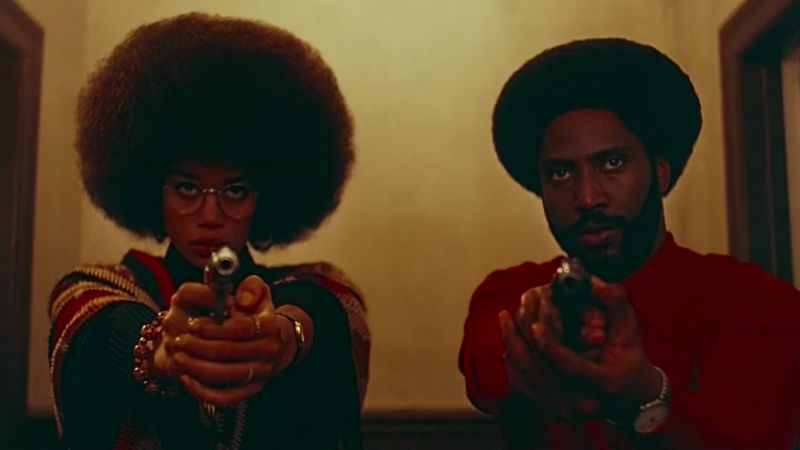
The best part about its absurdist plot is that it's a true story: the only Black police officer in Colorado Springs did actually infiltrate the Ku Klux Klan and speak with David Duke. But Lee is careful to not let said absurdity override the essential disturbing theme of American racism being alive and well in 1979 and to this very day. All of the direct encounters with the Klan members carry an atmosphere of danger and there are no hi-jinks that would lift the story out of the realm of drama and into comedy. That doesn't mean that the film is a brooding one, as Lee also consciously applied the style of the time in which it's set, using choreography and shooting angles that were an obvious homage to the Blaxploitation films of the 70s (Patrica and Ron skimming toward the camera with guns drawn, etc.) He was also careful to draw tight links to the reality of Trump and his followers in the present day ("There's no way America would ever elect someone like David Duke president!", Topher Grace as Duke muttering about "Making America achieve... greatness again!"), as that part of the message was repeated over and over: In many ways, nothing has changed in the last 40 years and the regular shooting of Black people isn't too far away from the organized lynchings and torture that Harry Belafonte as Jerome Turner spent several minutes elaborating upon for his young revolutionary audience. I think that message is a good one that bears repeating.


My one note of reluctance about the film is that, as has happened with many other Lee joints, I think he was attempting too much with one film and the editing was perhaps hindered by both the amount of material contained in the script (and the message) and the relatively thin characters that weren't able to carry the film from scene to scene. In many ways, it became too obvious that it was a message being delivered and not a story being told. The jumps from scene to scene were often choppy and the pace of the film dragged a bit in the middle, mostly because there wasn't enough story to carry it evenly from act 2 to act 3. You only cared about the inevitable resolution and not enough about what was happening to get you there. There was little warmth in the relationship between Ron (John David Washington) and Patrice (Laura Harrier) and most of the moments when Ron had to deal with the chief or other superiors felt almost as staged as your typical police procedural.


But there were some very strong and memorable moments. I found it kind of fascinating that the few moments of real levity were when Ron was conducting his phone kalls to to Klan members and other cops would be cracking up at his over-the-top performance. Of course, Washington was playing it so straight that what was truly funny about those scenes was watching the other cast members try to restrain themselves and end up giving him away. This is one of the interesting things about comedy, in that some of it can best be enjoyed with other people, so that true enjoyment comes from seeing how other people are reacting, even moreso than anything gained from the actual content of the joke. You'd like to think that that, too, was a part of the message, in that the best way to deal with that kind of visceral and unreasoning hatred and ignorance is to be able to laugh about it (and at the racists) together; taking collective joy in the behavior of fools rather than letting their foibles reduce our own.


Adam Driver as Flip Zimmerman had the most poignant moment of the film when it occurred to him just how much privilege he enjoyed, despite the fact that he was one of the primary unwanteds of the Klan, since it wasn't obvious that he was anything other than a White man. It was a great question of identity when he revealed that being Jewish was never something that was a part of his reality as a child until he grew old enough to understand what it meant and develop his sense of self. But that scene may have been a measure of Driver's greater experience as an actor, since he was able to convey that kind of identity quandary, whereas Washington, as the central figure in all of this, really didn't. He was constantly the straight man in the grand joke. Similarly, it occurred to me in act 3 that the person occupying the typical role of hero in the action scenes was, in fact, Driver, since he was the one taking the physical risks in interacting with the Klan, got the chance to show off his shooting skills, and then finally rescued Stallworth from overzealous cops at the end. So, once again, the person occupying the popularly understood notion of "hero" of the film about Black identity was a White guy (see: Amistad.) And this was a Spike Lee film! Two other performances of real note were Corey Hawkins as Kwame Ture and Jasper Pääkönen as Felix. The latter reminded of no one so much as Michael Biehn as the deranged Lt. Coffey in The Abyss.


Another familiar aspect was the little cultural touches that Lee included, sometimes with a feather, like Mr. Turrentine (Isiah Whitlock) using the tagline ("Sheeeeiiiitttt!") of his most famous role from The Wire, and sometimes with a cinder block, like dropping in the movie posters of those Blaxploitation films while Ron and Patrice are discussing them. I can see the desire to clue people in to what that conversation (and the consequent style touches throughout the film) was about, but I also think the heavy-handed approach kind of diminished the overall effect. No one I saw the film with had seen The Wire, so the Clay Davis moment was lost on them, but sometimes those Easter eggs are things to be discovered with later viewings, rather than shoved in your face the first time. Similarly, while I understand the desire to show the events of Charlottesville from last summer to drive home the fact again that, yes, this is still a reality and these people, including the president, are dangerous and a menace to civil society. But I'm not sure the full footage was as effective as a few still shots with captions would have been, allowing the audience to draw some of their own conclusions, rather than making them for it.

Regardless, it's a film that's well worth seeing for a variety of reasons and probably much more effective in the theater than it will be on smaller screens.

Tuesday, June 25, 2013

Welcome to the rest of the world

In the midst of job hunting again, I came across a listing for an NGO in California that is nominally led by a good friend of mine. They're looking for someone to handle the financial end of their operation and, while finance and fundraising are not my most preferred activities, I'd certainly feel a lot better about doing so for an activist organization than for yet another property owner. So I pinged my friend and asked if they'd be OK with me doing the job remotely, as I'm not currently compelled to go back to Cali. He said: "It's no problem doing it remotely, but I have to tell you, the board is pretty set on hiring a person of color."

...

The first thought that comes to mind, since I'm kind of eager to be employed again, is that it's frustrating as hell to immediately be discounted simply because of who I am. They haven't looked at a resume or even seen my name and already I am persona non grata. The second thought that comes to mind is: Welcome to what many non-white people encounter every day! Irritating as it is, it's almost impossible to remain so because there are probably 10 other jobs for which I would be ushered right to the top of the list, while someone who didn't share my skin color or gender would not be.

(H/T jabarkas for reminding me of this.)

Now, one competing thought is that the progressive political world is one that needs more people, not less. One of the defining characteristics of that world, in general, is inclusiveness. Anyone that wants to assist in reforming society or pushing forward an agenda that helps everyone, not just the rich, is going to be welcome there, regardless of color, sex, creed, whathaveyou. And not just welcome, but NEEDED. Gotta keep up with the Tea Party somehow, right? (Ignorance is always easier than reason.) On the other hand, it's also that world that should be at the forefront of demonstrating that people who aren't white can also be at the helm. It's that world that should be actively promoting the idea that non-white people are just as capable of performing any task asked of them. How does one do so? By counter-balancing the inherent racial attitude of society by creating accelerated opportunity. In other words, intentionally choosing people of color (and/or women.)

There is, of course, room for argument that doing so is inherently a racist act. I would be justified in the eyes of some by claiming: "I was encouraged not to apply simply because I'm white!" And that's true. As I said, the board was already slanted against me without even having seen my name. But there's a rather poignant example from the book, Freakonomics, on just how much impact actually seeing my name would have had. Those with "black-sounding" names frequently get less, or less positive, attention than those with "white-sounding" names. (And you don't get much more white-sounding than my full name.) I've seen evidence of this, first-hand, as well.

I just left a job on the south side of Taylor, the population of which is predominantly black. The company I worked for is fairly ruthless about rent collection and I had to review my delinquency reports with another long-time manager in an adjoining property to ensure that I was toeing the company line. Now, this woman is white and had been working in Taylor for at least 20 years. Every single time we came across a "black-sounding" name, like "Tawnisha", she would pretend to struggle over its pronunciation and then shake her head and grumble at the idea that someone would actually have that name, as opposed to something like "Judy". I always followed her faux struggles with a quick enunciation of the name in question ("Taw-NEE-sha."), which she responded to with a roll of her eyes. Accompanying that mild cultural resistance was a rather pronounced difference in attitude when it came to interpreting just why the rent wasn't paid. White names had reasons. Black names had excuses or lies.

So, in my personal circumstances, I'm disappointed that I wouldn't be given the opportunity. I like the sound of the job. It fits my principles. It's something I am motivated to do. I want the job. But there are many more people who may be as capable of and are as motivated to do the job as I would be who haven't had opportunities before this one and I think that's probably the more positive result for society, overall. Frustrating, especially while unemployed, but understandable.