Showing posts with label memories. Show all posts

Monday, December 10, 2012

Almost like it was

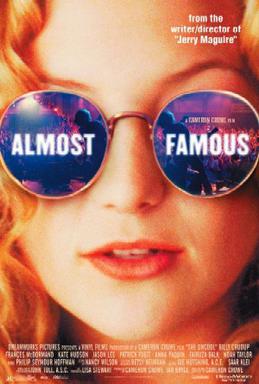
Cameron Crowe's Almost Famous is one of my favorite films. It's not a cinematic classic or something that will be remarked upon by critics or even fans a couple decades from now. It's clearly Crowe's best film (I saw his most recent, We Bought a Zoo, recently; it's preternaturally awful) and had great performances by Kate Hudson and Billy Crudup to propel it, along with the always-reliable Frances McDormand and Philip Seymour Hoffman. It was a great script because it was something that really happened to Crowe and you can see it in how natural most of the characters seem.


But I think the reasons it really appeals to me are two-fold. First, it's about music and the kind of devotion and enchantment that music can create, both among its creators and its fans. To quote Crudup: "My last words were [and mine may be]: I dig music." Jeebus, I listen to game soundtracks because of the twinges my soul gets from a nice violin piece. It's that bad.

But, secondly, it's about a bunch of creative people enjoying that process together, no matter where it took them. The comic studio was like that in many ways. We weren't reaching the big time. We never made any money. But it was never a bad time and I was committed to making it become... something. What, I'm never quite sure, but I was committed. That should be a startling shock to any of you that know me.

I met Jeff Donaldson in 1991 at the Chicago Comicon. I had already lined up my friends, Will Kliber and Wendy Law, in my quest to become a successful comic writer; nominally for DC or Marvel because they were, as they are now, the biggest kids on the block. I was shopping stuff around to other places/players (Dark Horse, Comico, Majestic) but hadn't gotten a bite and Image had just emerged on the scene. The comic world was just beginning to boom past its geeky, shadowy existence and there were a dozen hundred startups of all kinds at the big shows, where Dave Sim was lord of the small press manor. I vividly remember some kids drawing stick figures in a quartered letter-size piece of paper and selling them for $1.50 each. Hey, if Matt Feazell could do it with Cynicalman, why the hell not? The irony is thick and tendentious...


Jeff and Dave Witt and a couple other artists were making a scene in the small press area of the 1991 show and Will had met them on Saturday while I was still trying to make inroads with the bigger houses (this is where I first met up with an editor at Majestic who was more interested in sleeping with me than publishing my stuff; inroads being what they is, I kept in touch with her, show after show, for the next couple years until Majestic collapsed and died with the rest of the industry.) Will steered me over to them on Sunday and we talked about producing some stuff on an actual deadline for their studio, Fifth Panel Comics. As usual, Jeff was in no way serious about that deadline. I was deadly serious and hounded Will about the details of a 12-page neo-Gothic horror story involving a character called The Gargoyle (stunningly innovative) over the next few weeks. The kernel of that character came from a House of Mystery reprint I read in the late 70s (I forget nothing) and I had grand plans to turn it into something which it never became, while I continued to schlep even grander plans to outfits bigger than 5th Panel.


But those Grandiose Adventures never got sold and Jeff and I talked almost every day and it wasn't long before Fifth Panel started to become the focus of my comic world. This world, at least, since there are infinites, as you and I well know. However, everyone at 5PC was doing their own world and, since I was still very sold on the idea of the group thing that Almost Famous so vividly represents, I suggested making a group world that everyone else could pitch their own thing into and we could all reach that pinnacular moment that we all wanted to reach, separately AND together, and oh my wouldn't it just be so fine...

Jeff smiled and said: "Sure."

Interpreting his casual enthusiasm as a deadline of the most extreme sincerity (in this, I am Patrick Fugit), I sat down a couple days later and spewed out a couple dozen pages of outline with several dozen characters, a few hundred stories, and a few thousand possible storylines dangling off of it in an afternoon. My girlfriend came over at one point to see me, at which time I rather brusquely informed her that "I'm working." My shirtless, unshowered, fairly diffidently-gazed self probably indicated that, but I had to be sure. I couldn't be disturbed. Actually, it really wasn't that difficult or intense. I just had to be sure that she was aware that the creative process was in motion. It felt like the right thing to do at the time. Very Hunter Thompson.

That evening, I drove up to Jeff's place in White Lake and dropped the outline in front of him. He nodded, sagely (we were still kind of feeling each other out in our respective roles), and started reading. A couple pages in, he picked up the phone and called one of the studio's artists:

"Hey, you should get down here and read this cool outline that Marc wrote up for a shared world."

A couple more pages. Another call.

"Hey, you should really come over here and read this awesome outline that Marc put together."

A few more pages. Another call.

"Dude, get down here and check out this amazing stuff that Marc put together."

From that point on, Jeff and I were on the same page(s). Our lives weren't very similar. He had a career at Chrysler and was starting a family. I had a series of bullshit jobs and hung out with other political miscreants, theorizing about the revolution. But we shared a passion and conveyed it to a gaggle of artists and other comic-types who then joined us for our various road trips to locales around the Midwest and East coast. The small press scene was booming as the comic industry was booming on the fuel of speculation and we were going to ride this wave as long as we could. One day, Jeff would retire from Chrysler and become the full-time publisher, but a long time before that, I'd be writing my stuff and editing the rest of the studio's output to genuine comics glory.

At the time, we were assembling our books by hand, a group of us stalking around a table in Jeff's attic ("the studio"), drinking and swaying to Beck's Soul Suckin' Jerk, as we grabbed pages, folded, and stapled. There was no better way to spend an evening.


Our road trips were almost always excursions preceded by frenzied activity to pack all of our latest material and Jeff's latest updates to the booth into a minivan that he'd borrowed off the Chrysler lot (the really cool moments were when he borrowed a Viper to come down to Ann Arbor so we could talk studio work and then try to take it airborne on Michigan Avenue.) When we hit the shows, the object was to be as loud and obnoxious as possible to separate ourselves from the other two dozen small studios packed into the darkest and/or remotest corner of the major convention space or to be the one studio that stood out at the inexpertly-arranged small press shows. We were always the music source for our corner of the convention hall: RATM in the morning, James Brown in the afternoon, Mozart as the show came to a close. Beer and bad food and 10 people crammed into a hotel double. I loved every second of it.

Every day was a new idea. Every idea was something that someone guaranteed that they would complete. Every guarantee was a limitless promise, even if most of the ideas didn't have limitless promise or anything close to it. We were all in it together and it meant something to all of us. It was our thing and it was about the work (music), man!

Of course, I can only be so cynical and dismissive here because I would gladly turn the clock back 20 years and submerge myself in all of that again. That's why the film appeals to me so much, because I see our time in the expressions of those characters. We loved what we were doing as a supposedly upstart producer, but we yearned to be something bigger, even if we knew that being bigger would take us away from the absolute circus that we all loved and were thoroughly enjoying (and perpetuating.) It was at that time that being creative meant something. It surely didn't mean money, but that didn't matter. It surely didn't mean success, personally or otherwise. It occasionally meant sex, but Jeff was already married, so there were limits (Jeff's wife, Trish, whom I love to death, always kind of endured the studio, rather than engaged in it.) And there was a little fame. A very little. A lifetime of reading comics and a relative mastery of the English language led to me becoming a capable editor (yet one more skill that doesn't help me to land a decent job...) and I have a deep appreciation for and a decent assessment of good art, even if I don't express it that often.

Mostly it was about being with a group of like-minded people who would respond to one person's creative expression not with confusion or disdain, but with honest enthusiasm. We were fans, like Fugit's and Hudson's characters, who had a deeper appreciation for what was being shown to them than most (neither was "on drugs!" to make it a good time, as it were.) And, more than that, we were also the creators. I miss a lot of things about the studio: the people (I've only been able to keep in touch with Jeff and Dave, and then only sparingly), the road trips, the feeling of success when a project made it to print. But most of all I miss the ability to toss out an idea and have people immediately bounce one or two back. I miss bringing up a story idea and having people immediately become enthusiastic, rather than confused or hesitant. I miss walking into a space with Jeff and being able to feel like I was part of something, as I am part of so very little now.

I watch that film and I see us, even if on a much smaller scale. I'd give a lot to do that again.

Wednesday, May 2, 2012

Revolution in the streets

I've never been much of a TV watcher. Outside of a couple regular programs (Game of Thrones, obviously, and Mad Men), I tend to only turn it on when I'm eating, provided that I'm not already reading something. In doing so yesterday, I came across a documentary on VH1 called Uprising: Hip Hop and the LA Riots. It's a decent effort for a piece that runs all of 65 minutes and attempts to cover a very broad social topic and juxtapose it with the relevant music of the period. While I remember the events like they were yesterday (I was living in a house on North State Street in Ann Arbor and was transfixed in front of the images of the riots on the oak cabinet TV that my housemate, Wendy, had inherited from her grandmother), I hadn't thought about them in years and failed to remember how chilling and infuriating some of the depictions of the violence to both Rodney King and various bystanders in the subsequent riots really are:


As the documentary attempts to explain how the beating and the riots were direct inspirations for things like Dr. Dre's The Chronic, especially the track, "The Day the Niggaz Took Over":


which actually includes soundbites from an amateur cameraman's depiction of the outrage of the crowd following the verdict; and Ice Cube's The Predator, especially the track "We Had to Tear This Motherfucker Up":


which contains soundbites from the news coverage of the ridiculous verdict and the riots; and, of course, Ice-T's "Cop Killer":


which Ice-T has repeatedly stated was directly inspired by the beating of King.

The fascinating thing for me was, while watching it, I felt some pangs of memory from events that had occurred 20 years ago (and the associated "I wonder what happened to..." or "I remember that!" moments) but I had an even stronger reaction to the music being played with the depiction of events. That era of hip hop has always been my favorite and I've found very little since then to be as good (exceptions being Mos Def, The Fugees, Nappy Roots, and all subsequent releases by Public Enemy.) Certainly the textural appeal of much of it being about resistance to the hegemonic system is part of it. No one who knows me could be surprised at my finding public revolt to be an enthralling topic. But, of course, much of NWA's output was in that same vein and I found both Dre and Cube to be far better on their own, both having found their rhythm, literally and figuratively, when they were out from under Eazy-E's thumb. Certainly, accumulated wisdom and experience has something to do with it, but so does their turn toward the archly political and the broader social contexts of that experience, rather than the often more narrow-minded themes of NWA.

Those feelings aren't limited to just thematic subtext. It's really about the music, man! There's a general approach to the sounds and rhythms of that era of hip hop that are really appealing on a visceral level. Looking at my list of exceptions above: Public Enemy was clearly a part of it. Mos Def, while fascinating on a more introspective and often musical level, is much more layered than the basic beats of the time. The Fugees' limited output was also more developed on much of the groundwork that Dre had laid. And Nappy Roots is a whole different social level. The following video, one of the first that I remember replaying repeatedly on Youtube, is a perfect example of that:


(For some reason, the idea of three guys, completely stoned, being totally distracted by the Atlanta Hawk on a scooter while listening to Nappy Roots' "Aw Naw" is endlessly entertaining...) So, while the concepts behind the songs of that time from Dre and Cube and PE are necessarily complex, the music that drives them often isn't. Mos Def can get me to think along those same lines


but I spend more time thinking about the texture of his musical approach than what he's saying, whereas with Ice Cube's Predator, his lyrics are what are foremost in my mind while the music is a primeval undercurrent; a gut feeling, as it were.

So, what is inspirational about all of this? Should one normally be inspired by what was a catastrophe for much of the community (as Jello Biafra used to say: "Tomorrow you're homeless! Tonight it's a blast!")? The underlying problems that built much of the anger that was ignited that day have not been resolved. Ice-T's "economic prison" still exists in the form of unemployment and the often extreme disadvantages in the area for anyone who doesn't happen to be white. In short, the riots lived up to the age-old adage: violence solves nothing (other than providing a short-term wake-up call for the rest of the nation.) But the music continues to move, propel, and inspire. The pragmatist would suggest that redirecting said violence toward the proper targets would produce better results. Given the still-simmering anger evident in the documentary, all it will take is another spark. Will I have the same gut feeling when it begins again?

Thursday, January 12, 2012

Back to the music and other stories

For as expansive as my tastes are, there are a fair amount of musical styles, mostly modern ones, that I simply can't relate to. There is no resonance, to use the musical term. What follows is a recent single from Slash's band, Velvet Revolver:


Now, I was never a big Slash fan. Guns 'n Roses was not really my cup of tea, although I appreciate the driving beat on Welcome to the Jungle and I certainly appreciate Slash's talent on guitar, for which he's become pretty widely recognized. But neither his playing nor the band's ("Velvet Revolver" immediately makes me think of both the Velvet Underground and the Beatles' Revolver; subliminal intent or just me being old?) on the above "Set Me Free" evokes anything from me at all. Nothing leaps from the music to make it memorable. It's simply a constant drone in one direction or another. Of course, having Scott Weiland as your lead singer doesn't help in that respect. Since he stopped aping Eddie Vedder in the early 90s, he seems to have reverted to the level of "growl" as a vocalist. Since most of the band is already producing what is essentially an elevated growl, that doesn't help. There is no contrapunte, as it were.

Now, that could simply be my disaffection for the musical style. I have never been a heavy metal/hard rock person; vastly preferring the speed and anarchism of punk when it came to guitar-dominated music. But, in hearing this, I can think immediately of a similar song from my deep, dark past that has the same kind of beat and elevated string work that is appealing:


Having not heard much of anything from Van Halen since 5150, I've long thought that Fair Warning was their best album because of its simple approach (none of the synth stuff that soon dominated their music) and very bluesy theme. "Unchained" lacks the speed of most punk and, in fact, has the same droning approach as "Set Me Free" but there's enough blues foundation and style to it that it doesn't sound like it was produced on an assembly line. Imagine a stamping machine. Every time it strikes the line, there's another casting of a Scott Weiland-fronted 3.5 minute single.

On something of a tangent, my most memorable moment of Weiland's career was a date on which he actually didn't appear. In the mid-90s, KISS began their "Return to the Makeup" tour in the old Tiger Stadium in Detroit. Sponge and Stone Temple Pilots (Weiland's band) were supposed to open for them, but Weiland's addiction to heroin caused STP to cancel. In the end, a smaller local band that I don't remember (probably because we didn't see them, having spent an hour or two outside the stadium drinking...) and Sponge did the openers. We made it inside for the last couple numbers of Sponge's performance and our seats were on the playing field, some 60 rows back from the stage, which was set up in front of the right field seats. I was there with my business partner, Jeff Donaldson, his brother, and a few of his friends. Jeff had come up with the tickets through his job at Chrysler and had had to talk me into going. As noted before, most heavy metal acts are a non-starter for me. I remember being fascinated with Gene Simmons as a kid because he was all demonic- and sorcery-like and I'm a geek like that, but I had long since left it behind.

Jeff's brother had to use the facilities, so we wandered over to the row of porta-johns by home plate. Looking to my left, down the line of the stage, I noticed that there was no security. People were just milling about. I pointed this out to Jeff who was, like me, always willing to take advantage of an opportunity. The three of us kind of sidled over and sat down in some seats right near the corner of the stage as darkness began to fall. As soon as the lights came up for KISS' entrance, we hopped up and plunged into the crowd. There we were: front row. And to this day, despite my nonchalant attitude about the music, that remains one of the best shows I've ever seen. I walked away drenched with sweat on a humid July evening, a good proportion of which was probably not my own. (If that's at all repellant to you, may I suggest never engaging in martial arts? You can't be afraid of human contact...)

The music itself didn't move me. Sure, I responded to the old hits that I'd heard incidentally on the radio a thousand times (Detroit Rock City, etc.) But what really got me was the showmanship. The band had been doing this for 25 years and, clearly, knew their stuff. I didn't run out and buy a backlog of KISS material, but I could now appreciate it in ways that I couldn't before. Is that part of what resonates with Velvet Revolver fans?

Approaching this from a different angle, here's a band that I first heard live, down at the Falcon Club in Hamtramck:


That's Gangster Fun, a ska outfit that played in the 80s and 90s. I'm a fan of ska, in general, although I don't get as excited about classics of the genre, like UB40, but instead swing back a little closer to the punk end (surprise!) with bands like Streetlight Manifesto:


Nevertheless, what sold me on Gangster Fun was their electric stage presence, especially their front man and vocalist, John Bunkley. The above recording is from one of their albums and it isn't exactly inspirational. While it still had their trademark bouncy beat and John's sly smile behind the lyrics, I wouldn't be surprised if few of you, my faithful 3 or 4 readers, weren't impressed by it. But if you saw them do it live, it would be a whole different story.

I've had this experience at other times with performers like Chris Whitley:


whom I saw open at a Tom Petty concert (Why was I at a Petty concert? I got talked into it, of course. Admittedly, his earlier material from the late 70s is often quite good.) I was impressed enough with his performance to pick up an album, but never went past that because his material at the time just didn't sell me off the stage, unlike Gangster Fun. Would I be more interested in Velvet Revolver after seeing them perform, seeing their intensity, their connection with their audience, their devotion to their own art? I don't know.

In many ways, I've often found that the ability to do it on stage is more appealing to me than anything that can be put on an album. Sadly, in Gangster Fun's case, John left the band in the early 90s. I saw them perform shortly thereafter and they simply didn't have... it. I still enjoyed the music and they produced some good material in following years, but a little bit of the magic was gone and when I hear their music now, I think back fondly to following them to every club in the metro area but am also slightly chagrined at the loss of what was, for me, a great thing. That may be one of the key things that separates me from a lot of more recent music that is so heavily produced that many of the people producing it can't do so in a live setting without computer backup or lip-synching. Would Velvet Revolver's "Set Me Free" be better in concert or worse? Or will it always simply be a question of my general distaste for that style of rock?

Is there a limit to how many things can resonate with any individual? I'd like to think not, but it's not something I can answer anytime soon.