Tuesday, March 23, 2021

Batman: TAS, episode #25: The Cape and Cowl Conspiracy


Well, you know how I said episode #22, Prophecy of Doom, was the first example of an episode that simply failed to work? Here's your second. In fact, the problems with the The Cape and Cowl Conspiracy weren't even just about the plot. It was also the dialogue and the pacing and the action and questioning basic costs of animation time, both for the story and the studio. We started with a nice, moody opening with a guy following a rhyming clue, which makes the initial thought of the long-time Batman fan that this could involve The Riddler. Instead, we get a cheesy, bad James Bond-style quicksand trap. That's quickly followed by the exposition trap of trying to introduce a "famous" villain that is presented through dialogue, rather than story. That dialogue is supposed to represent two people who've known each other for years- The Batman and Commissioner Gordon -speaking to each other in rhetorical questions ("The guy who specializes in using deathtraps to pry information out of his victims?") They follow the unloading of exposition where nothing actually happens in the story (Don't do this when you're writing, kids!) with little in-jokes where the writer was apparently impressed with himself: "Look up 'slippery' in the dictionary and there's a picture of his face next to it. Well, if anyone can pin something on him and make it stick..."


But a major  problem with the screenplay isn't just the thin plot and the clumsy methods used to convey it. It's also a fundamental misunderstanding of the character. This is a very juvenile presentation of The Batman. He has a target for information about this crime and he abducts him in outrageous fashion by swinging across the stage of a public charity event. This is not the mysterious Darknight Detective, letting the shadows and atmosphere work for him. This is someone committing assault (and ruining a very expensive cake) in front of the "proper citizens" of Gotham. This is a teenager deciding that he's the toughest guy in town and this is how tough guys do their business because no one will tell them otherwise. This mindset is perpetuated in the following seconds, where The Batman smiles at the thought of the Baron being afraid of heights. There's no menace of an otherworldly creature there. It's just a bully being a bully and laughing about it. That's not The Batman and it's not very effective unless the plot demands that it be so. This is perpetuated in a later encounter with Gordon, where The Batman has already figured out Wormwood's first clue and Gordon asks: "Do you know what it means?" The response: "Don't you?" This is petty Batman: "I know something you don't!" This isn't our hero. This is someone too impressed with himself.


Pacing and direction are a big problem here, as well. When "the Baron" meets Wormwood to make his offer, we spend several seconds and a lot of animation cels with him tossing a poster-sized picture of The Batman for Wormwood to look at. Why? The story gains nothing from this kind of gesture. It doesn't create atmosphere. It doesn't convey information. It doesn't move anything forward anymore than "the Baron" simply telling Wormwood what he wants, which takes less time and doesn't require animators to do much, which means it saves production costs. What we got was just padding the story of a thin plot for no positive effect, but plenty of negative ones. That misaligned approach is evident throughout the entire production. This is presented as the first use(!) of the Batsignal by Gordon, except that one of the ears in the skyline image is bent. Was Gordon planning on fixing that first paint job later or was it just bad artwork from the animators? Then we get to the trainyard, where Wormwood has to announce that "you won't find me in there, but you will find... a TRAP!" Oh. Shocking. And it's doubly shocking when we witness the clichéd damsel-in-distress-on-railroad-tracks routine. Did they think that even kids would be intrigued by that so-dated-it-can't-even-be-a-meme situation? Even 30 years ago, no one serious used that gag.


Plus, it seems apparent that the writer's grasp on even his lesser characters wasn't that great. Wormwood, master criminal, is reduced to a stuttering henchman when he has to explain to the Baron that he failed in his first attempt to steal the costume of The Batman. You know, the guy who deals with criminal geniuses on the regular? Given that they decided this was the first appearance of the Batsignal, maybe this was supposed to be so early in his career that he hadn't earned that reputation yet? Except that Gordon is completely casual with him, again, just like they'd known each other for years (and, at this point, we're 24 weeks into this version of the character.) In their subsequent encounter, we try to just ignore the fact that Wormwood has somehow been able to install not only barricades on the front door, but elaborate traps in a public building/tourist site like a wax museum. This just highlights the problems with the plot and the character to begin with. This is all too staged to be threatening to our main character or interesting to our audience. Suspension of disbelief is a necessary element of any fiction. They failed here, repeatedly. And then we get Bully Batman growling in anger that he's seemingly been outwitted.


But then we come to the final action scene, where story and direction all break down together. There's a notorious failing in many superhero comics where the main characters do what we call "the pose." It's a panel that follows an action sequence where they all stand and face the camera and flex like they were in a photo shoot or on a modeling catwalk. It doesn't move the story forward and it doesn't tell the reader anything they didn't already know. It's just an opportunity for the artist to show off. It's the difference between graphic art and comic art. Animation can have that same problem and it shows up here in spades. The last five minutes of this episode are The Batman looking menacing while chasing an idiot and his key, when one punch or toss of a Batarang would've ended things on the spot. Instead, we get a fight sequence where Average Guy once again gets the best of the master unarmed combatant so that the latter can stalk down a hallway in the shadows and stand triumphant at the edge of a window. There's not even good atmosphere presented here. It's mostly just frustration as we sit through several minutes of "action" wondering why our hero looks like he has no clue what do next other than "the pose". Seriously, the only upside of this entire episode was that John Rhys-Davies was the Baron, and that character was still right out of (poor) central casting and completely obvious.

You cannot crash and burn much harder than this and it's surprising that regular director Frank Paur was the one helming it. Remarkably, it's actually based on a Detective Comics story from 1975, but those weren't always stunning pieces of literature, either. In fact, scheduling was so poor at DC in the 70s that they frequently put new covers on reprinted material; sometimes from a different book. This episode would've qualified at that level of disappointment.

Next time, we (cringe) have a dream sequence story with Perchance to Dream. Here's hoping for a better outcome.

Monday, March 8, 2021

Batman: TAS, episode #24: Mad as a Hatter


I'm a long-time Alice in Wonderland fan. I always appreciated the outright bizarreness of many of the concepts and characters contained in it; like a fairy tale, but with just that tinge of madness and darkness that takes it one step beyond. I designed a comic series many years ago that involved a number of characters with mental illnesses and one group of primary antagonists were called The Wonderland Gang. (I still have a few hundred pages of script for that sitting around somewhere...) And, of course, with so many of The Batman's opponents afflicted with their own particular issues, it doesn't seem outrageous that one of his enemies would be modeled on a notable character from Lewis Caroll's works. The Mad Hatter was first created by Bill Finger and Lew Sayre Schwartz in 1948 and has been a regular opponent and resident of Arkham Asylum ever since. That said, the Hatter always struck me as a bit of an outsider to the whole Batman milieu. Was he perhaps a bit too on the nose when lined up against more original characters like The Joker? Or is it lingering discomfort from seeing the Hatter's hat eyes shoot lightning that mind controlled people?


As a 5-year-old, that was kind of creepy, even if it later became as ridiculous as everything else connected to the Batman TV series. (Or maybe it was because they used the same visual effect as the Mummy Man from Ultraman, who was genuinely creepy?) Writer/producer Paul Dini fully engages the Wonderland mythos in this episode, establishing Jervis Tetch (strangely, one of the most normal of Batman villain names) as a devotee of Carroll, as well as a scientist at WayneTech. Instead of the hat being his central gimmick, he goes with the 10/6 price tags (the price of a hat (10 shillings, 6 pence) when original Carroll illustrator, John Tenniel, first drew the character) as his method of mind control. It's considerably less elegant than firing beams of light at your target, since you have to assume that everyone that Tetch approaches is going to let him wave a circuit board in the direction of their heads. But this is where fantasy meets reality. BTAS was intended for kids just as much as it was adults. Many kids might not be familiar with Alice in Wonderland and fully immersing them in the character as presented in Carroll's work might be a doorway (a very small door...) into the books where the character was created.


Dini goes full steam ahead with this approach, since the target of Tetch's affection is the department secretary, not only a dead ringer for Alice, but named that, as well. This is where we begin to debate the difference between ripoff and homage. Obviously, there are no illusions here, as this was intended to be a Wonderland adventure, beginning to end. But I couldn't help but feel that the whole treatment was a little heavy-handed. For all that the regular opponents, like The Joker and Catwoman, didn't receive the "origin" treatment or others, like Mr. Freeze, received nicely-woven new ones, this one stayed well within the bounds of what the character had usually been. The main exception was that the Hatter was acting not out of greed, but love unrequited, which is at least a more primal motivation and something that might encourage his more erratic behavior. It doesn't entirely cover all of the erratic behavior in the episode, since "Mr. Hat" didn't tell his would-be muggers to "climb the tower of the nearest suspension bridge and THEN 'jump in the river'", creating a really clumsy setup for The Batman to save them, but OK. Dini also uses lines from the books ("Curiouser and curiouser!") whenever he can.


There's a heavy dose of notable voice talent here, as well. The Hatter is Roddy McDowall of multiple SF production fame (Cornelius in Planet of the Apes, etc.), while Alice is Kimmy Robertson of Twin Peaks and Dr. Marcia Cates is Loretta Swit, most remembered as "Hot Lips" Houlihan from M*A*S*H, which makes her a very appropriate Red Queen, later in the episode. It's certainly arguable that, despite all of the high points, the story as a whole is a bit too much of a setup. Carroll didn't need to explain why the Unbirthday Party was so bizarre or why the Red Queen and her court were so strange because that was part and parcel of the whole adventure. Why everything seems so easy for Jervis Tetch and why Alice seems so willing to just ride along with it, outside of one great line ("This is getting too weird!") is a bit harder to explain. Where do we wobble between well-constructed story and amusement park ride? Certainly, Tetch hoping for Alice's affection makes him more relatable than most versions of the character in the comics or even the one who inspired all of them at the tea table which he attempts to recreate for his test subject rats in the first image of this episode. But it also doesn't make this much more than bog standard super-villain fare, either. But, then, this is a superhero cartoon, highlighted by the best line of the episode, from Alfred: "Then I'll prepare your usual breakfast: Toast, coffee... bandages." Overall, it was decent, but not especially thrilling.

Next time, we get a bit more down to earth, with The Cape and Cowl Conspiracy.

Batman: TAS, episode #23: The Forgotten


This episode is a really interesting intersection of two aspects: It's not really a Batman story, but it is a really well-told story with pertinent social themes, not only to the viewers, but to the characters involved. The Batman ending up somewhere in what looks like Wyoming to battle a mine operator is something that would've come out of he "Good ol' Bstman" frame of reference, in that the unusual locale and circumstances were something different for the guy usually skulking around warehouses or hanging from rooftops (The Simpsons go to Japan!) By the same token, it does embody one of the central themes of the character (defending those who can't defend themselves) and it turns out to be a really solid story, with good pacing and great visual cues and sequences that build the atmosphere at all the right points. Director Boyd Kirkland doesn't shy away from the Cool Hand Luke cues, with both the music and the ironic banter among the prisoners becoming easy reminders of that classic film.


But it's also built in other ways. The opening shot of the pigeons flying from a rooftop near the rescue mission is then mirrored by a cauldron of bats mimicking their motion as an indicator that we've transitioned to the Batcave. We've gone from Bruce Wayne to The Batman without even needing to see the costume. Kirkland then follows with a great visual sequence of a few seconds showing Bruce Wayne getting into his "transient" disguise. It's an example of letting the visuals tell the story, rather than adding dialogue which only muddies the waters (If you want to lose an hour of your life, ask me about this approach vis-à-vis Blade Runner sometime.) He continues that with Bruce driving around, looking for a suitable location to investigate the disappearances. It's just good storytelling and we get to see things without a word spoken to distract us, although it has to be said that a "transient" driving around in a nicely-maintained Studebaker probably blows his disguise. But, so rarely in this series, even while needing to present a situation where there's a threat to our main character, Kirkland doesn't hesitate to remind us that this is The Batman, master unarmed combatant, as he takes out two guys while keeping his hands in his coat pockets the whole time. Unfortunately, he's then distracted by a cat (Selina!) and we move to the next stage of our story.


Bruce in the mining camp gives the storyteller two opportunities. The first is the chance to further engage those Cool Hand Luke parallels, where the stories of the people in slavery only emphasize the already obvious injustice of the situation. It introduces us to the most laid back and positive chain gang worker ever, in Riley, but it's also a way to introduce someone who can be the level-headed one while Bruce is impaired. Speaking of level-headed, the second opportunity is the chance to show Alfred again as Bruce's right-hand man who's able to do more than just polish the silverware, as he smartly puts a tracker on a truck and then kinda flies the Batwing out to its location. That scene is a little awkward, because we've just been impressed with Alfred's confidence and ambition (and complete understanding of our main character: "Only vampires loathe daylight more than Batman!" He only missed the "The") and now we're reduced to him being completely impotent compared to the technology. One also wonders why it was appropriate to still wear his tuxedo out to "The Bowery!" of Gotham and not out to the hinterlands where gold mines exist. Lazy animators or something else?


That great visual storytelling continues in the dream sequence with The Joker. We see the hints at who Bruce Wayne/The Batman is without a voiceover or anything except what we see in front of us. The Joker is horrifying as a dream menace to begin with, but here, of course, it's also a clue.  But despite getting back to more of what a Batman story would normally be, the writers don't leave the central theme, as we see images detailing how many are doing without food or proper shelter in Gotham, the same way it is in the real world in the wealthiest nation on Earth. We also get to maintain that firm grip on the character's reality, as The Batman makes short work of multiple regular guys in the perfect environment: darkness, a cave, and with few firearms at hand. Again, the unarmed combat master who simply won't be stopped by Joe Average criminals. Even in those circumstances, the threat is present and the the tension remains, which makes it an interesting action sequence, rather than just a device to move the story along. That whole "character's reality" shows up in another way at the end, where we see the contrast between regular people and Bruce Wayne, millionaire. In that way, Bruce never really confronted the existence of the people who are doing without the bare minimum and it was kind of awkward to see him essentially rub it in their faces; to say nothing of how it arcs very close to being a secret identity revealing moment.

But in contrast to the previous non-super-villain episode, this was a really well done story from beginning to end. Next up, we see our first appearance of one of the more esoteric of The Batman's enemies, The Mad Hatter, in Mad as a Hatter.

Wednesday, March 3, 2021

Batman: TAS, episode #22: Prophecy of Doom


Ugh. This is the first example of an episode that simply failed to work on almost every level. The premise is weak, the pacing is tedious, and the presence of The Batman is the only thing that makes it distinct from a Murder, She Wrote episode. We hit the ground running with a Benny Goodman-style rhythm in the background on a cruise ship, which is then sunk for reasons unknown. Those reasons become obvious when we're informed of the presence of the mighty Nostromos, a cheap hood and former actor who's apparently willing to go through the expense (and lengthy investigation) of sinking an entire cruise liner and likely killing who knows how many people to make only one of his wealthy dupes believe even more deeply than his already-professed devotion. Eh? Part of Nostromos' acting ability is also the ability to keep his eyes large enough for one to suspect he's been given Alex's therapy for too long. This is on top of how some actors just can't function without a writer. Nostromos? I think the actual writers (Dennis Marks and Sean Derek) could've worked just a little harder on that name.


It's not that the themes are poor. They're just very common. Did anyone think of Fox News while listening to the description of The Great Fall, including the desire to transform all the cash into gold bullion in true, Ron Paul style? This was a few years before that network began, but the impulse for wealthy people to prevent the rabble from taking a piece of that wealth has been extant since human society was developed. Also, the usual generational conflict, as Ethan bemoans the fact that "We're raising a generation of cynics!", presumably using the modern perception of the term 'cynic', someone who doubts everything, while he clings to the hopeful message... of someone predicting the end of civilization. Yeah. But you could see the "OK, Boomer" message in that, too, because that theme has also not changed down through the ages. 


And that's kind of the overall theme that was delivered here, since this was straight out of the 1950s-era Batman, including the endless final battle scene (Attack of the Deadly Planetarium!), which makes one wonder if planetaria can, indeed, go into overdrive or be driven out of control and threaten everyone within them. I mean, apparently, elevators can be destroyed by literally tossing a wrench in their gears, so there it is. However, given the resplendence of Nostromo's HQ, one wonders where the out-of-work actor and SFX guy got the money for that place before collecting the wealthy idiots whom they're trying to rob right now. One perhaps inadvertent theme was that the only woman in the room, Lisa (voiced by Heather Locklear!) was also the smartest person in the room. (Apart from The Batman, of course, since Bruce Wayne has to look like an idiot; again, totally 50s-era approach.) That status apparently included the writers on this one, since it was kind of a grind to get through it.


That lowball, 50s approach also colors the other action scenes. Why is out-of-work SFX guy the most dangerous person The Batman encounters, not only outdoing him physically on a rooftop, including being strong enough to rip a steam pipe from its housing to then catch the master unarmed combatant full in the ribs, but putting up more of a fight than Killer Croc throughout the planetarium battle. Why? Because they needed that to keep a weak story moving along. What it does, of course, is diminish the main character and produce an episode that really isn't worth the time, as the villains seem somewhere between ridiculous and laughable and the hero, consequently, not much better. Even the in-jokes were weak, since Nostromos is apparently a fan of CCR ("I see a bad moon rising!") Every series has its low points and this was certainly one of them for BTAS.

Next time, we at least have a more interesting social issue in focus, with The Forgotten.

Saturday, February 27, 2021

I didn't really care enough


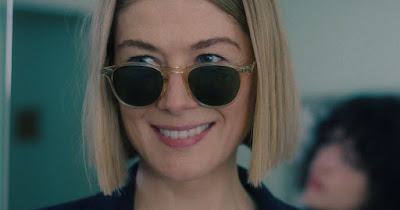
We've seen a few "new release" movies via Netflix or HBO lately and I'll probably get around to a couple more of them over the next few days, but this evening we watched I Care A Lot, which is a film written, directed, and produced by J. Blakeson, whose most notable credit prior to this was probably as the writer of Descent Part 2. That isn't an attempt to demean Blakeson. Everyone has to start somewhere. It's more like mild praise that someone can be involved with only their fourth feature film and be, essentially, running the whole show. The plot revolves around a woman, Marla Grayson (Rosamund Pike) who also runs her own show, which is basically running the lives of others. She's a professional guardian for the elderly who has a whole racket set up, from the doctor who gives false testimony about the capability of her patients to the care facility director who treats them any way Marla wants them treated to the various vendors who are eager to be involved with her selling their assets, auctioning their possessions, and draining their accounts. Marla's voiceover monologue at the start of the film eventually boils down her life's philosophy: There are predators and prey and she's a predator. That's until she steals the life of someone connected to even larger predators, which is where things get complicated, just like they do out in the wild.


Rosamund Pike is genuinely great in her role. She's completely in control and handles every situation with aplomb. She still has the icy void where human compassion and morality would be that she wielded in Gone Girl to great effect, except that in this role she's not erratic. She's just ruthless, which is every bit as threatening. Dianne Wiest is her usual capable self as one of Marla's wards (read: victims) and Peter Dinklage makes an appearance as the eventual seeming foil to Marla's business. The script is kind of funny and although the story drags a bit in the middle, we're mostly kept in a constant forward rhythm without much need to stop and consider the plausibility of all of this. There's also a small turn by Isiah Whitlock, Jr. ("Sheeeeeeit!") as the judge who's only too quick to respond to all of Marla's legal motions. So, it's a decent film, but I can't say that it's one I would've rushed to shell out $10 for at the theater.

For example, the tropes were kind of obvious. Marla's attitude about success and failure is clearly a stab at the current late-stage capitalism environment. There's nothing wrong with that, but it felt like it was delivered clumsily with lines like: "Wealthy enough to use money like a weapon. Like real rich people do. That's what I want." From most perspectives, Marla would've already appeared to be quite wealthy and using said wealth to extract even more from victims that the state had officially declared to be unable to defend themselves. She already has as large an arsenal as anyone needs. Is her obliviousness to that another example of the high six-figure salary earners who consider themselves "middle class" because they feel like they're broke after paying for the private school, the third or fourth car, and the second home? Is that the swipe that was taken here or was it even less subtle than that? If this was supposed to be about how the system takes advantage of those who aren't rich enough to manipulate it, no one in this film fit that bill, from Marla to the wealthy victims she was draining to the coterie of enablers she had nestled around herself, who were negotiating for stock options instead of a way to feed their families. It was a pretty glamorous precipice from which to be shouting about how money is the problem.


A central facet to Marla's character is not only that she's a winner, but also that she's a winner in a man's world. She points out to her girlfriend, Fran (Eiza González) that she's dealt with men like Dinklage's character before and she'll deal with him the way she does any other man. That's fine and it's a point that unfortunately still needs to be made (e.g. that women are just as capable and, apparently, just as capable of being ruthless) in modern society, but it's hammered home in that speech to Fran when it's already been made obvious when dealing with attorneys, care home directors, the relatives of her victims and pretty much anyone else that gets in her way. The point has been made. Making it again only weakens the delivery, but this film does that repeatedly with most of its themes. Also, one wonders what message is being delivered when it's shown that the vast majority of those in Marla's unethical and illegal network are, in fact, women already in positions of power.


Also, Dinklage has unfortunately become typecast. This is not a reworking of his role as Tyrion Lannister in Game of Thrones or Finbar McBride in The Station Agent or even Bolivar Trask in X-Men: Days of Future Past... but in a way it kind of is. Whenever people seem to need a somewhat moody, introspective, occasionally sensitive guy, he's first on the list. In this case, he's playing a mobster who's as capable as a Tyrion but also subject to temper tantrums that fit the character (and his usual role) not at all. We go from his quiet, measured, stare-into-your-soul contemplation to fits of pique and back again. I think that was supposed to be part of the black comedy aspect to the film, except that it wasn't really funny so much as jarring and other moments ("Is that my smoothie?") deliver that kind of absurdist veil over very dark reality much better. His direct encounters with Pike really only serve to make him one more in her endless train of victims, whether directly via the story or implicitly by their scene chemistry, and one kind of gets the feeling that we've seen this before. Is it different because she's lording it over a mobster as easily as she does a frail 80-year-old? I'm unconvinced.

So, yeah. Not a bad film. Certainly worth the couple hours to sit and watch it. But I think there was more there that could've been delivered with, perhaps, another hand on the tiller, whether writing, directing, or producing. The messages are all there and the characters are interesting enough to follow (Tricia complained at one point that "There are no good guys here!", which was, I believe, part of the point.) but the final package is just slightly off.

Thursday, February 25, 2021

Batman: TAS, episode #21: Vendetta


Right from the opening, we get the steady rain, down by the docks, at night. We know our noir atmosphere has returned. There will be no junior sleuths, caped or otherwise. This is just The Batman and his perfect environment. We have all the proper elements for a great Batman (and great noir) story: potential police corruption, Gotham crimelords (including Rupert Thorne), bad weather, and actual detective work. This really can't get much better if it doesn't involve The Joker. It instead involves Killer Croc, who was one of a newer generation of Batman foes created in the early 80s by previous series writer, Gerry Conway. There was always an element of tragedy that accompanied Croc's appearances, given his mutant origin and the general public distaste that came with it (not overly dissimilar to The Penguin, by the by...) But that came with a general sense of savagery that is unusual among The Batman's regular foes. The sense of danger that came with Croc was physical and brutal, even beyond what could usually be implied by menacing thugs with guns that are regular parts of any noir story (whether you get your nose sliced or not.)


That physical element is part of The Batman's nature, as well, and it's on full display here, as he not only threatens Thorne, but tosses him over the edge of a building, not to extract a confession, but simply because he can. This is a harder Batman; a darker one. In my mind, it's the ideal approach to the character and this episode had every inch of it and is a refreshing change from the more normalized version of the previous two episodes, in which this kind of behavior in front of the junior partner or the local children just wouldn't have worked. Batman the Upstanding Citizen wouldn't have used Thorne as a body shield, even though that's a perfectly natural reaction when facing the latter's henchmen armed with Tommy guns, including the comment that "You better hope your men are good shots!" This is the terror of the underworld. The Batman also turns the screws on Commissioner Gordon with his suspicions about Harvey Bullock, perpetual 'bad cop', but Gordon's character shines through here as he defends his man. We also get a proper insight to Alfred, who expresses the incredulity of a toothpick proving anything, one way or the other. But this is proper storytelling, right? The Batman is carrying a bias and following clues that confirm it, when the real culprit is elsewhere. However, it is something of an eyebrow-raising moment when he immediately jumps to a conclusion about crocodiles from Alfred's casual "microwaveable crock" comment. After studying the "human substance but reptilian structure" scale and then immediately running to the zoo for confirmation about crocodiles living in underwater caves (not actually true, since they tend to dig their own burrows), we get a little too plot jumpy but, as always, 22 minute episodes, yo.


The fight scenes with Croc are, of course, supremely reminiscent of this moment which was actually released right around the same time (1992) as this episode, so no borrowing really possible. Sewer fights just must have been on the collective consciousness at the time. Of course, that final scene also begins from The Batman starting a fight with Croc from the back of a moving car, which is perhaps not the wisest course of action for genius, Bruce Wayne. While that final scene hits the right notes of tension and fisticuffs, it's at least mildly disturbing to see a few bricks lead to what looks like a major cave-in of Gotham's sewer system (Infrastructure week!), but that's still just part of our atmosphere: the crumbling city, abetted by its corrupt cops and significant crime networks. That's why we need The Batman to protect us! Of course, as it turns out, Bullock's character is in question, but not an issue here. A significant element to our overall story is watching his reaction to the absence of his file which is, of course, illegally obtained by our hero. There are ethical layers to this, which are key to any kind of noir storytelling. "We may have different ways of enforcing the law, but we both believe in it!" says the vigilante to the actual police officer...


On top of all that, we have our minor characters that continue to be key threads in our overall tapestry. Not only does Alfred continue his advisory and mildly acerbic role with Bruce, but Renee Montoya also makes a couple appearances (seemingly always with Bullock around) as a routine presence in the force. This is part of an ongoing story, not just a one-off Batman adventure. Thorne and even thugs like Spider Conway (voiced by the same actor as Killer Croc, Aron Kincaid) are living breathing parts of Gotham, which Bullock is, as well (despite him being the occasional master of the obvious: "It ain't him getting to the hearings that's got him spooked, commish! It's somebody else getting to him before then!") This is an ideal BTAS episode, even if the major threat isn't a cerebral challenge for The Batman, as much as it is a more physical and visually bizarre one. My one note of complaint about those visuals is that they chose a more fish-like color for Croc, as opposed to his original olive green and, thus, more crocodilian one. But that minor complaint aside, it has to be said that this ranks right up there among the best episodes we've seen so far; for atmospherics, for storytelling, and for simply getting the main character right.

Next time, we encounter a strange cult in Prophecy of Doom.

Batman: TAS, episode #20: I've Got Batman in My Basement


Despite the seemingly subversive title, this episode marks the first appearance by one of the oddest Batman villains ever known: The Penguin. I say "oddest" not because of the bizarre nature of his particular psychosis, like many of the others, but because of the lack of genuine threat inherent to his character. He's a squat guy in an outdated suit who likes birds. There doesn't seem to be anything that truly gives him an identity, other than the strange compilation of all of his identities; from the name Oswald Cobblepot, whose mother always made him wear a bow tie and carry an umbrella, to the attachment to birds of all kinds, which helps lead to his nickname, alongside the constant presence of the old-style tuxedo ("penguin suit." It's not exactly what you'd call menacing, like a homicidal clown. In fact, it's mostly comedic (unlike the clown.) But he was one of the original Batman opponents (created by Bob Kane and Bill Finger in 1941) and has been among the most enduring; often cited by many as a member of the top 4, alongside The Joker, The Riddler, and Catwoman. Perhaps its because he doesn't share the psychoses of so many among his colleagues, but is instead a straight-up mobster and thief, lending an aura of straightforward crimefighting to the Darknight Detective's milieu? But, then, there are much more "normal" characters to use in that respect whom have nothing to with umbrella weapons...


It's worth noting that this version of The Penguin (voiced by Paul Williams) is a derivation of the Batman Returns appearance, who was cast as a sewer-dwelling mutant, obsessed with vengeance on the world that rejected him. He has the malformed hands, but lacks the dead white skin tone and the savagery of Danny DeVito's character. But most versions of the character throughout the decades have portrayed him as a normal human, albeit with an oddly-pointed nose, and perfectly sane; motivated strictly by profit. This episode does, however, lean on the "unappreciated genius" theme that often accompanies the character, wherein his nerdy nature led him to be persecuted as a child and which motivated him to show how much more successful he would be than those who bullied him. This is reflected in the other main character of the episode, aspiring detective Sherman Grant, who is more akin to the original version of Robin: a kid who wants to work alongside Gotham's greatest hero. In that way, the plot seems set up to be a "kids" episode and it is pretty standard superhero fare, but the story and pacing are simply structured better than, say, our previous outing. Or maybe it's just the oddity of The Penguin who seems more textured than someone like The Scarecrow?


Still, there's almost no way to escape the goofiness of the main villain (using a trained giant vulture, employing a thug named Raven, etc.) and the nature of the episode (boy detective hides ailing superhero in his basement) is straight out of the 50s era of comics. There's certainly a place for that and, again, it may be the version of good ol' Batman that a lot of people enjoy. But that's what The Penguin carries with him and it's perhaps why I've always questioned the basic nature of the character in the first place. This is aside from little details in this episode, like the precision of a thief like The Penguin being brought into question by the indelicate nature of his henchmen's entry to the jewel vault (They let the glass fall and break!) or the seemingly omniscient nature of one of Sherman's books, entitled "Crimes and Its Cases." We haven't even gotten to how The Batman may have been dying on this kid's basement sofa, but Sherman was determined to protect his own reputation and prevent his friend, Roberta, from summoning the police (and, presumably, an ambulance.)  But we come back to the relationship between children and their parents, which shadows The Penguin's typical origins, when Sherman delivers the classic response to his mother's inquiries about 'what are you doing down there?': "Nothing, mom." That was the young Oswald, developing his first poison gas gun for his umbrella. Also, there's no denying the great line from the Penguin: "... the beauty of this egg, for which we have scrambled."


Another deviation is the abandonment of our usual noir approach for the much more Encyclopedia Brown meets Batman theme. There is no real darkness here past The Batman's initial encounter with the world's most dangerous vulture; the tossing of which over the edge of a building leading to the result you could anticipate. Even the encounter in the warehouse, where the kids do almost as well as Robin in degenerating a situation that our hero was fully in control of (again, The Penguin does not present a feeling of danger), is basically a set piece of standard 50s superhero action, lacking the shadows and intrigue that often follow The Batman's adventures. Even the final fight between villain and hero has the former uttering the caveat: "Still a little dazed, are we?" that would explain why the master of hand-to-hand combat is struggling with the guy who waddles and carries an umbrella. Other mysteries such as electrified phone lines that are still not powerful enough to affect vultures about, as well. I will never be able to see The Penguin as anything but an (ahem) odd duck, but that doesn't mean that interesting stories can't be told with him. It just depends on where you're aiming.

Next time, we follow two relatively loathsome creatures, in Detective Bullock and Killer Croc in Vendetta.