I spent a week in Hawai'i in 2002, one decade ago this May. Watching The Descendants and its presentation of "trouble in paradise" and the contrast in attitudes between the business-like Matt and his "native-like" (as it were) cousins was redolent with memories about the place. It was the last real vacation I've taken that didn't also have purpose in something else (political meeting, etc.) As an aside, since I've now been able to mine the film for three posts, I'm thinking it may be even better than I first gave it credit for.
We went in May, which is a low period, tourist-wise and, to some extent, temperature-wise. We spent the whole time in shorts and sandals, but it was cooler than you'd expect the typical "tropical paradise" to be. I saw many locals in long pants and jackets. We were going to spend around 5 days on the Big Island and then the last couple on Moloka'i. This was right in the middle of my tenure with the Green Party and I had a ton of responsibility with the campaign season about to gear up, but we had seen a brief bit on the Travel Channel about the Moloka'i Ranch and it had sounded really inviting. My ex, never one to pass up researching a possibility, poked around and found a travel agent who landed us a pretty good deal, so we decided to go. This was before venturing into the American Dream™, so we actually had money (read: "credit space") to make the trip, even though it took a while to pay off.
This was the first flight I had taken since 9/11 so, of course, the "heightened security measures" were still the order of the day. Remember the "random" searches of passengers?
Between flying out, to and from the Big Island, to and from Moloka'i, and flying home, we had six flights. With my tattoos, long hair, and presence on at least one security list (protesting the elder Bush in 1991; long story), I was "randomly" selected to be plucked from line and put through an additional search every, single time. It was comical by the fourth time, as I'd seen the attendant at the desk in Honolulu take a look at her monitor, look straight at me, and then start the boarding call. I was the walking vision of menace and I didn't even have a keffiyeh.
We had decided to stay on the Hilo side of the island, to avoid most of the tourist traffic which tends to occupy Kona. The difference in climate on the two sides of the island is pretty remarkable, as Kona is "desert island" to Hilo's rain forest. Of course, since you can also ski on Mauna Kea, the Big Island has the gamut of climate covered, I think. We stayed at a bed and breakfast about 15 minutes away from Hilo, up in the hills in the midst of a couple dozen acres of macadamia trees. We arrived pretty late in the day and it was already dark by the time we ventured up the dirt-and-gravel road... without signposts... or lights... and with plenty of hairpin turns and dropaways. So, that was fun. We had taken a room that supposedly looked right out onto the Kulaniapia Falls and a deep pool that the inn was ensconced next to. When we crashed for the evening, we could hear the water. This was the sight right outside the window in the morning:
Yeah. I think we'd arrived.
We spent the next few days running from literally one end of the island- the Waipi'o Valley of the Kings (reputedly where many of the kings of Hawai'i were buried, as with Egypt)
to the other - the green sand beach (the sand is olivine, a volcanic byproduct), which is on a peninsula that is the southernmost point in the US. I called Leigh, who was watching the clan, from there.
The hike to the latter is pretty arduous and begins with a long drive from Hilo, a young boy sitting in a shack and attempting to extort money from people who choose to park in a dirt lot and walk (he said he would "make sure nothing happened to the car"), as we did, rather than drive overland some distance north, and a three mile trek over very uneven lava fields. My wife was in a walking cast at the time, having broken her foot shortly before we left, and I managed to tear my feet up pretty well by the time we got there (a couple groups before us had already turned back.) Getting down to the beach is no easy trick, either, as there's no path and you essentially have to slide down on your butt to get to the cove. Getting back up is a matter of balance and momentum. Once we'd gotten out, I turned to take a picture of the cove which was a perfect replica of one we'd seen in a couple tour guides but that I can't find anywhere on the Web. The camera was a standard film device and had been borrowed from my then-brother-in-law. It was the best camera I've ever used and I have no idea what happened to it.
The journey up to the Valley had its own little quirks, as the guy driving the tour horse-and-cart had been something of a world wanderer whom I mentioned in another post, as he'd been in AA the night Michigan won the national title in basketball. The town in the valley was only a few dozen people and most had generators for electricity, but he was the only person who had an Internet connection so, over the course of a week, everyone in town would drift through his living room to check their email...
We also spent a fair amount of time in and around Hilo and traipsing across Kilauea. After eating dinner that first night, I'll never be able to appreciate mahi mahi again until I end up somewhere that they've caught it a couple hours before it's in front of me. We spent most of the time eating local fare on the run, though, and filling in gaps with a large bag of macadamias that we bought on the first day. I have a hard time feeling satisfied with those out of a jar, too.
Finally, we ended up in Moloka'i.
The island is very much the model for "desert island" as the interior tends to resemble backcountry Wyoming, while the coast looks very much like the above, although often quite mountainous. The Moloka'i Ranch, the biggest hotel on the island, had set up a beach village on the western end with solar-powered, canvas bungalows and self-composting toilets ([shrug] Greens... whattaya gonna do?) which was the initial point for our being interested in the whole trip. Our bungalow was 50 yards from the Pacific and I could see the beach as soon as I opened the door... about 35 yards past the hammock strung between two palm trees. There was a central tent where they cooked meals three times a day and an activities director who tried to entice us into half a dozen different things (it was the off-season, so I think she was pretty bored; there was only one other occupied bungalow out of 40 while we were there.) I pointed to the book in my hand and that hammock and said: "After hiking all over Hell's half-acre for the past week, that's where I'll be for the duration, thanks."
Of course, me being me, I couldn't resist using the main tent's Internet access to check in on the party doings (it was operating largely with Yahoo lists at the time.) I stayed off the lists but emailed the usual series of "Jeebus, no. Don't do that."s and other warnings to a few people, who promptly admonished me for working on my vacation. I find that my memories of the couple days on Moloka'i are pretty dim, as I mostly just remember reading a treatise on Roman legion organization in the hammock, falling asleep in the hammock, waking up to read some more, going to eat, and then coming back and falling asleep again. Nevertheless, I remember thinking that I could do that for just about the rest of my life... Sadly, when the locals resisted the aggressive development plans of the owners, the Ranch closed up shop and left in 2008.
I'm not sure why that trip resonates with me so much, other than the obvious aspect of it being my last real vacation. I suppose it was a period, not only of dramatic difference with most of the locales I'd stepped into in my life, but also when my marriage was still kinda working and the party was near its peak and everything seemed like it held some degree of promise, as opposed to now when it resembles nothing so much as The Road Warrior. I'd still like to go back someday. I wonder how different it will feel.
Tuesday, February 14, 2012
Wednesday, February 8, 2012
Getting the most out of it before it's gone
So, I mentioned George Clooney's recent interview with James Lipton on the latter's Inside the Actors Studio. During the discussion, Clooney mentioned his tendency to do the pictures he likes for scale or a little more and to do advertising in order to make real money because that combination allows him to live a "nice life", as he put it, and still enjoy his career by doing the movies that he wants to do. In other words, he doesn't have to put up with typical Hollywood crap in order to pay bills or to live said nice life a la the typical big-time star.
He mentioned that the event that really put him on that course was one time when he was doing a shoot in Europe and he was staying at this nice villa on Lake Como in Laglio, Italy. It was actually undergoing some remodeling at the time and the owner asked Clooney if he liked the place and, if so, would he be interested in buying it. Clooney really liked the area and the villa and then stopped to notice the construction workers on the site walking off for lunch. He said they looked like typical construction workers that you might see anywhere with lunch in hand... but lunch was a loaf of bread and a bottle of wine for each of them and they were singing as they walked down to the water. Right away, he realized, those guys were enjoying life a lot more than he was and he resolved right there to enjoy what he was doing or to not do it. Ever since then, he's avoided dreck like Batman and Robin and turned his career in the direction of major critical and commercial success. He also bought the villa.
There's a man who knew what he wanted and had the talent and drive to get what he wanted and is now enjoying seemingly every moment of every day. I have no idea what that feels like.
I've already mentioned my inability to feel happy about most things. That's not to say that I can't take joy out of events. This past season for Michigan was one of the more enjoyable in recent years, as the team overachieved and the coaching staff put to rest most of the fears of a return to the Carr malaise. The funny thing is that there's one moment from the season that sticks in my mind more than any other and it actually took place right before the season officially started. I had joined a number of Victards on the golf course south of the stadium and we had decided to pack up and head in for the first game against Western Michigan. The south side of the course has a number of rolling rises as the terrain generally elevates to the intersection with Scio Church Road. Upon cresting one of them, I had a perfect view of the stadium, with the monstrous brick luxury boxes and the new oversized scoreboards. I felt positive about the team, the season, and going to see the game at that point. So positive, in fact, that I remember thinking that I was looking at a cathedral of the game. Here was Michigan Stadium and here was the moment in which things were going to return to their historical trend of victories, the joyous throng of 100K, and the team, the team, the team. No matter how insipid it sounds, this truly felt like a communal event where people were gathered in appreciation of the game itself, the great, young players that currently make up the team, and the past glories that the program had enjoyed again and again.
I was inspired enough by the scene and that moment to begin composing a description in my head that could have been verse or could have been an essay akin to one of those that Spencer at EDSBS or Johnny at RBUAS have written so many times; an emotive appreciation of the near-gladiatorial spectacle that many of us likely spend way too much time orbiting. But I never wrote those words because I realized at some point that I don't have the talent that Spencer and Johnny have and I really had no outlet with which to convey them, so it likely would have been a waste of time. Once again, emotion quails in the face of reason and pragmatism.
Would I have done better to have simply grabbed my loaf of bread and bottle of wine and pushed on through to enjoy the process of it all? To enjoy life as it lay before me? I don't know that it would have been enjoyable as soon as I got to that whole "realizing I don't have the talent" moment.
Clooney's life is emblematic of someone that has found his path. He does what he dreamed of doing and he does it the right way, in a manner that he loves, and on projects that speak to him and from him. That's a path that anyone from an engineer to a bureaucrat to an athlete to a construction worker can potentially walk. It's obviously a bit more emotive and obvious coming from an enormously successful (and wealthy) actor, but it's still something that bespeaks joy, regardless of occupation or walk of life. I've often thought that various life events and/or my own failings or poor choices have kept me from finding that path and enjoying that walk. But now I'm not even sure that I could find the path even without any obstacles in my way. I'm not just constrained any longer. I'm basically lost in the woods and so much so that I'm not sure it's worth the effort to try to find my way out.
As kind of a side note, I even started talking to a friend, late of the Michigan theatre department, about acting schools. As I've noted before, I'm fascinated with (good) films and I did some Shakespeare way back in the day (but, as Slim Charles noted: "the problem with back in the day is that it's back in the day.") It's funny because you watch those Lipton interviews and, when they do the crowd shots, you see people of all ages attending the class at Pace University. The vast majority are quite young, but I frequently see people as old or older than I am. So, in that moment of positivity, you think: "It's not impossible to start at this point, is it?" until that wave of reality and reason comes crashing in and you start to wonder if it's not just another pipe dream because no other path seems feasible or worthwhile right now and hasn't for quite some time.
I have three little lives depending on me and that's what keeps me wandering in the woods, I suppose, but it's hard to say for how long or when I simply give up on the idea of ever singing my way down to Lake Como. Of course, Orpheus kept singing even after meeting up with the Maenads. I had a story idea about that once...
Saturday, February 4, 2012
Find the gems where you can
So, I had planned on doing another "Oscars" post like last year because this remains my favorite time of year for seeing films, but 2011 seems to be coming up short in that respect. The nine listed films for Best Picture are pretty uninspiring for me, as only one or two of them hold any interest at all and a few are laughable inclusions. I realize that the Academy felt like they had to expand the category to deal with years where there are more than 5 films that really deserved consideration, but this slate seems to reinforce the popular (and not entirely erroneous) idea that the Oscars are just a way for the glitterati to pat themselves on the back, irrespective of what audiences and serious film critics actually think.
To date I have seen precisely one of the films in question and may get around to seeing one or two others, but that will be about it. What would often occur in years past is that the raves from critics and friends would encourage me to see films that I wouldn't otherwise have given much consideration (like The King's Speech last year) and I'll appreciate catching a gem that I would have missed. But even with the apparent deluge of positive appraisal coming forth for films like The Artist, I have little interest in seeing it.
I'm not a fan of French cinema, in general, as much of it seems to fit the phenomenon discussed last year on the Victors' board of Trying Too Hard. I've seen one too many French films that seem to be very eager to demonstrate that they are "relevant" or "daring" or "innovative" without actually being so in any significant fashion other than basic shock value. The notorious extended rape scene amidst the reverse chronology in Gaspar Noé's Irréversible is a perfect example. Another good one is almost any Woody Allen film since Annie Hall, where he seems to have been TTH to be Woody Allen-like. As luck would have it, Midnight in Paris is also on the list for Best Picture and is being widely hailed as the best Woody Allen film since... Annie Hall. But after 20 years of Woody TTH, I'm not particularly compelled to sit around for two hours to see if the critics are right.
With that in mind, it's particularly interesting to note the inclusion of Extremely Loud and Incredibly Close on the list, given that there's usually not such a division between Academy voters and mainstream critics. The latter film has a rating of 46% (rotten) on Rotten Tomatoes, yet there it sits on the list for Best Picture. I don't recall seeing that kind of divide, even before easily accessible indices like RT and Metacritic existed. Were the voters reaching because the field is so weak? Are they making some kind of political statement about a movie that most assume to be overtly political?
Other choices like Hugo and War Horse are easily dismissed. I like Scorsese, but he's been subject to fads in the past and Hugo is an example of the same. I'm at the point of ignoring any film shot in 3D. It's a pointless money grab by the industry and not even Scorsese using it as a point of promotion, suggesting that "actors are more upfront emotionally" being shot in 3D, is enough to change my mind, as it sounds like so much promotional horseshit. The sooner that craze winds to a close, the better. War Horse is another in the long line of films glorifying the idea of brutal combat; this time by using what is essentially a Muppet as a main character (memories of the thousands of personal emails sent to Barbaro...). I'm not a Disney-style film fan to begin with and it's not like Spielberg has ever been consistently high-minded in his approach but this seems like a particularly low reach for him.
As for The Help, The Tree of Life, and Moneyball... eh. The only one I'll probably see is the last, as I read the book and I appreciate Pitt's talents in quirky roles. I also really appreciate the concept as a whole, in which age-old methods of "scientific" assessment were proved to be ridiculously ham-handed and short-sighted (a recurrent topic on MGoBlog in the field of football) but, again, I'm not setting aside time to watch it on Amazon because it's just not that compelling. The one film on the list that I did seek out (finally... again, compelling or not?) was The Descendants.
When I left the theatre after seeing it, I knew that I liked the film, but I wasn't entirely sure why. On the one hand, I'm a huge Clooney fan. I think the work that he has done and his approach to the film industry as a whole over the past 15 years has been incredibly positive. In his recent discussion with James Lipton, he mentioned that he does most pictures for scale or near scale these days, in an effort to not inflate their budgets and, instead, takes 1 or 2% off the back end to make a return. Since many of them don't rake in huge amounts of cash, he also does narration for coffee and car advertising, much of it overseas, in order to be able to live a nice life and be able to run around finding financing for niche pictures. In short, in order to do the films that he likes, he makes allowances for how they'll get made. He further reinforced that with a story about his home in Italy that I'll get to in another post.
On the other hand, I'm not a huge fan of the introspective films that seem to be a prevailing trend lately. While I certainly don't object to films that show how people react to sometimes mundane but trying circumstances, I guess I'm more of a fan of films that at least slightly elevate the situation to another level. Using Clooney as an example, Michael Clayton is more than just the story of a man discovering that he really didn't like what he was doing for a living. Eastern Promises is more than just a story of a dead prostitute and the child she left behind. Rashomon is more than just how a few people see the same event. They're trying circumstances that any of the people in those worlds could have encountered at any time, but they're also elevations of "the everyday", as it were. They're concept films, in addition to being stories of relatively normal people in tough times (admittedly, Eastern Promises is a bit of a conceit here.)
It took a few days for The Descendants to really gel for me. I think that's part of what makes it a good film. I continued to think on it well past the two hours of watching it. It resonated and not because it struck me personally, because it really didn't. But I continued to mull over the whys and wherefores of its telling. There was certainly some personal impact; having visited Hawaii a decade ago and having certainly felt the atmosphere of the place quite strongly. A statement that Clooney's character makes at the onset of the film is meant to emphasize the fact that while most non-residents tend to view the islands as some version of paradise, the people there are just like everyone else and have the problems and minor to major traumas that everyone else experiences. Of course, this little venture into comparative existence rings a bit hollow or even hypocritical when it takes a moment to show the everyday life of Honolulu and then steps right into the life of a very wealthy family enduring a personal tragedy that doesn't quite reflect the struggle for existence of the less financially endowed among the population. Intentional? Hard to tell.
The performances of Clooney, Shailene Woodley, and Amara Miller as the grieving family are all excellent. Just watching Clooney in a very atypical role, where he is clearly not in control and striving to catch up to his far more self-assured daughters, is a treat. But it's in watching the transformation of all three of them as they go through the process of grieving and learning to live with each other through that process is where the film makes its bones. Matt King is suddenly confronted with the reality of having to be a father to his two daughters to whom he was more of an absentee landlord up to that point. Watching the contortions of his face as his older daughter (Woodley) gives constructive advice to his younger daughter (Miller) in a very profane manner ("She's a little twat! Say it!") should be a moment of profound insight to anyone who has ever been a parent or worked extensively with younger people. I have no such personal experience, which may explain why it took a little bit longer for those moments to ring true to me.
It was interesting to see Matthew Lillard in a genuinely dramatic role, post-Scream ("Peer pressure! I'm weak!") and the contrast drawn between people like King, acknowledging that Hawaii is still part of the real world, and the behavior of his daughter's friend, Sid (Nick Krause), and the various cousins (most notably Beau Bridges) who continued to be laid back in the midst of personal chaos (since, after all, they're in paradise, right?), putting the lie to Matt's assertion that all of this matters. The film even gets away with a double ending, which is often seen as the inability of the director to know when to close up shop (Return of the King is notorious for this: "And we're done... No? Ok. And we're done... Really? Alright. And we're done... Seriously?"), but here's it's almost essential to the conclusion of the story. There are very few times when I appreciate "feel good" moments in a story, but this one felt wholly appropriate.
So, there's my vote for Best Picture, as I really don't think the rest are worth my time. I guess I'll never be a real film critic. Having failed to see almost all of the nominated performances, there's no sense in tossing out votes or guesses there, either. Better luck next year, I suppose.
Thursday, January 12, 2012
Back to the music and other stories
For as expansive as my tastes are, there are a fair amount of musical styles, mostly modern ones, that I simply can't relate to. There is no resonance, to use the musical term. What follows is a recent single from Slash's band, Velvet Revolver:
Now, I was never a big Slash fan. Guns 'n Roses was not really my cup of tea, although I appreciate the driving beat on Welcome to the Jungle and I certainly appreciate Slash's talent on guitar, for which he's become pretty widely recognized. But neither his playing nor the band's ("Velvet Revolver" immediately makes me think of both the Velvet Underground and the Beatles' Revolver; subliminal intent or just me being old?) on the above "Set Me Free" evokes anything from me at all. Nothing leaps from the music to make it memorable. It's simply a constant drone in one direction or another. Of course, having Scott Weiland as your lead singer doesn't help in that respect. Since he stopped aping Eddie Vedder in the early 90s, he seems to have reverted to the level of "growl" as a vocalist. Since most of the band is already producing what is essentially an elevated growl, that doesn't help. There is no contrapunte, as it were.
Now, that could simply be my disaffection for the musical style. I have never been a heavy metal/hard rock person; vastly preferring the speed and anarchism of punk when it came to guitar-dominated music. But, in hearing this, I can think immediately of a similar song from my deep, dark past that has the same kind of beat and elevated string work that is appealing:
Having not heard much of anything from Van Halen since 5150, I've long thought that Fair Warning was their best album because of its simple approach (none of the synth stuff that soon dominated their music) and very bluesy theme. "Unchained" lacks the speed of most punk and, in fact, has the same droning approach as "Set Me Free" but there's enough blues foundation and style to it that it doesn't sound like it was produced on an assembly line. Imagine a stamping machine. Every time it strikes the line, there's another casting of a Scott Weiland-fronted 3.5 minute single.
On something of a tangent, my most memorable moment of Weiland's career was a date on which he actually didn't appear. In the mid-90s, KISS began their "Return to the Makeup" tour in the old Tiger Stadium in Detroit. Sponge and Stone Temple Pilots (Weiland's band) were supposed to open for them, but Weiland's addiction to heroin caused STP to cancel. In the end, a smaller local band that I don't remember (probably because we didn't see them, having spent an hour or two outside the stadium drinking...) and Sponge did the openers. We made it inside for the last couple numbers of Sponge's performance and our seats were on the playing field, some 60 rows back from the stage, which was set up in front of the right field seats. I was there with my business partner, Jeff Donaldson, his brother, and a few of his friends. Jeff had come up with the tickets through his job at Chrysler and had had to talk me into going. As noted before, most heavy metal acts are a non-starter for me. I remember being fascinated with Gene Simmons as a kid because he was all demonic- and sorcery-like and I'm a geek like that, but I had long since left it behind.
Jeff's brother had to use the facilities, so we wandered over to the row of porta-johns by home plate. Looking to my left, down the line of the stage, I noticed that there was no security. People were just milling about. I pointed this out to Jeff who was, like me, always willing to take advantage of an opportunity. The three of us kind of sidled over and sat down in some seats right near the corner of the stage as darkness began to fall. As soon as the lights came up for KISS' entrance, we hopped up and plunged into the crowd. There we were: front row. And to this day, despite my nonchalant attitude about the music, that remains one of the best shows I've ever seen. I walked away drenched with sweat on a humid July evening, a good proportion of which was probably not my own. (If that's at all repellant to you, may I suggest never engaging in martial arts? You can't be afraid of human contact...)
The music itself didn't move me. Sure, I responded to the old hits that I'd heard incidentally on the radio a thousand times (Detroit Rock City, etc.) But what really got me was the showmanship. The band had been doing this for 25 years and, clearly, knew their stuff. I didn't run out and buy a backlog of KISS material, but I could now appreciate it in ways that I couldn't before. Is that part of what resonates with Velvet Revolver fans?
Approaching this from a different angle, here's a band that I first heard live, down at the Falcon Club in Hamtramck:
That's Gangster Fun, a ska outfit that played in the 80s and 90s. I'm a fan of ska, in general, although I don't get as excited about classics of the genre, like UB40, but instead swing back a little closer to the punk end (surprise!) with bands like Streetlight Manifesto:
Nevertheless, what sold me on Gangster Fun was their electric stage presence, especially their front man and vocalist, John Bunkley. The above recording is from one of their albums and it isn't exactly inspirational. While it still had their trademark bouncy beat and John's sly smile behind the lyrics, I wouldn't be surprised if few of you, my faithful 3 or 4 readers, weren't impressed by it. But if you saw them do it live, it would be a whole different story.
I've had this experience at other times with performers like Chris Whitley:
whom I saw open at a Tom Petty concert (Why was I at a Petty concert? I got talked into it, of course. Admittedly, his earlier material from the late 70s is often quite good.) I was impressed enough with his performance to pick up an album, but never went past that because his material at the time just didn't sell me off the stage, unlike Gangster Fun. Would I be more interested in Velvet Revolver after seeing them perform, seeing their intensity, their connection with their audience, their devotion to their own art? I don't know.
In many ways, I've often found that the ability to do it on stage is more appealing to me than anything that can be put on an album. Sadly, in Gangster Fun's case, John left the band in the early 90s. I saw them perform shortly thereafter and they simply didn't have... it. I still enjoyed the music and they produced some good material in following years, but a little bit of the magic was gone and when I hear their music now, I think back fondly to following them to every club in the metro area but am also slightly chagrined at the loss of what was, for me, a great thing. That may be one of the key things that separates me from a lot of more recent music that is so heavily produced that many of the people producing it can't do so in a live setting without computer backup or lip-synching. Would Velvet Revolver's "Set Me Free" be better in concert or worse? Or will it always simply be a question of my general distaste for that style of rock?
Is there a limit to how many things can resonate with any individual? I'd like to think not, but it's not something I can answer anytime soon.
Tuesday, November 1, 2011
A job worth having
I stopped into a drugstore today and the clerk behind the counter ran me through his whole spiel on their discount card in a very enthusiastic manner. He struck me as a person who was very happy simply to have a job. Given the overall unemployment figures and especially those in Michigan, it's not unusual for that to be the case among any number of people.
The thought occurred to me to think to myself: "I've been there." I've been unemployed for fairly lengthy stretches at times, struggling to pay the rent on time and putting 1 or 2 dollars into the gas tank; just enough to keep the car moving from one interview to another. But it's not true. I've never been happy simply to have a job. Any job that I've had that has directly contributed to keeping a roof over my head has always been one that I despised. Its sole function was to pay for the necessities of survival and nothing else. Well, that's also not true. The other purpose it served was to make me hate the majority of my existence while I was doing it.
I have had jobs that didn't pay the rent. Those were the ones that I loved and would have gladly continued doing even as financial failures. I did them while I was also working for a paycheck and didn't consider them "work" in the dolorous sense. Of course, they were work and lots of it. They often required more energy and effort, physical and mental, than anything I expended on the tasks that people were paying me for. But I was driven to do them because I loved what I was doing. The people that enjoy those tasks they do for a living are often termed "people that love their jobs". They're defined as a jovial anomaly; someone that, essentially, got away with something in the game of life because they found a way to put food on the table and still be happy while doing it. "Pursuing one's passion" they call it and it often involves a serious expenditure of money on one's own part to get to the point where you can chase those dreams.
Except that it's not such a great idea to make the attempt any longer, as a number of recent reports suggest that unpaid student debt now exceeds $1 trillion (ever notice how no one uses the phrase "that's billion with a 'b'" anymore, because the numbers we talk about in ominous tones now routinely exceed trivial billions?) The sad thing about that is not only that a large share of said student debt is based on people making attempts into the fields that they were encouraged to pursue because they were seen as "sure things" (read: economically viable) but that those things are nowhere near as sure as they used to be.
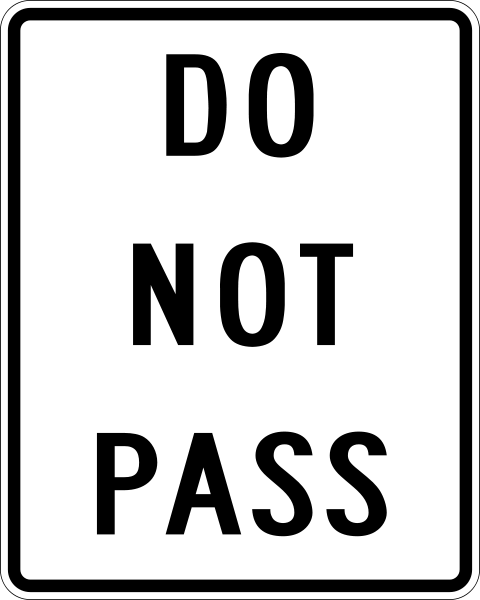
Time was, you could spend your 4 years in college and come out with an anthropology degree and find a career in research or curating or education or even cultural relations for the nearest oil company wanting to lay waste to Borneo. That's all gone now (except for the oil devastation.) I met a really interesting woman a while back who has just such a degree and further education besides. She's fully trained to maintain and enhance the nearest museum exhibits on what has gone before. But those exhibits might as well be telling the story of the American education system that used to be a byword for opportunity but is now reduced to this simple message:
(When I was 5 or 6, I remember thinking that my dad was going to get in trouble for driving past one of these signs...)
Do not attempt to be an art historian. Do not attempt to be a historian. Do not attempt to be a marine biologist (Ghostcrawler promised me a pony!) or a journalist or a practitioner of any number of cultural or geographic arts. And don't even bother to get medieval on anyone's ass. No one else cares. It doesn't serve the drive of the modern society. It's not productive. You can go into business, technology, the law, or medicine. Make your choice.
Except that... well... you can't really go into any of those, either. The vast majority of the aforementioned debt is the (ahem) product of people venturing into those fields in the past decade or so. Those are, after all, the fields that society has deemed truly beneficial. After all, they get paid the most and the most assuredly, right?
A friend of mine started a blog recently, entitled "Inside the Law School Scam", which details the apparent effort by major law schools to recruit students not for the purpose of teaching them to become lawyers, but simply to make money... for the law schools. It is becoming a supposition among lawyers that law school doesn't really teach you about practicing law. You learn that in the real world, when you're making money. After all, that's the point of being "productive", right? To make money? Except that making money often involves being unhappy; something done for the sake of "getting by".
What kind of successful society perpetuates unhappiness for the sake of popular concepts of efficiency? What kind of society deems any activity that does not make an immediate or enormous profit one that is, essentially, a burden to that society? Produce or die. And yet, most of the major works of art and literature that form the foundation of our modern society were the product of patronage or starvation. The very culture that is lionized and revered by the ownership class was created by the kind of people that that class reviles. Most of those people did so because they were driven by passion and, occasionally, assisted by those who had means.
Our means, at the moment, is often directed toward creating more means as an end unto itself. I remember thinking about going back to school a couple years after I had graduated from Michigan. I had thought about getting a master's in education and going into teaching. My father attempted to talk me out of it because "there's no money in it." True enough. Unless you're a big-time law or business or medical professor, I suppose.
What kind of society perpetuates these conditions? Presumably, the one that doesn't care about them and those left to endure them. That, in itself, is an argument for burning said society to the ground and starting over. "There always seems to be money for war but not for education..." Or happiness.
Friday, October 7, 2011
Restraint
So, it's been a while. I wanted to keep up with this on a regular basis, but I've been restrained. The restraints have been physical and mental. A lack of ability in some cases, but largely a lack of motivation or energy. Some have been self-imposed; others, not. But restraint comes in all kinds of forms...
I look out on the Occupy Wall Street (Chicago, LA, ad infinitum) demonstrations and I am both encouraged and dismayed (dichotomy, anyone?) I am encouraged because I see people finally following outrage with action. As much as the presumably cynical and worldly types like to express their worldly cynicism with a haughty disdain over the 'fact' that 'someone is always protesting something', the actual fact that people are actually in the streets at this moment is something that is all too rare in this day and age. But I am dismayed because my initial reaction to those demonstrations is that they are too passive and they will too easily become part of the background noise that is Somnolent America.
When I think of our current circumstances, what I want to say is this:
That was Lucy Parsons, who was intimately familiar with the lack of mercy and pity from the owning class. Thus, why not respond in kind? My response to the whine of: "You're talking about class warrrrrr!" has always been: "You're damn right. It's been going on against the poor since time out of mind. It's about time we started talking about it." After all, if we can freely talk about race (kind of) in our free and open society (kind of), then why can't we talk about class? Because it doesn't exist? Or because it strikes too close to the bedrock truth of our free, open, and equitable (not even close) society? We have classes; always have, likely always will, and the rich, the owning class, has a disproportionate amount of power in our free and open (kind of) society. The only way to wrest power from the powerful ("Power concedes nothing without a demand. - Frederick Douglass) has typically been by violence. After all, when one's entire society is based on the primacy of property and violence typically results in the abduction and/or destruction of said property, the people who own it tend to get a little nervous. Nervous is good. Terrified might be better. Compliant is the real goal.
The problem with compelling compliance through violence is that the people who often end up dying as a consequence of said violence are the 99%, as it were. It would be nice if we could all storm the Bastille again and watch the landholders flee the country, but they've figured out that being part of the owning class also means that they own most of the guns and the people that have access to them. Not that parallels to 1789 are completely absent:
Some people will always be oblivious, even if they don't know how to spell "brioche".
My gut reaction that trends toward violence is a product of decades of frustration on this issue, even if I recognize its obvious drawbacks. Thus, if I were to exercise a degree of restraint, I'd more likely want to express something like this:
That acknowledgement of the seeming need for restraint has a personal quality to it, as well. Marcus stressed the avoidance of negative emotions or actions. The expression of Stoicism in the face of difficult situations was meant to be the perfect example of the nobility of the human spirit. The ability to stand against daunting odds without lashing out should be seen as an example of how to resist and effect change without bloodshed. King thought this and eventually won. But that was 50 years ago and the owning class has learned (witness even now the implicit derision of the media toward the Occupy gatherings.) Brother Malcolm may have been ahead of his time in stating his own preference for how to resist and demonstrate. Or was it simply a reversion to the tried and occasionally true method, acknowledging that the real problem of society, class not race, would never truly be affected? After all, when King shifted his emphasis from race to class, they killed him.
I'm hoping for a tipping point. I'm hoping that said point leads to a genuine acknowledgement of the problem. I'm hoping that leads to genuine change. I'm hoping it happens without too many people getting killed. Or am I?
I look out on the Occupy Wall Street (Chicago, LA, ad infinitum) demonstrations and I am both encouraged and dismayed (dichotomy, anyone?) I am encouraged because I see people finally following outrage with action. As much as the presumably cynical and worldly types like to express their worldly cynicism with a haughty disdain over the 'fact' that 'someone is always protesting something', the actual fact that people are actually in the streets at this moment is something that is all too rare in this day and age. But I am dismayed because my initial reaction to those demonstrations is that they are too passive and they will too easily become part of the background noise that is Somnolent America.
When I think of our current circumstances, what I want to say is this:
Let every dirty, lousy tramp arm himself with a revolver or knife on the steps of the palace of the rich and stab or shoot their owners as they come out. Let us kill them without mercy, and let it be a war of extermination and without pity.
The problem with compelling compliance through violence is that the people who often end up dying as a consequence of said violence are the 99%, as it were. It would be nice if we could all storm the Bastille again and watch the landholders flee the country, but they've figured out that being part of the owning class also means that they own most of the guns and the people that have access to them. Not that parallels to 1789 are completely absent:
Some people will always be oblivious, even if they don't know how to spell "brioche".
My gut reaction that trends toward violence is a product of decades of frustration on this issue, even if I recognize its obvious drawbacks. Thus, if I were to exercise a degree of restraint, I'd more likely want to express something like this:
If, in the present chaotic and shameful struggle for existence, when organized society offers a premium on greed, cruelty, and deceit, men can be found who stand aloof and almost alone in their determination to work for good rather than gold, who suffer want and persecution rather than desert principle, who can bravely walk to the scaffold for the good they can do humanity, what may we expect from men when freed from the grinding necessity of selling the better part of themselves for bread?That was also Lucy Parsons. Certainly, she was speaking of the potential of her own class, likely having already discarded the idea that anything genuinely good for society could come from the wealthy leeches that surmount it. But it's still a noble idea that one would like to think would compel people toward that compliance; that, indeed, society would be better, even for the wealthy, if more people had access to the time and resources that would allow them to express some of the potential within them. It hearkens back to what I often refer to as the "Henry Ford principle": Ford realized that if he wanted his company to truly grow and become a buttress of American society, he couldn't continue to build products that his own workers couldn't afford to buy. It took a long time and a lot of violence for him to come to that realization, but it did occur. I'd like to cut out both the time and the violence parts and weave me a flying carpet while you're at it, won't you?
That acknowledgement of the seeming need for restraint has a personal quality to it, as well. Marcus stressed the avoidance of negative emotions or actions. The expression of Stoicism in the face of difficult situations was meant to be the perfect example of the nobility of the human spirit. The ability to stand against daunting odds without lashing out should be seen as an example of how to resist and effect change without bloodshed. King thought this and eventually won. But that was 50 years ago and the owning class has learned (witness even now the implicit derision of the media toward the Occupy gatherings.) Brother Malcolm may have been ahead of his time in stating his own preference for how to resist and demonstrate. Or was it simply a reversion to the tried and occasionally true method, acknowledging that the real problem of society, class not race, would never truly be affected? After all, when King shifted his emphasis from race to class, they killed him.
I'm hoping for a tipping point. I'm hoping that said point leads to a genuine acknowledgement of the problem. I'm hoping that leads to genuine change. I'm hoping it happens without too many people getting killed. Or am I?
Tuesday, August 16, 2011
Words, in fact, lived by
"Just, as a novel concept, try not pissing me off for a while."
"At this point, spiraling out of control seems like the far more suitable choice."
"Sad trombone." (in a far higher pitch than should have been used, unfortunately.)
"Don't let reason, fact, or any shred of sanity slow you down."
"If I thought it was a worthwhile endeavor, I probably would have tried it."
"Life is, in fact, often shorter than it should be."
"If I'm doing this right, you guys are screwed."
"Just let Douchebaggus Maximus over there say his piece and then we can all go on with our lives."
"I wish I had found a way to do it better. I wish I had found a way to do it. I wish I had found a way. I wish."
[All of the above were said by, near, or to me at some point in the last 24 to 36 hours. None of it may be worth a damn, but there it is.]
Subscribe to:
Posts (Atom)