Showing posts with label Peter Dinklage. Show all posts

Sunday, September 22, 2024

More Americans and their dreams


Last year's best film, American Fiction, is something that appealed to me beyond the great writing and the equally excellent acting because of its subject matter: a frustrated writer who feels like his message isn't getting across and being unwilling to change that message to what's "popular." I've just seen another film that shares the geographic application and is also about a frustrated writer, but is a bit more directly personal and emotional and is, in some ways, obviously being played for a farce. That doesn't mean that its message isn't delivered with the same intensity but it does mean, as good as I found it to be, that it doesn't quite, uh, measure up to the best film of 2023. It might be the best thing I've seen so far in 2024, though.


American Dreamer is the latest effort by Peter Dinklage or, at least, latest that I've seen, since it was produced in 2022, but not released in the US until earlier this year. (The Thicket was just released two weeks ago, so I'm hoping to get to it soon.) I'll obviously see almost anything involving Peter Dinklage, not only because he played my second-favorite character from Game of Thrones but also because I was a fan of his from things before that like The Station Agent and Death at a Funeral. This film is clearly a vehicle for the type of character that he's been most closely identified with: highly intelligent, frustrated at being constantly underestimated, and trying to adapt to hurdles that others of (ahem) greater stature might not encounter because of money, societal position or, well, size. He plays an adjunct professor of economics whose insights are revelatory but contrarian so earn him little respect and even less money and whom is desperate to find a place in life that might earn him some self-esteem; most notably by getting a long-suffering novel published. In the process, he encounters a woman who's way past that level of respect (and wealth) in the form of Astrid, played by the still-wonderful Shirley MacLaine, and the two of them try to figure out their paths forward, together and alone, sometimes simultaneously.


It's not outrageous to dismiss the entire thing as a parody of Dinklage's own life, in that the main thrust of the plot can be (short-sightedly) seen as a declaration that "Little people can do this, too!" Anyone who's seen him perform before doesn't need that message and so watching him portray it can seem to be something of an underselling of his abilities and one wondering why we're seeing it delivered on the screen. But what stuck out to me is the unabashed emotion underpinning everything that Phil (Dinklage) does and how the audience is able to sympathize with him, even when they're fully aware that he's doing the wrong thing for no other reason than that he's acting out like a five-year-old. Astrid is in a somewhat similar situation frequently confronted by seniors in this country in that she's often being treated like an invalid even when she is manifestly not one. (One assumes that the actual MacLaine, at the age of 90, has had that experience before...) Again, we don't need to be told that these are fine actors. We know this. And that means that, despite the predictability of much of the plot, it might be worthwhile watching it simply for the sake of the very human story and the often black humor contained therein.


Again, this is obviously a farce. One can tell this from the first scene of Phil talking to his buxom imaginary friends and how servile they are to his every want and need, only to be shrugged at by him in the course of those daydreams because he's self-aware enough to know exactly what he's doing and what "they" are. This is further heightened by each segment of the story being announced by typeface running across a blank screen, announcing a new chapter summary of anguish and failure that Phil will have to endure. (This is, of course, the writing part that I can't help but find appealing.) Part of that farce is also Dinklage's enormous talent in physical humor. An encounter with a shower and then a toiler and then the bathroom floor, only to have his inflicted injuries partially solved by duct tape is one of the several moments when I actually laughed out loud, which isn't a frequent occurrence, even in supposed comedies. But the other aspect to the story is where all of what Phil is encountering is relatable to most, if not all, of us and to those of us in the writing sphere most of all. Is anyone listening to what I'm saying? Does anyone understand what I'm saying? Is it that they're idiots or that I am? These are all questions that a lot of creative people ask and which Phil asks throughout the film, even as more and more absurd obstacles end up in his way, at least partially created, knowingly or not, by Astrid who then interjects with an acerbic declaration that answers all three of those questions in one manner or another. (No. No. And I think it's you.) Phil is helped along his tortured path by some solid performances by Matt Dillon, as his real estate agent, and Danny Glover, as a private investigator, as well. So, while I wouldn't hold it in the highest regard, I do think it's worth the time to see it, not least to get an hour-and-a-half of Dinklage's baleful stare at the fools that he can't avoid springing up around him, including the one in the bathroom mirror.

[Meanwhile, yes, I am back doing this film criticism thing that no one reads because, as often happens in creative ventures, real life has gotten out in front of my creative partner and we've run into some degree of delay. That, of course, means that I have not a lot to do, word-wise, with my other blogging efforts shut down so why not come here and write more stuff that no one cares about? Guess I could always go back to the long-suffering novel, just like Phil...]

Saturday, February 27, 2021

I didn't really care enough


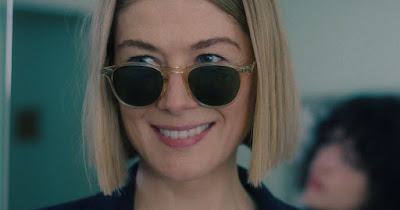
We've seen a few "new release" movies via Netflix or HBO lately and I'll probably get around to a couple more of them over the next few days, but this evening we watched I Care A Lot, which is a film written, directed, and produced by J. Blakeson, whose most notable credit prior to this was probably as the writer of Descent Part 2. That isn't an attempt to demean Blakeson. Everyone has to start somewhere. It's more like mild praise that someone can be involved with only their fourth feature film and be, essentially, running the whole show. The plot revolves around a woman, Marla Grayson (Rosamund Pike) who also runs her own show, which is basically running the lives of others. She's a professional guardian for the elderly who has a whole racket set up, from the doctor who gives false testimony about the capability of her patients to the care facility director who treats them any way Marla wants them treated to the various vendors who are eager to be involved with her selling their assets, auctioning their possessions, and draining their accounts. Marla's voiceover monologue at the start of the film eventually boils down her life's philosophy: There are predators and prey and she's a predator. That's until she steals the life of someone connected to even larger predators, which is where things get complicated, just like they do out in the wild.


Rosamund Pike is genuinely great in her role. She's completely in control and handles every situation with aplomb. She still has the icy void where human compassion and morality would be that she wielded in Gone Girl to great effect, except that in this role she's not erratic. She's just ruthless, which is every bit as threatening. Dianne Wiest is her usual capable self as one of Marla's wards (read: victims) and Peter Dinklage makes an appearance as the eventual seeming foil to Marla's business. The script is kind of funny and although the story drags a bit in the middle, we're mostly kept in a constant forward rhythm without much need to stop and consider the plausibility of all of this. There's also a small turn by Isiah Whitlock, Jr. ("Sheeeeeeit!") as the judge who's only too quick to respond to all of Marla's legal motions. So, it's a decent film, but I can't say that it's one I would've rushed to shell out $10 for at the theater.

For example, the tropes were kind of obvious. Marla's attitude about success and failure is clearly a stab at the current late-stage capitalism environment. There's nothing wrong with that, but it felt like it was delivered clumsily with lines like: "Wealthy enough to use money like a weapon. Like real rich people do. That's what I want." From most perspectives, Marla would've already appeared to be quite wealthy and using said wealth to extract even more from victims that the state had officially declared to be unable to defend themselves. She already has as large an arsenal as anyone needs. Is her obliviousness to that another example of the high six-figure salary earners who consider themselves "middle class" because they feel like they're broke after paying for the private school, the third or fourth car, and the second home? Is that the swipe that was taken here or was it even less subtle than that? If this was supposed to be about how the system takes advantage of those who aren't rich enough to manipulate it, no one in this film fit that bill, from Marla to the wealthy victims she was draining to the coterie of enablers she had nestled around herself, who were negotiating for stock options instead of a way to feed their families. It was a pretty glamorous precipice from which to be shouting about how money is the problem.


A central facet to Marla's character is not only that she's a winner, but also that she's a winner in a man's world. She points out to her girlfriend, Fran (Eiza González) that she's dealt with men like Dinklage's character before and she'll deal with him the way she does any other man. That's fine and it's a point that unfortunately still needs to be made (e.g. that women are just as capable and, apparently, just as capable of being ruthless) in modern society, but it's hammered home in that speech to Fran when it's already been made obvious when dealing with attorneys, care home directors, the relatives of her victims and pretty much anyone else that gets in her way. The point has been made. Making it again only weakens the delivery, but this film does that repeatedly with most of its themes. Also, one wonders what message is being delivered when it's shown that the vast majority of those in Marla's unethical and illegal network are, in fact, women already in positions of power.


Also, Dinklage has unfortunately become typecast. This is not a reworking of his role as Tyrion Lannister in Game of Thrones or Finbar McBride in The Station Agent or even Bolivar Trask in X-Men: Days of Future Past... but in a way it kind of is. Whenever people seem to need a somewhat moody, introspective, occasionally sensitive guy, he's first on the list. In this case, he's playing a mobster who's as capable as a Tyrion but also subject to temper tantrums that fit the character (and his usual role) not at all. We go from his quiet, measured, stare-into-your-soul contemplation to fits of pique and back again. I think that was supposed to be part of the black comedy aspect to the film, except that it wasn't really funny so much as jarring and other moments ("Is that my smoothie?") deliver that kind of absurdist veil over very dark reality much better. His direct encounters with Pike really only serve to make him one more in her endless train of victims, whether directly via the story or implicitly by their scene chemistry, and one kind of gets the feeling that we've seen this before. Is it different because she's lording it over a mobster as easily as she does a frail 80-year-old? I'm unconvinced.

So, yeah. Not a bad film. Certainly worth the couple hours to sit and watch it. But I think there was more there that could've been delivered with, perhaps, another hand on the tiller, whether writing, directing, or producing. The messages are all there and the characters are interesting enough to follow (Tricia complained at one point that "There are no good guys here!", which was, I believe, part of the point.) but the final package is just slightly off.