Showing posts with label Shakespeare-ing. Show all posts

Wednesday, April 28, 2021

The search for meaning


I was in Montana for a few days many years ago. I remember thinking to myself that when people called it "Big Sky country", they were right. The openness and the emptiness seemed to go farther than any other place I've seen. "Emptiness" doesn't have to mean "barren", though. There was life everywhere. It was just about looking for it in the right spots. This, to me, seems to be a central element to Chloé Zhao's film, Nomadland. From a certain perspective, the film is about emptiness. But it's a desired emptiness- a desired solitude -that the protagonist, Fern (the perfectly cast Frances McDormand) basically requires in order to live her life the way she is compelled to do.

Except for two sentences on a card at the beginning about the circumstances of the dissolution of Empire, NV, the story is told without any preamble and there are none of the normal setup cues, in which characters are introduced and some of their history and/or motivation are put on display. We're just dropped into the action and compelled to follow along with wherever Fern is going (I've often referred to this as the 'Howard Chaykin approach', after one of my favorite comic authors.) We only slowly learn the details of Fern's life before her current wandering, but all of her reality is written on McDormand's wonderfully-expressive face and in the matter-of-fact process by which she conducts her existence; traveling from job to job and gathering to gathering, making just enough to keep her and her van moving. She is the very essence of a nomad within the larger shell of the society that surrounds her. That society is pointedly demonstrated by Zhao with the long shots of an Amazon warehouse, a South Dakota national park, and a beet processing facility in Nebraska. We see the remnants of that society when she returns to the hollowed out remains of Empire and her former life. We see the open spaces that she yearns for on the California coast, the Badlands rocks, and the Black Rock Desert just past her former back yard in Empire.


Other than the capable David Strathairn, many of the rest of the nomad community that Fern interacts with are actual members of that community currently on the road in this country. Fittingly, most of them are there by choice, having not found what they wanted in that larger society. That's appropriate for McDormand, who often plays characters with tragedy hovering over them but with steel in their spines that won't let them be overcome by it. And, as usual, you can see every figment of that perspective on her face without her having to utter a word. Despite losing her long-time husband and her home, we later discover that she only stayed in Empire in the first place so that he, a man without parents or children, wouldn't be forgotten if she moved on. It's that sense of responsibility to the people around her that makes her a solid fit for the nomad community, who are made up of people just like that; presence remembered and given life by the people they associate with, whether they're actually present or not. Zhao does an excellent job of portraying that presence, those living memories, without allowing the story to become maudlin.  No matter how often she's presented with offers to stay with people who care for her, Fern can't bring herself to do it, as the solitude is the only thing that brings her respite from the memory of what she's lost and, mostly, what she's never found.
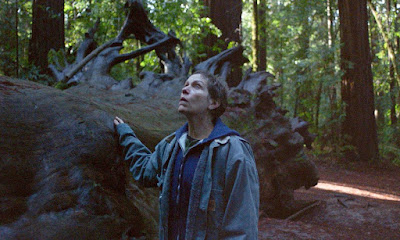

Tricia said she found the movie to be depressing and I can see why someone would think that. But I think that, despite the obvious pain and the struggle, the point was, in fact, the journey. It was predicted by a former student of Fern's whom she ran into in a store who, when asked if she remembered anything that Fern had taught her, recited one of my favorite bits from Macbeth:

Tomorrow, and tomorrow, and tomorrow,
Creeps in this petty pace from day to day,
To the last syllable of recorded time;
And all our yesterdays have lighted fools
The way to dusty death. Out, out, brief candle!
Life’s but a walking shadow, a poor player,
That struts and frets his hour upon the stage,
And then is heard no more. It is a tale
Told by an idiot, full of sound and fury,
Signifying nothing.

It may seem depressing to those who can't understand the need for the solitude that the road and the life provides and it may seem as if it signifies nothing to simply keep moving and leave behind all the connections that most people feel help make them who they are. But Fern and the people like her feel that they don't fit into that model of society and it's better for them to escape the petty pace and keep finding new candles to light their way.


Friday, December 30, 2016

And in the taste confounds the appetite

"These violent delights have violent ends
 And in their triumph die, like fire and powder
 Which as they kiss consume
 the sweetest honey is loathsome in his own deliciousness
 And in the taste confounds the appetite."
That's Romeo and Juliet, act II, scene VI. The first line was whispered by character Peter Abernathy (Louis Herthum) in the premiere episode of Westworld, which I am only now perusing since I've just recently turned the cable back on. Does that make me a cord rejoiner? I don't know. What it does make me is late to the party, since several people I know and most of the TV critics out there in La La Land (otherwise known as the realm of the ICP: Insane Clown President) think that Westworld is the best thing to hit HBO since the first season of True Detective (We will never speak of the second season again.) After watching the first two episodes, I can't say that I agree.


Westworld is based on the original Michael Crichton film from 1973 which, as an artifact of its era, was decent. Yul Brynner is excellent as the leading unstoppable android and Crichton's misunderstood premise of corporate greed (a theme he would return to, repeatedly) overriding basic morality was lost amidst the general audience perception that technology is evil and, obviously, wears a black hat. And I suppose I'm carrying some degree of bias while I watch the HBO series, because I know how this story plays out, based on what I've been seeing in the first couple episodes. Critics hailed it for its "world-building" but I spent a fair amount of time during both doing the "get on with it, already" wave with my hand. There is a certain amount of time that's necessary to establish the fact that the hosts essentially forget everything with every morning. Visual repetition is the best way to establish that for new viewers, so I get it.

But my problem with said world-building runs deeper than that. Many of the interactions, such as that between Lee, the narrative director (Simon Quarterman), and Theresa, the operations director (Sidse Babett Knudsen) were blatantly staged for the audience's benefit. Instead of appearing as an organic interaction (like, say, between Rust and Marty in True Detective), this was a neon sign blaring: "Here be conflict! Engage it if you dare!" Yes, you have to lay the groundwork and, yes, it's tough to do in a 10 episode series. But it's been done with somewhat more subtlety and which made both characters seem even mildly interesting, which those two do not.


Similarly, Ed Harris as the Man in Black in the world's most obvious homage to Brynner (Can his name be Johnny to make it that much more ham-fisted? He shoots people just to watch them die!) does nothing for me. He's been around awhile and he wants to see what makes the big machine tick. Fair enough. Does he have to be completely amoral in order to do that? Was the semi-gratuitous rape scene necessary to establish the spiel he'd already spoken on the train, about playing the black hat being the best time of his life? And if we were going to have a rape scene to establish an amoral character, was it necessary to close the door so that tender sensibilities somehow aren't bruised by the already-screaming woman? With the amount of nudity and violence already going around in order to establish that this is the point where ordinary people can abuse thinking beings to their heart's content, somehow that moment was deemed over the top and, instead of simply going off camera, Nolan felt that overtly shutting the barn door was how it should work? Get the audience to focus specifically on that act and then shield them from its consequences? Super-meta example of what the park embodies or shying away from what your story is depicting?

Don't get me wrong. It's not awful. It's just not gripping. I can and will watch the next couple episodes, but there's certainly nothing compelling me to do so. As all three of my regular readers know, I regard the director's cut of Blade Runner (no voiceover, ends in the elevator) to be the finest science fiction film ever made and one of the finest, period. That film asked many of the important questions about humanity and consciousness (and conscience) in a far more elegant way than anything I've seen so far on Westworld. Telling me that these are sentient beings locked in an endless loop for the entertainment of others is a good starting point. Expanding into their realization of this indentured servitude is a natural progression. But so far none of the mystery involved (Dolores and Maeve's past memories; the Man in Black's pursuit of the maze; etc.) is interesting enough to get me to want to rush back to the series tomorrow morning.


Also, I certainly respect Jonathan Nolan's (and Lisa Joy's) writing talent. He's been the co-writer on some of his brother, Christopher's, biggest films. But I wonder if he has the vision of his brother to carry a grand concept through to the ends that it requires. Crafting a story about questioning personal, corporate, and societal morality is all well and good. But including the original creator, Robert Ford (Anthony Hopkins; is he a coward? Does he have a friend named Jesse?), attempting to try to steer that amorality train back toward something more acceptable by including Christianity is just a step too far down the idiot path for me. Is the assumption that the park, in general, lacks a moral basis because it lacks religion? Do I really need to delve into the history of the church to prick that balloon? Hey, are the hosts like those slaves you can get from surrounding nations, per Leviticus? Or is Dolores like one of the daughters of Lot?

To the show's credit, I did really enjoy Jeffrey Wright's performance as Bernie, mildly conflicted soul designer (I thought he was great in Syriana, too) and the most intriguing moment for me of the whole two-plus hours was when programmer Elsie (Shannon Woodward) kissed host Clementine (Angela Sarafyan.) There was character revelation ("world-building") and mystery in one little motion that had me asking questions that are both intriguing and not obvious. More of that, please, and perhaps less of the grandiose references. I mean, if we're going to go all Shakespearean on everybody, should we be referencing the constant presence of the flies in what seems to otherwise be a fairly sanitized environment?
"As flies to wanton boys are we to the gods
 They kill us for their sport."
That's King Lear, act IV, scene I. Seems almost referential to the overall plot. Or perhaps I'm either overthinking it or asking too much?