Showing posts with label bloody fucking awful. Show all posts

Friday, November 7, 2025

Universal Horror, part V: Regrettable parody with an actual high point

Our last group is kind of a dichotomy, in that it's the introduction of the last monster that makes up the classic Universal set, but also the total degradation of the original foundation of the series. The Creature from the Black Lagoon ends up being a totem of the era in which it was created (the 1950s) in many ways through the three films which it stars in. The other half of this group, unfortunately, are spoofs of the Universal horror milieu, with famed comedy team Bud Abbott and Lou Costello dragging everything into the realm of camp and entirely departing from the atmosphere first laid down in the 1930s. The pair had already been a burlesque and radio act before their first film in 1940, eight years before their first film in the Universal horror genre which meant 21(!) films had been made in which they were doing the same routine that they'd been doing since 1935, which definitely colored their performances, even more than their growing personal distaste for each other.


Abbott and Costello Meet Frankenstein (1948)- This film at least opened in the same vein as its "House of" predecessors, in that despite only the Monster's name being in the title, it also includes both Dracula and the Wolf Man. Glenn Strange continues as the Monster, but both Bela Lugosi and Lon Chaney, Jr. return to their most notable roles, with Larry Talbot still looking for a way out of his curse and the Count still doing his vampiric thing, which was key to his signing the contract in the first place, since he felt like his legacy would be "unblemished", despite it being a comedy. He also hadn't worked in two years at that point and Chaney had been dropped by Universal during its recent contraction after new ownership came in, while Strange had had only limited opportunities since House of Dracula. So this was a good deal for all of them while, in contrast, both Abbott and Costello had to be convinced by large bonuses. So the comedians didn't want to do the comedy, but the horror actors were fine with it. The original script had also called for Kharis, the Invisible Man (who makes a last second "appearance" as the voice of Vincent Price at the end), and Count Alucard(?) but they eventually cut it down to what was still a Monster Mash before filming started. Director Charles Barton would later say that all three monster actors were impeccable professionals, while the real monsters were the two comics, who hated every minute on set and didn't hide it. That shows up on camera, too, in which Costello's skittish character spares no moment to shriek in terror at every opportunity, which is more grating than funny. I remember seeing this as a kid on Sundays and loving the presence of the monsters but being completely ambivalent about Bud and Lou. That feeling has not changed. Likewise, Chaney reviled the film, saying it had drained the life from previous pictures with genuine emotion. Karloff was paid to promote it by standing outside the Criterion Theatre in New York and agreed to do it "as long as I don't have to see the film." All of that said, it was the most successful film, financially, in the Frankenstein series since Frankenstein, so...


Abbott and Costello Meet The Invisible Man (1951)- Despite that success, it was three years before another entry in the Universal "horror" series. This time it was Arthur Franz playing Tommy Nelson, a middleweight boxer who has been accused of murdering his manager. He convinces his fiancé, Helen (Nancy Guild) to get her uncle, Dr. Philip Gray (Gavin Muir) to inject him with the serum that will turn him invisible so he can try to prove that he wasn't the murderer. Meanwhile, Abbott and Costello are two PIs investigating that same murder. That, of course, is not the plot of a horror film, any more than any of the other sequels in the Invisible Man series have been. At the very least, when a photo is shown of the invisibility serum's inventor, that photo is of Claude Rains, so there is at least some acknowledgement of the history at hand. But the rest of the film is just your standard adventure with Costello doing all kinds of limp gags to hide the presence of the invisible person that they've now come to trust in the process of trying to figure out the mystery of the murder. It's an Abbott and Costello film, not even an "Abbott and Costello spoof of a horror film." One minor trivia point is that the SFX were done by Stanley Horsley, who also did them for The Invisible Man Returns, Invisible Woman, and Invisible Agent, so he'd had a lot of practice, but it also meant that really none of it was new, just like the act of the two stars.


Creature from the Black Lagoon (1954)- And now we finally come to the last entry on our list of monsters. From a storytelling standpoint, this is easily the best film since the early days of the genre and the fact that it's an original creation (i.e. not based on a novel or folklore) tends to give it even more weight in the pantheon of the (sigh) "Dark Universe." Producer William Alland was told a story about half-fish, half-human creatures that supposedly lived on the Amazon in 1941. He jotted down a couple notes and then, a decade later, turned it into a treatment which eventually became the film. The design for the creature was originally done by Milicent Patrick, a Disney animator, but her role was downplayed by makeup artist, Bud Westmore, who was long credited as the sole visual creator of the Creature. The thing that most prominently sticks out about this story, though, isn't the technical achievements but rather the hostile buffoonery of not only the local geological workers who first see the Creature, panic, and attack it, resulting in their deaths, but also the supposedly educated scientists who come to the forest after said attack and continue to hound it until it again retaliates in self-defense. This is very much a "misunderstood monster" story in the vein of Frankenstein, but almost no one even wants to voice the possible sympathetic angle. This miraculous discovery, often cited during the film as an example of evolution, highlighting the changed general attitudes toward science in contrast to earlier decades, is once again treated as some kind of crime against nature in complete defiance of the philosophical language employed about it. In that respect, it's again just like Mary Shelley's original question: "Who is the real monster here?"


Revenge of the Creature (1955)- That question is even more valid in this sequel, given that the Creature, having survived being shot multiple times, is pursued and captured by a couple big game hunters and then put on display in an aquarium in Florida. If you didn't feel some sympathy for its situation in the first film, you'd almost have to do so here, as the Creature is repeatedly put through rigors like trained seals and orcas so that it can perform for audiences, despite having demonstrated (and continuing to do so in this film) a level of intelligence that vastly exceeds either. (That isn't, of course, to justify the treatment of those animals in similar circumstances.) Of course, the training of seals and orcas doesn't involve shocking them with a cattle prod, so this situation is also far worse from an ethical perspective. Said perspective is borne out by both the title and the action of the second half of the film, where the tortured Creature attempts to not only escape but also capture Helen Dobson (Lori Nelson)... who is one of the scientists involved in its torture. I mean, this is bog-standard Beauty and the Beast stuff, but at least situations like King Kong have the latter in less of a conflict of circumstances (somehow desiring one of his torturers in some bizarre Stockholm syndrome.) I spent most of this film kind of recoiling from the subject matter and wishing that the Creature got an opportunity to eviscerate everyone around it.


Abbott and Costello Meet The Mummy (1955)- This is both the last film in the Mummy franchise and that Abbott and Costello did for Universal entirely. In the latter respect, that might explain why their roles are written as Pete Patterson (Abbott) and Freddie Franklin (Lou) in the script, but they both use their regular names throughout the picture. Similarly, in contrast to the previous four films in the series, this time the mummy is referred to as "Klaris", instead of "Kharis" and the role is played by stuntman Eddie Parker, who had stood in for Lon Chaney, Jr. in the earlier films. Everything was clearly winding down here. But the plot ends up being kind of overcomplicated, in which two Americans stranded in Cairo get involved in a competition between treasure hunters and the followers of Klaris, led by Semu (Richard Deacon) to find the mummy's amulet, which supposedly leads to a hidden treasure but also contributes to the animation of Klaris. Hijinks ensue, not least of which is Abbott and Costello doing the "pass the poison" routine which results in the latter eating the solid gold amulet. Nothing was working here and no one involved was interested in anything but the paycheck, if that.


The Creature Walks Among Us (1956)- Our series finale returns to the question of who is "the real monster" here, but also engages in a bit of body horror towards the Creature, no less. Said real monster is Dr. William Barton, who not only is fanatically jealous about his wife, Marcia (Leigh Snowden) even talking to other men, but is abusive to her and obsessed with capturing the escaped Creature in the Everglades. In the process of doing the latter, the Creature is badly burned, such that three "scientists" led by Dr. Thomas Morgan (Rex Reason) end up bandaging it in a way that the Creature accelerates its evolution, growing human-like skin over its former scales. That skin results in the changed appearance seen above and a new dependence on lungs over its somehow shedded gills, which restricts it from being in the water that is its most customary habitat. Barton then kills one of the guys who did try to make a pass at his wife and tries to blame the Creature for it, who then goes on a rampage when it realizes this, killing everyone within reach (including Barton) and then walking into the sea. The water closes over its head the same way it does over this series of films. This is actually a more interesting story than many of the other Universal offerings, so it coming at the very end of the series' run is something of a rescue for a lot of what came before.

So, in the end, was it a worthy October? Kinda? I definitely don't regret having access to physical copies of the original classics. The front staircase scenes of Dracula are still among the visual moments that stick in my mind when I'm writing something with a horror atmosphere. But would I take the time again to watch a lot of the dreck that followed in the wake of those classics? Probably not. I thought perhaps about waiting a couple years and then doing a rewatch of the 30 of them from back to front, so that at least there'd be an upward trend in the quality of the films as I went along. But a lot of them like She-Wolf of London and the Abbott and Costello chapters are just not worth the time. At the very least, it was worth seeing some of them for the first time and being reminded that Revenge of the Creature was the subject of Mystery Science Theater one time. Will have to go look that one up...

Wednesday, November 5, 2025

Universal Horror, part IV: One mildly bright point in a sea of darkness

And, oh, how I wish that title could be taken as approbation of the "darkness" of Universal horror, but we're on a downward slope of quality here, as the studio went cheaper and cheaper in their attempt to squeeze as much juice out of the various franchises (and combinations of said franchises) as they could.


The Invisible Man's Revenge (1944)- Jon Hall returns as the transparent actor from Invisible Agent and encounters a plot that's perhaps less composed than the previous film, which isn't setting the bar very high. This is more about one man's obsession to recover money from the some swindling partners than anything else. The invisibility serum is just a side detail that enables more camera tricks that are no longer so interesting or enlivening as they had been in the past. The character, Robert, again bears the last name of Griffin, but has no connection to the previous owners. It's simply "the name of the Invisible Man" at this point. The most notable visual element of the film is the presence of John Carradine, patriarch of the Carradine acting family and who stated years later that he loathed the horror films that he had been relegated to acting in, but enjoyed this one, probably because his character, Doctor Peter Drury (not that Peter Drury), had clear motivation as the scientist who rediscovers the serum and then who is forced to entertain the desires of the subject that he enables with it. The phone conversation shown above is a solid acting moment for both players and it's probably the kind of thing that noted character actor, Carradine, would have appreciated. No one else in the film has either the chops or the thusly earned reputation, but there also wasn't a whole to work with, not least because the main villain ends up being killed by the doctor's dog, Brutus (played by the canine actor Grey Shadow) which happens off screen, which is the most invisible you can get in this industry.


The Mummy's Ghost (1944)- This is easily the best of the trio of direct sequels to The Mummy's Hand, although, again, that's not setting the bar especially high. Despite it once again taking place in suburban Massachusetts, there's more meat on the story, with the spirit of Ananka being essentially reincarnated in the form of Amina Manson (Ramsay Ames), which explains high priest Yousef Bey's (John Carradine, again) pursuit of her. That pursuit is enabled by Lon Chaney, Jr. as the title monster, Kharis, again and said pursuit is shared by him when it finally comes down to "who gets the girl", thus ending in Bey's demise. Curiously, this is the first really grim ending in the series, unless one bemoans the loss of the title creatures in question (and we'll get to that involving the Creature in the next post) as, in the finale, Kharis stalks into the swamp, seemingly destroying himself, but brings with him the rapidly-aging Amina, such that no one "gets the girl", since she dies with the monster and her fiancé, Tom Hervey (Robert Lowery) is the tragic figure, as he can't get his wife-to-be away from the cloudiness in her mind caused by an ancient spirit or the moldy, bandage-wrapped hands of Chaney. Speaking of whom, Chaney had real difficulty with the costume and makeup in this one, complaining often of his discomfort on set and that might have triggered some method acting, since one action scene found him almost choking Professor Norman (Frank Reicher) to the point where Reicher almost passed out. This does end up being the lone "high" point in this batch.


House of Frankenstein (1944)- This film follows in the path of Frankenstein Meets the Wolf Man in invoking the (sigh) "Dark Universe" where all of the monsters stumble upon one another and through the shadow of a plot until no one is quite sure why they're present or what they're doing. This is the return of Boris Karloff to the series, but not as the Monster. Instead, he plays Dr. Gustav Niemann, who was arrested for attempting to duplicate the more famous doctor's experiments and conveniently meets a hunchback, Daniel (J. Carroll Naish) in prison right before they both escape during an earthquake. They kill a local carnival barker and steal his wagons which supposedly contains the bones of Dracula, whom they then awaken to somehow seek revenge on the burgomaster who imprisoned them. Poor John Carradine, who like all others failed to emulate the presence of Bela Lugosi in the role of the most famous vampire, has all of 15 minutes in this film before being killed by sunlight, which should give you every indication of the quality of the story at hand. 'Lest I forget, the Wolf Man is here, too, as Lon Chaney, Jr. continues Larry Talbot's quest of tragedy, having been frozen alongside the Monster (Glenn Strange) under Castle Frankenstein. Like Carradine, neither Wolf Man nor Monster survive, the former dying to silver bullets and the latter drowning in quicksand with the aspirational Niemann. This is just a parade of scenes thrown together that are more amusement park than film.


The Mummy's Curse (1944)- If you've noticed that all of these films were produced in 1944, you'll probably be making a safe guess about their quality before you read a word of what I'm saying. While this is a sequel to The Mummy's Ghost, which took place in Massachusetts, this story suggests that we've all been transported to Louisiana, with the words "bayou" and "Cajun" thrown around. Both Kharis (Lon Chaney, Jr. soldiering on) and Ananka (Virginia Christine) emerge from the mud of the swamp, but the latter appears as an attractive young woman (i.e. not aged) once again as soon as the mud is washed off while Kharis remains Kharis (with Chaney hopefully relieved of some of his discomfort under the piles of makeup.) However, one thing that didn't change is when this film used stock footage from both The Mummy and The Mummy's Hand in the course of spieling out a condensed version of the previous three films. The real story of this one involves showing Ananka trying to remember herself while Kharis pursues her and basically kills everyone who happens to cross his path, including members of the Arkam sect like Ragheb (Martin Kosleck) and Dr. Zandaab (Peter Coe.) Ananka's sojourn as a beautiful young woman is again brought to ruin once all of the above meet their fate, as she also returns to being a mummy... which she wasn't at the end of the previous film so, yeah, I don't know where they were going here. Other than trying to make a profit on a cheap flick, again. You'd think this was the low point but, no.


House of Dracula (1945)- This is the return of the Monster Mash, with John Carradine, Lon Chaney, Jr., and Glenn Strange reprising their roles from House of Frankenstein. If you think Carradine looks utterly disenchanted with his whole life in the picture above, this film might be a good reason why, since Dracula has arrived at the home of Dr. Franz Edelmann (a castle, natch), played by Onslow Stevens, seeking a cure for his vampirism via blood transfusion. Larry Talbot soon appears seeking a similar relief, only to be told by the doctor that his transformations aren't the result of the full moon, but instead pressure on the brain(?) which a special fungus that the doctor is coincidentally growing should alleviate. Yeah, I don't get it, either, and neither does Talbot, since he tries to jump off the cliffside near the castle to finally achieve that suicide that he's craved for four films and is instead washed into the caves underneath the castle to find the Monster, still clutching the bones of Dr. Niemann. In the course of things, Dracula is destroyed again and Edelmann becomes a strange fusion of both vampire and werewolf (via transfusion) and begins killing people, only to be pursued by the townspeople of Visaria who think he's Larry Talbot. They chase him back to the castle where Talbot shoots and kills him and the townspeople piss off the Monster who begins killing them until they set the castle on fire and the collapsing building once again buries the Monster. At this point, the tension must be about what they're going to find said Monster immersed in next time they find him somehow still alive.


She-Wolf of London (1946)- But, no, this is definitely the low point of the entire series, as this film's only redeeming feature is the first top-billed role of a very young June Lockhart, who really only has relevance for those of us who were Lost in Space fans as kids. Despite its title, this isn't a horror film and actually doesn't have anything to do with werewolves or lycanthropy of any kind except for speculation. It's really a Cinderella story, where a young woman might possibly lose her handsome fiancée and inherited estate due to the scheming of her evil stepmother (housekeeper, really.) Said housekeeper is a mass murderer using her own acts to try to convince Phyllis Allenby (Lockhart) that she's rampaging around the countryside as a werewolf at night as a form of sleepwalking. Like Invisible Woman, there's nothing supernatural or horrific about this film. It's just a murder mystery dressed up to be something it's not, so how it gets included in the Universal horror/monster series is anyone's guess and yet somehow things like two versions of The Black Cat (1934, 1941), Horror Island (1941), and The Mad Ghoul (1942) were not.

We're crashing and burning here and I wish it was as exciting as that sounds. We'll have one last highlight that's extremely questionable in its own way, along with spoofs that are almost as horrifying as a lot of this set was but not for the reasons you'd expect.

Saturday, January 4, 2025

Contrast in binging results


While we were off during the holidays, we decided to binge a couple series because the time and opportunity were both there. The first one was Clarkson's Farm. Now, full disclosure: I largely detest "reality" TV because most of them are simply setups to create drama out of nothing. Presenting people in real situations will almost never be interesting enough to retain an audience unless you're an actual documentarian with an actual story. For this stuff, something always has to be manufactured. This was never more evident than when I had the misfortune to be sick a few years back and, even worse, decided to watch a couple of the Storage Wars-type shows (which may have included the actual Storage Wars. They were all so pedestrian that I don't remember.) Somehow, no matter where the nominal leads of the show went, there was always a "villain/huge rival" person that would be the primary opposition in bidding on abandoned storage units. It was obviously a setup to create situations that would have normally been Man from Mundania from the very outset. Your "reality" TV was clearly scripted. Even when there's not an obvious writer, it's usually quite evident that the producers are selecting "random" contestants by their personalities that will doubtlessly conflict, thus generating the aforementioned "drama." Perhaps it's because of Jeremy Clarkson's showmanship and experience (I have never seen Grand Tour or Who Wants To Be a Millionaire?), but Clarkson's Farm never seemed to require that. The people involved range from perfectly mundane (most of them) to rather unusual (Gerry, the wall-repairer and nominal "head of security") but Clarkson does such a good job of playing off of them that you don't feel like you're being spoon-fed anything. So, not only was it often hilarious, usually involving Jeremy's acerbic relationship with his primary contractor and assistant, Kaleb, but it was also incredibly educational. We learned more about modern farming in a few hours of watching this show than we probably could have in a week's worth of straight documentaries. It also did a great job of making rather pointed statements about climate change and Tory government incompetence without hitting you over the head with them. You lived the experience just like Jeremy does. Now, clearly, Clarkson is in a much more advantageous position than your typical farmer and his poor business decisions would probably be a death knell for the average farm if he weren't already a millionaire and wasn't being paid handsomely by Amazon to show his wild ideas either taking fruit or not (mostly not), so it's not like this is precisely "reality" TV, either. But he does spend a lot of time muttering with his land agent, Charlie, about the cost of things and how the farm- and farming, in general -just isn't sustainable in England. He also acknowledges his situation regularly (i.e. he probably couldn't do this if there weren't a film crew following him around.) We burned through the 24 available episodes with 8 more incoming in May.


After we finished that, we poked around for something else on Amazon and came across Goliath, a legal drama helmed by Billy Bob Thornton. Billy plays Billy McBride (convenient), a genius lawyer who apparently founded a legal firm that became high-powered enough in the span of ~20 years to be deeply in bed with major defense contractors. But Billy lost his taste for the big show and drank himself to near-oblivion, such that he now lives in a motel somewhere near the beach in California. He gets recruited to be the front man by another lawyer wanting to do a quick settle-and-cashout on a wrongful death case against one of the former firm's major clients. This, of course, morphs into a vast conspiracy that provides the apparent reasoning for making this into a TV series, rather than a one-off film. In addition to BBT, the cast is relatively star-studded (William Hurt, Maria Bello, Molly Parker) but the writing is... not, primarily because the entire basis of the series is kind of half-assed to begin with. We made it through 3.5 episodes, with the last .5 being under duress because I was already pointing out that a) no one in the series other than Billy is actually an interesting character and he is mostly because he's BBT; b) nothing in the plot or the action even graces the concept of what legal work is like; and c) that plot is completely paint-by-numbers. In all three episodes, there was a setup for a crisis, the crisis, the furthering of that crisis, and then its immaculate resolution. Said resolution was always ascribed to Billy's panache, encyclopedic knowledge of the law, and the use of every shortcut by which to execute the exercise of that knowledge. This is compounded by the fact that every character in this story already knows this about Billy and predicts that he'll do exactly as he does, at which point he does exactly that. He never makes a mistake because the plot doesn't allow room for mistakes. That might require another 10 minutes of screen time and that would disrupt the pattern that's been established. It's like how you could watch episodes of Star Trek: The Next Generation and know exactly where they'd hit the plot points (problem, heightened problem, crisis, resolution) at each commercial break. Just as an example of the detachment of this series, despite having apparently drunk himself to seeming ruin, Billy lives in the most nicely-appointed "cheap motel" rooms (two of them) that you'll ever see because I guess we can't have a genuinely burdensome living situation because that might require actual writing about a human character and would detract from the "cool" legal maneuvers that Billy is required to do in each episode that also largely take place off-camera...? It's like watching Deus Ex Machina, the Series. Do not bother.

Wednesday, October 9, 2024

Failure of vision


Francis Ford Coppola is a director of note mainly for the time period when he was part of the insurgent "New Hollywood" in the 70s, who were a collection of filmmakers that were lauded for breaking the studio system, such that the directors of films finally had more authority than the studio did. The studios just looked at the books and what might sell, while said directors had vision that audiences responded to. In Coppola's case, that means films like the Godfather trilogy, Apocalypse Now, and The Conversation. But he's also cited for one of the films that ended said era in One from the Heart, which led to a decade of him producing "commercial" (i.e. studio approved) films to pay back the debt he owed from that colossal failure (critically panned and earning ~$600k against a $26m budget.) Nothing he's done since the 1970s has been the type of success that you'd expect from someone who directed and co-wrote what many people regard as the greatest film ever made (The Godfather; for the record, I am not one of those people) and, in fact, he hadn't done anything for 13 years prior to the release of Megalopolis, which he wrote, directed, and produced. And when I say "produced", I mean "footed the bill for", since he'd been carrying this idea around for 40 years and could convince no one to fund it until he sold some of his businesses in order to do so, which should tell you quite a bit about why it couldn't have been done before now. That "why" is because it's a total travesty of a production and easily the worst thing I've seen since Power of the Dog.


Now, a note on that latter film. At the very least, it had a discernible plot. It wasn't a good story, but you could follow along (for two... and... a... half... hours... at... this... pace...) and at least get some great performances out of the people that were helping to tell that story. Megalopolis has none of this except the horrible pacing. The plot is supposedly based on the Catilinarian conspiracy from 1st century BC Rome. In point of fact, it has absolutely nothing to do with it. The conspiracy was about a demagogue, Lucius Sergius Catilina, who lost the election for consul and tried to instigate a populist insurrection to overthrow the then-current consuls, one of whom was Marcus Tullius Cicero. Sounds like modern times, right? We're dealing with that right now with the walking creamsicle and his collection of MAGAts. Except this film doesn't present that scenario in any way. Adam Driver, playing Cesar Catilina (Coppola was convinced to rename the character "Cesar" so that people would, y'know, get that it was a film about ancient Rome) isn't a political outsider. He's not leading a revolt. He's a visionary inventor who's created something called "megalon" which is supposedly the pathway to economic stability and prosperity for the downtrodden. Is this like the real Catilina promising to wipe out debt (albeit not just for the poor, but also the very wealthy) like the current orange idiot's obsession with tariffs? If this is the political warning that Coppola was trying to convey, then why is Cesar Catilina the hero of the film? Is it because Coppola is following the widely discarded idea that Cicero, in writing about the events, not only embellished but outright lied about what took place and that's why Lucius Catilina has gone down through history as a villain and general threat to democracy? I mean, OK, but then why do many of the opponents of Cesar Catilina, like Mayor Franklin Cicero (Giancarlo Esposito), end up endorsing the hero who has apparently saved society as we know it?


It's that kind of discordancy that is emblematic of the entire production. Apparently, Coppola would spend hours locked in his trailer, only to emerge with new scenes that had nothing to do with either the script or the day's shooting schedule, leaving everyone else to catch up to his "vision." The entire film is like that. We veer from parties that seem to be emblematic of societal decay but also seem to be made up of all of the characters shown as heroes at the end to scenes of Catilina hard at work on the MacGuffin (Meg-uffin?) that he has supposedly already invented to Wow Platinum (Aubrey Plaza) scheming about how having the world at her feet isn't good enough if she can't also have the one man who wants to do nothing but reject and also remake that world. What makes this even worse is the dialogue, which could have been plucked from the nearest 8th grader's first attempt at a novel. There's not a single line of dialogue in the film that I can recall, having seen it just last night, except the scene where Driver recites Hamlet's entire nunnery scene speech ("To be or not to be...") and the sequence where Julia Cicero (Nathalie Emmanuel) regurgitates bits of Marcus Aurelius in rapid succession. In other words, the only memorable dialogue in the entire 2.5 hour film is that written by other writers. The rest of it is boilerplate exposition and exclamation that you'd think would be used in a basic theater class as an exercise. The story from the set was that Coppola asked Driver to do the nunnery speech as a warm-up exercise and then left it in the film because it fit with... what? I have no idea.


Meanwhile, the central element of the plot- the megalon -is, as noted, a MacGuffin. It doesn't really do anything. It's just there for the rest of the non-story to revolve around. It finally makes a concerted appearance in the last 10 minutes, doing what it's claimed to be invented for (reshaping the way people live), but is mostly just visual effects that don't actually impact the story. At one point, Catilina is injured and megalon is used to seemingly save his life, but the miracle substance doesn't affect his body, his character arc, his attitude, or even his appearance in any way. It's just perfect plastic surgery and that major event in the story dissipates like everything else. That includes most of the performances. With a cast like this, you'd expect that you're going to get something interesting, at least. But with the parts they were given (or woefully miscast with; can you imagine Gustavo Freng as a confused buffoon? Because that's what Esposito is in this film.) or the lack thereof, it's not really a surprise that none of them were able to generate much. Dustin Hoffman is in this film for about 5 minutes of screen time and three lines. Like the megalon, he doesn't actually do anything except show up on the cast list, which may be the whole reason he was included, but even if his part were larger, I'm not sure what he could have done with it. Jon Voigt had a significantly greater part and still spent most of his time just being there while other people shouted monosyllabic platitudes around him. It takes real effort to make actors this good look this bad and that's even when they're doing something mildly interesting, like Shia LaBeouf as Claudio Pulcher going down on Platinum while she insists he call her "Auntie Wow." It has nothing to do with the plot and is completely incongruous with the scenes that came just before it, so it fits the definition of titillation perfectly, but at least someone was doing something.


I've really never seen anything like it and really don't care to ever again. I frequently suggest whether films are worth the time and effort of seeing them in this space and this is one in which I don't think I can mention a single, redeeming feature, unlike many others that I've not cared for. I sincerely wish I had the 2.5 hours of my life back. It's possible to see a film just so you can see something that was so bad, it's "good." But if you're going to do that, at least see something short, like The Room. This film is quite simply a mega waste of time (and money. Yours and Coppola's.)

Saturday, December 23, 2023

Directionless apocalypse


I love post-apocalypse stories. When I first started reading Harlan Ellison, one of my favorites of his work was A Boy and his Dog, which is set in America, post-nuclear disaster. One of my favorite films at a young age was John Carpenter's Escape from New York. When I first started running RPGs, my favorite setting was Gamma World. It's safe to say that I'm a child of the Cold War. So, when I heard that there was a film on Netflix that was really popular and that fit those themes, I was definitely interested. Unfortunately, that film was Leave the World Behind and it was a failure on so many levels that it's just about arcing toward the sublime.


Every science fiction premise needs some level of suspension of disbelief. You have to be willing to accept the conditions that make up the world in question, whether it be the talking plants and fusion rifles of Gamma World or the island of Manhattan as maximum security prison of Escape from New York. The basic premise of Leave is that a cyberattack has crippled the power grid of the eastern seaboard of the US and all of the problems that ensue following that, including many that have little to do with a fairly believable scenario like that one, like sonic weapons transmitted over the entirety of Long Island and herds of deer trying to send a signal about this impending doom that's approaching. I mean, those things could be part of our suspension, as well, if they weren't from a different level of sci-fi than simply Con Ed in New York being hacked. But that's where you wonder how this script might have benefitted from a firmer hand that kept it going in a coherent direction, rather than the scattershot approach that later takes hold of it and squeezes hard enough that all of its elements get splattered in random directions, to the denigration of cast and audience.


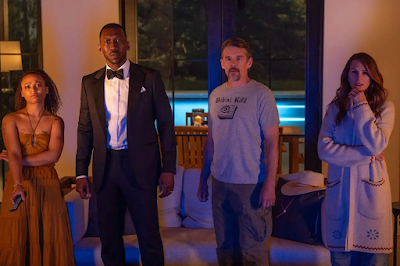
First off, if a cyberattack did take down enough of society to cause chaos, how (and why) is it that this one section of Long Island was spared? Was it because they didn't want to try to shoot all of the nighttime scenes by candlelight? Or so they could still have a functioning coffee maker in the house so that you'd know people would last two days instead of becoming instantly homicidal? I mean, part of the basis of most adventure stories is that the circumstances in front of us are just slightly different so that our heroes have a chance to do heroic stuff. So, fine. Our characters have power where all of New York City, visible across the river, does not. But then we discover that it may be beyond just power grids, in that satellite networks are down, so that planes and ships no longer have functioning navigation systems. But, of course, they still have functioning engines and ways to turn them off or keep them running, so why are ships beaching and planes crashing? And why is the latter only happening 18 hours after the initial shutdown when one of our heroes is walking on the beach? Said hero, G. H. Scott (Mahershala Ali) is an investment banker with high enough contacts to know one of the Illuminati who has offhandedly warned him that this disaster is coming. Scott, of course, dismisses the idea of the cabal that rules the world but also repeatedly reinforces the idea that such a thing exists. So, which is it? If writer/director Sam Esmail was trying to avoid the historical racist implications of that theory, he wasn't doing such a great job of it. Instead, he veers right into hitting us over the head with the overt racism of Amanda Sandford (Julia Roberts) when confronted with Scott and his daughter, Ruth (Myha'la) returning to their home which the Sandfords have rented. I mean, yes, the problem of inherent racism drives a large portion of American cultural relations and politics, so you don't really have to be that heavy-handed with said message. Amanda is borderline shrewish when conveying her distrust of the Black people in the house (their house, which she clearly doesn't believe because, you know, they're Black...) with her children.

Yeah, I can't believe how dumb this is, either.

But then we have all of the other more obvious story points that simply don't mesh with our aforementioned suspension. Why does Archie's (Charlie Evans) lyme disease take hold overnight and become worse than any version of that disease ever seen? If it is even just lyme disease, why do they think that a couple pills from local survivalist neighbor, Danny (Kevin Bacon), will solve his problem? Why do the local deer seem intent on gathering around just their house and not others? Why do flamingos show up in a Long Island swimming pool? Are these the surrealist components that are supposed to make us as confused as the characters? Why do Amanda and G. H., completely at odds over the situation and their respective identities, suddenly fall into each others' arms and consider cheating on their partners with each other in the space of 48 hours? Why would a man as wealthy as G. H. ever play ball at the local YMCA? There are so many little things detached from reality here that it's difficult to believe that one person wrote it and, if that is the case, whether that person has been outside their home to interact with actual humans anytime in the past few years. Is Esmail an isolationist/survivalist? Even the seeming in-jokes are off key. We see a trashed house with a sign of the previous owners hanging loose that says the home was owned by The Huxleys. If that's supposed to be a reference to Aldous Huxley, I'd have to ask why, given that this is a disaster film. Huxley is best known among his fiction works for Brave New World; a society under total control, not one that is falling apart. Archie walks around wearing an "OBEY" shirt from They Live, which is about the subtle control of society through subliminal advertising, not its collapse from a systemic breakdown.


All of this confusion and lack of direction is reinforced by the melodrama of both the cinematography and the score. The camera did repeated close-ups during dramatic moments, just in case we couldn't figure that out, and then wide pullbacks and spirals from above when action was happening. The score was the stereotypical orchestral crashing whenever a plot point was revealed or a realization was made by any of the characters; often multiple times in the same scene. The whole storytelling approach was amateurish, at best, and didn't convey the idea of a major production that would be carrying the heft of a film with the above listed stars, as well as Ethan Hawke. But, then, Hawke was almost insipid in his contrast to his abrasive wife, Amanda, who was presented in a thoroughly wooden performance by Roberts, which likely wasn't helped by the boilerplate dialogue she was given. Her first lines, when she wakes her husband to announce that they're taking a last-minute vacation and why are spoken like she's reading from a book of middle American homilies about modern society. And, of course, the worst thing about the whole presentation is that it reinforces the conspiracy theories that are rampant today, by suggesting that there may be some kernel of truth to them, if people would only pay attention. What those theories also carry are the racist overtones of anything similar to the Protocols of the Elders of Zion, which is kinda how this feels when you see the upper middle class White family having their vacation disrupted by all of the surrounding events (and Black people!)

It's just trash, beginning to end, and in no way worth your time or attention.

Tuesday, February 21, 2023

Falling short - 2022 Animation shorts

Woof. I'm an animation fan. When I posted a tweet last week in the vein of a lot of the chains going around entitled: "10 films to get to know me" (I'll be writing more on that later), two of those ten were animated films. I read and wrote comics for years, so it's kind of a natural segue between the two media. With that in mind, I'm usually most excited to see the animated shorts when they come around every year, but this year was kind of a trial. Three of the five ranged from forgettable to outright awful; one was at least interesting and the fifth (thankfully the last) was fantastic. It basically saved what was otherwise a pretty poor outing for what we usually expect from these mini-festivals.


An Ostrich Told Me The World Is Fake And I Think I Believe It: This was the one that had an interesting premise and was at least funny in parts. It's the story of an office worker who realizes that he's trapped in an animation studio and that everything around him is less than it seems. It uses one of my favorite animation techniques, which is stop motion. I'm a diehard Ray Harryhausen fan from when I was a kid, so that labor-intensive process and the slightly jerky motion (much better with modern processing than it used to be) will always have an instinctive appeal to me. Director Lachlan Pendragon not only has a cool name but also was a student when he created this film, which makes it that much more impressive. The fact that Neil (voiced by Pendragon) breaks the fourth wall in a fairly oblique fashion by discovering the processes and the different parts that make up himself and the other puppets, rather than communicating directly with the audience, is another excellent approach. The overarching theme of modern office work being detached from the "real world" is present, but not used as a bludgeon. Why is it an ostrich that clues Neil into what's really happening? Perhaps as a metaphor for people not being willing to notice what their world is until told by the bird who willingly blinds itself according to legend? Perhaps just because it's absurd? Doesn't matter. This was a smart little piece that deserves the notice that it has gotten.


The Flying Sailor: This was an abstract reconstruction of the Halifax Explosion in 1917, centered mostly around the story of Billy Wells, who was hurled almost two kilometers by the blast but survived. While it did heed historical details, like the fact that Billy's clothes were torn from his body in the initial shockwave, it veered off from there into a perspective that Billy might have had in terms of his life flashing before his eyes and taking time to look at the stars while he was hurtling through the air. That's fine, but it doesn't leave us with a whole lot to latch onto, story-wise. It is only an eight-minute film, so I don't think it was intended to deliver anything grandiloquent, but it also didn't say enough to leave much of an impression at all. If you didn't already know that it was about Halifax, you'd come away with even less than that, so I'm a little lost as to how it got nominated in the first place.


Ice Merchants: This one delivered a bit more in that its story was completely fantastical, about a man and his son living in a house perched on a mountainside where they make ice every day and skydive to the town in the valley to sell said ice, losing their hats in the process of the dive and buying new ones every time before they return on their motorcycle winched from the ground. One wonders why they wouldn't just ride the winch to the ground so that they could keep their hats, but I suppose that would deny them the thrill of their power dive every time. It also would spoil the rather indifferent ending when the warming (of the climate? of the seasons?) of the mountainside threatens both their home and their livelihood. I suppose that metaphor about climate change is the most likely and that's all well and good in principle, but one could just as easily draw a metaphor about consumerism with the constant waste of their hats and their need to buy more. Is the awesome heat created by the furious looms down in the town, weaving new hats every day, part of what's contributing to the change that threatens to ruin their lives? That's probably spinning those threads (ahem) out a bit far, but it's that kind of speculation that's needed to really make something of this story that left the feeling it was a bit lacking and, three films in, left me feeling rather underwhelmed about the whole evening until we got to the next film...


The Boy, the Mole, the Fox and the Horse: ... which was irredeemably awful. In all the years that we've been doing this, I don't think I've ever encountered a short film that I really wanted to walk out of, but there's a first time for everything. This film is dreadfully tedious. I'm all about the overall themes of empathy and kindness, but there really has to be something at least mildly dynamic about characters, story... something! Everything in this story was blasé from the opening moments of the insipid soundtrack. The animation technique was at least somewhat interesting, with the shifting pencil marks outlining the watercolors of characters and scenery, but everything else was soporific and I know it was because I caught myself starting to doze a couple times, which is never a problem in what is usually a collection of interesting perspectives (not just the animation, but all of the shorts on offer.) Tricia compared it to Winnie the Pooh, but even the stories about Pooh had a character like Tigger, who would at least provide some contrast to the fretting and timidity of Pooh, Piglet, and Eeyore. There was no such contrast here, as all of them were collegial nihilists, bemoaning their state of affairs while reassuring each other of how fond they all were of the others. At 34 minutes, this was already borderline too long for a short. Given the subject matter, it was about 33 minutes too long.


My Year of Dicks: But the evening was thankfully saved by the best film of the night, which was the last one. Pamela Ribon's story of her fifteen-year-old self trying to force her own sexual awakening was hilarious, familiar, and hugely entertaining, both visually and textually, for its entire 24 minutes. It struck a chord with the whole audience (a packed Michigan Theater screening room) because it unabashedly hit at sensations that everyone in that room had had at one time or another, whether in the role of Pamela or one of the boys that she tries to make her co-conspirator in the plot toward teenaged orgasm. The highlight, of course, was the cascade of anguish and emotion surrounding "the talk" with her father. I really appreciated the funhouse mirror approach to her feelings and expressions and everything that you remember in your own inner visualizations while having those excruciating moments with your parents. This was vastly more inclusive and understandable than the dreary Hallmark animal parade. But since it actually talks about real emotions and not fantasy ones, it will almost certainly lose the statuette to the wooden Pooh facsimiles. It's not like you can imagine anyone on stage actually voicing the title on national TV, anyway, even if they did acknowledge these film creators during the live broadcast, which they no longer do.

So, yeah, a somewhat underwhelming end to our three-day excursion. I think Live Action walked away with my personal "best of"s this time, as I'll remember The Red Suitcase and An Irish Goodbye for a long time, I think.

Saturday, February 18, 2023

They think you're the mark

"If you can't tell who the mark is in the first five minutes, then you're the mark." Some variation of that phrase is usually uttered in most movies or TV shows about gambling because most people think gambling is about losing. Or, well, most people actually think gambling is about winning, but most people end up losing because they're the walking example of that adage. Similarly, most people don't know how casinos actually function and, well, most people don't know what good writing actually is and, well, we can keep going in this vein for a long time before we run out of obvious examples. All of them lead to a situation where you could argue that Poker Face is actually a good show and you'd be wrong because it isn't and it took me getting all of 45 minutes into the first episode to tell you why. Tricia is currently finishing the last ~15 minutes of said episode while I'm writing this opening paragraph because she's willing to give it that much more consideration before deciding whether it's worth it.

First off, production design. It's shoddy, obvious, and stupid. If you're setting up a situation where you don't want to try to keep dancing around being set in the most obvious of locales (Las Vegas), then you probably want to at least set yourself up so that your replacement for Vegas seems like it's a realistic situation. The show seems to be set in "Frost County", because the big guy who owns the casino where most of the action happens is Sterling Frost. The county is named after him. The police answer to him. The casino that he owns is named after him. His son, Sterling Frost, Jr. (Adrien Brody, the only performance worth watching in the limited time that I could sit through; we'll get back to that) is named after him. Ego will often take you a long way. If that's the case, why would your ego think that it's necessary to name said casino "Frost Casino" like you never made it past the opening pitch of the series to some idiot producer, rather than something both more self-serving (just "Frost" might have worked, since everyone knows what it is, like "MGM Grand") and even vaguely more intelligent for the viewer? Does said viewer need to be reminded more than once that this place- where most of the essential action takes place -is the casino or do you think they can figure that out on their own? Similarly, no actual casino in the world has a blazing neon sign that announces its high rollers room as the HIGH ROLLERS ROOM. That is, unless the target audience for your show has both a) never actually been in a casino and is b) stupid. Just FYI: Most people with that much money don't want to be bothered by nosy spectators watching them lose that money, so the big neon sign to attract people would generally be seen as a poor choice.

Second, plot. The basic story of the first episode is that your lead character, Charlie (Natasha Lyonne) can tell when anyone is lying, so Sterling, Jr., the casino's manager, is going to use Charlie to help him beat a high roller in a game of poker, since she'll always be able to tell him and his inside guy when said high roller (Mr. Kane) is bluffing. There's a lot more going on in the episode involving a murder, but that's the basic premise around which everything else revolves. And that would be fine for a pilot that introduces Charlie, her ability, and how that will be used to set up the "murder of the week" situation that the entire series is supposed to work with except that said basic premise is bullshit because that's not how poker works. If Charlie always knows that someone's lying and, therefore, bluffing, OK. But what if they don't need to bluff/lie? If they think their three kings beats everyone else at the table and they bet on it, they're not lying. And if you think your two pair beats everyone, you're still losing to their three cowboys. So how does Charlie give you an edge in that situation? How could you even imagine that she would give you an edge unless you'd never played poker in your life and really had no idea how the game worked? They were also setting up cameras to see all angles of the room. If that's the case, then they should be able to see the mark's hand and play into it whether they have Charlie there or not, so what's the point of involving her? Are there really that many people out there who've both never played and never been in a casino that are willing to ride along with this situation because Lyonne and Brody's acting somehow make it worth watching?

Third, acting. Yes, Brody, like usual, is excellent, shifting from mildly perturbed to casually menacing to quietly plaintive and back again with aplomb. Lyonne, OTOH, brings a lot more fire and light to a lot of what happens, which seems to be her whole purpose in the general proceedings. The person who keeps turning over that page that people might not want turned seems to be her Sisyphean rock (e.g. she has to keep doing it, even if it's not really what she wants.) That's fine from a character motivation/goal standpoint, but it's also a situation that can get tiresome for the viewer right quick. She already fills her role with some level of exasperation. How long until that starts being the role of the audience, as well? The reason that some people find sitcoms to be more annoying than humorous (waves tiny flag) is that they're prescribed situations. You have to be willing to be set up to be knocked down and that's just not really entertaining to me because those characters are bowling pins, rather than bowling balls. They don't roll forward. They just stand there to get knocked down and set up to be knocked down again, over and over. They don't make progress. That's what this is and it's usually pretty tedious by the third or fourth time around. But in this case, it's not even the typical Colombo-style "murder-of-the-week" because Charlie's magical ability lets the writers do a shortcut. They don't even have to set up clues and do all that deductive reasoning nonsense. They can just set up one bowling pin to lie and the other pin will know that they're lying so we can just cut right to the chase, almost literally.

But, clearly, I am the exception to the rule because not only has said series been critically hailed (99% on Rotten Tomatoes! 99%! With an 8.6 average!), but intelligent people like Gail Simone are declaring it to be one of the best shows on TV, at the moment. I have Peacock because it's the only way I can be sure to see all of Liverpool's Premier League matches, so I definitely didn't go out of my way to pick it up in order to see Poker Face and I can tell you right now that no one else should, either.

Wednesday, September 21, 2022

As plain as the nose smashed into your face

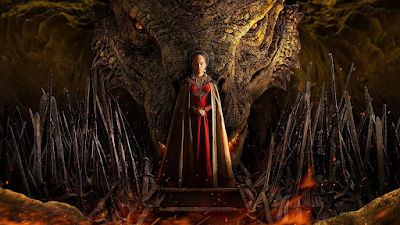
I didn't bother to write this the night of the most recent episode of House of the Dragon because I didn't bother to watch it that night. We just really had better things to do (and the best episode of the season so far for Rick and Morty more than made up for it.) Having finally gotten around to watching it, I have to say that the wait made no difference whatsoever. The overriding impulse for House to this point in time is boredom. Everything is obvious. The competing interests are obvious. The reactions of every character are obvious. The showrunners explaining their self-evident motivations, both within the story and their intentions for the story, could not be more obvious. In many ways, the "inside the episode" so-called 'revelations' seem exactly like how I felt when trying to read Fire and Blood. All they're doing is reciting a litany. It's all been played out in front of them already. It's the equivalent of an oral history heard one too many times. It's become mundane and rote.

This episode for all of its "shocking" intent was just the same. Seeing both Ryan Condal and Miguel Sapochnik explain that they felt they had to set up the episode in this fashion because Game of Thrones fans "expect that weddings won't go well" is fan service of the plainest and most idiotic sort. They're essentially admitting that they have no story to tell. They're simply reciting the litany that GoT fans are supposed to expect. It's not innovative. It's not original. It's not interesting. It's just performative. The fact that they chose to take a presumed modern approach with Laenor Valaryon (John Macmillan) is a nice concession to the fact that people, even royal people, throughout history have had different sexual identities but if that's the most innovative thing you can present in your entire storyline to date, then you're really struggling. I guess you could say that the production has fallen into line with the entire reign of Viserys; always appearing weak and surprising no one with its ennui.

The central fact that I keep bemoaning is the lack of a magnetic character; ANY magnetic character. The most genuine moments continue to be shared by Rhaenyra (Milly Alcock) and Criston Cole (Fabian Frankel), as they're the only two that seem able to express a genuine emotion that isn't angst or outrage, with accompanying cynicism about how all of this is such an act. (The Bard's "All the world's a stage" quote was perhaps never more appropriate.) If any one of these people could do one thing that wasn't completely predictable, it might rescue an entire episode for me. Hey, look! We got to see Rhaenyra roll her eyes at the boorishness of Jason Lannister (Jefferson Hall) for the second time in a month! That's, uh, not new. I'm a story guy. Give me something- anything -that tells me that these people aren't just locked into a script that has them moving and talking like the animatrons on an old funhouse ride, gesturing and shifting in the same patterns forever. OK, there was one interesting point when, for some reason, the Velaryon ships pulled out their oars while they were at full sail approaching the city. Unless they were planning to beach said ships and never return that, like the rest of this series so far, was a very bad idea.

But, hey, Nielsen declared numbers the other day and House is supposedly drawing the strongest of any HBO show since GoT, so I am clearly in the minority. Or perhaps there are simply millions like me who are watching to see just how oddly disinterested they can become. Next episode is finally the jump forward to adult Rhaenyra and Alicent so, OK, maybe we can chalk up half of the entire season as simply setup to the "real action?" Does that sound interesting or compelling to anyone? Bueller?

Monday, August 22, 2022

Rehashed plots with dull characters may not be the best approach


Those of you who've been reading for a while (all three of you) may remember when I was regularly writing about Game of Thrones. It was, for the first five seasons at least, one of the best shows on TV at the time. It takes some real talent- writing, acting, producing -to make a series of that quality for that long and that's why, in the somewhat-pre-streaming era, GoT became what most are referring to now as a cultural touchstone. It's one of the last series where people were gathering around the water coolers (you know, when people used to go into offices?) to talk about the Sunday night episode that had just dropped. The Battle of the Blackwater. The Red Wedding. The duel between The Mountain and The Red Viper. How hot the sexposition scenes were. All that. That's a more difficult scenario in this, the age where entire seasons can be consumed in a day, but there are still shows that have a bit of a culture-wide thread by dint of both their restrained production (weekly episodes) and the high quality of their acting, writing, direction, and overall production, like Better Call Saul. The first spinoff from GoT, House of the Dragon, has set itself in that first mode, repeating GoT's Sunday night schedule, but is lacking significantly in the latter aspect.


The first Damocletian sword hovering over the series may, in fact, be its connection to GoT. I'm not sure there's a parallel in television history where a show of that quality took such a nosedive in not just its last season, but its last three seasons. The capper, of course, was the final couple episodes where it was more than evident that the producers and writers were really eager to say goodbye to Westeros before HBO could try to throw more money at them. Of course, one could look at the mother series and think that another factor that torpedoed it was the lack of George R. R. Martin's plotting. Once the story had moved past his books, it was David Benioff and D. B. Weiss with an outline and no one to tell them they were wrong. House does not have that problem because it not only is following Martin's "novel", Fire and Blood, but also has him directly involved in its production (perhaps to forestall a downturn in quality? Hard to say.) But part of the issue may be the story itself. I refer to the book as a "novel" because my brief experience with it found it to be more like a fictional documentary in book form. Martin and some collaborators had already produced The World of Ice and Fire; a coffee table-style tome that was something of an encyclopedia about the world that contains Westeros and Essos. Said tome contained a great deal of detail on the "Dance of the Dragons" which is the general term for this period in House Targaryen's history. Then he produced Fire and Blood, which goes into even more detail on said period. I got about 30-some pages into the latter before realizing that I was just rereading the same history (not story, really) in even more detail and put it down, never to be opened again so far. Just like with Star Wars, if you're doing a reboot, tell me it's a reboot. Don't try to sell me on something new before handing me the same thing I've already seen or read.


And, of course, a lot of people will say something similar (or already have) about House. It very much is back-to-basics Game of Thrones. In a sharp turn away from the pointless action scenes and rather brusque storytelling of the final couple seasons of the mother show, the showrunners for House have decided to invest heavily in the action-by-discussion method that produced the often-wonderful political machinations and storylines of the first series. The problem with that is two-fold: 1. Doing that in the first episode produces a pace that likely has already alienated some viewers. 2. You really need compelling characters to sell that approach, especially in the first episode. What made the later seasons of GoT still somewhat must-watch TV were the characters; most of whom were introduced in that first episode in 2011. House had precisely zero of that kind of character in its opener. There was no witty but rueful Tyrion or menacing but conflicted Jaime or earnest but frustrated Arya. In fact, almost none of the characters presented in last night's opening episode had any personality at all. They were just inhabiting roles to move the plot along because the script said to do that. The only exception was Matt Smith as Prince Daemon. His personality just happens to be "arrogant dipshit", which isn't really a selling point, but there it is. At least he's something other than a dilettante or a mannequin, which really defined the rest of the cast. I mean, perhaps it's a compliment to the veracity of their characters that most of them are so accustomed to being above all of humanity that they didn't actually display any humanity for the entire hour? I'm all about characters that are appealing because of their lack of emotion (witness the comic version of V in V for Vendetta as opposed to the Hollywoodized and stereotypical film version), but they normally have to be a bit more dynamic than anyone was in the first episode of House.


To break up the tedium of discussions about stuff we already know and tittering about what someone is wearing to the joust, the producers decided to continue in the GoT vein but even more over the top, as it were. Not only did we have the obligatory orgy scene, but were handed a feast of blood and violence that was even more gratuitous than anything this side of the nearest direct-to-video/Amazon streaming slasher flick. We already knew that the queen was going to die in childbirth (even if you hadn't already read Martin's histories, it was obvious that she was there to present the "difficult birth" scene from the moment she appeared on screen.) Exactly how many minutes of Emma (Sian Brooke) screaming from her pool of blood did they think was necessary to get that across? For that matter, how many skulls needed to be split open to demonstrate that jousts were violent contests? One probably would've been enough, but not for Ryan Condal and Martin, apparently. Those were the moments of "action" that were supposed to provide respite from the sneers and muttering of the Targaryen (and hangers-on) family, but all they really were was a different form of tedium. I used to do a "Lines of the week" feature for each episode of GoT. I can't think of a single moment from last night that was clever enough to jot down as being memorable.

Pilots are tough. Opening a series with all of the baggage that Westeros still carries is an even steeper hill to climb. But the showrunners did themselves no favors with this beginning. We've really (in some cases, literally; pun intended) seen it all before and it wasn't nearly as interesting as it was the first time. I'll keep watching for another episode or two, but if the writing doesn't improve quickly, my disdain will be overwhelming and it will have nothing to do with the stink of a dragon.

Wednesday, March 3, 2021

Batman: TAS, episode #22: Prophecy of Doom


Ugh. This is the first example of an episode that simply failed to work on almost every level. The premise is weak, the pacing is tedious, and the presence of The Batman is the only thing that makes it distinct from a Murder, She Wrote episode. We hit the ground running with a Benny Goodman-style rhythm in the background on a cruise ship, which is then sunk for reasons unknown. Those reasons become obvious when we're informed of the presence of the mighty Nostromos, a cheap hood and former actor who's apparently willing to go through the expense (and lengthy investigation) of sinking an entire cruise liner and likely killing who knows how many people to make only one of his wealthy dupes believe even more deeply than his already-professed devotion. Eh? Part of Nostromos' acting ability is also the ability to keep his eyes large enough for one to suspect he's been given Alex's therapy for too long. This is on top of how some actors just can't function without a writer. Nostromos? I think the actual writers (Dennis Marks and Sean Derek) could've worked just a little harder on that name.


It's not that the themes are poor. They're just very common. Did anyone think of Fox News while listening to the description of The Great Fall, including the desire to transform all the cash into gold bullion in true, Ron Paul style? This was a few years before that network began, but the impulse for wealthy people to prevent the rabble from taking a piece of that wealth has been extant since human society was developed. Also, the usual generational conflict, as Ethan bemoans the fact that "We're raising a generation of cynics!", presumably using the modern perception of the term 'cynic', someone who doubts everything, while he clings to the hopeful message... of someone predicting the end of civilization. Yeah. But you could see the "OK, Boomer" message in that, too, because that theme has also not changed down through the ages. 


And that's kind of the overall theme that was delivered here, since this was straight out of the 1950s-era Batman, including the endless final battle scene (Attack of the Deadly Planetarium!), which makes one wonder if planetaria can, indeed, go into overdrive or be driven out of control and threaten everyone within them. I mean, apparently, elevators can be destroyed by literally tossing a wrench in their gears, so there it is. However, given the resplendence of Nostromo's HQ, one wonders where the out-of-work actor and SFX guy got the money for that place before collecting the wealthy idiots whom they're trying to rob right now. One perhaps inadvertent theme was that the only woman in the room, Lisa (voiced by Heather Locklear!) was also the smartest person in the room. (Apart from The Batman, of course, since Bruce Wayne has to look like an idiot; again, totally 50s-era approach.) That status apparently included the writers on this one, since it was kind of a grind to get through it.


That lowball, 50s approach also colors the other action scenes. Why is out-of-work SFX guy the most dangerous person The Batman encounters, not only outdoing him physically on a rooftop, including being strong enough to rip a steam pipe from its housing to then catch the master unarmed combatant full in the ribs, but putting up more of a fight than Killer Croc throughout the planetarium battle. Why? Because they needed that to keep a weak story moving along. What it does, of course, is diminish the main character and produce an episode that really isn't worth the time, as the villains seem somewhere between ridiculous and laughable and the hero, consequently, not much better. Even the in-jokes were weak, since Nostromos is apparently a fan of CCR ("I see a bad moon rising!") Every series has its low points and this was certainly one of them for BTAS.

Next time, we at least have a more interesting social issue in focus, with The Forgotten.