Showing posts with label science fiction. Show all posts

Saturday, September 13, 2025

Batman: TAS, episode #62: His Silicon Soul


Right off the (ahem) bat, this is obviously an episode that plays right into this meme. But that doesn't completely trivialize His Silicon Soul. Yes, it's kind of an odd epilogue to a story that was already told in two episodes in the first place. But one can suppose that Bruce Timm and Co. were simply huge Blade Runner fans, which I wouldn't blame anyone for. But also, as noted before, Kevin Altieri mentioned that the original script for the HARDAC story was even longer than the two-parter it became, so perhaps this was simply the part three that was originally envisioned. The philosophical underpinning of this story is a bit heavier than the rest of the material frequently seen in TAS, as well. But if it was, in fact, the last segment of that original longer story, you can also see where the cuts might have happened and perhaps been too imprecise.


For example, our scene opens with crooks breaking into the Cybertron warehouse in search of gear to sell. But when they start cracking the crate with the symbol of HARDAC, they're quickly assaulted by the Batman duplicant. If it was so easy for said construct to break out of said crate, why did it wait for these underworld commoners to start the process? Is it because their attempts reactivated it? How? Why? These are story notes that would've taken seconds to demonstrate (and which we would've seen in most episodes) but which are bypassed here to the story's detriment. In contrast, when the duplicant shows up at Wayne Manor, the normal example of good direction appears, as the image in the mirror of the Batman's cowl creates a memory of HARDAC in the duplicant, who then traces those symbols in unison. That's a great example of using visuals, rather than dialogue, to convey both the confusion and anguish of the machine at hand, which later plays right into the ending question of whether it had a soul (hence, the title.) These are questions which, again, draw directly from Blade Runner (What makes us human?) and are worth asking in all kinds of fiction, not just SF, as well as everyday life. I'm just not sure they make for one of the best stories about The Batman, which are usually more character-driven, as comics tend to be.


Other moments like the question of the crate keep occurring. If Alfred has already recognized that the duplicant is a machine and, in fact, points that out to the machine itself, why does he immediately try to activate the Batcave's gas defenses? He knows it's pointless, which it is then proved to be. This is out of character for Alfred, wastes story time, and would immediately make any viewer with any knowledge of the issues the plot is trying to convey question everything about the inclusion of this scene. The one good element about it is when the duplicant asks the computer to "Magnify lower right quadrant" which, again, almost can't be seen as anything but a Blade Runner reference. On cue, we're reintroduced to Karl Rossum, who is voiced by William Sanderson, from the film. He has no interest in dealing with anything but the vegetables in his substantial garden (He's gone organic!) which, of course, turns into a battle scene when the two Batmans begin doing the Spider-Man thing. It also turns out to be the world's most fragile greenhouse when breaking one support post and one exterior panel ends up collapsing the entire thing. This is pyrotechnics (albeit without the fire) for the sake of it. Why? Was this intended as a message for the internal anguish of the machine that would somehow lash out to destroy everything a la HAL 9000, as mentioned in the Heart of Steel, part 2 post? Again, the overall ham-fistedness of it makes it difficult to tell. Our return to Gotham City also includes a side wipe transition, which is a really unusual approach for the series as whole, which usually just does cuts to a new location.


Those broader philosophical implications soon begin to intersect with current events here in the real world, as HARDAC's plan to replace all of humanity with duplicants (The Great Replacement Theory!) once again becomes the primary focus. In the process we're told that the duplicant Batman is now a fully operational Batman station. Again, the action vis-a-vis reality tends to get a little muddled in the urge perhaps to fit the story into broadcast time limits. A forklift is chucked into a shelving unit and, despite the minimal damage that brought down a 100-foot greenhouse, in this case, the shelf doesn't even come all the way down. Similarly, our Batman is punched through a warehouse wall and doesn't seem to display any of the effects of same except for having his cape torn in half, which becomes the more easily displayed visual cue so that we know which Caped Crusader is The Batman and which is the repli- ahem, duplicant. That question extends to the final scene, where the duplicant is defeated, with half of Bruce Wayne's face and half of a Terminator face displayed. Is this a message about the internal steel and diffident nature that our hero's work requires? Or is it just a setup for that final line: "Could it be that it had a soul, Alfred?"

So, yeah, not one of the series high points, IMO. Next time, we're introduced for the first time to a classic Batman villain that most modern fans had and have no clue about, Maxie Zeus, in Fire from Olympus.

Wednesday, August 27, 2025

Alien: Earth, episode 4: The moral quandary of only briefly touching on your title subject


This is the episode in which the series has made the jump from using the xenomorphs as a shell by which to attract eyes to their story about artificial life/intelligence/whathaveyou to actually having a dual plot about the alien intelligence among us (the synths/cyborgs/hybrids) directly interacting and perhaps even relating better to the alien intelligence that's external (the xenomorphs.) It's not the cleanest of transitions, but those are often the best kind, since they leave all kinds of nooks, crannies, and other non-Euclidean angles that can be explored, expanded upon, or ignored until the time is right (aka Season Two after a long session in the writers' room.) Given that HR Giger's artwork (the original visual designer of Alien) has often been referred to as "Lovecraftian" and HP Lovecraft was fond of citing non-Euclidean geometry as something beyond the ken of humankind, this whole thing has just about come full circle. Or circles. Or, y'know, bubbles. I'm being slightly facetious here because I'm still watching the series with a sense of detachment, as I'm still not quite sure where to place it on a level of interest. In truth, I was watching tonight out of a sense of obligation to write about it, since I assumed that the two or three people that follow what I'm saying here might want to see me continue.


That's not to say that there aren't some interesting discussions or reactions happening. One of the foremost is Kirsh (Timothy Olyphant) as a synth with ego, as he struggles under the assaults on his competence by Boy Kavalier (Samuel Blenkin) whose role has become one of increasing obnoxiousness as he feels his control of the new situation growing. "What kind of an intellectual argument is 'please'?" 
And, yet again, I'm wondering about the meta-ness of it all. In the same way that I question if Noah Hawley and his writing team really believed in the tiresome trope of The Lost Boys, I wonder if he deliberately had Kavalier misquote Isaac Asimov. The famous "Any sufficiently advanced technology is indistinguishable from magic" was a line delivered by Arthur C. Clarke as one of his three laws essentially about science fiction writing and the future. Certainly, Hawley has to be aware that there are enough SF nerds out there watching his story that would catch that. So, again with the SF references and the obvious parody of Elmo Musk and the references to other stories in this neo-cyberpunk milieu and we come back around to questioning whether all of this is worth it or simply a grandiloquent statement on the current mindset. (Are xenomorphs 'immigrants'?)


On top of that is the devoted attachment of so many around the hybrids to insist that they're children, as opposed to products or potentially lethal threats as Nibs (Lily Newmark) demonstrates to Dame Sylvia (Essie Davis.) The inherent uncertainty of the main team, including Arthur (David Rysdahl) about everything that they're doing, despite having been presumably recruited by Kavalier specifically for this project and having been involved with it for years is a significant plotting question. Yes, it's certainly possible to not have realized the implications of the scientific exploration that you're engaged in, but to continually harp on your subjects' well-being not so that their operation continues successfully but because you're doing a Helen Lovejoy seems more than a bit disconnected to me. That, again, makes Morrow Babou Ceesay) one of the two best characters, since not only is he aware of how to manipulate Slightly (Adash Gourav) but it's obvious that he can do so because he relates to him, despite being so old that everyone he knew and loved is long dead, as he stated in episode three. That brings us back to the "minds of children in the bodies of adults" Blade Runner quandary, which is still a great plot angle which here still lacks the subtlety of the original and kinda suffers for it. But at least Morrow and Slightly's dialogue touches on a lot of those issues of ethics that both adults and children can question at different levels without becoming tedious. Two exchanges: "I didn't know if you were a villain or a hero." "... Hero." and "How can you steal from a thief?" "A riddle?" "A moral inquiry." were great points accompanying the broader picture of corporations ruling the planet in the name of profit and the question of ownership of other lifeforms and ideas.


Like most science fiction, it draws back to the present day in order to elaborate upon accelerated tenets of society. In some instances, it's an obvious parallel, like Kavalier's parody of Elmo. In others, it's slightly removed, such as when Joe (Alec Lawther) is confronted with the ultimate example of present-day American health insurance by being told that if he doesn't continue to serve Prodigy, they'll just bill him for the rest of his life for the lung that they graciously replaced for him. Similarly, while I don't spend much time in Starbucks, I have to imagine that, even in comparison to our current era of earbuds and tiny microphones, where the technology for communication in the show is so much more advanced, it might still be a little disconcerting to others in a coffee shop to see the one guy talking to the empty space surrounding his table for so long. But maybe not. And this is all centered on the one storyline about manufactured "alien" life. The other storyline of actual alien life doesn't play much of a part in this episode until the last couple minutes. The lone exception is the eye creature's takedown of the poor sheep, who is then transformed into the most threatening ungulate that isn't adorning some ancient depiction of Satan. In some ways, you can see the discussion in that writers' room, where someone had to stand up and say: "Hey. We have nothing "alien" happening in our show called "Alien: Earth" and the eyeball scene was dropped in to remind people that this isn't just a variation on Blade Runner, rather than a derivation of Alien.


Overall, I have to say that my dismissal of the Helen Lovejoys is at least partly motivated by the complete lack of concern I have over the idea that these are "children" inside the hybrids because it's a well-trod road and the whole concept was set up to engender sympathy and I don't respond well to setups. I've seen a lot of "kids slowly realizing stuff" over the years and I'm not particularly eager to go down that road again (Too late, I guess.) So, as much as I'm willing to keep watching, I'm still going to be doing so from a distance. We could've done without the entire scene to elaborate upon the face hugger process, too, unless that was just another way to remind audiences that this isn't solely a show about androids. ("Don't tell me what I wanna hear! Tell me the truth!") Plus, although I appreciate Jane's Addiction far more than Dio Sabbath, Tool, or Metallica, I'm still not sure what reference any of these ending tracks is making other than "sounding cool." "Ocean Size" is about being homeless. If that was the implication for the newly-spawned xenomorph... yeah, I don't get it.

Wednesday, August 20, 2025

Alien: Earth, episode 3: Metamorphosis (into something mildly interesting)


The opening moments of episode 3 were emblematic of some of my thoughts on the first two, as Nibs (Lily Newmark) questioned with some disdain why she and the rest of the hybrids were named after Peter Pan characters. My thoughts, exactly. Here's where we really get meta. Was Hawley doing that to show how shallow Boy Kavalier (Samuel Blenkin) is, despite his genius (shades of Elmo yet again)? Or was Hawley genuinely using that as I thought before, simply because it's a trope that a lot of people will latch onto? And, again, it is a Disney property. (Marketing! Woo!) But I'm starting off with a heavy dose of similar disdain for an opening to an episode that, as it went along, actually turned into the best of the initial three. There were still some predictable parts and it's still part of an origin story, which is always below the degree of originality that I'm usually looking for these days, but there are a couple interesting things going on.


What stuck out to me overall were the number of references to other elements of our sci-fi culture over the past 50 years. Once might call them "homages." One might also call them "obvious touchstones." If you want to really be dismissive, you'd call them "ripoffs designed to evoke familiarity because, once again, your story is lacking originality." I'm not sure that I'm quite that cynical, as of yet, but it's something that's going to continue to rear its head as long as the central plot is the overtly Blade Runner-esque "What does it mean to be human?" There's nothing wrong with that plot. It's a great premise for any number of stories. I'm just continuing to draw this comparison and my mild frustration with it based on the assertion at the very beginning of episode 1, which stated that the major corporations were engaged in a race to find "immortality", despite synths and their cyborg simulacra being not suitable for what you'd assume "immortality" was intended to do (i.e. preserve the rich.) The only model that's come close is that of the new one: the hybrids. Presumably, this is supposed to define Kavalier's "genius", in that he's finally found a way to accomplish this desired goal of people like him. But synths and cyborgs were never going to be part of that goal, so that whole element still seems a little hazy and more of a sop to Blade Runner fans (like me.)


But Hawley is at least spreading his net wide. Not only are we doing the replicant thing, but it's obvious that someone among the story team was a Netrunner player, since the identities of the corporations that we've seen are much like the major players of that legendary card game: Haas-Bioroid specialized in android design. Jinteki was about biological enhancement. And the Weyland Consortium had a wider portfolio than any other. And, yes, the name of that Consortium was almost certainly a reference back to Weyland-Yutani from the original film, who still exist here. Can you do an homage to an homage? If the next corporation we're introduced to is a media conglomerate (NBN!), my suspicions will be confirmed. Similarly, although slightly more subtle, we have Kavalier's exclamation: "New lifeforms! With acid for blood! Like an undiscovered country!" Hello, Star Trek fans. At least they cited the best of the films. (Fight me, Khan fans.) But some of that referential material is self-referential and, as with the first two episodes, gets a little annoying. Morrow (Babou Ceesay) confesses to Smee (Jonathan Ajayi) and Slightly (Adarsh Gourav) that he was given the same instructions and found some of the same internal conflict that Ash would find two years later (or, y'know, almost 50 years ago when the original film was released): Mother told me to do this and I had to struggle with the ethical complications of making the crew expendable. I get that major corporations tend to lack innovative thought but my first question had I been in that writer's room would have been: Haven't we been here before?


And that extends to Kersh (Timothy Olyphant) somewhat, as well. He begins to take on a minor deus ex machina role (how drolly appropriate...) as he deftly uncovers and explains all the little mysteries about what happened, what's happening now, who Morrow is, how the aliens function, and why it's dangerous for the inferior human, Kavalier, to be near the eggs. He's the walking exposition guy that kept the story below 60 minutes. But you can only have that ultimate info key walking around for so long before suspension of disbelief begins to fail. That said, Kersh and Morrow are still, by far, the most interesting characters, based on Olyphant's gravitas and Ceesay's genuine inhuman struggle with his nascent humanity. That comes out even more strongly in this episode than it did in the opening two because this script is stronger in character action than either of the openers. The inclusion of Joe (Alex Lawther) with Wendy (Sydney Chandler) has grounded some of the more emotional content in something that's real, as opposed to plot-driven. Of course, Joe spends most of this episode unconscious, but the fact that he still has the opportunity to be so is one of my major story questions. As noted, the xenomorph in the first two episodes was like an ever-expanding cloud of shrapnel, eviscerating everything in its path. But, suddenly, Joe is the first choice for it to do the "phlegm them for the eggs" capture routine. Why him and why now? Is it just the plot armor for a starring role? If so, that's quite weak.


And there are a couple more points of interest that pop up outside of the airspace of Kersh or Morrow. One of them is Curly's (Erana James) insistence to Kavalier that she should be the favorite: "She's my favorite because she was first." "My dad always threw the first pancake in the trash." She's demonstrating the hyper-awareness and unbridled ambition of some youths, which does play right into Kavalier's complaint to Dame Sylvia (Essie Davis) that he's creating this multi-billion dollar project because he's bored and wants to have a decent conversation with someone (obvious segue) but it also at least gives James and her charisma some screen time. Now I'm just waiting for her to do a floor spin at some point to kick away an alien threat. Kavalier also asserts that he created the hybrid project in part because "Children have access to a world of infinite imagination." Not only is this another tired Peter Pan reference but, hey, man: I'm 55 years old and my imagination is still pretty damn good. The other interesting bit is Wendy reacting to the shrieks and pain of the face hugger that Kersh dissects... perfectly. Somehow. That's at least a worthwhile mystery for now. I also have to say that I appreciate the cynical design of the Prodigy logo, as our camera recedes from Wendy's throes of agony to end the episode. Just like with the first two, I'm not sure how relevant Metallica's "Wherever I May Roam" is for the end credits but, yeah, whatevs. Overall, it was an improvement from the first two. Still not classic, but worth watching episode 4.


Monday, August 18, 2025

Might be TTH: Alien: Earth, episode 1 and 2


Those of you who've followed my work here for any length of time know that I'm a Ridley Scott fan... to a point. I think his first three films (The Duellists, Alien, Blade Runner (the director's cut; no voiceover, ends in the elevator)) are as fine a contribution to the history of cinema as anyone's. Indeed, I still consider Blade Runner to be the finest SF film ever made and one of the greatest films period. Its influence is rampant across my own fiction work. And not far behind in that SF film and film ranking is Alien, which demonstrated that you didn't need lasers or robots or heroic prophecies to make a solid story in the near future. You just needed regular people in extraordinary circumstances, which is the root of a lot of good fiction. Noah Hawley's new series, Alien: Earth unfortunately evades that premise entirely in its first couple episodes. Whether that's just a different take or a significant flaw in the overall story is open for question.


The problem that a lot of creators have struggled with within the constraints of the Alien "franchise" is how to keep drawing people back to the perceived threat of the xenomorphs once they've been "solved" in this or that film. James Cameron produced (and directed) what is probably the greatest sequel ever made with Aliens, when he took the horror film and turned it into an action film without sacrificing story or character. That's because he recognized that what Scott did is create approachable and memorable characters against- again -the backdrop of extraordinary circumstances. (Shakespeare alert!) That's exactly what most creators have failed to do since, instead relying on a new alien gimmick, rather than a story about the moving things on screen that the audience can actually relate and connect to (Full disclosure: When I saw Alien at the age of 7, I was rooting for the creature, but I was like that (far more enthralled by Darth Vader than whiny Luke Skywalker, etc.))


On the one hand, Noah Hawley recognized that his series likely wouldn't be a hit if the story was about the creatures and people just having to figure out the "villain of the week" gimmick like a police procedural or any of a number of mostly DC comics throughout the ages. Instead, he inserted a broader plot that examines the question of why both humanity and the xenomorph's reactions to each other are so foreign. I'm not sure if it's going to work, but it was at least a decent effort so far. The main premise is the competition between the five major corporations that rule the planet Earth to produce a new form of "immortality", be it synthetic (like the androids from the film franchise), cyborg (a single prominent character in the first two episodes), or hybrid (human consciousness transmitted into a synth.) The latter are the creation of the "world's youngest trillionaire", as if this were something to aspire to for all the current tech bro followers of Elmo Musk. They're also the central focus of the plot. I believe the idea is that, since they inherently have human consciousness (and, supposedly, conscience), they'll be the most interesting to follow and most relatable to the audience. Since all of the hybrids are created from terminally ill children, Hawley chose to cloak this whole aspect of the plot in the regrettable Lost Boys trope from Peter Pan, which has been so done to death that not even supposed immortality can rescue it. It's also an interesting insight into current world circumstances, in that it allows a company owned by Disney (Hulu) to produce a show that also uses Disney properties as central themes of the story in the form of that film, as well as Ice Age. Something something corporations ruling the world and all that. I mean, the whole premise of the xenomorph reproduction process is parasitic, so this should come as an easy turn for a company like Disney...


Hawley has done good work in the production process by borrowing extensive elements from the original film. Given that this is technically a prequel (le sigh), most of the technology on the Weyland-Yutani ship retrieving the specimens is drawn from the original film, from the text sounds to the light panels of Mother, the ship's AI. That's interesting for a bit but it eventually veers from homage to near-mockery. And I'm fine with cross-time technologies, in that their space travel is vastly more advanced than ours but their Internet and communications aren't. That's just a fact of SF only being able to predict so much (people still using pay phones in Neuromancer, etc.) But said advanced space travel also completely ignores the laws of physics when a ship crash lands on Earth under some measure of thrust and somehow doesn't create the mile-wide crater that one would expect. When there are obvious ways to defuse these kinds of glaring plot points (and when you have Disney money to do it with), it does leave you wondering. But those are details.


The main problem with the premise of the superhumans (whether synth, cyborg, or hybrid) engaging with the vastly physically superior aliens is that, well, we lose that whole "regular humans in extraordinary circumstances" element. We do have the hybrids being impaired by the immature emotional responses to events, which is similar to Blade Runner's replicants having difficulty dealing with their own existence. But that was interesting because the entire focus of the film was the question of what it means to be human. This is not that. Instead, it's about what it means to be more than human, which isn't quite as exciting in a genuine Marvel vs DC heroic fantasy comparison. On top of that, there are not yet any genuinely compelling characters to propel the story (in true adventure comic fashion.) In truth, the most interesting people are Morrow (Babou Ceesay), a Weyland-Yutani cyborg determined to serve the company, and Kersh (Tim Olyphant), a Prodigy synthetic determined to be as icy and distant as possible in every circumstance. The most notable thing about Morrow is how much of a fanatic he is to serve the mission (retrieve and protect the specimens, akin to Ash from the original film) but also how utterly inhuman he is when the definition of cyborg is a cybernetically-enhanced human. Again, are we attempting to hearken to the Blade Runner conflict of the inhuman human and the human inhumans? If so, why do we need aliens?


The visuals have been good. I'm finding the architecture to be very Mega City One, which would be an interesting reach if that was their intention, given the far different structure of that society to this one. And, of course, when our gang of hybrids set out to encounter the xenomorphs, the staging shifts into a very familiar "superheroes setting out on a mission" approach which again raises the question of just which aspect of (non)humanity are we focusing on here? Both? Neither? Episode two also branches into high action a la Aliens to Alien. But it also bends distinctly into John Carpenter's The Thing territory with the amount of blood unleashed by the primary alien and some of the other specimens brought back. It's not just the cool tentacles and the disturbing parasites (and not even Face Huggers.) It's the sheer torrent of blood. The original creature was a stalker. People mostly died offscreen. The creatures in Aliens were soldiers, but still mostly did the dirty work off-camera, presumably because people had to be at least partially alive to propagate the bugs. Hawley has taken a very different horror angle in this show, going from the eerieness of The Haunting to something like Friday the 13th, which is vastly less interesting to me from a storytelling angle. I have bloody scenes in my Dystopia work, too, but it's generally meant to be detail, not a starring role. I'm also not entirely certain what the relevance of the 18th-century French party was nor the baseball angle. Is this our sign of actual humans, in that they have hobbies and distractions where the synths and the cyborgs don't? I'm also questioning the choice of credits music, going from Black Sabbath's "Mob Rules" to Tool's "Stinkfist", neither of which seem to have relevance to what's happening onscreen, except in the broadest sense.

So, yeah, overall I'm kinda lukewarm on the whole thing. It's not awful, but it's not exactly compelling, either. Again, watching Ceesay and Olyphant perform means I'll probably continue to see if they can take it somewhere interesting, but it's certainly not in The Wire/Breaking Bad/Game of Thrones (seasons 1-5) territory of something that must be seen or even a "you really should watch this" effort like Andor. I know that's a tall ask, so I'm certainly willing to give it a couple more episodes to see if it can at least aspire to get there.

Sunday, March 24, 2024

Been there, Dune that


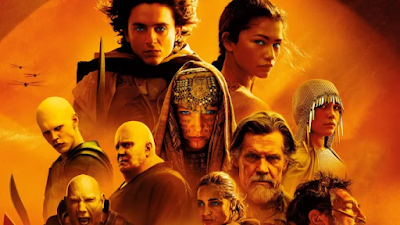
As noted when Part One came out, two-and-a-half years ago, Denis Villeneuve's style and attention to theme and mood shines through in most of his productions and Dune: Part Two is no different. The visual splendor and Hans Zimmer's excellent score are the high points in this second half the same way they were in the first. And in terms of story structure and trying to encompass all of Frank Herbert's highly-developed universe, this film has the same flaws, in that the actual practical application of the spice and the enormous presence of the Spacing Guild are both absent from what was originally a highly political tale. But in this part of the overall picture, I think that that lack emphasizes a problem with the way the story is being received by many.


Dune is a story about religious fanaticism and how seemingly positive changes at one point can have distinctly negative consequences down the line. (Anyone thinking of the supposed Chinese proverb about the horse and the old man can give themselves a gold star.) That fanaticism takes many forms, from the Bene Gesserit adherence to their plan of breeding the ultimate human to the Fremen prophecies of the Lisan-al-Gaib who will lead them to paradise. Herbert rooted his story in many of the traditions of the Middle East and its most prominent religion, Islam, which itself is derived from the other two prominent religions of that region: Judaism and Christianity. That was intentional because one of the primary messages of the novel is that extremism is bad and can lead to unintended consequences. The Bene Gesserit not realizing that their perfect human might not be under their control when all is said and done is one of them. But the other is that when Paul, the nominal "hero" of the story, finally defeats the Harkonnens and the Emperor of the Known Universe, the immediate result of that is a crusade by the Fremen to deliver the message that the mahdi (literally "savior" in Arabic) has come and all worlds must bow to him as the Fremen do. (The irony of a group known as the Fremen (i.e. "free men") slavishly devoted to the whims of one man in the name of freedom and/or paradise is perfectly placed here.)


But that message is apparently too subtle for some, since people are coming away from the film with the idea that Paul is a hero (something that the novel almost directly states is the wrong thing and which Herbert wrote three more books to reinforce, as many had that problem with the novel, as well) or that the real message is about outsider Europeans exploiting a non-European culture for their own ends. That latter part does have some play, but it's not anything like what most should be walking out of the theater with foremost on their minds. And I think part of the reason for that, alongside the tendencies of many to look at stories purely from a "good guy/bad guy" perspective, is that, again, the practical elements of the Dune universe in this version are almost completely ignored in favor of the spiritual elements. Granted, that, too, is Villeneuve's style. His stories (such as Prisoners and Arrival) almost always contain a heavy dose of the spiritual, either central to the plot (as in the former) or driving its interpretation (as in the latter.) Dune has both, which might have made him an ideal storyteller for the cinematic version of it, but which also means that things like the Guild and the Mentats are left by the wayside, leaving solely the spiritual elements like the Bene Gesserit and the Fremen at center stage, which then possibly delivers a message which is actually counter to the one Herbert wanted to bring. One thing to keep in mind is that the structure of the novel is mostly about people standing around (or sitting, as in the excessively long dinner scene) and talking. There's nothing wrong with that. Isaac Asimov built an entire oeuvre on people talking about historiography and robot ethics and those are often really good stories. But they're also really difficult to translate to other media. 


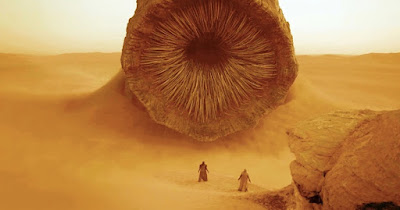
Visually, just like with Part One, it's resplendent. There's a long sequence on Giedi Prime where we're introduced to Feyd-Rautha (an excellent Austin Butler) in which the "black sun" of Giedi Prime bathes everything in black-and-white until we step out of the sunlight and things like skin tones reemerge. The celebratory fireworks in that kind of sunlight resemble globs of ink hitting a windshield. Just as with Lynch's film, the most interesting visual touches almost always orbit around the Harkonnens. But the sandworms are also kept offscreen sufficiently to still elicit real menace when one of them bursts forth from the ground and the Fremen culture has a much more "lived in" feeling and, undeniably, a much more Bedouin feeling, as well. But the spice harvesters and gunships and other elements of heavy technology are also much more visually developed than in earlier attempts at the story. One element of this film that completely failed for me, however, was Christopher Walken. Not only did he not fit my image of the head of House Corrino, but he's been so typecast by memes and earlier performances that when his face appeared onscreen for the first time, I immediately muttered: "More cowbell." The part written for him was also way below his ability to deliver an impact, as it mostly required him to be looking pensive, whether someone was delivering bad news or Paul was threatening to exterminate his line. There just wasn't much of a part to be had, so Classic Line (or at least look) Walken was never going to have the room to operate, which means this was basically just part of the film's marketing, rather than giving real substance to the role. In the broad view, that's OK, since the emperor was mostly a stand-in in the novel, as well, but it still feels like an opportunity missed.


As with so many things we've seen recently, it's not a bad film and definitely worth seeing in the theater for the greater impact of both sound and screen. But just like I said with Part One, I've never been a Dune devotee (even if I do LOVE the board game) so anyone trying probably has a steeper hill to climb with me than most other viewers. This is the modern version of Star Wars for a new generation, but one thing to remember is that that film wasn't very good, either, once you looked past the visuals.

Friday, October 22, 2021

Arrakis revisited


Dune is something of a landmark in the science fiction world. Most SF fans are aware of it even if they haven't read it or haven't sat through one of the film versions prior to Denis Villeneuve's 2021 effort. Consequently, almost everyone will have some kind of predisposition when they watch this version. Mine is colored by all four of the original novels (Dune, Dune Messiah, Children of Dune, God-Emperor of Dune), David Lynch's 1984 film, the Sci-Fi Channel's limited series of 2000, and multiple sessions of the legendary board game from Avalon Hill (I even own an original copy. Woo! Nerd credit!) So, uh, the story is familiar to me. But one of my key departures from much of Dune fandom is that, despite it sharing the 1965 Hugo award for Best Novel, I've never been really impressed with Dune as a story. (In that respect, I think the book it shared the award with, Roger Zelazny's This Immortal, is better.) The writing is somewhat pedantic. The pace is slow. Character development that isn't demanded by the plot (e.g. Paul Atreides) is basically non-existent. But what made Dune into a landmark (and a franchise) is the exercise in world-building, which is phenomenal. Just like Tolkien's Middle-Earth, Frank Herbert drew heavily from history and the cultures of the Middle East to create a universe with an enormous backstory, languages, customs, traditions, and intricate political machinations that few others have matched and which certainly exceeded almost everything to that point in the SF genre. The Dune franchise exists because of the data dump that is the original novel. What makes it intriguing is that sensation of vast fields of unexplored territory that is only hinted at in most of the film and TV productions. Someone recently referred to this most recent film as "this generation's Star Wars", which is understandable because George Lucas did the same thing; creating a whole galaxy of history and peoples surrounding his B-movie Western about Luke Skywalker and a couple droids. But what that writer misses with that comparison is that Dune has been its own thing for over 50 years now, in the same way that Star Wars is still a thing for this new generation as it has been for the last couple. Yes, a whole new group of people will now be immersed in the concept of the kwisatz haderach, but it's been around for a while and, of course, given that it's basically a prophet/messiah concept, it's been around a long time before Frank Herbert, too.


First off, I think the decision to split the film into two parts was a wise one (Everyone is forewarned when the initial title comes onscreen as "Dune: Part One.") The novel is too long and too dense to be properly conveyed in two hours. Lynch argued furiously with Universal Pictures to include more of the tremendous amount of material that he had filmed so that the story wouldn't seem shallow. When they refused, thinking that SF audiences were too stupid to handle anything over two hours, he eventually took his name off the film, leaving the credit to the legendary Alan Smithee. But just as importantly, Villeneuve instead embraces the aesthetic and atmosphere of the novel; avoiding the 80s shine and glitz which distorted Lynch's work. While there are laser weapons in this film, the director heeds the book's insistence that they're quite rare and dangerous for the users, so we see a lot more visceral, hand-to-hand combat, which Lynch tried to sidestep with the ridiculous "sound weapons." And you can see right away that this is a Villeneuve film when he quickly demonstrates his trademark dialogue close-ups with very hazy backgrounds. It's a highlighting technique that shows up regularly in his films and which serves this story well because, in truth, most of the action is in the dialogue and personal interactions. Dune is a highly political story and that's not something that's normally explained at the end of a sword. If you really want to understand what's going on, you have to pay attention to who these people are and what they're saying.


Of course, what that often means is that the pace of the film gets a little laborious and the atmosphere is one of angst, especially in the scenes involving Paul. I never got to the point where I was doing the "move along" hand motion but Villeneuve takes his time with the emotion and drama of a number of different scenes. That's not a bad thing, per se, because the book is that way, too (and, really, much slower and more laborious) and if you're going to do the book justice, then you have to take your time. In truth, he still skips over a lot, as he doesn't bother to explain who the mentats (Thufir Hawat and Piter De Vries) are or why they exist or how Dr. Yueh circumvented his Imperial conditioning. One of my mild disappointments was actually how little screen time Piter (David Dastmalchian) gets as, even though his role wasn't large in the novel, one of the little pleasures of Lynch's film is Brad Dourif in that same role ("It is by will alone I set my mind in motion.") Also, one of the key moments of the novel is Duke Leto (Oscar Isaac) interacting with the Shadout Mapes and learning about Fremen culture and, of course, first discovering the betrayal occurring within his house. That's almost completely glossed over here and Stilgar (an almost-unrecognizable Javier Bardem) is given a more prominent moment to suggest that he feels a connection with the duke, which seems like a place where something hit the cutting room floor that might've been important for story coherence.


Visually, it's spectacular, as you might expect from both a 2021 sci-fi film and one by Villeneuve (Arrival being his most notable other example.) The sandworms are impressive, the shield fights are exciting (although I question just how slow a lot of the lethal strikes were moving in most of them), and the depictions of things as functional as the ornithopters are really well done. The dramatic moments of the landing ramps and various groups' arrival; the massive presence and implicit threat of the Guild transport ships; the overview of the sprawling Arrakeen; all great stuff. However, I will say that I was disappointed to not see a scene similar to the one Lynch opened his film with: the arrival of a navigator to talk about the Guild's involvement in the overall plot. (That element is replaced by Gaius Helen Mohiam (Charlotte Rampling) coordinating with Baron Harkonnen (the eversteady Stellan Skarsgård) on Giedi Prime.) The appearance of a navigator in Lynch's film was both a great representation of how they'd been described in the books and a reinforcement of how important the spice was to the empire and what it did to its constant users. It's a very visceral element of the working mechanisms behind the empire and it helped make the spice into something more than a MacGuffin. It escapes that here because of the time they spend showing its effect on Paul as he breathes it in out in the desert, but for all of this film, the emperor, the Guild, and pretty much every element of that political life outside the catfight between the Atreides and the Harkonnens is just background noise. Again, it's a data dump and some things are going to get sidelined for the sake of a two-hour (presumably four-hour, if the expected Part Two is ever announced) production, but there are certain things that make the Dune universe what it is and I've always felt that the Guild is a big part of that. All of those visual elements are underwritten by an excellent score by Hans Zimmer, which is another notch in his impressive track record. He keeps the majesty and mystery of what's happening foremost in your mind and weaves in plenty of sounds that many would identify with musical styles that touch on the cultures that are part of the story. On a technical level, the film is really well done.


Overall, I'd say it's a better version of the story than either the 1984 or 2000 productions; in part because of Villeneuve's style, which incorporates enough spiritual atmosphere to really let that part of the novel shine through. Herbert wasn't shy about mining cultures for inspiration. The term mahdi, used by the Fremen to label (and often dismiss) Paul comes right from the Arabic term, meaning "the savior" or "the guided one" and whom is an expected unifier of the world before the end times in Shia and Baha'i traditions. The novel is draped in a number of Islamic motifs and Villeneuve doesn't shy away from those spiritual trappings, even if he doesn't call them out as starkly as Herbert did. In the end, it's a worthwhile effort to try to deliver a new version of the story. I wouldn't consider it groundbreaking or compelling, as there are no performances that really stand out and I am irretrievably jaded as far as the story is concerned, but it's definitely worth your while if you're a Dune fan. Keep in mind, of course, that it's also only half the story, so perhaps my assessment will improve when (if) Part Two is released.

Sunday, December 27, 2020

The sky doesn't need framing


It's been a while since I've posted anything here. (If you're really desperate for my overly wordy writing, you can always look at Extratime.blog, but probably only if you're a Liverpool and/or Euro football fan.) Part of the reason that I haven't been present is, well, kind of obvious. Since I spent most of my time doing movie criticism here and we really haven't been to see any movies since March, 2020, there hasn't been a ton of material to work with. Like most other people, we've been watching a lot of TV, some of which has been really interesting (Boardwalk Empire!) and some of which really didn't measure up (Lovecraft Country.) But tonight I decided to sit down in front of an actual newly-released film in the form of The Midnight Sky on Netflix. It's a George Clooney effort, as he both starred in and directed it, and that's always a draw for me. I'm a Clooney fan both for most of the work he's done and his philosophy on life that he mentioned to James Lipton on Inside the Actors Studio many years ago. I recorded that episode and watched it several times (before the DVR crashed.) I often wished I had the drive and ambition that Clooney talked about in that interview but, at the very least, it made me respect his work even more than I did when I simply enjoyed it. That said, I can't say I'm entirely sure about this one.

The Midnight Sky is based on the novel Good Morning, Midnight by Lily Brooks-Dalton and I can see the novel structure in the film and its underlying screenplay. Like much modern science fiction since the advent of the New Wave in the 70s, the central focus isn't on the technology but the people caught up in the vortex that it may (or may not) be a part of. In short, it's a humanist perspective that makes most stories more interesting if you're not just interested in laser beams, global catastrophes, and spaceflight. Of course, this is a story about a global catastrophe and spaceflight... (But no lasers!) But what it's really about is one man's struggle with his humanity or lack thereof. The initial lead character is Clooney as Augustine Lofthouse, an astro-something (-physicist? -nomer? It's never mentioned but the crew of the space flight seems super indebted to him for their mission without ever having met him, which is odd in itself.) I say "initial lead" because despite our story beginning at an Arctic observatory and Augustine waving away his colleagues as the global catastrophe ensues, there's a whole other primary locale for our story, which is said spaceflight: the returning mission Æther, on the back leg from its voyage to K-23, a heretofore undiscovered moon of Jupiter which is habitable (Shades of 2010, although this takes place in 2049.)


So, the story is nominally about Augustine and his obsession with looking outwardly, to outer space and new worlds, and inability to focus on the inward: himself, his relationships, and his commitment issues. Delivered in so few words, the story sounds incredibly trite and very overused: Cold scientist (literally and figuratively) discovers human contact is right in front of him if only he'd try. It's also staged against a very grand tableau (the collapse of the old world, the discovery of a new one) that can serve as a metaphor for the need for more empathy in our society as a whole before it leads to our own destruction. I can see how this story would work in novel form, especially if the author was willing to immerse the reader in the emotions and inner thoughts of her characters. But as a film, it really doesn't or at least it doesn't in the manner in which this one is presented.

We have a story that's about the inner struggles of one man, writ large against the disasters happening around him. But we spend a lot of time on those disasters to no significant end. First off, we're skipping between the Arctic and outer space. We have two radically different settings and two completely disparate sets of characters that are nominally telling the same story but really aren't. The struggle for survival contrasted with the casual return home of the Æther is kind of jarring as we switch back and forth. Here's a man struggling with some form of lethal disease and surviving in one of the deadliest zones of a ravaged world... and then there's the spaceship crew eating cereal with holograms of their families. It changes tune a bit when the Æther suddenly veers off course and has to approach Earth through uncharted space(?), whereupon various physical disasters begin occurring off the planet, as well as on.


But if the main struggle is supposed to be one man searching for empathy in trying circumstances, why do we spend so much time with this ship's crew as they battle meteor storms on the way home? There's a ton of action involving smashed spaceships, blood, and Star Trek-style RED ALERT sirens (that are pointedly turned off in an acknowledgment of pragmatism) that really departs from what otherwise seems to be a fairly inward-looking and cerebral story. As jarring as the shift from survival to the boredom of spaceflight is, it's even more jarring to have a story about humanity dropped into bog-standard Hollywood sci-fi action. I mean, I guess the leverage of trying circumstances can explain the transformation of Augustine, but isn't survival in the Arctic enough? Couldn't we have simply had the global catastrophe teaching him how to care about other people? Being alone in the Arctic and delirious from chemo and blood transfusions should be sufficient stress to drive most people to examine their lives. We also need the (exaggerated) dangers of space travel and a new moon around Jupiter to make this happen? Because what ends up happening is that a potentially intelligent and personal story is being hoisted on the massive framing devices of global catastrophe and humanity-saving spaceflight and making both of them seem like they were half told. Did we need both frames to create the window on our story? One already seems like it may have been enough, if not too much. (Global catastrophe!)

This, of course, leads one to question how much the film departs from the book and/or how much is lost in the usual translation between the two media. There's always going to be something lost from the author's vision when you take a 400-page novel and turn it into a two-hour film. Always. Something will be lost. But the danger is also that a studio decided that a movie audience wouldn't appreciate a very cerebral tale about one man's inner self, spaceflight or not, and decided to toss in the usual rock'em, sock'em action in order to keep people watching. And that's where we usually end up in the technical issues.


Most sci-fi stories have technical issues. That's why they're science fiction. But some plot holes are bigger than others and they're only more obvious when they're as large as these two stories are (because this really is two stories that kind of touch each other in various places.) Augustine keeps talking to his young companion, Iris, about not breathing the air or when and where the air is safe. Meanwhile, the catastrophe is referenced several times as being rooted in radiation. The only way radiation would spread through the air is via dust, most of which wouldn't reach the Arctic in the manner displayed and certainly wouldn't be released in ever-growing, perfectly circular shapes as shown on his instruments. Dust travels on wind patterns which go around the globe because... you know... our world is a globe, Trump followers. When I saw the scene of Augustine examining what appeared to be mutated birds who'd suffered the effects of the catastrophe, I thought they were some kind of alien organisms and wondered just how far out (space joke!) we were going to go. Did someone bring back an alien from an earlier voyage to K23? Other than vague "radiation" and "don't breathe the air" descriptions, "The Event" isn't detailed at all; other than it apparently being an accident of some kind.

Also, Æther has to approach Earth from "the dark side" or some such thing, so it's stated that they're "flying in the dark". Other than that being another obvious space joke, there is no "dark side" to Earth. Because it rotates. Like a globe. And there are observatories and satellites on every "side" of that globe that have explored the local environment extensively. There are no clusters of ice or rocks in the vicinity that would create a threat to spacecraft that I'm aware of. It's just a plot device so that some kind of action other than the holographic kind actually happens in one half of our movie setting. Action which is, of course, kind of unnecessary to tell the story, since confronting death in space (just like on Earth!) is superfluous to the plot. This is, of course, compounded when members of the crew make the decision to confront certain death upon reaching home, for reasons that aren't especially clear other than overwhelming depression at the state of affairs (arrived at in a couple minutes of screen time) and a desire to join everyone else on the planet in the depths of that despair. This doesn't even touch on the idea of a perfectly temperate moon around Jupiter (almost five times as far from the Sun as Earth) and the awesome radiation and magnetic fields around that planet (witness Io) that would make the likelihood of said inhabitable orb extremely small.


Again, all of these strange, very human emotions and their consequential actions may be perfectly explained at a reasonable pace in a written novel, but they don't come across at all well in a two hour film. Once again, the problem of moving a story from one medium to another. Aside from all that, there aren't really any performances to speak of other than Clooney's, since he has the most range and material to work with (It's good to be the king (director)) which brings us back around to why all of this narrative was included for a story that is, in the end, comparatively small, despite a broad and well-felt message. Overall, it's not a bad film, but it simply tries too hard (and in too many large ways) to be a good one and mostly fails.

Monday, August 13, 2018

Creatures of Light and Darkness


For those of you that are New Wave SF nerds like me, you'll recognize the title of one of Roger Zelazny's more esoteric novels. Originally envisioned as simply a writing exercise, Zelazny never intended to publish Creatures of Light and Darkness. But once friend and fellow author, Samuel Delany, heard about it, he encouraged an editor to take the manuscript from Zelazny and put it into print, for good or ill. It has one chapter devoted entirely to poetry and the end is written like a screenplay. In other words, it's a very stylized approach to telling another of Zelazny's stories about futuristic beings of myth and their very human motivations. Similarly, Michelle MacLaren, director of the latest episode of Better Call Saul, used a backlighting technique throughout to indicate moments of tension, where the conflict between characters was subtle but significant to the story; where decisions kept the direction of the story for those characters balanced on that edge between light and darkness that scientists call 'the terminator' as sunlight creeps across the spinning ball of our planet. Would their decisions move them wholly into the light or the darkness or would continue to inhabit the halfway point, not quite sure how or if to proceed?

The first example was Jimmy and Kim, as the former putters around the kitchen, determined to flee from having to talk with Kim about recent events, and to reassure himself that he can still be of value, even without the law license that his now dead brother wrested from him; the only real thing of value that Jimmy has ever acquired in his life. Jimmy's face is shrouded like his soul is and looking away from the light just shows how unwilling he is to face his role in what happened. The next example was Ignacio, who faced his father in darkness, trying to reassure him that the threat from the Salamancas to launder money through his car business was finished, although his father cannot look at his shrouded son. Nevertheless, still fearing for the safety of the son who so wounded him by involving himself with criminals, pays the tax, anyway. Ignacio tries to convince him not to and then surrenders to what he knows he cannot change. The next example was the meeting between Mike and Lydia, as the latter cringes from Mike's bold play at the warehouse, thinking that continuing as normal is better than laying the defense against his inevitable discovery by someone. Mike knows better, but still has to convince the person who effectively outranks him. Here is the former cop, still walking in the twilight with his new partner who covers the drug business contained within the parent corporation; meeting in a darkened conference room, as if someone might discover them with the lights turned on.


The technique is still in evidence when Kim accosts Howard over the backhanded estate settlement that she knows will only further demoralize Jimmy. Their conflict is much more prominent and not subtle, so the contrast is fainter, as Kim's fury lights up the scene. But there's still the faint shadow that symbolizes the undercurrent of Howard wanting to get a last jab in at Jimmy, whom he knows tortured his friend and partner of many years, and Kim, despite her vociferous defense, knowing that Howard is probably justified in wanting to do so. But it comes back in full force in both instances when Gus' men tell him about the results of Hector's tests, as the light streaming through the window in the car and in his office leaves Gus partially in shadow as he struggles with himself and how he should proceed with his attempt to keep Hector alive so that only he can exact the full extent of the vengeance he desires ("I decide what he deserves. No one else.")


There is no shadow in the moment of direct conflict. When Ignacio and Arturo confront Gus' men over the number of kis that they're picking up, everything is brightly lit. The conflict is overt. The threat is real. There is no shadow across it. Everyone knows the motivations at hand and what actions they will drive. But the contrast returns when Arturo is killed and the implications of what Ignacio has done and what he will now have to do are spelled out to him by Gus. As direct as the threat may have been to Arturo, the shadow returns for Ignacio, denying him the assertion that he made to his father about how he was working on getting out of a bad situation, as he is now only that much deeper into darkness with someone who is far more dangerous than Hector.


I've really enjoyed Michelle MacLaren's work over the years on Breaking Bad and Game of Thrones, precisely for her deep understanding of story and how to present it in a visual manner. This may have been her finest effort yet in that respect. It doesn't hurt that Gilligan's writers continue to outdo themselves in presenting the cast with so much red meat to work with. Take Jimmy's interview with Neff Copiers. He knows they'll reject him as unsuitable for a sales job after having been a lawyer, whether it's because of a lack of actual experience or a belief that he'll decide the job is beneath him and they'll have to find someone else when he moves on to another law gig. So he goes back in to convince them that he has what it takes and easily does so. But his own self-loathing; the recognition that that kind of hucksterism is what he's been doing his whole life, prevents him from accepting the job that he wins. All he can think of is how these guys are precisely the kind of marks he's been working since forever and how he won't be able to respect them for giving in so easily to his routine. And, of course, how he can't stand himself at the moment for everything he's done to Chuck and how he doesn't deserve anything good to come his away, especially when it was achieved by Slippin' Jimmy.


Full marks to Rhea Seehorn in this episode. Her scene with Howard was one of her best moments in the entire series, as she ate him alive and confronted him with his own ulterior motives, while she took the opportunity to vent her frustration at the situation that Jimmy still keeps her in. She's doing amazing work and I hope it lands her other solid roles in the future. Similarly, Michael Mando as Ignacio has been getting progressively better as the series has moved along. The emotion on his face when Gus corners him and he realizes just how deep his personal hole has gotten was great. It was extremely entertaining to see Gus doing some of his own dirty work again, too. Other little details, like an appearance by The Cousins at Hector's bedside, and Jimmy and Kim deciding to watch White Heat, a noir film in this most noirish of BCS episodes and a film about a man confessing to a lesser crime to hide a larger one, pushed this one among the best of the series, in my opinion. I was still intrigued by episode one of this season, but episode two has launched BCS back near the top of my TV agenda (right behind Liverpool games.) The series can't get much better, which only makes me want to see how they're going to outdo themselves as we move along.

Monday, July 17, 2017

In other news, somewhere on the timestream


I'm not a Dr. Who fan. For some reason, it just never sold me. My SF experience as a kid began with Saturday morning cartoons which have few barriers when it comes to special effects and, of course, exploded in 1977 with the release of the original Star Wars. At that point, I decided that anything that couldn't blow me away visually probably wasn't worth my time. In that respect, the foppish doctor and the phone box and the clumsy Daleks were just never going to work. I could see "old" stuff like Planet of the Apes and Space: 1999 that was more entertaining than that. Of course, a few months later while reading Lord of the Rings for the first time, I realized just how wrong I was in wanting everything to be served to me on the screen. Still, the good doctor and his exploits in time just never seemed to work for me. But I know enough about the franchise to find yesterday's announcement of the person taking over as the 13th Dr. Who far more entertaining than the show has ever been.


Jodie Whittaker will be Dr. Who. For those of you not in the know, this will be the first time a woman has assumed the role. This, of course, has generated the usual tirade from the neo-Gamergate crowd about their personal worlds being shattered at the thought that a man will no longer be the protector of the timestream. Because, you know, women can't protect anything.


Or be strong.


Or smart.


Or determined.


Or heroic.


Did any of these guys forget about how they felt about their mothers when they were growing up? Do any of them not feel that about their mothers now?

Some of the best responses have been even more overtly sexist; as in, talking about the act itself, since Victoria Tennant, being an attractive woman, could make some of the straight male nerd crowd apparently forget themselves:


Because, you know, somehow only straight male fans of Dr. Who exist. Or is it that they just feel like their wants are the only ones that matter? This came to a head last month when a few theaters across the country decided to do women-only screenings of Wonder Woman. One guy was so incensed that he wrote the mayor of Austin, TX, threatening to boycott the city for allowing such perfidy to take place. Horrors. The mayor's response was spectacular but his communications director, John Stanford, had a salient point: "Furthermore, 99 percent of all the screenings in Austin are dude-friendly. It's almost like the whole world is set up for us."

And that's true because it essentially is. A lot of people don't like change and if things have always been the way they are, then why change them? Well, because change is often good. Or interesting. Or fun. Or needed. Or all of those things. The charge that many of the outraged are wielding is that the producers are bowing to the "PC crowd." So, let's think about that.

If the producers are literate and capable of dressing themselves in the morning, they're probably aware that the reaction to a female Dr. Who would generate a substantial amount of uproar (not that that's always a bad thing; any publicity good, etc.) With that in mind, is it more likely that they wanted to serve the "PC crowd", most of whom would have remained slavishly devoted to the franchise if another man was chosen, or that they just wanted to do something different? Creative types often need to branch out. You can't keep telling somebody to recycle Dragonriders of Pern and expect that they're going to produce stuff of the same quality. Sometimes you have to try new things. You'd think that all those fans looking toward the future (and, OK, the past, too /timestream things) would understand that.