Showing posts with label season 4. Show all posts

Sunday, August 26, 2018

Limits testing

[This one is obviously very late. Life and schedules and ambition kind of conspired against me. Episode 4 should be much more timely.]


What we hide from people is often just as important as what we say. Similarly, what we're willing to do is often equally as important as what we're not willing to do. Episode 3 of this season was all about those two concepts, as many different characters were asked to find their limits, while Jimmy, for the most part, sailed through it all.

From Ignacio acting out the cover story that has him getting shot and operated on by a veterinarian in a Jiffy Lube (patiently hovered over by the cousins) to Mike simply turning down a B&E for a rare figurine, these are the decisions that shape these characters, not only for the audience, but the sake of the character's identity. Ignacio, disenchanted as he is with the drug scene, is now serving two masters, either of whom will kill him at a moment's notice if they feel he's a liability. This is the tragic case of someone forced to test his limits for a world that he no longer wants to inhabit; to give in the utmost for a cause that he not only does not believe in, but actively detests.


And then there's Mike, who's not only obviously disappointed that Jimmy would approach him with something so pedestrian, something which doesn't test his abilities at all, but is also clearly disappointed that Jimmy would sink so low as a simple robbery in order to make money. Mike knows that Jimmy is capable of more and so does Jimmy, inherently, but circumstances have put the latter in a situation where immediate cash flow seems more important than the style with which it is delivered. Mike, OTOH, has no such issues and can now pick and choose jobs that suit him. Even so, it's highly likely that Mike would never have bothered to risk himself in a job so simple and with so little payoff.


But Kim is the one we should be paying most attention to, because she ends up seeing both ends of the spectrum in this respect. Her rewrite of what we assume was Chuck's scathing departure letter into a tepid encouragement shows just what she's willing to do to try to salve the wound that Jimmy is feeling and not drive him further into the pit of guilt, despite the fact that he earned it in some respects. When she dissolves into tears, we're left uncertain as to whether it's about her own sense of guilt for having deceived him or the angst over the fact that the letter she wrote couldn't help him without giving away the lie and so simply leaves him in a state that's not worse, but still not good.


On the other end is the meeting with the CEO of Mesa Verde. No small bank suddenly expands into a half-dozen more branches (and elaborately-styled ones, at that) without something happening off the books. She wanders around the display room, knowing that she's gotten herself into something that's going to violate her ethics as surely as what she's just done to Jimmy and has done with him before. Like Ignacio, she's uncomfortable with that, so now comes the test: How far are you willing to go?


The one exception to this overall theme is presented by the return of Gale Botticher. Gale, in his usual constantly positive and endlessly inquisitive way, wants to do more for Gus than the latter actually wants. He's disappointed with the quality of what Gus is working with now and wants to show him a way to do it better. There is no question of willingness of Gale's part, which was always the case in Breaking Bad, as well, which is what made him part of one of the best moments of that show, when Jesse was pushed past his limits and almost broke from Walt completely. On the one hand, it's amusing to see Gale make his return. OTOH, knowing that the most emotionally poignant moments of the character's existence are the ones we've already scene and which won't be a part of Better Call Saul is mildly disappointing.

Episode 3 was a bit of a step back from the majesty of episode 2, but they can't all be park-clearing winners. Plus, this episode managed to lay down a lot more of the interesting themes that will be pursued this season (Nacho's travails, Mesa Verde, Gale, etc.), so there's still plenty to look forward to.

Sunday, June 15, 2014

And yet another closing


So, yeah. Lot of things to talk about. If you step back and look at the bigger picture, it's obvious that the end of Storm of Swords was intended to be a bit of a breaking point in the series. Martin's original intent was that he would put in a gap of five years or so to allow the political situation to settle and also allow the child characters (Bran, Arya, etc.) to grow so that their roles weren't restricted by physical issues. Of course, when he was several hundred pages into the next book, he realized that he had spent the majority of those pages re-capping what had happened in that five-year period, so he scrapped it all and started over (thus creating part of the extraordinary wait for Feast for Crows.) In that respect, the show is no different in that they've spent a great deal of time over the past couple episodes not only bringing stories to their logical conclusion but also killing off a large portion of the cast. (Don't worry. They'll be replaced in number by next season. Off to Dorne! Woo hoo!) But there were still plenty of segues to the continuing epic with a couple high points and a couple that were just off.


For as important as the events at the Wall were for character, resolution, and plot, I thought they spent a bit too much time there. While Ciaran Hinds continues to play it stately, I'm not sure we needed his perspective on Jon and Ygritte's relationship when we were already going to have the burning scene and Tormund's perspective (who spent much more time with the two of them.) Also, once again, the budget limitations kind of killed this scene, since there was probably no money left to show Stannis' armies crashing into and scattering the Wildling army rather than simply surrounding Mance's camp. It would certainly leave a first time watcher wondering where the hell the other 100K are, although Stannis accomplished what Jon's goal was in the first place: cutting the head off the beast. There was a great moment there while Stannis and Jon came to grips with who each other happens to be and the expected roles they'll follow in the future.


The collection of Cersei scenes that followed was fairly skillfully written, in that it reestablished her influence over her own choices (ordering Qyburn to proceed on the Mountain, refusing Tywin, getting Jaime to screw her in ceremonial places, etc.) but also tied up things that need to be tied up in order to lay the groundwork for next season. Furthermore, it clearly arced the story toward its conclusion as far as Tywin is concerned, since everything began to slip beyond his determined grasp. I think it's interesting how they've played his knowledge of his twins' relationship, in that he seemed willing to tip his hand to Jaime during Tyrion's trial but just as willing to play stupid while Cersei confronted him with it here. In the books, he's somewhat less concerned about all of that and it certainly raises one of the central cultural questions that I've always had about the story: why do the other houses care so much about incest?

Certainly, the Targaryens were 'other' in that they were Valyrian while the rest of the population are Andals (except the Dornish), so it was natural to look on the practices of the ruling house as something that would never happen with proper folk except that they, you know, had the dragons. The practice had also become less common as the dynasty had proceeded. Even so, many of the houses still had a deep attachment to their Targaryen overlords and custom has deep roots in Westerosi society. If you're willing to accept overlords who had long since passed their prime simply because tradition says so... Of course, one of the pillars of the story rests upon the fact that Robert had essentially said that that much adherence to tradition, in the face of the Mad King and his depravities, was no longer acceptable. Furthermore, one could argue that Aerys was one of the clearest examples of why not to continue with the practice of incest. I suppose the fact that Robert's wife was pursuing the Targaryen tradition even as he overthrew them is one of the little faux ironies of the story.


Meanwhile, one of the other social constructions begins to have even wider repercussions: How do you cripple an economy overnight and still make it work? (Well, one way is to be Goldman Sachs, but then it only works for a few...) The fact that many slaves in the Bay had become accustomed to their lives or even favored them because of the station that they brought was something that was clearly not considered by the clarion song of freedom and, if played to its fullest extent, is rife with story possibilities...

HOWEVAH, a lot of those story possibilities are interesting to people like me who enjoy social transformation (some people refer to it as 'revolution' (still hoping)) but they tend to lack drama unless said drama is packed together at a very rapid pace which then makes that transformation somewhat illogical and trivial. Thus, the famed Meereenese Knot of Martin's dismay. Even worse, a lot of those situations don't play as well visually as they do in prose. You can go off on extended descriptions of issues of the day in prose and make it work. On TV, it can come off like C-Span, dragons or no dragons. I'm certain they included the Missandei/Grey Worm relationship to add a bit more character meat to Meereen and they're going to have to do more with it if they want to keep people interested in Dany's story at all. Of course, now that we're arcing full force into Dance of Dragons, there are a lot of ways to go. One note here is that we did finally get some screen time with Viserion and Rhaegon... only to see them chained up in a dungeon. Remove the chains from the slaves and add them to your real children. That'll solve everything.


One reason I say that we are full on into Dance because Bran and Co. are firmly there. I wasn't even certain that they were going to do the wight fight outside the tree (which I keep wanting to call a 'world tree' because of World of Warcraft; read/play/see enough of these damn things and they all start blending together) but I'm glad they did because Ray Harryhausen FTW, dammit! I'm enough of an old-timer at SF/fantasy films to basically always think of Jason and the Argonauts whenever anyone shows me animated skeletons. They were a lot smoother than his, of course, since CGI is often leaps and bounds better than stop-motion from the 60s, but there is a certain intelligence that seems to be conveyed to the automatons by the hesitation inherent to the older technique. Anyway, decent scene, although I was a little disappointed by the look of both Leaf and the interior of the cave, especially given that Mr. Three-Eyed Raven was depicted far differently than in the books. I'm, again, hoping that this was a money issue and not a step down from the immortal Gemma Jackson. It also has me wondering how they're going to get around to explaining who Mr. T-ER is, since the relevance of his identity is basically absent in the TV show to date and is really only prominent for careful readers and those who've followed the Hedge Knight stories.


And now we finally get to the one major departure from canon: the showdown between Brienne and the Hound. Here's where I offer all of D&D's excuses about how they're doing an adaptation, not a note-for-note simulacrum. They are, of course, correct. They have to do an adaptation. But I thought they were going to end Brienne and Pod's travels this season with a far more powerful scene, so I was a little disappointed on that front. In the process, they also managed to seed character problems into the rest of the story and spoil the subtlety of one of my favorite moments from the book.

The seed: Brienne knows that Arya is alive. That means that she can carry that information to other people and make it part of their worldview. One can suggest that this was already done by Arya and Sandor naming her at the Bloody Gate, but how hard would it be to write in disbelief on the part of the Arryn guardsmen that some dirty little girl was claiming to be Arya? Not very. Brienne, OTOH, is a person of some respect and stood in Arya's presence. That has little ripples across a lot of ponds, given that most people assume Arya to be long dead. It doesn't mean it's blown the lid off of anything, but it can significantly alter the perceptions of a number of characters.


The spoilage: In the book, the Hound's infection is what brings him to the point of death. Arya abandons him in the same way she does here, but it's because he can't walk any farther, not just because she wants to let him suffer and die. In that way, his ending is kind of the ultimate denouement to a life completely driven by violence. There was no violence to his end in the books. He just finally exhausted his ability to keep moving and keep killing. That plays to me in a way that him being mortally wounded in yet another fight simply doesn't and I think the possibilities for both actors would have been far greater with her simply watching him sit down and die, rather than all of the slam-bang action that took place in this sequence. It was worthwhile for a few quotes and for hearing the unbridled rage in the scream of Brienne as she slammed away with the rock, but I think the idea of 'less is more' is what has always made that scene memorable for me in the books, above and beyond the fact that it was my all-time favorite character from ASoIaF meeting what was probably the most appropriate end of any of them.


Finally, the escape. I know some people will complain about the lack of interaction between Jaime and Tyrion in this sequence, but I think a lot of that interplay in the books really kind of detracts from what's happening around them. The whole sequence is already anguish enough for Tyrion without piling on and I think the relationship that's been built up in the show between the brothers is even stronger than what Martin wrote, so leaving them on a good note with a heartfelt embrace felt right to me.

As for the rest of it, they got it all spot-on. I was so concerned that they wouldn't follow through with the strangulation bit, but they got it and Peter Dinklage was brilliant in the performance. We miss a little on the details (in the books, he strangles her with the chain of office for the Hand), but since those were absent earlier, it didn't make that much difference. Charles Dance also played Twyin's last actions somewhat differently but, in many ways, I think he played them better. Tywin is a manipulator and being spiteful while sitting in the privy is just no way to make things move better for you (more fiber!) Trying to convince those that you are sure must be weaker than you is usually the way out. Of course, when confronted with someone who has just murdered the woman he loved with his bare hands, your options become few, if not non-existent. That, of course, becomes the road down to the docks in a ventilated crate and a further destination unknown.

Lines of the week:

"Of all the ways I'd kill you, poison would be the last." - And then he offers him the Wildling equivalent of rotgut...

"We're not in the Seven Kingdoms and you're not dressed for this weather." - This is what Michigan people say when any Southern state gets a little snow.


"You should know: the process will change him. Somewhat."
"Will it weaken him?"
"Oh, no!"
"Very well, then." - Cersei and Qyburn, still the molders of men(?)

"I'm not interested in hearing another one of your smug stories about a time you won." - This line was so true about Tywin that I was cracking up.

"They're so small I can't even see them. I only see what matters." - Cersei, taking control.

"They young may rejoice in the new world you have made for them. For those of us too old to change, there is only fear and squalor." - Truth, especially iPhone squalor.

"She loved you."
"She told you?"
"No. All she ever talked about was killing you. That's how I know." - Tormund talks about marriage.

"You can shit later! There's people coming!" - Arya should have told Tywin...

"Go on, Brienne of fucking Tarth! Tell me that's not Lannister gold." - Still my favorite.

"Going it alone... You won't last a day out here."
"I'll last longer than you." - The student finally leaves the master.

And the winner, for Dinklage's masterful performance:

"I am your son. I have always been your son."- In more ways than he ever knew.

Sunday, June 8, 2014

All Wall, all the time


The 9th episode of each season has become notorious for including THE moment of the season. In season 1, it was Ned's execution, letting all the viewers know that no one was immune to Martin's pen. In season 2, it was the Battle of the Blackwater, in what I thought was at least some desire by D&D to make up for the fact that season 1 had been completely bereft of large-scale combat in the midst of a war. In season 3, it was the Red Wedding (Seriously. No one is safe. Fer reals.) The difference in season 4, which was asserted by D&D prior to its beginning, is that we've already had multiple huge moments over the course of the season. It wasn't a case of build up to climax... except in one storyline: the Wall. In that respect, they kind of overdid it in that almost every scene of the North so far was Jon and Co. saying: "The Wildlings are coming!" to the point of fatigue. You can only cry (dire) wolf so much before people start ignoring you and that was what I had largely begun to do, in addition to the fact that the scenes in the North had often been the most standard-fantasy-heroic-adventure stuff, which I can probably live without for the rest of my days.

However, in those prior seasons, that big event, even the Blackwater, has not dominated the entire episode. Tonight was a miniature version of Feast for Crows: We're going to give you these characters and only these. We'll get back to the rest of them some other time. On the one hand, that's irritating, as there's a lot more going on (obviously.) OTOH, I think this battle lived up to the majority of its hype as, for the most part, you could really imagine the magnitude of what was going on but were still given opportunity to focus in on the heroic set pieces, like Alliser Thorne throwing down with Tormund Giantsbane. Furthermore, unlike the Blackwater, this fight saw named characters die left and right in true, GRRM fashion ('cuz, you know, that's what happens in war, strangely enough.)


Of course, GoT being GoT, they stopped in the middle of fire and blood to watch the effects those kind of circumstances have on the human condition. Even though it's half-expected, I really enjoyed John Bradley's depiction of Samwell almost literally growing up before our eyes as he explained to Pyp how to try to live through the night (oops...) and still live up to the vows that they'd taken. Furthermore, I appreciated Owen Teale's acknowledgment of his error as Alliser Thorne while staying within the contemptuous and venomous nature of the character. Being willing to admit one's errors is, in fact, a sign of genuine leadership, as opposed to the tale of woe that he spins about "loudmouthed twats."

But the really impressive part of the episode was how they managed to keep so many moving parts operating at once. This kind of action is a logistical nightmare (as it often is in reality) and when D&D mentioned post-production that doing this season "almost killed us", I'm betting that this was the episode they were thinking of. I was genuinely impressed with the CGI transition from the battle beginning at Castle Black, over the Wall, and to the assembled ranks of Mance's army. But even more spectacular was the terrific crane shot late in the battle, moving from named character to named character enmeshed in their own aspect of the fight. It makes me cringe to think about how many takes they might have needed to get that one right while everyone goes through their battle paces. Kudos to director Neil Marshall (also director for the Blackwater) for pulling that off. I want that guy on every historical war movie I see for the rest of my life.


Sam wasn't the only one coming into his own at a moment of crisis, of course. Edd's command of the Wall late in the battle showed his positive side (kill or be killed, yo) and Grenn's encouraging his brothers to bellow their vows at the oncoming giant was awesome. That kind of unification of spirit is a further reflection of Thorne's actions, as well, so I think the screenplay really found its footing in this extended battle scene, as all of those perspectives were part of what kept the fight interesting (not to mention the excellent solo fights, such as the one between Jon and Styr, which may be the best mano-a-mano fight in the series to date.) But it also calls up an interesting perspective about human nature in these kind of crises.

The conflict at the Wall is one of the cruces of the story. This is the Ice side of the Song because of the Others, but it's also the most pointed question about the societal system in Westeros in the first place: are we people or property? The Wildlings follow the typical hidebound traditions of claim to the land for x number of generations and so on. But their main focus is the desire to live free; to not be obligated to a lord simply because that person is recognized by society as having a higher social station. So although the fight at the Wall is often presented from the perspective of Good/Night's Watch vs. Evil/Wildlings, it can be argued that the Wildlings have the purest motives of all of the various factions of the story: the desire not to rule, but simply to live on their own terms. They can't live as well in the utter North, so it's not as if their motives are (ahem) as white as the driven snow. But more of them would be willing to do so if they weren't being pushed forward by the Others. In that way, they're no different than any of a hundred different migrations in Eurasia. You can see the tribes as evil if you're living on the land they're coming to, but if they're running ahead of an even greater threat, it becomes hard to blame them for doing so. Then, of course, you bring in the Thenns and that bit gets to be a bit harder to argue...

I also don't want to make this into a Cliven Bundy screed, where everything is caused by the evils of government, but it's pretty clear that Martin's intent is to show a certain degree of enlightenment to the aged and corrupt systems that dominate both Essos and Westeros. Whether that enlightenment will take root is one of the driving questions of the story.


Lines of the week:


"We're all gonna die a lot sooner than I planned. You're the closest I'm going to get to knowing." - At this point, Sam does at least get the vows right in that they don't require the Watch to be celibate. They just require them to not get married and/or father children. Of course, if you're of the Puritan disposition, one immaculately follows the other, but that's what happens when people try to deny basic biology in the name of presumed higher callings (see: Catholic church.)

"Right now, I don't wanna think about the bear you never fooked." - Ygritte ruining what was going to be a great story.

"Serve him up a nice thick slice of ginger minge." - Hearing this from Styr expands the meaning into a fairly uncomfortable place...

"Thousands of books and no eyes to read them. Old age is a wonderful source of ironies, if nothing else." Who else thought of this episode of the Twilight Zone?
and
"Nothing makes the past as sweet a thing to visit as the prospect of imminent death." - Peter Vaughan's performance as Maester Aemon tonight was fantastic.

"Promise me you won't die." - The world's most broken promise by every soldier who's never come home.

"When you're nothing at all, there's no more reason to be afraid." - A somewhat more nihilist approach by Sam.

"You know nothing... Jon... Snow." - Once again, they got the quote right. I think the outrage if they hadn't would have been far in excess of that over Littlefinger's misquote.

And the winner:


"I should have thrown you from the top of the Wall, boy!"
"Aye. You should've." - Jon Snow with the most realistic response to the vows and promises that war has made him break to everyone around him.

Sunday, June 1, 2014

Close the deal

There comes a time in every story, every encounter, almost every point of life where you have to close the deal. When it's lying there in front of you, finish it. When the goal is within reach, finish it. When the focus of your life for however many years is there, finish it. As we all now know, Oberyn Martell, the Red Viper, didn't close the deal. Hesitation will get you nowhere.


But, of course, in many stories, the deal was never meant to be closed. This was one of them. Martin has stated many times that certain characters were slated for death: Ned Stark and Robb Stark are just the two most notable examples for most fans of the Song of Ice and Fire. But Oberyn Martell was one of those, too. There's an old expression: "If you seek vengeance, you had best dig two graves." It was evident from the moment he was introduced that Martell was a singly-focused character, both in personality and in the writer's intent. Here was a person meant to take the story to a precipice... and then fall over it. Nothing about him would change, because changing would defeat the purpose of his existence, both in the mechanical and existential senses.

On the other hand, the rest of the episode was filled with examples of characters who did close the deal, to one degree or another, and in doing so changed in a variety of ways. That's what made up the genuine fascination for me in what was otherwise a very slow pace (in addition to the fact that I know what's happening.) You get to see the wonder of Ramsay as his father transforms his life; the anguish and fury of Daenerys as the ground leaves her feet; and the brilliant awakening of Sansa as she finally begins to take control of her own destiny.


That trend begins in the smallest of ways, with Grey Worm and Missandei bathing in the river. D&D are spending a lot of time on this relationship that doesn't exist in the books. At one point, I felt like it was too much, as there's still so much occurring in other corners that could use the screen time. However, as they progressed through their two moments, one clothed and one non-, it occurred to me that this was another example of the showrunners extending their own writing chops into Martin's story but in the same vein as him. Here were two people thrown together by circumstances beyond their control who'd had essentially no control over their own lives almost from birth and still mostly didn't, as they breathed at the behest of a queen (fortunately, one who cares for them on a personal level.) But when given the opportunity to create something between themselves that can't be controlled by others, they took it. All of that complexity (the handmaiden of a queen communing with the eunuch chief of her devoted warrior corps) was summed up in the simplest expression of honesty: "I'm glad you saw me." "So am I." Honesty being a rare bird in this world makes that all the more endearing and worth the screen time expended. (And, as a straight male aside here, I have to say that when Nathalie Emmanuel stood out of the water... uh... wow. I mean... yeah... Wow! Not surprised to see even a eunuch gawk there...)


Continuing in the East, the showdown between Jorah and Daenerys, while long in coming, was extremely well-played. Jorah is an interesting character in that, while suffering the continued frustration and humiliation of the woman he loves shacking up with a mercenary captain, he feels that his expression of devotion, above and beyond his earlier betrayal, should place him in a favored spot. That is, of course, not how it works, as betrayal is never forgotten and devotion and affection frequently are. Jorah, if he'd been wise to the nature of the deal, should have taken his pardon back in the day and fled Essos back to the Mormont lands. Instead, he fell in love with his target and tried to close another deal that was forever denied him. He just didn't know it at the time. There's a certain level of pathos to the Jorah character that Iain Glen continues to excel with, even under the guise of his usual restraint. Speaking of which, Emilia Clarke was excellent in this scene, as her mask of barely controlled rage could have tipped over the edge into scenery chewing (think Al Pacino at any point in the last 20 years), but she held it perfectly.


Ramsay, on the other hand, knows what's good for him and makes sure that all the loose pieces of flesh are cut away in proper order. This whole sequence was interesting, not least because, in the books, we never get to see Moat Cailin. It's constantly referred to but no point of view ever travels there. So, seeing it in the opening sequence was cool, but getting to see the fortress itself and the bogs it caps as the gateway to the North was even better. Ramsay knows how to play the game for solely his own benefit. That benefit extends from the good graces of his father, Roose, who proceeds to transform Ramsay's life by making him no longer a bastard. He is now the heir to the Dreadfort and the Warden of the North, which means that his schemes are no longer dismissed as the errant ways of a baseborn sociopath, but now proper noble conduct. It has to be said that Alfie Allen continues to do brilliant work as the sorely conflicted Reek/Theon. Just the moment where he was about to break down in front of the challenge of the garrison commander spelled out exactly how real his identity as Reek has become. On the one hand, he could have broken the chains and taken command of the garrison to resist the Bolton army, which likely wouldn't have been able to take the fortress. On the other hand, seeing how badly it was going for the Ironborn in the midst of a swamp, he knew that Ramsay would have him eventually, so he made sure to finish his mission as Reek.


But the best moment in that respect, by far, was done not once, but twice, by Sansa. Again, Sansa is one of those characters that people seem to either love or hate. I detested her for the first couple books and I continue to think that was Martin's intention. But I think it may have been a bit of a mistake on my part, too, since Sansa's reactions to everything have always been quite human. People quail in the face of danger and often have outside expectations about what their world should be like. They often learn otherwise about those expectations and become defeated and cynical, but few of them are able to pivot and begin to not only draw strength from those experiences, but also take control of their circumstances and begin to use them to their advantage. Sansa has become one of them. This is not Arya, who has learned to coast above trouble and seize opportunity where she can. This is Sansa, who has now learned the game at the feet of a master and is about to begin playing as her own piece on the board, rather than simply a pawn. Her gaze over the shoulder of Anya Waynwood at Petyr was transfixing, as she knew that she had surprised him with her invented story (have to say that Aidan Gillen was masterful here, keeping the straight face, but with his eyes showing just a bit of wonder at the skill with which she was playing it.) The fact that this scene played out differently from the books actually made it better, as there Littlefinger escapes on a technicality of protocol. Later, Sansa's clipped responses to his threatening questions lead us to begin questioning just who was in charge of whom here. And, of course, the descent of the stair as Catelyn the Second was great. Right now, the first among equals as far as acting goes this season is Sophie Turner, without question. She's been magnificent.


Oh, yes. The fight. Well, knowing a bit about how to wield a staff/spear, I have to commend the fight choreographers. They showed Oberyn wielding it properly: using the danger of the spearhead to keep distance with your opponent, stepping inside their strikes and then turning to trap the sword with the staff, keeping the shaft moving to not try to take a direct hit from the sword which would destroy it, etc. I enjoyed it, even if screen Oberyn seemed somewhat more vulnerable than book Oberyn did. And they got the lines right! There was much dismay last episode that Petyr had used the line "Your sister." when pushing batshit-crazy Lysa through the Moon Door instead of the line from the book "Only Cat." I had forgotten about that line (it's been a while), but I will never forget the exchange between Ellaria and Oberyn upon her first sight of the Mountain: "You're going to fight that?!" "I am going to kill that." It was delivered just as it should have been, as has been every line that Pedro Pascal has uttered as Oberyn. I'm really going to miss his presence, even though I knew it was temporary. He was excellent. Deal closed.

Side notes:

I liked the depiction of the assault on Mole's Town, not only for its demonstration of Ygritte hellbent on revenge, but also her continuing humanity when she notices Gilly. That's a complex character. I was a little disappointed for the first time in the music for that scene. I guess I expected something a bit more urgent than the heavy bass line.

It's still interesting to see the little details that D&D maintain to demonstrate Dany's departure from the typical noble/royal attitudes. Here's the queen of the biggest city-state on Slavers' Bay taking time out to fix the hair of her handmaiden. It's a role reversal intended to convey humanity and I think it continues to work well with the very emotive Emilia Clarke.

I was confused by the long shot of the Bolton army returning to the Dreadfort. Obviously, Ramsay had returned some distance from the Moat to meet Roose in the field, but why bother showing us the grand return? A couple seconds would have sufficed, if it was necessary at all.

We only got a couple minutes with the Odd Couple, but it was still worth some good lines and Arya's almost-hysterical laughter had me cracking up as soon as she started. There was no better depiction of the frustration and cynicism that has already overtaken this young girl. To come as far as she has and find that Death has beaten her there (today...) once again was a really good moment.

And even though it seemed to be a departure from the overall theme of the episode, the extended conversation of the Kingslayer Brothers was, once again, one of the best scenes. Tyrion's long discursion into the meaning of life seen in the activities of a mentally-handicapped cousin and the obvious resonance with Jaime, as he recognized how all of them were the beetles in most of the events surrounding them, was really well done.

The only thing I really missed about the whole fight sequence was seeing the dismay of Cersei and Tywin when Oberyn declared his intent (in the book, it happens in the throne room.) Their frustration at Tyrion having gotten the better of them and the realization that the next-in-line to the throne of Dorne may die while they're trying to bring House Martell back into the fold (Tywin because obviously and Cersei because they have Myrcella) was a powerful moment in the book.

This week's band name: The Pillar and the Stones.

Lines of the week:

"She surived Caster and he was the worst shit I've ever met." and "Whoever dies last, be a good lad and burn the rest of us." - Dolorous Edd, pragmatist.

"Traditions are important!" says the man carrying the banner of the Flayed Man.

"You betrayed me! From the first!" - Daenerys with the second tagline of the series.

"I wanted to see the look in his eyes when he knew it was over." "Yeah. Nothing beats that look." - Two killers, talking shop.

"Family. Honor. All that horseshit." - The Hound never changes.

The Kingslayer Brothers:

"Oberyn believes in himself."
"That's putting it mildly."

"There's no kind of killing that doesn't have its own word."
"Cousins."
"Cousins! You're right. Well done."

"On the contrary, laughing at another person's misery is the only thing that made me feel like everyone else."

But still the best:
"You're going to fight that?!"
"I am going to kill that."

Sunday, May 18, 2014

Taglines and their emotion

One of the qualities of superior drama is genuine emotion. While it's very easy to write stories that are emotional, it's not so easy to generate the kind of emotion that becomes palpable to the audience and allows them to understand why rational people do very irrational things or why they may choose to act out a decades-long effort for a goal that they know they will never reach or why they make an effort at another goal that has nothing to do with what their life to this point seems to indicate.

All of these situations were present in this episode and it was, by far, the best-acted of the season. There were no truly transformative events but there were multiple moments when that genuine emotion conveyed more than multiple deaths or breasts ever could have.


Among the best, as always, were Westeros' favorite odd couple, who aren't nearly as odd a match any longer. Where the Hound said: "Could be food.", Arya replied: "Could be soldiers." They're on the same level now, which is what made the later scene around the campfire such an interesting one. Sandor has been teaching Arya some life lessons, but he really hasn't come close to revealing himself to her. The campfire scene changed all of that and it allowed both of them to display some of the humanity buried beneath their cold exteriors, especially since it followed on the most brutally cold display by Arya yet seen. Her execution of Rorge was kinda brilliant and my second-favorite moment of the episode. Interestingly, Clegane's speech about his brother in the books was given to Sansa in Kings' Landing where Martin displayed the quite human and vulnerable side of the imposing warrior to the only human Clegane knew was guileless enough to almost trust. It's a very different dynamic here, where he's learned to trust Arya as a boon companion (and stone cold killer) but used to the same effect in presenting the greatest cynic in Westeros as a somewhat tortured soul. That contrast is later mirrored by the second-greatest cynic, Tyrion, in my favorite moment.


Likewise, the cold, calculating Petyr Baelish finally really exposes himself to Sansa and shows what has driven him for most of his life, in which he's also set this entire recent set of events in motion, always shifting pieces and playing the game to prove himself worthy of the attention of a woman who never loved him and never would have. Littlefinger is far too intelligent to think otherwise, but that's where rational thought gets clouded by emotion. Everything he's done has, in the long term, been for the attention of Catelyn Stark, who disdained him as too small and not propertied enough to be the mate of the eldest daughter of House Tully. In that way, he was the perfect match for batshit-crazy Lysa, who was also driven by being overlooked in favor of her more attractive and socially viable sister. Even now, with Catelyn dead, Littlefinger continues his pursuits in the name of her eldest daughter, bringing himself as close as possible to his lifelong goal, even if only as a proxy. One scene that neither GRRM or the show explored was seeing Baelish's reaction to the news of the Red Wedding. Despite all of the peripheral benefits of the wheels he set in motion (lord of Harrenhal, lord of the Eyrie, etc.), to get the shattering news that the person to whom he'd devoted his life was now firmly beyond his grasp must have been overwhelming. But this is Littlefinger and when you're that driven you just shift gears to the nearest available substitute, as we see here. Dropping one of those substitutes out the Moon Door is just a way to give some degree of satisfaction to both Littlefinger and the audience.

That said, I have to say again that Sophie Turner has become one of the best performers in the series, which is setting the bar very high indeed. Her ability to convey any number of emotions with very brief looks or reactions is truly impressive. The small delight of seeing snow for the first time since Winterfell and the memories it obviously created was great. The wheels turning as she utilized her new-found sense of suspicion about Baelish's motives and then still fell into his embrace was even better.


The interesting thing about displaying those intense emotions is that it has to be done well or it falls over into melodrama. The rhythm of the author will often allow the reader to make their personal judgments about this or that character. I think Littlefinger is a more sympathetic character in the show because you can see Aidan Gillen's face writhe under developments and the burning desire in his eyes to finish what he started as a child. In that same manner, the Essos Triangle strikes me as a more engrossing situation than in the books because you can actively see the torture on Jorah's face and the blatant desire on Dany's (Michael Huisman has not quite sold me as Daario yet.) Emilia Clarke has never looked more desirable than when issuing the royal command: "Take off your clothes." But just minutes later, we get to see her exercise the (other) muscle of the queen when dictating to Jorah exactly what she's going to do to those who've defied her. We've been waiting for her line "They can live in my new world or die in their old one." for seven episodes and it was delivered at the end of a philosophical sparring match that was driven by emotion and the lust for vengeance but tempered by wisdom and Jorah's desire to see the woman he loves not descend into the tyrannical nature of rulers he's seen before. She started this with the idea of justice and he's keeping her tempered to the genuine embodiment of that concept even as he writhes under the knowledge that she's giving herself to the sellsword. The "Tell  him that you changed my mind." line was a very nice touch and the panoply of emotions that fired across his face tell you all that you need to know about writing and presenting complex humans.


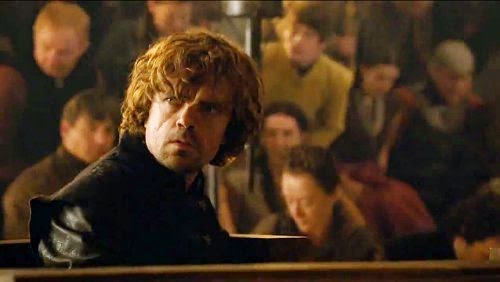
But the crown prince of this episode remains The Imp. There was a great outpouring of praise for Peter Dinklage during the last episode when he turned on the crowd in the throne room. While I enjoyed it, I have a hard time associating Dinklage or Tyrion with emotions that are that direct. His roles have often been tragic and complex (see The Station Agent for a wonderful example of that) and watching him hurl contempt, even at targets that deserved it, was a distinct step away from the character that had always landed far more devastating blows with remarkable subtlety. This episode gave him three shining moments to do just that.

The first was with Jaime, as the two of them spar over the wisdom of his outburst at the trial and Tyrion gets in one last stab at his incestuous but favored siblings which draws a look of malice from Nikolai Coster-Waldau that was chilling and a line that was prophetic: "Careful. I'm the last friend you've got." When they finally get to the root of the matter, whether Jaime will stand for him in the way that Tyrion had hoped he would at the Eyrie, we see the depths to which their relationship goes. Jaime knows that he's physically incapable of fighting the Mountain. He knows that standing for Tyrion, even if he somehow wins, will permanently sever the relationship with Cersei that he's endured quite a bit to try to restore. They revel in the idea of finally truly screwing up daddy's master plan if Jaime does die... but then you see that when confronted with the genuine possibility of death that their relationship has reached its limit. It's not just that Jaime would be throwing his life away for nothing and Tyrion would still die. It's that Jaime still wants to live, which is a perfectly understandable desire. So they sit and rue the circumstances.

And then we come to Bronn. Their relationship has always been one of convenience: the mercenary sellsword and the wealthy lord. But it's obviously developed well beyond that, as loathe as they both are to admit it. Just like Jaime, Bronn is taking the rational angle: killing the Mountain and getting more gold is nothing compared to becoming a landed lord, even if Tyrion could potentially make him a more landed lord at some point in the future. They both know that he's playing with dead cards in that respect and, as much as he'd like to have his savior back on his side, Tyrion can't possibly begrudge him taking the path that 1 sellsword in 10 million would ever have access to; in addition to not getting annihilated by the Mountain. Tyrion has been buying friends for a long time because he's a Lannister, but he's found that he can't depend on blood or money in his current situation, which is when the despair really sets in.


But the best moment is, of course, the final scene with Oberyn. This is where Dinklage truly excels. This is where the raw emotion of rejection and the horrible loneliness that has haunted Tyrion's entire life becomes expressed in brief moments as the tears well in his eyes. The only member of his family to ever care for him has turned him down. The only real friend he's had, even via business, has turned him down. The woman he loves has betrayed him. And along comes the enigmatic heir to House Martell, who proceeds to spell out exactly why Tyrion has faced that rejection and why it was so unfathomable to the Dornish who take a very different perspective on the weakest among them and those who don't fit the social order of the Andals.

Again, we've waited some time for the tagline: "If you came here for justice, you came to the wrong place." and Dinklage delivers it to the person who has been focused on precisely that since he first appeared in episode 1 this season. It is the converse of the lesson on justice that Jorah delivered earlier to Daenerys: killing only begets more killing. In that respect, it remains an irrational act. But Oberyn isn't acting rationally for the sake of the world to come. He's acting for the past and the only way to quiet the demons in his breast in the same way that Littlefinger pursues his goal with the object of his desire already out of reach. Nothing will bring back Elia and her children. But Oberyn will make this stand, regardless, and he will do so on behalf of a man that society has wronged since the day he was born.

Side notes:

We have our third casting of the Mountain in 4 seasons. I wondered a bit why they chose to take the camera angle that they did when Cersei met with him. That usually done to create perspective to hide something. Is it because he's not quite as tall as the others? I'm hoping the fight to come isn't mostly camera work.

The scene at the Wall was completely superfluous. Yes, Jon still bridles under the control of Alliser Thorne. Yes, we're still waiting for Mance to arrive. Yawn. At this point, either get on with it or just leave it out.

Likewise, the scene with Melisandre and Selyse accomplished exactly nothing other than getting another look at Carice van Houten's body and wondering why Selyse was so fascinated by it. It's a concept not even hinted at in the books. Selyse Florent is frigid toward Stannis because of whom she is, not because she gets her inner fire lit by the priestess.

OTOH, the Hot Pie cameo that allowed Brienne and Pod to firmly get on the track of at least one of the Stark girls was well done. Brienne's quest was always a bit of a fool's errand, since the prospect of finding either Arya or Sansa was extremely remote. Finding a source of information on that quest was more deftly accomplished than the somewhat drawn out method that occurs in the books. Plus you get a bit more interplay between Brienne and Pod as they begin to learn each others' limits.

Lines of the week:

"I thought you were a realist. I didn't realize you'd die for pride." - Not quite the angle that was taken, but emotion gets to you sometimes.

"You give me. I give you. Fair. A balance. No balance anymore." - If only it could be that simple.

"If I wanted wits, I'd marry you."
"I like you, pompous little shit that you are. I just like myself better."
"Because you're an evil bastard with no conscience and no heart? That's why I liked you in the first place." - Bronn and Tyrion, ladies and gentlemen. Truth in comedy.

We interrupt these lines for a last look at batshit-crazy Lysa

"The slaves you free... brutality is all they've ever known. If you want them to know something else, you have to show them." - Jorah's wisest line to date.

Almost every line of Oberyn and Tyrion's scene could be included here, but the best among them:

"I've got every kind of filth down here except the kind I like."
"Making honest feelings do dishonest work is one of her many gifts."
"It is rare to meet a Lannister who shares my enthusiasm for dead Lannisters."
"Horns, a tail, the privates of both a girl and a boy..." "That would have made things so much easier."

"A lot can happen between now and never." - No greater encapsulation of the life of Petyr Baelish.

"I've only loved one woman my entire life... your sister." - Great, even if entirely predictable.

And the winner:

"What's your name?"
"Rorge."
"Thank you."
"You're learning." - Completely emotionless and excellent.

Sunday, May 11, 2014

Trials and tribulations


So this is the point where you could feel like they're stretching it a bit if you're a reader. The Red Wedding takes place roughly halfway through the book and it continues to be compelling reading the rest of the way through. The show is still compelling television, but the Red Wedding's impact is now a year old and any imaginative impetus generated is long gone. The first three or four episodes this season had their own driving forces but the last two haven't been as gripping. That happens every season (see: bridge episodes) but not normally for two in a row. The downside is that there's a bit less to be geeked about on Monday morning. The upside is that it's an indication of a big setup for moments to come, none of which I will spoil here, per usual. On the other hand, this episode presented any number of moments to think about, which is often what makes the best stories. You walk away not necessarily in awe, but in considering just what was done and by whom and how others reacted.There's a lot going on that doesn't necessarily involve blood or moments that draw it but still involve dense plotting and very real characters and emotions.


It was a treat to finally see Braavos in the opening credits, complete with clockwork Titan, in addition to getting another look at it in the episode itself. It's unfortunate that a lot of the detail about Braavos can't make it into the show yet, because it's definitely one of the more interesting locales that Martin created for the world. What's even more interesting in the scene at the Iron Bank is (just like last week) how similar it is to our own reality, where the banks own everything and king and commoner alike will sit upon the plain stone benches and become supplicants to the power of money; all in the Bank's good time, of course. Liam Cunningham has a great moment pleading Stannis' case to the money gods, but it struck me as kind of odd that in the series they show him missing the first two segments of his fingers on his left hand, whereas in the books Stannis only removed the first knuckle. Better visual impact, I suppose. And, of course, who better to have as the chief of the Iron Bank than overbearing but still refined Mycroft Holmes? Braavos also reintroduces us to Lucian Msamati, playing Salladhor Saan, and despite the skin on display, there was none of the fabled sexposition. Instead, just an old pirate joke.


Continuing the seeming directorial theme of the past couple episodes, we come to this week's Great Departure from Canon. Asha Greyjoy (yes, Asha; I refuse to continue with the "Yara" nonsense because it's silly) advances on the Dreadfort to free Reek/Theon. This, of course, never happens in the books because the Dreadfort is on the other side of the North from the Iron Islands, which means they'd have to sail all the way around the south and Dorne, past Kings' Landing and White Harbor and up the narrow river to the Dreadfort. This kind of sea traffic does happen in the world and it's really no different from running through the Strait of Magellan to do Pacific trade with Europe before the Panama Canal was built. However, my book bias says it's mildly crazy except to keep Gemma Whelan employed. Again, gotta do what ya gotta, etc. The difference between this GDC and previous ones is that this scene actually turns out to be really good. Alfie Allen does brilliant work presenting the desperate and terrified Reek and seeing Ramsay take down three or four Ironborn reavers gives some indication of just how capable he is. In the end, they wrote their way out of the GDC pretty easily and appear to be setting up another one, but there are a lot of ways to go with the events in the North during Feast and Dance, so it won't be hard to get to the same place, even if by a different path. Coming back to the bath scene and watching Ramsay indulge in his mindgames on top of mindgames allows the audience to enjoy his constantly churning mind, even if Reek still looks pretty put together after months upon months of torture.


It will be interesting to see how the series-only audience reacts to Dany's ongoing stay in Meereen. Many book readers decry it as stagnant. I wasn't as put off as most, as I could sympathize with the struggles that Martin was having in staying true to his characters and the route the story had taken to that point (boy, have I been there...) This scene was a great example of that. Runnin' things ain't easy, especially if you're trying to be conscientious about it (which, like, no one normally is.) This was a good opportunity to once again observe just how big Drogon and Co. are becoming and was also a good moment to introduce Hizdahr zo Loraq who is the first character that only appeared as of Dance with Dragons, so we're firmly stepping past the expected timeline here (again, keeping in mind for those of you who aren't readers, that Feast and Dance were intended to be two halves of one book, so perhaps not quite as far a leap forward as you'd think.)


But the best scene outside of the trial has to go to the Small Council meeting and the subsequent fencing match between Oberyn and Varys. All the little clues of rank and expectation are on display at the meeting (Tywin sending Mace, the Lord of House Tyrell, to fetch paper; Oberyn being the most interested in Varys' description of Daenerys and her doings; etc.) There are clues and hints here of future events and revelations, so it's always a good idea to pay attention to those nuances but I can't say much more. I wonder, though, why D&D and Cogman (the writers) felt like Varys wouldn't have known of Oberyn's widespread reputation as a warrior with sellsword companies in Essos, unless the Spider was just playing him to get something else...?


And, then, of course, the trial. This is a really interesting scene from a dramatic standpoint. You know where this is going. Everyone knows where this is going. The question is simply: how difficult will it be to get there? Do you have a give-and-take before one side wins on the strength of surprise evidence and/or a witness or do you have the farce where one side is basically Franz Kafka? We got the latter and it's interesting to watch because of how frustrated the audience becomes at having seen the whole picture that Tyrion has seen while the show audience gets led by the nose by those truly in control. The crowning moment is, of course, when Shae appears and lays Tyrion's heart on the table to be stabbed repeatedly. It's a somewhat different dynamic than in the books because of what happened in the second episode, but it's still just as heart-rending for him. It's not so much the lies about he and Sansa plotting. He would know that they've gotten to her and threatened her if she doesn't. It's when she gets back at him for sending her away and reveals the extent of their relationship that you realize how things have changed irrevocably for both Tyrion and Tywin.

The latter, of course, had all of his plans falling into place like clockwork up to that point. He knows his kids. He knows what they'll likely do, so this was the perfect opportunity to bring his "proper heir" back into the fold and continue the Lannister line. But he doesn't know the extent of the emotion between Shae and Tyrion or how that betrayal will make the latter react, as he still partially sees Tyrion as this beastly little man with an appetite for whores and one who will try to save his own skin if given the opportunity, which Jaime has given him. Emotion ruins even the best-laid plans but it also drives drama and so here we are. While I respect the fact that this trial was, in many ways, the Lannister family problems being laid out and finally brought to a head, I can say that I really wouldn't mind going a long time without ever hearing "The Rains of Castamere" again.

Lines of the week:


"Here our books are filled with numbers. We prefer the stories they tell. More plain. Less... open to interpretation." and "You can see why these numbers seem unlikely to add up to a happy ending." - Mycroft, givin' it to'em short and sweet. Having been in bookkeeping for a number of years, I've actually had the opportunity to have a conversation like that a time or two. Stannis' reaction is pretty true to form.

"Does this mean I'm the Master of something now? Coins...? Ships...?" and "I have seen the Unsullied. They are very impressive on the battlefield. Less so in the bedroom." - Watching the foolish Mace become petulant about being Master of Ships to his rival from the south is more telling than anything else about Lord Tyrell's character. And Oberyn is, of course, Oberyn. Always in the bedroom.

"I wish I was the monster you think I am." - Tyrion hasn't had a ton of material this season but this strikes closer to home for both him and the people around him than almost anything else.

"You've got bigger balls than he ever did. But with those big balls of yours, how fast can you run?" - Ramsay always seems to have a (ahem) grasp of things.

But the best line came from that same scene, as Alfie Allen gave us an example of pure terror and a completely broken identity:

"I don't believe her! I know who I am!" - only to be told that he had to pretend to be his old self by Ramsay a while later. Watching him be nice to Reek is far creepier than when he's savage and that's good acting and good television.

Sunday, May 4, 2014

Mid-season

For the longest time, I've felt that The Wire was the best thing ever put on TV. There have been a few close seconds: seasons 3-7 of The Simpsons, Breaking Bad, and now Game of Thrones. However, since I read the books long before the series ever emerged into the force that it has now become, I've never quite been able to separate one medium from the other. The Wire is the best television show ever. Game of Thrones/A Song of Ice and Fire is still more book series to me than TV series and this is one of those episodes that kind of highlights that. So far this season, each episode has had kind of a stunning event (as D&D had implied during the pre-season interviews; "each episode has a kind of 'Red Wedding' moment") that sets the Interwebs abuzz.

This episode kind of lacked that if you happen to have read the books, since everyone who has already knows that Littlefinger was essentially the impetus behind the entire series of events that became the chaos that is his ladder by convincing batshit-crazy Lysa to murder her husband, Jon Arryn, Hand of the King and fosterer and mentor to both Robert Baratheon and Ned Stark. So the TV-only audience is one step closer to being on the same page (ahem) with the rest and perhaps finally firmly aware of just how dangerous one, small, barely-a-lordling can be if he's really ambitious. Aidan Gillen did remarkable work tonight, as well, since you could see his reluctance behind his usual steely demeanor as Lysa was throwing herself at him. And, as always, poor Sansa gets to listen to the screamer all night.

That said, for the first time I'm at a bit of a loss in terms of thinking about really powerful scenes because a lot of this was just progression or bridging. In a narrative sense, it's difficult to continually have "wow moments" (DaveBrandonCreatingTheFuture™) one after the other because your audience will become inured to them and your story will begin to suffer from requiring yet another peak, followed by the inevitable come down. In Hollywood, they tend to "solve" that problem by just blowing up more stuff. Not possible in the more limited scope of TV budgets and yet expanded scope of a serial production (if one chooses to look at the series as a sequence of 10-hour films, which seems reasonable to me.)


Even so, there were high points in this episode. They were just a bit more subtle than usual. For example, both scenes with Arya and Sandor were, as usual, excellent. Arya naming the Hound at the end of her list, even though likely expected by most watching, book-reader or not, was great. Rory McCann's continued concern over the way his pseudo-charge is developing,  even through the haze of his general disdain for all things, is great. You could see the thoughts moving through his raised head as she finished: "Did she just name me? Well, alright, then." It's an excellent student-teacher relationship that I'm sure GRRM is kicking himself for not exploring further.

The later scene with the swordplay was almost better. Much as I appreciate the essentials of Eastern sword technique (and was a practitioner of it for several years), there is something to be said for simply overpowering your more nimble opponents with solid steel and irresistible force. The fact that said opponent is a young girl without much of a chance to develop the strength to try to counter that armor (especially when worn by a nearly 7-foot man) just makes the point that much more obvious. The Hound is such a cynic that he continually tries to reinforce the point that nothing she does will make things better, whereas Arya is determined to make them so, even if she has to take a relatively morbid path to do so. In that way, they're as alike and as disparate as two characters can get.

But did D&D jump ahead of the books again? Tywin tells Cersei that the last of the Westlands' gold mines was played out three years before. That doesn't mean the Lannisters are broke. It just means that they're not as liquid as before. Thus, the greater emphasis on the Iron Bank this season, which is a much larger presence in the current thread of the TV series than it ever was in the books. Is this a way of creating a bit more dramatic tension about the crown's debt or is it a way to keep the audience intrigued since the power of the Bank is so similar to our own current times? Either is acceptable from a storytelling perspective, but I wonder if Martin did drop them a hint of the Lannisters' impending financial troubles and they decided to run with it?


Sticking with that perception of "lacking a big moment", the lone scene with Dany and Co. seemed to introduce the notorious Meereenese Knot in just a few short moments. How does one keep slaves free in a culture that is utterly reliant upon them since time out of mind? If one is going to rule, what makes Westeros that much better than Slavers' Bay and however much of Essos one can conquer (and without half the politics)? For that matter, if one is trying to be just and free people from their bondage, what entitles one to do it anywhere other than the strength of the sword? Wouldn't freeing people from bondage mean ending the serfdom of Westeros just like the slavery of Essos? Once again, the gray areas of both story and character dominate, especially in the case of Dany. At least we got the name drop of Cleon the Butcher, too.


I will say that the one scene I was genuinely disappointed in was that between Oberyn and Cersei. Here are two of the most interesting (and volatile) characters and two of the strongest actors with extended time together and they spend it largely rehashing Oberyn's slights against the Lannisters and Cersei's despair over Myrcella's absence. Those are certainly valid topics, but I was hoping for a bit more in the way of fireworks. Once again, peaks/valleys/how many can you tread, etc. The little tête-à-tête with Margaery was, in contrast, more interesting for its lack of flames. One has to assume that Margaery is wary enough to understand that a sympathetic Cersei is akin to dealing with a sleepy viper. Lena Headey is doing great things this season and that's saying quite a bit considering what she's done to date.


So we come to Craster's. My main concern with the deviation with Bran's story was that he would actually link up with Jon and the impact that would have on the two characters. In the end, they wrote their way out of that and the whole thing became a bit of an unnecessary sideshow. There were interesting points, certainly, in that the fight scene between Jon and Karl was well done (and the counterpoint to the assertion by the Hound about big swords versus faster ones) and it was definitely exciting to see Hodor get the killing blow on Locke, despite it being a case of him being warged by Bran (the gentle giant looking in confusion at the hands that just committed murder was a very nice touch.) But, in the end, it felt a bit too obvious that this was a scene inserted to try to cover for long stretches in the book where, again, Bran's story is the trek north and Jon's is getting ready for Mance and the Wildling army to appear. Again, you do what you gotta to keep the ball rolling. I just think that, as a capper to an already intermediate (as it were) episode, it kind of highlighted some of the story problems that they're already running into.

Side notes:

The extended applause for Not-Joffrey's coronation reminded me of the gushing for Obama shortly after his first election. The fact that he wasn't his predecessor was enough to win him a completely farcical Nobel Peace Prize. It was, of course, notable that Cersei was the only one not applauding the death of her firstborn.

It was interesting to see the Bloody Gate, despite not seeing it on our trip to the Vale in season 1. One assumes that was a budgetary issue. That said, in the books, Sansa and Petyr stop off at his old home before proceeding overland through the gate. Having just sailed from Kings' Landing, one would have expected them to stop at Gulltown where we could have skipped the Gate sequence entirely.

Brienne and Pod's scenes were similar. There's some development going on in that Brienne reverts to her pre-Jaime distance and aloofness while the ever-earnest Pod does his best to screw up and break her out of it. But this odd couple can't hold a candle to the previous Brienne pairing or Arya and Sandor, of course, and that made it seem a little like filling time.

To go even further with the Hound's comments about fighting styles (tank-like knights vs. faster blades), I really want to play Crusader Rex again... /wargamenerd.

Drink from the Skull will be sharing a stage with Sword through the Gullet in Gin Alley next week...

Quotes of the week:

"Who told you to take the Meereenese navy?"
"No one told me."
"Why did you do it?"
"I heard you like ships." - Forget roses. Queens want ships.

"You know what stories poor men love best? Ones about rich girls they can't have." -Petyr with the little biographical note that batshit-crazy Lysa elaborates upon later with Sansa.

"What do you think will happen if you leave?"
"They'll say I wasn't a very good squire." - Pod the pragmatist.

"Mostly I poured wine." - Pod the realist.

And the winner and still champeen:

"Your friend's dead and Meryn Trant is not, because Trant had armor. And a big fucking sword." - It's mildly terrifying seeing how mature Maisie Williams is in that scene. What's she going to look like in three years?