Showing posts with label historical ignorance. Show all posts

Thursday, January 7, 2021

The mirror, darkly


People usually ask me around the appropriate times: "What do you want for Christmas?" or "What do you want for your birthday?" My typical response is something like: "Bloody revolution." Most that know me also know my political outlook, which is one that decidedly contrasts much of America's and certainly the outlook that has come to embody America. Whereas most believe in and promote the idea of big business, everything for profit, what's good for GM is good for America, etc., I'm a Marxist. What that means is that I favor people over profits, whether it comes to labor law, environmental law, or any other rules of society. So, when I talk about "bloody revolution", my image is of a popular revolt based on a higher principle, rather than on petty prejudices and a demagogue. So, when it came to the events today around and inside the Capitol building, my primary reaction was a mix of disgust and humor. The humorous part was that all of these fools were following the commands of an idiotic con man whose true nature has been blatantly apparent for 40 years. The disgust was based on watching all of the institutions that are held so sacred by most Americans being brought to their proverbial knees by a bunch of ignorant QAnon believers and a large number of racist cops; many of whom are also supporters of that idiotic con man. (How can someone that stupid deceive so many people? Animal cunning isn't bounded by intelligence. It's an instinct that's well-served by people who want to be deceived in the first place. But I digress.)

First off, let's get one thing straight: Anyone invading the Capitol today should have been shot. Full stop. That's what any nation does when an insurrection is attacking its primary legislative body. If I were leading my much-fantasized bloody revolution, I'd certainly expect to be shot if I was in the halls of Congress or the White House. That's what happens when you're trying to violently overthrow a government. People tend to shoot you or at least shoot back when you shoot at them. These people should have been treated as the domestic terrorists that they are and been shot. The first few to go down would have scattered the rest to the four winds. This is how this normally works. But, instead, what we saw were repeated instances of police retreating from unarmed invaders, taking selfies with said invaders, and even letting them in the door in the first place. This was after the date of January 6 was singled out by both President Trump and anyone who casually followed this thing called the Internet for weeks. Everyone knew this was coming, so there can be no argument that the Capitol Police or the myriad of security forces in and around DC were surprised by what happened. The fact that they stopped to share photos with these insurrectionists demonstrates what the reality was: These cops supported this insurrection. The foxes were, indeed, guarding the henhouse.

This brings into stark contrast what happened over the summer, when actual protests occurred across the nation in response to the death of George Floyd. In those instances, since the protests were made up of non-White people and were in support of non-White people and protesting against their usual treatment at the hands of authority (Protect and serve!), those participating in those events were attacked by police as if they were the enemy... because we are, to their thinking. We threaten the institutions because we point out that those institutions are either flawed or malicious. That's never a good idea in a state that's beholden to a very few. Indeed, the starkest example of the difference in response to the two events were what Washington looked like then:


 And what it looked like today:

This speaks to not only orders given from on high, given the weeks of lead-in to this event, but also attitudes among the police themselves. After all, these "protesters" weren't Black! We're all in this together as fellow Americans, right?! This was cooperated with. Messages were sent from above that this behavior was acceptable in the corridors of power. (15 whole arrests today! Woo!)

And that's where the disgust really ramps up. Right away, you get the plaintive mewlings of government officials with the "This isn't who we are." line. This isn't America!, they say. This doesn't represent our grand, idealized vision of the city on the hill that, as one CNN reporter put it tonight, is the "anchor of democracy throughout the world." I nearly spit my water across the room because, you see, this is America. It totally is. This nation is seen as the "anchor of democracy" in many corners of the world only if your interpretation of "anchor" is something that weighs you down until you drown. This image- of self-entitled White people given free reign by cops to attack the legislature in the hopes of intimidating it to hand power to a would-be dictator -is absolutely America; especially when contrasted with what happened over the summer and what has happened to Black people in this nation for 400 years at the hands of authority, both locally in the form of cops and nationally in the form of Congress. This is so on brand for America it's almost as funny as it is disgusting. The "This isn't who we are" line is a dodge. It's an evasion that allows people to not confront this truth and pretend that real problems don't exist until everyone can move on to the next episode of The Mandalorian and forget that bad things even happened. It usually helps that the people using that line are the ones for whom those problems don't really exist (i.e. White, often wealthy) because they're never directly affected by them.


But that's another thing to keep in mind: This problem is far bigger than The Idiot, Donald J. Trump. This is the Republican party in a nutshell (with their often all-too-willing accomplices, the Democrats.) Trump may be the beacon in these insurrectionists' lives. He may be the one that keeps whipping them into a frenzy with lies that they love to hear and fantasies that can't possibly make sense. But it's vermin like Ted Cruz, Lindsey Graham, Matt Gaetz, Mitch McConnell, and Josh Hawley that have made this possible, among many, many others. They enabled this creature and looked the other way every time he committed crime after crime just like today, usually only after announcing that he was going to commit whatever crime that took place. (Someone tell me: Is Susan Collins concerned again? Or has she learned her lesson...?) This is the modern GOP and no one should ever forget what this party is: fanatical hucksters, dependent on ignorance, and completely devoid of any policy ideas that will improve life for anyone but the tiny sliver of the wealthy of which they are a part. This is a party so dependent on the Reagan religion, the tenets of which that have been so resoundingly disproved or rejected over the past 40 years that they can't reasonably be brought forward as actually popular ideas, that it can't promote anything but ignorance and fear; mostly of The Other (the non-Whites, the foreigners, the immigrants, the "socialists", etc.) Trump is the outward manifestation of this trend and they have covered his tracks at every opportunity; so much so that Cruz and Hawley have played to his base tonight on the Senate floor as prospective candidates for 2024. This is the Republican party and no one should ever forget what they've created.

The humor of today was also brought about by entities like the National Association of Manufacturers, suddenly realizing that widespread public violence might be bad for their profit margins, finally suggesting that Trump is unfit for office, two weeks from his removal after four years of perfidy. Or Twitter and Facebook, finally responding to the unending stream of lies that he spews forth that led directly to the national legislature being evacuated from its building by cutting him off their platforms; the same platforms that were used to organize this little revolt and which did nothing but promote his bullshit for years as a concession to "free speech", but really because they made money from it. As always in American politics, it's about the money. It's always about the money. Even the corporate media finally had to concede that perhaps "protesters" and "demonstration" weren't quite sufficient euphemisms for insurrectionists attempting a coup. CNN even labeled them "anarchists" at first. Remember anarchy? That thing you do when you're trying to keep the current government in power? Yeah. That. But all of this is reflective of the normalization of fascism. History is replete with examples of events like this, both within America (the Wilmington Massacre of 1898 (also racially-motivated)) and without (Mussolini's March on Rome in 1922.) Fascism is a solidification of corporate and political power and most major media sources are corporations, so they feed off this. Organizations like the New York Times remain eager to avoid buzzwords that might make anyone think that something is wrong with the American democratic edifice like, say, when the President is a liar or when people attempting to intimidate the legislature are staging a coup. That's why the term "anarchist" is thrown around. Anarchy represents change, so it's used to represent chaos, the lack of order (Law and order!), the undermining of authority, the breaking down of institutions.


So, don't kid yourself when you think that America is "better than this." It never has been, because things like this usually lead to profits for the people that own America (exactly what the NAM was concerned about.) It's also a shining example of what the US has done, repeatedly, in other nations around the world, also at the behest of those owners (the term "banana republic", which many are applying to the US these days, came about because of the activities of United Fruit, the US Marines, and the CIA.) This is America. One of our two major political parties has simply begun saying the quiet part out loud; usually embodied in the form of The Idiot, but now also in his devoted followers who have been elected to the highest legislative body in the land. But his departure will not change anything but the façade. While every effort should be made to both arrest all of the participants of today's debacle (including the outgoing president) and expel all of the Congresspeople promoting sedition (It actually should be done, legally, per the 14th amendment.), there will still be much more work to be done. They and the people they serve will still own everything and will still work to maintain that situation. The only thing to potentially look forward to is the actual bloody revolution that might serve the interests of someone other than a minority of racist morons. I await that day with great anticipation.

Thursday, September 17, 2015

Clown Car, part deux


So, 10 guys go to a funeral to meet up with this one woman who knew it was actually a business meeting... That's pretty much the encapsulation of last night's clownshow which was only too ready for punchline after punchline. The continued pontificating and breathless grasping at the MLK moment ("I have a dream... that someone might say something of actual substance so that we may measure the content of their character instead of CNN's constant trolling...") all came in utter contrast to the one person who talked in blunt terms and short sentences. That's why many people think Carly Fiorina "won" the "debate", which is like saying someone outran a bunch of toddlers to the juice box table where everyone still got one. Hooray?


Fiorina answers questions like she's in a boardroom, which is precisely what you want if you want someone to talk about basic facts. She's still evasive as hell when someone asks a direct policy question (it's way too early to establish positions that could be picked apart for their inadequacy) but she keeps it short, spares everyone the flowery prose, and makes her case. People appreciate that, especially when it's down the dais from the bloviating Trump and his ego which only barely share space between themselves, much less Dexter Bush and the Right Reverend Huckabee. That makes Fiorina come across as halfway intelligent, even if she wasn't already standing out as the only female clown on stage. And on matters of sex and sexism, she did have the best genuinely funny moment (as opposed to all of the unintentionally funny moments) when she responded to Trump's idiocy from the last debate with her simple line: "I think every woman in America knew exactly what Mr. Trump said." That was worth a Kelso:


Of course, as soon as she wandered off the rez and decided to try to impress us with her prose, she withered. Note the pseudo-closing statement (dressed up nicely by CNN with their softball about what their respective presidencies would look like (You mean other than The Handmaid's Tale?)) where she blathered on about her personal manifest destiny, the return to the glory of the City on the Hill, and yadda yadda yadda (Gotta include the Yiddish phrase for all the Israel references when people were talking about what their American presidency would look like...)

[Tangent: It's hilarious to note the omnipresence of said references to Israel in most GOP discussions of foreign policy as perhaps the one hot button they can still press to get a visceral, red meat response from the masses. Said masses don't really know shit about foreign issues other than "Foreigners are weak [French], out to steal our jobs [Mexican], communists [Europeans, in general], and crave American leadership." but you can name drop "Israel" into almost anything and immediately get the kneejerk that equates to "Spend billions on the military to protect pseduo-Christians from evil Muslims and prepare for the Second Coming!" That latter part is most important to people like Huckabee, who always fail to see the disconnect between supporting the militarists in Tel Aviv so that they may bring about their own damnation when only Christians are allowed into Heaven. /tangent]

Speaking of CNN and their softballs... Ugh. These things are a complete farce in the first place, even if we weren't watching in glee over just how many clowns will do a pratfall as they climb out of the car, but CNN's questions were brutally bad. I know they're ratings-conscious and are aware that a large segment of the audience is watching for entertainment and not because they'll even consider voting for one of these idiots, but could they at least give a nod to propriety? The vast majority of the questions were the equivalent of conversation on a middle school playground: "Hey! I heard he said X about you! What are you gonna do about it?!" All they're doing is continuing to feed the perception that "the media" (whoever the hell they are) is out to get the GOP/right-wing/Trump/America's hayseed population. Even if that perception is inevitable, at least try to show a little class.

A couple highlights:

Christie: "Don't prosecute these people after the crime is committed, intervene before the crime happens!" I know what his intent probably was, but given all the other 1984 trappings that hang over much of GOP discussions these days (including the oft-quoted "Strength is peace!"; Ignorance, therefore...) that was totally a Minority Report moment.

Huckabee: "Vaccinations are a part of big government!" Why, yes. Yes, they are. Most people don't complain about the eradication of things like polio.

Trump: "We're three trillion in debt!" followed by "We're not spending enough on our military!"


This, of course, is a perfect example of the disconnect between the embedded disdain for George and Dick's Excellent Iraqi Adventure walking hand-in-hand with the earnest shouts to go balls out in Syria, because that worked so well the last time. Your Republican candidates, America. Exxon's biggest nightmare is someone hooking up a power cable to Goldwater's grave because he's not gonna stop spinning anytime soon.

Thursday, January 2, 2014

Calcification

Some of you are Michigan fans who had the temerity to endure the most recent season of a fairly-talented team looking about as inept as any produced by Michigan in the history of the program, including the disaster-laden Rodriguez years. The dreary minor-league bowl game produced a suitable performance and came within a final drive of being the fifth game under Brady Hoke in which Michigan produced less than 200 yards of offense and the sixth to fail to score a touchdown (Number of such games under Rodriguez? Zero.) Even so, it became the 11th under Hoke to produce less than 300 yards of offense. In the modern game, 300 yards is a pretty pedestrian number, even against solid defenses. But the key phrase in that sentence is the first: "In the modern game" because that's precisely what Hoke and his offensive coordinator, Al Borges, are seemingly doing their best to avoid.

Bill O'Brien recently left his job at Penn State after two years to become the new head coach of the Houston Texans (Only the NFL could produce a team name that's essentially a tautology: "We're the Texans. From Houston." It's like going to Europe and telling people that you're Americans. From, you know, 'Murica!) While few had high hopes for O'Brien, taking over the presumed crater that would be the whole of Penn St. football for the next decade, he actually did remarkably well there and one would assume that the fanbase would be more than appreciative for what he was able to accomplish with a team full of no-one-wants and walk-ons.


But O'Brien was saddled with the expectations of a segment of the PSU fanbase who had grown so long in the tooth with their former coach that they apparently have a hard time imagining anyone else doing as well as the old man. O'Brien went 8-4 and 7-5 in his two years there. Paterno went 7-6 and 8-4 in his last two years. But it's not so much about the records as it is the preservation or calcification of "the way things are done around here." (I'm not even going to get into the Sandusky scandal. This is just about football and institutional blindness, thanks.) So, when he left, O'Brien allowed some derogatory comments about "the Paterno people" to be printed:
“You can print this: You can print that I don’t really give a (expletive) what the ‘Paterno people’ think about what I do with this program. I’ve done everything I can to show respect to Coach Paterno. Everything in my power. So I could really care less about what the Paterno faction of people, or whatever you call them, think about what I do with the program. I’m tired of it,”
This was apparently in response to fans complaining about the departure of Ron Vanderlinden, Paterno's last hire, from O'Brien's staff. So, you're giving grief to the guy who has done a better job with your undermanned team than anyone else could expect, because he didn't keep an assistant that the old man hired? Is it because Vanderlinden was, by fiat, a "Penn State man" and O'Brien somehow wasn't? Where have I heard that before?


Oh. Right.

Michigan has a similar problem in that there's a fairly large segment of the fanbase, alumni and, most notoriously, former players and the athletic director, who live in the fantasy of the "Michigan Man." Spencer Hall at EDSBS has turned the "Michigan Man" concept into a favorite punchline because that's really what fantasies are often suited for. The idea is that no one can truly understand what it takes to lead Michigan football to success if he isn't a "Michigan Man", mostly because they think that Bo Schembechler, the man who revived Michigan football from its dolor of the 60s, was a "Michigan Man."

Except that he wasn't.

Bo had been an assistant at Ohio State(!) and the head coach at Miami (not that Miami) of Ohio, a rather pronounced unMichigan Man. So was Fritz Crisler, who came from Princeton. And Fielding Yost, who came from West Virginia. There were no "Michigan Men" until Bo inadvertently popularized the term before the 1989 NCAA basketball tournament. Bill Frieder had announced his departure to Arizona State and Bo appointed Steve Fisher as interim coach, saying he wanted a "Michigan man" to lead a Michigan team. It was only later that it became like a religion, mostly promoted by Lloyd Carr and his sycophants, such that "Michigan Men" became very like the "Paterno people"; both quite pod-like and equally disturbed by those who were not like them (read: everyone.)


The casual reference becomes tradition and then ironclad law. When Rich Rodriguez became the head coach at Michigan, he was immediately treated with outright disdain, with several of Carr's former players openly stating that he was not welcome until he had earned his way in and that the program was "theirs".

And so we come to the present day, where former Carr assistant, Brady Hoke, is now the coach and the cheerleading athletic director and former Bo benchwarmer, Dave Brandon™, is busy making excuses for his rather lackluster performance. That performance is largely based on a perception of what Michigan football should be and, of course, really never was. The modern game moves faster. The modern game incorporates new ideas on an almost monthly basis. The modern game learns and adapts and realizes that opponents will be doing the same on a weekly basis. Michigan football currently does none of those things but instead plunges ahead as only a stalwart "Michigan Man" can.

Just like water pipes, too much time doing the same thing in the same way leads to a slowing down of the flow of information, a buildup of detritus that inhibits the overall structure from functioning. The "Paterno people" are wedded to a distorted ideal of a coach who created their program 60 years ago and have driven out a capable coach in the process. The "Michigan Men" are wedded to a distorted ideal they've created around the coach who revived the program 45 years ago and they're helping to retain a coach who should have never been given the job in the first place and wouldn't have if he was not numbered among the carriers of pods.

The Rose Bowl kind of brought that problem to the fore again in an oblique manner, won as it was by the former Little Brother of football in the state of Michigan. I say "former" because it's highly unlikely that Michigan will be able to regain its former status under Hoke, whether nationally, in the conference, or in its own state. But the problem was brought into sharpest focus by watching the offense of MSU's opponent, Stanford. Stanford was brought to its recent run of glory by one Jim Harbaugh, former quarterback for Bo and latterly-heralded "Michigan Man." Harbaugh, who actually played for Bo (unlike most currently outspoken "Michigan Men"), installed a power running game at Stanford with a rather complicated system of checks and blocking, just like the old man. David Shaw, his successor, has reverted to the style seemingly favored by Hoke and Borges; that of "manball", often cited by ignorant football fans as a way to "impose your will on the defense" by hammering away at the line even when the defense is clearly lined up to stop just that kind of play. It's more like "imposing your willingness (to give up and die)" on the defense than anything else. Shaw tried it, MSU ate it alive (just like they did to us this season!) and Stanford lost. Michigan tried that, too, and gave up more plays for negative yardage than any other team in the nation.

Oh, but they were "Michigan Man" plays and that, for some, makes all the difference.

Monday, June 10, 2013

They already know everything because you let them

Edward Snowden is now being heralded by no less than Daniel Ellsberg. Snowden, of course, exposed the rampant NSA spying program and fled to China in order to escape what will surely be energetic attempts at retribution by the US government. The program is being labeled an attempt at "security". The question that no one is asking is: Security from what?


A "war on terror" is deliberately left wide open to be pursued in any direction. Nameless, stateless; it could be anyone and anywhere and, most importantly, it could be us. The first time government of, by, and for the people was mentioned was the last time it existed. Now the only question is why.

Why would the government be so obsessed with controlling its citizenry? Because people left with no other choices tend to revolt. Revolt would be bad for those in power, not least because it disturbs their carefully crafted image of the land of opportunity/greatest nation in the world/(insert pathetic slogan here.) It's been less than a couple weeks since the last time I was attacked for rejecting the benefits afforded me by being part "of this great nation." People believe this stuff, even when the evidence of rampant inequality, perhaps the highest in the history of said nation, is everywhere. If much of the population is doomed to work low-wage jobs for the rest of their existence, with little prospect of change, what hope do they have other than violence? If the highly educated segment of the population is largely demoralized because that education has been devalued if it doesn't produce instant profits, what message might they deliver to people actually willing to read their books, view their art, and listen to their speeches? Is it hope? Is it opportunity? Or is it "don't bother following me here"?

A populace without choices is a populace without hope. No hope means nihilism. Nihilism means violence. Thus, the control. That control is already so effective that much of the population, urged on by wealthy and compliant media sources, screams for more whenever a violent event occurs. After the Boston Marathon bombing, some of the first responses were complaints about the government not knowing enough and/or acting quickly enough. The only way to know that much and act that fast is with the type of program that Snowden revealed. It's a howl of outrage, not that two men took such actions, but that the government wasn't hovering over them to stop those actions. It's easy to do when it's "crazy Muslims" aka NOT ME. I don't have anything to hide! I don't have anything to answer for! They shouldn't be spying on me! Just the bad people! It's NOT ME!

But it is you.

Just like animals in a very pretty and comfortable enclosure at the zoo, it is you. If you're lucky, you have food and a nice place to stay and despite the fact that you walk the same boring path and look at the same boring plants every day, it's easy to not think about how your entire world is 50 square yards. Until perhaps you lose that nice job of being looked at by the tourists. Or you lose that good food. Or that enclosure isn't so comfortable anymore. And then you realize that they have been watching you, guiding you, controlling you... because, at its root, they're afraid of you.

They're afraid because they know that if enough animals in the zoo that are less equal than others decide to band together and resist the controls, revolt against the keepers, and abandon the enclosures, they might be in trouble. Without doubt, their profit margins would be in trouble and that is, in the end, the most important thing to any member of Congress and any president elected in the past 150 years, at least.

So, should people be outraged about the NSA program? Sure, I guess. It's just one more symptom of how the system is maintained. But what they should really be outraged about is not that the system of control was exposed, but that it exists in the first place. The NSA program is one element of a massive problem that is summed up in one simple phrase: rule by the rich. As long as that exists, you might as well relax and perform for the watchers. Nothing you do will matter until that changes. And, incidentally, if 1/10 of the outrage currently being spewed about the spying were directed at the massive economic and environmental problems in this country, things might actually start to change.

The Man's got a surefire system
An economic prison!
Ya gotta get out!
Ya gotta get out!

Friday, June 7, 2013

The riddle of Scott

Ridley Scott was once one of my favorite directors and he's still a pretty respected name in the industry, but largely for films I consider to be nowhere near his peak. Like John Carpenter, Scott is one of those directors whom I feel lost his way somewhere along the course of his career. If one defines success as making a ton of money, he still does that and does it better than ever before. If one defines success as making memorable films, one of his most lauded, Gladiator, appeared well past the point where I had abandoned his efforts as far less than his earlier achievements. In fact, Gladiator won him the only Academy Awards that he currently holds (of course, James Cameron swept the Oscars for the execrable Titanic...) What disturbs me about most of Scott's material, post-Thelma and Louise, is his placement of spectacle over story. When explosions and hundreds of extras are a replacement for solid writing and intriguing plot, you have what Scott has largely become and what Hollywood tends to be in love with: Big Summer Blockbusters!!!... that, of course, reside in one's memory for only about a week until the next Big Summer Blockbuster!!!


His early films, on the other hand, hold a place in the audience's memory because of the enormous attention to detail that was taken and the often gripping performances by the cast whom were given miles of story and nuance to work with. The Duellists is a fine example and Scott's first major film. The plot itself seems simplistic: Gabriel Feraud (Harvey Keitel), a dedicated duellist in Napoleon's army takes offense to Armand d'Hubert's (Keith Carradine) attempt to arrest him for his activity and, of course, challenges him to exactly that proscribed activity: a duel. When they're unable to complete the first encounter, Feraud makes it his life's mission to salvage his honor by finishing a duel with d'Hubert. The essential crux of the story is that Feraud and d'Hubert's personal contest is framed against the ongoing political situation in France. In fact, their series of duels is shaped by the success and final disastrous failure of the Napoleonic regime, including being on opposite sides of the Loyalist/Bonapartist divide upon the general's return from Elba. It's a story about personal ambition as one small part of a nationalist ambition; a drilled down focus, as it were, on the life and culture of the times in the officer corps.

Indeed, the film is most often hailed for its remarkable attention to detail in costumes, hairstyles, and fencing styles. It's that detail, that sensation, that atmosphere that tends to define Scott's early works when it was clear that he was determined to give the whole broad picture, even as he was focusing on the small interactions between characters. Focus in the pacing sense is also mirrored by the cinematography, as he demonstrates what would become a Scott trademark, in showing regular action from a distance and a tendency toward broad establishment shots that help set the mood of the scene. For a film based around the idea of personal combat, the action is genuinely secondary to what is motivating the characters; most notably d'Hubert, who wants nothing to do with the entire concept and yet is inevitably drawn into it by a variety of circumstances. On the one hand, I do think it deserved the Best Debut prize at Cannes. OTOH, it does carry that veneer of angst that colored many films of the mid- to late-70s.


His next notable work, however, was an example of a filmmaker and a studio defiantly stepping away from the order of the day and producing a film that stands out as one of the finer examples of science fiction filmmaking in the modern era. This was 1979, 2 years after the emergence of Star Wars. The proliferation of laser blasters and outer space explosions had spread to every corner of the film world, including James Bond. But not here. In Alien, Scott not only presented a less hyperkinetic situation, but he did so with characters that were industrial workers in an industrial world. No one was weighed down by prophecy or besotted by privilege. These were normal people doing a normal job who just happened to run across extraordinary circumstances. Furthermore, the story didn't start and stop with the unusual situation. Their interactions were about payment shares, command issues, ship security, the food, and everything one might normally discuss in an ore trawler heading back to Earth. And, again, the attention to detail is part of what makes the story work. They acknowledge the actual science of space travel by the very tagline of the film ("In space, no one can hear you scream.") Much time is taken showing the descent to the moon to answer the distress call and the difficult conditions on that moon. Again, the broad establishment shot of the descent gives the viewer time to appreciate the magnitude of the undertaking and how it's being engaged as much as the broad shot of the interior of the alien craft allows the impact of the moment and the age of the ship itself to become noticeable to the audience. In both cases, Jerry Goldsmith's score is brilliant, as well.


Notice how Scott doesn't end the action while he pulls back. There is no orchestral crash and a camera freeze. He just lets the continuing motion of the crew crawling into the chamber and the echoes and the brief, static-shrouded comments on the radio set the tone. In other words, he lets the scene play. It's wonderfully moody stuff which is exactly what the moment calls for and which would probably be hammed into irrelevance by many other directors, desperate for a "Wow!" moment. Scott, at the time, let the story tell the tale. Just as important, he let the undercurrents of the plot (the fact that Weyland-Yutani was willing to sacrifice them all and Ash (Ian Holm) was their tool to ensure it) appear without added emphasis. The audience was allowed to absorb the lines on Mother's screen and the actors' reactions without encouragement. Likewise, even in the charged moments where characters like Ripley (Sigourney Weaver) are frantic or yelling, he doesn't let that energy overwhelm the pacing. It's a restraint that is emblematic of his direction in those earlier years and which, sadly, was later lost.

What followed was a film that Scott has declared his "most complete and personal" and is one that I think is the finest science fiction film ever made and one of the best, regardless of genre... with a caveat.


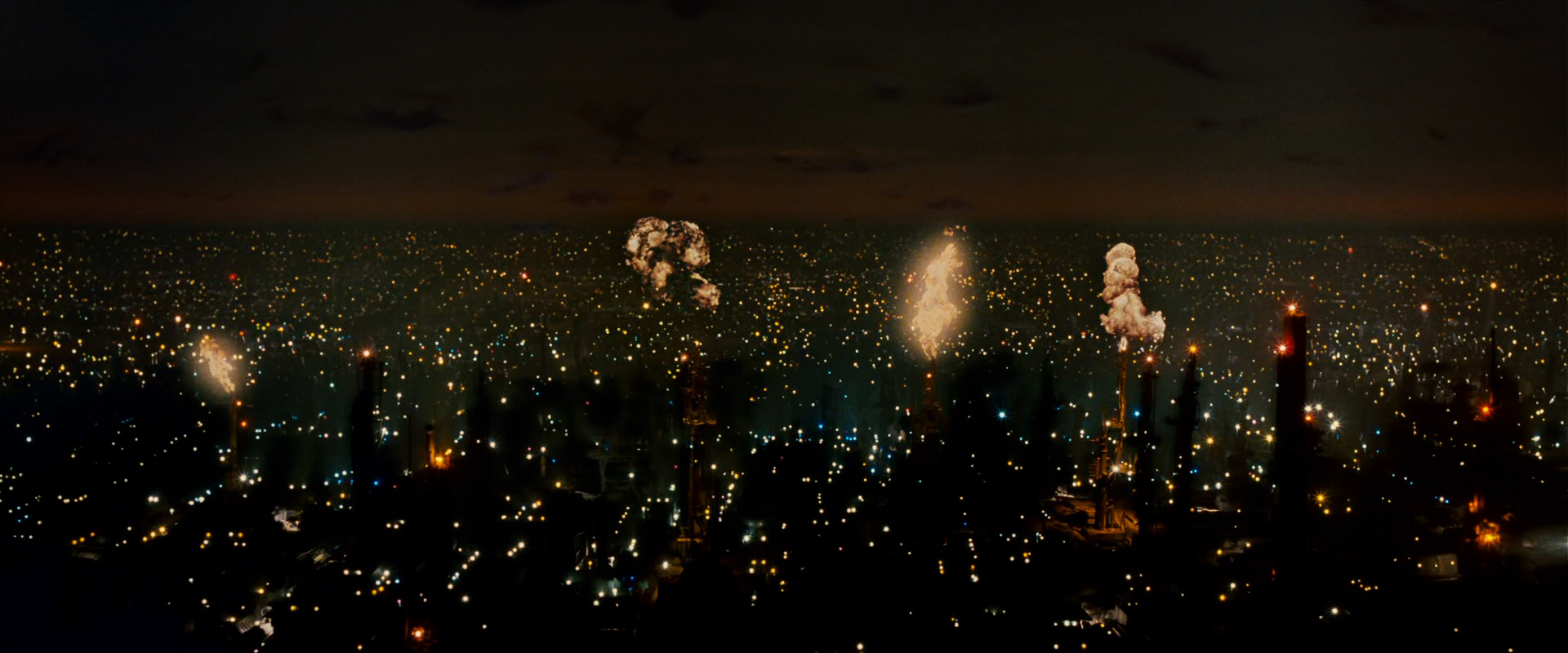
Blade Runner, based on Philip K. Dick's Do Androids Dream of Electric Sheep? broke ground in many ways. Once again, it strayed from the prevailing SF model of the time, with the armadas and the armor and the lasers. Instead, it went back to a Dashiell Hammett-model of noir and used a plot of unusual thematic complexity, not only for SF of the time, but for Hollywood in general. It also, as originally cut, spent a lot of time allowing the audience to simply absorb the visuals presented to them. As film is a visual medium, one would think this would be natural, but it's rarely the case in major cinema that what is presented on screen can go unaccompanied by someone yakking about this or that element of the plot and/or the characters' reactions to what is happening right in front of them. Have an exciting car chase? Don't forget to interrupt it every 15 seconds to show the hero yelling "Oh my God!" when something else blows up. There was none of that here. We're shown vistas of Los Angeles, the towers of the elite, and the alleyways of the downtrodden, including where those who form the foundation of the elite's wealth also live. Statements are made about the future and about now, all by only what appears on the screen (along with, of course, Vangelis' brilliant score.) And here comes the caveat...

Because the version I'm speaking of is the so-called "Director's cut" as originally presented in the early 90s. Scott originally shot the film without Deckard's (Harrison Ford) voiceover, with Deckard's dreams about the unicorn, and without the tacked on Hollywood ending where he and Rachael (Sean Young) drive off into the test audience-pleasing sunset. Instead, the original cut ends with Deckard picking up the origami unicorn in the elevator and remembering Gaff (Edward James Olmos) shouting "It's too bad she won't live! But, then again, who does?!" Just that moment leaves open the essential questions that the film asks (and which Scott lets it ask) about creation, humanity, life, and perspective. Warner Bros., in its inimitable wisdom, distorted the theatrical release because it was afraid that audiences wouldn't understand those questions, but that's precisely the point: people aren't supposed to understand them because understanding implies answering and some questions aren't meant to be answered. They're intended to be posed and left to each individual to answer in their own way. Scott let those questions be posed and the studio butchered that process. Thankfully, the directors' cut release later ameliorated this to a certain degree and there are now seven different cuts of the film, happily released by Warner Bros. to cloud the issue even further. Hooray for Hollywood.


This clip is a great example of Scott's restraint, in which Deckard callously reveals to Rachael that her existence is a lie. She digests that while he transitions from thinking of her as an object to a person that has feelings (something he often lacks and the source of the popular theory that Deckard is so good at "retiring" replicants because he actually is one.) The camera is very patient, watching the changes come over them, and not changing pace even as the facts are revealed.

This trio of films marks the high water period for me in Scott's career. The attention to story, detail, pacing, and atmosphere are brilliant examples of filmmaking. There is an argument to be made that working with good material often produces good films. In the case of The Duellists, the inspiration was a Joseph Conrad short story, The Duel, in the same manner as Blade Runner. But Alien was an original screenplay; certainly a good one, but lacking a foundation in the "higher" medium of literature. Granted, he also benefited from such things as the artistic inspiration of H. R. Giger in Alien and that of Syd Mead in Blade Runner but it was the use of those visuals to tell a complete story in both cases that shows the hand of Scott most prominently. Indeed, later in his career, his films are still celebrated for their impressive visuals and set design. They're just used to enhance the spectacle, rather than the story.

Following that trio, Scott perhaps saw a route by which he could be deemed more successful (none of the three was a major hit; Alien doing the best) and began to conform to more Hollywood-like expectations with films like Legend and Black Rain. The latter film especially begins to show signs of formula in the, by then, tried and true Dirty Harry style. But they were also only moderate successes at the box office (at best) and he really didn't hit his stride, fame-wise, until the release of Thelma and Louise.


This was Scott's last truly daring excursion in topic matter as the film took on the subject of gender politics in a rather (ahem) direct fashion. It was reviled for that by some audiences (because, you know, there ain't no justice for you if you're male (and, even better, white) in this world) but became an instant hit because of not only the controversy, but the powerful performance of the two female leads, Susan Sarandon and Geena Davis. In contrast to the aforementioned moody pacing, Thelma and Louise was a very bright and very aggressive story that Scott told in a rather hasty fashion. While it still falls into some degree of formulaic approach as a Hollywood "buddy" film, the fact that he was willing to be that aggressive on what remains a touchy topic for the hierarchy, as well as end it in a very non-Hollywood but story-justified manner makes it the last really good film that he has completed. One other element of the film is telling in Scott's career: for as fast as the story is, he takes over two hours to tell it. This became an issue in many of his later films.

The decade of the 90s produced nothing of any particular merit for Scott but what became his most famous film emerged in 2000 in the form of Gladiator.


Gladiator is Scott's most-heralded film and is almost universally loved except for those of us who bemoan the lack of actual storytelling in favor of explosions (Why are there explosions in ancient warfare? Hey, watch it and try to suss that out for yourself if you have three hours to spare.) This is the primary example of what became Scott's trademark for the past decade: glitz over substance. He had a wonderful cast (Russell Crowe, Joaquin Phoenix, Connie Nielsen, Oliver Reed, Richard Harris) and a wealth of background to work from. I'm an acknowledged fan of Roman history and there are great stories to be told (and retold) and you can do it without inventing anything to go along with them. This holds true in non-fiction, as well. Want to read about the Gallic Wars? Read the book by the man who conducted them. Scott decided to take a fictionalized scenario, add historical trappings to it, and then proceed, which is all well and good. But the fact is that the story itself is completely linear and asks almost no questions about its own or our modern circumstances and can't even be used to draw parallels to modern culture. It's a cipher, used mostly to show off Crowe's talent and employ hundreds of extras (real and CGI) to create a spectacle. It unintentionally draws an object lesson about itself and the old "bread and circuses" aphorism, in which modern audiences will swallow anything completely thoughtless as long as you have big battle scenes.


But that in itself is almost a betrayal of Scott's earlier and respected tendency for detail because much of the battle scenes don't even make any sense. Unlike The Duellists, the costuming is largely wrong. No one used siege engines in a field battle. No one sane conducts a full cavalry charge through dense forest ("Hey! Your horse just tripped on that root... and you're dead.") Roman infantry tactics are completely ignored in favor of Hollywood-style single combat (among thousands of figures.) At the same time, the original script called for the gladiators to promote various products from the floor of the arena - which is what actually happened, in the same manner as former NFL stars boosting beer or razor blades during games - but Scott rejected the idea because he thought audiences would find it hard to believe. So, catapults and explosions are believable enough, but stuff that actually happened is beyond the pale. Check. This is where story (even HIstory) gets abandoned to make a bigger splash on the screen. This is where a director's previous work, now highly respected and immortalized for its subtexts and meanings, gets abandoned so millions can be made with tigers and trapdoors. In many ways, Gladiator is remarkably similar to The Duellists, in that it's about the driving obsession of one man indexed against the larger politics proceeding around him. The problem is that the later film utterly lacks the dramatic depth of the previous one, no matter how good the lead actor was and is. Furthermore, Scott took almost three hours to tell a story that could have been done in half that time. I was not entertained.

Scott also began to trend in an odd direction for a filmmaker who earlier seemed to favor projects that questioned cultural tendencies in that his work post 9/11 began to be almost a series of cheerleading escapades for US foreign policy, like Black Hawk Down, Body of Lies, and, most notably in a cultural sense, Kingdom of Heaven.


Once again, we see the travails of a lone hero in the midst of political and military activity that largely revolves around his Joseph Campbell moment, which is fine. It's bog-standard, but fine. The problem here is that, unlike Gladiator, where Scott shied away from the history to keep his story sound (the prerogative of any creative storyteller), in Kingdom he simply ignored it. What makes it even worse is that he employed a far lesser talent to try to carry the central role. If you're going to abandon history to tell your story, at least make sure you have an actor capable of telling it. Orlando Bloom is not that actor, even while surrounded by an otherwise excellent cast (Vera Green, Edward Norton, Ghassan Massoud, Jeremy Irons, Liam Neeson.) Furthermore, if you're going to take advantage of that cast's talents, you're better off doing it in your previously heralded moments of patient cinematography, rather than following the standard Hollywood route of quick cuts between mass actions, interspersed with your lead's anxious relaying of just how the battle is proceeding, which we've already seen in the five previous cuts.

Incidentally, I realize that not everyone is as interested in historical veracity as I am and, as noted, I certainly acknowledge the right of people adapting history to take liberties with it to make a story flow better (While Commodus did fight in the arena, he didn't die in it, but was instead strangled in his bath; that really would have let the air out of that scene.) But there are limits to all things. The city of Jerusalem is arrayed on a number of hills. That's part of why the city emerged as a trade and, later, cultural and religious center. It didn't sprout like a lone cactus as the only feature on the frying pan of the Negev as depicted in Kingdom. But, of course, a flat, open plain is the best way to show medieval trebuchets bashing through walls like a modern howitzer would, right? Except that said devices were never that powerful and both modern howitzers and medieval trebuchets hurl objects in a parabolic arc, so neither would function in the way the action is shown in the film. But that's OK because EXPLOSIONS! And, in direct contrast to The Duellists, the fencing techniques in the film weren't actually developed for another four hundred years.


But most damning (heh) of all is the fact that, in the end, there's no there there when it comes to the story. The film would have been far more interesting (and been carried better by its lead) if it had been about Ed Norton's role as Baldwin IV, the leper king. Instead, we got Balian, the common bastard blacksmith (he was actually one of the most powerful nobles in the Crusader kingdoms) becoming a hero for the ages and requiring a level of suspension of disbelief akin to what's required to believe in Genesis. There was no foundation to support that disbelief and, yet, Scott blamed the mediocre reception of the film on the fact that the studio had hacked it down to an hour-and-a-half adventure tale when he wanted to tell a three-and-a-half hour historical epic with the same flawed story. I've seen the director's cut. It does not rescue the film.


American Gangster has a similar problem. Here you have Russell Crowe and Denzel Washington. With those two actors, you should be able to work some real magic, right? Your basic plot is the gritty 70s (Mr. Tarantino to the white scriptwriters' phone!) and one of the most audacious drug rings ever known, in which kilos of heroin were allegedly shipped in the coffins of American soldiers coming back from Vietnam. I'd give a couple fingers to have the chance to write that story. But what comes out of it? Glitz, flash, and almost nothing else. We get a lot of scenes of Washington parading around Manhattan and Crowe doing the stereotypical 70s-broken-marriage-while-Serpico thing... but it's been done. There's no meat there. The film promises much and delivers little other than a sterling performance by Ruby Dee in a very small role. Scott spends as little time considering his characters' reactions to their respective ethical and organizational crises as he does in Black Rain, because it's simply more exciting to follow the action film formula.

Now I'm not even sure he's following any formula. I sacrificed two hours of my life to watch Prometheus because it showed up on HBO the other day. I knew it was awful. I'd been told it was awful. But I did it, anyway, because I'm still hoping for a return-to-Jesus moment even though I long since should have given up hope. It was, of course, awful. He utterly wasted the talents of people like Charlize Theron, Idriss Elba, and Guy Pearce (most people I've spoken to didn't even know he was in the film) and attempted to tell four different stories at once and told none of them decently. Once again, he blamed it on the fact that his original cut was too long for wide release, but one can only make that excuse so many times before people will begin asking why you're allowed to helm the production. I agree that the first compliment given to him for The Duellists 36 years ago remains true today: it was a pretty film. But pretty only gets you so far and eventually, it shows its age. So has Scott, unfortunately. I'm going to go watch Blade Runner for the hundredth time now.

Next: David Fincher.

Wednesday, January 23, 2013

It's like it really happened!

One of Caelus' This Day in History posts on the board recently mentioned Edward II of England and that quickly invoked the topic of Braveheart to those of us who are historically-inclined. While not a great film (Oscar winner or no), I continue to think Braveheart was a very good film almost solely for its cinematic qualities and cultural effects; the latter of which demonstrated how some degree of ignorance about history can sometimes generate a greater response than the actual facts.

It had been some time since a film had created the kind of mass battle effects that Braveheart displayed and which have now become virtually routine in historical and fantasy films (or those that combine the two, like this one.) On the one hand, that generated some veracity street cred right away. Gibson showed the effects of mass combat, morale, the chaos that frequently embodied such events in the Middle Ages (as opposed to ancient combats involving Roman armies; let's not get started on the idiocy of Gladiator...), and the rather brutal results. On the other hand, it was the history of the battles themselves where the movie most often went awry.

First off, the Scots didn't win any fights on an open field, precisely because of the threat of heavy cavalry and the always superior numbers of their southern oppressors. The initial battle of the film, referred to as "Stirling" was actually that of Stirling Bridge, wherein the Scots hung out on the opposite side of the bridge from the English until the latter crossed, piecemeal, and began forming up their lines. Like any good guerrilla commander, Wallace chose that moment to defy propriety and decided not to let the superior force get good and ready. Pushed up against the river, the English scattered and fled. As much as it might have made good cinema for Gibson to suggest that the Scots had developed one of the two key elements that reduced the power of the mounted knight (pike formations, most famously wielded by the Swiss; the other being gunpowder), it's a bit hard to swallow, given that word about those kinds of things does tend to get around. Yes, I realize that the English didn't realize the Renaissance was happening until a century after it was over, but stories about things like military surprises not only travel but tend to grow in the telling, as opposed to tales of Italian paintings. Suggesting that such a dramatic victory could have occurred and not been recorded by someone (especially, say, those Irish monks who "saved" Western civilization) is testing the limits of reason pretty hard.

Or is it?


History, as they say, is written by the winners. This is the central conceit of Gibson's film, in that it purports to give the "true" story of William Wallace that was covered up by the English for centuries in order to prevent the inspiration of the Scottish people. Consequently, massive victories by Wallace were supposedly changed in the historical record to make him seem like more of a bandit than a wartime hero. Of course, one person's bandit is often another's wartime hero and there's no shortage of situations in which the above maxim about the historical record is plainly obvious. Take the War of the Pacific in the 40s. It's almost universally presented as a war of response to unfounded Japanese aggression and it's certainly true that the martial character of the post-shogunate Japanese state certainly encouraged that kind of aggression. However, what drew Japan into conflict with the United States (against its greatest admiral's inclination, but not dramatized and dire warnings) was the fact that the latter was conducting a trade war against a nation that has always been desperate for natural resources, in addition to sovereignty-violating impositions like the Washington Naval Treaty of 1922. Few people talk about that because its easier to simply imagine that the Japanese were evil.

So, is it beyond the realm of reason to think that Wallace's time on earth may have been closer to Gibson's Hollywood version? No, it's not. But it's still pretty unlikely. To his credit, Gibson has never said anything about the film other than it made a great story. He also deserves credit for one of the greatest Oscar quotes ever made. But what really makes the film interesting is the impact that its fantastical story had on Scottish culture and the national attitude, in general. Following the film's release, there was an upsurge in Scottish nationalism and greater discussion of national identity. The Scots began pressing London to fulfill longstanding promises for greater autonomy. This was the final leg being kicked from the stool of the British Empire and it was caused by a movie. Said movie also resulted in the only extant statue of Mel Gibson known to exist:


I mean, sure, it's supposed to be William Wallace but, uh, I got news for you: among the many, many historical errors or outright fantasies presented in the film, one of the most prominent is that they had men running around in skirts. Kilts are a 19th-century faux "tradition" that supposedly hearkens back to the days of the Picts. It was created during another surge of Scottish nationalism that didn't make it very far. During the time of Wallace, men mostly wore what they wear now: jorts.


Or pants, actually. Even the title of the film actually referred to Robert the Bruce, who's presented as a conflicted bad guy that has to learn about leadership from Wallace.

Interestingly, that same Scottish nationalism is so obvious to most that pay attention to politics on the other side of the pond and/or the EPL that it struck me as utterly distorted in the latest James Bond film, Skyfall. While it was a generally good Bond film and was the proper follow-up to Casino Royale in place of the utterly forgettable Quantum of Solace, at one point, they're ostensibly testing Bond's mental state and decide to do some word association. The doctor says "Country" and Bond responds with "England." First off, as an officer of MI6, he's serving the crown or Great Britain, not England. Furthermore, the second half of the film is spent emphasizing Bond's origins... in Scotland. I think it's a pretty safe bet that no Scot would respond with "England" to any word association trigger other than "Detestable."

What many Scots would gladly do to Windsor Castle
One final note on Braveheart is that it has to be acknowledged that Patrick McGoohan was absolutely brilliant in his depiction of Edward I, the Longshanks:


although, again, it's mildly ridiculous that they refer to Edward as "a cruel pagan", given that he was not only Christian but participated in the Crusades. If they really wanted to emphasize how cruel he supposedly was, they'd have shown him breaking the will of the Welsh where, in at least one instance, he refused the surrender of a Welsh castle in order to test out his new toy from the Continent: a trebuchet. But no one can pronounce the names of any Welsh national heroes, so...

Wednesday, November 7, 2012

They've won. Again.

Nation of sheep. Ruled by wolves. Owned by pigs.

Election season arrives at its two- to ten-month hiatus, depending on your status (local, state, federal) and obsession (What will Fox and Friends choose to obsess over and will the term "lame duck" begin to be used for a president's entire second term?) Last night was similar to 2008 in that I kept only vaguely in touch with the proceedings until it was all over but Karl Rove's shouting (Well, sniveling, really.) Then it was a mix of laughing uproariously at the funereal air enshrouding Fox News and nauseous disgust at a lot of the blather on Facebook and other networks where friends, associates, and colleagues of mine seemed to revel in the idea that a Democratic president had been reelected to continue to plague the nation with both action and inaction.

He doesn't even need the rock rolled away first. (H/T gamesthirst.com)
This is a man who justifies the assassination of US citizens from afar without due process or trial, who claims that the death of children in the process of these assassinations is also justified because they are of "military age", and who maintains a "kill list" of people he most desires to see in the crosshairs of the nearest unmanned drone (regardless of the nearby presence of a few dozen Pakistani villagers.) This is a man who employed Tim Geithner as his Treasury Secretary (the primary goalkeeper for the interests of the banks who nearly destroyed the global economy) and Larry Summers as his primary economic adviser. Summers is perhaps the one person about whom I could accept the concept of public lynching, as would doubtlessly happen were he to set foot in the Baltic nations or Russia anytime soon, where the people who lost savings, homes, livelihoods, and relative after relative to suicide as a direct result of Summers' "shock therapy" transformation away from communism would descend on him as soon as he appeared in public. This is a man who not only extended the duration of the most virulently anti-privacy and anti-individual rights law since 1790, but expanded upon its tenets. The Patriot Act is now even more oppressive than the previous administration had hoped for and we have liberal, socialist, Muslim Obama to thank for it. Don't you all feel safer?

I mean, to a certain degree, I'm used to this. I've been involved in electoral politics even before I could vote (1988) and it's no surprise to see the public mindlessly flock to the polls every 2 and 4 years to elect people who think of them as beneath contempt (i.e. easy targets for unmanned drones and the economic dreams of Larry Fucking Summers) and then revel in it as if this time they finally found the right guy. In this case, they found him again, even though he spent the last 4 years doing everything he could to dissuade them of their fantasies. What makes it even more galling was seeing a number of people whom I, at one time, considered political allies crowing about the reelection of a man who's done everything he can to make "Hope and change" into a punchline, rather than a mantra.

"But health care!", they say. Right. A money soak for the already wealthy insurance industry and a "solution" that does nothing to address the real problem of lack of government price controls, even in government programs, and the ever increasing costs created by medical professionals too willing to soak the system. As always, gotta protect those big donors. "But social issues!", they say. The Democrats' response to most social issues is the equivalent of someone attacking the tide with a broom. Obama's lone progressive social moment in his first term was a last-minute acknowledgment of the right of gay people to have a publicly recorded relationship with the person of their choice and he only did that when it was clear that his poll numbers were wavering. Glory fucking day. Otherwise, he essentially served out George W. Bush's third term.

Those social issues, while important in the long run, are also often seen as inevitable in that same period of time (witness Colorado and Washington's legalization of marijuana; anyone want to make a bet with me that Obama doesn't touch that issue for the next 2-3 years? The prison industry donates a lot of money to Democratic coffers.) Said issues also do absolutely nothing to alleviate the fact that those soon-to-be-happily-married gay people are just as economically screwed as the rest of us. It's the equivalent of the GOP getting angry, poor, white guys to vote for guns and against abortion while draining their wallets of anything meaningful. We've arced past the inequality of the Gilded Age. What do we call it when everything is plated in platinum?

This is the wealthiest nation in the history of human existence... but more people are going hungry now than at any time since the 1930s. This is the fabled Land of Opportunity... but social mobility is lower now than it has been in a century and getting worse. We'll have spent $707 billion on guns, planes, tanks, and soldiers in FY 2012 but somehow teachers' salaries and their pensions are the reason that our municipal, state, and federal budgets are out of whack. Progress on social issues? You mean we're finally approaching the level of devoutly Catholic Spain, which permits gay marriage and abortions as national policy? Awesome. Is that happening because of or in spite of the fact that people keep gladly electing criminals to public office and then throwing a party at their own funeral?

Hello, um, America. And goodbye.
Now, you could say that the outpouring of emotion last night and today is a product of the relief of a closely fought election but the worst part about that supposition is that all of this was easily predictable, months ago. Sure, Nate Silver is properly getting his 15 minutes because he actually paid attention to the numbers and understood what was happening, whereas the rest of the political world was still trusting its collective gut, which all too often has shit for brains. But all of this was obvious even above and beyond Silver's data. Romney was an historically bad candidate with a campaign that will be the benchmark for what not to do for decades to come. Who lets their candidate on a yacht named Cracker Bay(!) for an exclusive "thank you" dinner for big donors in the midst of economic hard times? What GOP candidate in the past century could have imagined having the CEOs of two of the biggest multinational corporations in the nation tell him that he and his ad crew were "full of shit"? Even at a private dinner, who dares to state that almost half the electorate is beneath your notice? The incompetence displayed by the Romney campaign over the past year is astonishing and I have a hard time believing that any of those who led it could possibly find another job in 2014.

Put simply: There was no doubt that Obama was going to win. There was as little doubt as in 2008 when the Alaskan Dingbat Carnival took over the McCain campaign. There was no struggle of values here; no hard-fought engagement for the future of the American people. It was two rich guys slinging crap at each other in an effort to make themselves seem less bad (as in, more attuned to people who won't make in 10 lifetimes what either of them will make next month) and betting heavily on the idea that said people are too weak-willed or defeated or distracted to ask for something better. It makes me physically ill to see people claim that their vote doesn't matter because of where they live so that they feel free to vote for what they actually want and believe in, while others bemoan the fact that their state isn't "safe" and they therefore don't feel justified in choosing the candidate that they truly desire. This is the Democrats' Boogeyman Syndrome written into stone. It's no longer used as a threat to scare people. It's now a moral obligation to heed the fact that the Dems' candidate gives better lip service to the ideals that those voters favor and that said voters must accept personal blame if their vote leads to the GOP candidate winning who, in the example laid out for us by Obama, is only slightly worse, if at all. Think GWB would have been in favor of the indiscriminate bombing of the Pakistani countryside? I'd give a lot to be able to see that interview, especially now that he's out of office.

So, yeah: Four more years. Hoo. Ray. Four more years of killing, hedging away from anything the public actually wants, and rule by the monied elite. The below picture was perhaps the best summation of the whole thing. I wonder how big the party will be in 2016 when they get elected for a third time.

(H/T Not a Dime's Worth of Difference)


Wednesday, February 15, 2012

"The Catholic Church is not a democracy."

These were the words posted on the board in response to this poll, which indicates that 61% of Catholics in the US support the idea of mandatory coverage of contraception in insurance plans provided by religiously-affiliated employers. I'm sure you've heard about the controversy, since it's been rebounding from the walls of the newsosphere for the past couple weeks. The opinion proffered by the title comment was that it didn't matter that the majority of US Catholics supported the idea. The Church is against it and the Church is not a democracy, so people will just have to suck it up and live with medieval philosophy for a while longer. A quick response was that it was too bad for the Church, because the US is a democracy. In a democracy, we don't cotton to the idea of a bunch of old, rich, white men making decisions about what happens with women's bodies without even consulting the women.

Anti-abortion bill signing, because all of them are worried about being forced to have one.

Oh. Right.

What I always find amusing is the ability for the same people who regularly rant about "government control infringing upon our freedoms" to instantly accede to the idea that "the Church is against it, therefore we must obey." This isn't even a case of drawing some barely contextual example from the Bible to "prove" that "God said so!". This is following a dictate set down by a bunch of guys who are extrapolating from that presumed word of God and giving it their own shine (in the same way that a lot of people like to extrapolate from the Constitution... but let's get back to that later.) "Go forth and multiply" becomes "Thou shalt never not run the risk of having kids if thou art performing the evil, evil deed that God intended thou perform to have kids." And that's it. They said, therefore everyone must follow. This is the same institution that used to pressure scientists to not talk about things that contravened Church opinions, even though those discoveries soon were proved true and are accepted by everyone today. But most of those, of course, were about physical phenomena and this issue is about social engineering, which has always been more important to the proponents of organized religion.

Much of said engineering occurs on the strength of one idea: the Pope is the direct conduit to God. Everything the Pope says is what God says. Even the councils to choose the next Pope must be divinely inspired (omniscient and omnipotent, remember?) because that's how they got the right guy, of course. Believe what you'd like to believe, but it stretches credulity for intelligent humans in this day and age to completely subsume themselves in the concept that someone can be a regular, pious individual one moment and be speaking the Word of God in the next; especially in a day and age when the Church is losing members. It's as if they feel like they're in an arms race with other religions and everyone has to do their part. Repeatedly. And without end. The arms just happen to be human and most have two of them (the concern over the loss of "cherished cultures" as a consequence of low birth rates (in comparison to less cherished (i.e. non-white) cultures) has been prevalent for some time.)

In the end, it's hard to escape the idea that this is all really about sex, as opposed to the sanctity of human life and/or associated organisms.


Sin of Onan and all that. The funny thing about that skit is the line in the song where he says that "Catholics will take you as soon as you're warm", when most know that the anti-choice movement in the US is far more concerned about human life when its connected to an umbilical cord and for not one second after that cord is cut (especially if you're not, you know, white...)

There are two things that humans in general and men in specific like to do: screw and kill each other. Given the choice, most would prefer the former. Why that's always been a problem for organized religion is enough to fill a couple dozen more posts but let's let it rest with the idea that if people favor "earthly pleasures" over "serving God (and especially the Church!)", many think that religion kinda loses its verve. While humans have proved at times that they're fully capable of engaging in multiple pursuits with abandon, monotheism is monotheism for a reason. If you piss off the one God, you can't go running to another like Taygete (even though she didn't really anger Zeus; it was all about the sex (again!)) Therefore, sex should be about procreation and it's enjoyable because you should be multiplying. If you take away the threat of procreation, it's just enjoyable and you forget about serving God. See how easy? And you don't even have to get into that whole conflict of interest wherein a desire for sex may preclude you from killing each other or, preferably, those the Church would have you kill. That's too complicated. Deus vult!

Thursday, July 21, 2011

It's not capitulation. It's collusion.

So the latest rumor from the Beltway is that the default avoidance deal will be all cuts and no revenue increases (i.e. taxes on the rich.) There was the usual anguished gnashing of teeth and dismay among the Democrats and D-sympathizers on the board which, at a base level of sympathy, I can understand. After all, you'd like to think that a still-relatively popular president with a pathetically-loyal following and control of the top house of Congress would be able to cut a better deal than everything the opposition party wants and none of what his wants.

But do they want it?

We all know the answer to that because we are all thinking people, rather than believing people. The answer is: Don't be ridiculous. Of course they don't want it.

Almost every member of Congress and the vast majority of Obama's administration are either too wealthy or completely servile to those who are too wealthy to ever want a change in economic policy that imposes more of the public burden on them; regardless of what happens to the little people depending on the programs targeted for the deepest cuts (Social Security and Medicare.) That includes Obama. The election is less than a year-and-a-half away. He can't cut into the loose change of the people who fill his election coffers and whom will be happy to pave the driveway of the rest of his life with gold when he leaves office. He's already raised a record amount of cash. No sense turning off that spigot.

"But how can he do this?!", his erstwhile supporters shriek. It will cost him the election! Interestingly, most of them don't voice the more immediate concern: it's a complete violation of the line of horseshit that all of them fell for in 2008 (and every election prior...) and, for some reason, continue to cling to in the face of all activity to the contrary. It's hard to confront the truth sometimes, so we'll give them that. But will it cost him the election?

Traditionally, on the face of it, you don't want to savage major spending programs right before an election when the economy and employment situation is already weak. The current employment situation in the US would more properly be termed "dire", so it would seem even less intelligent to cut spending in the situation where most sitting presidents start showering programs with money in order to have something beneficial to the peasants to point to on the campaign trail. So, why?

Because, despite all the Obama and Dem supporters' insistence that he has the GOP by the short hairs in this standoff (which, in political terms is probably true) what they don't understand (or don't want to admit) is that the people he really has in his grip are them. You can come to that conclusion simply by listening for the howls of outrage to gradually be drowned out by the sonorous drone: "He had no other choice."


Imagine that these monks are your average Democrats or D-sympathizers; condemned to a life of self-abuse and mindless chanting while their leaders discard them like so much Dark Ages rabble. The image is perfect. They're the mirror image of GOP followers of people like Bachmann and Palin, neither of whom should be allowed near public office if common sense were the determinant of political reality in this country. Those Democrats believe that their leaders won't betray them again and again, despite repeated occurrences of exactly that. They're believers, not thinkers, and they're every bit as dangerous to the body public as the Bachmann hordes, if not worse, because they prevent any real change from occurring while encouraging everyone around them to accept palliatives as real medicine. And, when the Dems are betrayed, they immediately fall to the mantra: "He had no other choice." Despite being a sitting president and controlling half of Congress, he had no other choice. Clinton committed all kinds of perfidy against traditional Democratic values and programs, even while the Democrats controlled both houses, and the Democrat base was still informed that "he had no other choice." He had to go along to get along with people who really couldn't have stopped him, despite much sound and fury to the contrary. But Clinton, at least, was slick while selling his aluminum siding. Obama doesn't even try that hard.

"But the election-!", they scream. "Even loyal followers and, most importantly, independents won't put up with this." Oh, but they will. This is where the short hairs come back in, courtesy of two things: 1. The GOP field is pathetically bad in the eyes of the general public. Even if Obama hammers those least able to resist, the idea that anyone on the GOP side wouldn't do the same thing is preposterous. 2. The age-old Democratic boogeyman about how it could only be worse under the GOP, no matter how bad the current guy is. That's the essence of Democratic politics for the past two decades.

So, no, he won't end up losing the election by showing his true colors here (for only the 30th time of his presidency so far...) People will lap up the "nothing else he could do" mantra and hedge it with the idiocy of the current GOP field and that old boogeyman: "Think of how much WORSE it could be... as it continues to do nothing but get worse. But, y'know, slowly. So, that's better."

The simple fact is this: Obama has too many donors, friends, colleagues, and sycophants who are enjoying the Bush II tax rates, so there's no way he'd stoop to change them, even if he personally wanted to, which he doesn't, based on every action he's taken since he's been in office. If we had more thinkers and fewer believers, perhaps the reaction of the populace (and his supporters) would be different.

Democracy (and its republican bastardizations) with a somnolent electorate ensures oligarchy. Welcome to it.