Showing posts with label walking dead. Show all posts

Tuesday, April 19, 2016

The teevee and the moving picture shows

Bird watching.
The finale of Better Call Saul was excellent. The best thing about that show is the fully-formed characters, in that you can see a number of different possible reactions and/or paths for them to take and all of them seem valid to one degree or another, such that none of them are easily predictable. You can't look at decisions that Jimmy, Chuck, Mike, Kim, Nacho, or Howard have made and say that they were obviously linear storytelling or that the actions were obvious because there was only one instinctive response to a situation. In many ways, I think Vince Gilligan's storytelling has only improved since Breaking Bad and it was already excellent there. I watched a few minutes of Talking Saul with Gilligan, Peter Gould (the other showrunner), and Jonathan Banks (Mike) as the guests. Gilligan was talking about the fact that Chuck had ended the season pulling a con on the ultimate con man (Jimmy) and he turned to the studio audience and asked: "Did you like that?" The response was a muted chorus of boos. Is that an example of the low expectations of much of the audience or of a writer willing to travel the rough road with his characters, or both? I think it, again, shows the well-rounded nature of these characters, in that it was perfectly reasonable for Chuck to have given in by now or, in fact, be taken in by his brother's shenanigans, given how disoriented Chuck has become. Instead, Gilligan and Co. have kept Chuck alive and in the game and given Jimmy a much larger hill to climb in season 3.

Also, despite the knowledge that nothing is going to kill either Mike or Hector (since both are still alive in Breaking Bad), there was a great deal of tension in the sniper scene, both in terms of Mike's target (Is he trying to take out Hector? Is Hector's condition in BB an aftereffect of being shot through Nacho?) and the car horn and note event. Even if Mike isn't going to be killed, being cornered by someone who's been able to stalk the canny Philly cop is enough to leave the scene with the eerie sensibility I think they were (ahem) aiming for. Plus, Mike's role in the show is one of slow transformation, just like Jimmy. You see how, step-by-step, his overwhelming pragmatism slowly erodes the moral barriers he puts in front of it and transforms him into the efficient fixer of Breaking Bad. As Banks said, he's not there yet, but this is the story of how it happens. Because we know the end result of both Jimmy/Saul and Mike, one of the more interesting characters of the show turns out to be Kim, the end result for whom we don't know at all. Does she finally get disgusted with Jimmy's excesses and leave before he becomes Saul or does she ride the con job and stay attached when he's in full flower? Does she get caught up in the Mike/Saul world and get killed? Some good things to think about while we await the return of Gus Fring to the TV world. Also, it still remains amusing that calm and cool Mike was once this guy:

"Don't you do it, Jack!"
Of 48 Hours and Beverly Hills Cop fame.

Who's "House Martell"?
I've been rather studiously avoiding most of the previews and trailers for Game of Thrones, mostly because my demeanor at the end of last season was pretty similar to Jon Snow's above, but I suppose I'll watch them this week and then write up a preview of sorts before Sunday. I was fairly demoralized by last season, since the problems with the storyline and its presentation (Dorne!) were numerous, which was new for this series. It is interesting to see the amount of Flounder coming from the cast during the promotional tour/interviews this year. Are they trying to reassure TV fans disenchanted with last season (of which I was far from the only one) or book fans worried about the uncharted waters without GRRM? Both? Was last season the point where GoT descended from being a cultural event to another series that dragged out too long?

What? Again?
On that note, I think I'm over The Walking Dead. It's not that this past season was bad or even worse than those before it. It's just that it's basically more of the same. I appreciate some of the moral introspection that Rick's group went through when they were slaughtering the Saviors, but it's not really that different from the "kill or be killed" quandary that they've been facing for 5 years now. While fans of the comic are enraptured by the introduction of Negan, I look at him and his band and see just one more charismatic menace, just like the Governor or even whatshisname from Terminus. Just because the threat to survival now has a new name and a weapon named after a famous blues guitar (Base Ball (bat) King...?) doesn't make it much different from the last one. That point was driven home when I tried to watch the first episode of the second season of Fear the Walking Dead and realized it was true for that series, as well (i.e. they're about to run into the true threat in the midst of the world being overrun by zombies: other living people.) It's basically the Gilligan's Island principle, right? How long can you keep making stories about the threat that the environment presents before you have to resort to the coconut radio or bring in aliens/crashed cosmonauts to introduce some variety to the situation? Except that said cosmonauts just want the same thing you do and are willing to step on you to make it happen. I mean, in the broader sense, that's the competitive perspective on the human condition in the first place. But it also reaches a point where one charismatic sociopath is the same as any other: they're both a threat that Rick's going to have to shoot if the show wants to continue.

I've been catching up on Oscar-season films lately, too, courtesy of the omnipresence of our Amazonian overlords.

Guess who the crazy twin is.
Legend was decent. There was a ton of story to try to pack into two hours and you could certainly tell where the editor had pulled out the machete. Tom Hardy, per usual, was brilliant as both of the Kray twins (the mannerly-looking one above is actually the less socially stable of the two.) But it seemed like there were too many stories to tell, so that many of them got shorted by the necessities of the medium. The fact that they didn't skimp on the Cockney slang at all is to their credit, as it originated as a way for East End gangs to keep the police from figuring out what they were saying, but it also slowed the pace of the film for the viewer, as you occasionally had to try to dissect what was being said. The fairly muddled shifts from the perspective of Reggie Kray to his girlfriend/wife, Frances (Emily Browning), didn't help. I was tickled to see Christopher Eccleston looking like a very senior Scotland Yard inspector, as he will forever be the Duke of Norfolk to me, but that's about the only genuinely memorable thing about the film. Except for Tom Hardy, of course, who is worth seeing in just about anything.

"Operator, I'm trying to reach some place without a bland ending."
Bridge of Spies... Ugh. Nathan and Kate tried to warn me off of this, but I was like: "Cold War themes! Good reviews! Dude won Best Supporting! I have to try-! ... Oh. Spielberg." There was a day when Spielberg films were actually progressive. When he was making things in the late 70s and the 80s, it seemed like he was willing to take risks with his storytelling approach and cinematography. I mean, he's never been a visionary, but it takes real drive to do something like his magnum opus, Schindler's List, with all of its stylistic approaches to a very sensitive topic. Most of what he's made since then have basically been him killing time. "Hello? Oh, hey. How ya doin'? Me? Just livin' on the residuals, man. Something new? Well, I guess that sounds like a middle-of-the-road topic. I could do that for a few months, sure." Hence, Bridge of Spies. There are no risks here. It's a completely linear story that finishes with the perfect Hollywood Spielbergian ending: hero safe, marriage secure, world and picket fence perfectly painted. Bleah. Admittedly, Mark Rylance's performance was the absolute highlight of the film and I can see why it earned him the nod for Supporting Actor, but the fact that his performance was so low-key and subtle may give you a clue as to how the rest of the film feels (and I still say Hardy got robbed for The Revenant.)

Unlike you and me, these people were actually working.
I liked Spotlight. I think it's a worthwhile film. I don't quite get the accolades it's received, since I have a feeling it could have worked almost as well as a documentary about the investigation and its aftermath. Yes, there was a fair amount of emotional tension and, yes, most of the performances were quite good. But I don't get the raving over Mark Ruffalo's role as the emotional guy on the investigatory journalist team. He was good, but the role was pretty much paint-by-number. I thought Michael Keaton's role had much more meat on the bone, even though Keaton preferred to handle it in his usual "I can out-subtle you without even trying" manner. When it came time for his character's turning point confession about an error in judgment from years before, it fell completely flat because he'd played an awesome statue to that point. Oddly, I thought the best performance was from Liev Schreiber because of its understated nature (and he's, uh, not the first guy I'd associate with the word "understated" in most films to date.) And it was nice to see John Slattery still doing semi-Roger things, post Mad Men.

Advantage of smoking: you can burn that damned blank page if it stares too long.
Likewise, I liked Trumbo. It's a topic that's kind of near-and-dear to my heart (both screenwriting and persecution for one's Marxist ideas) and Bryan Cranston has earned one of those passes that means I'll likely not regret losing the two hours of my life simply because he's onscreen. But, like Legend, I think there was a bit too much story here to really elaborate upon what needed to be told. Plus, the overall subject matter is one that's somewhat difficult to portray in a dramatic sense. Is there real tension between starting a screenplay and finishing one? Does the audience rise in anticipation as the last few keys on the typewriter are struck? No. Writing is a long and solitary process that doesn't really present moments of accomplishment until you're winning an award or someone's handing you a check; both of which in this story were muted because of the blacklist. It's an interesting quandary to be in as the writer of a screenplay about screenwriting and I'm glad that John McNamara was able to get something workable out of it. I just think the end result was kind of tedious because that's what watching a writer work can often be (no matter how cool it may be for the writer.) I thought Helen Mirren was her usually capable self as Hedda Hopper and Mark Stuhlbarg's turn as Edward G. Robinson deserves mention for some of the most emotionally-affecting moments of a film which didn't have many. Recommended for writers, at least.

Too small to be one of the actual plot holes.
I've gone on record before as stating that the Daniel Craig Casino Royale is the best Bond film every made, full stop. When I saw it (and saw it again. And again.) and realized that, for once, a screenwriter and director may have actually read a Fleming novel, I thought perhaps we were on our way to a new era with Daniel Craig able to shoulder the responsibility of being the ruthless assassin for the good guys. Quantum of Solace doused that fire almost instantly, as he went from ruthless to monotonous in very short order. Skyfall rescued it a bit, but not that much, and Spectre has now put the last shovelful of dirt on it, since it's obvious that they've decided that what works is Bourne over brains. I wanted so much more from this film, since they had run the gamut of old Bond schticks in new format with Skyfall and now were finally introducing his most famous nemesis, played by Christoph Waltz. But, no, it's just Bourne and, even worse, Bourne with added layers of technological improbability that induce installations in the middle of the Moroccan desert to spontaneously explode when their owner's plans go awry. Said owner's plans being universal control of all surveillance and information networks around the world, naturally. Didn't we leave this shit behind with Moonraker? Waltz really has nothing to do but look menacing and we can confirm that Lea Sèydoux is perhaps the least-convincing Bond romance of all time, since she and Craig have the chemistry of lead plus formica. Conclusion: Back to the books for the real Bond.

Hopefully, that's not something I have to say about GoT season 6 (especially since there is no book yet, George!)

Monday, November 16, 2015

Into the bad(writer)lands


Yes, I am going to write about Into the Badlands. Yes, that is a picture of Darryl from The Walking Dead leading off the post because the intent, despite the title, isn't to talk about how bad the writing was on Into the Badlands because it wasn't, overall. I actually found the show to be pretty interesting, if a little shallow but it was a first episode so, whatevs.

No, the moment that really stuck out to me through two hours of TV was one that many people probably coasted past because they either a) didn't know, b) didn't care, or c) thought that what was being portrayed was accurate. That moment was the one where Darryl's new friends, Dwight and Sherry, use insulin to "save" the third new friend, Tina, who's apparently in some form of distress (obviously, a diabetic.)

Now. I've been a diabetic for 40 of my 45 years, so this stuff is as natural as breathing to me. I never begrudge anyone their lack of knowledge of the condition (Tangent: People refer to it as a disease. There is no disease. There's no bacteria or viral agent involved. There may have been when it first emerged, but that's only a theory. It's a condition like having any other body part that doesn't work properly; in my case, the pancreas. /tangent) I've had emergency room residents not know how to respond to various situations (e.g. attempting to treat me for drastically high blood sugar when mine tested within normal limits not 10 seconds earlier) so, despite the prevalence of both type 1 (my type; permanent) and type 2 (can be at least partially alleviated) diabetes in the body public and the social consciousness in recent years, there's still a fair amount of confusion out there about what the condition entails and how to treat its rougher moments.

That being said, there's zero excuse for writing it into your screenplay and not performing the most basic research so that you not only portray the condition accurately for the sake of your story, but also don't mislead your audience into making a potentially fatal mistake if they encounter someone having a problem in the real world.

Left to right: Darryl, Tina, Sherry, Dwight
Darryl escapes from his new "friends" and swipes their infantry duffel bag (which they've stuffed a cocked and loaded crossbow into; Raise your hand everyone who thinks that's a smart idea?) A few minutes later he discovers that the other item in the bag is a small cooler, clearly labeled "Insulin" (this is akin to labeling your bag full of shells "Ammo" so you don't forget; again, WTF?) Darryl, being the morally consistent type in this our semi-civilization, returns with the cooler to the trio so that he doesn't deprive whichever of them needs the drug that's keeping them alive (whether that's a favor or a curse in this our semi-civilization, I'll leave to the viewer to decide.) Now, despite Tina seemingly functioning normally to this point, a few minutes later she's impaired and clearly suffering the effects of hypoglycemia (aka low blood sugar.) "Hypo" means low, as in the body has a calorie deficit and the person afflicted will have muscle spasms, lose motor control, and possibly lose consciousness as the body desperately searches for energy. You know what causes hypoglycemia in diabetics? Insulin. You know what the worst possible response to hypoglycemia is? Injecting someone with insulin. And, yet, that's exactly what Sherry does in order to "save" Tina at a crisis point in the script. What Sherry did there is effectively poison her friend, since Tina's state of semi-consciousness would typically continue to a complete loss of consciousness, seizures and, if it persists long enough, death.

If Tina was suffering from advanced hyperglycemia (aka high blood sugar), she would have been showing effects from it long before the point where she stumbles and collapses and, if she was in the state where she's unable to function, one small injection of insulin isn't really going to help her, since she's probably well on the way to the shutdown of several bodily systems (kidneys, heart, etc.) and the resulting coma and eventual death that follow (also known as the way all diabetics used to die before the synthesis of insulin in the early 20th century.) That injection certainly isn't going to snap her out of her problematic state, so it's pretty safe to assume that writer Heather Bellson figured she'd just take that moment that diabetics have in public sometimes (hypoglycemia) and decided that they must be taking this drug in order to keep those from happening; a misinterpretation that could have been cleared up with five minutes of reading between two pages of Wikipedia. This is writer/producer/director fail.

I mention this not just because it's colossally stupid, but it's also potentially dangerous. Just spinning a struck-by-lightning scenario here: What if the next time someone's suffering from hypoglycemia and unable to respond and someone decides that the solution is to jab them with an insulin syringe, just like they've seen on TV? And I ask this not to do a Helen Lovejoy, but because I've been in the situation where I've been fading out and people have asked me: "Do you need insulin?" Thankfully, I've been aware enough to refuse, but Bellson, director Jeff January, and the producers have just reinforced that idea to the largest single audience in America.

This is the expression of confused dismay that I was wearing.
But the reason I think it's mostly writer fail is not just because of that ridiculous error that, again, could have been resolved with very basic research. It's also the loaded crossbow in the bag thing, where anything (say, a cooler?) could have knocked against the trigger and shot someone in the ass or worse (Sure, Sherry may be a little dim, but if they've survived this long, some sense must be evident.) And the clearly marked cooler, as if the people carrying it need to be reminded of what they're carrying (this is to say nothing of the fact that, in the Georgia heat for an extended period of time, the cooler would have done exactly zero for a drug that needs to remain at room temperature or below to remain effective; they might as well have been shooting her up with water, at that point.) Furthermore, who in the world lets anyone get as close as Tina did to a corpse, almost knowing that they're going to be active? Seriously, in TWD America, who does that anymore?

But the crossbow had to be loaded to get the last-minute shot off to save Darryl and the cooler had to be labeled so that Darryl could immediately make his moral decision and go back for the trio. And Tina, apparently, had to die to lend pseudo-weight to the episode and ensure that Sherry and Dwight could rob Darryl again and escape, since they couldn't cram three people on his bike. It's just a series of writer shortcuts that, yes, sometimes are left to fortuitous circumstance (i.e. that's why people are heroes, because they're able to do heroic stuff that wouldn't otherwise happen (aka fiction)) but in other cases are just papering over a story that really doesn't work. This episode was one of those. It was only reinforced when we shifted to the other storyline and found Abraham muttering ridiculous lines like: "A man can tell." when Sasha confronted him with the fact that she may not want to get horizontal with him. My girlfriend snorted in disdain at that line for the same reason I did: we know that Abraham has a high opinion of himself and his own capabilities, but that line means we've crossed the point from confident to idiot and an otherwise fairly moving sequence of him coming to grips with his own anger and frustration at his impotence in the world at large is diminished.

This whole episode was doubly frustrating because Darryl remains one of the more interesting and complex characters in the show and yet here he's reduced to placeholder for a contrived crisis so that the show could introduce another set of "bad guys" that may or may not be worse than the Wolves. In short, this is how trying to cram too much into one episode can often lead you down a path that doesn't make sense for either characters, story entire (Seriously, who lets someone get that close to a corpse? Who?), audience, or basic science.


And now a few words from our other show...

Hm... I liked it, for the most part? I thought they did a decent job of introducing setting and characters while still avoiding exposition dumps. They kept a certain level of mysticism which is important for a lot of post-apocalyptic stuff where people speak of far-off lands that may or may not exist. I always found that to be essential when running games of Gamma World, for example (nerd moment.) I did appreciate the fact that they avoided a lot of the usual "badass" symbology (for example, Baron Quinn's house symbol is an armadillo, rather than something ferocious, like a dragon) since different symbols grow into contexts that may not always be apparent, which means there's some depth and thought given to the story and just how long this state of affairs may have been extant. I thought the sword work was good and exciting, although if they're deriving most of it from Japanese origins, as seems to be the case, there's still way too much edge on edge contact (do that with two katanas and you'll end up with your blades stuck together.)

On the technical aspects, I thought the dialogue was a little pedestrian. Why use: "You're every bit as good as they say you are."? We already know that about Sunny. We've seen it. That's a superfluous line and doesn't do anything to enmesh the Widow in the story. If, instead, she'd said: "Good to see that all the rumors were true.", the audience would still know what she was talking about and it would be apparent that she lives in that world, instead of just reading scripts in it. I thought some of the set pieces were a little too kitschy. That final fight in the town felt a little improbable because here was the Widow, apparent enemy of Quinn, rolling right into town with several of her Clippers and sitting there watching the fight without any apprehension whatsoever, even as her car gets pierced multiple times. Perhaps there's more to that because of what she mentioned about Sunny not being able to touch her because she's a baron, but it still felt like a scene that was supported on more artifice than it should have been.


Speaking of which, Martin Csokas, as Quinn is kind of a weird mesh of two recent Hollywood figures that ran plantations. He looks like Michael Fassbender as Edwin Epps in 12 Years a Slave, but he acts more like Leonardo DiCaprio, who played Calvin J. Candie in Djanjo Unchained. It left me wondering if they'd consciously aimed for that kind of derivation when considering what a post-apoc poppy plantation owner with what is, in essence, both a slave workforce and a slave army, might look and act like and how the audience might be able to identify with him. OTOH, Daniel Wu was kind of wooden. This is his first major venture into American film or TV and it's not like there's a ton of difference in how the industries operate or how audiences react between China and the US, but acting styles are different. I know much more about Japanese cinema and I could see how Wu's reactions (or lack thereof) might play better in a culture that's generally more reserved than the American one. It may just have been the contrast between Wu's seeming diffidence and everyone else emoting pretty regularly. Regardless, I'll certainly watch next week and see where they take it.

Monday, October 26, 2015

Caught in a loop of its own making

Arterial Splendor
Time has stopped and, no, not because of the implied shock of the scene above (even though time has "stopped" in that picture because, y'know, it's not moving... Meta!... This may be why some people believe cameras steal your soul... but can they steal the souls of zombies? I digress...) No, it's because the first three episodes of season 6 of The Walking Dead have all revolved around the same two-hour period. In the same way we never left that goddamned farm in season 2, we may never leave this day in the show. It'll turn into a soft landing spot for Bill Murray after the movie bomb of the weekend- Groundhog Day 2: Continually Back from the Dead (Meta!)

My friend, Nathan, texted me a few weeks ago as he was catching up on season 5 and said that he thought the writing in the second half of last season was the best yet and I agreed with him. I thought they were really pushing the envelope on certain characters and showed that they were willing to drive people like Rick into seeming insanity as the grinding, horrifying nature of life finally started taking its toll. Clearly, the theme of this season is the introduction of chaos in the form of good intentions. Happy Fun Land, otherwise known as Alexandria,  has been doing just fine up until Rick and Co.'s arrival. Now that they're here to demonstrate to the natives what it takes to survive in our brave, new world, said natives are dying in droves. What was this supposed to help again? If the intent is to show the road to hell, that's great. Sometimes people don't need a whole new outlook on life when they've been doing just fine to this point and turning Rick's group, the people that the audience is closest to, into well-intentioned idiots is something of a curveball. Will people still be fans of Rick and Carol and Abraham and the other hardliners if they show that the only thing that they brought to Alexandria was the elimination of half its population?

We're here to help. Really.
But some things are starting to gnaw on me (Zombie joke.) On the one hand, yes, being cooped up inside Alexandria with actual food, electricity, and Call of Duty: Black Ops (Meta!) means you haven't really been tested on how to live in the "real" world, but it also doesn't reduce you to the equivalent of a 2-year-old trapped on an escalator. The stark, raving incompetence of most of the inhabitants makes me think they'd have trouble pushing a wheelbarrow, much less maintaining a solar grid and constructing the kind of wall that surrounds the place. Yes, the Grimes band are survivors, but that doesn't mean that everyone in Alexandria is incapable of using a fork when eating, either. The writers have been really heavy-handed in emphasizing just how vulnerable and stupid most of the Alexandrians are and it's starting to get a little tiresome. We know that Rick is tougher than everyone else. He's proved it. But if you're telling me this whole town of fools and invalids has lasted for a couple years, post-apocalypse, I say you're a liar and these people are all actors.

Similarly, they've now introduced at least one person per episode this season who is only too ready to overtly accuse Rick of leading everyone to their collective doom. That person is subsequently killed off within minutes of stating said objection. If this is how the writers have chosen to portray the fact that Rick's best intentions are actually doing a ton of damage, we've gone past "heavy-handed" to "hit you over the head with this plot element like it's a cinder block." We can already see that things are going awry just fine by ourselves. We don't need to be reminded by the whiny assholes each episode, only for them to suffer the Truthsayer Phenomenon ("If you'd only listened to me, maybe I wouldn't be dead!") Perhaps that's their way of keeping Rick as a sympathetic figure while he's leading everyone to destruction because other people have to keep standing up for him, even while doubting his actions (like Michonne this episode)? If so, well played, but it's still getting annoying.

This one gang kept wanting me to join because I'm pretty good with a bo staff.
Next episode is supposed to be another time excursion as we get 90 minutes of Morgan, delving into his past and watching him wrestle with the problem of being the designated Arbiter of Morality in a world that tends to lack any. I like Morgan more than many of the other characters because he's conflicted but said conflicts haven't become a weight around his neck in the same way that, say, Carl's moroseness has become for him. (How annoying must it be for Chandler Riggs to have spent the vast majority of his acting career to date playing a petulant teenager, especially because he's... sixteen? Um, meta...?) Morgan also wields that staff (it's either a short bo or a long jo) with something approximating real knowledge of the weapon (I still grit my teeth every time I see Michonne gripping that damn sword like a baseball bat), so he automatically qualifies as interesting/hardcore for the martial arts geeks among us. So, even though we'll still be trapped in the Day of Infamy while we take the flashback train with Morgan, I'm OK with it.

The other big topic is, of course, the fate of Glenn (not really shown at the top of this post.) My opinion is: he's not dead, walking or otherwise. It was clear that Nicholas, after conveniently removing himself from the ranks of the returned via serious head trauma, fell on top of Glenn as they made the world's worst attempt at crowdsurfing. The blood and entrails were clearly coming from that body and Glenn's anguished reaction was from seeing someone else torn apart on top of him (which, y'know, could be trying) after having just witnessed a suicide. This is clearly a bad mental health day for Glenn. So, yeah, he's alive and this is shock value. Of course, in doing so, the writers are taking the viewers on a bit of a thrill ride by dangling the possibility that a crowd favorite is on his way out, but the payoff at the end of the ride seems almost impossible to do correctly. If Glenn does just die, then they might as well have just shown that and given everyone the Game of Thrones moment ('Anyone can be killed! Er.. except people crucial to the plot!") and moved on. If he doesn't die under a pile of walkers, then they're going to have to introduce some kind of deus ex machina moment that saves him and no one with any sense of storytelling will like that. At all. If they do come up with a way that successfully navigates out of this scenario, great. They've surprised me and that's always good. If not, well, they've made a cheap gamble for viewers on the most popular show on TV so... WTF?

Anyway, still worth watching. It's just descended a bit from "really intriguing" to "OK, but what do they do when this day is finally over?"

Sunday, March 3, 2013

Finally, the deeper meaning

Significant spoilers below if you haven't seen the most recent episode of The Walking Dead.


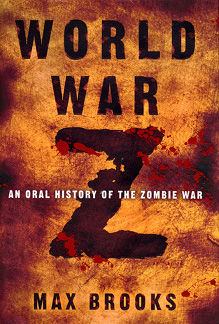
I'm not a huge zombie fan. Most of the entertainment surrounding them is pretty one-note: dead people chase, live people flee and occasionally kill. None of the Living Dead films has ever been more complex than that and most have been relatively self-contained in scope, aside from occasional details about what might be happening elsewhere. The whole world is represented by one little town or even one shopping mall. The exceptions to that are the "28" films (Days and Weeks), which examined the initiation of the problem from a purely scientific perspective (a weaponized disease that escaped containment) and which instigated the utter collapse of the British nation, and World War Z, an excellent book presented as a series of first-hand accounts collected by a UN Commission ten years after the "zombie war".


The book is used to examine any number of social issues that confront us today and which would be accentuated by the utter breakdown of society that takes place during the war, just as it does in the 28 films. That is what makes both book and films interesting, because the problems are far more complex than simply confronting walking corpses. The Walking Dead, originally as a comic and now as the TV series, is presented in a similar vein: the story isn't about running from and occasionally killing zombies. It's about what happens when society completely breaks down. Where does food come from? Where does electricity come from? Who enforces the laws? Who heeds them? Do you absorb others into your group, creating security but also creating more mouths to feed? Or do you reject all but a chosen few once you've learned to trust them?

The TV series has come under criticism from fans of the Romero movies who profess to simply want more scenes of hardcore corpse-killing action. That's a series that would last about two seasons and then get cancelled and the producers and the original writer of the story, Robert Kirkman, have often tried to explain that reality. There has to be something more to the story being presented or else it will quickly become trite. Tonight's episode highlighted that in almost every way possible and finally made the last two-and-a-half seasons well worth watching.


Lennie James returns as Morgan, who appeared in the first episode of the first season with his son, Duane (Adrian Turner), as they rescue Rick Grimes (Andrew Lincoln) after his escape from the hospital. They're holed up in their house in Rick's home town and they explain how the world has changed before Rick sets off in search of his family, promising to try to keep in touch with them by radio. Tonight, we learned that Morgan has remained in town, but shifted locations to a more defensible area where he's amassed an arsenal and established an array of traps for the walkers while he continues to paint doomsday graffiti on every available surface. Duane has died and turned at the hands of his mother whom Morgan says he was too selfish and too weak to kill. Morgan has been driven at least mildly insane by this course of events and is now determined to embody the nihilistic approach toward the world that he thinks is the only reasonable course: everyone will turn and everyone will die, so there's no sense in associating with other other people or trying to rebuild society.

This is the crux of the story: Will society be rebuilt and, if so, by whom and how? The Governor of Woodbury has one approach that seems bent on authoritarian control and an intent that society will be what they want it to be, which is closer to the approach of most of the forces present in the 28 films. Rick's group, on the other hand, seems relatively deterministic: survival is the only real goal and the future will somehow take care of itself, once the problem of the zombies is resolved, which is closer to World War Z's depiction of the problem. The Walking Dead has managed to incorporate both approaches and this episode is what brings it into focus. Morgan had been a survivor, but now presents as an iconoclast. Nothing matters and it's his own weakness that has assured that situation (again, still somewhat deterministic, as his inaction seemingly assured his insanity and change in philosophy.) As he says: "I was too weak and it's people like me that have inherited the Earth."


Meanwhile, the former iconoclast of Rick's group, Michonne, discovers in the course of the same episode that perhaps it is better to be part of a group than a loner determined to distrust everyone. She does this by assisting Carl in the retrieval of the last picture of his mother that he knows to exist. His effort to reach this is motivated by personal feelings, but also by his desire to show his sister, Judith, what their mother looked like. In this way, he firmly positions himself in the camp of those trying to rebuild society, as he understands that the foundation of many human relations is the memory of what has gone before. If we don't possess knowledge of our forebears, we're cast adrift; essentially making it up as we go along, rather than confronting problems with a set of values rooted in the past and our knowledge of the people that lived then. As Orwell said: "Those who control the past, control the future. Those who control the present, control the past." That's a bit more heavy-handed than Carl's motivations, but the truth is essentially the same. Society will be based on a vision of what the controllers feel is essential to preserve, whether out of genuine altruism (Carl) or darker motivations (The Governor.)

I've been watching the series because I'm interested in most comic-oriented stories and Kirkman's is one that has been spoken of quite highly (I only read the first arc.) At times, it was difficult to continue because the story seemed to lack purpose. It was, in fact, just a bunch of people sitting around bemoaning their fate and occasionally entertaining us with new methods of killing walkers. But the third season has been a bit of a revelation in that it finally began to address the bigger picture and this episode brought it home, not because it delivered some poorly-executed expositional homily to the idea of recreating what was, but because it showed people confronting those problems and how it motivates and changes all of them. In that respect, I think I've become an actual fan.

Sunday, October 14, 2012

Five minute impressions: The Walking Dead, season 3, ep. 1

Disclaimers:
1. I only read Kirkman's first story arc. It was OK.
2. I am not a zombie guy, despite being very much a post-apoc guy.
3. My standards for watchable TV are admittedly kind of high.


I'm a huge fan of some of AMC's offerings but it took me a while to get there. I watched the first episode of Mad Men when it premiered, but wasn't taken by it and never watched another until last fall, when a friend suggested that I was missing out and should take advantage of the series on Netflix (other people had suggested this before; this time, I listened.) I immediately realized that I should have been more patient with it, watched seasons 1-4 quite quickly, and was on track for season 5 this past spring. Likewise, I hadn't bothered to pay attention to Breaking Bad but had always put it on my "someday" schedule. After learning that season five would be airing this past summer, I once again hit Netflix for as much as was available and then watched the rest on DVD and the new season with a group of friends that had also caught up rapidly. Both series are brilliantly written and I haven't regretted one second of the time I've sat in front of them. I've often said that the best thing ever put on TV was The Wire, but Breaking Bad is a very close second, at this point.


Determined that I would not be left behind again, I began to watch some of AMC's more recent offerings from the beginning; specifically, The Walking Dead and Hell on Wheels. Unfortunately, both have been much more uneven than either of the aforementioned series. I wasn't even sure that I'd watch the second season of Hell on Wheels and am still uncertain about the third season, despite its steps toward improvement, script-wise, in the recently concluded episodes. I had the same issue with Walking Dead in its second season, as the storyline seemed to stagnate and the characters other than Daryl were two-dimensional in their motivation and hollow in their actions. Hell on Wheels improved because of a creative change in which the brothers Gayton were removed as the writers. Walking Dead also underwent a fairly dramatic change in the off-season, in which the tempestuous Frank Darabont left the project and a new showrunner, Glen Mazzara, stepped in. It was with that in mind that I decided I'd give it one more try.


I knew a lot about what was coming in this season as I've accumulated information from AMC's promotions, talk on the Web, and friends who are dedicated fans. I know that they're still loosely following Kirkman's story and that the events at the prison and the introduction of Michonne are key developments here. So, it was gratifying to see them dive right into it within the first few minutes of the opening. I was under the impression that, having seen the prison so nearby in season 2's finale, the story would reopen relatively soon after that close. A quick glimpse of Lori's distended belly and Herschel's thick beard put the lie to that and it was clear that we were seeing the group a few months post-season 2. With a new writing team and direction, I think that's fine. It gives the new team a chance to jump right into their versions of the characters and it's not jarring for the fans to see them moving as a coordinated unit when dealing with the walkers. It also gave rise to good character moments, such as Carol attempting to joke about screwing around with Daryl. It's left uncertain as to whether their relationship has taken that next step or whether they're still sorting it out, which is a good tease for the viewers.


On the one hand, having seen the prison so close in the season 2 finale, there's room to question how they could have failed to stumble across it for several months. Of course, one has to consider just how easy it is to run in circles in the countryside without modern communication and the activity of other humans to follow, so I have no issue with that. I think Rick's demonstration of disdain and anger with Lori is a sign of the writers having moved him past the angst-filled "nice guy" to a genuine survivalist in the Daryl mode. What made Daryl the only really decent character in the first two seasons was the fact that he actually matured in respect to his surroundings. He was still the callous survivor, but it was clear that he was also touched by the group actually desiring his presence and the fact that his particular code of ethics (concern for others' well-being not only as a survival method but also because that's how humans generally act in crisis) was particularly well-suited to the circumstances. If that's the direction that Rick is going, so much the better, as it will reduce the level of guilt/angst/general caterwauling that often brought things to a grinding halt in season 2. Obviously, Rick is also being set up to be too callous and cold, but I can live with that kind of development as long as it doesn't become rote "redemption of the hero."


There were a lot of ways that introducing Michonne could have been an abject failure. She's the most fanciful of Kirkman's characters to appear and it could easily disintegrate into the Roger Corman arena if she's not handled carefully. I think it was well done here, showing a bit more of her sword work and her pet zombies, but staying away from exposition and allowing her to retain an air of mystery for a while longer. I'm especially interested in seeing a bit more of her style with the weapon. On the one hand, there are different ways to use it. OTOH, in the picture above, she's holding it like a baseball bat, which is not the way a katana would be wielded whether you're doing iaido, kendo, or some kind of koryū. I really hope they paid attention to some of the riddles of steel, as it were. Unfortunately, there continues to be no riddle whatsoever about T-Dog, who keeps running his two season marathon of following orders and generally not contributing anything to the conversation. Likewise, it seems pretty unusual that Glenn and Maggie would still be that wooden with each other with another few months of life under their relationship belts.

That said, I think this was probably the best episode of the series so far. The script was well-paced and no one said anything glaringly stupid or annoying. The action scenes were more suspenseful, especially since the zombie action is moving back into enclosed spaces inside the prison, rather than outdoors in the sunlight where they're much less threatening. It's still not hitting the high points of Mad Men or Breaking Bad and likely never will, given the greater room for thoughtful subtlety afforded to those mostly-"real life" stories (yes, even including the blue meth.) But I felt actually intrigued by this episode and not left thinking that I shouldn't be watching so much TV. It's also the closest I'll ever get to seeing something like Gamma World, where mundane facilities like prisons are highly valued for the trove of stuff that could be inside...


I do have to say that, if AMC does much more of this mini-season split crap, where a series is shown eight episodes at a time, separated by several months, I may just give up even on things that I enjoy. It's ridiculous that we're waiting another year after only 8 episodes of Breaking Bad and having a multi-month split in between the two halves of season 3 of Walking Dead is possibly even worse. There is a point where you piss off your loyal viewers and, IMO, AMC is reaching it.