Showing posts with label alfonso cuaròn. Show all posts
Monday, December 17, 2018
Emotional tools
Alfonso Cuarón stated that he wanted to make his latest film, Roma, 12 years ago, right after he made the highly-regarded Children of Men. But he also said that he now feels it was a good thing that he didn't do that, since he lacked the "emotional tools" to tell the story properly. Given that Roma is a story based on those emotional tools that all of us use in daily life, I think he may have been correct in both doing and saying so.
Roma is a story told from the perspective of Cleo, a cleaning woman in a well-to-do household in Mexico City in 1970. The story is semi-autobiographical, as Cuarón grew up in the Roma neighborhood of that city and wanted to convey something about his childhood there. It becomes quickly apparent that the youngest of the four children, Pepe, is the stand-in for the director as he spends most of his time observing what is happening and spending time getting Cleo's feedback on events in the household; just as Cuarón did in preparing for the film, through extensive conversations with his own childhood housekeeper. The traumas that engulf Cleo and the members of her family (as this is clearly what they are) are not exotic or complicated in a storytelling sense, but they carry the complexity that emotional situations of this kind always have. So, in a sense, Roma is not complicated, but it carries great emotional depth because it's something that is both instantly relatable for many people and still foreign enough (leaving aside the dual subtitles; Spanish and Mixteca) to hold one's interest. Cuarón emphasizes that simplicity with the opening shot of the film over which the credits are depicted, which is nothing but the tile of the driveway, occasionally broken by water and soap suds, which we later discover is Cleo cleaning dog shit off that driveway. But it's that simple take on an everyday task that becomes entrancing when contrasted with the dense emotional interplay of the characters.
The film is also a woman-focused story, in that men are largely absent other than a couple of key moments, while everyone else deals with the impact of those moments or the impact of their absence afterwards. Fermin, Cleo's boyfriend, we eventually learn is a member of Los Halcones (from the Corpus Christi massacre), a paramilitary group trained by the government (and funded by the CIA) to react to student demonstrations. He impregnates and then abandons her before later reappearing in the midst of one of those demonstrations with severe consequences on whether she can have that baby. Antonio, the father (figure) of the family, whose most notable contribution to it is the Galaxie which can barely fit into their driveway, later abandons both car and family, leaving all of them to deal with the repercussions. Indeed, Antonio is so much an afterthought in the film that we never a closeup on his face or even see it for longer than a split second. Again, these aren't complicated storylines. The plot is not dense. The beauty of the film comes across in how simply it's told, with Cuarón's love of long shots (the opening, Cleo sitting in the theater waiting for Fermin to return, staring at the bumper of the Galaxie while Antonio tries to maneuver it inside) and stark imagery keeping the viewer paying attention to the most detailed things provided to them: the characters' faces and the emotions flowing across them. The decision to shoot it in digital black-and-white maintains that simple and spartan approach to the vision that the director wanted to convey.
There's been some debate about whether the "appropriate" venue in which to screen the film is in a theater or at home on Netflix. Cuarón, as one might expect, chimed in with his opinion at a recent event that Roma is best viewed in a theater. I think that's probably based on the mindset he wants his audience to have. In a darkened theater, there are no other distractions, visual or otherwise, and you experience the film the way he does: as memory, quietly, intimately. We ended up watching it on Netflix and perhaps that's why, despite its obvious high points, I found myself less impacted by it than I had anticipated. As noted many times before, I'm a story guy. I want you to tell me a story that holds my interest. I think Cuarón does that, but it's not a story that sat with me or had me mulling it over days later. I was entertained by it. I was fascinated, as usual, by the craft which he demonstrates in all of his films. But I found it far less earth-shattering than many other people have. I can definitely recommend carving a couple hours out of your life to sit in front of it, wherever you do so, and would be interested to hear others' experience from seeing it in theaters. But it's not a film that I would urge people not to miss. As much as I enjoyed the story, it's like many others out there.
Sunday, October 13, 2013
Gravitas. Not quite.
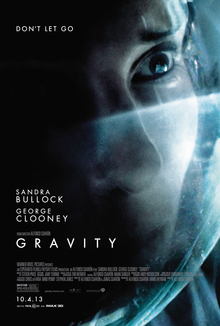
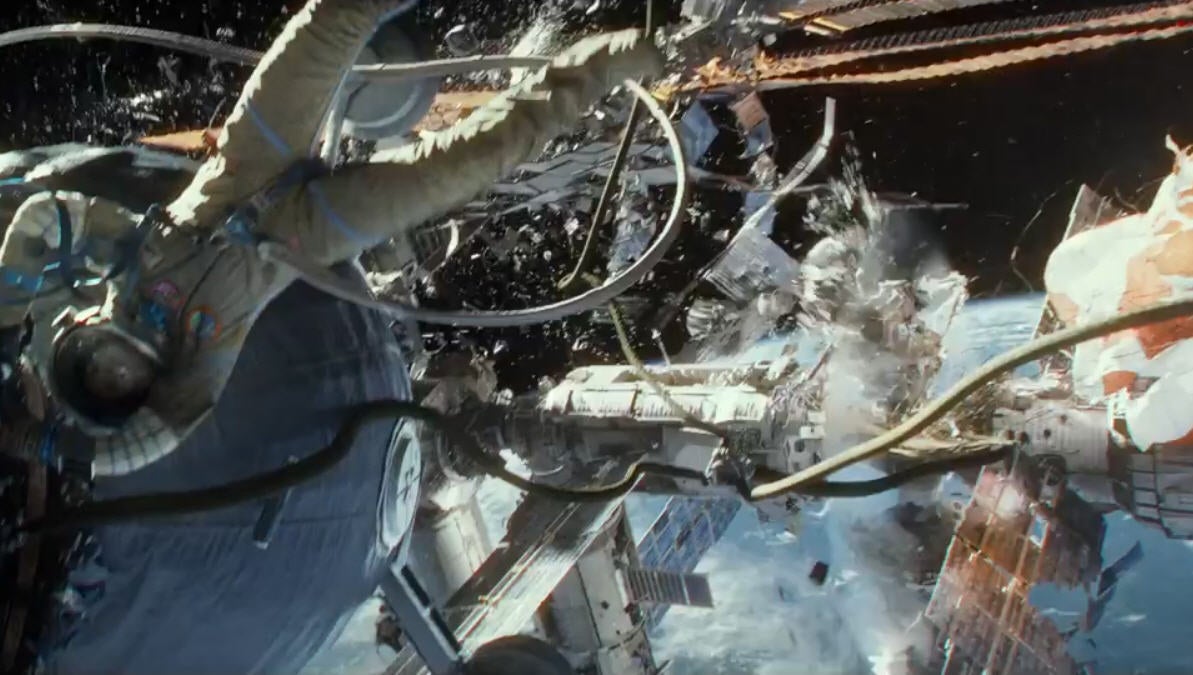
I went to see Gravity today and, for once, didn't feel ripped off by doing the whole 3-D, IMAX, extravapalooza. Multiple sources had insisted on this approach for the full effect and I'm glad to say that they were right. The immersion created by the enhanced formats made what is already a solid film more of a visual experience, which I believe was the intention of director, Alfonso Cuaròn; best known as the creator of the brilliant Children of Men. The basic premise of the film is that an accident has taken place in orbit around the Earth and George Clooney and Sandra Bullock are the unfortunate recipients of the results which makes both staying alive and figuring out how to get back down from 230 miles above the surface quite the pair of challenges.
Good things first: the visuals are amazing, which you kind of hope for in a film like this. The vistas of the planet and the stars and horizon shots can leave you sitting there in awe no matter what else is happening. It's the kind of thing you'd normally expect to see in a more typical IMAX film, generally on the order of National Geographic programming. I could have spent a lot more time just watching the lights of Cairo and the Nile Valley go past the camera and there are moments where that kind of thing happens. I think Cuaròn did an excellent job in transitioning between moments of intensive action and dead, ominous silence, which is the normal condition of outer space. Since this is intended to be a contemporary film, there are no science fiction elements added and the activity of humans in space is reminiscent of one of my favorite Ridley Scott films, Alien. This is work. It's scientific and industrial and often the most important piece of equipment is a power ratchet.
The pace is tense. Even during the "quiet" moments, the awareness that the characters are in the most lethal environment known to humanity is everpresent. Scientific principles of the film's title are at the forefront of what occurs and it's obvious that great care was taken to convey that detail. This is a film about what could actually happen and no amount of reconfiguring the main deflector dish will fix it. Both Clooney and Bullock help this sense of pace by generally reacting in a genuine fashion to their extraordinary circumstances. Clooney's role is the old-hand space veteran and you never doubt that. Bullock is the rookie brought up to make specific alterations to the Hubble Space Telescope and she tends to panic over the environment far more than the veteran, as you'd expect.
OTOH, I don't think Cuaròn was able to get all that you might expect out of these two excellent actors because of one main problem: the story is pretty thin. There's an accident in space and these two have to figure out how to get out of it. That's it. Most people tend to believe that novels make films. In other words, you have a story that has x amount of depth to it and the film will absorb all of that depth, turning half the 60K words into visuals and the other half into dialogue and action. Of course, film history is filled with examples of how a 2-hour film can't possibly convey the complexity of the novel that it's based upon. The issue with Gravity is that its central premise wouldn't even be that compelling of a short story because there simply isn't enough depth to it. It's a very linear equation and there aren't too many ways to explore the personal dynamics of the characters involved because the movie isn't about them so much as it is about the event. If you're OK with that, then it's all good. But I'm normally swayed by story, not how much eye candy you can show me, and Gravity largely doesn't have it.
What it does have at certain points seems either contrived or tacked on. Bullock's character's personal history becomes a primary motivator at a certain point and that was interesting as she struggles with issues that have nothing to do with her current circumstances. But when she comes through that, her newly-resolute attitude and decision to make everything work struck me as very, very Hollywood and not really convincing. Of course, the very limited amount of dialogue in the script outside of official announcements or panicked gasps certainly doesn't help with this and I think Cuaròn was aware of these collective weaknesses and wisely kept the film to a fairly brisk 91 minutes. You can barely get children's movies that are that short these days.
For those of you among the science-inclined, you should have no trouble with suspension of disbelief for the vast majority of the film... except for one key moment which is unfortunately huge in the story and the two characters' presence in it (when momentum is arrested, it stays that way unless other forces are active...) Even my relatively shallow knowledge of astrophysics could pick that out, but sometimes you need to make a story work and Cuaròn did very little papering over such that most viewers should be fine with events as they happen.
So, is it a classic of Oscarian proportions? Eh. No. It was good and, as noted, it's an accomplishment for me to say that I didn't mind throwing down the extra cash to see it in as visually-enhanced a manner as possible. But I also wouldn't say it was "Absolutely cannot miss!" in stature. I saw it mostly because I'm a fan of the director and Clooney and the rave reviews were enough to push me into the theater and, certainly, it will be far more impressive on a 3-story screen than it will even on your 60" plasma, but it ain't like escaping an event horizon.
Subscribe to:
Posts (Atom)