Showing posts with label house of the dragon. Show all posts

Wednesday, October 26, 2022

Could watch it in my sleep

The title of this piece is perhaps counter-intuitive because most people's dreams aren't predictable. Indeed, what makes many dreams so memorable is precisely how unpredictable and bizarre they often are. They're potentially great stories, although sometimes lacking rhyme or reason (Let me be far from the first to state that Rick Veitch's Rare Bit Fiends was awful, self-indulgent crap.) House of the Dragon, in contrast, has been utterly predictable from the opening moments of the series. No one ever did anything surprising. Few enough of them did anything that one would connect with a human's often irrational and emotional reactions. Everything has been acted out precisely to form, as if we were watching a dramatization of the Westerosi encyclopedia entry of The Dance of Dragons. As I've mentioned before, that's essentially what the "novel" Fire and Blood is. But it's disappointing to see it conclude without a single deviation from expected form, to where you could recite the outcome of each scene (and its pedestrian dialogue) before it happened.

Now, I can see someone arguing that I'm complaining about the converse of what I was complaining about with regards to the finale of Rings of Power. But the problem with Rings wasn't that they stuck to form. It's that they savaged their encyclopedia (the appendices of Return of the King) for a cheap marketing trick. Theirs was a failure of approach and perhaps philosophy, rather than execution. The problem with House isn't that it was setting up for a stunt ending. It was that they weren't really interested in doing something even vaguely as innovative. Case in point is Rhaenys Targaryen. Eve Best has had the misfortune to play a non-entity for 90% of the series. Outside of one scene where she reproves the young Rhaenyra for having the temerity to think that women could make their own choices in Westeros, she's had basically nothing to do but be an add-on to whatever room she found herself standing in. She doesn't really do anything and, when she does, it's the most obvious reaction of scolding her overambitious husband or grieving the loss of her children. This all changed when she came bursting through the floor on dragonback. Suddenly, she had agency. She could make her own choices and people had to pay attention or get roasted or eaten alive. That is, of course, the prevailing theme of the series: women who lack agency, despite the intelligence and will to compete evenly with the men around them. But when she does achieve this agency, she uses the latter half of the finale to simply stand off to one side and smile knowingly at whatever Rhaenyra or others do to prepare for the coming war, almost like she could've predicted all of it because, well...

Now, you could say that part of the problem (which I've mentioned before) is that House revolves around one house (appropriately) and said house is made up of Targaryens who consider themselves to be above typical humans. Daemon certainly acts the part. In a way, it could be considered as the same problem that DC Comics has with its characters, who are superheroes first, humans second, in contrast to the far more successful and relatable Marvel heroes, who are almost always humans who just happen to be super-powered. When all you're writing about is demigods, it gets difficult to find ways for their very human readers to relate to what they're doing and how they act. But I'd argue that the Valyrians don't have to be presented as aliens among men and could, in fact, present a very human side that would not only make them into characters that people would find appealing (an Arya; a Tyrion; a Hound) but would also create genuinely interesting opportunities for the story. Aegon is the perfect example. Here's a man who is repelled by responsibility, is plagued by self-doubt, is an alcoholic, and is obviously depressed about all of that, but mostly about being dragged into the role of king. With all of this written plainly on his face, his doting mother hands the borderline suicidal king-in-waiting a dagger when they're riding to his coronation.

My immediate thought was: "Yeah, the best thing they could do here is have him wait until the crown he doesn't want is put on his head and then stand up, turn to the crowd, and slit his own throat with that pretty knife." Not only would that be his last attempt to show them his own agency and how much he's taking in order to not be forced into this thing that he fears and hates, but it would send all of their precious plans into a tailspin and force the writers to come up with a few more turns as to how they actually get to the big, impending conflict. Instead, what we got was the utterly unbelievable moment of the man who hates all the attention suddenly transforming into the king his family wants because he's given more attention by a cheering crowd. Wut? It will, of course, lead to the perfectly predictable situation of them having finally rid themselves of the king no one liked having on the throne (Viserys) because of how he wouldn't act kingly only to have yet another king no one likes because he's an alcoholic deviant who likes to watch kids claw each others' eyes out before screwing the victor. In other words, we'll just be in essentially the same situation we've been in for the first season where everyone plots behind the king's back because he either is incompetent or they assume that he is. Yawn.
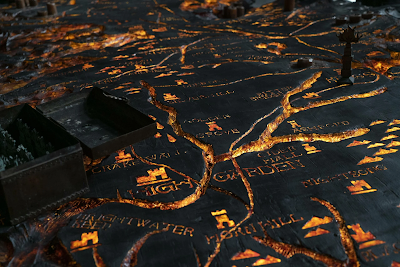
Lighting up the table may have been the most exciting part of the whole episode

This is all so obvious that it's approaching tedium. I sat through a film last night (Ticket to Paradise) that was almost exactly the same: totally predictable; no character deviating from their assigned role in any way; boilerplate dialogue; and an ending that was almost too saccharine to be believed. House at least lacked the Hollywood ending, but it was still something that anyone could've seen coming from the opening credits: child dies, mother gets angry, war is initiated. There's nothing interesting here, except for a few moments of Matt Smith having to be the lone emotional outlier. The writers decided to capitalize on that for the almost baffling choking scene, which the showrunners later declared was the way they reminded the audience that Daemon was dangerous. I've reminded five-year-olds that coin flips are random, too. It's every bit as exciting.

Thursday, October 6, 2022

It's a soap opera


Despite episode 6 of House of the Dragon being, by far, the most interesting of the season, since episodes 1-5 were nothing but prologue leading up to the actual conflict, I didn't get around to writing anything about it because, honestly, the whole series just hasn't been that interesting. In episode 6, we finally got to see Alicent and Rhaenyra become fully-fleshed characters being driven by something other than youthful uncertainty and teenaged angst. That's definitely a step forward. We also got to see the conflict upon which the entire story is based become (almost) fully realized, in that the lines were clearly drawn and the questions loudly asked. We even got to see the emergence of a Master of Whispers in Sir Larys Strong; the role which would go on to produce the eternally wonderful Lord Varys in Game of Thrones. But through it all I was left with an overarching feeling of disappointment with the knowledge that the 5+ hours we'd sat through to that point could all have been condensed into a one-and-a-half hour film that would have dropped us into the situation with adult Rhaenyra and Alicent much more quickly and we could have gotten the show on the road. Well, with episode 7 the show has largely arrived and... it's as tired as anything that has come before it. Oh, sure, we're back to the grisly deaths and Valyrian incest and millions spent on dragon scenes. That's all well and good if you're into that. But we can't really rise into the realm of GoT because House has the problem of its essential nature.

It's a soap opera. With dragons.


The compelling feature of GoT was its sprawling nature. It was a story that was steeped in history, not only because of the setting, with the ancient Others being in the background of a land that had just had a massive political upheaval after centuries of Valyrian rule, but also because each house and family were their own entities, with histories of their own and cultures of their own. This was a conflict with many angles and many roots and, 'lest it not be said too infrequently, compelling characters. By confining the story to just the Targaryens and their hangers-on, we're missing all of that sprawl that gave the story of Game its massive identity that could draw audiences in to find any number of sides to root for. It also meant that the grievances driving the central conflict had bases in something other than "He hit me first-!", which is what you get when you reduce everything to an intra-family squabble that lacks any other compelling theme like race, religion, geography, or history beyond whom was screwing whom at the right time and which person had the right body parts to get pricked by the dangerous throne. There's nothing expansive about this story. It's like Dallas, but without the oil business. They've tried to add in elements of interest to the kingdom as a whole, but they've succeeded in making all of it a sideshow by pushing those elements back into the background after the death of the Crabfeeder and going back to circling around children swatting (or slicing) each other in the courtyard. It's not too far from history to suggest that wars could be fought over the question of a child's parentage, but it's a lot more interesting when they're fought over the fact that the lord of House Stark was beheaded because he couldn't trust a minor lord from the Fingers who was better at manipulation than anyone else in the kingdom.


I mean, sure, some people love soap operas and dragons, so I'm sure those people are thrilled. And there's no argument that a lot of dramatic fiction, fantasy or otherwise, does carry elements of modern soap operas. But that's because most dramatic fiction in the Western world finds its roots in Shakespeare. It's still possible to tell a story without reverting to the devices that made shows like All My Children and General Hospital appeal to the lowest common denominator. At the moment, House is using most of said devices with a little incest thrown in to spice it up. Something tells me that CBS in the 70s and 80s wouldn't have gone for that storyline. But what they would've done better than this latest episode is properly lighting a night time scene. People were complaining on Twitter because it was "too dark." What they should've been complaining about was the use of a technique that hadn't been seen since those 1970s: putting a gray screen over the lens to make it "seem" dark, when it's actually broad daylight which everyone can, of course, easily see. Modern lighting techniques removed the need for that primitive trick about, oh, 40 years ago. And, yet, despite the massive budget behind this show, we get this trip back in time to when the audience had to play along with the director informing them that it was "night." I'm amazed that they thought this was a good idea. That is unless Driftmark had, uh, drifted to somewhere near the northern pole of the planet and everyone was heading to bed at 10 PM in the land of the midnight sun. Or did all of the scenes with Vhagar tap the SFX budget for this episode? If that's the case, there will be some really unhappy fans when it comes to the battles that happen during this conflict that are supposed to involve multiple dragons and thousands of warriors. At this point, I'm pretty sure that I'm not going to bother to be disappointed.


Yes, if you're well-versed in the lore of Westeros, you perhaps can take pleasure in the idea of the Hightowers angling the conflict in their favor to take what they feel is their rightful place above the Tyrells as one of the oldest houses in the kingdom because of how they were cheated of mastery of the Reach when Aegon selected the steward house for the destroyed House Gardner. You could be tickled by the idea of Aemond mastering Vhagar, dragon of Visenya, sister-wife of Aegon the Conqueror 150 years before. But taking pleasure in those things occurring is an example of being a fan of world-building, not storytelling. Something that Rings of Power has been attempting to do (with very mixed results) is to tell stories about the characters at hand and not simply do a slideshow of the big things that happened in the appendices of Return of the King. But that's pretty much all that House has been from the very beginning (see: Fire and Blood) and if their only way to give it character of its own is to reduce it to which family member is irritated over the lack of respect from another's children, then we're really kind of wasting our time here, just as we were through the interminable prologue that got us to this point.

Wednesday, September 21, 2022

As plain as the nose smashed into your face

I didn't bother to write this the night of the most recent episode of House of the Dragon because I didn't bother to watch it that night. We just really had better things to do (and the best episode of the season so far for Rick and Morty more than made up for it.) Having finally gotten around to watching it, I have to say that the wait made no difference whatsoever. The overriding impulse for House to this point in time is boredom. Everything is obvious. The competing interests are obvious. The reactions of every character are obvious. The showrunners explaining their self-evident motivations, both within the story and their intentions for the story, could not be more obvious. In many ways, the "inside the episode" so-called 'revelations' seem exactly like how I felt when trying to read Fire and Blood. All they're doing is reciting a litany. It's all been played out in front of them already. It's the equivalent of an oral history heard one too many times. It's become mundane and rote.

This episode for all of its "shocking" intent was just the same. Seeing both Ryan Condal and Miguel Sapochnik explain that they felt they had to set up the episode in this fashion because Game of Thrones fans "expect that weddings won't go well" is fan service of the plainest and most idiotic sort. They're essentially admitting that they have no story to tell. They're simply reciting the litany that GoT fans are supposed to expect. It's not innovative. It's not original. It's not interesting. It's just performative. The fact that they chose to take a presumed modern approach with Laenor Valaryon (John Macmillan) is a nice concession to the fact that people, even royal people, throughout history have had different sexual identities but if that's the most innovative thing you can present in your entire storyline to date, then you're really struggling. I guess you could say that the production has fallen into line with the entire reign of Viserys; always appearing weak and surprising no one with its ennui.

The central fact that I keep bemoaning is the lack of a magnetic character; ANY magnetic character. The most genuine moments continue to be shared by Rhaenyra (Milly Alcock) and Criston Cole (Fabian Frankel), as they're the only two that seem able to express a genuine emotion that isn't angst or outrage, with accompanying cynicism about how all of this is such an act. (The Bard's "All the world's a stage" quote was perhaps never more appropriate.) If any one of these people could do one thing that wasn't completely predictable, it might rescue an entire episode for me. Hey, look! We got to see Rhaenyra roll her eyes at the boorishness of Jason Lannister (Jefferson Hall) for the second time in a month! That's, uh, not new. I'm a story guy. Give me something- anything -that tells me that these people aren't just locked into a script that has them moving and talking like the animatrons on an old funhouse ride, gesturing and shifting in the same patterns forever. OK, there was one interesting point when, for some reason, the Velaryon ships pulled out their oars while they were at full sail approaching the city. Unless they were planning to beach said ships and never return that, like the rest of this series so far, was a very bad idea.

But, hey, Nielsen declared numbers the other day and House is supposedly drawing the strongest of any HBO show since GoT, so I am clearly in the minority. Or perhaps there are simply millions like me who are watching to see just how oddly disinterested they can become. Next episode is finally the jump forward to adult Rhaenyra and Alicent so, OK, maybe we can chalk up half of the entire season as simply setup to the "real action?" Does that sound interesting or compelling to anyone? Bueller?

Monday, September 12, 2022

Riding the dragon


This is where we begin to question what actually makes a good story in House of the Dragon. It's occurred to me a couple times that George R. R. Martin might have taken some of the criticism of his books and the subsequent TV series to heart about the role of women in Westeros. His intent was to present a set of cultural conditions that would have been typical of Middle Ages and Renaissance Europe and which, honestly, remained largely similar even into modernity, especially for the noble classes still conscious of how trading women could gain them money and status. His response to those conditions was largely embodied by characters like Cersei, Arya, and eventually Sansa, who manipulated, evaded, or endured (and hardened; at least somewhat in the books by the end of Dance of Dragons) those conditions, respectively, to forge as much of their own path as they could. But despite their starring roles in ASoIaF, the voices complaining about the general misogyny of the setting became louder and more numerous. When he switched over to what seems like an endless delve into the history of the Targaryens, he pushed that issue to the forefront. This was no longer a story about ice demons and prophecies, but about political struggle quite focused on the question of whether women deserve to be treated as equals. This is why Rhaenyra is the focal character of House and probably why it's far less of a sprawling epic, since the vast majority of the plot tends to center around her and the consequences of her actions. So, at root, House is a story about sexual identity, which means that sex, even if we hadn't seen it regularly in Game of Thrones, would naturally be an important aspect of it.


With that in mind, it's fair to question at this point whether depictions of sex are just titillation or actual aspects of the plot. I pointed out one instance in the first episode where it was clearly the former, as we didn't need to see Daemon's experience with actual impotence (in addition to his political impotence) in a brothel when it could have been displayed in one room with his consort. But GoT-style sexposition being what it had been in the past, I'm assuming the showrunners decided to just follow suit. Last night's setting was somewhat different, in that it was a chance to see Daemon showing his niece what the other side of King's Landing looks like, as well as explore the chemistry that's existed between them, with the idea that he might not only get back at his brother in a rather vicious way, but also take one step closer to the throne by, y'know, screwing the currently-named heir. The fact that he happens to be her uncle is less of a concern for him, trying to be a prince of genuine Targaryen/Valyrian outlook than it is for Viserys, who's mostly trying to keep a pile of unstable alliances with the far-less-sanguine-about-incest Westerosi houses under his thumb. The fact that it would have been Rhaenyra's first sexual experience, as a virgin waiting to be traded for highest value, adds another layer of complexity to it.


From a storyteller's perspective, what I've been mulling over is: Knowing that the thing that most people would be discussing would be the fact that Uncle Daemon almost screwed his niece, does that serve your story?  Certainly, a story about politics will often involve sex because politics is about life, as I was saying over here. As noted above, a story centered on sexuality is even more likely to involve sex. There's nothing wrong with that, as long as it serves that story. Will most of the commentary be about the motivations I mentioned above or the fact that Daemon was once again unable or unwilling to perform or the fact that the two of them have already exhibited an attraction for each other and what all of that says about their characters? Or will most of the discussion be about the fact that he almost shagged a 16-year-old? The fact that she later went on and had that first experience with her oathsworn personal protector, also much older than her, and whom would be likely burned alive for participating is almost a side note to the main scene in the brothel. Alicent is, of course, the prime example of the type of life that Rhaenyra is trying to avoid- trapped in an uncomfortable relationship with a man she isn't attracted to and feeling like nothing that happens is her choice, including sex -so the fact that she made her own physical choices that night (and seemed to be ready to make her own earlier with Daemon) is the centerpiece of this story. This is what it's supposed to be about. But I'm still left wondering if people are really going to get that in the same way they might have if the brothel part was left out of it.


This might be a microcosm of my continuing unease with the whole series. I mean, sure, sex. Sex is fun. I'm not objecting to the brothel scenes in the same way I'm not shocked by the potential incest. If that's what your story is about, then, there it is. Part of what's leaving me adrift is that so much of the rest of what's going on outside of Daemon is kinda pedestrian. When Cersei and Jaime Lannister were first presented, they were wicked people AND they were screwing siblings. But there was an element of texture to their menace that was fairly rapidly revealed to be high intelligence and an understanding of where each of them stood in society-at-large. Even though she was better at playing the game than the vast majority of men involved, she was still a lesser entity in that game than they were. Jaime's confrontation with Eddard in the streets of the city was more an expression of his affection for Tyrion and an acknowledgment of his role as a tool of his house than anything to do with his own personal perfidy. You could see all of this in the first couple episodes. So far, I'm not getting anything nearly that complex or interesting from anyone but Daemon, which is only continuing the trend from the first episode where he was the only one with an actual personality. So far, these characters just aren't deep enough to be intriguing, which only makes the presentation of what could be character- and culture-building moments like the brothel scene seem more like titillation to distract from the fact that most of these people just aren't that fascinating. One mild exception is Ser Criston Cole (Fabian Frankel), since he's been playing the role of the guy who's extremely conscious of just how out of place he is quite well.


The reality of most speculative fiction is that it can be either plot-driven or character-driven (unlike most literary fiction which is largely the latter.) But to be plot-driven, you usually need some more high concept stuff than "noble families bicker over throne", dragons or no dragons. GoT was character-driven. There wasn't anything involved that ventured too far past bog-standard fantasy other than a willingness to kill major characters because more major characters in these settings should die more often or everything becomes trite. ASoIaF is a character-driven story and the showrunners of House are presenting this show as the same sort of thing. But to do that, you need interesting characters and, so far, it's lacking in that respect. It is improving from the first couple offerings, but that's not a really high bar by which to measure. I'm holding on to kinda just see where it meanders off to. The preview of what may be happening to Viserys next week means that things might start to really accelerate. Will the story be able to carry the lack of compelling people? Dunno.

Monday, September 5, 2022

Nothing but devices


Most historians will tell you that framing the topic at hand is of significant importance in how it's received. If you present the American Revolution as a bunch of hard-working frontier people angry about how they were treated as nothing more than a source of revenue by the English crown, it's a much different picture than saying it was a bunch of wealthy landowners who knew they'd largely escaped the grip of the king's tax collectors and didn't want that to change. There are degrees of truth to both of those, but the way it's depicted by the historian will have a huge effect on how it's remembered. Fiction is similar in many ways because the way that different characters and events are presented will leave the reader/viewer with a different impression of just what the story is about. Episode 3 of House of the Dragon told us more about what the previous episodes had been (e.g. nothing but preamble) and less about where it's going, which has been obvious all along.


One thing in its favor is that, three episodes in, we've finally reached a point where the story is actually moving forward to some degree. Daemon's solo assault on the Crabfeeder lurches us past the Stepstones side plot and carries with it some meaning for both him and the popular perception of whom should be king. The rest of it was the same dithering about Rhaenyra's frustration and Viserys' indecision and the generally corrupt nature of Westerosi high society. In many series', you'd call events like Viserys slaughtering the immobilized stag and Rhaenyra complaining to her sworn protector "character development." The problem here is that we already knew all of these things. We know Rhaenyra is frustrated with being passed over because she's a woman. We know that Viserys is struggling with his personal feelings about the succession and how he feels bound by tradition. This is just the same chorus in a higher octave. We don't really need these static positions "developed" any further. It's gotten to the point where the "Inside the Episode" segments that follow each offering are either pedantic or self-defeating, in that they're showing the motivations of the storytellers and how interested they are in getting their story points across to the audience when those points are patently obvious from the opening minute of the series. They're not offering any deeper insight. Instead, they're just showing how simple the story is and how it hasn't really gone anywhere until the last few minutes of this latest episode.


The story of the Crabfeeder is an interesting quandary from a theoretical perspective. Clearly, the character has some history with the Targaryens. Given the burns all over his body, one might assume that he's had an unfortunate encounter with a dragon and has decided to take vengeance on the rulers of Westeros in whatever way he can manage and with the tacit support of the Free Cities trying to knock a rival down a peg or two. That sounds like something that could have been built upon, even if it was an obvious distraction from what the real story is: the fight over the succession. But the amount of atmospheric build-up in the first three episodes which led to this three-year problem being dealt with off-camera by Daemon was kind of jarring. Yes, the whole fight on the beach was an example of Daemon demonstrating that not only did he not need his brother's help to do the job (a point emphasized by trying to literally kill the messenger) but that he was also the more appropriate "warrior king" that the Westerosi nobility might respect. But it was also a removal of a story element that had been sitting in both background and then foreground, with several moody scenes emphasizing the threat of said element, which was then eliminated in a few seconds, off-camera. This was something akin to the massive, years-long threat of the Night King being wiped out in a single battle of a single episode. In other words, the Crabfeeder and everything around it was a device and nothing more. No, we didn't need the end of Joseph Campbell's journey where we see a literal blow-by-blow depiction of the final battle, but it really rubbed our noses in the fact that all three episodes to date have been nothing but setup, which kinda makes one stop and ask: Why am I bothering?


What reemphasizes that dolor is anything involving Viserys and the court. It's tedious. Unlike the cut-and-thrust of Game of Thrones, where the interaction between people like Tyrion and Varys and Cersei was always loaded with potential and menace and actual good dialogue, everything involving Viserys' court is a chore. There is some sympathy for the king as a man in well over his head, but that's about the most emotion I can generate for yet another moment where everyone titters and looks uncomfortable about the king who's in over his head. There is no "game" happening here. It's emblematic of a society long removed from any kind of game or competition over who would rule, except for the obvious setup of this being a(nother) series about who is going to rule. This is history presented as a World Book encyclopedia, not as something that gives a real examination of who or what was involved and how their motivations can be interpreted in any number of ways. There are no "number of ways." There's just one, point A to point B, and it's mostly pretty boring. If we thought there was any possible variation on how this story would play out, all of this prologue might be worthwhile. But there really isn't. I'll give it another episode or two to see if that ending battle scene might take the story somewhere interesting but, if not, I'm giving up the ghost and moving on. (Rick and Morty was so good and so suffused with possibilities...)


Monday, August 29, 2022

History is a funny but weighty thing


There's a lot that goes into the very concept of history. You'll hear all kinds of aphorisms about it as a concept, such as "history is written by the winners"; an assertion that suggests that the way things are remembered is determined by those who are in control. The modern Republican party is very eager to (pun intended) whitewash many things out of the historical record, thus creating a common wisdom that will work against the idea of what actually happened. Both of these approaches play into my favorite Orwell quote: "Who controls the past controls the future. Who controls the present controls the past." Humans are creatures of habit. If something becomes "tradition", then it will tend to stay that way and, just as importantly, be thought of as if it were always that way. This is why the modern discipline of historiography exists (and why the politics of base motivations is almost always awful.)

House of the Dragon, as just one element of A Song of Ice and Fire (neither of which are actual elements for the non-alchemically-inclined among you), is suffused with history. George R. R. Martin began writing the novels because he was inspired by the history he'd read about the power games between the city-states of medieval Italy and other locales of that period. In many, many cases, the idea that "truth is stranger than fiction" is quite accurate. Yes, they really did do things like that back then and so neither Game of Thrones nor House has shied away from presenting the realpolitik of the Middle Ages. After the latest episode of House, a friend mentioned that he was almost repelled by the idea that Viserys was being encouraged to marry a 12-year-old. But that's what happened among the upper classes of earlier times. Marriage was a contract for money and power. Women were the property exchanged in said contracts. Families were sometimes outraged at the emotional attachments of their children, not just because the prospective spouses were seen as beneath them, but because emotion often forestalled the opportunity for the family to gain more money and prestige. This is that "family loyalty" that Tyrion always struggled with in GoT. But, pick up most books about medieval Europe and you'll get a ton of this, if you hadn't already seen or read enough examples in the earlier show or Martin's books. And that's something to consider when watching House.


There's no arguing that the second episode was better, overall, than the first. Pilots are often difficult because they spend a lot of time setting up a story rather than progressing one. It's world-building instead of storytelling. In this latest episode, we got a lot more of the latter, as the various factions displayed more texture and some of the essential personal conflicts were introduced. We have Daemon's outrage at being replaced mixing with his love for his brother and loyalty to his house (and the realization that he'll be deemed a traitor for the rest of time if he fails; there's that history thing again.) We have Rhaenyra's frustration with being treated like a dilettante or a placeholder just waiting to be returned to the status of property, now compounded by the realization that her father is going to marry her best friend in order to produce an heir to replace her. We have the scheming of houses Velaryon and Hightower to affect those events and more. And we have some guy who likes feeding people to the crabs. (Everybody's gotta have a hobby.) This is all better and more interesting that watching the rich laugh at the death and dismemberment of those sworn to serve them, certainly. But it's also pretty typical of what the previous show was and it still lacks anyone that could even vaguely be considered compelling.


Again, Martin developed ASoIaF with a strong sense of history(!) In the same way that Ridley Scott discovered that test audiences wouldn't believe that gladiators pitched products from the floor of the arena just like modern commercials, Martin knew that there was plenty of material about stuff that actually happened to inspire a fantasy series where it could take place and people could feel comfortable about being one step removed from it. But House, so far, isn't removed enough from what we've seen before. It's a step forward in some respects in that there are no obvious "bad guys" like the Lannisters or the White Walkers. But one of the best parts about having the Lannisters be the "bad guys" was how interesting and entrancing their central figures- Tyrion, Jaime, Cersei, Tywin -all happened to be. Tyrion was never a "bad guy." Jaime was but then became a nominal "good guy." Cersei and Tywin stayed "bad guys" the whole way through, but you always really wanted to see all of them on the screen because they were almost always going to do something interesting. There is no one like that who has yet appeared in House. Due credit to actors like Milly Alcock as young Rhaenyra and Paddy Considine as the eternally self-conscious king, Viserys, but those people just aren't that interesting. Perhaps it's a matter of the characters in GoT being already familiar with the game (win or die) and given roles that emphasize that knowledge? But then you'd expect people like Otto Hightower (Rhys Ilfans) and Corlys Velaryon (Steve Touissant) to fill roles other than "person who looks at everyone like a dog just pissed on the rug" and "performative but still subdued outrage every time I don't get what I want", respectively. (One could easily imagine Corlys kicking the dirt every time he gets told that Viserys won't do anything about the Stepstones.)


The basic plot is still missing some of the heroic themes of GoT, which is always going to be a bit harder to sell in Western storytelling (see: Joseph Campbell.) But I'd actually appreciate a step away from that, if only everything happening in House right now didn't feel so... tired. It still feels like we've seen it all before because, in a way, we really have. I might be more subject to the bias of someone who's been repeatedly exposed to precisely this story in Martin's canon (How much more interested would I have been in a story rooted in the commoners' perception of the world around like, say, Dunk and Egg? Very.) But we've all been exposed to it, to one degree or another, if we watched GoT. How much better or different can it get than what's gone before (minus the last two seasons, at least)? It seems odd to say this, since this kind of Machiavellian competition stuff is usually right in my wheelhouse of interest. But, so far, I can't say that there's a whole lot of draw to Sunday nights outside of morbid curiosity. We'll see how long it lasts or if it changes.

Monday, August 22, 2022

Rehashed plots with dull characters may not be the best approach


Those of you who've been reading for a while (all three of you) may remember when I was regularly writing about Game of Thrones. It was, for the first five seasons at least, one of the best shows on TV at the time. It takes some real talent- writing, acting, producing -to make a series of that quality for that long and that's why, in the somewhat-pre-streaming era, GoT became what most are referring to now as a cultural touchstone. It's one of the last series where people were gathering around the water coolers (you know, when people used to go into offices?) to talk about the Sunday night episode that had just dropped. The Battle of the Blackwater. The Red Wedding. The duel between The Mountain and The Red Viper. How hot the sexposition scenes were. All that. That's a more difficult scenario in this, the age where entire seasons can be consumed in a day, but there are still shows that have a bit of a culture-wide thread by dint of both their restrained production (weekly episodes) and the high quality of their acting, writing, direction, and overall production, like Better Call Saul. The first spinoff from GoT, House of the Dragon, has set itself in that first mode, repeating GoT's Sunday night schedule, but is lacking significantly in the latter aspect.


The first Damocletian sword hovering over the series may, in fact, be its connection to GoT. I'm not sure there's a parallel in television history where a show of that quality took such a nosedive in not just its last season, but its last three seasons. The capper, of course, was the final couple episodes where it was more than evident that the producers and writers were really eager to say goodbye to Westeros before HBO could try to throw more money at them. Of course, one could look at the mother series and think that another factor that torpedoed it was the lack of George R. R. Martin's plotting. Once the story had moved past his books, it was David Benioff and D. B. Weiss with an outline and no one to tell them they were wrong. House does not have that problem because it not only is following Martin's "novel", Fire and Blood, but also has him directly involved in its production (perhaps to forestall a downturn in quality? Hard to say.) But part of the issue may be the story itself. I refer to the book as a "novel" because my brief experience with it found it to be more like a fictional documentary in book form. Martin and some collaborators had already produced The World of Ice and Fire; a coffee table-style tome that was something of an encyclopedia about the world that contains Westeros and Essos. Said tome contained a great deal of detail on the "Dance of the Dragons" which is the general term for this period in House Targaryen's history. Then he produced Fire and Blood, which goes into even more detail on said period. I got about 30-some pages into the latter before realizing that I was just rereading the same history (not story, really) in even more detail and put it down, never to be opened again so far. Just like with Star Wars, if you're doing a reboot, tell me it's a reboot. Don't try to sell me on something new before handing me the same thing I've already seen or read.


And, of course, a lot of people will say something similar (or already have) about House. It very much is back-to-basics Game of Thrones. In a sharp turn away from the pointless action scenes and rather brusque storytelling of the final couple seasons of the mother show, the showrunners for House have decided to invest heavily in the action-by-discussion method that produced the often-wonderful political machinations and storylines of the first series. The problem with that is two-fold: 1. Doing that in the first episode produces a pace that likely has already alienated some viewers. 2. You really need compelling characters to sell that approach, especially in the first episode. What made the later seasons of GoT still somewhat must-watch TV were the characters; most of whom were introduced in that first episode in 2011. House had precisely zero of that kind of character in its opener. There was no witty but rueful Tyrion or menacing but conflicted Jaime or earnest but frustrated Arya. In fact, almost none of the characters presented in last night's opening episode had any personality at all. They were just inhabiting roles to move the plot along because the script said to do that. The only exception was Matt Smith as Prince Daemon. His personality just happens to be "arrogant dipshit", which isn't really a selling point, but there it is. At least he's something other than a dilettante or a mannequin, which really defined the rest of the cast. I mean, perhaps it's a compliment to the veracity of their characters that most of them are so accustomed to being above all of humanity that they didn't actually display any humanity for the entire hour? I'm all about characters that are appealing because of their lack of emotion (witness the comic version of V in V for Vendetta as opposed to the Hollywoodized and stereotypical film version), but they normally have to be a bit more dynamic than anyone was in the first episode of House.


To break up the tedium of discussions about stuff we already know and tittering about what someone is wearing to the joust, the producers decided to continue in the GoT vein but even more over the top, as it were. Not only did we have the obligatory orgy scene, but were handed a feast of blood and violence that was even more gratuitous than anything this side of the nearest direct-to-video/Amazon streaming slasher flick. We already knew that the queen was going to die in childbirth (even if you hadn't already read Martin's histories, it was obvious that she was there to present the "difficult birth" scene from the moment she appeared on screen.) Exactly how many minutes of Emma (Sian Brooke) screaming from her pool of blood did they think was necessary to get that across? For that matter, how many skulls needed to be split open to demonstrate that jousts were violent contests? One probably would've been enough, but not for Ryan Condal and Martin, apparently. Those were the moments of "action" that were supposed to provide respite from the sneers and muttering of the Targaryen (and hangers-on) family, but all they really were was a different form of tedium. I used to do a "Lines of the week" feature for each episode of GoT. I can't think of a single moment from last night that was clever enough to jot down as being memorable.

Pilots are tough. Opening a series with all of the baggage that Westeros still carries is an even steeper hill to climb. But the showrunners did themselves no favors with this beginning. We've really (in some cases, literally; pun intended) seen it all before and it wasn't nearly as interesting as it was the first time. I'll keep watching for another episode or two, but if the writing doesn't improve quickly, my disdain will be overwhelming and it will have nothing to do with the stink of a dragon.