Sunday, May 11, 2014

Trials and tribulations


So this is the point where you could feel like they're stretching it a bit if you're a reader. The Red Wedding takes place roughly halfway through the book and it continues to be compelling reading the rest of the way through. The show is still compelling television, but the Red Wedding's impact is now a year old and any imaginative impetus generated is long gone. The first three or four episodes this season had their own driving forces but the last two haven't been as gripping. That happens every season (see: bridge episodes) but not normally for two in a row. The downside is that there's a bit less to be geeked about on Monday morning. The upside is that it's an indication of a big setup for moments to come, none of which I will spoil here, per usual. On the other hand, this episode presented any number of moments to think about, which is often what makes the best stories. You walk away not necessarily in awe, but in considering just what was done and by whom and how others reacted.There's a lot going on that doesn't necessarily involve blood or moments that draw it but still involve dense plotting and very real characters and emotions.


It was a treat to finally see Braavos in the opening credits, complete with clockwork Titan, in addition to getting another look at it in the episode itself. It's unfortunate that a lot of the detail about Braavos can't make it into the show yet, because it's definitely one of the more interesting locales that Martin created for the world. What's even more interesting in the scene at the Iron Bank is (just like last week) how similar it is to our own reality, where the banks own everything and king and commoner alike will sit upon the plain stone benches and become supplicants to the power of money; all in the Bank's good time, of course. Liam Cunningham has a great moment pleading Stannis' case to the money gods, but it struck me as kind of odd that in the series they show him missing the first two segments of his fingers on his left hand, whereas in the books Stannis only removed the first knuckle. Better visual impact, I suppose. And, of course, who better to have as the chief of the Iron Bank than overbearing but still refined Mycroft Holmes? Braavos also reintroduces us to Lucian Msamati, playing Salladhor Saan, and despite the skin on display, there was none of the fabled sexposition. Instead, just an old pirate joke.


Continuing the seeming directorial theme of the past couple episodes, we come to this week's Great Departure from Canon. Asha Greyjoy (yes, Asha; I refuse to continue with the "Yara" nonsense because it's silly) advances on the Dreadfort to free Reek/Theon. This, of course, never happens in the books because the Dreadfort is on the other side of the North from the Iron Islands, which means they'd have to sail all the way around the south and Dorne, past Kings' Landing and White Harbor and up the narrow river to the Dreadfort. This kind of sea traffic does happen in the world and it's really no different from running through the Strait of Magellan to do Pacific trade with Europe before the Panama Canal was built. However, my book bias says it's mildly crazy except to keep Gemma Whelan employed. Again, gotta do what ya gotta, etc. The difference between this GDC and previous ones is that this scene actually turns out to be really good. Alfie Allen does brilliant work presenting the desperate and terrified Reek and seeing Ramsay take down three or four Ironborn reavers gives some indication of just how capable he is. In the end, they wrote their way out of the GDC pretty easily and appear to be setting up another one, but there are a lot of ways to go with the events in the North during Feast and Dance, so it won't be hard to get to the same place, even if by a different path. Coming back to the bath scene and watching Ramsay indulge in his mindgames on top of mindgames allows the audience to enjoy his constantly churning mind, even if Reek still looks pretty put together after months upon months of torture.


It will be interesting to see how the series-only audience reacts to Dany's ongoing stay in Meereen. Many book readers decry it as stagnant. I wasn't as put off as most, as I could sympathize with the struggles that Martin was having in staying true to his characters and the route the story had taken to that point (boy, have I been there...) This scene was a great example of that. Runnin' things ain't easy, especially if you're trying to be conscientious about it (which, like, no one normally is.) This was a good opportunity to once again observe just how big Drogon and Co. are becoming and was also a good moment to introduce Hizdahr zo Loraq who is the first character that only appeared as of Dance with Dragons, so we're firmly stepping past the expected timeline here (again, keeping in mind for those of you who aren't readers, that Feast and Dance were intended to be two halves of one book, so perhaps not quite as far a leap forward as you'd think.)


But the best scene outside of the trial has to go to the Small Council meeting and the subsequent fencing match between Oberyn and Varys. All the little clues of rank and expectation are on display at the meeting (Tywin sending Mace, the Lord of House Tyrell, to fetch paper; Oberyn being the most interested in Varys' description of Daenerys and her doings; etc.) There are clues and hints here of future events and revelations, so it's always a good idea to pay attention to those nuances but I can't say much more. I wonder, though, why D&D and Cogman (the writers) felt like Varys wouldn't have known of Oberyn's widespread reputation as a warrior with sellsword companies in Essos, unless the Spider was just playing him to get something else...?
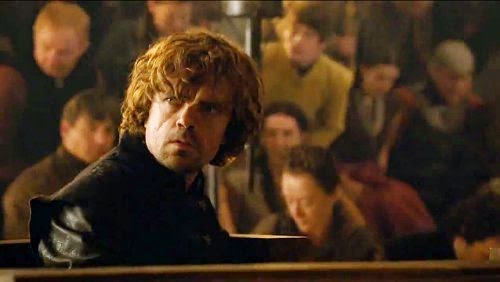

And, then, of course, the trial. This is a really interesting scene from a dramatic standpoint. You know where this is going. Everyone knows where this is going. The question is simply: how difficult will it be to get there? Do you have a give-and-take before one side wins on the strength of surprise evidence and/or a witness or do you have the farce where one side is basically Franz Kafka? We got the latter and it's interesting to watch because of how frustrated the audience becomes at having seen the whole picture that Tyrion has seen while the show audience gets led by the nose by those truly in control. The crowning moment is, of course, when Shae appears and lays Tyrion's heart on the table to be stabbed repeatedly. It's a somewhat different dynamic than in the books because of what happened in the second episode, but it's still just as heart-rending for him. It's not so much the lies about he and Sansa plotting. He would know that they've gotten to her and threatened her if she doesn't. It's when she gets back at him for sending her away and reveals the extent of their relationship that you realize how things have changed irrevocably for both Tyrion and Tywin.

The latter, of course, had all of his plans falling into place like clockwork up to that point. He knows his kids. He knows what they'll likely do, so this was the perfect opportunity to bring his "proper heir" back into the fold and continue the Lannister line. But he doesn't know the extent of the emotion between Shae and Tyrion or how that betrayal will make the latter react, as he still partially sees Tyrion as this beastly little man with an appetite for whores and one who will try to save his own skin if given the opportunity, which Jaime has given him. Emotion ruins even the best-laid plans but it also drives drama and so here we are. While I respect the fact that this trial was, in many ways, the Lannister family problems being laid out and finally brought to a head, I can say that I really wouldn't mind going a long time without ever hearing "The Rains of Castamere" again.

Lines of the week:


"Here our books are filled with numbers. We prefer the stories they tell. More plain. Less... open to interpretation." and "You can see why these numbers seem unlikely to add up to a happy ending." - Mycroft, givin' it to'em short and sweet. Having been in bookkeeping for a number of years, I've actually had the opportunity to have a conversation like that a time or two. Stannis' reaction is pretty true to form.

"Does this mean I'm the Master of something now? Coins...? Ships...?" and "I have seen the Unsullied. They are very impressive on the battlefield. Less so in the bedroom." - Watching the foolish Mace become petulant about being Master of Ships to his rival from the south is more telling than anything else about Lord Tyrell's character. And Oberyn is, of course, Oberyn. Always in the bedroom.

"I wish I was the monster you think I am." - Tyrion hasn't had a ton of material this season but this strikes closer to home for both him and the people around him than almost anything else.

"You've got bigger balls than he ever did. But with those big balls of yours, how fast can you run?" - Ramsay always seems to have a (ahem) grasp of things.

But the best line came from that same scene, as Alfie Allen gave us an example of pure terror and a completely broken identity:

"I don't believe her! I know who I am!" - only to be told that he had to pretend to be his old self by Ramsay a while later. Watching him be nice to Reek is far creepier than when he's savage and that's good acting and good television.

Sunday, May 4, 2014

Mid-season

For the longest time, I've felt that The Wire was the best thing ever put on TV. There have been a few close seconds: seasons 3-7 of The Simpsons, Breaking Bad, and now Game of Thrones. However, since I read the books long before the series ever emerged into the force that it has now become, I've never quite been able to separate one medium from the other. The Wire is the best television show ever. Game of Thrones/A Song of Ice and Fire is still more book series to me than TV series and this is one of those episodes that kind of highlights that. So far this season, each episode has had kind of a stunning event (as D&D had implied during the pre-season interviews; "each episode has a kind of 'Red Wedding' moment") that sets the Interwebs abuzz.

This episode kind of lacked that if you happen to have read the books, since everyone who has already knows that Littlefinger was essentially the impetus behind the entire series of events that became the chaos that is his ladder by convincing batshit-crazy Lysa to murder her husband, Jon Arryn, Hand of the King and fosterer and mentor to both Robert Baratheon and Ned Stark. So the TV-only audience is one step closer to being on the same page (ahem) with the rest and perhaps finally firmly aware of just how dangerous one, small, barely-a-lordling can be if he's really ambitious. Aidan Gillen did remarkable work tonight, as well, since you could see his reluctance behind his usual steely demeanor as Lysa was throwing herself at him. And, as always, poor Sansa gets to listen to the screamer all night.

That said, for the first time I'm at a bit of a loss in terms of thinking about really powerful scenes because a lot of this was just progression or bridging. In a narrative sense, it's difficult to continually have "wow moments" (DaveBrandonCreatingTheFuture™) one after the other because your audience will become inured to them and your story will begin to suffer from requiring yet another peak, followed by the inevitable come down. In Hollywood, they tend to "solve" that problem by just blowing up more stuff. Not possible in the more limited scope of TV budgets and yet expanded scope of a serial production (if one chooses to look at the series as a sequence of 10-hour films, which seems reasonable to me.)


Even so, there were high points in this episode. They were just a bit more subtle than usual. For example, both scenes with Arya and Sandor were, as usual, excellent. Arya naming the Hound at the end of her list, even though likely expected by most watching, book-reader or not, was great. Rory McCann's continued concern over the way his pseudo-charge is developing,  even through the haze of his general disdain for all things, is great. You could see the thoughts moving through his raised head as she finished: "Did she just name me? Well, alright, then." It's an excellent student-teacher relationship that I'm sure GRRM is kicking himself for not exploring further.

The later scene with the swordplay was almost better. Much as I appreciate the essentials of Eastern sword technique (and was a practitioner of it for several years), there is something to be said for simply overpowering your more nimble opponents with solid steel and irresistible force. The fact that said opponent is a young girl without much of a chance to develop the strength to try to counter that armor (especially when worn by a nearly 7-foot man) just makes the point that much more obvious. The Hound is such a cynic that he continually tries to reinforce the point that nothing she does will make things better, whereas Arya is determined to make them so, even if she has to take a relatively morbid path to do so. In that way, they're as alike and as disparate as two characters can get.

But did D&D jump ahead of the books again? Tywin tells Cersei that the last of the Westlands' gold mines was played out three years before. That doesn't mean the Lannisters are broke. It just means that they're not as liquid as before. Thus, the greater emphasis on the Iron Bank this season, which is a much larger presence in the current thread of the TV series than it ever was in the books. Is this a way of creating a bit more dramatic tension about the crown's debt or is it a way to keep the audience intrigued since the power of the Bank is so similar to our own current times? Either is acceptable from a storytelling perspective, but I wonder if Martin did drop them a hint of the Lannisters' impending financial troubles and they decided to run with it?


Sticking with that perception of "lacking a big moment", the lone scene with Dany and Co. seemed to introduce the notorious Meereenese Knot in just a few short moments. How does one keep slaves free in a culture that is utterly reliant upon them since time out of mind? If one is going to rule, what makes Westeros that much better than Slavers' Bay and however much of Essos one can conquer (and without half the politics)? For that matter, if one is trying to be just and free people from their bondage, what entitles one to do it anywhere other than the strength of the sword? Wouldn't freeing people from bondage mean ending the serfdom of Westeros just like the slavery of Essos? Once again, the gray areas of both story and character dominate, especially in the case of Dany. At least we got the name drop of Cleon the Butcher, too.


I will say that the one scene I was genuinely disappointed in was that between Oberyn and Cersei. Here are two of the most interesting (and volatile) characters and two of the strongest actors with extended time together and they spend it largely rehashing Oberyn's slights against the Lannisters and Cersei's despair over Myrcella's absence. Those are certainly valid topics, but I was hoping for a bit more in the way of fireworks. Once again, peaks/valleys/how many can you tread, etc. The little tête-à-tête with Margaery was, in contrast, more interesting for its lack of flames. One has to assume that Margaery is wary enough to understand that a sympathetic Cersei is akin to dealing with a sleepy viper. Lena Headey is doing great things this season and that's saying quite a bit considering what she's done to date.


So we come to Craster's. My main concern with the deviation with Bran's story was that he would actually link up with Jon and the impact that would have on the two characters. In the end, they wrote their way out of that and the whole thing became a bit of an unnecessary sideshow. There were interesting points, certainly, in that the fight scene between Jon and Karl was well done (and the counterpoint to the assertion by the Hound about big swords versus faster ones) and it was definitely exciting to see Hodor get the killing blow on Locke, despite it being a case of him being warged by Bran (the gentle giant looking in confusion at the hands that just committed murder was a very nice touch.) But, in the end, it felt a bit too obvious that this was a scene inserted to try to cover for long stretches in the book where, again, Bran's story is the trek north and Jon's is getting ready for Mance and the Wildling army to appear. Again, you do what you gotta to keep the ball rolling. I just think that, as a capper to an already intermediate (as it were) episode, it kind of highlighted some of the story problems that they're already running into.

Side notes:

The extended applause for Not-Joffrey's coronation reminded me of the gushing for Obama shortly after his first election. The fact that he wasn't his predecessor was enough to win him a completely farcical Nobel Peace Prize. It was, of course, notable that Cersei was the only one not applauding the death of her firstborn.

It was interesting to see the Bloody Gate, despite not seeing it on our trip to the Vale in season 1. One assumes that was a budgetary issue. That said, in the books, Sansa and Petyr stop off at his old home before proceeding overland through the gate. Having just sailed from Kings' Landing, one would have expected them to stop at Gulltown where we could have skipped the Gate sequence entirely.

Brienne and Pod's scenes were similar. There's some development going on in that Brienne reverts to her pre-Jaime distance and aloofness while the ever-earnest Pod does his best to screw up and break her out of it. But this odd couple can't hold a candle to the previous Brienne pairing or Arya and Sandor, of course, and that made it seem a little like filling time.

To go even further with the Hound's comments about fighting styles (tank-like knights vs. faster blades), I really want to play Crusader Rex again... /wargamenerd.

Drink from the Skull will be sharing a stage with Sword through the Gullet in Gin Alley next week...

Quotes of the week:

"Who told you to take the Meereenese navy?"
"No one told me."
"Why did you do it?"
"I heard you like ships." - Forget roses. Queens want ships.

"You know what stories poor men love best? Ones about rich girls they can't have." -Petyr with the little biographical note that batshit-crazy Lysa elaborates upon later with Sansa.

"What do you think will happen if you leave?"
"They'll say I wasn't a very good squire." - Pod the pragmatist.

"Mostly I poured wine." - Pod the realist.

And the winner and still champeen:

"Your friend's dead and Meryn Trant is not, because Trant had armor. And a big fucking sword." - It's mildly terrifying seeing how mature Maisie Williams is in that scene. What's she going to look like in three years?

Sunday, April 27, 2014

It's the little things


Despite the title of the episode ("Oathkeeper") and the numerous interesting events that took place, the final scene was by far the most interesting to those of us who've read the books since it is such a radical departure. There are only a couple direct interactions with the Others in the five published books and the most notable doesn't occur for some time. The fact that Craster was feeding his male children to the creatures is entirely a show creation, D&D (and Bryan Cogman, the episode's writer) apparently decided to detail what exactly the Others are doing with those children, perhaps in an effort to explain why we only ever see male White Walkers? Clearly, there was no oath involved between showrunners and GRRM to hew to material as written and it's common knowledge that they've been given an outline by Martin as to how the story is going to proceed and wrap up in case the show begins to pass his published work. That leaves a large question: Is this something that he has in mind that he hasn't revealed or is it something the show developed in order to give some identity to the Others?

I'm of two minds on that topic. One is that knowing that there's a driving force for the Walkers other than simple slaughter of living humans does give them a bit more depth. The other side of it is that giving them that depth robs them somewhat of their ominous threat. If the Others are so alien as to simply be called "the Others" (as they are in the books, if not the show), then the fear sown is enhanced by the fact that their motives are unknown and they seem to be implacable and motivated solely by killing based on some ancient war between them and the First Men with the Children of the Forest. The counter-argument is that they go beyond being simple two-dimensional boogeymen by having some detail about what and whom they are, however minor. However, given the hideously complicated political motivations and factional infighting already present in the story, I think their limited status is actually appropriate. If you can't unite against things that are only present to destroy you, you won't unite at all. Granted, the fact that they seem to be creating more of themselves which inherently still destroys the human side is reaching the same goal, so this may all just be debating storytelling angles, anyway.


Of course, much of the episode is mostly discussion about the angles that make the story and, in fact, make most of the characters actually human (to one degree or another...) from Missandei teaching Grey Worm how to read and speak Common to Sansa and Littlefinger discussing details of the regicide plot to Margaery following Olenna's advice on how to manipulate Tommen to Jaime and Brienne's departure scene where she names her new sword and titles the episode. There's a certain humanity to Cogman's writing (he was Benioff's assistant when production began and later advanced to being "lorekeeper" and regular writer of at least one episode per season) in that he clearly sympathizes with certain characters and tends to play up their more sensitive sides or simply chooses to move the plot along by their basic interactions with others. I find it a little less dramatic than D&D's stuff (which often gets worked into episodes, anyway, as the move scenes around) and it tends to have less memorable lines, but there's certainly a time for simply watching these people live their lives (or not) amidst the plots and chaos that surround them. I've noticed that it trends away from the more Machiavellian characters like Tywin and the more brutal characters like the Boltons and spends more time with people like Samwell, Bran, and Sansa.


OTOH, you can't get much more brutal than the Dragon Queen in this episode ("Crucifixion? Good. Out of the door. Line on the left. One cross each."), which kind of dovetails nicely with a point I was trying to make in my most recent non-episode post about the so-called "moral principles" of various characters. Daenerys is often seen as the only real "hero" of the story and one of the most likeable female characters, as well (although I have to say that I loved Olenna Redwyne in the books and appreciate her even more now with Diana Rigg layin' it down about both her past and the plot.) Yet in this episode, she ignores Barristan Selmy's relatively wise advice (and he should know about royal excesses, having served both Aerys Targaryan and Robert Baratheon) and exacts vengeance against Meereen's noble class. I have to say that the scene of her viewing the city from the top of the pyramid while the shrieks of the crucified echo below and the Targaryen banner flutters in the wind was (ahem) killer. But it's also a reminder of the constant level of gray. Becoming-honorable Jaime may be keeping his oath to the now-dead Catelyn Stark but he can still be a rapist. Dany may be freeing people from brutal slavery by the tens of thousands, but she can also be a ferocious killer. It's about putting your characters in positions to make decisions that have real impact and that's what makes the story what it is. Bronn cornering Jaime over his love for Tyrion was a perfect example of that theme.

Little things that carry that decision-making theme:

Is Margaery manipulating a young boy king for his own benefit or only for hers? Admittedly, I thought they might go so far as to show him getting the real benefit of being married to Margaery which most boys his age would be ecstatic about... And they worked in Ser Pounce, which is nice for completists. This becomes a question of whether Margaery is solely politically motivated and plays the gentle soul to further that agenda or whether she's actually interested in making things a bit more positive around the Iron Throne, if only for her own sake.

Is Littlefinger showing a sign of weakness by indoctrinating Sansa or setting her up to further his own ends? They're making it very clear that he looks on her as something desirable because she is Catelyn's and perhaps slightly moreso than in the books. This is the point where Sansa really began to become interesting for me, as she was mostly a foil in the earlier part of the story. In contrast, I think I've developed more interest in her from watching Sophie Turner play the role on the show and have argued at least once that she may be the strongest character in the story, if only because she is so human. It also begs the question about whether Petyr Baelish has any weakness other than Catelyn which is something that has been danced around in the books, as well.

Is Cersei treating Jaime the way she is because she's so angry at him for "taking too long" or because she's given up hope on their relationship, making her that much more bitter? Probably both and more. Of all the good exchanges in this episode, this was the best. Lena Headey continues to excel with the simplest glances and grimaces at the world around her. At this point, where does duty win out over blood? Does being the commander of the Kingsguard mean that they're only queen and commander and no longer brother and sister and, of course, lovers? Or, again, is it just a useful device for continuing her hold on power now that the far more manipulable Tommen is on the throne. Remember, the only thing Cersei truly loves are her children...


And, finally, the little differences. The elimination of the wolves from the storyline, barring Summer, is getting greater as time goes by. Why keep Ghost imprisoned at Craster's when he has a greater connection with Jon than most of the other wolves had with their masters? If the story was already going to have Jon arrive there as a tactical decision, did they think that having Ghost there was the only way to have Bran and Co. stop to check it out? Wouldn't them seeing Night's Watch members have been sufficient? Of course, that also begs the question as to why they would bring Bran and Co. to Craster's in the first place. Admittedly, there are long stretches where Bran's story is: "We're out in the wilderness. Moving north." but this just seems like an odd juxtaposition of plot lines in which Sam bemoans the fact that he couldn't get Bran to turn around and then Jon shows up to rescue him. I think maintaining the separation of the Stark children is part-and-parcel of the overall tragedy and would hate to see that changed if they run into each other. Furthermore, on that final scene with the Walkers, I hate to think that we're again missing Gemma Jackson, since the Stonehenge-like site for the transformation of the baby was a little chintzy. I was really reminded of, um, classics like Conan the Destroyer, from the movie hell that was the 80s.

Lines of the week:

"Unsullied. Always Unsullied. Before Unsullied, nothing." - The dedication of the eunuch.


"Her son?" "Don't." and "The Kingslayer Brothers. You like it? I like it." and "Sansa's not a killer. Not yet, anyway." - As usual, the Lannister brothers' scenes are close to priceless. I think Tyrion was thinking of Arya with that last line, though.

"A man with no motive is a man no one suspects." and "I don't want friends like me." - No one wants friends like Littlefinger.

"Figured I wouldn't have to suck up to any highborn cunts here... Guess I was wrong." - One wonders if Locke was telling a bit of the truth here about his own fealty to the Dreadfort?

"I'll find her. For Lady Catelyn. And for you." - Continuing this season's trend, a line that isn't witty or memorable except for the sincerity with which it's delivered and the unspoken communication that accompanies it. Brienne's attachment to Jaime in the show is far more prominent than in the books and that's a change that I really think is for the better.

And the winner:

"You want to fight pretty or you want to win?" - This should be the tagline of the show. When Bronn got him with the hand, all I could think about was Nelson Muntz ("Stop hitting yourself!")

Oh, and Drink from the Skull is the new band name.

Saturday, April 26, 2014

Fantastic misogyny?


As expected, last week's Cersei and Jaime scene generated quite a bit of discussion around the Interwebs, most of it fueled by some degree of outrage and/or disgust... which one would hope for in a scene that was pretty clearly rape. However, I think some people are losing sight of a) what the story is; b) whom the characters involved are; and, c) what the scene was obviously trying to do. Sarah Kolb's piece at medium.com is an example of that.

Now, like usual, this is treading dangerous ground because here I am, a man, talking about a topic that's, uh, not from my perspective. Although the sexual assault of men does occur in our society, there's no question that it's far more prevalent against women. Therefore, it's very easy to slide back into the commonly patriarchal view of such activity, which often leads to blaming the victim for displays of initial desire ("She wanted it!") or a failure to act sternly enough ("I would have stopped if she really didn't want it!") Even more importantly here, this is a work of fiction, so there's no interview to be done afterward to get the reaction from the characters or determine whose intent was whose, etc. However, this being fiction, one would like to assume that we can go ahead and analyze this from a relatively secure foundation of complete and total speculation and assumption, which is what we'll try here.

First off you can't (ahem) lionize Cersei as one of Martin's most interesting characters (which she is) and then complain about how the show has trivialized her into a victim because the show, if anything, has made her more interesting. Cersei doesn't become a POV (point-of-view) character until well after this event took place in the books (she begins in Feast for Crows, not Storm of Swords as Kolb stated) so we're not privy to her thoughts when this happens, just as we're not privy to said thoughts from either the character or Lena Headey on the HBO series. That said, you get a different level of detail from watching a performance than you do from reading a book. Cersei is little more than vengeful manipulator through the first few thousand pages of the books. Only later do we learn her vulnerabilities. We've already seen those multiple times from Headey in the show's four seasons. We can already sympathize with and even love her, in Kolb's words. She's already complex and she's still a victim, simply on the basis of her sex. But suggesting that the latter condition is somehow indicative of an overall attitude of the show and its creators is a bit too far of a leap, IMO.

Secondly, saying that the scene in the books is "completely consensual" is pretty poor memory on Kolb's part. The circumstances are markedly different (it's the first time Jaime has seen her in months, rather than being home for weeks; Joffrey has been dead for some time; etc.), but she says "No." quite a bit during that scene, as well, before giving in. It's easy to read her "No" in the books into the idea that she's just worried about someone coming in and seeing them and the uproar that would result. But how do we know that? In the same way that we shouldn't make a determination about anyone's intent leading up to a rape, we shouldn't here, right? "No means no", right? Is it safe to say that she "wanted it" because at some point she seems to have mentally said "I don't care if someone comes in. Do me, Jaime!"? Likewise, in the same way that it's possible to view that scene as "without question consensual", it's also possible to note that Graves' scene also shows Cersei giving in, returning Jaime's kisses, and then clutching the altar dressing in a pretty clear display of passion. At what point do we determine that her desire does or does not make it rape?


In the end, was it rape? Yeah, I think so. That's what I thought from the moment it started to the moment we transitioned to somewhere else, even after she began returning Jaime's passion. That's what it was and I was certainly a bit put off by it, too, not just because of what was happening but also because it was a radical departure from the route that Jaime's character has taken in the show and the books. However, that's what happens in good dramatic works and it usually turns into something more interesting than otherwise. Furthermore, to extrapolate from that shock into discarding the entire show as an exercise in misogyny is a good way to get me to discard said opinion as an exercise in hyperbole. For that matter, how exactly are rape scenes to be shown in fiction if not as a moment of shock and, presumably, horror? How exactly should they be shown or told "correctly"? What better reaction for the audience to have than the one that the vast majority had precisely to this one?

Women are property in Westeros, just as they were in many societies in earlier times (and still are in many today, unfortunately.) That's precisely the focus of Cersei's character in that she has been one of the most powerful people in the Seven Kingdoms for quite some time and, in an instant, she's reduced to being a bargaining chip again. Consistency in storytelling is actually a strong point, so deviating from what has been firmly established is as much a fool's errand as rewriting history because it's too dark for today's tender sensibilities and more enlightened viewpoints. To be honest, Kolb's is the only opinion I've seen so far that's even speculated on the idea that part of the audience would react in a "bitch got what she deserved" manner. On the contrary, the reaction has been one of almost universal shock and confusion... which is exactly the reaction you would expect to get for a rape scene! Art works. Wonders never cease. Because, yeah, it is a lot like real life. Maybe that's the point?

Later, Kolb's argument turns to the fact that what seems to be really eating at her is that Jaime's upward return from the vile person that he was before has now been put on hold. In other words, he's still a self-centered guy who feels entitled to take what he wants, even from the person he loves most in the world. She's upset that the show "butchered the moral principles of one of [her] favorite male characters." Exactly how many "moral principles" does a child-killer and nobleman who regards most commoners as footstools to be used mounting his horse actually have? While it's a surprise to everyone (at least in some way because it is such a deviation from his path in the books), it's also no reason to dismiss the show and, to some extent, Martin's work as misogynistic (even aside from the seeming hypocrisy.)


That's almost the funny part, because there was an opinion for quite some time after 2000 and prior to the publication of Feast for Crows that A Song of Ice and Fire was a work of misogyny, primarily because even though Martin had multiple strong and interesting female characters, the vast majority of them were regarded as either despicable, weak to the point of contempt, or harridans (Cersei, Sansa, and Catelyn, respectively.) The only real exception was Daenerys, who is still widely regarded as the story's only genuinely heroic figure, and who is still one of those whom modern society would term "morally questionable" because of the casual way in which she's willing to execute thousands of Astapori, Yunkaii, and Meereenese. So, whose high horse is really being ridden here?

The scene wasn't funny. It wasn't titillating. It didn't even show any of the famed nudity that people seem to think is so overdone (oh, but not the brutal violence... no, there can never be enough of that for American audiences because that's OK for the children...) It was exactly what it was supposed to be: dark, and not just because the lighting was low. While many people, like Kolb, have had a visceral reaction to it, I think that was honestly intentional. Whether it was a good idea or not remains to be seen. I think it works within the scope of what the show has already portrayed and will continue to do.

(And, incidentally, Asha Greyjoy is Yara Greyjoy in the show because they thought people would be dumb enough to confuse 'Asha' and 'Osha', the Wildling. Asha, again, doesn't really come into her own until A Feast for Crows begins, so while I'd like to see more of her, that story is still being played out. Again, not because the producers hate women.)

Short post-mortem

In years past, I've always made some effort to fit in as many of the year's Oscar-mentioned films because I liked to have experienced what people were lauding as worthy of mention. Of course, there are always films (like Blue is the Warmest Color) that don't end up getting attention from the Academy that I think are simply better than many things that do, but most of what ends up on the Best Picture list or are the vehicles for the 'Best X' category tend to have some merit and end up being worth watching. I caught one before the awards were given out and two in the last couple days.


The first was Dallas Buyers' Club. While I've read a fair amount of criticism about the distortions to the story of Ron Woodroof (who is portrayed, brilliantly, by Matthew McConaughey), the fact remains that the essential story, that of a group of people fighting to extend their lives in the face of a modern plague, is displayed wonderfully in this film. I thought the structure was a bit off, in that we never really see the emotional impact of the changes on Woodroof because he's so driven to keep fighting in every arena that civil society allows. He's a fighter and he remains one, right to the end, and there's never really a different side. That said, it was such a departure from the usual fluff that McConaughey is attached to that I think I was won over by his performance in the same way that I was convinced ever after that Brad Pitt could act after seeing 12 Monkeys (and I was right!/breaks arm patting back.) Of course, soon after I'd seen DBC, True Detective began and I may never have a bad word to say about McConaughey again...


And you can't really say anything about the film without mentioning Jared Leto, who stole every scene that he was in. Again, the standard story about someone transitioning from bigot to at least grudgingly respectful is all well and good. But in the case of both actors, I was far more interested in the zeal that they obviously carried for their roles and how willing they were to embody them (quite literally, given that they both had to starve themselves to portray very sick individuals.) In that respect, just watching the performance was more important than getting something thrilling in the form of a plot.


The same was essentially true of 12 Years a Slave. I enjoyed it for what it was, even though it veered away from drama and closer to documentary at some points. I thought the performances, top to bottom, were excellent with the lone exception of the aforementioned Pitt, whose role was so artificial that it fairly screamed "deus ex machina" and he played it that way. That may underscore my real problem with the film in that, while it certainly may be true that there was a Canadian contractor who is the person that eventually opens the door to Solomon Northrup's freedom (I have not read the original text), the development of that relationship isn't given the space that it needs to make Pitt's role feel like anything other than a device. Indeed, the film's title presents an agonizing length of time for the specific kind of injustice that Northrup endured (saying nothing about the broad-based injustice of slavery in the first place), but the film really fails to portray that time.

There are a couple instances where it seemed like director Steve McQueen (not that Steve McQueen) attempted to show the passage of time by cutting away to moments of scenery that I found quite entrancing visually and useful in and of themselves to give the audience time to consider Solomon's circumstances or even to contrast his situation in a brick-walled prison in slave country Virginia as the Capitol sits serenely on the other side of the river in nominally free Maryland. That's moody atmospheric stuff and if McQueen was using it to build that mood and show the passage of time, that's great. He just didn't do it often enough. One of the essential keys of the story is the dolorous, repetitive labor that was slavery (and especially cotton harvesting) and how this man was separated from his family with no recourse for Twelve. Long. Years.... except that it never felt like that. Solomon's circumstances changed so rapidly that I never got the sense that he was stuck in this situation for anything longer than a few months, so that by the time the film ended I watched the credits roll thinking that I had seen a good film, but not one for the ages.


All of that said, just like DBC, the performances were worthy of watching regardless of the mild flaws of the story. Chiwetel Ejiofor's anguish in the final scene where he's reunited with his family (spoiler!), as a man who has clearly lived his entire life under tight self-control; indeed, a man who has survived as a slave for a dozen years because of that self-control, is now faced with a situation where the emotion is simply resonating off of him but he is still unable to break down and release it. That was magnificent.


And then there's some crazy people in backwoods (backplains?) Oklahoma. While August: Osage County seemed to get the fewest raves of the three, I actually thought it was the best film. Once again, performances carried the day. I can't say enough about the cast and I guess I don't need to, as there was certainly more than enough talent packed in there, but aside from the excellent and glowingly-reviewed and nominated turns by Meryl Streep and Julia Roberts, I found myself equally as intrigued by Juliette Lewis and Julianne Nicholson. Juliette, as Karen, wasn't stepping too far outside her sphere by playing the ditzy sister trying to score big with a playboy husband, but she had the best line of the film at one point, cutting straight to the heart of the story as she rants at Barbara (Roberts):


Because I doubt that Jean’s blameless in all of this. I’m not saying that I blame her. Just because I said that she’s not blameless. I’m not saying she’s to blame. It’s just that she might share in the responsibility. It’s not cut and dried. It lives where everything lives. Somewhere in the middle. Where the rest of us live! Everyone but you!...
And I may have to do some things I’m not proud of again because life just puts you in a corner that way. And then, come January, we’ll be in Belize. Doesn’t that sound nice?
That final line made me crack up because you can't try harder to escape from your situation without telling everyone that that's exactly what you're doing. Likewise, Ivy (Nicholson) has the most emotional moments of the story that have the most to do with a positive outlook. Surrounded by the chaos, outrage, and despair, she's actually trying to move forward and responds with as much restraint as she can muster to try to be the stalwart of the three daughters that she's always been.


What should be evident from those two is that Osage County had the best story. In many ways, it's the smallest and most personal, taking place in one house over a few days, rather than spanning nations and years, but those are often the ones that live with you the longest. I know that I'll remember moments from Osage County longer than any from the other two films because it presented a situation that I could relate to while still being interesting enough to keep me watching simply because it was so different from my own. These were real people and we could have been voyeurs watching them go about their lives. The film is based on a play of the same name and, as so often happens, those films present the most memorable characters that have already been put through their paces to reach an audience. Add a camera and some remarkable talent and you're going to make memories for a much wider swathe of people.

There's one more film that I considered seeing but eventually didn't and which also received a shower of accolades in award season and that's The Wolf of Wall Street. I'm a fan of both DiCaprio and Scorcese, but the reason I didn't see it is still with me: I'm not particularly interested in further lionizing a pattern of behavior that should have landed many, many people in jail and which resulted in almost no one seeing the inside of a cell. Make me a film about Jamie Dimon on trial for his life and I'll be camped outside the theater.

Sunday, April 20, 2014

Bridges to cross, women to trade.

As the map spun into view, my first thought was: "Hey, I think they're saying that things are happening in Kings' Landing." Since we'd gone from the Red Wedding to the Purple Wedding, we must be arcing into a little bit of the old ultra-violet? Nevermind... Of course, then I noticed that the map had gone west to get to Meereen this time. Weird. Does that mean Euron's showing up soon?


While I was certainly excited to see the whole Dontos rescue/Littlefinger surprise scene, I couldn't help but wonder if they had Petyr Baelish being a little too glib about the whole sequence. Perhaps it's because my perception of him is deeply colored by the books and, as always, there are wheels within wheels of his plots. But it struck me that he was trusting Sansa with a lot more at this point in the story than he would readily admit to others. Shades of his transposed affection for her from Catelyn?

After that, there was a significant amount of this episode that was taken up less by action and more by people reacting to said action. Certainly, the death of Joffrey was a momentous event and the repercussions have to be acknowledged. Furthermore, many of those reaction scenes were excellent in and of themselves. But some were simply functional, such as Margarey and Olenna musing about what the future holds while Olenna as much as admits that she removed her granddaughter's road to self-empowerment, as women are still mostly a resource or trading chip in Westeros. Of course, we need that reaction in order to move the story, which is why it's often referred to as a bridge scene, but I can't help but be a little underwhelmed by moments that would more easily be woven into prose. That's media transition for you.


Speaking of excellent scenes, the extended moment in the Sept of Baelor with Cersei, Tommen (who is shockingly old to me, given his age in the books; is this boy going to want a kitten?), Tywin, and later Jaime was one of them. Tywin, wearing his grandfatherly mien for the sake of the tender Tommen, was still as callous as ever. His daughter is there agonizing over her slain child and he proceeds to disparage him even as she grimaces and twists under the criticism (Lena Headey, again performing subtle wonders.) Following that up with her rape by her twin virtually on top of the corpse of their son will be fodder for social scientists (and, doubtlessly, outrage by the Helen Lovejoys of the world) for the next decade or so. Cersei responds to the man she still wants in a way that people often do when faced by death: wanting to feel alive. But then she recoils when she touches his neo-prosthesis. So, Jaime engages in the so-called "crime of passion." But which passion? Anguish because it's his son lying there, too? Lust for this long-time lover that has denied herself to him? Anger because of just how hateful she is as he exclaims before forcing her to the floor? Or is this just one more example of how women are objects to be used in Westeros? I think it's all of that, which is what makes Jaime one of the better characters in the story, as he was just getting a fan following and then he does... this. Incidentally, the lighting in this scene was excellent. The moment after he tells the High Septon to leave and looks at Cersei from the shadow is stunning.

But then we're back to Dragonstone, where both scenes of Davos, first with Stannis and then with Shireen, are either just reactions to last episode or setup for future episodes involving the Iron Bank...


... which made it all the better when we return to the comedy duo of the Riverlands. To their credit, D&D threw me a bit here. I thought, in order to make their journey last through the season, they might really consider going really afield (ahem) from the books and sit down to be farmers for a bit. But then the reality of the Hound interrupted all that and they're on their way again. I should have known better. It's clear from their writing that they understand Sandor Clegane intimately (and clear from this interview that Rory McCann does, as well.) One wonders: at which point does writing for certain characters become influenced by how much the audience and the writers enjoy them? Martin has already mentioned that he was so tickled by Natalia Tena's performance as Osha in previous seasons that he plans to do more with her in Winds of Winter. I can't help but think that D&D are of similar opinion with Arya and the Hound, not just because it's crucial to show Arya's development along her personal road, but also because the material is so enjoyable to write. There are serviceable moments, like this episode's bridge scenes, and there are the moments where you're saying to yourself: "This is gonna be cool!" and that makes it all worth leading up to it. Alex Graves' direction in this scene was great, too. The shots of the idols and the stewpot during the prayer scene and the daughter's fascination with the Hound were highlights.

Some of that writers' enthusiasm doubtlessly occurred with Sam and Gilly as they continued to explore their relationship. Watching her attempt to tease him into acknowledging his own emotions is hilarious. By the same token, the rejection scene in Mole's Town was extremely similar to Shae's rejection by Tyrion last episode and Pod's rejection by Tyrion in this one. In both of the former cases, it's yet another example of women as objects ("I'm doing this for your own good!"), to which Gilly pointedly objects. Pod, of course, isn't confined by that sexual status but he's also something to be traded, since he's a lower class than the people trying to manipulate him. Honestly, I thought the scene with Pod was much more heartrending than last episode's with Shae, if only because Pod's devotion has been without question or conflict.

This doesn't match the scene from his episode. I just love his look.
But the best of all the bridge scenes and, indeed, the best scene of the episode was Tywin's visit to Oberyn in the brothel. They not only react to the past and setup the future, but they also get a great performance from both actors as they spar with each other over the greater goals that both of them are pursuing. Most of the scenes that involve Oberyn hearken back to Robert's Rebellion, which precedes even the ongoing story of the books, so they're always going to be heavy on references to stuff that hasn't existed in the show. But the fact that they carry that lengthy timeline and events of consequence is what makes them so interesting (above and beyond Pablo Pascal's and Charles Dance's masterful embodiment of their roles) and gives the performers so much to mine. These are people pursuing grudges or enacting plans that are two decades old. That carries weight, especially when the audience can sit back and appreciate the magnitude of the entire story (and several more of those moments will be coming up.)


But the final setup scene was the concluding one. While it was great to finally see Meereen and set off the greatest struggle that Dany is going to face in Slavers' Bay, it was also a bit slow, exposition-heavy, and ended in a very odd manner. I'm all about driving home the philosophical point you're trying to make, but it's usually better done in a less obvious manner that doesn't leave your audience feeling like you just handed them the world's mildest cliffhanger. So, we get slave collars and the slaves don't like it and... credits. Wait. What? I mean, we all get it by now. We know her intent. Watching another sequence of Daario showing what a badass he is with that khopesh is cool and all but they're treading pretty carefully to the Meereenese knot that George suffered through in that it was a lengthy scene that really didn't do a whole lot. In speaking about this season, both of D&D said that they felt like all 10 episodes had moments of impact. I'm sorry to say that this one ended with more of a whimper. That said, Dany's speech was fantastic and Emilia Clarke's delivery of it was likewise. But why the jousting lance for a fight to the death?

Lines of the week:

"He was a drunk and a fool and I don't trust drunk fools." Trusting an emotional one won't do you much better.

"You did wonderful work on Joffrey. The next one should be easier." - Olenna, always ready for the next deal.

Martin and Lewis: "If I'm standing on it, it's my land."
"Our cottage burned down and my mother with it. He's never been the same." (This made me bust out laughing.)
"You going to do all seven of the fuckers?"
"And we ask the Stranger not to kill us in our beds tonight for no damn reason at all."

"I will not become a page in someone else's history book." - All these years later and Stephen Dillane still delivers lines that Jefferson would have said.

"If you're a famous smuggler, you're not doin' it right." "Your father lacks an appreciation for the finer points of bad behavior." - Davos, speakin' it.

"So you deny ordering Elia's murder?"
"Categorically." - Just like last episode, these lines aren't great but the stares that accompanied them were excellent.

"Give it to my father. He never fails to take advantage of a family tragedy." - Tyrion knows the score, even in a cell.

"I come from nothing. Before long, I will return to nothing. Let me kill this man for you." - Daario, killin' it.

And the winner:
"There's plenty worse than me. I just understand the way things are. How many Starks they got to behead before you figure things out?" - This is the Hound in three sentences. If he could have added a "Don't call me 'ser'.", it would have been perfect.

Friday, April 18, 2014

Friday Music

There's a habit on the board (it's not really consistent or old enough to refer to it as a "tradition") for a couple years now in which people post Youtube videos of bands they're currently listening to or have recently discovered or just think that the majority of the regulars won't know and might enjoy. There's a fairly diverse set of tastes and interests there, so it's usually a decent introduction to new and generally good stuff. The few times that I've participated (where I'm working now makes Youtube a bit of a challenge), I've usually posted 4 or 5 items largely because I tend to be listening to multiple new things (just today I dropped another $40 in new mp3s over at the commerce overlords (aka Amazon)) or have enough varied things on my mind that people might be interested in that it's easier to just do an information dump. Since I was home today (hooray for pointless religious observances that have nothing to do with the religion (or lack thereof) of the majority of the population!), I was ready to spam my usual output, but in thinking about what to post, decided to bring it here instead.


I've been listening to a lot of North Mississippi All-Stars lately. I'm fond of Delta Blues and these guys are the genuine item; plus they put on a helluva show because they're very enthusiastic about their music and their fans and that's always fun to see. Two overriding themes in many of the bands/performers that I regularly listen to is: a) Fearlessness. They try different stuff on a regular basis and aren't afraid to grow, even if they know that will piss off a segment of their audience that doesn't want to change; and, b) They're audiophiles. Part of that willingness to try new stuff is because they like taking sounds and making music with them, regardless of source or connection to their own assigned genre. NMAS are definitely in that vein, even if they stick to their Delta roots. The multiple layers of percussion in Goin' Down South makes it stand out from its more conventional blues guitar work. There are several rhythms going on here and you can bob and weave with any or all of them.

Speaking of awesome shows, my friend, Nathan, traveled down to the Majestic in Detroit with me a few weeks ago to see one Les Claypool and his current project, Duo de Twang:


I've enjoyed stuff by Claypool ever since Primus because, again, he's one of those aural experimenters. His song are bass-focused, as you might expect, but he's all over the spectrum in terms of rhythm, melody, and style. The problem is that, unlike more electronically-focused performers like The Orb or The Crystal Method, his music doesn't really jump off the disc to me when it's prerecorded. There are some performers that just do better on stage than in the studio and, based on what I saw at the Majestic, he's one of them, as his show completely blew me away. He and Bryan Kehoe just sat on stage with nothing but a blue light on them the whole time and just tore it up. I kept trying to follow his hands on the bass and kept losing him because he was doing more with it than most other players that I've ever seen (the only person I can remember who struck me as similarly talented is Melvin Gibbs, who I saw a couple times with Rollins Band.) It didn't hurt that they had a hilarious opening act ("Hello. We are reformed whores... and, uh, that is the name of our band, too.") and I happened to be the crossing point for two different groups of people passing some really good stuff back and forth (since I was helping, I was duty-bound to take a hit; Duty. Bound.) I pulled up some regular tracks on Youtube the next day and it just didn't have the same energy, so I'll wait 'til he rolls into town again but I will definitely be going. EDIT: Of course someone recorded the Majestic show, the first part (of six) of which I've now included.


Speaking of electronic bands, I've been a long-time fan of the Dutch techno producer, Speedy J, who originally engaged in the more flowing style that emerged from Detroit in the 90s and became prominent with groups like the aforementioned Orb and Aphex Twin, but later switched into much heavier rhythms and more complex sonic arrangements that often leave a tonal memory in your head precisely because of their lack of melody. He's using sounds to create an image in the same way that musical scores do for film, TV, and stage. What I really like about this approach is that it hearkens back to the industrial sounds of the early 90s that bands like The Disposable Heroes of Hiphoprisy and Atari Teenage Riot were using (albeit in drastically different ways) and, again, keeps with that thought of using new and interesting sounds to make music that a wider audience can still appreciate.

Soundtracks aren't confined to just performed art anymore, either, as there's a great amount of really good music turning up in games.


This is the background music for an area of the World of Warcraft called Booty Bay. As you might expect from the name and should be able to tell from the sound, it's where a lot of pirates tend to hang out. It's clearly soundtrack music designed to generate a certain image and atmosphere and does so in a rather phenomenal way, IMO. Even though the location is some distance from the regular cities where the majority of players tend to stay because certain services are easily available, I've left a couple characters here upon signing off just so that when I logged on, I could hear the background theme because it was so inspiring and exciting. Having a full orchestra to make game music certainly helps with that endeavor and, as any viewer of shows like Game of Thrones will tell you, having an innovative thinker like a Ramin Djawadi can go a long way toward making your show/game/play a compelling draw for years to come and leave your viewers/players/audience humming your theme songs as they go about their day.


On the orchestral note, I figured I'd end with a favorite composer, George Philipp Telemann. Telemann was a German baroque composer of the late 17th to mid-18th centuries and a contemporary of JS Bach and his sons, as well as Georg Friedrich Handel, among others. He was one of the most prolific composers of history and tended to stay at the cutting edge of musical development and led a lot of that change himself by his willingness to experiment with underused instruments (like the viola) and new arrangements. I have a collection of his trumpet concertos that's a favorite because of the compelling sound of the horns breaking free from the supporting music around them. This piece, the Concerto for 3 trumpets, 2 oboes, and timpani in D, is probably my favorite from that collection. Unfortunately, the arrangement in the above performance is a bit shaded toward the strings and less toward the horns, which are much clearer in the one that I have listened to most often (and which occasionally compels me to abuse Shakespeare's sonnet style, to the chagrin of everyone around me.) But the music still embodies the phrase "clarion call" and is one of the more compelling that I own. I gave a copy to my friend, Juscha, a few years back and she emailed me the next day, saying that she "woke up today to the sound of beauty."

Bonus extra!:

In the course of the last 45 minutes of writing this I've actually been listening to none of these performers but instead to Trixie Whitley. She's the daughter of semi-known blues guitarist Chris Whitley, whose one significant charting hit from the 90s was a track called "Big Sky Country":


Sadly, Chris died about a decade ago but his daughter has been carrying on with her own career after performing on several of his albums. She did some work with a group called Black Dub, which is kind of a blues/dub/rock fusion with some supporting sounds, but recently released her first full-length offering, Fourth Corner. This is one of the gems from that:


In short, she has dad's voice which kinda makes my knees go weak every time I hear it (but I'm odd like that; I've been talking a lot recently with a friend from the political past who speaks Dutch and my knees wobble just at the thought of hearing that...) Plus, it was a good excuse to bring this back to its blues beginning. Now on to some Lydia Loveless...