Wednesday, September 21, 2022

As plain as the nose smashed into your face

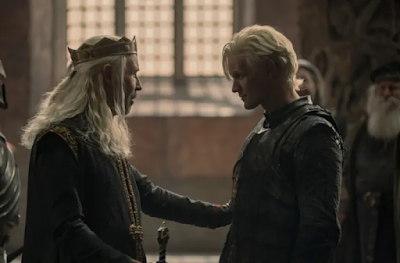
I didn't bother to write this the night of the most recent episode of House of the Dragon because I didn't bother to watch it that night. We just really had better things to do (and the best episode of the season so far for Rick and Morty more than made up for it.) Having finally gotten around to watching it, I have to say that the wait made no difference whatsoever. The overriding impulse for House to this point in time is boredom. Everything is obvious. The competing interests are obvious. The reactions of every character are obvious. The showrunners explaining their self-evident motivations, both within the story and their intentions for the story, could not be more obvious. In many ways, the "inside the episode" so-called 'revelations' seem exactly like how I felt when trying to read Fire and Blood. All they're doing is reciting a litany. It's all been played out in front of them already. It's the equivalent of an oral history heard one too many times. It's become mundane and rote.

This episode for all of its "shocking" intent was just the same. Seeing both Ryan Condal and Miguel Sapochnik explain that they felt they had to set up the episode in this fashion because Game of Thrones fans "expect that weddings won't go well" is fan service of the plainest and most idiotic sort. They're essentially admitting that they have no story to tell. They're simply reciting the litany that GoT fans are supposed to expect. It's not innovative. It's not original. It's not interesting. It's just performative. The fact that they chose to take a presumed modern approach with Laenor Valaryon (John Macmillan) is a nice concession to the fact that people, even royal people, throughout history have had different sexual identities but if that's the most innovative thing you can present in your entire storyline to date, then you're really struggling. I guess you could say that the production has fallen into line with the entire reign of Viserys; always appearing weak and surprising no one with its ennui.

The central fact that I keep bemoaning is the lack of a magnetic character; ANY magnetic character. The most genuine moments continue to be shared by Rhaenyra (Milly Alcock) and Criston Cole (Fabian Frankel), as they're the only two that seem able to express a genuine emotion that isn't angst or outrage, with accompanying cynicism about how all of this is such an act. (The Bard's "All the world's a stage" quote was perhaps never more appropriate.) If any one of these people could do one thing that wasn't completely predictable, it might rescue an entire episode for me. Hey, look! We got to see Rhaenyra roll her eyes at the boorishness of Jason Lannister (Jefferson Hall) for the second time in a month! That's, uh, not new. I'm a story guy. Give me something- anything -that tells me that these people aren't just locked into a script that has them moving and talking like the animatrons on an old funhouse ride, gesturing and shifting in the same patterns forever. OK, there was one interesting point when, for some reason, the Velaryon ships pulled out their oars while they were at full sail approaching the city. Unless they were planning to beach said ships and never return that, like the rest of this series so far, was a very bad idea.

But, hey, Nielsen declared numbers the other day and House is supposedly drawing the strongest of any HBO show since GoT, so I am clearly in the minority. Or perhaps there are simply millions like me who are watching to see just how oddly disinterested they can become. Next episode is finally the jump forward to adult Rhaenyra and Alicent so, OK, maybe we can chalk up half of the entire season as simply setup to the "real action?" Does that sound interesting or compelling to anyone? Bueller?

Tuesday, September 20, 2022

A treat of the visual art form

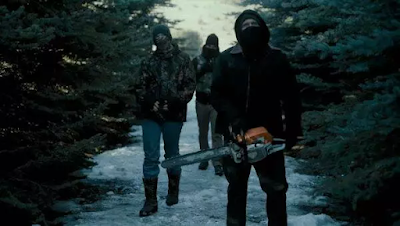
It's pretty rare that, even with as many good films we see at the Michigan/State Theaters, we hit it out of the park two weeks in a row. I still haven't written anything about The Good Boss, but I will get to it. But I had to immediately sit down and write something about God's Country, because it was simply that good. (Admittedly, I also wanted to test out the keyboard of the new machine I picked up with something a little lengthier than a tweet. So far, so good.) You've probably seen me comment about film being a visual medium and, consequently, the best of them letting the visuals tell the story. This is the key behind many of my favorites, like Rashomon and Blade Runner (the director's cut.) When you have a good director and someone great behind the camera, you can take a short story, as this film did, and make it blossom into something far greater than originally presented. When we first saw the trailer for Country a couple weeks ago, I was interested, but kind of dreading the "outsider dealing with the locals until the violence of justice erupts" premise that it implied. We've seen that many times before. But this film was something far greater and far more interesting than that simple (and often simplistic) approach. There was a depth of character and story here that meant much more than just another Dirty Harry pastiche, where the bad guys get what was comin' to'em, no matter what the law says.

The roots of Thandiwe Newton's character go far beyond the simple setting. We're presented with a college professor at a small school out in the hinterlands who has just lost her mother and is entering the holiday season at the end of the term still wrestling with her sorrow and now being confronted by a couple of local hunters who want free rein on her land; possibly because she's a she, an academic, is Black, but mostly because all of the above makes her an outsider to 'Merica. But the impact of her recent loss goes beyond a child losing their last and strongest link to family, as we slowly discover that Sandra isn't just an "outsider" from cosmopolitan New Orleans now in the backcountry, but that she and her mother were present during the most traumatic event of the city's existence, when Katrina struck in 2005. That sense of loss and anguish; for herself, for her mother, for the people that she knew ("born and raised") colors everything about Sandra's character and how she deals with everyone from the too-casual sheriff's deputy (Jeremy Bobb) to her too-comfortable colleague at the university (Joris Jarsky) to said colleague's beleaguered assistant (Tanaya Beatty.) There's been a recent surge in stories about the survivors of Katrina and the enormous psychological impact it had on them and everyone in and around New Orleans. For many outside the city, the disaster was over as soon as we stopped hearing about the toxic FEMA trailers ("You're doin' a great job, Brownie!") But for those who were there, it persists and those stories need to be told (HBO's Katrina Babies is a good recent example.)

On the face of it, that sounds like something that could easily become overloaded with emotion and it is a dramatic film. There's a lot of tension in the air, even when not dealing with the eminently hostile locals and their guns. But it's also a patient film that is willing to tell its story slowly which gives its characters and story room to breathe and, in some ways, even contributes tension to scenes that would otherwise be mundane. What keeps everything moving is, quite literally, the camera. Julian Higgins' direction and Andrew Wheeler's cinematography are both spectacular. Again, we're given the opportunity to see the story happen, rather than have it told to us. When Sandra enters her bedroom, we don't see her face and then drop to the dog she notices, sprawled on its bed. We start at the dog's level, seeing her feet enter before she drops into our frame of reference. When she confronts one of the locals and he threateningly invites her inside and then slowly pursues her to her car, we don't get an orchestral crash that signals something ominous. We just get the rush of movement that is then interrupted by the blaring noise of a passing train. When Sandra angrily opens a long-sealed box from her closet, none of it happens on-camera with her hands working ominously and the object of her search rising into the light. Instead, all of it happens behind the bed that she's crouching beside, as the intensity of her action and our supposition about what she's after are already telling us what we need to know.

The framework for all of this is one of faith and belief or the lack thereof; in oneself, in one's community, in the societal structures that elevate some and confine others. It's not difficult to see where the film likely departed from the boundaries of the short story it's based on, James Lee Burke's "Winter Light." But those departures are necessary to showcase a larger and more complex character study that needs the little moments of every day life and how they have different meaning to everyone involved and how each day contains events of magnitude, whether obvious or not. The original story is one of coming to grips with the modern ethics around masculinity. This story is about everything except that and it's a better insight into the modern state of society which is contrasted with the slower-changing world that Sandra finds herself in. This is one person's experience of endings and then transformation, rather than simply the creation in seven days which is the arc of presentation. It's a well-acted, well-written, well-directed film that is the complete package of what you'd hope to get whenever you sat down in a theater. Can't recommend it highly enough.

Friday, September 16, 2022

From the high end to the legendarily mundane


Most fiction is either character-driven or plot-driven. The novels that make up A Song of Ice and Fire and the subsequent TV series, Game of Thrones, are notably character-driven. There is no high concept that drives the story. It's pretty much straightforward epic fantasy. But it's a story that is steered by several amazing characters, such as Tyrion Lannister and Arya Stark. It's the lack of these that currently hinders its prequel, House of the Dragon. The Rings of Power has the mild advantage of being plot-driven- everything centers around massive events like the creation of the rings and the fall of Numenór -but also having multiple characters that are interesting in and of themselves, like Galadriel and Halbrand. Granted, Galadriel is being written and played by Morfydd Clark so intensely as to be borderline annoying at times. Yes, we get it. You're obsessed with Sauron, greatest surviving servant of Morgoth, whom you hold responsible for the death of your brother and whom you will never, ever stop pursuing. We're right there with you but, at some point, we're all hoping that you learn one of Sauron's essential talents (e.g. more flies with honey, etc.) And, yet, somehow your vinegar roped in the queen-regent of the Dúnedain, Míriel (Cynthia Addai-Robinson.) It's that kind of irritating leap that made this the first episode of Rings that felt more rote than splendid. It was still interesting, but it was also the kind of routine adventure story that you'd expect from material much lower on the scale of such things and more like you'd get out of a Terry Brooks novel (to speak of only one of the most notable of Tolkien ripoffs, complete with a Gandalf who sends some halflings on a mission.)


Just like that Brooks novel, this episode of Rings also involves a sword that the dark forces want to possess. Said weapon is in the hands of young Theo (Tyroe Muhafidin) who is determined to be more active in the defense of his fellow villagers that have taken shelter in the very watchtower that Arondir and company abandoned a couple weeks back. Everything old is new again and all that. The fact that this is much like Théoden leading his people to Helm's Deep should be in the forefront of most LotR fans' minds, if they're paying attention. And, again, this is what makes this episode somewhat rote in its telling. This is the adventure story, as the common people do their common things and the heroes among them stand out, to one degree of success or another. The fact that Theo waits until dark, when the orcs can move around at will, to try to escape from the otherwise empty village is another example of how one person's hero is another person's fool. But stumbling into things is also one of the easier ways of getting a story out of them, so here we are. There's a Tolkien nerd moment when the old man warns Theo of the return of Sauron, since said name was given to him by the elves as something of a mockery of his original name (Mairon, "the admirable"; Sauron means "the abominable") Would Sauron's servants use the elf name? Obviously, that's way too much detail for the casual viewer but it occurred to the Tolkien nerd.


The events on Numenór are a little more awkward in terms of delivering a story. Isildur "failing" at the Sea Guard tests is pretty standard for Campbell's hero's journey and, as noted, Míriel is somehow convinced by Galadriel discovering the secret of her ailing father. I guess they did well enough in showing just how disturbed the queen regent was by the vision she kept seeing in the palantir that she has, but it still felt unconvincing and simply like a plot element (e.g. this is how Elendil and a bunch of Dúnedain first end up in Middle-Earth!) that had to be fulfilled. Speaking of the seeing stones, it was odd to hear Míriel say that "the rest" had been lost or hidden, considering that when the Numenóreans finally moved to M-E for good, they brought seven of them along with them and Tolkien lore suggests that there may have never been more than eight in the first place. One other detail is that, in the books, the stones were only used for communication and it was mentioned that they could be used to view the past. The presence of visions of the future was never a thing, but artistic license by the show writers has already been employed, so this is probably just another one of those things. Still, I question why the others had to be "lost or hidden", rather than simply explaining that the one in the palace was simply one of them. Galadriel would have known what they were and why they were there, as they had been given to the kingdom by the elves. It was nice to see them displaying Pharazôn's political acumen, by setting up a rabble-rouser to inflame a crowd, only for the chancellor to calm them and display his leadership qualities. Thus are coups set in motion...


We were also brought back into the realm of the dwarves, as we finally returned to the amusing interplay between Elrond (Robert Aramayo), Durin (Owain Arthur), and Disa (Sophia Nomvete.) Obviously, all of this was leading up to the discovery of mithril at Khazad-Dûm, which is fine. It's a good way to show off the mistrust of the elves that the dwarves share with the humans, as well as the grasping possessiveness that the former have when the possibility of crafting something comes around. Disa is by far the most entertaining of the trio (That's right, racists. The Black dwarf is the cool one.) Alongside the typical blustery Durin and the aloof but still earnest Elrond, Disa is entirely practical yet eminently sociable and clearly the one most capable of navigating the disruptions created by the instincts (or agendae) of others. Nomvete is kind of a delight and I really hope her role expands in the future. In contrast, the appearance of the Morgoth-serving elf, Adar, was kind of restrained. I had expected a bit more of a Romulan experience, with the cold intellect surrounded by some degree of actual fury. For his couple of minutes on screen, he's essentially still the figure in the shadows that didn't need to be seen or named at all. That may be what is still the Diablo-esque nature of the M-E scenes shining (shadowing?) through, though, which is still part of what makes the show enjoyable. So, we've lost a bit of the shine of wonder and are through to the "story simply progressing" phase; much like the difference between Peter Jackson's Fellowship of the Ring and The Two Towers. It's still absolutely worth the time.

Monday, September 12, 2022

Riding the dragon


This is where we begin to question what actually makes a good story in House of the Dragon. It's occurred to me a couple times that George R. R. Martin might have taken some of the criticism of his books and the subsequent TV series to heart about the role of women in Westeros. His intent was to present a set of cultural conditions that would have been typical of Middle Ages and Renaissance Europe and which, honestly, remained largely similar even into modernity, especially for the noble classes still conscious of how trading women could gain them money and status. His response to those conditions was largely embodied by characters like Cersei, Arya, and eventually Sansa, who manipulated, evaded, or endured (and hardened; at least somewhat in the books by the end of Dance of Dragons) those conditions, respectively, to forge as much of their own path as they could. But despite their starring roles in ASoIaF, the voices complaining about the general misogyny of the setting became louder and more numerous. When he switched over to what seems like an endless delve into the history of the Targaryens, he pushed that issue to the forefront. This was no longer a story about ice demons and prophecies, but about political struggle quite focused on the question of whether women deserve to be treated as equals. This is why Rhaenyra is the focal character of House and probably why it's far less of a sprawling epic, since the vast majority of the plot tends to center around her and the consequences of her actions. So, at root, House is a story about sexual identity, which means that sex, even if we hadn't seen it regularly in Game of Thrones, would naturally be an important aspect of it.


With that in mind, it's fair to question at this point whether depictions of sex are just titillation or actual aspects of the plot. I pointed out one instance in the first episode where it was clearly the former, as we didn't need to see Daemon's experience with actual impotence (in addition to his political impotence) in a brothel when it could have been displayed in one room with his consort. But GoT-style sexposition being what it had been in the past, I'm assuming the showrunners decided to just follow suit. Last night's setting was somewhat different, in that it was a chance to see Daemon showing his niece what the other side of King's Landing looks like, as well as explore the chemistry that's existed between them, with the idea that he might not only get back at his brother in a rather vicious way, but also take one step closer to the throne by, y'know, screwing the currently-named heir. The fact that he happens to be her uncle is less of a concern for him, trying to be a prince of genuine Targaryen/Valyrian outlook than it is for Viserys, who's mostly trying to keep a pile of unstable alliances with the far-less-sanguine-about-incest Westerosi houses under his thumb. The fact that it would have been Rhaenyra's first sexual experience, as a virgin waiting to be traded for highest value, adds another layer of complexity to it.


From a storyteller's perspective, what I've been mulling over is: Knowing that the thing that most people would be discussing would be the fact that Uncle Daemon almost screwed his niece, does that serve your story?  Certainly, a story about politics will often involve sex because politics is about life, as I was saying over here. As noted above, a story centered on sexuality is even more likely to involve sex. There's nothing wrong with that, as long as it serves that story. Will most of the commentary be about the motivations I mentioned above or the fact that Daemon was once again unable or unwilling to perform or the fact that the two of them have already exhibited an attraction for each other and what all of that says about their characters? Or will most of the discussion be about the fact that he almost shagged a 16-year-old? The fact that she later went on and had that first experience with her oathsworn personal protector, also much older than her, and whom would be likely burned alive for participating is almost a side note to the main scene in the brothel. Alicent is, of course, the prime example of the type of life that Rhaenyra is trying to avoid- trapped in an uncomfortable relationship with a man she isn't attracted to and feeling like nothing that happens is her choice, including sex -so the fact that she made her own physical choices that night (and seemed to be ready to make her own earlier with Daemon) is the centerpiece of this story. This is what it's supposed to be about. But I'm still left wondering if people are really going to get that in the same way they might have if the brothel part was left out of it.


This might be a microcosm of my continuing unease with the whole series. I mean, sure, sex. Sex is fun. I'm not objecting to the brothel scenes in the same way I'm not shocked by the potential incest. If that's what your story is about, then, there it is. Part of what's leaving me adrift is that so much of the rest of what's going on outside of Daemon is kinda pedestrian. When Cersei and Jaime Lannister were first presented, they were wicked people AND they were screwing siblings. But there was an element of texture to their menace that was fairly rapidly revealed to be high intelligence and an understanding of where each of them stood in society-at-large. Even though she was better at playing the game than the vast majority of men involved, she was still a lesser entity in that game than they were. Jaime's confrontation with Eddard in the streets of the city was more an expression of his affection for Tyrion and an acknowledgment of his role as a tool of his house than anything to do with his own personal perfidy. You could see all of this in the first couple episodes. So far, I'm not getting anything nearly that complex or interesting from anyone but Daemon, which is only continuing the trend from the first episode where he was the only one with an actual personality. So far, these characters just aren't deep enough to be intriguing, which only makes the presentation of what could be character- and culture-building moments like the brothel scene seem more like titillation to distract from the fact that most of these people just aren't that fascinating. One mild exception is Ser Criston Cole (Fabian Frankel), since he's been playing the role of the guy who's extremely conscious of just how out of place he is quite well.


The reality of most speculative fiction is that it can be either plot-driven or character-driven (unlike most literary fiction which is largely the latter.) But to be plot-driven, you usually need some more high concept stuff than "noble families bicker over throne", dragons or no dragons. GoT was character-driven. There wasn't anything involved that ventured too far past bog-standard fantasy other than a willingness to kill major characters because more major characters in these settings should die more often or everything becomes trite. ASoIaF is a character-driven story and the showrunners of House are presenting this show as the same sort of thing. But to do that, you need interesting characters and, so far, it's lacking in that respect. It is improving from the first couple offerings, but that's not a really high bar by which to measure. I'm holding on to kinda just see where it meanders off to. The preview of what may be happening to Viserys next week means that things might start to really accelerate. Will the story be able to carry the lack of compelling people? Dunno.

Friday, September 9, 2022

The political crux emerges


With the introduction of Númenor, we are now fully into the story of the latter part of the Second Age. Most of the key moments of the story of the rings, the return of Sauron, and the creation of what would be the Middle-Earth of the Third Age (where Lord of the Rings is set) is based in, affected by, or fully revolves around the island kingdom of Men that was granted to the Dúnedain by the Valar (aka the gods themselves.) This is where most of the political struggle and upheaval that should be central elements of The Rings of Power will take place. With that in mind, it's not surprising that, with a couple excursions to the captive Arondir and (sigh) the half-halfling nature people, all of the action took place in Armenelos, the capital of Númenor, where we were introduced to the key figures of not only Elendil, but his son, Isildur, who ends up having a bit of history with the most important ring of them all.

The amount of money poured into the series was once again on full display, as Armenelos and the port all looked spectacular, as did all of the ships and pretty much every bit of kiwi scenery, CGI-enhanced or not. The series is a visual treat without question. The issue at hand is whether they'll be able to present a story to match. (Just as a side note: I have absolutely zero concern about the impact of racists "review-bombing" the series. With the positive opinions coming from critics and the non-ignorant, the general audience will soon vastly outweigh the closed-minded keyboard warriors who have spent the last few days accusing Neil Gaiman of having ruined Tolkien.) So far, they seem to be doing well with both "canon" material and the new stuff designed to bridge the gaps and bring Tolkien's myths down to earth to some degree. The presence of characters like Halbrand (Charles Vickers) as the smooth-talking, regular guy with the dark past and occasionally criminal habits does help to break the ice that the presence of people like Galadriel (Morfydd Clark) would otherwise create to keep the entire thing at a distance from viewers; kinda like a legend, one would think. One funny side effect of their interaction on screen is that her Welsh accent makes his name "Halbrand" sound like "Hellbrand", which only serves the current fan theory that he's actually Sauron come to Númenor in disguise to scope out the scene. If you want a long-running series with characters that people can identify with, that's typically the best approach.


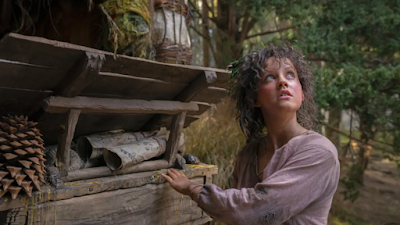
The other one is to engage a fan sop about the source material and continue to subject us to stories about the little people that hide from every danger. I'm still not particularly thrilled with the Horfoot material because it's still kind of routine and that makes it kind of tedious. The odd contrast is that those scenes also contain the greatest number of characters that the audience can identify with, as Nori (Markella Kavenagh), Sadoc (Lenny Henry), Largo (Dylan Smith), and Poppy (Megan Richards) are at least somewhat funny and quite believable in a charming, Underhill kind of way. But just like with the first two episodes, I continue to not see the necessity of the Horfoots (Horfeet!) other than to add the LotR shine to a story that could've been told without the clown act constantly running. It's not actively repulsive and tiresome like the court scenes in House of the Dragon, but it's such a step down from what else is happening in the story that it stands out as something of a flaw, overall. In something of a contrast, I can't help but arch an eyebrow at some of Clark's moments. One assumes she's been instructed to be such an absurd hothead to present the starkest possible contrast with the ethereal thousands-of-years-older version of Galadriel in LotR. The confrontation with Elendil (Lloyd Owen) over whether she could kill him, fight her away aboard a tiny skiff, and then pilot said skiff singlehandedly out of the port was just a bit OTT on the acting side. Since we've been given the impression that Elvish immortality extends to limitless endurance, given her willingness to swim from Valinor back to Middle-Earth, I suppose it's not completely unreasonable to the point of stupidity, but it's awfully close.


On a couple other production notes, the revelation of the glyph being a map of Mordor and the (for some reason) written plan to create a place where "evil could thrive" was a bit heavy on the melodrama and orchestral crashes, but that may be my "I know all this stuff already" bias speaking. Along those lines, the Númenorean distaste for elves in general and Galadriel in particular strikes me as a bit overdone. What might have softened it somewhat is a bit more elaboration upon why not just the rulers of the island but the people, in general, hold that opinion with such intensity. Even the real racists in our world complaining about non-White actors try to come up with excuses as to why they're so opposed to the presence of people who don't look like them. On that topic of looks, while almost everything is quite stunning on the visual side, I'm not sure we needed 90 seconds of Elendil and Galadriel riding, along with every shot possible of Galadriel, her perfectly white horse, and her flowing blue robes to drive that home. It's also kind of funny to note that, despite the elaborate use of chains as weapons and the savagery of the orcs driving their prisoners, the direct death scene of one of Arondir's (Ismael Cruz Cordóva) compatriots involved as little visible blood as possible and certainly not the kind of arterial spray you'd normally get from a mortal wound on the neck. I'm not objecting to the lack of blood. It just seems like kind of an odd way to pull your punches a few minutes removed from a warg chewing through people. Also, Arondir's commander pointing out that the rudimentary cover to protect the orcs from the sun being "how they hid from our sight" in the middle of a path of devastation through forested land stretching for miles is, uh, a head-scratcher of a script point.


Regardless, it's still entertaining and has me looking forward to subsequent episodes, although I'm willing to question if that's not more because of my latter-day Tolkien nerdism than whether the story is simply that interesting. Bringing in Isildur (Maxim Baldry) this early is an interesting choice, since it allows plenty of time for him to build into the alternately heroic and tragic character that he becomes. OTOH, creating someone new like Adar- apparently an elf serving the forces of Morgoth, which doesn't seem at all irrational given the Kinslayings and the shame of the Noldor that Galadriel avers to -shows a willingness to strike out in new directions, which is certainly of interest. Is it compelling? Not quite yet. Could it be? Positive signs.

Monday, September 5, 2022

Nothing but devices


Most historians will tell you that framing the topic at hand is of significant importance in how it's received. If you present the American Revolution as a bunch of hard-working frontier people angry about how they were treated as nothing more than a source of revenue by the English crown, it's a much different picture than saying it was a bunch of wealthy landowners who knew they'd largely escaped the grip of the king's tax collectors and didn't want that to change. There are degrees of truth to both of those, but the way it's depicted by the historian will have a huge effect on how it's remembered. Fiction is similar in many ways because the way that different characters and events are presented will leave the reader/viewer with a different impression of just what the story is about. Episode 3 of House of the Dragon told us more about what the previous episodes had been (e.g. nothing but preamble) and less about where it's going, which has been obvious all along.


One thing in its favor is that, three episodes in, we've finally reached a point where the story is actually moving forward to some degree. Daemon's solo assault on the Crabfeeder lurches us past the Stepstones side plot and carries with it some meaning for both him and the popular perception of whom should be king. The rest of it was the same dithering about Rhaenyra's frustration and Viserys' indecision and the generally corrupt nature of Westerosi high society. In many series', you'd call events like Viserys slaughtering the immobilized stag and Rhaenyra complaining to her sworn protector "character development." The problem here is that we already knew all of these things. We know Rhaenyra is frustrated with being passed over because she's a woman. We know that Viserys is struggling with his personal feelings about the succession and how he feels bound by tradition. This is just the same chorus in a higher octave. We don't really need these static positions "developed" any further. It's gotten to the point where the "Inside the Episode" segments that follow each offering are either pedantic or self-defeating, in that they're showing the motivations of the storytellers and how interested they are in getting their story points across to the audience when those points are patently obvious from the opening minute of the series. They're not offering any deeper insight. Instead, they're just showing how simple the story is and how it hasn't really gone anywhere until the last few minutes of this latest episode.


The story of the Crabfeeder is an interesting quandary from a theoretical perspective. Clearly, the character has some history with the Targaryens. Given the burns all over his body, one might assume that he's had an unfortunate encounter with a dragon and has decided to take vengeance on the rulers of Westeros in whatever way he can manage and with the tacit support of the Free Cities trying to knock a rival down a peg or two. That sounds like something that could have been built upon, even if it was an obvious distraction from what the real story is: the fight over the succession. But the amount of atmospheric build-up in the first three episodes which led to this three-year problem being dealt with off-camera by Daemon was kind of jarring. Yes, the whole fight on the beach was an example of Daemon demonstrating that not only did he not need his brother's help to do the job (a point emphasized by trying to literally kill the messenger) but that he was also the more appropriate "warrior king" that the Westerosi nobility might respect. But it was also a removal of a story element that had been sitting in both background and then foreground, with several moody scenes emphasizing the threat of said element, which was then eliminated in a few seconds, off-camera. This was something akin to the massive, years-long threat of the Night King being wiped out in a single battle of a single episode. In other words, the Crabfeeder and everything around it was a device and nothing more. No, we didn't need the end of Joseph Campbell's journey where we see a literal blow-by-blow depiction of the final battle, but it really rubbed our noses in the fact that all three episodes to date have been nothing but setup, which kinda makes one stop and ask: Why am I bothering?


What reemphasizes that dolor is anything involving Viserys and the court. It's tedious. Unlike the cut-and-thrust of Game of Thrones, where the interaction between people like Tyrion and Varys and Cersei was always loaded with potential and menace and actual good dialogue, everything involving Viserys' court is a chore. There is some sympathy for the king as a man in well over his head, but that's about the most emotion I can generate for yet another moment where everyone titters and looks uncomfortable about the king who's in over his head. There is no "game" happening here. It's emblematic of a society long removed from any kind of game or competition over who would rule, except for the obvious setup of this being a(nother) series about who is going to rule. This is history presented as a World Book encyclopedia, not as something that gives a real examination of who or what was involved and how their motivations can be interpreted in any number of ways. There are no "number of ways." There's just one, point A to point B, and it's mostly pretty boring. If we thought there was any possible variation on how this story would play out, all of this prologue might be worthwhile. But there really isn't. I'll give it another episode or two to see if that ending battle scene might take the story somewhere interesting but, if not, I'm giving up the ghost and moving on. (Rick and Morty was so good and so suffused with possibilities...)


Friday, September 2, 2022

Re-forging the rings of storytelling


Amazon's long-anticipated series about the Second Age of J.R.R. Tolkien's Middle-Earth, The Rings of Power, was released in the last couple days and brought with it my usual personal complications around Tolkien's work. I'm a long-time fan, having read pretty much everything he's ever written about his world (yes, including the collections of notes and letters; a lifetime ago, I worked for Borders and got'em on the cheap. I used to read a lot more then, too.) However, Middle-Earth became the bog standard for fantasy literature, TV, and films so long ago that there's some degree of disdain that now accompanies it. While I was fascinated by Peter Jackson's films bringing the world I'd known for so long to visual life, those felt like isolated instances and not something I was really interested in reengaging with on a creative level. If you'd asked me if I ever wanted to write a bog-standard, Western fantasy story at any point over the past thirty years, my answer would've been a resounding: "No." It's been done. I see no point in my doing it again. In that respect, it wouldn't be illogical to extend that to more productions about Middle-Earth. I thought The Hobbit was an overproduced and overlong video game with a half-assed script and didn't see either of the sequels. Consequently, I went into Rings with a certain degree of weary trepidation because I didn't expect to see anything more than the usual routine of orcs, elves, and dwarves. Having watched House of the Dragon tread heavily over the same ground that Games of Thrones did in the past two weeks certainly didn't help my attitude. But now that I've seen the first two episodes of Rings, I have to say that I'm not entirely convinced, but I'm at least more interested in watching episode three of that series than I am House. (Of course, I'm far more interested in the season opener of Rick and Morty on Sunday than anything else, but that's a (very) different story.)


One significant upside of Rings is the tonal shift that they've taken in terms of storytelling. In LotR, everyone but the hobbits seemed to know everything that was going down. The hobbits were the new players at the RPG table, while everyone else had read the Monster Manual years ago and knew just what to do and when to do it at almost all times. All the bad guys and good guys were clearly marked. The approach to Rings is somewhat different. Rather than being straightforward D&D, the atmosphere felt far more Diablo-esque, in that things were dark and murky and uncertain and everyone was attempting to figure out just what was happening during much of it. The hunt for Sauron in the far north; the skull-wearing goblin bursting from the ground; the sword that feeds on blood; the secret that Durin is hiding from Elrond; all of these things are not hugely innovative fantasy elements (far from it) but they were presented in such a way that even those of us intimately familiar with Tolkien's world were dropped into a bit of uncertainty, just like the characters were. That's a distinct advantage of the story being set in the Second Age, which has only just emerged from an almost-literal war of the gods (The War of Wrath between Morgoth and the Valar.) What that means is that everything is somewhat new, as Middle-Earth has lost about a third of its land mass and a lot of it has to be genuinely explored by the people in front of us. But since it had still been partially inhabited for thousands of years prior, one still gets the mystery of the "people who came before us" that has always been one of the enchanting parts of Tolkien's work (and subsequent epic fantasies by other authors.)


Certainly, one can't fault the notorious budget that was put into this series, as everything looked like it had just come out of a nine-figure film production. Also, unlike House, there was the occasional moment of interesting dialogue ("Why should we enter where sunlight fears to tread?") and the majority of the characters felt like something other than people slotted into roles to move the plot. I can't say I'm thrilled with the large presence of the Harfoot; both as a Tolkien fan (Hobbits don't appear until the Third Age, whereas the Harfoot were an offhand comment of his) and as someone who feels like this series should stand on its own (relatively) without pandering to the people who think that "Middle-Earth" means "goofy characters with big feet" by default. There are enough "regular Joe" humans present that I'm not sure we really needed more of the "people who have no idea what's going on" since, as noted, that's largely everyone in the first place. We don't need little roly-poly people for the audience to identify with. We have the real humans to do that with already, plus elves and dwarves who are a lot more emotional and approachable than Orlando Bloom will ever be.


On the topic of storytelling in the big picture, my friend, Nathan, did point out that in their condensed telling of the First Age at the beginning of episode one, they missed a rather grand opportunity to build upon the fact that the Noldor elves had pursued Morgoth to Middle-Earth against the wishes of the Valar and had slaughtered other elves in order to do so (the Kinslaying; one of several.) It was pride that created that war and that's a great dramatic building block that could have been carried by Galadriel (Morfydd Clark) and Elrond (Robert Aramayo) and everyone else who remembers what things were like before Morgoth was defeated and Beleriand sank into the ocean. I'm not sure how many people would have caught the note about Elrond not being allowed into the council because it was for "elf lords only" and Elrond, of course, is only half-elven; a topic that was ignored in Jackson's films. It's not beyond the realm of reason that those things might be included and/or elaborated upon later in the series (five seasons are planned) but it was an opportunity to inject it right away. Certainly, loading down newcomers with that much lore might be a bit much to ask. It's easier, for example, to present the ingrained dwarven distrust of elves as something personal between Durin and Elrond than it is to point out how the dwarves were actually created first by the Valar, Aulë, who was forbidden from awakening them because Eru, the big god, wanted his chosen folk, the elves, to come first. There's a fair amount of subtext built in there that's more complex than just "You missed my wedding!" and that's the same for a lot of Tolkien's world that didn't really become obvious to readers who may have only confined themselves to The Lord of the Rings. Is all of that necessary to tell a good story? No. But I think it helps tell one that can be a straight adventure story, like this one was for the first two episdoes, as well as a more involved political tale, like GoT was and House is attempting to be. Of course, much of that kind of story will likely emerge as we introduce the men of Númenór starting next episode (speaking of pride leading to disaster...)


So, if you haven't figured it out by now, I'm feeling a lot more positive about Rings than I am House. It wasn't earth-shaking. It wasn't mindblowing. It didn't even stray that far from the dread "bog standard." But it was solid and somewhat interesting and has me looking forward to the next episode to see where the showrunners take us both within the boundaries of Tolkien's tales of the Second Age and beyond. And whether the guy who fell in the meteor is Beorn (which was another very Diablo-esque moment, for anyone who played Diablo III, for example.)