Sunday, March 31, 2013

The storm begins


So, a solid opening episode. As with both previous seasons, there were a lot of intro and catch-up sequences in this first offering. That's going to be standard in a series as complex as this one but the best part about that, of course, is the intro element, since we got to see a few new elements to the story that book readers have been waiting for. A couple of those elements showed up in the title sequence, as Winterfell became largely replaced by the smoking ruin that it now is and Astapor appeared for the first time.

The Wildling sequence was simply a way to introduce Mance Rayder (and Tormund Giantsbane), which is fine, but it was also a great way to display another of the fantasy elements in the northern story by showing a giant for the first time. The key element of this sequence was the clear maturing of Jon Snow, as he properly plays the subterfuge in responding to Mance by using his own outrage at the actions of Craster to fuel his story. Telling a good story often requires a foundation in truth and/or history, as any good author will tell you (even GRRM, who based this tale on the Wars of the Roses and the Italian city-state wars.) I'm glad they kept in the scene of Jon kneeling to Tormund, though.


We're treated to two lengthy sequences of Tyrion, since he was the key player of last season and had the most tumultuous events right near the end. Pod prevents Bronn's attempt at sexposition. It was interesting to note Tyrion and Cersei's rapid descent back into standard sibling rivalry as soon as they began discussing their father. ("What are you going to tell him?" "Why do you care?") It sounded like any pair of siblings I've ever known when trying to manipulate their parents to take their respective side. It was good to see them emphasize Bronn's mercenary nature, as well, to keep the audience from becoming too comfortable with the idea that someone in Kings Landing might be doing something out of genuine altruism ("I don't even know how much I'm paying you now." "Which means you can afford it.") I think I'm going to name a band "Knights are worth double." This theme was continued with the brief appearance of another mercenary type, one Salladhor Saan. I'm betting it will be the last we see of the pirate, since his role in the book is equally brief. It's too bad because Lucian Msamati plays him with a great deal of style and personality ("If you fail, they will burn you. If you succeed, they will burn you.") This scene with Davos and his later one on Dragonstone are both effective in presenting his genuine earnestness and internal conflict in trying to serve Stannis and yet detach them both from Melisandre.
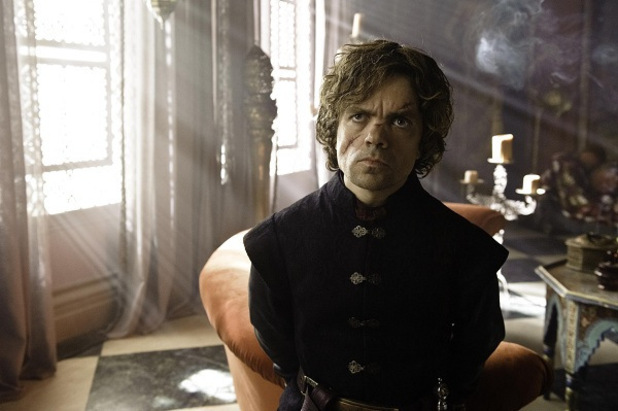

However, one wonders at the later scene with Tyrion and Tywin. It drives home the latter's contempt for his son and the broad injustice and disdain that has encompassed Tyrion's life to date... but we already knew that. Was this scene really necessary other than to have the excellent Charles Dance on camera for a few minutes in the first episode? Certainly, it might have been presented to indicate Tyrion's desire to escape the game and return to the west, but he had just spent most of the last season showing how much he enjoyed the game so, again, I'm not sure this scene did a whole lot for the story. There was one great line, though: "Jugglers and singers require applause. You are a Lannister."


Robb's entry into Harrenhal had me mostly watching Roose Bolton, of course (for non-book readers: Yes, that's a hint.) When they found the piles of dead inside, I expected Bolton to look as unaffected as ever. Instead, Michael McElhatton showed some emotional impact. I don't think McElhatton has been bad in the role, but Bolton is such an unusual figure that I guess I've been expecting more from him. As Jaime said in SoS: "Bolton's silence was a hundred times more threatening than Vargo Hoat's slobbering malevolence." That's a memory of a terrifying figure and McElhatton is... not. On the upside, the costuming is as brilliant as ever, as you could see the brand of the flayed man on the leather doublet over Bolton's armor. It's that kind of detail that really helps make the show what it is. This scene also introduces Qyburn, which is great for the enormous ripples that it foreshadows, but no sign of the other Free Companions, which is a bit discouraging.


OTOH, on the costuming note, Dan Wenioff and D. B. Weiss laughed about the fact that Jorah Mormont has been wearing the same shirt since season 1 in one of their commentaries on the season 2 DVDs and here he is again in that same yellow shirt. But that's a very minor point of a solid scene with the dragons (Dragonfishing, FTW!), now as large as the average Doberman, and the continued emphasis on Dany's intent to do things "the right way". It wouldn't be too much of a stretch to be cynical about that effort, assuming that Dany being the "good" aspirant to the throne is a bit too convenient (and, of course, is one of the reasons for the long delay of Dance of Dragons (the famed Meereenese knot.)) I'm not there yet, as Dany is still a decently complex character, but I wonder how much they'll choose to focus on that issue in the TV series.

The short scenes with Sansa, showing her maturation into an understanding of how to deal with Littlefinger even as she insists on Shae playing the imagination game properly, and Cersei's subtle conflict with Joffrey, as Margaery becomes the new woman in his life, are well-written developments demonstrating the change of emotion for both. Sansa still wants to imagine herself elsewhere like a child, but adapts outwardly. Cersei wants to resume her control of her son now that war is not at their doorstep, but he's more eager to impress his new bride ("My mother has always had a penchant for drama. Her command of the facts grows less as she grows older.") Cersei, as always, is not above tossing a shot when the opening is presented ("We can't all have a king's bravery.") This is good groundwork for Margaery's role as the frustrating populist and her attempt to sway the people around the capital to side with her (not to mention next episode's arrival of the Queen of Thorns.)


Dany's issues come into sharp focus as she attempts to purchase some Unsullied and later survives an assassination attempt. Unfortunately, the latter was attempted by a Sorrowful Man in the books and is replaced by the Qartheen warlocks here. Given that Jaqen H'ghar kept going on about the Red God and didn't bring up the Faceless Men, does that mean that both groups will be absent in the show? Part of what makes the world real is the high number of groups, factions, people, and motivations. Continuing the House of the Undying story seems to detract from the fact that many people want to see Dany dead for any number of reasons. And, of course, they had to do the arrival of Barristan Selmy in the open, as there's not much chance of fooling the audience by calling him "Whitebeard" for a few thousand pages. Even so, where was Strong Belwas?! Is he another detail to be brushed aside? They've already eliminated a number of characters from Dany's story (including her handmaidens.) I understand the limits of budget (you can only pay so many actors) and time (and have them on screen) but turning the whole thing into the Dany and Jorah show doesn't really serve the texture of the story, either.

Still, a solid opening and one has to be prepared for the deviations from the books, as both the showrunners have warned about them. It's good to be back.

Friday, March 15, 2013

Songs to shag to

Horrible prepositional phrases, FTW!

There's very little possible argument against music as a sexual force. It's been condemned throughout history as an enabler, from David to Marilyn (no, not that Marilyn (thanks, Brian) but, yeah... her, too.) What's occasionally rattled around in my brain (and... other... places...) is what kind of music really drives the sexual impulse. It certainly depends on the listener(s) and their particular tastes and impulses, but sometimes it's the foundation of the track:


Ministry's Jesus Built My Hotrod off their transcendent Psalm 69 can't be described any other way by anyone willing to pay attention. Gibby Haynes' obvious lyrics and the song's driving, repetitive beat tend to make it obvious. But would it be a song that encourages sex with someone other than oneself?

Schubert's Ave Maria, on the other hand, is a piece I've heard recommended more than once to "set and continue the mood."


I can see the possibilities, even if it's something that might not occur to me. I wonder, however, if the soprano's presence is too much of an intrusion into the situation for most people. Does she make one rise and fall with her voice or propel one forward? Of course, in the classical vein, many people say you can't go wrong with the classic:


The physical mimicry of Ravel's Bolero, shifting from a slow, quiet build with an everconstant beat to something of more prominence is doubtlessly why it's lasted through the years as music emblematic of the deed. In the modern era, its attachment to Bo Derek and the movie 10 has certainly perpetuated that mental image.

Or we can shift away from mimicry and return to the direct approach:


John Lee Hooker's I'm in the Mood is not only a song explicitly about sex, but also contains that languid beat that tugs at your guts until you're willing to move in the way he wants you to. Many people think that there's something essentially sexual about the blues and its origins from long, slow, hot nights along the Mississippi. Of course, if you'd rather stick with modern tradition, you hearken back to the 70s:


I'd never be able to do it because I grew up in the 70s and Barry White makes me think of seedy, vaguely-Irish-themed bars, filled with smoke and the sounds of Space Invaders; not that the increasingly rapid and regular rhythm of the advancing aliens doesn't make a good aural simulation.

But there's a key element: Is the music supposed to draw you into another world or help enhance the one you're in? I suppose it depends on whom you have to imagine you're screwing, if you have to do that, but then we wouldn't really be talking about playing the right music. Personally, I remember having one of the more thrilling experiences of my life while listening to


AC/DC's Shake a Leg. Again, it was the driving beat and urgency of the whole track (I will forever be rooted in punk, I think) that kind of set the tone for the whole moment. We had put the album on to cover the noise and, thankfully, this track came on at just the right time, just as things were reaching a physical crescendo, as it were. Just like Ministry, it's a complete separation from the slower and just as intense urges driven by players like Hooker and again highlights the question of just which world you're trying to inhabit at any given moment.

Of course, sometimes it's all about timing. I have a friend who was hitting his peak right around the time that someone next door in the dorm was blasting Kraftwerk at 11:


He said that he could never hear this track again without, um, feeling it. Of course, some would say that techno/house/dub music like The Orb's Blue Room


is supposed to inspire precisely that kind of motion on the dance floor, vertically and horizontally. I can't really disagree with that, especially given the ethereal quality that is, in fact, meant to transport the listener (often to another world...) I had this track playing in a hotel room in Coldwater, MI one time (long story.)

Admittedly, I had sexual meaning on the brain tonight after tripping over Friends With Benefits while looking for a brief distraction. I like Mila Kunis as an actress (and, because, well, yeah) and I think the chemistry of the two stars and the script were both great but it was, in the end, yet another formulaic romantic comedy that spoiled all of that potential by kowtowing to test audiences. They were "daring" enough to make the movie largely about sex (trying to PG-13 it would have sacrificed the essential tenet of the story) but music and sex will always beat movies and sex, outside of the whole pr0n thing (Oh. That.) because the former often requires actual thought, whereas the latter frequently avoids it.

Sunday, March 3, 2013

Finally, the deeper meaning

Significant spoilers below if you haven't seen the most recent episode of The Walking Dead.


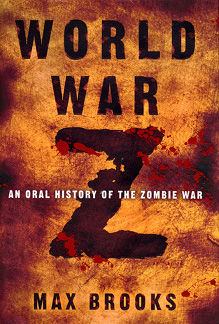
I'm not a huge zombie fan. Most of the entertainment surrounding them is pretty one-note: dead people chase, live people flee and occasionally kill. None of the Living Dead films has ever been more complex than that and most have been relatively self-contained in scope, aside from occasional details about what might be happening elsewhere. The whole world is represented by one little town or even one shopping mall. The exceptions to that are the "28" films (Days and Weeks), which examined the initiation of the problem from a purely scientific perspective (a weaponized disease that escaped containment) and which instigated the utter collapse of the British nation, and World War Z, an excellent book presented as a series of first-hand accounts collected by a UN Commission ten years after the "zombie war".


The book is used to examine any number of social issues that confront us today and which would be accentuated by the utter breakdown of society that takes place during the war, just as it does in the 28 films. That is what makes both book and films interesting, because the problems are far more complex than simply confronting walking corpses. The Walking Dead, originally as a comic and now as the TV series, is presented in a similar vein: the story isn't about running from and occasionally killing zombies. It's about what happens when society completely breaks down. Where does food come from? Where does electricity come from? Who enforces the laws? Who heeds them? Do you absorb others into your group, creating security but also creating more mouths to feed? Or do you reject all but a chosen few once you've learned to trust them?

The TV series has come under criticism from fans of the Romero movies who profess to simply want more scenes of hardcore corpse-killing action. That's a series that would last about two seasons and then get cancelled and the producers and the original writer of the story, Robert Kirkman, have often tried to explain that reality. There has to be something more to the story being presented or else it will quickly become trite. Tonight's episode highlighted that in almost every way possible and finally made the last two-and-a-half seasons well worth watching.


Lennie James returns as Morgan, who appeared in the first episode of the first season with his son, Duane (Adrian Turner), as they rescue Rick Grimes (Andrew Lincoln) after his escape from the hospital. They're holed up in their house in Rick's home town and they explain how the world has changed before Rick sets off in search of his family, promising to try to keep in touch with them by radio. Tonight, we learned that Morgan has remained in town, but shifted locations to a more defensible area where he's amassed an arsenal and established an array of traps for the walkers while he continues to paint doomsday graffiti on every available surface. Duane has died and turned at the hands of his mother whom Morgan says he was too selfish and too weak to kill. Morgan has been driven at least mildly insane by this course of events and is now determined to embody the nihilistic approach toward the world that he thinks is the only reasonable course: everyone will turn and everyone will die, so there's no sense in associating with other other people or trying to rebuild society.

This is the crux of the story: Will society be rebuilt and, if so, by whom and how? The Governor of Woodbury has one approach that seems bent on authoritarian control and an intent that society will be what they want it to be, which is closer to the approach of most of the forces present in the 28 films. Rick's group, on the other hand, seems relatively deterministic: survival is the only real goal and the future will somehow take care of itself, once the problem of the zombies is resolved, which is closer to World War Z's depiction of the problem. The Walking Dead has managed to incorporate both approaches and this episode is what brings it into focus. Morgan had been a survivor, but now presents as an iconoclast. Nothing matters and it's his own weakness that has assured that situation (again, still somewhat deterministic, as his inaction seemingly assured his insanity and change in philosophy.) As he says: "I was too weak and it's people like me that have inherited the Earth."


Meanwhile, the former iconoclast of Rick's group, Michonne, discovers in the course of the same episode that perhaps it is better to be part of a group than a loner determined to distrust everyone. She does this by assisting Carl in the retrieval of the last picture of his mother that he knows to exist. His effort to reach this is motivated by personal feelings, but also by his desire to show his sister, Judith, what their mother looked like. In this way, he firmly positions himself in the camp of those trying to rebuild society, as he understands that the foundation of many human relations is the memory of what has gone before. If we don't possess knowledge of our forebears, we're cast adrift; essentially making it up as we go along, rather than confronting problems with a set of values rooted in the past and our knowledge of the people that lived then. As Orwell said: "Those who control the past, control the future. Those who control the present, control the past." That's a bit more heavy-handed than Carl's motivations, but the truth is essentially the same. Society will be based on a vision of what the controllers feel is essential to preserve, whether out of genuine altruism (Carl) or darker motivations (The Governor.)

I've been watching the series because I'm interested in most comic-oriented stories and Kirkman's is one that has been spoken of quite highly (I only read the first arc.) At times, it was difficult to continue because the story seemed to lack purpose. It was, in fact, just a bunch of people sitting around bemoaning their fate and occasionally entertaining us with new methods of killing walkers. But the third season has been a bit of a revelation in that it finally began to address the bigger picture and this episode brought it home, not because it delivered some poorly-executed expositional homily to the idea of recreating what was, but because it showed people confronting those problems and how it motivates and changes all of them. In that respect, I think I've become an actual fan.

Wednesday, January 23, 2013

It's like it really happened!

One of Caelus' This Day in History posts on the board recently mentioned Edward II of England and that quickly invoked the topic of Braveheart to those of us who are historically-inclined. While not a great film (Oscar winner or no), I continue to think Braveheart was a very good film almost solely for its cinematic qualities and cultural effects; the latter of which demonstrated how some degree of ignorance about history can sometimes generate a greater response than the actual facts.

It had been some time since a film had created the kind of mass battle effects that Braveheart displayed and which have now become virtually routine in historical and fantasy films (or those that combine the two, like this one.) On the one hand, that generated some veracity street cred right away. Gibson showed the effects of mass combat, morale, the chaos that frequently embodied such events in the Middle Ages (as opposed to ancient combats involving Roman armies; let's not get started on the idiocy of Gladiator...), and the rather brutal results. On the other hand, it was the history of the battles themselves where the movie most often went awry.

First off, the Scots didn't win any fights on an open field, precisely because of the threat of heavy cavalry and the always superior numbers of their southern oppressors. The initial battle of the film, referred to as "Stirling" was actually that of Stirling Bridge, wherein the Scots hung out on the opposite side of the bridge from the English until the latter crossed, piecemeal, and began forming up their lines. Like any good guerrilla commander, Wallace chose that moment to defy propriety and decided not to let the superior force get good and ready. Pushed up against the river, the English scattered and fled. As much as it might have made good cinema for Gibson to suggest that the Scots had developed one of the two key elements that reduced the power of the mounted knight (pike formations, most famously wielded by the Swiss; the other being gunpowder), it's a bit hard to swallow, given that word about those kinds of things does tend to get around. Yes, I realize that the English didn't realize the Renaissance was happening until a century after it was over, but stories about things like military surprises not only travel but tend to grow in the telling, as opposed to tales of Italian paintings. Suggesting that such a dramatic victory could have occurred and not been recorded by someone (especially, say, those Irish monks who "saved" Western civilization) is testing the limits of reason pretty hard.

Or is it?


History, as they say, is written by the winners. This is the central conceit of Gibson's film, in that it purports to give the "true" story of William Wallace that was covered up by the English for centuries in order to prevent the inspiration of the Scottish people. Consequently, massive victories by Wallace were supposedly changed in the historical record to make him seem like more of a bandit than a wartime hero. Of course, one person's bandit is often another's wartime hero and there's no shortage of situations in which the above maxim about the historical record is plainly obvious. Take the War of the Pacific in the 40s. It's almost universally presented as a war of response to unfounded Japanese aggression and it's certainly true that the martial character of the post-shogunate Japanese state certainly encouraged that kind of aggression. However, what drew Japan into conflict with the United States (against its greatest admiral's inclination, but not dramatized and dire warnings) was the fact that the latter was conducting a trade war against a nation that has always been desperate for natural resources, in addition to sovereignty-violating impositions like the Washington Naval Treaty of 1922. Few people talk about that because its easier to simply imagine that the Japanese were evil.

So, is it beyond the realm of reason to think that Wallace's time on earth may have been closer to Gibson's Hollywood version? No, it's not. But it's still pretty unlikely. To his credit, Gibson has never said anything about the film other than it made a great story. He also deserves credit for one of the greatest Oscar quotes ever made. But what really makes the film interesting is the impact that its fantastical story had on Scottish culture and the national attitude, in general. Following the film's release, there was an upsurge in Scottish nationalism and greater discussion of national identity. The Scots began pressing London to fulfill longstanding promises for greater autonomy. This was the final leg being kicked from the stool of the British Empire and it was caused by a movie. Said movie also resulted in the only extant statue of Mel Gibson known to exist:


I mean, sure, it's supposed to be William Wallace but, uh, I got news for you: among the many, many historical errors or outright fantasies presented in the film, one of the most prominent is that they had men running around in skirts. Kilts are a 19th-century faux "tradition" that supposedly hearkens back to the days of the Picts. It was created during another surge of Scottish nationalism that didn't make it very far. During the time of Wallace, men mostly wore what they wear now: jorts.


Or pants, actually. Even the title of the film actually referred to Robert the Bruce, who's presented as a conflicted bad guy that has to learn about leadership from Wallace.

Interestingly, that same Scottish nationalism is so obvious to most that pay attention to politics on the other side of the pond and/or the EPL that it struck me as utterly distorted in the latest James Bond film, Skyfall. While it was a generally good Bond film and was the proper follow-up to Casino Royale in place of the utterly forgettable Quantum of Solace, at one point, they're ostensibly testing Bond's mental state and decide to do some word association. The doctor says "Country" and Bond responds with "England." First off, as an officer of MI6, he's serving the crown or Great Britain, not England. Furthermore, the second half of the film is spent emphasizing Bond's origins... in Scotland. I think it's a pretty safe bet that no Scot would respond with "England" to any word association trigger other than "Detestable."

What many Scots would gladly do to Windsor Castle
One final note on Braveheart is that it has to be acknowledged that Patrick McGoohan was absolutely brilliant in his depiction of Edward I, the Longshanks:


although, again, it's mildly ridiculous that they refer to Edward as "a cruel pagan", given that he was not only Christian but participated in the Crusades. If they really wanted to emphasize how cruel he supposedly was, they'd have shown him breaking the will of the Welsh where, in at least one instance, he refused the surrender of a Welsh castle in order to test out his new toy from the Continent: a trebuchet. But no one can pronounce the names of any Welsh national heroes, so...

Sunday, January 13, 2013

Warped reflections

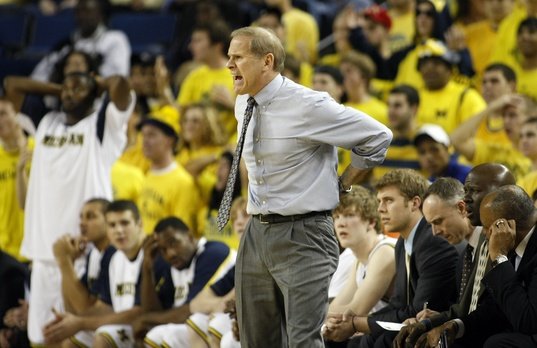
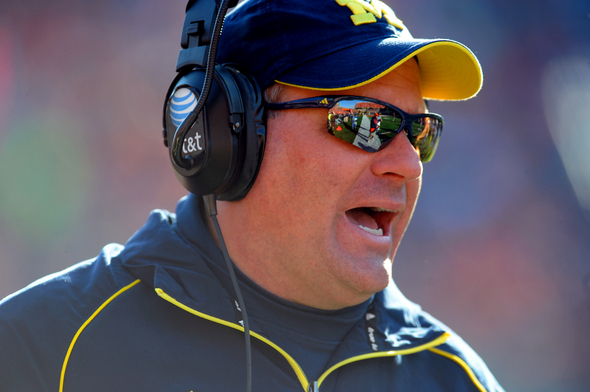
The University of Michigan swiped two coaches from the University of West Virginia in the last few years; hiring John Beilein to coach basketball in 2007 and Rich Rodriguez in 2008. The paths they have taken since those points were remarkably similar and became almost completely divergent, resulting in Rodriguez's dismissal in 2011, while Beilein continues to lead the basketball team, including a phenomenal start to the '12-'13 season.

Bed goes up


Bed goes down
My reactions to and expectations for both hirings were as radically different as the paths their careers took in Ann Arbor and it's interesting for me to look back and assess what I did and didn't appreciate about the two of them.

Both men were considered "system coaches". Rodriguez is hailed as one of the innovators of the spread option offense, while Beilein's offensive and defensive systems were unusual; the former being of his own devising (like Rodriguez) and the latter being the 1-3-1 zone, rarely used in major college ball. I immediately dismissed Beilein's hiring as the "safe" play for the blue bloods at Michigan whom were determined to never allow the shadow of NCAA regulations to ever darken Michigan's southern campus again, even if that meant being a middle-of-the-pack program that only occasionally would compete for a Big 10 title, to say nothing of a national one. I was convinced that Beilein's system would not attract the players that we needed to get back to the upper strata of the basketball world, which seemed far more important to me, since basketball teams are fewer in number and far more reliant on on pure talent than football often is. Beilein was known as a "well-respected" coach among his peers, which is tantamount to referring to African-American men as "well-spoken". It means he's non-offensive. Everyone likes him, but doesn't think he's any kind of threat on the court and had been that way for many, many years. He had done well at the non-basketball power of West Virginia, but he certainly wasn't considered the same caliber of coach as a Rick Pitino.

Rodriguez, on the other hand, was one of the game's up-and-comers. He had taken West Virginia to heights that it hadn't realized since the early 90s under famed coach, Don Nehlen, and he was the mastermind behind the new wave of football offense, designed to gain a numbers advantage against the defense from almost any formation or position. It had been adopted or extrapolated upon by any number of prominent coaches in the game, including names like Urban Meyer. Anyone who had seen Michigan's play under Lloyd Carr for many of his last years had to be thrilled at the idea that opposing defenses would no longer be able to predict our plays. And I was thrilled. I grew up with Rick Leach and will always carry a torch for option football, even though my appreciation extends to any offensive system that works. Carr's, too often, demonstrably didn't. I thought our problems were solved and we were about to have one of the most exciting programs in the country. Finally, Michigan would be more than simply living off of its past glories. Well, it was exciting, in the literal definition of the word (synonyms: perturbation, agitation.)


At first, they both ran into trouble. Beilein's 10-22 first season was the worst result in the history of Michigan basketball. Not only did we not have the players we needed to compete in Division 1, but it was evident that converting said players to Beilein's approach to basketball was an enormous project. Furthermore, all of the talent on the team had been recruited by his predecessor, Tommy Amaker. Beilein's late arrival meant that he had to attempt to catch up in recruiting and could only land what were, to most basketball fans, non-entities in the recruiting world like Zack Novak, Stu Douglass, and Ben Cronin. In the next couple years, that pattern didn't change much, as Michigan State continued to sweep up most of the highly-regarded recruits in-state and we saw even more continue out of state to Tobacco Road and Louisville (coached by Rick Pitino...) However, his second season was a breakthrough: Michigan made the tournament for the first time in 11 years. I frequently cited my distaste for Beilein's system, which seemed heavily dependent on sharpshooting from the 3-point line and still believed that we couldn't compete on a level basis with MSU and OSU while that dependency existed, but I was willing to acknowledge his achievement.

However, the following season was a prominent setback. The team finished 15-17 and it was obvious to anyone that the offense wasn't functioning consistently and the 1-3-1 was not going to be effective without very specific personnel. After losing to OSU in the conference tournament, where we left their best player, Evan Turner, undefended as he sunk an admittedly phenomenal shot to end our season, I remember declaring that "We will never win a championship with Beilein as the coach."


RichRod also started poorly, going 3-9 and breaking Michigan's streak of non-losing seasons since 1967, as well as its NCAA-best-ever mark of 31 consecutive years in bowl games. It was blatantly evident that Michigan's transition to the spread was not going to be easy. Rodriguez had come into the job saying that he would design the offense around the personnel available, which seemed to imply that we would be running something at least partially conventional (what most refer to as a "pro set") while he taught the team how to work the spread. No such half-measures were taken. Not only was he attempting to institute the spread wholesale, but he was doing so with a severely depleted talent base, given Carr's lackadaisical recruiting over the previous couple of years However, he was lackadaisical himself about an entire facet of the game: defense. His coordinator, Scott Schafer, the only member of the staff without WVA roots, was instructed to install aspects of the defense that Rodriguez favored (the 3-3-5) and which Schafer was completely unfamiliar with.

Given the turbulent situation, Rodriguez's recruiting also frequently wasn't up to Michigan's historical standards. Beilein was looking for recruits that were hot shooters and often appeared to be little else. Rodriguez was looking for players that were almost solely suitable for the spread offense and, again, little else beyond that. Both were recruiting as if they were still in the disadvantaged position that they had at West Virginia or the stops that each had made before that (Canisius and Richmond for Beilein; Glenville State, Tulane, and Clemson for Rodriguez.) Both systems had been designed because their respective teams lacked the players that their opponents often had. When you form a habit, you tend to stick to it. That's what a habit is. If you've always recruited tiny receivers from the backwoods of Florida and done well with them, you'll tend to do it again. If you've always recruited Euro-style, shooting forwards who can't play inside, you'll tend to do it again (even if that style of ball won't play well in the B1G, where officials often let basketball games function as thinly-disguised rugby matches.)

I eviscerated Beilein for his failures because his style of basketball was something I didn't appreciate. I enjoy the precision of the Princeton-type approach, but am more eager to see an inside game that contests an opponent directly. Contrarily, I wanted to forgive Rodriguez for his failures because I loved his style of offense, even though it's essentially the same principle as the Princeton basketball offense. It wasn't "smashmouth football". It was "I'm going to score whether I have to smash you or not" football. After years of the grinding of Carr, I was more than eager for it. By the same token, after years of Amaker's "pass around the perimeter and then take a shot from outside when there's 3 seconds left on the clock" approach, Beilein's system seemed to be just a slightly more complex version of the same.

And here was the fork in the road.


Confronted with the fact that his recruiting and offensive approach wasn't going to put Michigan back atop the Big 10, Beilein dumped his whole staff and changed directions. He largely abandoned the 1-3-1 (people still assign it to him, even though Michigan has run it only a handful of times in the past 3 years) and changed his methods. All team members used to have to complete a ridiculous number of threes in pre-season practice and even centers were expected to shoot the 3 when given the opportunity. Now, players do what they're best at. I don't think Jordan Morgan has attempted a 3 in the past two seasons. Beilein's ability to find hidden gems like Pittsnogle has continued, as he correctly identified current stars Trey Burke, Tim Hardaway, Jr, Glenn Robinson III, and Nick Stauskas long before rivals did, but he's also begun to win the battles for hotly-contested stars like Mitch McGary. Michigan still uses the three and still employs misdirection and backdoor cuts, but it also runs a more conventional offense with ball screens, iso plays, and a transition offense better than any seen since the Fab 5.


RichRod, on the other hand, confronted with some of the same facts as Beilein, and the fact that his defense was a nightmare, did almost nothing to alter his approach. He still recruited like he was at West Virginia, hired another defensive coach sight unseen, and still did nothing to ease the transition from the offense that Michigan had employed since 1982. The defense was, in the end, the most damning issue (including Mike Martin's assertion that the defense was used as a punching bag for the offense in practice) but it was evident that, in need of some drastic measures, Rodriguez was in over his head. And, again, I wanted Rodriguez to succeed. The system that he created is fast becoming an essential part of the stodgy NFL's offensive approach and will likely be used by the aforementioned Meyer to torture Michigan for the next decade (It remains to be seen whether Al Borges can adapt...) No one should have been expecting him to run a standard one-back passing attack anymore than they would expect Beilein to run Bo Ryan's abomination of an offense. But we could expect him to do what Beilein did and change just enough to adapt to the environs in which he found himself. That's the mark of a smart coach and a smart program director. Rodriguez did neither and, facing the drastically higher expectations for football at Michigan, found himself fired and engendering far less respect from me as a coach.

I'd still love to see the spread at Michigan. I think ignoring its possibilities will be a key flaw in Michigan's effort to compete with OSU for the Big 10 title. If Rodriguez gets canned at Arizona, I honestly wouldn't hesitate for a second to suggest that he'd make a great OC, especially with someone like Hoke around to ensure that the whole team gets coaching and advise that perhaps we don't quite have the quarterback to run the read option. But he's not a great head coach and I don't think I could safely suggest him as that to any fanbase looking for a replacement (if anyone bothered to ask me.) Beilein, on the other hand, is a great head coach. He's not perfect but he understands how to adapt and that's the best kind of leader, in my opinion, and he did so at an institution absolutely famous for not changing (and now under the control of an athletic director who thinks every Twitter post is an excuse to have a "Wow moment".) So, I was wrong about at least one of Bill Martin's multiple screw-ups as athletic director. He still screwed up, but it was with the other guy. That's not to say it wouldn't have been cool to see what Pitino could have done here...


Saturday, January 12, 2013

Heading home after an indifferent loss

Driving very low to the road, the light scattered and the sounds faint. Zydeco, jin, and swamp pop trickle to the floor and taillights register off and on. The fact that mist and puddles are strange for January occurs only briefly. I'd like to think that something more enlivening will be present at the point where I stop and exit the car, but I'm doubtful. The lack of proper alcohol is certainly a regret. A finger or two of Talisker would have suited the weather. But drinking alone was never my thing.

4-1 Alaska, Pathetic.

Saturday, December 29, 2012

Nassty Hobbitsezzzzzzzzzzz

About halfway through yet another interminable fight scene, I knew that my prevailing thought about The Hobbit was going to be: "Oh God, make it stop." Alas, there was to be no divine intervention and I would have to wait through the whole thing. I'm seriously questioning whether I'm willing to sit through two more over the next couple years.

A suitable instrument for slow torture? Oh, yes...
When the project was first announced under the command of Guillermo del Toro, it was going to be one film. I think the idea was that del Toro would give his dark fantasy spin to what was originally intended to be a children's tale. Anyone who's seen Pan's Labyrinth would understand that such an approach is right up his proverbial demonic alley. Creative conflicts ensued and del Toro left the film. Peter Jackson, slated to be the producer, picked up the reins with his usual team of wife and friend (Fran Walsh and Philippa Boyens, respectively) and decided to make two films out of it. I understand the desire to do so, as The Hobbit is the foundation from which The Lord of the Rings and The Silmarillion (and mountains of backstory) would spring. There are brief mentions of things, like the Necromancer, in the book that wouldn't be appropriate to drop into a film, but could easily be expanded into their own segments. Hell, I wanted to see the White Council challenging the Necromancer. Why not? It sounds cool. We all know what it leads into in the later books. But I guess I still envisioned the Hobbit being a two-hour movie and then perhaps the Necromancer material being its own thing, because the book is only about 200 pages. There's not enough there to make an epic. And, of course, once some studio executive who'd never read it heard about all the footage that was shot and left in the editing room, I'm sure he immediately thought: "It'll be a SECOND trilogy just like the FIRST one!"

You guys don't look like you're enjoying the genius of this idea.
Except... well, it's not. The Hobbit was a fairy tale. Lord of the Rings was a genuinely epic story about cultural change and Christian mythology. I could sit through a trilogy of three-hour (or even four-hour) films drawn from the latter. The former is a single three-hour movie, at most. Stretching it in this fashion makes it tedious and that's exactly what this first offering was. Most of the scenes lost my interest after about a minute and they all lasted ten. I don't think Jackson realizes that while he's been off working on other projects, we've all been watching his extensive CGI and liberal use of circling helicopter shots over and over on TBS. We've been there and have the really expensive T-shirts to show for it. But The Hobbit is just more of the same; more and more and more of the same. Ian McKellen, reappearing as the constant Gandalf, actually had a little unintentional insight on the whole project early in the film when he mentions Radagast the Brown for the first time. He tells the group that the Istari are actually five wizards, including the two blue ones whose names he can't recall. He can't remember them because Tolkien didn't name them until his son collected his notes for Unfinished Tales and Jackson probably didn't want to bother explaining even more. But he really did name them in this film because I know their names: Exposition and Padding. They were the stars of the show.

First lesson of fiction writing: Avoid expository dialogue. Show your story. Don't have your characters tell it. But the meeting of the White Council in Rivendell was exactly that and this is the material that was added to the story. The four of them stand around for over five minutes of screen time, arguing over whether an evil knife means anything and giving everyone insight into how the Necromancer is really the Enemy (but maybe not really.) This scene goes nowhere and contributes nothing. It's precisely the kind of scene you'd put in if you were spoon-feeding your story to your audience because you don't know how to make it a story, rather than a Wikipedia article. People stood around and talked in Lincoln, but they were talking about big ideas that propelled the film. This was tedium disguised as backstory.

My sword actually glows blue from angst.
What makes it even worse is that the action scenes were no better. A chase through a cavern where people are falling? Sure. Moria. Been there. Running through the woods or over hills being chased by warg riders? Yep. The added scene in Two Towers. Seen it. Jackson was essentially ripping himself off for two-and-a-half hours. You could even recognize some of the same locations in New Zealand. And the action scenes not only wouldn't stop, but he had to add the extra moments of melodrama to make them even more grueling. Did we really need to see Thorin stalk off the burning tree in full righteous outrage to confront his "nemesis" that he'd met all of one time before? In the book, Azog was a detail, a snippet of Thorin's story that established him as a warrior who'd experienced some profound personal trauma (snd just as important to the story of Dain of the Iron Hills.) In the film, Azog is a cheap recurring villain with a motivation as thin as "See familiar dwarf. Kill."

By far, the best scene in the film is one of the two best scenes in the book: the riddle contest.
You were saying the director took too much time?
Andy Serkis once again does an excellent job of making the repellent and pathetic Gollum a highly entertaining character that the audience laughs with as much as they laugh at. I wrote the title of this review in that fashion because I almost fell asleep during the troll encounter, but I was wide awake and perfectly enchanted during the riddle scene, even though I know the riddles and the result by heart. This scene demonstrated that, once again, CGI doesn't have to be explosions. Even though Serkis' character is mostly generated, it was the dynamic between him and Martin Freeman that makes that scene come alive. Acting and dialogue makes a film work? Who'd'a thunk it? At the very least, I noticed that Serkis got a promotion for his efforts, as he appeared in the credits as the second unit director. And one has to at least credit Jackson for inserting the Wilhelm scream into the escape from the goblin kingdom. Freeman's Bilbo was solid for Freeman. He's an excellent actor and I love his Watson in the Sherlock TV series. But it wasn't solid for the Bilbo Baggins from the book, who is at least mildly neurotic and still quite frantic even at the end of the story during the Battle of Five Armies. Freeman just isn't a frantic person. He's too level-headed for that. So, while he makes a good lead and performs well, he's not what the story really calls for.

Perhaps the most telling moment of my experience was walking out of the film with the collection of 20-somethings around me. These are people who literally grew up with Jackson's Lord of the Rings movies so, in many ways, this is kind of their Star Wars prequels moment... with exactly the same result. They were as dismayed as I was because Jackson essentially abandoned his profound sense of story in the first trilogy for cheap melodrama and lots of explosions and blurred action in the second. This is why directors generally need to avoid material that they've mined before.

I was interested to see the film both because I love the books, I loved Jackson's LotR movies, and I honestly wanted to see the impact of the high frame rate on the audience. I didn't see the 3D version because I detest it as a marketing tool that does nothing but make people pay more for the same film and that's the version cited in the Gizmodo article as the source of the problem (and confirmed by more than one friend.) I can't say that I saw any real difference in visual quality and I certainly didn't dislike the film because my visual receptors were overloaded. I disliked it because it was bloody awful. If you want to experience the Hobbit, read the book again. You'll probably finish it before you could make it through the film (and you'll probably stay awake.)