Tuesday, June 28, 2022

This cannot possibly be a surprise


Shocking testimony! Surprise witness! A surefire distraction from the fact that Congress has yet to take any of the plentiful actions available to them to rein in the Supreme Court-!

The first two of those read like headlines from your average supermarket scandal rag; the last one, not so much. That's because the last one is actually true and the other two are trying to create something out of nothing. Today's "shocking witness", Cassidy Hutchinson, former top aide to former Trump chief of staff, Mark Meadows, sat in front of the January 6th committee to tell everyone precisely nothing of interest outside of a soap opera script and nothing that could in any way be a surprise to anyone who has actually been paying attention. Of course, that latter category tends to include less than 10% of humanity, so perhaps I can't really find this unusual, either. Everyone knew on January 6th, 2021, that Trump had organized a mob to attack the Capitol. We knew this. It was right there in front of us and there's been a mountain of evidence piled on top of that accusation since that day. That Hutchinson, an insider to the Trump cabal, albeit one of minimal importance, was actually willing to talk about it in detail is the only mildly extraordinary event that took place.


I'm honestly baffled by the number of people reacting to this as if it's any more shocking than anything Trump has done before and what he's done for the vast majority of his life. Anyone that has paid attention to this man-child's behavior can't possibly be surprised that he would be throwing a tantrum because his attorney general followed the law; because not enough people could get through the metal detectors for his pity party at the Ellipse; that he attacked his driver who wasn't willing to let him bask in the glow of his devoted followers by leading them to sack the Capitol. This is who he is. This is who he's always been. The last six years have been daily reminders of that very fact and, yet, people are still somehow shocked that he's not only not "presidential" or anything even vaguely close to it, but is an outright criminal, as he has been for most of his life. There was a steady stream of commentary about his criminal behavior while in office and the last two years have been a constant parade of a host of other actions and events that only reinforce that perspective.


Most are assuming that nothing will come of this and they're absolutely right. Nothing will come of this because the people controlling the institutions of power are interested in only one thing: preserving those institutions of power and their place within them. That means preserving the dignity of the office of President by not prosecuting a blatant criminal who once held that office and attempted to retain it by overthrowing those very same institutions. It's why the New York Times refused to call Trump a liar when that's what he clearly is. It's why the current AG, Merrick Garland, chosen for his status as a legal non-entity that the GOP might actually go along with on the Court until McConnell decided to refuse to do even that, isn't standing outside Mar-a-Lago right now with a battalion of FBI agents. It's why Biden and Congress aren't taking the blizzard of actions they can, quite legally, take against both Trump and the corrupted Court. All these people care about is preserving the façade that is the American version of "democracy" and that means not bringing those institutions into question. Again, anyone who's been paying attention should have begun to question them decades ago. But most people don't pay attention and, thus, here we are in the Weimarican Republic with our far more threatening version of the Beer Hall Putsch resulting in prison terms for precisely no one who actually matters. And it's because, in the grand scheme of things, those people matter and we don't. To quote one of the greatest stand-up comedians of all time: "It's a big club and you ain't in it!" And all they care about is the club.

Thursday, June 16, 2022

Lacking verse and rhythm


In 1996, The English Patient won Best Picture at the Academy Awards. It beat out Fargo, Secrets and Lies, Jerry Maguire, and Shine; almost all of which were considered to be better films among the wider movie-going public, not only now with the benefit of hindsight, but when the awards were announced. But The English Patient was considered to be a prime example of "Oscar bait", not only because it was A SERIOUS FILM but also because it was English and, thus, escaped the veneer of being genuinely innovative (Secrets), being something that was funny as well as good (Fargo), or something that appealed to the general public (Maguire.) Patient was something that the academy members could laud as serious filmmaking in classical, serious style. I don't want to tar this week's film, Benediction, with that same brush, but Patient was the film stuck in my head when we walked out of the theater; not only because it took itself VERY SERIOUSLY but also because, like Patient, it's about war and the effects of war and if there's anything that mainstream cinema loves, it's taking that very serious topic and moralizing about it.

As it stands, Benediction is at least partially about moralizing on the existence of war, since it's a biopic about Siegfried Sassoon, who made a name for himself by writing poetry about the horrors of trench warfare at the Somme and how the British government was only too happy to toss more young men into the grinder in the name of absolute victory. Sassoon had the audacity to risk a firing squad to make his point about how the war was wrong. He was also one of the more prominent literary figures of the time who wasn't under threat of imprisonment like his hero, Oscar Wilde, for having the audacity to be gay. And it's that latter aspect that the film is mostly centered upon, despite its framing as a war movie about the war poet. Sassoon has a difficult time maintaining a lasting relationship and tends to slant that situation in the direction of others betraying him, but it's also obvious that his version of survivors' guilt makes him fairly tiresome to be around for any lengthy period of time. While others want to enjoy life, Sassoon struggles to accept that it's still happening when so many around him died.


That sounds like the makings of a good story and, if writer-director Terence Davies had chosen to limit the scope of his undertaking a bit, it might have been one. But instead we end up with a film that, like Patient, is too long, unfocused, and like Sassoon himself, kind of tiresome. In choosing to show us seemingly every relationship he had before finally giving up the social ghost and marrying Hester Gatty (Kate Phillips), the parade of passion becomes confusing, rather than compelling. While seemingly most head-over-heels for Ivor Novello (Jeremy Irvine) before being abandoned, Sassoon then gets involved with Glen Byam Shaw (Tom Blyth) for perhaps 90 seconds of screen time before shifting suddenly to Stephen Tennant (Calam Lynch) without any kind of build-up. Later, we see a much older Stephen returning to try to make amends for having departed Siegfried's company for a more vivacious German prince with the idea that Stephen, not Ivor, was the love of Siegfried's life. But we were given 20 minutes of story to tell us about how attached Siegfried and Ivor were and only a tenth of that for Stephen. It felt like we had missed something before the film was even finished. Indeed, that was evident from the very beginning, where Davies chose to depict Sassoon's late-in-life conversion to Catholicism and the personal struggles he had mixing his faith with his emotions by showing a few seconds of his son, George (Richard Goulding), shouting at him in a church. Perhaps we were supposed to read a biography of Sassoon before seeing the film so we'd know the impact of the key points of the story, despite their brief presentation?


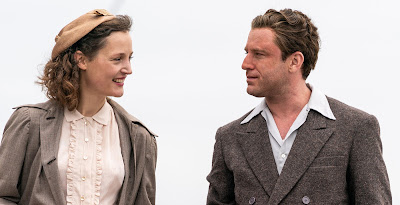
Jack Lowden does a good job in the title role as a man struggling with both his place in society and the fact that he's still alive to try to find a place. Those are deep questions that certainly deserve a slow-paced and methodical portrayal to give them the gravitas that makes them feel genuine. But when we're tossed from lover to lover with the only emotional delivery being that of Sassoon's contempt for the world at not seeing things the way he does, that word "tiresome" springs to mind again. Like Patient, which departed from its source material to bring an element of mystery to a story that's otherwise lacking in it (and which was so obvious that it made the film even more dolorous), Benediction tries to pack so much of a complicated figure's life into a couple hours that it ends up feeling trite and repetitive, rather than significant. By the third (or fourth?) moment of being left by another man he was supposedly deeply in love with, the only response I could think of was: "Yes. We've seen this. Let's move on." Don't get me wrong. It's not a bad film. It's well-acted and may have been well-written before an editor got hold of it and assured Davies that you couldn't keep people in the theater for four hours. It just seems like it might've been better served as an HBO miniseries, where all the nooks and crannies of war, love, and faith might've been explored to their fullest extent.

Tuesday, May 24, 2022

Can't quite reach past the edge


I'm generally an Alex Garland fan. All of his films have a very distinct visual style, embodied by sharp contrast in lighting, vivid colors, closing shots on his main characters, and ethereal imagery. He's also fond of moody and loud scores that often dictate the pace of the visuals, rather than simply accompanying them. That's all very interesting stuff and I'm glad to watch it most of the time. His writing, however, can often fall short of what he seems to be setting up. His best work, by far, is Ex Machina. Every work of his I've seen since has shown some refinements of his technique (and, perhaps, bigger budgets to play with) but hasn't really approached that level of cerebral storytelling and seems to fail somewhere in the third act that makes you think the film is running a bit long for what it's trying to say. Men is no different.


From the very beginning, we're aware that this is going to be a psychological thriller/horror film even if, for some reason, you weren't aware of that going into it, given trailers, reviews and, y'know, Alex Garland as writer and director. But the scene is set right away that our lead character, Harper (Jessie Buckley) has faced some trauma at home and has decided to escape it in the English countryside with AirBnB owner, Geoffrey (Rory Kinnear.) Along the way, she also meets an insipid and disingenuous local vicar (Rory Kinnear), a demented parochial schoolboy (Rory Kinnear), a disinterested cop (Rory Kinnear), and a devotee of The Green Man (Rory Kinnear.) The first three could easily be examples of the men in Harper's life that either won't help her, would make her situation worse, or would make it so that she'd never be willing to escape the roles that society would impose upon her. All of that plays right into the guilt trip and shifting of blame that she was attempting to escape in the situation with her husband, James (Paapa Essiedu.) But all of that seems to be (ahem) rooted in the underpinning provided by The Green Man; an ancient English/Celtic symbol of fertility and rebirth and that's where the story kind of goes awry. I guess it's all well and good to have presented this as something of an eternal problem in that men will keep seeing women as an object of desire or as simply an object to be claimed and used, no matter how many changes they affect or how many different versions of them there may be in society. But did we need the Celtic imagery to deliver that message?


This was part of my disaffectation with Annihilation, in that it was simply The Colour Out of Space with a loftier presentation. Instead of dropping into someone's well and disturbing a family, it occupied a beach and became a national security crisis. So, here we have one woman's trauma and problem with the opposite sex that is revealed to be a larger issue (it is) that is conveyed in a spiritual and mystical story (OK) but then gets overshadowed by a mythical theme that maybe didn't really need to be there...? I mean, sure, I guess it did if you're still trying to wrap up the loose ends of True Detective, season 1, but I think we've moved on by now. I would've been content just to see some weird stuff happening without any of the Celtic imagery being present at all. We'd already gotten a lot of it with the screaming creature at the end of the tunnel running at Harper (which seemed pretty clearly to be a mirror image) and the anguished face interrupting the FaceTime calls with her friend, Riley (Gayle Rankin) so we know that some spooky stuff is happening. Did it have to be the ancient fertility god which gave an excuse to use the creature effects reminiscent of John Carpenter's The Thing (which is apparently being re-released... Hey! Everything old is new again! It really is constant rebirth! ... Save me, jeebus.)


Don't get me wrong. It's not a bad film in the same way that Annihilation isn't a bad film. They're just not great ones. Again, the visual style is entrancing all on its own and both Buckley and Kinnear do some great stuff. Harper is shown as a woman who's clearly freaked out by what's happening, but also determined enough to take charge of her circumstances and begin to push back against what's happening to her, which is emblematic of the trauma with which this story began. Kinnear is weird in all of his roles (socially awkward landlord, sleazy minister, perverted schoolboy, diffident cop) but weird in a different way for each one and sells them all, which shows a really remarkable level of versatility. I felt certain that I'd seen him in something other than just his bit parts in the recent Bond films but can't recall anything and now I want to see him in something more. Guess I should watch Our Flag Means Death. But this film sold me on the cast's acting chops, not its own story. And that's why I opened by talking mostly about technique. Garland is a great director and, in that way, a great storyteller. He just doesn't seem to have great stories to exercise that ability upon. Is it worth the two hours? It's not "unworth" it, but I'm still kind of waiting for a payoff that doesn't make me feel like it should've come about 15 minutes faster.

Tuesday, May 17, 2022

Deux au cinéma


I'm generally not a fan of French films. I've seen many and some I thought were excellent (Blue is the Warmest Color; Portrait of a Lady on Fire) but many others have left me generally unimpressed or detached. I don't find the appeal in the way I do Japanese or Mexican films, by and large. But the last two films we've seen at the Michigan/State have, indeed, been French. We saw one based on creator and the other based on topic and they again hit the range of my experience with French cinema, as one was well-done but underwhelming and the other was great and not easily forgettable.


The first was Petite Maman, a film written and directed by Céline Sciamma, who also wrote and directed Portrait. It's a quite simple but still fantastical story about dealing with grief, the scars of childhood, and the life experiences that shape one both as a child and an adult. It's a thoughtful film and Sciamma's style seems to be to minimize dialogue in favor of physical expression. That's a fine method and there are many films down through the years that probably could have benefited from that approach. I think it's a great way to convey emotion without overburdening scenes and Portrait was a fine example of that. But inasmuch as simple stories can sometimes have excellent depth, Petite Maman failed to deliver. While it remained interesting to watch the development of Nelly (Joséphine Sanz) and Marion (Gabrielle Sanz) and the film didn't feel overlong, it also never felt like any of the dramatic moments conveyed the emotion that a film like Portrait does. In a way, I kept waiting for it to reach a peak of some kind, but the whole time it pretty much stayed in its place, not disturbing anything around it and not driving the audience to feel anything except a form of blasé morbidity about what was happening and what the two girls were experiencing. In a sense, given that we start in the future-present of the characters' lives and interact with the past-present, we end up knowing everything that's going to happen. Sometimes that's a fine thing, as it is with rewatching a favorite film, as you get to pick out the little moments that are highlights and which compel you to watch again. But there weren't really any of those moments in this film and the emotion that could have been delivered was left wanting. I don't think it was a failure by Sciamma, as I think avoiding high emotion was her intent in delivering the story. But it simply didn't resonate with me and was one of those moments of detachment where I could have been half-watching and still would've gotten the same effect.


In contrast, Happening is a film that really can't be ignored or experienced without being drawn in to what's transpiring on the screen. It certainly doesn't hurt that the subject of the film, a young woman trying to deal with an unwanted pregnancy at a time when ending that condition in France was illegal, is unfortunately quite timely here in the medieval United States. Director and co-writer Audrey Diwan spares no visuals whatsoever, as the more enlightened European attitudes toward nudity (In a film about sex! Horrors.) are used to good effect to show the reality of what Anne (Anamaria Vartolomei) is experiencing, physically and emotionally. Indeed, it's the focus on her inner feelings that keeps us enraptured to the screen during every second of this piece, even when she's doing something as commonplace as walking down a rural road to her parents' tavern. As an aspiring university student, she feels as if there's no way that she can have a child, socially or economically, and she tries to find every possible method to change her circumstances. There's a quite pointed scene where she discovers that she's been deceived by a doctor who pretends to help her and instead hinders her goal because he "feels it isn't a woman's choice." I had instant flashbacks to the pictures of Fox News assembling a panel to discuss the topic, made up exclusively of older, White males.


Among the visuals unsparingly presented are those of both the procedure she finally secures and its unfortunate aftereffects. I mentioned afterwards that one of my lasting memories of the film are going to be of both Tricia and Jaime squirming on either side of me in the theater watching those scenes. But this was the reality of women at that time and will, of course, soon be the reality for even more women here in the States. I appreciated that Diwan not only told a moving and human story conveyed through Vartolomei's eyes of obvious mental anguish, but also of the harsh reality that making a personal choice about one's self and one's life resulted in because others sought to deny those decisions. As Jean (Kasey Mottet Klein) attempts to mock Anne about whether she enjoyed the sex that now might eliminate her university aspirations and tied the noose of social stigma around her neck, she responds that it was "None of your business!", which is exactly the truth. Like Maman, Happening is also not a complicated story. But it's one of great depth that brings significant impact to the viewer and one that I'd recommend to everyone; French cinéma enthusiast or no.

Friday, May 6, 2022

Hammered


There are few topics that will present a film with as daunting an underpinning as the Holocaust. It's a fair statement to suggest that it might be difficult to approach from a new angle or be able to say something that hasn't been stated in the many excellent films about it that have been done in the past half-century. But it's a topic that continues to resonate because of the lasting tragedy that it was and continues to be. Indeed, with the rise of fascism in many nations around the world at present, it's a story that almost demands to be told again; a story of unfathomable cruelty that begins with a simple assumption about people as 'others', rather than as humans. In this respect, The Survivor is another in the long list of those films that delivers that brutal message with hands both overt and subtle. Almost like a talented boxer, you might say.

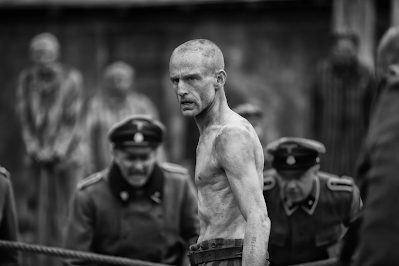
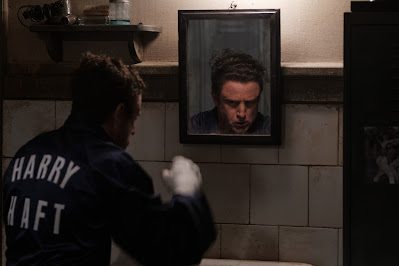
I didn't know the story of Harry Haft before seeing it this evening, so everything that was old was new again, as it were, and I certainly appreciate that both writer Justine Joel Gilmer and director Barry Levinson apparently stuck closely to the work of Harry's son, Alan, who wrote the book that the film is based on, which in turn was based on the stories that Harry relayed to him throughout his life. In historical films like these, you often don't want to take liberties with a tragedy that still remains a living memory to many people and because the dramatic effect is already built in. You don't need to try very hard to make people react to what was done in the camps and what effects it had on the people who did manage to survive, as well as those who lived alongside them in the years that followed. All of those emotional effects are on display in this film and it's something that can and should resonate with any empathetic person. The aspect that always reaches me in films like this is the question of how these characters- these humans -deal with the mental and emotional impact, not only of things that happened to them, but decisions that they made that contributed to or altered those events.


In this case, the most obvious element of that was Harry boxing in the camps at the behest of an SS officer. In doing so, he was seen as "cooperating" with the scions of evil that were torturing him and everyone he knew because of their identity. But it was also a perfect example of a survivor's instinct (hence, the title.) Not only did he accept the path that was offered to him on behalf of his own lizard brain, as the first instinct of most when offered a route out of that hell would be to take it, but also because he was driven by the memory of his lover, Leah, and figured that the better the chance he stood of survival, the better the chance he would be reunited with her. Those are both quite self-oriented motivations. But as his friend, John, also suggests to him at one point, they can be seen as an expression of defiance all their own, in that not only would he not be killed at the hands of the butchers that treated him as something subhuman, but he would persist beyond all their efforts to treat him as something less than, so that he could return to at least some part of the life that had been normal before they arrived. In that respect, it was a personal statement that represented all those who came through the Nazi effort to exterminate them; that no matter how hard they tried, Harry and his people would survive. That SS officer suggests to Harry that it's a choice between being the hammer or the anvil, but the anvil always survives the attempts by the hammer to reshape it, even if it leaves marks in the process.

It takes an actor of a certain magnetism to carry that role and I think Ben Foster and his driving eyes was an ideal choice. He was excellent as the younger brother in Hell or High Water and also steals a couple scenes as Charlie Prince in 3:10 to Yuma, which is a personal favorite. In this film, you're never in doubt that Harry is struggling with every breath as he yearns for his lost love, who had become the driving force of his life in the camps, and with the guilt that he carried from those camps, which is the weight that drags at his every step in the decades that followed. You can see his reluctance to get close to anyone, for fear of losing them like he lost Leah, but also perhaps for fear of infecting them with the remorse that he carries for being the survivor that he is. Vicky Krieps is also solid as the woman who tries to reach inside that shell, not out of pity, but because she can see the human and the very human choices that he made in order to be standing next to her in the first place. Similarly, Peter Sarsgaard gives a good turn as a reporter who can also see something more than just the brawler that Harry presents in the ring. I think Levinson borrowed somewhat from earlier films with the decision to show all of the flasbbacks to the camps in black-and-white, but it doesn't come across as trite. Also, Hans Zimmer's score is as brilliant as ever, following each scene with a sound that never loses poignancy, regardless of what's happening on the screen.


If you've been reading these for any stretch of time, you've probably come to understand that the storytelling approaches that most appeal to me are those that ask basic questions about humanity and how characters deal with those questions and the ripples that they leave, even in hammered steel. Definitely worth a watch.

Saturday, April 30, 2022

As simple as point A to Blood


Vikings have been the hot thing in various media for the past several years. From Michael Hirst's Vikings (now with a Netflix sequel, Vikings Valhalla) to The Last Kingdom to games like Raiders of the North Sea and Champions of Midgard. On the one hand, you could say that it's just an historical period that hasn't gotten as much exposure as many others and people jumped on the wave once it started forward. On the other hand, you could argue that some of the impetus may be coming from the surge in White nationalism that is on the rise in places like the US and Western Europe. (No, I'm not saying that just because someone makes a Viking movie or game that they're a White nationalist. Please save the outrage for something actually pertinent.) The latest entry in the cinematic field is Robert Eggers' The Northman.

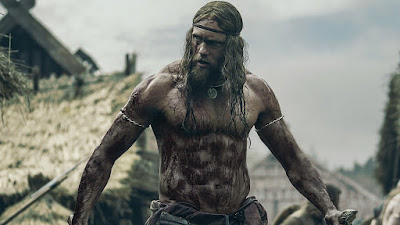
When we first saw the trailer, it was intensely visually appealing. It was clear that a great deal of craft had gone into the lighting, costuming, and cinematography. This was a film that was fully immersed in the idea of the visual medium. The cynical side of me might suggest that that concerted focus was because there wasn't much of a story to back it up and they were trying to cover that fact with fancy visual effects and moments of shock to keep the audience interested at all. The screenplay is about as "stock Hollywood" medieval revenge fantasy as you can get. Son witnesses father die to usurper. Son spends decades with his rage keeping him alive. Son finally finds a way to try to avenge his father. Much blood happens. The end. There's a difference between "simple" and "simplistic." Rashomon is a simple story. The Northman is the latter and does not benefit for it. What happens in those instances is that any of the audience versed in either/both popular culture and/or adventure stories can immediately start drawing parallels to what has gone before. The scene where Amleth's (Alexander Skarsgârd) vengeance is set in motion is almost a carbon copy of the scene in Conan the Barbarian, where the latter is also set on the path of revenge. Amleth's muttering of how he'll avenge his father and save his mother to keep focused while rowing a boat out to (presumably) the North Sea is reminiscent of nothing so much as Arya Stark's list of people that she's going to kill. What results is that nothing in the film feels original. It feels like a pastiche of what Hollywood thinks a big budget Viking film should be.


Again, there's no arguing that the visuals are resplendent. From the vistas of Iceland and Scandinavia to the intensity on Amleth's face as he pursues his ultimate goal, the emotion and wonder are there in abundance. In that way, it's not dissimilar from Eggers' previous film, The Lighthouse, but the two scripts are completely night and day, with the latter presenting an opaque situation with plenty of mysticism and things to question, while this film is basically lifted right from an Icelandic saga, most of which were both linear and not too complicated by dint of the form and because they were preserved in the oral tradition. We've, uh, moved past that just a bit in the last millennium. Those intense visuals don't stop at the regular intervals of violence, either. My friend, Larissa, visibly flinched at several instances of blood showering this or that corner of the set, while I started raising an eyebrow at the absurdity of it all about halfway through the film. Yes, it was a violent era and a fairly violent culture at the time. But are you saying that your film is so linear that the only way to get through its 2+-hour running time is to follow that straight line through a sea of blood? Oh. I guess you are.


The performances were solid, such as they were. Anna Taylor-Joy is still a delight as Olga of the Birch Forest, while Nicole Kidman does a good turn as Queen Gudrún, Amleth's seemingly conflicted mother, although her role was as predictable to me as anything else about the film. I also liked Ralph Ineson (Dagmer Cleftjaw of GoT fame) in a bit role as the Rus captain who aids Amleth and Olga in their attempt to reach Iceland. And, of course, with many things Icelandic, Björk was involved and at least played an interesting version of herself as the Seeress of Amleth's dream-state. But none of that can cover for the fact that the initial story pitch had to comprise about 40 words, at best, and left me thinking of a half-dozen other films or TV shows, rather than the one right in front of me. I didn't get lost on the straight line. I just didn't feel like I should've bothered by the time I got off it.

Friday, April 29, 2022

Finding the right elephant


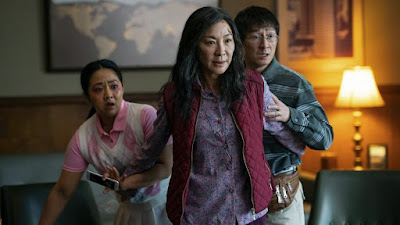
Most films are created with an intent. Unless you're doing something avant garde, you're not just throwing stuff at a wall and seeing what sticks. (TV series, on the other hand...) If you're the director, you get a screenplay and think: "This is the film that I want to make." and then proceed into production and casting and everything that's going to make your piece of rock eventually look like an elephant. If you had a competent writer, that piece of rock should already have impressions for trunk, tusks, and tail, but some directors can overcome that absence (and others can ruin the rock when they first take a chisel to it.) With that said, it has to be noted that Everything Everywhere All at Once is a remarkable film, not only for what shows up on the screen, but for the driving vision of co-writers/co-directors Dan Kwan and Daniel Scheinert. No matter what else I may say about it, it has to be clear that I enjoyed it and would probably like to see it again someday. Can I recommend it to everyone as the gushing hordes on Twitter have insisted? Well... no. I think there's something essential that is lacking there that would turn it from "interesting and enjoyable" into "GREATEST FILM EVAAAAAHHH!" as seems to be the popular opinion among many of the younger people I know and hear from. Perhaps the way to explain this without sounding too harsh is to do a comparison.

There's a film called Big Trouble in Little China. It was made during the extended downswing of Jobn Carpenter's career and has a decent-sized cult audience. Amusingly enough, what first made me consider this comparison was when I was sitting in the theater watching EEAaO and noticed that one of its leads was James Hong, who played the wicked Lo Pan (Indeed!) in Big Trouble. Carpenter's film is somewhere between a B-action flick and an intentional farce. With Kurt Russell chewing scenery and Kim Cattrall doing an exposition dump every five minutes, it's not a good film, but I'd argue that it was never intended to be. It's pretty clear about 20 minutes in that both Carpenter and his cast had decided to go full-bore into the absurdity of the situation and let whatever happened, happen. What did happen is that it justly bombed at the box office, but has since developed a following among those who'd seen it and simply appreciated the circus for what it was.


EEAaO is in a similar but not identical situation, in that I think Kwan and Scheinert intended to present a visual spectacle, first and foremost. In that respect, they succeeded. The repeated transitions of Michelle Yeoh through multiple and wildly varying other-dimensional versions of herself is definitely entertaining to watch. You could almost have gone down that more artistic, experimental path that I referenced above and still had something worthwhile to display. But, instead, the filmmakers decided to angle toward a more philosophical bent, constructing an elaborate story that explores all of Evelyn's (Yeoh) personal foibles, relationships, history, and emotions. All of these things are splayed out in often jarring fashion that leaves the audience little room to digest what's happening... until the third act, when all of it is regurgitated again in repetitive, droning, agonizing detail. There is something to be said for a story about a main character who simply fails to register what's right in front of them. Constructing the entire third act of a film about a character who simply refuses to do so is something else entirely.

And that was my main disaffection with the film. As enjoyable and funny and surprising as it could often be, I think the filmmakers lost the thread of what they had begun weaving when they got into it. Big Trouble was clearly intended to be a cult film. It's a circus and you're supposed to just turn your brain off and enjoy it. (Something I often have a very difficult time doing.) But EEAaO presents as a circus, but attempts to drown you in personal metaphor in that third act. Suddenly, everything has deeper meaning and you will be repeatedly instructed on how to absorb said meaning before you leave your seat. It's kind of like an analogy for P.T. Barnum, who is credited with various bits of sage advice from running a carnival and a "museum of oddities" in the 19th century. No matter how sage Barnum could be, in the end, he never held himself up as anything other than a showman trying to squeeze coins from the local audience for coming in to see the freaks. Kwan and Scheinert attempt to attach a very serious underpinning to their circus and it never quite finds its footing. In a way, their story rooted in personal travail and the difficulties of human relationships ends up so overwhelmed by the dizzying array of visuals that it all ends up feeling lighter than it should have been. The story isn't married to the visual storytelling, but is kind of an adjunct that makes the third act longer than it needs to be when it could've been just a great show.


Most of the performances are excellent, with both Yeoh and Jamie Lee Curtis as a menacing IRS auditor particularly standing out. If this elephant could've had a slightly shorter and less onerous tail, I think it would've reached the heights that a lot of others are assigning to it. But that would've been a somewhat different beast (Indeed!)