Showing posts with label Catwoman. Show all posts

Tuesday, April 27, 2021

Batman: TAS, episode #30: Tyger, Tyger


Speaking of mad scientists, this episode is a complete Island of Dr. Moreau pastiche, including island. I'm OK with that, given that they were aiming for a younger audience who would be both unaware of and attracted to the idea of what is essentially just a ripoff. Also, it doesn't stray too far from the general concept of The Batman resembling Man-Bat. In this case, it's Catwoman becoming more Catwoman-like. One thing I'm less OK with is the general discordancy of the relationship between The Batman and Catwoman. We've already seen Catwoman and this episode continues with the "general knowledge" theme, assuming that viewers don't need to be told the origins of our hero's major opponents. But we've also seen Catwoman get arrested by The Batman for her various crimes in her earlier appearance and yet here Bruce Wayne and Selina Kyle are back on the social circuit together, as if he has no idea who and what she is. This is DC Comics in a nutshell up to the mid-1970s, where they finally started following Marvel's lead. It's disappointing that this series, which extends credit to the knowledge and awareness of its viewers in so many ways up to this point, decided to partially abandon that courtesy here. It's not even ham-handed. It's just poor storytelling, since you're not extending credit to your viewer. You're suggesting that they ignore what they already know. In another discordant moment, Bruce Wayne simply brushes off the cops when investigating what happened at the zoo, despite them pointedly informing him that "This is police business." We know he can kinda do this because he's The Batman, but it makes no sense within the story for playboy Bruce Wayne to ignore the cops.


When we make it to the island, we're introduced to the main villain, Dr. Emil Dorian, who is bog-standard mad scientist, unlike Hugo Strange. And the main opposition is his perfect creation, Tygrus. The only real problem with him is that name, which sounds like "tigress", which is not exactly the audible image one wants to create for the aggressively male character that the mad scientist is using Selina Kyle as a potential mate to breed with. So we're already running into multiple odd style choices within act I. That pattern continues when we find The Batman going to Kirk Langstrom for help in identifying the combination knockout drug/genetic transformation serum used on Selina. Again, it's great that we're hearkening back to earlier episodes and creating a timeline within the series. But this is the same problem as before, since it would help to remember that this version of Langstrom, in a deviation from the comics, was criminally motivated in becoming Man-Bat, instead of inadvertently transforming as the original version does. And, yet, just like with Selina, The Batman is fine consulting with a criminal who's remarkably out of jail, despite arresting him the first time they encountered each other.


Another positive in this mixed bag is that the episode is filled with action, but it's not boring or confusing action, since much of the fisticuffs involves the "genetically-superior" Tygrus; a proper challenge for our master combatant hero. Despite the story not really involving what one would consider our preferred noir elements, since it's the Darknight Detective on a tropical island fighting mutant animals, it's at least paced well enough and in scenarios that involve The Batman trying to save his own life and that of Selina Kyle, while not trying to treat Tygrus as just any thug to be waved away or an opponent to truly be beat down, like most of his other villains. So the tragic aspect is played well, even if the genuine opposition in Dorian is fairly routine. Also in yet another upside of continuation and respect for the viewers, the effect of the first encounter with Tygrus is visually carried throughout, as the slashes on The Batman's chest never go away, which is a level of animation sequencing and continuance that was uncommon for cartoons of the time and hasn't even regularly been used in earlier BTAS episodes. We also take a slight deviation from our Island of Dr. Moreau retelling to also include elements of The Most Dangerous Game, which is fine because, again, we have to include our younger viewers who may not have seen something like this before, despite it being pretty old hat for those of us who've been around longer. On the other hand, I'm not sure why you'd include the line "Search your feelings, Tygrus (Luke.)" since viewers young and old will automatically associate that with the Star Wars franchise and be jarred out of any story you're trying to tell. And, perhaps appropriately for our discordant tale, the best line in the episode comes from a throwaway character, when the security guard at the zoo mentions that "Her taste in boyfriends lacks severely! Guy looked like an ape!" when talking about Garth, the substandard gorilla servant (in story and in action within the story.) Fittingly, Garth doesn't even get a voice credit(!)


So, a very mixed bag as an episode, for any number of strange plot and style choices. But the final product isn't horrible. Credit has to be extended for using the William Blake poem (even if Bruce Timm fumbled the pronunciation of the last line (symmetrI, not symmetree) and it was appropriate to wrap the episode with a return to the title card image. Again, it's a nice snippet of tragedy. It just doesn't particularly stand out, plot-wise, for only our second appearance of Catwoman. But next up is our third appearance of The Scarecrow in Dreams in Darkness.

Thursday, January 14, 2021

Batman: TAS, episode #8: The Cat and the Claw, part 2


The most notable thing about the opening for part 2 of The Cat and the Claw is one of the more subtle things: The score. The music playing over the windy evening in the park where The Batman is meeting one of his mob stoolies is a huge part of the atmosphere, as scores should be. When most people talk about the music for BTAS, they usually focus on the infections theme song written by Danny Elfman and they're not wrong. The theme is a defining aspect of the show, since it so wonderfully depicts the aura and stylistic themes behind it in true, Romantic period-style. But there's a lot to be said for the score composers, too, since there's rarely a moment where the eerie background notes separate one from what's happening on the screen. Even when The Batman is operating in a scenario with a lot of action and explosions (literally in the case of this episode), there's still an overall aura of mystery that enshrouds the character and the score is an essential part of that.


Another part of that is maintaining the noir-ish approach. The nighttime meeting with the stoolie, the deduction of the military transport, and the date turning into an attempted assassination on the road before the suddenly-ruthless Bruce Wayne turns things in their favor; those are all scenes that could be drawn from films like Night and the City and other similar offerings. Since this was the second part of the series opener, it was important to keep reinforcing that approach and I think director, Dick Sebast, did that well. There are some good transition moments, such as when we shift to where Red Claw's goon invades Selina's apartment and the intro to that moment is highlighted by a cat leaping from a trash can in the street below. Similarly, as we see Catwoman enter the ventilation shaft of the underground bunker, the Batwing silently passes overhead. That's good pacing that keeps the style and theme rolling while still serving a storytelling function.


Unfortunately, we also end up maintaining the outdated sexism, with The Batman stumbling over it yet again ("Red Claw?! A woman?!") Thankfully, the writers let her volley right back when she escapes: "You've finally met your match, Batman! Not surprising it's a woman!" And that may be the point. As out of place as it sounds to modern ears, considering the audience that they could rightfully assume they were playing to (young boys and some not-so-young boys), what sounds clumsy to us may have been the overt message they were trying to drive home: It's not just guys who can be heroic... and wear costumes while committing crimes and/or enacting vigilante justice. So, not quite the moral message one would hope for, but certainly with the right intent. The central idea is that women are just as capable as men. Selina stops to point this out in the face of Bruce's concern, claiming that she's never been able to do the "damsel in distress" thing. It's interesting to note, however, that that's exactly the role she ends up playing in the car chase/combat scene, clinging to Bruce in fright while he goes Mad Max on their pursuers. However, you do want to convey tension and emotion in scenes like that and that's difficult to do without the more immediate action of live performers. If you don't draw overt reactions to events, your characters end up sitting still when they should be displaying something. (This is the difference between actual animation and something like Hanna-Barbera.) So, it's understandable that Selina may have been showing some degree of shock and dismay, even when the character's personality wouldn't normally conform to that. In some ways, you just have to go with what the scene demands.


But that approach is slightly problematic in a couple later moments, where the emotional displays by our two leads seem somewhat clumsy. Bruce declares his affection for her after one visit to Multigon and a couple aborted dates, while Maven later informs The Batman that Selina is in love with him after two encounters, in one of which she threw him off a building. I think the pacing of the episodes was sufficient to convey the time that had passed and you certainly want that final scene, where he cuffs her, to have the semi-tragic impact of caring about someone you're about to send to jail. All of that is an essential element of the Batman/Catwoman relationship and has been almost since the first time they met in the comics. I guess one could argue that they overdramatized those moments a bit here... but, again, we're talking about a show that's intended for a broad audience. Adults may pick up on those concepts much more easily than children do, so their intent might have been to really reinforce the message. As this was the second episode of the series, it could've been an attempt to really lay the groundwork for their relationship in future encounters. The counterpoint to that argument is that this series clearly seemed intended to credit the audience with awareness of who and what The Batman and his world are. That would include the emotional/sexual tension between the two leads in this episode.


One quirky thing to note is that the mountain lion that Catwoman released on the guard outside and on Red Claw herself presumably could have killed either or both of them. In neither case do we see the results. That would be a bit more visceral than the character has ever been in her existence and also something that would be a bit past the "violence" rating that HBO assigns the show. In this case, what happened off-camera, stays off-camera, I guess. (Leopards ate my face!) 

So, that was a decent end to a solid opening. Next time, Harvey Dent returns as a main character in an encounter with some Pretty Poison.

Monday, January 11, 2021

Batman: TAS, episode #1: The Cat and the Claw


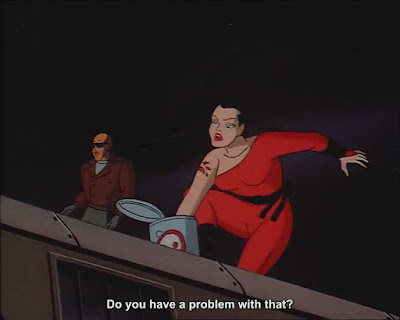
The HBO listing begins where the series did, with Catwoman being a Robin-Hood-of-the-animals, as she steals to raise money for the environmental/wildlife causes that she's dedicated her life to. In the process, she runs across the operations of a terrorist group, led by the mysterious Red Claw who, in a nod to The Batman's rather overt sexism ("So, this new cat burglar is a woman-!") is, uh, also a woman. So, there's more than a bit to examine here.

First off, let's start with the positive: Adrienne Barbeau ("Just call me Billie! Everyone does!") plays the role of Catwoman and delivers the appropriate amount of both sultry and belligerent dialogue that has frequently defined the character. The producers pulled no punches with the immediate ignition of sexual tension between her and our title character. This is a longstanding tenet to their interaction. Adam West commented ruefully on the relationship he had with Julie Newmar on the set of the Batman TV series, where the latter played up that sexual tension off-camera so that the frisson of their scenes was often a real thing. He said she would leave him suggestive notes on the steps of his trailer so that she was never far from his mind. In this story, given that they play into that relationship in their alter egos (leaning a bit hard on the "if only this were Batman outside this door" routine, IMO), it's fair to say that the producers wanted there to be no mistaking what was really happening between the two characters, even for the kids for whom the show was ostensibly intended. Given that sex is always the most untouchable of taboos when it comes to American media supposedly aimed at children, I think it was interesting that they declared their intent right out of the gate. Yes, it's a cartoon and, yes, it's a character that's been acclimated for children by cultural perception, but it was clear that their approach wasn't going to abandon elements of the character that had been maintained for decades, to whatever degree.


By contrast, this was a presentation of Catwoman that producer Bruce Timm has said that he was never quite comfortable with. The switch from self-interested thief to fervent environmentalist is a significant one. It certainly makes her a more sympathetic character to much of the audience and introduces the trend that Timm and Co. felt was important to highlight throughout the series; in that the "bad guys" aren't necessarily just the people in the weird outfits, but often the far wealthier and societally-acceptable types. That plays right into the zeitgeist of the time, dominated as it was by the Reagan religion ("Greed is good!"), where outsiders to society, including a few wealthy types like Bruce Wayne, were starting to drift from the perspective that money solves everything.

Similarly, Red Claw is kind of a mishmash of socio-cultural realities of the time. When this was released, the USSR and its satellites were in free-fall. Without the ominous presence of the Soviets, the world's attention had already turned to the imminent threat of international terrorism as the bogeyman of the day. But it seems like the writers couldn't entirely abandon the old tropes, since she's still "red" and still speaks in some contortion of an Eastern European accent by Kate Mulgrew, of Star Trek Voyager fame, who would go on to revive that accent as Galina "Red" Reznikov in Orange is the New Black. So, in this episode, Red Claw is kind of the generic "enemy" that The Batman and Catwoman will have to face together, one for the law and one for the environment (Natural law?), but she doesn't bring a lot of character or memorable impact to either episode or series, in general.


Again, in contrast, it's interesting to note that Selina's cat, Isis, is a fully-fledged character of this episode. Time is taken to show her reactions (initial hostility to the Batman and then terror at his reappearance; a need to be comforted after Catwoman's dive off the skyscraper) and also her actions (struggling to get out of the window with the jewels in a cute touch; we wait to see her successful leap in the chase across the rooftops) until finally she's rescued from an oncoming truck by The Batman and Catwoman retrieves her. There's a common approach in visual media where someone granted a first-person perspective is highlighted as someone especially important to the story (see: Game of Thrones as a good example.) Isis is given that perspective when we see the laser defenses of the jewels through her eyes before the successful robbery. In that way, we know as an audience member that she is important and concern for her well-being amidst the action is played up as an element of the story.


We also get our first moment with Commissioner Jim Gordon, who makes sure to warn his people cleaning up the attempted theft of US Army weapons that: "These guys are crazy!" and then proceeds to hold a conversation with a guy dressed as a bat... Said weapons are also Thompson submachine guns, carrying the mixed timeline theme forward as one of "generally 20th century, but probably earlier than you'd think", which accompanies the general Dick Tracy look of the assembled mobsters whom The Batman shakes down for info on Red Claw. The closeup on Gordon and subsequent ones with Selina also demonstrate the animation decision to not give anyone pupils. Like the blank, white slits of the main character, no one's eyes will get more detail than a single-colored dot, with emotion displayed by the contortion of the face around them. This decision is highlighted multiple times in this episode, where reactions are shown clearly both without dialogue and leading into confirming dialogue (Bruce obviously agreeing to postpone their date before mouthing that agreement, for example.) While the pupil absence could be seen as simply a style choice, I think it's part of the decision to overtly demonstrate subtle emotions on the face of these characters that was often lacking in animation of the day.


The episode doesn't shy away from the little touches of the comics, either, such as when Catwoman uses her famous cat-trops in the ventilation shaft to deter pursuit or when the unreality of the situation is pointedly emphasized as she commits the attempted homicide (throwing The Batman off the roof) of the man she's infatuated with, simply assuming that he'll be able to save himself. On that note, it's essential to point out the role that Timm and Co. have assigned Bruce Wayne in this version of the stories. In many cases, he's portrayed as a dilettante playboy who can't possibly help himself. But in BTAS (and Steve Engelhart's work; we'll come back to this a lot), Bruce is assertive and confident in his actions; showing far more of his Batman side than is normally employed. Indeed, at one point, you could argue that he goes past assertive to mildly creepy when he grabs Selina's arm at the fundraiser to insist upon the date that she's won. It's certainly a more natural portrayal of the type of person one would except Bruce to be, given his background and especially in this series, when he's shown to be far more interested in throwing his weight around to the benefit of his interests, rather than simply riding the tide of his bank balance. Plus, one interesting little touch of HBO's was presenting this as the first episode in the series, just as Fox did in the original broadcast, but saving part 2 for the eighth episode presented, rather than immediately following part 1. It gives The Batman's final line "And there will be a next time." a bit more weight and gives the impression of the "living world", where many things are happening and stories are not uninterrupted or linear, that has made Marvel's productions even more effective. The simple choice of timing can be disastrous (see: Firefly), but can also be a subtly positive touch, as it is in this case.

Next time, we encounter a guy who really dresses up as a bat, with On Leather Wings.