Showing posts with label deep urges. Show all posts

Sunday, September 14, 2014

What it meant


One of my earliest memories is of reading a comic. We were at one of those highly-regulated and organized suburban vacation spots called Camp Dearborn. It's actually owned by the city of Dearborn, MI but is 35 miles away in Milford, MI. I have no idea why. They had canvas-roofed cabins that you could rent, a small lake, a swimming pool, a golf course, hayrides, and the whole nine yards. Very Midwest; very "get away for a weekend"-type thing, and that's exactly what I remember us doing. I was four years old and I was sitting in one of the cabins reading an issue of Man-Thing, Marvel's answer to DC's Swamp Thing (in fact, the same writer had worked on both as many of them drifted back and forth between the Big Two in those years) and another example of Marvel's return to horror comics after its neutering of the Comics Code a couple years earlier. We had been sharing a couple of the cabins with another family we knew and I was in the "boys' cabin" and had a small pile of comics with me. My vague memory says that most of them were mine, but I knew that one of the older boys had a few with him, as well. They had decided to leave before us at that point or were perhaps just running home for a while (the camp at the time was only about an hour from our home) and he burst into the cabin, grabbed a bunch of the comics, including the one in my hand, and ran out. I don't remember which issue it was and I don't remember being particularly outraged that I'd been interrupted and perhaps even had something stolen from me. I just remember that the images of that comic stayed with me and turned into an almost lifelong obsession.

I met someone recently and dropped a Stan Lee reference. We'd been texting about being enchanted and it turned into an exchange of synonyms: beguiled, befuddled, bamboozled, bemused. She mentioned that she liked the alliteration and I said I couldn't help it. I'd read too many Stan Lee comics as a kid. Lee frequently titled his columns "Bullpen Bulletins" or "Stan's Soapbox" or was fond of referring to the readers in ways like "the fightin', ferocious, fantabulous fans of fun!!" Any quick look at many of his early characters (J. Jonah Jameson, Reed Richards, Sue Storm, Peter Parker) demonstrates that this was a regular habit of his. My new friend mentioned that she wasn't really a fan (fightin' or otherwise) but she was fascinated(!) by people that were and what they got out of comics or why they enjoyed them. That, of course, got me to thinkin'...

Alliteration fer reals. No one has ever really determined why he has to wear pants, either.

I think most kids are into superheroes to one degree or another. One only has to look at Marvel's film success over the past decade to see some of that. I don't remember what my particular attachment became early on and what led me to collect over 30,000 of them in the intervening years. I do remember that I was far more interested in the stories themselves than the accompanying artwork. I wanted to know why Cyclone had kidnapped J. Jonah Jameson in Amazing Spider-Man #143 and why Mary Jane Watson seemed to be having a really hard time in her relationship with Peter Parker (my own parents were getting divorced around this same time.) Furthermore, I really wanted to know why Mary Jane ended that issue by uttering the phrase "Far freakin' out." which was the same exclamation that Green Arrow used at the end of an issue of Justice League of America! (Drifting writers again.) That's not to say that I wasn't interested in the accompanying art. I remember picking up my first copy of magazines like Heavy Metal (the American version of the French Métal Hurlant) or Marvel's own Epic Illustrated and being engrossed in the painting of artists like Mœbius, Richard Corben, and Jim Starlin. Both Marvel and DC would also later venture into more daring artistic approaches with people like Dave McKean and I would remain a fan of the moody approach of Matt Wagner and many, many others. But it was really always the stories that hooked me and what had led people to create them...

Beta Ray Bill, FTW!

... which is kind of funny in one respect because I'm a ferocious critic of story and when you look back at many of the comics that I loved at the time they were produced, like the above issue of Thor, produced by Walt Simonson who has long been considered the best writer/artist to ever helm the book, the pace and dialogue are awful. There are long stretches of clunky exposition or explanations of what's going on in the establishment shot (which can be a regular cityscape) or re-statements of who Thor is and why he is. Editor-in-chief of the time, Jim Shooter, always said that you have to have a continuing story to retain regular readers but that every issue is always someone's first read, so the story couldn't be so dense that they wouldn't be able to get into it. That philosophy is blatantly obvious in reading those old series and makes them kind of painful to get through. That approach was standard in TV for much of its history, as well, and it's only comparatively recently that it has changed such that trying to drop into the middle of things like Breaking Bad would have been difficult for new viewers and it's by far the better experience to watch from the beginning. The way to tell good stories is to let characters grow and develop, especially if they're character-driven stories like almost all superhero comics. You can't have that growth or development if you have to keep explaining what's going on to the new readers. Thankfully, the emergence of limited series in the 80s enabled many writers to escape that Minosian circuit and other series developed with that principle firmly in mind, such as Sandman.

Not a Sandman cover, but one of my favorite McKean images

But the mention of Sandman is important here because it led to the most significant shift in comics since the Code destroyed EC. While the book has always been written by Neil Gaiman and he had a definite path in mind for it, since it was in the DC Universe he had to play along with the superheroes in his backyard for the first year of its publication, although he tried hard to skirt them as much as possible. Once Karen Berger finally convinced DC to let her take books like Sandman and Swamp Thing into their own imprint, Vertigo, they were finally free from the thing that has held back comics in many ways for the past half-century: superheroes.


Don't get me wrong: I love superheroes. I grew up with them. I've read tens of thousands of stories about them. The nostalgic pull is strong whenever someone brings up stuff like Iron Man under David Michelinie or Amazing Spider-Man under Roger Stern in the 80s. I think the Wild Cards series of anthologies, edited and contributed to by George R. R. Martin, are brilliant. But, as with any genre, there are limits to what can be done with them. Despite my history, I haven't read a superhero comic with any regularity since the early 90s. I can't. The stuff bores me to tears because in many ways it's still following the Jim Shooter model. My friend, Curtis, who is the owner of the local shop in Ann Arbor, Vault of Midnight, tried to sell me on a new version of Iron Fist a few years ago and I devoured the first six-issue collection which was about the character coming to grips with his past and the spirituality surrounding the strange city of K'un Lun and what it meant for him to hold the power that he acquired. I was like: "Yeah. This is the shit!" It was thoughtful, but retained enough touches to Chinese mythology and 60s-era kung fu films to have just a bit of camp to lighten it at the right points. Plus, having practiced martial arts for many years, I was on the same page with the concept of trying to express oneself physically and conform to the art as laid down by those before you. I was totally geeked. And then I picked up issue #7... and it was Villain-of-the-month again. Bzzzt! Thank you for playing! Lovely parting gifts, etc.

Gothic #1 by me and Kevin Leen, cover by Guy Davis

When we started the studio in the early 90s, it was with the same idea that so many other comics companies have begun: do it differently and better than the big guys. Almost by default, that meant no superheroes. If you wanted superheroes, you knew where to go. Dark Horse didn't do them (except for one brief excursion around that time that I actually kind of enjoyed) because they wanted to avoid competing directly with Marvel and DC and they frequently stated that they thought the concept was more than played out. Image started around that time with the very brash and public announcement that they were going to do things differently from the Big Two. What they produced at the time was utterly similar and essentially the same stuff that all of them had been doing for Marvel with different names. Alan Moore and Frank Miller had shown what superheroes could be taken to in the mid-80s and that limit had pretty much been set. Trying to keep going after that wasn't interesting to me nor was it to many readers who really wanted to read good stories. Fifth Panel Comics produced creator-owned material, though, so amongst our early producers were people that did their hero-of-the-moment stuff but they soon gave up and left. The small core that remained continued with the idea that the medium could only really be advanced with good stories that had little to do with bright costumes and stopping bank robbers or alien invasions.


I read very few comics these days and the closest I come to superheroes is Kurt Busiek's Astro City, which is essentially Busiek using the world he'd created as a kid to convey stories about the human condition. The facade is "superhero" but the stories are very human. Otherwise, ironically, I actually read a lot of Image output as they decided somewhere along the way that most of their stuff was played out, as well. Most of the original creators had moved on and they've attracted a stable of artists and writers that produce good stuff from many different genres, like Greg Rucka's Lazarus. But I still have a deep attachment to the medium as I tend to think of stories in a cinematic fashion (comics being far closer to film than prose.) When I pitched the idea of Coding Time to Ghostwoods, I did so with the idea of a film called The Machinist firmly in mind and I wrote it in that fashion. I could see the panel transitions in my head. I still have a ton of stories for Fifth Panel that never saw the light of day (or the black of night) and I'd still like to see them published somewhere. My friend, Margot, suggested to me a few years back that I try to convert them to prose. It's something I considered a few times but always abandoned because, again, of the chasm between the two media. There are tricks that you can perform with comics that are very difficult, if not impossible, with prose. When you can let the artwork tell one half of the story and can tell a conjoined but disparate story at the same time via captions, that's a technique that's not feasible in prose and that wouldn't be easy to do in film, either. But comics can make it happen because your reader proceeds at his pace, not the film's which gives more time for reflection and understanding. If you have eye-catching art to go with it, so much the better.

So, yeah. That (and so many, many more details) is what I get from comics/what they mean to me/why they still hang over me even though my connection to them is fairly tenuous these days. My creative outlook is shaped by them and always will be. I analyze plot and story of films through the glass of comics in many ways (noting that Snowpiercer worked well as a comic but not very well as a film, for example.) I think it's a powerful medium that doesn't get a lot of the respect that it deserves because it's tied to the shadow of the cape and cowl, despite the billions earned by Marvel's increasingly Bay-like films, which are still regularly trivialized as "summer blockbusters" from an artistic standpoint and deservedly so in most cases. But there are still gems to find. I'd like to think that one or two of them are still in my head.

Monday, December 10, 2012

Almost like it was

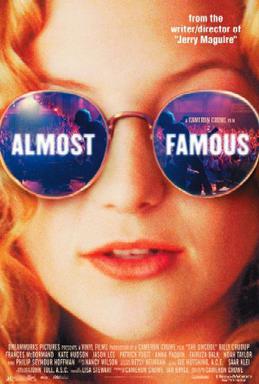
Cameron Crowe's Almost Famous is one of my favorite films. It's not a cinematic classic or something that will be remarked upon by critics or even fans a couple decades from now. It's clearly Crowe's best film (I saw his most recent, We Bought a Zoo, recently; it's preternaturally awful) and had great performances by Kate Hudson and Billy Crudup to propel it, along with the always-reliable Frances McDormand and Philip Seymour Hoffman. It was a great script because it was something that really happened to Crowe and you can see it in how natural most of the characters seem.


But I think the reasons it really appeals to me are two-fold. First, it's about music and the kind of devotion and enchantment that music can create, both among its creators and its fans. To quote Crudup: "My last words were [and mine may be]: I dig music." Jeebus, I listen to game soundtracks because of the twinges my soul gets from a nice violin piece. It's that bad.

But, secondly, it's about a bunch of creative people enjoying that process together, no matter where it took them. The comic studio was like that in many ways. We weren't reaching the big time. We never made any money. But it was never a bad time and I was committed to making it become... something. What, I'm never quite sure, but I was committed. That should be a startling shock to any of you that know me.

I met Jeff Donaldson in 1991 at the Chicago Comicon. I had already lined up my friends, Will Kliber and Wendy Law, in my quest to become a successful comic writer; nominally for DC or Marvel because they were, as they are now, the biggest kids on the block. I was shopping stuff around to other places/players (Dark Horse, Comico, Majestic) but hadn't gotten a bite and Image had just emerged on the scene. The comic world was just beginning to boom past its geeky, shadowy existence and there were a dozen hundred startups of all kinds at the big shows, where Dave Sim was lord of the small press manor. I vividly remember some kids drawing stick figures in a quartered letter-size piece of paper and selling them for $1.50 each. Hey, if Matt Feazell could do it with Cynicalman, why the hell not? The irony is thick and tendentious...


Jeff and Dave Witt and a couple other artists were making a scene in the small press area of the 1991 show and Will had met them on Saturday while I was still trying to make inroads with the bigger houses (this is where I first met up with an editor at Majestic who was more interested in sleeping with me than publishing my stuff; inroads being what they is, I kept in touch with her, show after show, for the next couple years until Majestic collapsed and died with the rest of the industry.) Will steered me over to them on Sunday and we talked about producing some stuff on an actual deadline for their studio, Fifth Panel Comics. As usual, Jeff was in no way serious about that deadline. I was deadly serious and hounded Will about the details of a 12-page neo-Gothic horror story involving a character called The Gargoyle (stunningly innovative) over the next few weeks. The kernel of that character came from a House of Mystery reprint I read in the late 70s (I forget nothing) and I had grand plans to turn it into something which it never became, while I continued to schlep even grander plans to outfits bigger than 5th Panel.


But those Grandiose Adventures never got sold and Jeff and I talked almost every day and it wasn't long before Fifth Panel started to become the focus of my comic world. This world, at least, since there are infinites, as you and I well know. However, everyone at 5PC was doing their own world and, since I was still very sold on the idea of the group thing that Almost Famous so vividly represents, I suggested making a group world that everyone else could pitch their own thing into and we could all reach that pinnacular moment that we all wanted to reach, separately AND together, and oh my wouldn't it just be so fine...

Jeff smiled and said: "Sure."

Interpreting his casual enthusiasm as a deadline of the most extreme sincerity (in this, I am Patrick Fugit), I sat down a couple days later and spewed out a couple dozen pages of outline with several dozen characters, a few hundred stories, and a few thousand possible storylines dangling off of it in an afternoon. My girlfriend came over at one point to see me, at which time I rather brusquely informed her that "I'm working." My shirtless, unshowered, fairly diffidently-gazed self probably indicated that, but I had to be sure. I couldn't be disturbed. Actually, it really wasn't that difficult or intense. I just had to be sure that she was aware that the creative process was in motion. It felt like the right thing to do at the time. Very Hunter Thompson.

That evening, I drove up to Jeff's place in White Lake and dropped the outline in front of him. He nodded, sagely (we were still kind of feeling each other out in our respective roles), and started reading. A couple pages in, he picked up the phone and called one of the studio's artists:

"Hey, you should get down here and read this cool outline that Marc wrote up for a shared world."

A couple more pages. Another call.

"Hey, you should really come over here and read this awesome outline that Marc put together."

A few more pages. Another call.

"Dude, get down here and check out this amazing stuff that Marc put together."

From that point on, Jeff and I were on the same page(s). Our lives weren't very similar. He had a career at Chrysler and was starting a family. I had a series of bullshit jobs and hung out with other political miscreants, theorizing about the revolution. But we shared a passion and conveyed it to a gaggle of artists and other comic-types who then joined us for our various road trips to locales around the Midwest and East coast. The small press scene was booming as the comic industry was booming on the fuel of speculation and we were going to ride this wave as long as we could. One day, Jeff would retire from Chrysler and become the full-time publisher, but a long time before that, I'd be writing my stuff and editing the rest of the studio's output to genuine comics glory.

At the time, we were assembling our books by hand, a group of us stalking around a table in Jeff's attic ("the studio"), drinking and swaying to Beck's Soul Suckin' Jerk, as we grabbed pages, folded, and stapled. There was no better way to spend an evening.


Our road trips were almost always excursions preceded by frenzied activity to pack all of our latest material and Jeff's latest updates to the booth into a minivan that he'd borrowed off the Chrysler lot (the really cool moments were when he borrowed a Viper to come down to Ann Arbor so we could talk studio work and then try to take it airborne on Michigan Avenue.) When we hit the shows, the object was to be as loud and obnoxious as possible to separate ourselves from the other two dozen small studios packed into the darkest and/or remotest corner of the major convention space or to be the one studio that stood out at the inexpertly-arranged small press shows. We were always the music source for our corner of the convention hall: RATM in the morning, James Brown in the afternoon, Mozart as the show came to a close. Beer and bad food and 10 people crammed into a hotel double. I loved every second of it.

Every day was a new idea. Every idea was something that someone guaranteed that they would complete. Every guarantee was a limitless promise, even if most of the ideas didn't have limitless promise or anything close to it. We were all in it together and it meant something to all of us. It was our thing and it was about the work (music), man!

Of course, I can only be so cynical and dismissive here because I would gladly turn the clock back 20 years and submerge myself in all of that again. That's why the film appeals to me so much, because I see our time in the expressions of those characters. We loved what we were doing as a supposedly upstart producer, but we yearned to be something bigger, even if we knew that being bigger would take us away from the absolute circus that we all loved and were thoroughly enjoying (and perpetuating.) It was at that time that being creative meant something. It surely didn't mean money, but that didn't matter. It surely didn't mean success, personally or otherwise. It occasionally meant sex, but Jeff was already married, so there were limits (Jeff's wife, Trish, whom I love to death, always kind of endured the studio, rather than engaged in it.) And there was a little fame. A very little. A lifetime of reading comics and a relative mastery of the English language led to me becoming a capable editor (yet one more skill that doesn't help me to land a decent job...) and I have a deep appreciation for and a decent assessment of good art, even if I don't express it that often.

Mostly it was about being with a group of like-minded people who would respond to one person's creative expression not with confusion or disdain, but with honest enthusiasm. We were fans, like Fugit's and Hudson's characters, who had a deeper appreciation for what was being shown to them than most (neither was "on drugs!" to make it a good time, as it were.) And, more than that, we were also the creators. I miss a lot of things about the studio: the people (I've only been able to keep in touch with Jeff and Dave, and then only sparingly), the road trips, the feeling of success when a project made it to print. But most of all I miss the ability to toss out an idea and have people immediately bounce one or two back. I miss bringing up a story idea and having people immediately become enthusiastic, rather than confused or hesitant. I miss walking into a space with Jeff and being able to feel like I was part of something, as I am part of so very little now.

I watch that film and I see us, even if on a much smaller scale. I'd give a lot to do that again.

Tuesday, October 23, 2012

Roxanne


I have a fundamental attachment to this film. It's one of those that I've seen any number of times but would gladly watch again any time that I see it on or even toss in myself (VHS!) First off, I think Steve Martin is a creative genius and I have always been a fan of the work that he has created, like The Jerk and his stand-up material. I draw that line between what he's "created" (acknowledging that acting, in and of itself, is a creative effort) and what he's done to earn a paycheck, like the execrable comedies he's been making with people like Goldie Hawn and Queen Latifah. There was a self-assuredness that I heard in his stage routines that was really appealing to me when I was young and remains so. He's confident and so much so that much of his humor seems self-deprecating without being desperate. He doesn't make decisions out of lack of knowledge ("I played football in high school. I was the quarterback. I used to like to punt on first down.") He makes them because he's simply on a higher plane of understanding than everyone else ("You take geometry and geology in college and it's all numbers and you just forget it all. But you take just one semester of philosophy and it's enough to fuck you up for the rest of your life.")

While the tone of the film veers toward the sappy and it deftly avoids any deeper message than what the original story of Cyrano de Bergerac conveyed; and while none of the performances outside of Martin's (and Shelly Duvall's somewhat) are memorable; and while the story is simple... it's still appealing because the script is so brilliant and Martin's performance is so earnest that it dispenses with guile and cynicism even while his character is the most cynical person in town. He takes you past that and demonstrates a basic feeling that many of us (most assuredly me) are often loathe to admit: the desire to be wanted.

American individualism is an essential element of our modern culture. It's the dictum that encourages people to slough off any emotional pain and keep rolling along. If they can't "get over it", then there's something wrong with them. Martin's character attempts to turn that perspective on its philosophical head and declare that deep (and often tragic) feelings are what make people feel alive. I've known that from a very negative perspective for as long as I can remember. Rage drove me for many years and occasionally still does. But I'm attached to this simple little movie because it the character is "weak" and is plaintive and is lost in the search for something that he feels he can't have but which is actually searching for him.

And, of course, any film that presents both Strauss' Blue Danube and Mozart's divertimento in B flat Major is worthwhile viewing, IMO (I try to overlook the standard alto sax theme music and score that all 80s movies were contractually obligated to use):


Wednesday, May 2, 2012

Revolution in the streets

I've never been much of a TV watcher. Outside of a couple regular programs (Game of Thrones, obviously, and Mad Men), I tend to only turn it on when I'm eating, provided that I'm not already reading something. In doing so yesterday, I came across a documentary on VH1 called Uprising: Hip Hop and the LA Riots. It's a decent effort for a piece that runs all of 65 minutes and attempts to cover a very broad social topic and juxtapose it with the relevant music of the period. While I remember the events like they were yesterday (I was living in a house on North State Street in Ann Arbor and was transfixed in front of the images of the riots on the oak cabinet TV that my housemate, Wendy, had inherited from her grandmother), I hadn't thought about them in years and failed to remember how chilling and infuriating some of the depictions of the violence to both Rodney King and various bystanders in the subsequent riots really are:


As the documentary attempts to explain how the beating and the riots were direct inspirations for things like Dr. Dre's The Chronic, especially the track, "The Day the Niggaz Took Over":


which actually includes soundbites from an amateur cameraman's depiction of the outrage of the crowd following the verdict; and Ice Cube's The Predator, especially the track "We Had to Tear This Motherfucker Up":


which contains soundbites from the news coverage of the ridiculous verdict and the riots; and, of course, Ice-T's "Cop Killer":


which Ice-T has repeatedly stated was directly inspired by the beating of King.

The fascinating thing for me was, while watching it, I felt some pangs of memory from events that had occurred 20 years ago (and the associated "I wonder what happened to..." or "I remember that!" moments) but I had an even stronger reaction to the music being played with the depiction of events. That era of hip hop has always been my favorite and I've found very little since then to be as good (exceptions being Mos Def, The Fugees, Nappy Roots, and all subsequent releases by Public Enemy.) Certainly the textural appeal of much of it being about resistance to the hegemonic system is part of it. No one who knows me could be surprised at my finding public revolt to be an enthralling topic. But, of course, much of NWA's output was in that same vein and I found both Dre and Cube to be far better on their own, both having found their rhythm, literally and figuratively, when they were out from under Eazy-E's thumb. Certainly, accumulated wisdom and experience has something to do with it, but so does their turn toward the archly political and the broader social contexts of that experience, rather than the often more narrow-minded themes of NWA.

Those feelings aren't limited to just thematic subtext. It's really about the music, man! There's a general approach to the sounds and rhythms of that era of hip hop that are really appealing on a visceral level. Looking at my list of exceptions above: Public Enemy was clearly a part of it. Mos Def, while fascinating on a more introspective and often musical level, is much more layered than the basic beats of the time. The Fugees' limited output was also more developed on much of the groundwork that Dre had laid. And Nappy Roots is a whole different social level. The following video, one of the first that I remember replaying repeatedly on Youtube, is a perfect example of that:


(For some reason, the idea of three guys, completely stoned, being totally distracted by the Atlanta Hawk on a scooter while listening to Nappy Roots' "Aw Naw" is endlessly entertaining...) So, while the concepts behind the songs of that time from Dre and Cube and PE are necessarily complex, the music that drives them often isn't. Mos Def can get me to think along those same lines


but I spend more time thinking about the texture of his musical approach than what he's saying, whereas with Ice Cube's Predator, his lyrics are what are foremost in my mind while the music is a primeval undercurrent; a gut feeling, as it were.

So, what is inspirational about all of this? Should one normally be inspired by what was a catastrophe for much of the community (as Jello Biafra used to say: "Tomorrow you're homeless! Tonight it's a blast!")? The underlying problems that built much of the anger that was ignited that day have not been resolved. Ice-T's "economic prison" still exists in the form of unemployment and the often extreme disadvantages in the area for anyone who doesn't happen to be white. In short, the riots lived up to the age-old adage: violence solves nothing (other than providing a short-term wake-up call for the rest of the nation.) But the music continues to move, propel, and inspire. The pragmatist would suggest that redirecting said violence toward the proper targets would produce better results. Given the still-simmering anger evident in the documentary, all it will take is another spark. Will I have the same gut feeling when it begins again?

Wednesday, February 8, 2012

Getting the most out of it before it's gone

So, I mentioned George Clooney's recent interview with James Lipton on the latter's Inside the Actors Studio. During the discussion, Clooney mentioned his tendency to do the pictures he likes for scale or a little more and to do advertising in order to make real money because that combination allows him to live a "nice life", as he put it, and still enjoy his career by doing the movies that he wants to do. In other words, he doesn't have to put up with typical Hollywood crap in order to pay bills or to live said nice life a la the typical big-time star.

He mentioned that the event that really put him on that course was one time when he was doing a shoot in Europe and he was staying at this nice villa on Lake Como in Laglio, Italy. It was actually undergoing some remodeling at the time and the owner asked Clooney if he liked the place and, if so, would he be interested in buying it. Clooney really liked the area and the villa and then stopped to notice the construction workers on the site walking off for lunch. He said they looked like typical construction workers that you might see anywhere with lunch in hand... but lunch was a loaf of bread and a bottle of wine for each of them and they were singing as they walked down to the water. Right away, he realized, those guys were enjoying life a lot more than he was and he resolved right there to enjoy what he was doing or to not do it. Ever since then, he's avoided dreck like Batman and Robin and turned his career in the direction of major critical and commercial success. He also bought the villa.

There's a man who knew what he wanted and had the talent and drive to get what he wanted and is now enjoying seemingly every moment of every day. I have no idea what that feels like.

I've already mentioned my inability to feel happy about most things. That's not to say that I can't take joy out of events. This past season for Michigan was one of the more enjoyable in recent years, as the team overachieved and the coaching staff put to rest most of the fears of a return to the Carr malaise. The funny thing is that there's one moment from the season that sticks in my mind more than any other and it actually took place right before the season officially started. I had joined a number of Victards on the golf course south of the stadium and we had decided to pack up and head in for the first game against Western Michigan. The south side of the course has a number of rolling rises as the terrain generally elevates to the intersection with Scio Church Road. Upon cresting one of them, I had a perfect view of the stadium, with the monstrous brick luxury boxes and the new oversized scoreboards. I felt positive about the team, the season, and going to see the game at that point. So positive, in fact, that I remember thinking that I was looking at a cathedral of the game. Here was Michigan Stadium and here was the moment in which things were going to return to their historical trend of victories, the joyous throng of 100K, and the team, the team, the team. No matter how insipid it sounds, this truly felt like a communal event where people were gathered in appreciation of the game itself, the great, young players that currently make up the team, and the past glories that the program had enjoyed again and again.

I was inspired enough by the scene and that moment to begin composing a description in my head that could have been verse or could have been an essay akin to one of those that Spencer at EDSBS or Johnny at RBUAS have written so many times; an emotive appreciation of the near-gladiatorial spectacle that many of us likely spend way too much time orbiting. But I never wrote those words because I realized at some point that I don't have the talent that Spencer and Johnny have and I really had no outlet with which to convey them, so it likely would have been a waste of time. Once again, emotion quails in the face of reason and pragmatism.

Would I have done better to have simply grabbed my loaf of bread and bottle of wine and pushed on through to enjoy the process of it all? To enjoy life as it lay before me? I don't know that it would have been enjoyable as soon as I got to that whole "realizing I don't have the talent" moment.

Clooney's life is emblematic of someone that has found his path. He does what he dreamed of doing and he does it the right way, in a manner that he loves, and on projects that speak to him and from him. That's a path that anyone from an engineer to a bureaucrat to an athlete to a construction worker can potentially walk. It's obviously a bit more emotive and obvious coming from an enormously successful (and wealthy) actor, but it's still something that bespeaks joy, regardless of occupation or walk of life. I've often thought that various life events and/or my own failings or poor choices have kept me from finding that path and enjoying that walk. But now I'm not even sure that I could find the path even without any obstacles in my way. I'm not just constrained any longer. I'm basically lost in the woods and so much so that I'm not sure it's worth the effort to try to find my way out.

As kind of a side note, I even started talking to a friend, late of the Michigan theatre department, about acting schools. As I've noted before, I'm fascinated with (good) films and I did some Shakespeare way back in the day (but, as Slim Charles noted: "the problem with back in the day is that it's back in the day.") It's funny because you watch those Lipton interviews and, when they do the crowd shots, you see people of all ages attending the class at Pace University. The vast majority are quite young, but I frequently see people as old or older than I am. So, in that moment of positivity, you think: "It's not impossible to start at this point, is it?" until that wave of reality and reason comes crashing in and you start to wonder if it's not just another pipe dream because no other path seems feasible or worthwhile right now and hasn't for quite some time.

I have three little lives depending on me and that's what keeps me wandering in the woods, I suppose, but it's hard to say for how long or when I simply give up on the idea of ever singing my way down to Lake Como. Of course, Orpheus kept singing even after meeting up with the Maenads. I had a story idea about that once...

Tuesday, November 1, 2011

A job worth having

I stopped into a drugstore today and the clerk behind the counter ran me through his whole spiel on their discount card in a very enthusiastic manner. He struck me as a person who was very happy simply to have a job. Given the overall unemployment figures and especially those in Michigan, it's not unusual for that to be the case among any number of people.

The thought occurred to me to think to myself: "I've been there." I've been unemployed for fairly lengthy stretches at times, struggling to pay the rent on time and putting 1 or 2 dollars into the gas tank; just enough to keep the car moving from one interview to another. But it's not true. I've never been happy simply to have a job. Any job that I've had that has directly contributed to keeping a roof over my head has always been one that I despised. Its sole function was to pay for the necessities of survival and nothing else. Well, that's also not true. The other purpose it served was to make me hate the majority of my existence while I was doing it.

I have had jobs that didn't pay the rent. Those were the ones that I loved and would have gladly continued doing even as financial failures. I did them while I was also working for a paycheck and didn't consider them "work" in the dolorous sense. Of course, they were work and lots of it. They often required more energy and effort, physical and mental, than anything I expended on the tasks that people were paying me for. But I was driven to do them because I loved what I was doing. The people that enjoy those tasks they do for a living are often termed "people that love their jobs". They're defined as a jovial anomaly; someone that, essentially, got away with something in the game of life because they found a way to put food on the table and still be happy while doing it. "Pursuing one's passion" they call it and it often involves a serious expenditure of money on one's own part to get to the point where you can chase those dreams.

Except that it's not such a great idea to make the attempt any longer, as a number of recent reports suggest that unpaid student debt now exceeds $1 trillion (ever notice how no one uses the phrase "that's billion with a 'b'" anymore, because the numbers we talk about in ominous tones now routinely exceed trivial billions?) The sad thing about that is not only that a large share of said student debt is based on people making attempts into the fields that they were encouraged to pursue because they were seen as "sure things" (read: economically viable) but that those things are nowhere near as sure as they used to be.

Time was, you could spend your 4 years in college and come out with an anthropology degree and find a career in research or curating or education or even cultural relations for the nearest oil company wanting to lay waste to Borneo. That's all gone now (except for the oil devastation.) I met a really interesting woman a while back who has just such a degree and further education besides. She's fully trained to maintain and enhance the nearest museum exhibits on what has gone before. But those exhibits might as well be telling the story of the American education system that used to be a byword for opportunity but is now reduced to this simple message:
(When I was 5 or 6, I remember thinking that my dad was going to get in trouble for driving past one of these signs...)

Do not attempt to be an art historian. Do not attempt to be a historian. Do not attempt to be a marine biologist (Ghostcrawler promised me a pony!) or a journalist or a practitioner of any number of cultural or geographic arts. And don't even bother to get medieval on anyone's ass. No one else cares. It doesn't serve the drive of the modern society. It's not productive. You can go into business, technology, the law, or medicine. Make your choice.

Except that... well... you can't really go into any of those, either. The vast majority of the aforementioned debt is the (ahem) product of people venturing into those fields in the past decade or so. Those are, after all, the fields that society has deemed truly beneficial. After all, they get paid the most and the most assuredly, right?

A friend of mine started a blog recently, entitled "Inside the Law School Scam", which details the apparent effort by major law schools to recruit students not for the purpose of teaching them to become lawyers, but simply to make money... for the law schools. It is becoming a supposition among lawyers that law school doesn't really teach you about practicing law. You learn that in the real world, when you're making money. After all, that's the point of being "productive", right? To make money? Except that making money often involves being unhappy; something done for the sake of "getting by".

What kind of successful society perpetuates unhappiness for the sake of popular concepts of efficiency? What kind of society deems any activity that does not make an immediate or enormous profit one that is, essentially, a burden to that society? Produce or die. And yet, most of the major works of art and literature that form the foundation of our modern society were the product of patronage or starvation. The very culture that is lionized and revered by the ownership class was created by the kind of people that that class reviles. Most of those people did so because they were driven by passion and, occasionally, assisted by those who had means.

Our means, at the moment, is often directed toward creating more means as an end unto itself. I remember thinking about going back to school a couple years after I had graduated from Michigan. I had thought about getting a master's in education and going into teaching. My father attempted to talk me out of it because "there's no money in it." True enough. Unless you're a big-time law or business or medical professor, I suppose.

What kind of society perpetuates these conditions? Presumably, the one that doesn't care about them and those left to endure them. That, in itself, is an argument for burning said society to the ground and starting over. "There always seems to be money for war but not for education..." Or happiness.

Tuesday, August 9, 2011

Outside agitators

I've been in a couple near-riots. The first was in 1989. Michigan had just won the national championship in basketball and the students (of which I was one) erupted on to the streets of Ann Arbor in a frenzy of celebration. As with most large gatherings that involve a) sports b) victory and c) alcohol, the cheers and hugs and dances soon turned to collapsed awnings, torn down street signs, and broken windows. In their rush to outdo each other as to whom can CELEBRATE HARDER, destruction became easier than doing a better dance. The university's response was to declare all such destruction to be the work of "outside agitators" and not their highly intelligent and presumably civil-to-a-fault student body. (Strangely, on a trip to a town of 60 people on the north end of Hawaii's big island 12 years later, I encountered someone whose only visit to Ann Arbor had been that very night, as he attended a concert at Hill Auditorium and later said: "And I walked out into the midst of a riot." I responded: "Yeah! I was in that riot!" Small world...)

The other was a few years later when I went to see the fireworks over the Detroit river with a couple friends. It had been one of those deathly humid July nights and something, somewhere, sparked a bunch of the locals to start intimidating, then threatening, and then assaulting and robbing the wealthier folks who had come down from Oakland County to see the show. By the time we were leaving, there were a dozen melees erupting all over Jefferson, Washington, Griswold, and Woodward and crowds of people naturally screaming and fleeing the ruckus. The city's assessment? "Outside agitators"... until someone pointed out that most of the young men arrested were, in fact, residents of the city. Then they became "hardened criminals."

I had first-hand exposure to the perpetrators in both incidents. The first group were students. Period. They were drunk and they decided to party to the limit, as it were. The second group were no more "hardened criminals" than my grandmother, unless average high school kids in Polo shirts had become the most fearsome element of society.

As I'm sure you've all seen, London and other communities are on fire:


Events were triggered by police shooting an unarmed man as they attempted to make an arrest last Thursday. The man, Mark Duggan, happens to be black. A candlelight vigil two days later soon erupted in the first wave of violence and it's been proceeding since then. PM David Cameron's and Home Secretary Theresa May's responses: "a certain element", "outside agitators", "hardened criminals." It's like training parrots: One says it, then the others follow.

In addition, they mentioned "more robust police action", "prosecuting to the limits of the law", and general harsh justice and recrimination all around. What they didn't stop to do was question why this much unrest amongst the typically staid British populace might be taking place with no Premier League win to be seen. Likewise on this side of the pond, only a few people have brought up the diverse array of motivations, any or all of which might be responsible for the outbreak: youth unemployment, racial tensions, police brutality, austerity measures. That's a pretty toxic combination of economic and social conditions that would strain most societies to a potential breaking point (unless they're distracted by the latest episode of Toddlers and Tiaras like, you know, Americans.) And yet London's response is typical British (and American) Empire: Control and punish.

Certainly, some swift action has to be taken to contain a situation that could easily boil out of control, if it hasn't already. And, of course, the stiff upper lip must always be displayed to reassure the rest of the obedient population that reacting to the government's draconian treatment of its non-wealthy citizens must not be tolerated. Can't go giving anyone any ideas or tolerating any new ones, for that matter. Like telling schoolchildren that they can't bring a nail clipper to class because of a "zero tolerance" policy, it's simply inconceivable to those in charge, especially annoyed as they are from having been dragged home from their Mediterranean vacations, that wielding the hammer even harder might be precisely the wrong thing to do. After all, if the trigger event for this was police brutality (only exacerbating the bad economic straits that many find themselves in), what happens when Cameron's order for a "more robust response" is taken seriously by the police on the ground?

As is the situation with most riots, the eruption of same in lower-class or middle-class neighborhoods has only engendered the disgust and enmity of the people suffering many of the same problems (leaving the racial issue aside, for the moment.) As Jello always said: "Tomorrow you're homeless. Tonight it's a blast!" That's not exactly the best way to effect social change, but some outbursts can't necessarily be controlled. All the same, just as in politics, making enemies of those who might otherwise be your allies and support you is, in a word, stupid. But I don't think anyone's ever seen an intelligent riot.

If I had my way, I wouldn't necessarily try to control it but, rather, direct it. No sense in tearing up your own community when the problem is the rather ritzier locales elsewhere, where the people who own your community actually live. It's like the old Q&A: Q- Why rob banks? A- That's where the money is. If you're going to cause general mayhem, you might as well do it where the money is. Nothing gets the state hopping faster than threatening the paymasters.

Am I talking about class war again? Tsk, tsk, old boy.

Wednesday, February 16, 2011

Cue the shivers

I don't play any instruments. I kind of doubt I have the talent for it but I've never made a concerted effort so I can't verify it one way or the other. My parents felt it was necessary to put my sister through the unwanted travails of piano lessons but never subjected me to it/gave me the opportunity. I suppose they thought that excelling in school was sufficient to get me through life, devoid of other talents, or some such thing. The more likely reason is that they just didn't care and I, in turn, didn't either.

But music became really important to me in my early teen years, in part because it was one of the ways that I could more easily associate with the older people in my classes in the process of skipping two grades. If we could all relate via music that we liked (and that our parents likely didn't), then we could all be part of a group, as opposed to Them and Me. But mostly because something in it simply, uh, sung to me. I could see and appreciate the energy and effort that went into it and that it consequently produced. I've met few people that can get through life without music at some time, but I found a need for it pretty much all the time.

I jumped into the music world with both feet, as I am wont to do with most things, and had music playing around me as often as possible. Worked with it, studied with it, slept with it. I began to learn things about the musicians that I was hearing and started noticing tendencies and styles and genres and techniques. I especially began to notice moments that simply worked for me; that I could pick out and remember even apart from the surrounding sound and almost cringe at the force or delicacy or precision with which it was played. Just as an example, here's Bitch from the Rolling Stones' Sticky Fingers:

Keith Richards' counterpoint chord from the very beginning of the song is played in tight fashion, so the driving beat by Mick Taylor concentrates the energy and Keith releases it with those little twangs. It's at 2:10 where he starts one of the great solos in all of rock and 2:50 where he takes it to the next level. Both of those moments still make the hair on my arms stand on end. There was someone totally immersed in his craft and speaking volumes with one or two notes.

I became deeply enthused with the punk scene. It's what was "now" for when I was coming of age and the politics of the movement in general spoke to me. One of my favorites was Bad Brains because of the primal energy they retained in everything they did (even when they were just doing reggae.) In fact, for the famous "what one album would you have on a desert island?" question, Bad Brains may be it (or Mozart's clarinet, oboe, and bassoon concertos.) This is the track that pushed me over the top with Bad Brains:

Just the growl of Dr. Know's guitar at 38 seconds in makes my chest fill with energy because the band is about to explode with it, as well, and I can feel that. That's communication on a very basic but still very elevated level. They're letting you know that they're about to take you on a ride and you'll enjoy every minute of it, while H. R. yells at you about the loss of your basic liberties and how you're ignoring it.

Mozart's work is rife with little (big) messages of all kinds. For all that he's regaled for the technical precision of his work, Mozart was first and foremost a storyteller and often communicated through his work even when it wasn't accompanied by a libretto. The second movement of the Sinfonia Concertante that I spoke of a couple weeks ago is a perfect example of that, with the plaintive wails of the violin and the viola. But another favorite piece with what seems to me to be a constant driving message is the Rondo of the Haffner Serenade (no. 7, K. 250):

The lead violin (which was largely Mozart showing off, as serenades were traditionally supposed to be background music) propels the entire piece and keeps the listener rolling from one stanza to the next and at 4:20 briefly carries the tone to an even higher level that always keeps me hanging in anticipation (even though I've probably heard the piece a couple hundred times.)

I'm not much for country. I like a little bit of Johnny Cash and my stepmother was a big Jimmy Buffet fan when I was a kid so I have some of that imprinted on my brain (and I know he's not strictly "country" by most estimations) but it generally takes some blues mixed in to really find favor with me, be they Memphis or Irish. Steve Earle does the trick:

That's a piece sung with so much soul it could almost raise James Brown from the dead. You can hear him barking to the band when they come together between the verses because he's so immersed in delivering this story that it just bursts from him.

You may notice a dearth of whatever the current musical rage is (Lady Gaga, Glee, et al.) Despite the fact that I enjoy many types of music and just in the above have traveled from the 18th century to the 00s of the 21st (and the fact that I'm fond of many acts still performing in the last decade, such as Cake and The Crystal Method), I have zero interest in studio-processed crap that relies on the presence of programs like AutoTune to make it function. It has no soul. If you want to make music, make it. If you want to let the computer do it, let it. And get off my lawn.

By the way, while I was writing this, in addition to the tracks above that generate some kind of deep reaction from me, I was also listening to Mastodon's Blood and Thunder, Mos Def's Know That, The Orb's Toxygene, John Lee Hooker's Boom Boom, the flamenco theme from 3:10 to Yuma, Jimi Hendrix's Machine Gun, The Pogues' Sally Maclenanne, and Ice Cube's Wicked, among others. They all engender that same response from me: they're saying something and I know they are because some part of my body tells me that they are on a level that delves deeper than whatever lyrics may be present. If we could find a way to encapsulate that into words, the world might be a very different place.