I'm going to delve back into my Dungeons and Dragons metaphor because it works for this latest episode of Rings of Power in more ways than simply the subject matter. Yes, D&D and Tolkien are almost the standard-bearers of nerdism, hand-in-hand. The former is the outward expression of the genre that the latter almost introduced into modern storytelling. Fantasy was an aspect of storytelling from the time humans began sitting around campfires and entertaining and/or educating each other. But in the 20th century, it became a literary genre of note when Tolkien did his thing, even if it was long-preceded by things like Robert Howard's Conan the Barbarian stories. That story (The Lord of the Rings) spawned the role-playing game culture as we currently know it. That, in turn, kept Tolkien alive and in the minds of kids who became adults and that's why we had Peter Jackson's films 20 years ago and why we now have this Amazon series. You can't really escape it and so it's often easiest to use the techniques that the game has both taught and presented to demonstrate how good and bad storytelling is conducted. I've referred to this before when I mentioned the difference between the good DM and the bad DM (dungeon master, traditionally, although "GM" (game master) is probably more appropriate these days.)
You have your group of characters and they're given a set of circumstances to react to and engage with. These are player characters, meaning that they're people involved in the story that, you, the GM is creating, but they're also other humans that you have to entice to play along. In the case of Galadriel and the people around her, the enticing circumstances are the eruption of Orodruín and the creation of what would be known as Mordor. We already know what this is and we know where it is. Outside of the fact that, in any normal situation where a volcano would release a pyroclastic flow, all of those people that it swept over would be instantly dead, we can at least follow along with this set of circumstances and see massive changes to one key figure, Miriel, and more subtle changes to others, like Galadriel. Miriel being blinded and the devastation wrought by the orcs and the mountain compels her to bring her people back from their island kingdom to make a stand on behalf of the other humans that have also been devastated by this. While this is kind of a stretch for any regular player characters, this is at least a premise that's been put in front of them that they can react to in a relatively reasonable manner. They've been wounded and those around them have also been, so it's easy to see how simple vengeance and/or a sense of justice would compel the characters to act in this way. Fair enough. It's a little on the obvious side, but a good GM could make this work, given that there's already been a character with a driving motivation (Galadriel) dropped into the midst of this scenario. The problem with that character is that she's been so monochromatic that it's more likely she's an NPC (non-player character) than someone who would naturally be inclined to act that way. She's a storytelling device, rather than someone who acts normally, like you'd hope a player would in response to what's happening around her. Miriel, Elendil, Theo, and the rest in this scenario are more like players and are the people you'd hope that the audience could relate to, given what's happening, and much of this storyline is made to work by them, rather than the obsessed elf. But it's still kind of a mixed bag and the producers do themselves no favors by not only providing the very obvious cues, but then providing the very obvious labels to everyone (e.g This was The Southlands and it is now Mordor, just in case you somehow didn't get it.)

Similarly, we were kind of hit over the head with the mithril story. Anyone could see what was coming, when NPC King Durin denied the desires of nominally PC Elrond and Prince Durin and Disa. They're given a bit more to work with, in that Prince Durin has to overcome the distrust of the elves that his father and culture have taught him and Disa gets to express her personal desire for power and how she and her husband will step into it when the old man is dead. Likewise, Elrond gets to express not only his exceptional character but his rueful understanding of the violence to come when Gil-galad is informed that the dwarves have essentially told him and his people to piss off and die. All of this is decent reaction to a very obvious situation that, again, we all could see coming from leagues (traditionally, the distance one could walk in an hour; roughly three miles; fantasy term) away. We also get to see non-traditional emotion from hardened dwarven warrior Prince Durin, so we understand how difficult this situation is for him on a governmental, cultural, honorable, and personal level. Similarly, we see the legendary wisdom of Elrond in his understanding of both King Durin and Prince Durin's choices, despite his dismay that they're making said choices. All of these are good storytelling choices by the GM and actions by the PCs. It all gets almost completely ruined by the "teaser" scene at the end showing the balrog incinerating the leaf at the bottom of the mithril vein. For some reason, the incredibly powerful servant of Morgoth isn't sleeping entombed in the ground with the departure of his master (what actually happened in the books) but is instead laying in wait for a dramatic moment next season...? It's right there and it knows they're right there because they just dropped a leaf apparently 50 yards down an open hole. As soon as they crack that hole a little wider and start grabbing the shiny stuff, it's ready to grab them with that famous whip. The importance of the whole story concept was that the dwarves were so greedy for the stuff that they dug too deep after centuries, not that they could drop a piece of paper down a hole after first discovering it and realize that an immortal fire demon is present. They basically just trivialized one of the eeriest legends of the whole Tolkien mythos and one of the trademark scenes of the standard-bearing novel to make a ham-handed teaser.

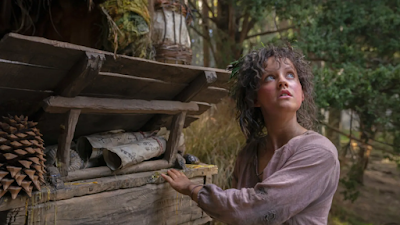
But the best GMing example is the storyline with the (sigh) Harfoots. Here we have multiple PCs that are allowed to make what seem to be mistakes but which actually just continue the story in the direction that the GM probably wants it to go. They brought the big man along, but then they sent him away because he seemed to be doing destructive stuff. Both of those choices moved the story along. Now several of them are setting out to retrieve him in the name of charity and understanding, which are also very human choices that may not make much practical sense, but are perfectly understandable and relatable motivations. On the practical side, it is kind of odd for them to give rousing speeches about sticking together being the most important thing to the Harfoots as a people, only for four of them to split off from the rest to pursue an adventure but, yeah, most people aren't always consistent even when trying to be noble. In fact, they're pursuing the big man because they don't know who or what he is, but they also told him to leave because of the actions of the trio of white-robed people whom they also don't know. And the best part about all of that is that we, the audience, the largest group of player characters, also don't know who he is or who they are, even as Tolkien fans. (I'm still kinda thinking that he's Beorn, especially since they sent him north to Greenwood (later Mirkwood), but I still wouldn't put money on that.) That's the least amount of recitation of history and the most amount of new story in the whole series so far. My only gripe is that it has to come via the hobbits. Again.
The way to keep your readers/viewers/players interested is to present them with stuff that they have to sink their proverbial teeth into. They have to explore. They have to discover. They have to question their own actions and they can't just have everything served up to them on a plate. That's boring. That's obvious. That's not the way to keep their/our interest. Riugs has run into a similar problem to House of the Dragon, in that we know all this stuff already and there has to at least be an interesting presentation of it to keep people coming back. I don't think I will be with House, but I can be convinced as long as Rings does away with idiotic moves like the balrog teaser and tries to make its leads a bit more like people and a bit less like devices.