Showing posts with label fifth panel comics. Show all posts

Sunday, November 10, 2024

Dystopia; or briefly The Thing That Describes a Lot of My Mindset About the World


Jeff Donaldson and I were the main figures in a comic studio that Jeff started almost 34 years ago. The studio ran for almost the entire decade of the 90s before economic factors (lack of distribution, lack of money) shut us down. A few months back, Jeff told me that he'd started drawing again with a new program and wondered if I was interested in digging up some of the old material that I'd created for said studio- Fifth Panel Comics -and seeing if we could produce it as a Webcomic. I signed on and here we are:


https://www.dystopia.ink/

Dystopia is a multi-genre setting somewhere in middle America that was basically a way for me to introduce a lot of concepts that I hadn't found a home for, as well as a way for everyone involved in the studio at the time (somewhere in the range of a dozen people, but really a half-dozen "regulars") to collaborate on the same project, if they chose to do so. I explain a lot of this here: https://www.dystopia.ink/2024/04/20/the-origin-story/ which is the almost-first post on the News page of the site. At the moment, when you go to the News page, you'll see the most recent post, but then have to scroll down to see the older ones. I'll figure out how to rework that at some point. Anyway, all of the posts on the News site describe the basic background of the setting, how we wanted to implement it, and what the idea is for the future. The comics, OTOH, are here:

https://www.dystopia.ink/comic/

When you first arrive on the site, you'll automatically see the last page that Jeff has completed and can use the controls to shift to the beginning or to previous (and subsequent) pages and so forth. At the moment, we're beginning with a story based on The Rim, the top level of the city (Into Darkness), but we'll be moving around from there. Jeff is hoping to maintain a schedule of a page a week as we move forward. Meanwhile, I'll be posting more stuff on the blog page (News) and, for those so inclined, we've set up a Discord (linked on the Home page) and will be hoping to hear/see as much feedback as possible; not just on places like Facebook, but the site itself.

If you know anyone who likes comics, Webcomics, SF, horror, cyberpunk, or anything even vaguely related, PLEASE feel free to send them the link to the site. The most gratifying thing for me as a writer has always been for as many people as possible to read it and see if they get something out of it. Quite literally, the more the merrier, yo. Thanks and I hope (at least some of you) enjoy.

Friday, July 12, 2024

Hopes and dreams


I haven't been posting here much lately because there hasn't been much to post about, as the films we've been seeing have been somewhere on the spectrum of typical, bland, and mediocre. Most of my writing time has been going toward a semi-new project and I don't have particularly high hopes for that one because it, like every other writing venture I've been involved in, likely won't find an audience and will come to nothing. That's how I tend to prepare for things like that, anyway. My ex- once asked me: "What are your hopes and dreams?" I said: "I don't have any. I kinda just take each day as it comes and deal with it." I have interests (way too many), desires (like any human), and make a lot of plans to do this or that thing, some of which even come to fruition. But dreams? No. I've seen too many of those dissipate to spend any time hoping for one of those to come true.

I've never written anything for myself. Some people like to engage in that; journaling so that they have a record of their thoughts (and dreams!) and observations about life. That's a worthwhile endeavor. It's just not something I engage in. If I'm going to put down my thoughts, as I'm doing right now, it's always for someone else to read. I don't need to spell things out for myself. I can do that already. Everything I write is for someone else to hopefully get something from. The problem I run into too often is that there either aren't enough people who get something from it (that's my fault) or there aren't enough people who care (which isn't anyone's fault.)

I wrote about American Fiction a while back; the film that I thought was the best of 2023. It sang to me from the opening stanza because it was about a writer who never seemed to get his message across to people or at least not enough people who cared. I know that feeling better than any other in my life. I get it every time someone reads something and doesn't react or gives the most harmless of platitudes: "It was good." that tells me that it didn't register with them at all. I feel that sensation even more when I know that they didn't bother to read it at all; as I look at things I've blogged about where the unique views are in the single- or low double-digits. I mean, I guess I should be happy, right? If I was "writing for myself", the only unique view would be mine; the loneliest number.


My friend, Jeff, and I are returning to material I created for our comic studio, Fifth Panel Comics. He's decided that he needs to be drawing again and I have several hundred pages of script, prose, story concepts, scenes, characters, and setting that have never seen the light of day. So we're going to try to turn it into something again, 30 years later. I don't have any hope for it. I can't. Every time I think of 5th Panel, I think of the hilarious times we had in the studio and doing conventions and just speculating- dreaming, you might say -about what we could make it into. But I also think of the time that we stopped into a restaurant with a couple of our artists and the guy behind the counter asked us what we were talking about and we showed him the anthology book we'd created, Razorwire. He asked everyone to sign it and both artists signed their stories and Jeff signed as the publisher and then the guy looked at me and said: "And who are you?" And I had nothing to say because, despite being the nominal editor and having come up with the title, neither my name nor my work was in that book. I had made other people's dreams come true (at least partially), but I hadn't even been able to write something for me. Or, at least, what little I had that had been published hadn't been good enough to become something noticeable.

So we're back at it. We have a website and some of the old artwork and I, of course, have every one of the hundreds of thousands of words that I've written for, about, and of the world that I created. Will it come to anything? I don't know. The dream, of course, would be that it takes off and Jeff and I can both retire from our day jobs and do this thing that we love for as long as we want to do it. But that's the kind of dream that I find myself unable to believe in (which is, y'know, like all of them.) I believe in Jeff's intent. I believe- kinda -in the work, although you'll never hear me say it. I'd like those around me to believe in it, but most of those people just aren't interested, which doesn't make me think that this time is going to be any different from the last one. You can't blame people for not being interested. That's the first hurdle in writing things for other people. They either are or they aren't the camel that can be led, presuming you're even leading them to water. If there's no water, it won't matter that they've been led in the first place.


When we get the material rolling and the site loaded with stuff, I'll post the link here to whoever still notices this outlet. "Hopefully" someone will. Maybe it will even be worth your time and attention. I'm afraid I was always more writer than oneiromancer. Or, at least, that's what I claimed to be. For someone else.

Sunday, August 7, 2022

Milestones past


Back in the early 1990s, the comic industry went through something of a boom cycle. There were enough creators that were eager to escape the work-for-hire dungeons of the big two (Marvel and DC) and enough smaller companies that had been doing largely licensed fare (Dark Horse, etc.) to prove that it was viable to work outside the two colossi. The general feeling was that the only way to do "good" comics was to do "new" comics. The trigger event for much of this, of course, was the departure of some of the biggest artist names in the industry from Marvel to form Image Comics. Around the same time, former Marvel editor-in-chief, Jim Shooter, had found some investors to help him put together Valiant Comics, who picked up a lot of old Gold Key properties from the 1960s, like Solar and Magnus, Robot Fighter. Dark Horse soon followed suit with their first venture into superheroes and their Comics' Greatest World (headlined by Frank Miller's X) and smaller companies like Malibu also recruited veterans like Steve Gerber into their Ultraverse. It was that highly-competitive environment in which Denys Cowan and Dwayne McDuffie, long-time veterans of mostly Marvel books, decided to launch Milestone Comics, which is the subject of HBO's new documentary, Milestone Generations.

Denys, DC publisher Jenette Kahn, and Dwayne

I knew Denys and Dwayne very casually back then because Milestone was set up as an independent studio that happened to have a distribution deal with DC. But because they were independent both editorially and style-wise (or so they thought), they often showed up in the "small press" area of the larger comic shows, which is where we were with our Fifth Panel Comics. At one Motor City show, we had booths right next to each other. We were known for regularly having music playing at our booth, which I tried to vary on the regular so that everyone could find something they liked (I, of course, generally like all of it.) At one point, it was Dwayne who looked over and said: "Alright, who's the James Brown fan?" when the godfather had started belting out "Cold Sweat." Yeah, that was me. Those were good days because there were so many people trying to do something different with any number of motivations toward that difference. In Shooter's case, he was trying to directly challenge the powers-that-were by showing them how he could do a shared universe experience "better" (He was later fired by his investors in the same way, and for many of the same reasons, that he'd been removed from Marvel.) In Dark Horse's case, it was an attempt to do superheroes in the "more realistic" DH style. (They folded quickly and went back to doing their usual fare.) In our case, it was mostly an attempt to carve out a space where we could do our own thing, as well as be part of the movement that was shifting away from brightly-colored spandex as the main theme of the industry. (We, of course, didn't even have color in our books, except for a couple covers.) But Milestone wanted to stay in that vein of providing heroes for kids (and some adults.) They just wanted to make those heroes look more like the people that were often reading them and speak to their lived and living experience.


The documentary is pretty thorough in examining a lot of the motivation for and the creation of the company and the "Dakotaverse"; their nickname for their universe based on the metropolis where the first books were largely based. It also covers a lot of the later activity of the company, after they had shut down the comics division a couple years after the mid-90s market crash, and gone exclusively into licensing and the production of a cartoon based on Static, one of their first books and the best seller among them. Denys is pretty open about the difficulties that they faced but isn't bitter about it. Having worked in the industry for so long and having done so as a person of color, he was aware of how the world works. Plus, in my experience, Denys was the quiet one among the creative founders, while Dwayne was far more outspoken. The most salient issue for them, of course, was the fact that they wanted to actively engage issues like racism, homophobia, and teenage sex. As one might expect in Puritan America, it was the last one that was the tipping point for DC, in which they adamantly objected to a cover depicting Static in an embrace with his girlfriend with a couple condoms on the floor next to them. Milestone, despite being editorially independent, eventually conceded to DC's demands for an outer cardstock cover that would hide a lot of the artwork once word came back from distributors and outlets that that would also be objectionable to them. This, of course, is an industry that has had any number of problems with religious types and helicopter parents objecting when they discovered that comics aren't just for kids. But in this case, it wasn't blowback from the street. It was internal and Denys suspects that it was, in fact, driven by DC and it was easy for stores and distributors to follow along, not just because it was sex (just FYI: as in any other entertainment medium, sex sells in comics) but because it was Black sex.


Most of those at Milestone expressed the opinion in the film that I remember hearing back then, in which low sales were a consequence of people not wanting to buy "comics for Blacks", as if stories about Black characters were somehow exclusive to those who shared their skin tones, while White characters were for Whites. Here is where we veer into the usual absurdity of racism, often the unconscious type, in which there is irrefutably an impact from people not being willing to identify with others simply as human, regardless of identity. I think that's a fair focus for the film to take because it can't be denied that that was part of the cause of their demise in the comics world. But all of the detail I spelled out above is also pertinent. When the industry imploded because of the collapse of the speculator bubble (Newsflash, kids: If they're printing 20 million copies of a book, it's probably not going to be "collectible", which usually implies scarcity.), it took down multiple companies, including Valiant and Malibu, countless stores, one of the two major nationwide distributors (Capital City), and led Marvel into Chapter 11. So, yes, there were external factors having nothing to do with money that led to their demise. But money had a lot to do with it, too. On top of that, there were some internal factors because, in some cases, the books just weren't that great.


I liked Denys' artwork and I appreciated Dwayne's writing, but neither of those were really industry leaders. Would I have gone out of my way for a Cowan or McDuffie book because I knew they were on it, like I would an Alan Moore or a Jill Thompson? Probably not. I was interested in Hardware and Icon and Blood Syndicate and Static because I wanted to see those stories from their perspective. I wanted to see "different" superheroes from the usual pablum that was often dished out. But did I save those comics for last in the weekly pile because I was most looking forward to them? No. They were solid, but not earthshattering. And many of the later books, like Xombi, were more obtuse than insightful, especially for a monthly serial. So while I can see their argument that being identified as "Black" superheroes and not actually being able to tell the stories that they thought might resonate with the largely older audience of the time (which Marvel had recognized in the 60s and DC still refused to comprehend in the 90s) were both confining and probably had an impact on their success, I still think there was a lot more going on that the film didn't really cover. I do, however, appreciate the several minutes at the end talking about how Denys is still in the mix and still trying to lead new faces into the industry (Dwayne, sadly, passed away over a decade ago) and Milestone is the company that he's still using to do that. It's both a more diverse and still positive voice that could really add to the tableau if given a shot.

Sunday, September 14, 2014

What it meant


One of my earliest memories is of reading a comic. We were at one of those highly-regulated and organized suburban vacation spots called Camp Dearborn. It's actually owned by the city of Dearborn, MI but is 35 miles away in Milford, MI. I have no idea why. They had canvas-roofed cabins that you could rent, a small lake, a swimming pool, a golf course, hayrides, and the whole nine yards. Very Midwest; very "get away for a weekend"-type thing, and that's exactly what I remember us doing. I was four years old and I was sitting in one of the cabins reading an issue of Man-Thing, Marvel's answer to DC's Swamp Thing (in fact, the same writer had worked on both as many of them drifted back and forth between the Big Two in those years) and another example of Marvel's return to horror comics after its neutering of the Comics Code a couple years earlier. We had been sharing a couple of the cabins with another family we knew and I was in the "boys' cabin" and had a small pile of comics with me. My vague memory says that most of them were mine, but I knew that one of the older boys had a few with him, as well. They had decided to leave before us at that point or were perhaps just running home for a while (the camp at the time was only about an hour from our home) and he burst into the cabin, grabbed a bunch of the comics, including the one in my hand, and ran out. I don't remember which issue it was and I don't remember being particularly outraged that I'd been interrupted and perhaps even had something stolen from me. I just remember that the images of that comic stayed with me and turned into an almost lifelong obsession.

I met someone recently and dropped a Stan Lee reference. We'd been texting about being enchanted and it turned into an exchange of synonyms: beguiled, befuddled, bamboozled, bemused. She mentioned that she liked the alliteration and I said I couldn't help it. I'd read too many Stan Lee comics as a kid. Lee frequently titled his columns "Bullpen Bulletins" or "Stan's Soapbox" or was fond of referring to the readers in ways like "the fightin', ferocious, fantabulous fans of fun!!" Any quick look at many of his early characters (J. Jonah Jameson, Reed Richards, Sue Storm, Peter Parker) demonstrates that this was a regular habit of his. My new friend mentioned that she wasn't really a fan (fightin' or otherwise) but she was fascinated(!) by people that were and what they got out of comics or why they enjoyed them. That, of course, got me to thinkin'...

Alliteration fer reals. No one has ever really determined why he has to wear pants, either.

I think most kids are into superheroes to one degree or another. One only has to look at Marvel's film success over the past decade to see some of that. I don't remember what my particular attachment became early on and what led me to collect over 30,000 of them in the intervening years. I do remember that I was far more interested in the stories themselves than the accompanying artwork. I wanted to know why Cyclone had kidnapped J. Jonah Jameson in Amazing Spider-Man #143 and why Mary Jane Watson seemed to be having a really hard time in her relationship with Peter Parker (my own parents were getting divorced around this same time.) Furthermore, I really wanted to know why Mary Jane ended that issue by uttering the phrase "Far freakin' out." which was the same exclamation that Green Arrow used at the end of an issue of Justice League of America! (Drifting writers again.) That's not to say that I wasn't interested in the accompanying art. I remember picking up my first copy of magazines like Heavy Metal (the American version of the French Métal Hurlant) or Marvel's own Epic Illustrated and being engrossed in the painting of artists like Mœbius, Richard Corben, and Jim Starlin. Both Marvel and DC would also later venture into more daring artistic approaches with people like Dave McKean and I would remain a fan of the moody approach of Matt Wagner and many, many others. But it was really always the stories that hooked me and what had led people to create them...

Beta Ray Bill, FTW!

... which is kind of funny in one respect because I'm a ferocious critic of story and when you look back at many of the comics that I loved at the time they were produced, like the above issue of Thor, produced by Walt Simonson who has long been considered the best writer/artist to ever helm the book, the pace and dialogue are awful. There are long stretches of clunky exposition or explanations of what's going on in the establishment shot (which can be a regular cityscape) or re-statements of who Thor is and why he is. Editor-in-chief of the time, Jim Shooter, always said that you have to have a continuing story to retain regular readers but that every issue is always someone's first read, so the story couldn't be so dense that they wouldn't be able to get into it. That philosophy is blatantly obvious in reading those old series and makes them kind of painful to get through. That approach was standard in TV for much of its history, as well, and it's only comparatively recently that it has changed such that trying to drop into the middle of things like Breaking Bad would have been difficult for new viewers and it's by far the better experience to watch from the beginning. The way to tell good stories is to let characters grow and develop, especially if they're character-driven stories like almost all superhero comics. You can't have that growth or development if you have to keep explaining what's going on to the new readers. Thankfully, the emergence of limited series in the 80s enabled many writers to escape that Minosian circuit and other series developed with that principle firmly in mind, such as Sandman.

Not a Sandman cover, but one of my favorite McKean images

But the mention of Sandman is important here because it led to the most significant shift in comics since the Code destroyed EC. While the book has always been written by Neil Gaiman and he had a definite path in mind for it, since it was in the DC Universe he had to play along with the superheroes in his backyard for the first year of its publication, although he tried hard to skirt them as much as possible. Once Karen Berger finally convinced DC to let her take books like Sandman and Swamp Thing into their own imprint, Vertigo, they were finally free from the thing that has held back comics in many ways for the past half-century: superheroes.


Don't get me wrong: I love superheroes. I grew up with them. I've read tens of thousands of stories about them. The nostalgic pull is strong whenever someone brings up stuff like Iron Man under David Michelinie or Amazing Spider-Man under Roger Stern in the 80s. I think the Wild Cards series of anthologies, edited and contributed to by George R. R. Martin, are brilliant. But, as with any genre, there are limits to what can be done with them. Despite my history, I haven't read a superhero comic with any regularity since the early 90s. I can't. The stuff bores me to tears because in many ways it's still following the Jim Shooter model. My friend, Curtis, who is the owner of the local shop in Ann Arbor, Vault of Midnight, tried to sell me on a new version of Iron Fist a few years ago and I devoured the first six-issue collection which was about the character coming to grips with his past and the spirituality surrounding the strange city of K'un Lun and what it meant for him to hold the power that he acquired. I was like: "Yeah. This is the shit!" It was thoughtful, but retained enough touches to Chinese mythology and 60s-era kung fu films to have just a bit of camp to lighten it at the right points. Plus, having practiced martial arts for many years, I was on the same page with the concept of trying to express oneself physically and conform to the art as laid down by those before you. I was totally geeked. And then I picked up issue #7... and it was Villain-of-the-month again. Bzzzt! Thank you for playing! Lovely parting gifts, etc.

Gothic #1 by me and Kevin Leen, cover by Guy Davis

When we started the studio in the early 90s, it was with the same idea that so many other comics companies have begun: do it differently and better than the big guys. Almost by default, that meant no superheroes. If you wanted superheroes, you knew where to go. Dark Horse didn't do them (except for one brief excursion around that time that I actually kind of enjoyed) because they wanted to avoid competing directly with Marvel and DC and they frequently stated that they thought the concept was more than played out. Image started around that time with the very brash and public announcement that they were going to do things differently from the Big Two. What they produced at the time was utterly similar and essentially the same stuff that all of them had been doing for Marvel with different names. Alan Moore and Frank Miller had shown what superheroes could be taken to in the mid-80s and that limit had pretty much been set. Trying to keep going after that wasn't interesting to me nor was it to many readers who really wanted to read good stories. Fifth Panel Comics produced creator-owned material, though, so amongst our early producers were people that did their hero-of-the-moment stuff but they soon gave up and left. The small core that remained continued with the idea that the medium could only really be advanced with good stories that had little to do with bright costumes and stopping bank robbers or alien invasions.


I read very few comics these days and the closest I come to superheroes is Kurt Busiek's Astro City, which is essentially Busiek using the world he'd created as a kid to convey stories about the human condition. The facade is "superhero" but the stories are very human. Otherwise, ironically, I actually read a lot of Image output as they decided somewhere along the way that most of their stuff was played out, as well. Most of the original creators had moved on and they've attracted a stable of artists and writers that produce good stuff from many different genres, like Greg Rucka's Lazarus. But I still have a deep attachment to the medium as I tend to think of stories in a cinematic fashion (comics being far closer to film than prose.) When I pitched the idea of Coding Time to Ghostwoods, I did so with the idea of a film called The Machinist firmly in mind and I wrote it in that fashion. I could see the panel transitions in my head. I still have a ton of stories for Fifth Panel that never saw the light of day (or the black of night) and I'd still like to see them published somewhere. My friend, Margot, suggested to me a few years back that I try to convert them to prose. It's something I considered a few times but always abandoned because, again, of the chasm between the two media. There are tricks that you can perform with comics that are very difficult, if not impossible, with prose. When you can let the artwork tell one half of the story and can tell a conjoined but disparate story at the same time via captions, that's a technique that's not feasible in prose and that wouldn't be easy to do in film, either. But comics can make it happen because your reader proceeds at his pace, not the film's which gives more time for reflection and understanding. If you have eye-catching art to go with it, so much the better.

So, yeah. That (and so many, many more details) is what I get from comics/what they mean to me/why they still hang over me even though my connection to them is fairly tenuous these days. My creative outlook is shaped by them and always will be. I analyze plot and story of films through the glass of comics in many ways (noting that Snowpiercer worked well as a comic but not very well as a film, for example.) I think it's a powerful medium that doesn't get a lot of the respect that it deserves because it's tied to the shadow of the cape and cowl, despite the billions earned by Marvel's increasingly Bay-like films, which are still regularly trivialized as "summer blockbusters" from an artistic standpoint and deservedly so in most cases. But there are still gems to find. I'd like to think that one or two of them are still in my head.

Monday, December 10, 2012

Almost like it was

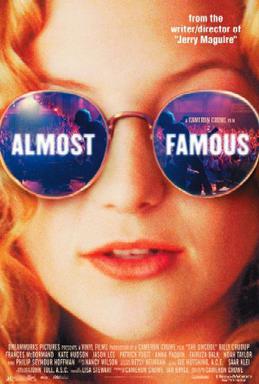
Cameron Crowe's Almost Famous is one of my favorite films. It's not a cinematic classic or something that will be remarked upon by critics or even fans a couple decades from now. It's clearly Crowe's best film (I saw his most recent, We Bought a Zoo, recently; it's preternaturally awful) and had great performances by Kate Hudson and Billy Crudup to propel it, along with the always-reliable Frances McDormand and Philip Seymour Hoffman. It was a great script because it was something that really happened to Crowe and you can see it in how natural most of the characters seem.


But I think the reasons it really appeals to me are two-fold. First, it's about music and the kind of devotion and enchantment that music can create, both among its creators and its fans. To quote Crudup: "My last words were [and mine may be]: I dig music." Jeebus, I listen to game soundtracks because of the twinges my soul gets from a nice violin piece. It's that bad.

But, secondly, it's about a bunch of creative people enjoying that process together, no matter where it took them. The comic studio was like that in many ways. We weren't reaching the big time. We never made any money. But it was never a bad time and I was committed to making it become... something. What, I'm never quite sure, but I was committed. That should be a startling shock to any of you that know me.

I met Jeff Donaldson in 1991 at the Chicago Comicon. I had already lined up my friends, Will Kliber and Wendy Law, in my quest to become a successful comic writer; nominally for DC or Marvel because they were, as they are now, the biggest kids on the block. I was shopping stuff around to other places/players (Dark Horse, Comico, Majestic) but hadn't gotten a bite and Image had just emerged on the scene. The comic world was just beginning to boom past its geeky, shadowy existence and there were a dozen hundred startups of all kinds at the big shows, where Dave Sim was lord of the small press manor. I vividly remember some kids drawing stick figures in a quartered letter-size piece of paper and selling them for $1.50 each. Hey, if Matt Feazell could do it with Cynicalman, why the hell not? The irony is thick and tendentious...


Jeff and Dave Witt and a couple other artists were making a scene in the small press area of the 1991 show and Will had met them on Saturday while I was still trying to make inroads with the bigger houses (this is where I first met up with an editor at Majestic who was more interested in sleeping with me than publishing my stuff; inroads being what they is, I kept in touch with her, show after show, for the next couple years until Majestic collapsed and died with the rest of the industry.) Will steered me over to them on Sunday and we talked about producing some stuff on an actual deadline for their studio, Fifth Panel Comics. As usual, Jeff was in no way serious about that deadline. I was deadly serious and hounded Will about the details of a 12-page neo-Gothic horror story involving a character called The Gargoyle (stunningly innovative) over the next few weeks. The kernel of that character came from a House of Mystery reprint I read in the late 70s (I forget nothing) and I had grand plans to turn it into something which it never became, while I continued to schlep even grander plans to outfits bigger than 5th Panel.


But those Grandiose Adventures never got sold and Jeff and I talked almost every day and it wasn't long before Fifth Panel started to become the focus of my comic world. This world, at least, since there are infinites, as you and I well know. However, everyone at 5PC was doing their own world and, since I was still very sold on the idea of the group thing that Almost Famous so vividly represents, I suggested making a group world that everyone else could pitch their own thing into and we could all reach that pinnacular moment that we all wanted to reach, separately AND together, and oh my wouldn't it just be so fine...

Jeff smiled and said: "Sure."

Interpreting his casual enthusiasm as a deadline of the most extreme sincerity (in this, I am Patrick Fugit), I sat down a couple days later and spewed out a couple dozen pages of outline with several dozen characters, a few hundred stories, and a few thousand possible storylines dangling off of it in an afternoon. My girlfriend came over at one point to see me, at which time I rather brusquely informed her that "I'm working." My shirtless, unshowered, fairly diffidently-gazed self probably indicated that, but I had to be sure. I couldn't be disturbed. Actually, it really wasn't that difficult or intense. I just had to be sure that she was aware that the creative process was in motion. It felt like the right thing to do at the time. Very Hunter Thompson.

That evening, I drove up to Jeff's place in White Lake and dropped the outline in front of him. He nodded, sagely (we were still kind of feeling each other out in our respective roles), and started reading. A couple pages in, he picked up the phone and called one of the studio's artists:

"Hey, you should get down here and read this cool outline that Marc wrote up for a shared world."

A couple more pages. Another call.

"Hey, you should really come over here and read this awesome outline that Marc put together."

A few more pages. Another call.

"Dude, get down here and check out this amazing stuff that Marc put together."

From that point on, Jeff and I were on the same page(s). Our lives weren't very similar. He had a career at Chrysler and was starting a family. I had a series of bullshit jobs and hung out with other political miscreants, theorizing about the revolution. But we shared a passion and conveyed it to a gaggle of artists and other comic-types who then joined us for our various road trips to locales around the Midwest and East coast. The small press scene was booming as the comic industry was booming on the fuel of speculation and we were going to ride this wave as long as we could. One day, Jeff would retire from Chrysler and become the full-time publisher, but a long time before that, I'd be writing my stuff and editing the rest of the studio's output to genuine comics glory.

At the time, we were assembling our books by hand, a group of us stalking around a table in Jeff's attic ("the studio"), drinking and swaying to Beck's Soul Suckin' Jerk, as we grabbed pages, folded, and stapled. There was no better way to spend an evening.


Our road trips were almost always excursions preceded by frenzied activity to pack all of our latest material and Jeff's latest updates to the booth into a minivan that he'd borrowed off the Chrysler lot (the really cool moments were when he borrowed a Viper to come down to Ann Arbor so we could talk studio work and then try to take it airborne on Michigan Avenue.) When we hit the shows, the object was to be as loud and obnoxious as possible to separate ourselves from the other two dozen small studios packed into the darkest and/or remotest corner of the major convention space or to be the one studio that stood out at the inexpertly-arranged small press shows. We were always the music source for our corner of the convention hall: RATM in the morning, James Brown in the afternoon, Mozart as the show came to a close. Beer and bad food and 10 people crammed into a hotel double. I loved every second of it.

Every day was a new idea. Every idea was something that someone guaranteed that they would complete. Every guarantee was a limitless promise, even if most of the ideas didn't have limitless promise or anything close to it. We were all in it together and it meant something to all of us. It was our thing and it was about the work (music), man!

Of course, I can only be so cynical and dismissive here because I would gladly turn the clock back 20 years and submerge myself in all of that again. That's why the film appeals to me so much, because I see our time in the expressions of those characters. We loved what we were doing as a supposedly upstart producer, but we yearned to be something bigger, even if we knew that being bigger would take us away from the absolute circus that we all loved and were thoroughly enjoying (and perpetuating.) It was at that time that being creative meant something. It surely didn't mean money, but that didn't matter. It surely didn't mean success, personally or otherwise. It occasionally meant sex, but Jeff was already married, so there were limits (Jeff's wife, Trish, whom I love to death, always kind of endured the studio, rather than engaged in it.) And there was a little fame. A very little. A lifetime of reading comics and a relative mastery of the English language led to me becoming a capable editor (yet one more skill that doesn't help me to land a decent job...) and I have a deep appreciation for and a decent assessment of good art, even if I don't express it that often.

Mostly it was about being with a group of like-minded people who would respond to one person's creative expression not with confusion or disdain, but with honest enthusiasm. We were fans, like Fugit's and Hudson's characters, who had a deeper appreciation for what was being shown to them than most (neither was "on drugs!" to make it a good time, as it were.) And, more than that, we were also the creators. I miss a lot of things about the studio: the people (I've only been able to keep in touch with Jeff and Dave, and then only sparingly), the road trips, the feeling of success when a project made it to print. But most of all I miss the ability to toss out an idea and have people immediately bounce one or two back. I miss bringing up a story idea and having people immediately become enthusiastic, rather than confused or hesitant. I miss walking into a space with Jeff and being able to feel like I was part of something, as I am part of so very little now.

I watch that film and I see us, even if on a much smaller scale. I'd give a lot to do that again.