Showing posts with label visual style. Show all posts

Wednesday, January 13, 2021

Batman: TAS, episode #7: Joker's Favor


Let's establish one thing right away: I love The Joker. He's always been endlessly entertaining to me. The concept of a homicidal maniac whose only purpose in life is to find new ways to entertain himself, usually by jousting with The Batman, seemingly has endless possibilities about where to carry a story. That's probably why I'm such a fan of Master Shake on Aqua Teen Hunger Force. Of course, the danger of those endless possibilities is what happened in the 50s, wherein said homicidal maniac became a lot less dangerous and ended up being a parody of himself (Can you parody a clown?); more noted for the increasingly tedious, 'wacky' method of challenging his opposite number than for the threat that originally motivated our hero to try to stop him. If he was just going to be a clown robbing banks with increasingly bizarre methods, you might as well just let Commissioner Gordon and the cops deal with him. But when he was restored to his glory in the early 70s under Denny O'Neill and Neal Adams, the Clown Prince of Crime genuinely returned to being the true antithesis of The Batman. No one else could ever claim to be the Darknight Detective's #1 opponent. Not Ra's. Not Bane (ugh.) The Joker. End of story.
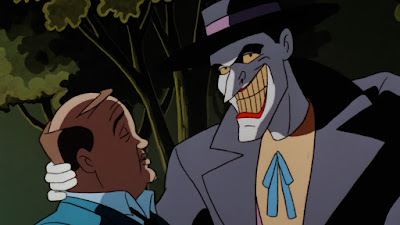

Thankfully, the story of The Joker almost never ends. But, again, he has to be done right. That's probably why producer Paul Dini was the writer for this episode. It's like Stan Lee declaring that only he would be writing stories about The Silver Surfer. When you have someone as important as The Joker is to the mythos, you need a sure hand. By the good fortune of discovering Mark Hamill in a minor role and then Tim Curry developing bronchitis, they also lucked into the perfect voice for the role, as well. That laugh! I regularly crack up when I hear it. It has just the right touch of both the jovial and the menacing, on top of the maniacal, which is just like the character. This is on full display when he's first encountering poor Charlie Collins (in another sojourn in the studio by Ed Begley, Jr.) and first remonstrating about public courtesy ("We can't have people cursing at each other on the freeway! It's simply not polite!") before revealing the occasional short-sightedness of the master criminal when asked what favor Charlie should provide ("I don't know! I haven't thought of it yet!") Even genius occasionally has its limits, which we see with The Joker constantly serving his vanity by requiring his henchmen to applaud every other word. Not that vanity precludes genius. Even, self-centered smart guys occasionally need fans.


Which is why we have Harley! This is the first appearance (HBO order or otherwise) of The Joker's assistant neé girlfriend, who would later go on to regular status in DC Comics and has since transitioned to film. Ably voiced by Arleen Sorkin, who actually inspired the creation of the character, Harley is an excellent sidekick to The Joker, lacking his palpable menace, but almost as manic and with a certain "everyday person" vibe that probably made him more approachable by association for parents and younger children who identify clowns with 'fun' (Seriously. Some people do that.) Harley's danger is a bit more "fun" than the leering Joker's. That kind of thinking is, again, where you can see that Dini and Bruce Timm and the other producers really understood the fine line they were walking with the "dramatic cartoon" concept. It's also the first appearance of Renee Montoya, Harvey Bullock's date for Gordon's celebratory dinner who, like Harley, transitioned from the series into the comics and then later into Christopher Nolan's films.


And, despite my disdain for the 50s-era stuff, the fight scene in the remarkably-preserved Mesoamerican temple (a point of absurdity noted by The Joker) is purely from that realm and invokes the fun side to the two characters and their encounters. As with most scenes of that order, it's more like watching a video game than an actual story, but it's still entertaining seeing them go through the paces that both they and the audience know they've trod so many times before. This is part of the hidden dynamic between them, as neither would know what to do with themselves if The Joker actually succeeded in killing his nemesis; a point emphasized by Alan Moore in Batman: The Killing Joke and which Dini drew from with The Batman's rueful laughter at Charlie finally putting one over on his terrible oppressor of the last two years. A lot of people expressed distaste at not only the savagery displayed by The Joker in Killing Joke but also the idea that The Batman somewhat enjoyed their contest of wills. Those people, quite obviously, didn't get the joke. ("I'm here to give you a small token of affection, from me and all the guys doing 25-to-life!")


There's some great visual style employed here, as well. It's not a real deviation from their usual, but little things like the outrageousness of the Crazy Clown Catering truck and maintaining the extra wide smile of Harley even when she's out of her usual costume are good touches that keep the craziness going. Also, the entrance of The Batman to the dinner was a really classic approach, with the spreading cloak (like bat wings...) and the screen being filled with the Batsignal symbol on his chest. There's also a great moment when Collins stays just this side of breaking the fourth wall, when he mutters: "He's nuts!" after hearing more of The Joker's plan. Yes, he is. That's what's so glorious about it. The swinging glider in front of the window as a makeshift Batsignal was also a nice touch. Another was the key quote when The Batman's presence is detected: "I smell a bat!"

There are so many good things about this episode, I could go on and on. On the story side, it's obviously not what Heart of Ice is. The plot is just a vehicle for The Joker's insanity (and perhaps a warning against road rage) so there's nothing particularly deep or meaningful about it. But, like the encounters with Clayface, these are intended to be adventure stories before anything else, and there's almost never been a moment that involved The Joker that isn't an adventure, so I'm fine with it. There's nothing deep or meaningful about ATHF, either, and I'm a huge fan. Sometimes the absurd is good enough.


Next time, we return to Catwoman and Red Claw with The Cat and the Claw, part 2.

Monday, January 11, 2021

Batman: TAS, episode #2: On Leather Wings


This was the first episode produced but the second to be released and was done so in prime time to make the biggest splash. You can tell it was definitely an intro episode from its basic structure, which is high action and drama from the very beginning and introduces a number of characters at a rapid pace. One of the more intelligent moves made by the producers with this series was that they essentially assumed that the audience was aware of who and what The Batman is from the beginning. They further that assumption with most of the major characters. Most people whom are aware of the lead character are also familiar with Commissioner Gordon, for example, and around that period of time, many would also be familiar with the two Harveys: Bullock and Dent, the latter of whom makes the briefest of cameos, highlighted mostly by his almost off-camera flipping of his famous coin, in true noir style.


But Bullock gets the full intro, not only of his lust to take down Gotham City's acknowledged hero, but also his willingness to defy direct superiors in order to do it. Bullock was created by Doug Moench in the early 80s (there is some debate about that based on a character seen for three panels in Archie Goodwin's run on Detective in the early 70s) as a corrupt cop trying to undermine Gordon. That's a noir character if I've ever seen one, so it seems perfectly natural that the producers would ensure that he was a presence in this version of the Batman. As with his Moench origin, Bullock tends to follow the lead of the mayor, rather than the commissioner. But the real star of the episode is, as usual, the villain of the piece: Man-Bat.


In the comics, Kirk Langstrom was a good-intentioned scientist who let his own confidence in his work carry him into danger. A similar example in the comics world is Spider-Man's friend, Dr. Curtis Connors, also known as The Lizard. Obsessed by the benefit that he thinks his formula will bring to humanity, Langstrom tests it on himself and goes through a horrible transformation until The Batman is able to save him. Why Kirk felt that it was urgent for humans to develop a sonar sense like bats, as compared to Connors' attempt to regrow lost limbs like many lizards, is for your editor to decide, but this has always struck me as one of those very DC (irrational device for character) vs Marvel (semi-rational device for character) comparisons. In BTAS, however, Kirk is both ambitious and quite aggressive about it, suggesting that his colleague, Dr. March, was too weak to do what he'd done... which is transform into a monster to rob drug companies. I mean, I'm all about knocking down Big Pharma, too, but there are better ways to go about it. But in this series, they seemed determined to portray Man-Bat as an actual villain; the "beastly" side of what The Batman is. One dresses up like a bat to terrorize criminals, while the other transforms into one to terrorize everyone. It's a "there but for the grace of the bat-god go I" kind of element which would probably work much better in a story told at a somewhat slower pace.

And that's because there's a questionable plot/timing issue with this episode, as well, given that they set up the "Dr. March is lying and must be the bad guy!" angle, with the big switch supposed to be revealed when we discover it's actually Langstrom who's the villain. But that story isn't given enough room to breathe while we're also meeting Harvey Bullock and the police are suspecting The Batman of being a menace. Clearly, these are intro episode problems, where you try to cram in as much story and characters as possible and one angle of that story kind of suffers for it. In that respect, Dr. March seems somewhat irrelevant, other than that he's the weird, antisocial guy who works in the strangest chiroptera lab ever (How many are actually in caves?) It also means that Francine Langstrom (who stops to point out that she's also to be referred to as "Dr." (Like the new First Lady)) is basically just scenery, unfortunately. She gets the Oh, No!-girl role as the story circles around her criminal husband, about whom she can only wail in anguish. Sigh...


On the upside (literally), we get one of our police airships right out of the gate, which is pertinent because a lot of the action in the second half takes place in the air. We're also introduced to a few of the legendary gadgets of our hero's repertoire, with gas bombs employed to foil security guards and the "huthuthuthut" zealotry of Bullock's tactical squad, as well as a pair of goggles that let The Batman see day-old footprints and hairs among debris. From an animation perspective, we also get a bit more anime style in this episode with the closeup to the transforming Man-Bat's teeth to fangs and with Bullock's disheveled appearance (hair, tie, shirt, coat) constantly in motion. The teeth-to-fangs scene had me flashing back to things like Legend of the Overfiend for a moment. They also dropped the reaction shots (e.g. no Batman standing in menacing pose for a moment), even though this was directed by the same person, Kevin Altieri. Again, that may be a factor of how much story they were trying to squeeze into one intro episode, while the previous story had been spread across two.

Also, a note about the title cards, since this one was particularly emblematic of the style. One of the other inspirations for this series was the Fleischer Studios Superman cartoons from the 1940s. In that period, many presentations, live action and animated, would use title cards like the one above just like the title page for a book. The one for Cat and the Claw was perfectly good, but this one has that grainier, black-and-white cast to it that really evokes those old-timey films. The attention to details like those are what make BTAS the classic that it's become. That said, like many intended pilots, I think this one suffered from the usual issues, which is why both Fox (and now HBO) decided to start with another episode.

Next up, we drop the temperature but raise the story level with Heart of Ice.

Batman: TAS, episode #1: The Cat and the Claw


The HBO listing begins where the series did, with Catwoman being a Robin-Hood-of-the-animals, as she steals to raise money for the environmental/wildlife causes that she's dedicated her life to. In the process, she runs across the operations of a terrorist group, led by the mysterious Red Claw who, in a nod to The Batman's rather overt sexism ("So, this new cat burglar is a woman-!") is, uh, also a woman. So, there's more than a bit to examine here.

First off, let's start with the positive: Adrienne Barbeau ("Just call me Billie! Everyone does!") plays the role of Catwoman and delivers the appropriate amount of both sultry and belligerent dialogue that has frequently defined the character. The producers pulled no punches with the immediate ignition of sexual tension between her and our title character. This is a longstanding tenet to their interaction. Adam West commented ruefully on the relationship he had with Julie Newmar on the set of the Batman TV series, where the latter played up that sexual tension off-camera so that the frisson of their scenes was often a real thing. He said she would leave him suggestive notes on the steps of his trailer so that she was never far from his mind. In this story, given that they play into that relationship in their alter egos (leaning a bit hard on the "if only this were Batman outside this door" routine, IMO), it's fair to say that the producers wanted there to be no mistaking what was really happening between the two characters, even for the kids for whom the show was ostensibly intended. Given that sex is always the most untouchable of taboos when it comes to American media supposedly aimed at children, I think it was interesting that they declared their intent right out of the gate. Yes, it's a cartoon and, yes, it's a character that's been acclimated for children by cultural perception, but it was clear that their approach wasn't going to abandon elements of the character that had been maintained for decades, to whatever degree.


By contrast, this was a presentation of Catwoman that producer Bruce Timm has said that he was never quite comfortable with. The switch from self-interested thief to fervent environmentalist is a significant one. It certainly makes her a more sympathetic character to much of the audience and introduces the trend that Timm and Co. felt was important to highlight throughout the series; in that the "bad guys" aren't necessarily just the people in the weird outfits, but often the far wealthier and societally-acceptable types. That plays right into the zeitgeist of the time, dominated as it was by the Reagan religion ("Greed is good!"), where outsiders to society, including a few wealthy types like Bruce Wayne, were starting to drift from the perspective that money solves everything.

Similarly, Red Claw is kind of a mishmash of socio-cultural realities of the time. When this was released, the USSR and its satellites were in free-fall. Without the ominous presence of the Soviets, the world's attention had already turned to the imminent threat of international terrorism as the bogeyman of the day. But it seems like the writers couldn't entirely abandon the old tropes, since she's still "red" and still speaks in some contortion of an Eastern European accent by Kate Mulgrew, of Star Trek Voyager fame, who would go on to revive that accent as Galina "Red" Reznikov in Orange is the New Black. So, in this episode, Red Claw is kind of the generic "enemy" that The Batman and Catwoman will have to face together, one for the law and one for the environment (Natural law?), but she doesn't bring a lot of character or memorable impact to either episode or series, in general.


Again, in contrast, it's interesting to note that Selina's cat, Isis, is a fully-fledged character of this episode. Time is taken to show her reactions (initial hostility to the Batman and then terror at his reappearance; a need to be comforted after Catwoman's dive off the skyscraper) and also her actions (struggling to get out of the window with the jewels in a cute touch; we wait to see her successful leap in the chase across the rooftops) until finally she's rescued from an oncoming truck by The Batman and Catwoman retrieves her. There's a common approach in visual media where someone granted a first-person perspective is highlighted as someone especially important to the story (see: Game of Thrones as a good example.) Isis is given that perspective when we see the laser defenses of the jewels through her eyes before the successful robbery. In that way, we know as an audience member that she is important and concern for her well-being amidst the action is played up as an element of the story.


We also get our first moment with Commissioner Jim Gordon, who makes sure to warn his people cleaning up the attempted theft of US Army weapons that: "These guys are crazy!" and then proceeds to hold a conversation with a guy dressed as a bat... Said weapons are also Thompson submachine guns, carrying the mixed timeline theme forward as one of "generally 20th century, but probably earlier than you'd think", which accompanies the general Dick Tracy look of the assembled mobsters whom The Batman shakes down for info on Red Claw. The closeup on Gordon and subsequent ones with Selina also demonstrate the animation decision to not give anyone pupils. Like the blank, white slits of the main character, no one's eyes will get more detail than a single-colored dot, with emotion displayed by the contortion of the face around them. This decision is highlighted multiple times in this episode, where reactions are shown clearly both without dialogue and leading into confirming dialogue (Bruce obviously agreeing to postpone their date before mouthing that agreement, for example.) While the pupil absence could be seen as simply a style choice, I think it's part of the decision to overtly demonstrate subtle emotions on the face of these characters that was often lacking in animation of the day.


The episode doesn't shy away from the little touches of the comics, either, such as when Catwoman uses her famous cat-trops in the ventilation shaft to deter pursuit or when the unreality of the situation is pointedly emphasized as she commits the attempted homicide (throwing The Batman off the roof) of the man she's infatuated with, simply assuming that he'll be able to save himself. On that note, it's essential to point out the role that Timm and Co. have assigned Bruce Wayne in this version of the stories. In many cases, he's portrayed as a dilettante playboy who can't possibly help himself. But in BTAS (and Steve Engelhart's work; we'll come back to this a lot), Bruce is assertive and confident in his actions; showing far more of his Batman side than is normally employed. Indeed, at one point, you could argue that he goes past assertive to mildly creepy when he grabs Selina's arm at the fundraiser to insist upon the date that she's won. It's certainly a more natural portrayal of the type of person one would except Bruce to be, given his background and especially in this series, when he's shown to be far more interested in throwing his weight around to the benefit of his interests, rather than simply riding the tide of his bank balance. Plus, one interesting little touch of HBO's was presenting this as the first episode in the series, just as Fox did in the original broadcast, but saving part 2 for the eighth episode presented, rather than immediately following part 1. It gives The Batman's final line "And there will be a next time." a bit more weight and gives the impression of the "living world", where many things are happening and stories are not uninterrupted or linear, that has made Marvel's productions even more effective. The simple choice of timing can be disastrous (see: Firefly), but can also be a subtly positive touch, as it is in this case.

Next time, we encounter a guy who really dresses up as a bat, with On Leather Wings.

Sunday, January 10, 2021

Noir toons and roots in reality - Batman: The Animated Series


Recently, I discovered that HBO had picked up the full run of Batman: The Animated Series for its catalog and I sat down to watch a couple of them. I hadn't seen any of them since they were originally broadcast in the early 90s, so it was an interesting experience to hearken back to a period that's now almost 30 years past, but still feels "relevant" to the modern era. My comic experience is woefully out of date as far as superheroes are concerned, so I'm only able to frame this from what I knew up to that point and others who have begun watching the series may feel that it's quite dated, as many things from that era are for natural reasons. But I suspect that series will still hold a lot of its contemporary charm for a couple of reasons: 1. It was designed to have its own, unique timeline that wasn't intended to reflect any particular era. 2. The Batman is the most timeless of DC's characters; just one more reason that he's also the best.

Reason #1 was a decision by producers Paul Dini, Bruce Timm, and Mitch Brian. Inspired by Tim Burton's interpretation of the mythos (Batman and Batman Returns), they wanted Gotham City to appear in its own technological bubble. Thus, right alongside classic big-fendered cars and Gothic architecture were not only modern technological conveniences (computers, etc.) but also police airships, which have never existed, but were indicative of the kind of "between the lines" approach that Dini and Co. were bringing to the idea. But part of that inspiration also had to do with overall tone. Now, right away, let's lay this on the table: I am not a fan of Tim Burton's version of The Batman. I appreciated his willingness to adopt much from the Neal Adams/Denny O'Neill approach from the early 70s, where DC tried to pry their most famous hero away from the endlessly goofy Batman TV series of the late 60s. Burton, a storyteller who's fond of working in the shadows (Legend of Sleepy Hollow, Edward Scissorhands, etc.) was kind of a natural choice to take on the challenge, as there would be much more in the way of moody settings than the "Biff!" and "Pow!" of the Adam West show. However, Burton is also quite fond of the goofy, as films like Scissorhands and A Nightmare Before Christmas will display. That tendency stayed with him in his two Batman films and it put off at least this fan of the Darknight Detective approach to the character. When Michael Keaton confronts a thug on the street and says: "I'm Batman!", those of us who like to stick more to the shadows would've vastly preferred him to say: "I'm THE Batman!" (as I am regularly doing here) because it conveys a much more serious tone about a character who had his origins rooted in killing criminals with a .45 caliber pistol.


Thankfully, while more than willing to continue with lighthearted moments centered around Bruce Wayne's social life and his interactions with Alfred, Dini and Co. decided to stick to the more serious version of the character in their series. Indeed, they took some heat from the studio (Warner Bros.) and from various Helen Lovejoys because their series was on the darker side of good ol' Batman. However, the critical raves about that tone, the textured storytelling, and the very human aspects of the characters were enough to drown out any concern about the fact that, unlike Adam West, this Batman only came out at night, as he should. And that's the other key part about their style: This was clearly intended to be a noir approach. The entire series is suffused with the measured pace, mystery, and cynicism that are hallmarks of the genre. The Batman may be a hero who's punching out bad guys, but he's also very aware of whom some of the true villains in our society are and the series doesn't spare on displaying the ills of money, inequality, and prejudices that are everpresent in the modern world. The humanity is something that's often missing from these kinds of adventure stories, but that aspect is prominent here.

And it's that human side that makes up reason #2 cited above. The Batman is DC's best character because he's their most human character. One of the (many) reasons that DC's ventures into TV and film are often failures is the very nature of the beast: Their characters aren't human. They're demigods, with which it's far more difficult for most viewers/readers to relate. How can someone relate to the "life struggles" of a man who can fly through the sky and is invulnerable to harm or a woman who is an Amazon princess from a land that's almost literally paradise? The key aspect to Marvel wresting the comic world away from long-time suzerain DC was that the former's characters were humans first, superheroes second. Peter Parker may be able to climb walls and shoot webs from his wrists, but he also worries about paying his rent, his grades, and whether he can make his date with Mary Jane. Marvel recognized in the 60s that the bulk of their regular audience was college-aged, rather than elementary schoolers. DC wouldn't concede to that reality for another 20 years and the essence of their characters still denies it. The Batman, despite being a billionaire, genius, unarmed combat master(!) is, in the end, still just a guy. His life is vastly different from any other human in our real world, but he's still human. That's the key that makes him approachable.


Batman: The Animated Series (from here on out: BTAS) didn't shy away from that humanity. In fact, it became a lynchpin of their storytelling, not only about Bruce Wayne, but also his rogues' gallery of opponents. In truth, The Batman is the antagonist in his own stories. Many people don't necessarily read or watch his stories because they're fascinated by him. They're usually fascinated by the erratic behavior of the villains that he's attempting to get off the streets. He's constantly locking up people like The Joker, Mr. Freeze, and Two-Face in Arkham Asylum, despite the fact that a man who dresses up as a bat and spends his nights beating up criminals isn't too far a cry from being a viable patient there, as well. But he's the straight man to their comedy. He's the force of nature that tries to contain the aberrant activities that make up their personal tales. And, to their enormous credit, Dini and Co. didn't shy away from that. Their version of Mr. Freeze isn't a "bad guy" just because he's a bad guy like Sauron from Lord of the Rings. He's a "bad guy" because of an extraordinary tragedy in his life that pushed him past the point of stability. That's a far more interesting version of Freeze than almost anyone had presented prior to the cartoon's creation. That's the humanity that the producers inserted into a "kids' show" that made it an excellent watch for adults, as well.

So, I'm going to be going through the whole series, all 65 episodes that HBO has, one by one and taking a look at how those stories were told, whom they were about, and how those elements, new and old, were melded with the 53 years of history prior to the show's release. Along the way, I'll talk about visual style, previous versions of the main characters involved, new characters, and what methods it seems they might have used to get their stories from point A to point B. There have been many phases (as noted) in the character's existence and many audiences to satisfy and I think it's worth examining just how said creators jumped through those hoops, as well as how they added their own imprint to the character that many, without hedging, have declared to be among the best versions of that character ever shown. I'll be watching them in the order that HBO has them lined up (which is pretty close to the original), so my next post will be about The Cat and the Claw, part I.