Showing posts with label Dune. Show all posts

Sunday, March 24, 2024

Been there, Dune that


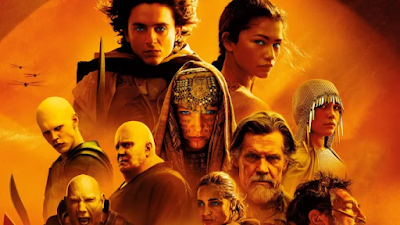
As noted when Part One came out, two-and-a-half years ago, Denis Villeneuve's style and attention to theme and mood shines through in most of his productions and Dune: Part Two is no different. The visual splendor and Hans Zimmer's excellent score are the high points in this second half the same way they were in the first. And in terms of story structure and trying to encompass all of Frank Herbert's highly-developed universe, this film has the same flaws, in that the actual practical application of the spice and the enormous presence of the Spacing Guild are both absent from what was originally a highly political tale. But in this part of the overall picture, I think that that lack emphasizes a problem with the way the story is being received by many.


Dune is a story about religious fanaticism and how seemingly positive changes at one point can have distinctly negative consequences down the line. (Anyone thinking of the supposed Chinese proverb about the horse and the old man can give themselves a gold star.) That fanaticism takes many forms, from the Bene Gesserit adherence to their plan of breeding the ultimate human to the Fremen prophecies of the Lisan-al-Gaib who will lead them to paradise. Herbert rooted his story in many of the traditions of the Middle East and its most prominent religion, Islam, which itself is derived from the other two prominent religions of that region: Judaism and Christianity. That was intentional because one of the primary messages of the novel is that extremism is bad and can lead to unintended consequences. The Bene Gesserit not realizing that their perfect human might not be under their control when all is said and done is one of them. But the other is that when Paul, the nominal "hero" of the story, finally defeats the Harkonnens and the Emperor of the Known Universe, the immediate result of that is a crusade by the Fremen to deliver the message that the mahdi (literally "savior" in Arabic) has come and all worlds must bow to him as the Fremen do. (The irony of a group known as the Fremen (i.e. "free men") slavishly devoted to the whims of one man in the name of freedom and/or paradise is perfectly placed here.)


But that message is apparently too subtle for some, since people are coming away from the film with the idea that Paul is a hero (something that the novel almost directly states is the wrong thing and which Herbert wrote three more books to reinforce, as many had that problem with the novel, as well) or that the real message is about outsider Europeans exploiting a non-European culture for their own ends. That latter part does have some play, but it's not anything like what most should be walking out of the theater with foremost on their minds. And I think part of the reason for that, alongside the tendencies of many to look at stories purely from a "good guy/bad guy" perspective, is that, again, the practical elements of the Dune universe in this version are almost completely ignored in favor of the spiritual elements. Granted, that, too, is Villeneuve's style. His stories (such as Prisoners and Arrival) almost always contain a heavy dose of the spiritual, either central to the plot (as in the former) or driving its interpretation (as in the latter.) Dune has both, which might have made him an ideal storyteller for the cinematic version of it, but which also means that things like the Guild and the Mentats are left by the wayside, leaving solely the spiritual elements like the Bene Gesserit and the Fremen at center stage, which then possibly delivers a message which is actually counter to the one Herbert wanted to bring. One thing to keep in mind is that the structure of the novel is mostly about people standing around (or sitting, as in the excessively long dinner scene) and talking. There's nothing wrong with that. Isaac Asimov built an entire oeuvre on people talking about historiography and robot ethics and those are often really good stories. But they're also really difficult to translate to other media. 


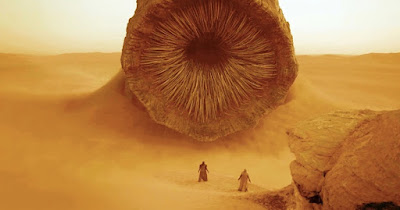
Visually, just like with Part One, it's resplendent. There's a long sequence on Giedi Prime where we're introduced to Feyd-Rautha (an excellent Austin Butler) in which the "black sun" of Giedi Prime bathes everything in black-and-white until we step out of the sunlight and things like skin tones reemerge. The celebratory fireworks in that kind of sunlight resemble globs of ink hitting a windshield. Just as with Lynch's film, the most interesting visual touches almost always orbit around the Harkonnens. But the sandworms are also kept offscreen sufficiently to still elicit real menace when one of them bursts forth from the ground and the Fremen culture has a much more "lived in" feeling and, undeniably, a much more Bedouin feeling, as well. But the spice harvesters and gunships and other elements of heavy technology are also much more visually developed than in earlier attempts at the story. One element of this film that completely failed for me, however, was Christopher Walken. Not only did he not fit my image of the head of House Corrino, but he's been so typecast by memes and earlier performances that when his face appeared onscreen for the first time, I immediately muttered: "More cowbell." The part written for him was also way below his ability to deliver an impact, as it mostly required him to be looking pensive, whether someone was delivering bad news or Paul was threatening to exterminate his line. There just wasn't much of a part to be had, so Classic Line (or at least look) Walken was never going to have the room to operate, which means this was basically just part of the film's marketing, rather than giving real substance to the role. In the broad view, that's OK, since the emperor was mostly a stand-in in the novel, as well, but it still feels like an opportunity missed.


As with so many things we've seen recently, it's not a bad film and definitely worth seeing in the theater for the greater impact of both sound and screen. But just like I said with Part One, I've never been a Dune devotee (even if I do LOVE the board game) so anyone trying probably has a steeper hill to climb with me than most other viewers. This is the modern version of Star Wars for a new generation, but one thing to remember is that that film wasn't very good, either, once you looked past the visuals.

Friday, October 22, 2021

Arrakis revisited


Dune is something of a landmark in the science fiction world. Most SF fans are aware of it even if they haven't read it or haven't sat through one of the film versions prior to Denis Villeneuve's 2021 effort. Consequently, almost everyone will have some kind of predisposition when they watch this version. Mine is colored by all four of the original novels (Dune, Dune Messiah, Children of Dune, God-Emperor of Dune), David Lynch's 1984 film, the Sci-Fi Channel's limited series of 2000, and multiple sessions of the legendary board game from Avalon Hill (I even own an original copy. Woo! Nerd credit!) So, uh, the story is familiar to me. But one of my key departures from much of Dune fandom is that, despite it sharing the 1965 Hugo award for Best Novel, I've never been really impressed with Dune as a story. (In that respect, I think the book it shared the award with, Roger Zelazny's This Immortal, is better.) The writing is somewhat pedantic. The pace is slow. Character development that isn't demanded by the plot (e.g. Paul Atreides) is basically non-existent. But what made Dune into a landmark (and a franchise) is the exercise in world-building, which is phenomenal. Just like Tolkien's Middle-Earth, Frank Herbert drew heavily from history and the cultures of the Middle East to create a universe with an enormous backstory, languages, customs, traditions, and intricate political machinations that few others have matched and which certainly exceeded almost everything to that point in the SF genre. The Dune franchise exists because of the data dump that is the original novel. What makes it intriguing is that sensation of vast fields of unexplored territory that is only hinted at in most of the film and TV productions. Someone recently referred to this most recent film as "this generation's Star Wars", which is understandable because George Lucas did the same thing; creating a whole galaxy of history and peoples surrounding his B-movie Western about Luke Skywalker and a couple droids. But what that writer misses with that comparison is that Dune has been its own thing for over 50 years now, in the same way that Star Wars is still a thing for this new generation as it has been for the last couple. Yes, a whole new group of people will now be immersed in the concept of the kwisatz haderach, but it's been around for a while and, of course, given that it's basically a prophet/messiah concept, it's been around a long time before Frank Herbert, too.


First off, I think the decision to split the film into two parts was a wise one (Everyone is forewarned when the initial title comes onscreen as "Dune: Part One.") The novel is too long and too dense to be properly conveyed in two hours. Lynch argued furiously with Universal Pictures to include more of the tremendous amount of material that he had filmed so that the story wouldn't seem shallow. When they refused, thinking that SF audiences were too stupid to handle anything over two hours, he eventually took his name off the film, leaving the credit to the legendary Alan Smithee. But just as importantly, Villeneuve instead embraces the aesthetic and atmosphere of the novel; avoiding the 80s shine and glitz which distorted Lynch's work. While there are laser weapons in this film, the director heeds the book's insistence that they're quite rare and dangerous for the users, so we see a lot more visceral, hand-to-hand combat, which Lynch tried to sidestep with the ridiculous "sound weapons." And you can see right away that this is a Villeneuve film when he quickly demonstrates his trademark dialogue close-ups with very hazy backgrounds. It's a highlighting technique that shows up regularly in his films and which serves this story well because, in truth, most of the action is in the dialogue and personal interactions. Dune is a highly political story and that's not something that's normally explained at the end of a sword. If you really want to understand what's going on, you have to pay attention to who these people are and what they're saying.


Of course, what that often means is that the pace of the film gets a little laborious and the atmosphere is one of angst, especially in the scenes involving Paul. I never got to the point where I was doing the "move along" hand motion but Villeneuve takes his time with the emotion and drama of a number of different scenes. That's not a bad thing, per se, because the book is that way, too (and, really, much slower and more laborious) and if you're going to do the book justice, then you have to take your time. In truth, he still skips over a lot, as he doesn't bother to explain who the mentats (Thufir Hawat and Piter De Vries) are or why they exist or how Dr. Yueh circumvented his Imperial conditioning. One of my mild disappointments was actually how little screen time Piter (David Dastmalchian) gets as, even though his role wasn't large in the novel, one of the little pleasures of Lynch's film is Brad Dourif in that same role ("It is by will alone I set my mind in motion.") Also, one of the key moments of the novel is Duke Leto (Oscar Isaac) interacting with the Shadout Mapes and learning about Fremen culture and, of course, first discovering the betrayal occurring within his house. That's almost completely glossed over here and Stilgar (an almost-unrecognizable Javier Bardem) is given a more prominent moment to suggest that he feels a connection with the duke, which seems like a place where something hit the cutting room floor that might've been important for story coherence.


Visually, it's spectacular, as you might expect from both a 2021 sci-fi film and one by Villeneuve (Arrival being his most notable other example.) The sandworms are impressive, the shield fights are exciting (although I question just how slow a lot of the lethal strikes were moving in most of them), and the depictions of things as functional as the ornithopters are really well done. The dramatic moments of the landing ramps and various groups' arrival; the massive presence and implicit threat of the Guild transport ships; the overview of the sprawling Arrakeen; all great stuff. However, I will say that I was disappointed to not see a scene similar to the one Lynch opened his film with: the arrival of a navigator to talk about the Guild's involvement in the overall plot. (That element is replaced by Gaius Helen Mohiam (Charlotte Rampling) coordinating with Baron Harkonnen (the eversteady Stellan Skarsgård) on Giedi Prime.) The appearance of a navigator in Lynch's film was both a great representation of how they'd been described in the books and a reinforcement of how important the spice was to the empire and what it did to its constant users. It's a very visceral element of the working mechanisms behind the empire and it helped make the spice into something more than a MacGuffin. It escapes that here because of the time they spend showing its effect on Paul as he breathes it in out in the desert, but for all of this film, the emperor, the Guild, and pretty much every element of that political life outside the catfight between the Atreides and the Harkonnens is just background noise. Again, it's a data dump and some things are going to get sidelined for the sake of a two-hour (presumably four-hour, if the expected Part Two is ever announced) production, but there are certain things that make the Dune universe what it is and I've always felt that the Guild is a big part of that. All of those visual elements are underwritten by an excellent score by Hans Zimmer, which is another notch in his impressive track record. He keeps the majesty and mystery of what's happening foremost in your mind and weaves in plenty of sounds that many would identify with musical styles that touch on the cultures that are part of the story. On a technical level, the film is really well done.


Overall, I'd say it's a better version of the story than either the 1984 or 2000 productions; in part because of Villeneuve's style, which incorporates enough spiritual atmosphere to really let that part of the novel shine through. Herbert wasn't shy about mining cultures for inspiration. The term mahdi, used by the Fremen to label (and often dismiss) Paul comes right from the Arabic term, meaning "the savior" or "the guided one" and whom is an expected unifier of the world before the end times in Shia and Baha'i traditions. The novel is draped in a number of Islamic motifs and Villeneuve doesn't shy away from those spiritual trappings, even if he doesn't call them out as starkly as Herbert did. In the end, it's a worthwhile effort to try to deliver a new version of the story. I wouldn't consider it groundbreaking or compelling, as there are no performances that really stand out and I am irretrievably jaded as far as the story is concerned, but it's definitely worth your while if you're a Dune fan. Keep in mind, of course, that it's also only half the story, so perhaps my assessment will improve when (if) Part Two is released.