Showing posts with label better call saul. Show all posts

Wednesday, August 17, 2022

Getting crime to pay


We haven't seen much that's been particularly inspiring at the Michigan Theater in recent days, when we've been seeing things at all. Yesterday's offering was also not something that would have ordinarily jumped out at me, but when faced with few or no choices, you take what's there. That, of course, is also one of the central themes of Emily the Criminal. The film is the first feature-length effort as either writer or director for John Patton Ford and it's a pretty solid starting point if he's choosing to make a career out of this whole cinematic thing. The choice of career is also the quandary of the central character of the story, Emily, played by Aubrey Plaza, formerly of comedic fame in stand-up and Parks and Recreation. It's a story about contemporary LA, the economic difficulties faced by much of the modern generation, and the sacrifices one is willing to or is forced to make to overcome those difficulties. It's a pretty straightforward scenario, as Emily, an artist weighed down with tens of thousands in student debt, gets a tip from a co-worker that leads her to a credit card fraud scheme that brings immediate, albeit risky, returns. Seeing it first as an amusing distraction and then later as a real opportunity for cash, she gets in deep with both the scheme and its co-owner, Youcef (Theo Rossi.) We can see where this is going a long time before it gets there.


Emily is a fully-realized character and Plaza plays her well. It's not difficult to either believe or understand why a woman with a history of impulsive behavior and unwise choices might choose to participate in the venture. Those poor choices also persist and make her life more difficult than it already is, which is saying something, even if she's not immediately impoverished as so many others in our society are. The film is also rather pointed with its social commentary, not only in reference to the obvious things like the onerous weight of student loans that accumulate interest faster than payments can reduce the original amount, but also to the social disdain that people Emily might once have considered peers express toward her and her co-workers as they bring food to company gatherings. It does get a bit heavy-handed in spots, like when her boss points out that she's an independent contractor and, therefore, has no ground to stand on when he reduces her hours. He points out that she can't go complain to the shop steward because she's an IC. I'm not sure how many people that might watch the film even know what a shop steward is, given the reduction in organized labor in this country, so pointing out that she, like so many other workers, simply has no rights was probably sufficient. In the end, Emily continues to make what she feels are the only reasonable choices available to her and we begin to realize that her situation is not too far from a certain irascible chemistry teacher,,,


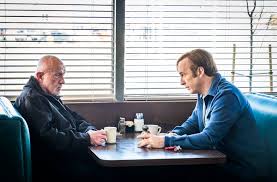
After we got home from the film, we sat down to watch the final episode of Better Call Saul. I have often said that The Wire is the best thing ever put on TV, but that Breaking Bad is a very close second. BCS has been very close to its progenitor in quality and not simply because it takes place within the same setting and involves many of the same characters. Unlike BB, where showrunner, Vince Gilligan, went into it with the idea that he was going to tell the story of a lead character who becomes a lead villain in the audience's eyes, I think his approach to Saul, along with co-runner, Peter Gould, was a bit more textured. Since it was a prequel, the act of building drama is sometimes more complicated, especially in a post-Game of Thrones world, where you know that anything life-threatening to lead characters that have appeared in later times isn't actually that dire. That doesn't keep the story from being interesting. It just means that you have to use different approaches to keep the audience really riveted to what might happen to our (anti)hero.


But I think the other advantage that Saul/Jimmy as a character had is that, unlike the force of nature that Walter White became, Jimmy often remained sympathetic even while he was engaging in acts that ranged from petty to downright awful. Sure, he was Slippin' Jimmy, scamming people out of their money because he couldn't be bothered to earn an honest living. But he was also James McGill, partner to Kim Wexler (the truly excellent and underrated Rhea Seehorn) and showed a genuine concern for the well-being of others, even if it only sometimes appeared when he realized that what he'd done had real consequences for others. He'd go through his period of recrimination and anguish and self-doubt... and then he'd be right back at it because that's who he was. In a genuinely impressive summation, all of those themes came to the fore in this final episode, including the acknowledgment that he was, even after all he'd done, still a really likeable guy, as displayed by the respect and affection shown by the other inmates in his final destination. Like Emily, I think Jimmy was a fully-realized character; an actual human being with all of the foibles and bad choices and sentimental strengths and failings that inhabit all of us, to one degree or another. That made the series eminently watchable and sets a very high bar for any storyteller to aspire to. Whether it pays off or not, the pursuit of the goal may be the most important thing.

Monday, October 21, 2019

Half truck, half story


[There are minor spoilers, yo.]

Stories have a beginning, middle, and an end. Full stop. That's what a story is. From that rather unforgiving perspective, El Camino is not a story. It's an addendum to a story, because the beginning is in Breaking Bad and this is really all about the end. I mean, I guess you could say that this two-hour film was about not having the money, getting the money, getting more of the money, and then using the money to disappear into Alaska... and that's a story. It's not quite the level of discourse I'd expect from someone as talented as Vince Gilligan, but it's arguable.

This is starting out pretty bleak, as a lot of things have over the past few weeks. These are relatively bleak times, on a personal and public level, so that's quite possibly coloring my perspective. Furthermore, I'm still aggravated about having to scrape out a draw against the Mancs yesterday, so there's that. When it comes to sports, writing, media... I am pretty much an "excellence demander", as the saying goes. That's why I'm looking at El Camino from the perspective of the basics: Does this tell a story? Does it tell a good story? Does it serve any purpose beyond titillation of hardcore Breaking Bad fans? The answer to all of those is, largely, "No." On the other hand, most TV and most films are filed under "entertainment" for a reason. This one gives you a couple hours to watch Jesse's recurrent struggle with his sense of humanity that almost constantly gets him in trouble in the morally ambiguous world that he followed Walter into. It gives you another look at Breaking Bad fan favorites like Badger, Skinny, Mike, Todd, and even Walter himself; still in desperate schoolteacher mode and not yet having descended to the notorious Heisenberg. It also gives us one last look at clean-up guy, Robert Forster (RIP), who is his usual low-key, amiable, but still memorable self.


And that contrast raises a lot of overarching and frequently asked questions about these kinds of entertainments. How is something defined as "good" or, in the case of Breaking Bad, "universally acclaimed"? Beauty is in the eye of the beholder, right? (No. Not that kind of beholder.) If El Camino was written for Breaking Bad fans and it serves the interests of Breaking Bad fans who just want to spend more time in that world (especially with Better Call Saul having been on hiatus for a while), then that kinda makes it good by default, right? We still get Vince Gilligan's solid writing and directing, as well as Aaron Paul. Sure. It's fine. I'm a diehard Breaking Bad fan. I'll watch anything that Gilligan puts on the screen, which is why I was eager to watch El Camino.

But I'm also interested in stories that actually go somewhere. Yes, we get to see Jesse once again regret that his streak of morality prevents him from pulling a trigger that he probably should and gets him into a problem that is more complicated than it had to be, if he could just emulate some of Walter's ruthlessness. Yes, we get to see his final interaction with his naive and anguished parents. Yes, we get to see him reminiscing about the frustration of his relationship with Todd; his ironic innocence and brash youthfulness in interacting with Walter; his wistful longing for Jane. All of those are well-acted and at least somewhat poignant moments that are well written, too. Those are all entertaining.


And, in the end, just more of the same. This is an epilogue to the real story that is Breaking Bad. Unlike the prologue that is Better Call Saul, we don't get to see a character that transforms over the course of a story; in which we see key moments that we can look back to as the places where the path was laid in and the might-have-beens blew away in the breeze. El Camino is just an elaboration on Jesse's hysterical laughter as he flees Walter's murder/suicide of Jack's Aryan gang in the final episode of the series. We knew Jesse was getting away and finally escaping Walter's shadow and all the danger that had come with it, despite never being able to escape the pain that had ensued. This film was just an elaboration on how he got away, which doesn't tell us anything we didn't know already and doesn't really do much else, except entertain, which is perhaps the point.

HBO has started up a sequel series about The Watchmen. I don't have any particular interest in seeing it because, when it comes to that particular property, I tend to agree with both its artist, Dave Gibbons, and its writer, Alan Moore, both of whom expressed varying levels of confusion and dismay that anyone would want to "continue" a story that they had told and completed. It's done. As Moore has stated, it's an icon of its time and an artifact of it. There's nothing else to be done with it that doesn't diffuse or distract from the original. Who knows? It might be fantastic. But does it really do anything with the material that we haven't seen before or hadn't really been interested in seeing in the first place? Breaking Bad is kind of in that same sphere. No one wants to see HeisenBadger: Back to the Blue. We've seen the story that Gilligan wanted to tell. Now let's move on.


In the end, is El Camino worth your time? Sure. If you're a Breaking Bad fan, you could be doing a lot worse than spending a couple hours with Jesse and Vince Gilligan again. It's still entertaining, if somewhat predictable. It's just not transformative like BB was and it won't do much more than make you think you should go back and watch "Fly" again.

Sunday, August 26, 2018

Limits testing

[This one is obviously very late. Life and schedules and ambition kind of conspired against me. Episode 4 should be much more timely.]


What we hide from people is often just as important as what we say. Similarly, what we're willing to do is often equally as important as what we're not willing to do. Episode 3 of this season was all about those two concepts, as many different characters were asked to find their limits, while Jimmy, for the most part, sailed through it all.

From Ignacio acting out the cover story that has him getting shot and operated on by a veterinarian in a Jiffy Lube (patiently hovered over by the cousins) to Mike simply turning down a B&E for a rare figurine, these are the decisions that shape these characters, not only for the audience, but the sake of the character's identity. Ignacio, disenchanted as he is with the drug scene, is now serving two masters, either of whom will kill him at a moment's notice if they feel he's a liability. This is the tragic case of someone forced to test his limits for a world that he no longer wants to inhabit; to give in the utmost for a cause that he not only does not believe in, but actively detests.


And then there's Mike, who's not only obviously disappointed that Jimmy would approach him with something so pedestrian, something which doesn't test his abilities at all, but is also clearly disappointed that Jimmy would sink so low as a simple robbery in order to make money. Mike knows that Jimmy is capable of more and so does Jimmy, inherently, but circumstances have put the latter in a situation where immediate cash flow seems more important than the style with which it is delivered. Mike, OTOH, has no such issues and can now pick and choose jobs that suit him. Even so, it's highly likely that Mike would never have bothered to risk himself in a job so simple and with so little payoff.


But Kim is the one we should be paying most attention to, because she ends up seeing both ends of the spectrum in this respect. Her rewrite of what we assume was Chuck's scathing departure letter into a tepid encouragement shows just what she's willing to do to try to salve the wound that Jimmy is feeling and not drive him further into the pit of guilt, despite the fact that he earned it in some respects. When she dissolves into tears, we're left uncertain as to whether it's about her own sense of guilt for having deceived him or the angst over the fact that the letter she wrote couldn't help him without giving away the lie and so simply leaves him in a state that's not worse, but still not good.


On the other end is the meeting with the CEO of Mesa Verde. No small bank suddenly expands into a half-dozen more branches (and elaborately-styled ones, at that) without something happening off the books. She wanders around the display room, knowing that she's gotten herself into something that's going to violate her ethics as surely as what she's just done to Jimmy and has done with him before. Like Ignacio, she's uncomfortable with that, so now comes the test: How far are you willing to go?


The one exception to this overall theme is presented by the return of Gale Botticher. Gale, in his usual constantly positive and endlessly inquisitive way, wants to do more for Gus than the latter actually wants. He's disappointed with the quality of what Gus is working with now and wants to show him a way to do it better. There is no question of willingness of Gale's part, which was always the case in Breaking Bad, as well, which is what made him part of one of the best moments of that show, when Jesse was pushed past his limits and almost broke from Walt completely. On the one hand, it's amusing to see Gale make his return. OTOH, knowing that the most emotionally poignant moments of the character's existence are the ones we've already scene and which won't be a part of Better Call Saul is mildly disappointing.

Episode 3 was a bit of a step back from the majesty of episode 2, but they can't all be park-clearing winners. Plus, this episode managed to lay down a lot more of the interesting themes that will be pursued this season (Nacho's travails, Mesa Verde, Gale, etc.), so there's still plenty to look forward to.

Monday, August 13, 2018

Creatures of Light and Darkness


For those of you that are New Wave SF nerds like me, you'll recognize the title of one of Roger Zelazny's more esoteric novels. Originally envisioned as simply a writing exercise, Zelazny never intended to publish Creatures of Light and Darkness. But once friend and fellow author, Samuel Delany, heard about it, he encouraged an editor to take the manuscript from Zelazny and put it into print, for good or ill. It has one chapter devoted entirely to poetry and the end is written like a screenplay. In other words, it's a very stylized approach to telling another of Zelazny's stories about futuristic beings of myth and their very human motivations. Similarly, Michelle MacLaren, director of the latest episode of Better Call Saul, used a backlighting technique throughout to indicate moments of tension, where the conflict between characters was subtle but significant to the story; where decisions kept the direction of the story for those characters balanced on that edge between light and darkness that scientists call 'the terminator' as sunlight creeps across the spinning ball of our planet. Would their decisions move them wholly into the light or the darkness or would continue to inhabit the halfway point, not quite sure how or if to proceed?

The first example was Jimmy and Kim, as the former putters around the kitchen, determined to flee from having to talk with Kim about recent events, and to reassure himself that he can still be of value, even without the law license that his now dead brother wrested from him; the only real thing of value that Jimmy has ever acquired in his life. Jimmy's face is shrouded like his soul is and looking away from the light just shows how unwilling he is to face his role in what happened. The next example was Ignacio, who faced his father in darkness, trying to reassure him that the threat from the Salamancas to launder money through his car business was finished, although his father cannot look at his shrouded son. Nevertheless, still fearing for the safety of the son who so wounded him by involving himself with criminals, pays the tax, anyway. Ignacio tries to convince him not to and then surrenders to what he knows he cannot change. The next example was the meeting between Mike and Lydia, as the latter cringes from Mike's bold play at the warehouse, thinking that continuing as normal is better than laying the defense against his inevitable discovery by someone. Mike knows better, but still has to convince the person who effectively outranks him. Here is the former cop, still walking in the twilight with his new partner who covers the drug business contained within the parent corporation; meeting in a darkened conference room, as if someone might discover them with the lights turned on.


The technique is still in evidence when Kim accosts Howard over the backhanded estate settlement that she knows will only further demoralize Jimmy. Their conflict is much more prominent and not subtle, so the contrast is fainter, as Kim's fury lights up the scene. But there's still the faint shadow that symbolizes the undercurrent of Howard wanting to get a last jab in at Jimmy, whom he knows tortured his friend and partner of many years, and Kim, despite her vociferous defense, knowing that Howard is probably justified in wanting to do so. But it comes back in full force in both instances when Gus' men tell him about the results of Hector's tests, as the light streaming through the window in the car and in his office leaves Gus partially in shadow as he struggles with himself and how he should proceed with his attempt to keep Hector alive so that only he can exact the full extent of the vengeance he desires ("I decide what he deserves. No one else.")


There is no shadow in the moment of direct conflict. When Ignacio and Arturo confront Gus' men over the number of kis that they're picking up, everything is brightly lit. The conflict is overt. The threat is real. There is no shadow across it. Everyone knows the motivations at hand and what actions they will drive. But the contrast returns when Arturo is killed and the implications of what Ignacio has done and what he will now have to do are spelled out to him by Gus. As direct as the threat may have been to Arturo, the shadow returns for Ignacio, denying him the assertion that he made to his father about how he was working on getting out of a bad situation, as he is now only that much deeper into darkness with someone who is far more dangerous than Hector.


I've really enjoyed Michelle MacLaren's work over the years on Breaking Bad and Game of Thrones, precisely for her deep understanding of story and how to present it in a visual manner. This may have been her finest effort yet in that respect. It doesn't hurt that Gilligan's writers continue to outdo themselves in presenting the cast with so much red meat to work with. Take Jimmy's interview with Neff Copiers. He knows they'll reject him as unsuitable for a sales job after having been a lawyer, whether it's because of a lack of actual experience or a belief that he'll decide the job is beneath him and they'll have to find someone else when he moves on to another law gig. So he goes back in to convince them that he has what it takes and easily does so. But his own self-loathing; the recognition that that kind of hucksterism is what he's been doing his whole life, prevents him from accepting the job that he wins. All he can think of is how these guys are precisely the kind of marks he's been working since forever and how he won't be able to respect them for giving in so easily to his routine. And, of course, how he can't stand himself at the moment for everything he's done to Chuck and how he doesn't deserve anything good to come his away, especially when it was achieved by Slippin' Jimmy.


Full marks to Rhea Seehorn in this episode. Her scene with Howard was one of her best moments in the entire series, as she ate him alive and confronted him with his own ulterior motives, while she took the opportunity to vent her frustration at the situation that Jimmy still keeps her in. She's doing amazing work and I hope it lands her other solid roles in the future. Similarly, Michael Mando as Ignacio has been getting progressively better as the series has moved along. The emotion on his face when Gus corners him and he realizes just how deep his personal hole has gotten was great. It was extremely entertaining to see Gus doing some of his own dirty work again, too. Other little details, like an appearance by The Cousins at Hector's bedside, and Jimmy and Kim deciding to watch White Heat, a noir film in this most noirish of BCS episodes and a film about a man confessing to a lesser crime to hide a larger one, pushed this one among the best of the series, in my opinion. I was still intrigued by episode one of this season, but episode two has launched BCS back near the top of my TV agenda (right behind Liverpool games.) The series can't get much better, which only makes me want to see how they're going to outdo themselves as we move along.

Monday, August 6, 2018

Saul waiting


With the long-awaited release of season 4 tonight, one begins to garner the idea that this may be it for Better Call Saul. Creators Vince Gilligan and Peter Gould have stated that Saul won't exceed the length of its progenitor, Breaking Bad, which means a season 5 would be the limit. However, the opening Cinnabon scenes are possibly finally drawing the noose around Jimmy's existence in Nebraska, with the blankly menacing stares from the cab driver with the 'Albuquerque' air freshener. One could also sense a breaking point at the end, after all the emotional turmoil of Chuck's death, when Jimmy declares that his death is Howard's "cross to bear" when the latter clearly came to Jimmy and Kim seeking sympathy. This is the blame shifting that Jimmy has engaged in throughout his life, but never in such a ruthless manner. There was always the angst apparent in his awareness that he was really doing someone wrong. This time, he's just coasting, likely not least because he's found the angle that lets him off the hook he'd just imagined himself on because of the insurance stunt.


But by that time, we already knew that Jimmy had turned a corner in his emotional transformation. The best moment of the episode was when he and Kim were sitting on the bench outside the ruin of Chuck's house and Jimmy was muttering about how Chuck had been getting better and "something made him relapse." Just watching Rhea Seehorn's face was a treat because so many emotions washed over it in the space of a few seconds it was hard to keep up with all of them. There was the frustration with Jimmy still thinking Chuck could have gotten better; there was the concern for his emotional state; there was the angst over how she was going to get him to change his mind and not blame himself... but there was also the hesitation. That hesitation said that she knew why Chuck had "relapsed" and what may have led to his state of mind that caused the "accident" to happen. She knew because she knows Jimmy. She knows what Jimmy did to Chuck's career and life. She knows how casual Slippin' Jimmy can be about the travails of others. No matter how much she loves Jimmy McGill, there's an inner self to him that's basically amoral. She's been making excuses to herself or simply forgiving him for it up to now, but the crux point may have been reached.

The other clue we might have that this is the final seasons is Bob Odenkirk's statement that "Breaking Bad is going to swallow season 4." With Mike Ehrmantrout well on his way to becoming Gus Fring's fixer and the latter's business now rolling with Hector having been reduced to what will be his wheelchair-bound state, we're rapidly approaching the state of affairs that saw Saul enmeshed in that business as the "criminal lawyer" that Walter White first encountered on behalf of one of his dealers.


Speaking of which, Jonathan Banks continues to excel as Mike. Despite the fact that he ended up doing the "Axel Foley in the bonded warehouse" thing as he was scoping out Madrigal, that whole scene kept us intrigued as we watched him develop an idea of just what kind of front Lydia and Gus were running. You can tell that he's become more comfortable with his return to the twilight of the law, if only by the obvious boredom that he experienced while sitting at home watching the Isotopes, before finally deciding to move on the suspicions he had about the check he received. The music choice for the warehouse bit was also excellent, as was the rest of the episode in that respect. Gilligan's aural cues continue to be a distinct element of his productions and I'm glad that he's not abandoned that trait.

So, this is it. We're in the home stretch of the transformation into the "real pipe-hittin' member of the tribe." Even with the recent and coming deluge of things to watch (Orange is the New Black, second season of Ozark on the 31st, Liverpool, Michigan), I'll still take time to sit down on Monday nights and endure commercials just to see the final pre-chapter of Breaking Bad roll out.

Tuesday, April 19, 2016

The teevee and the moving picture shows

Bird watching.
The finale of Better Call Saul was excellent. The best thing about that show is the fully-formed characters, in that you can see a number of different possible reactions and/or paths for them to take and all of them seem valid to one degree or another, such that none of them are easily predictable. You can't look at decisions that Jimmy, Chuck, Mike, Kim, Nacho, or Howard have made and say that they were obviously linear storytelling or that the actions were obvious because there was only one instinctive response to a situation. In many ways, I think Vince Gilligan's storytelling has only improved since Breaking Bad and it was already excellent there. I watched a few minutes of Talking Saul with Gilligan, Peter Gould (the other showrunner), and Jonathan Banks (Mike) as the guests. Gilligan was talking about the fact that Chuck had ended the season pulling a con on the ultimate con man (Jimmy) and he turned to the studio audience and asked: "Did you like that?" The response was a muted chorus of boos. Is that an example of the low expectations of much of the audience or of a writer willing to travel the rough road with his characters, or both? I think it, again, shows the well-rounded nature of these characters, in that it was perfectly reasonable for Chuck to have given in by now or, in fact, be taken in by his brother's shenanigans, given how disoriented Chuck has become. Instead, Gilligan and Co. have kept Chuck alive and in the game and given Jimmy a much larger hill to climb in season 3.

Also, despite the knowledge that nothing is going to kill either Mike or Hector (since both are still alive in Breaking Bad), there was a great deal of tension in the sniper scene, both in terms of Mike's target (Is he trying to take out Hector? Is Hector's condition in BB an aftereffect of being shot through Nacho?) and the car horn and note event. Even if Mike isn't going to be killed, being cornered by someone who's been able to stalk the canny Philly cop is enough to leave the scene with the eerie sensibility I think they were (ahem) aiming for. Plus, Mike's role in the show is one of slow transformation, just like Jimmy. You see how, step-by-step, his overwhelming pragmatism slowly erodes the moral barriers he puts in front of it and transforms him into the efficient fixer of Breaking Bad. As Banks said, he's not there yet, but this is the story of how it happens. Because we know the end result of both Jimmy/Saul and Mike, one of the more interesting characters of the show turns out to be Kim, the end result for whom we don't know at all. Does she finally get disgusted with Jimmy's excesses and leave before he becomes Saul or does she ride the con job and stay attached when he's in full flower? Does she get caught up in the Mike/Saul world and get killed? Some good things to think about while we await the return of Gus Fring to the TV world. Also, it still remains amusing that calm and cool Mike was once this guy:

"Don't you do it, Jack!"
Of 48 Hours and Beverly Hills Cop fame.

Who's "House Martell"?
I've been rather studiously avoiding most of the previews and trailers for Game of Thrones, mostly because my demeanor at the end of last season was pretty similar to Jon Snow's above, but I suppose I'll watch them this week and then write up a preview of sorts before Sunday. I was fairly demoralized by last season, since the problems with the storyline and its presentation (Dorne!) were numerous, which was new for this series. It is interesting to see the amount of Flounder coming from the cast during the promotional tour/interviews this year. Are they trying to reassure TV fans disenchanted with last season (of which I was far from the only one) or book fans worried about the uncharted waters without GRRM? Both? Was last season the point where GoT descended from being a cultural event to another series that dragged out too long?

What? Again?
On that note, I think I'm over The Walking Dead. It's not that this past season was bad or even worse than those before it. It's just that it's basically more of the same. I appreciate some of the moral introspection that Rick's group went through when they were slaughtering the Saviors, but it's not really that different from the "kill or be killed" quandary that they've been facing for 5 years now. While fans of the comic are enraptured by the introduction of Negan, I look at him and his band and see just one more charismatic menace, just like the Governor or even whatshisname from Terminus. Just because the threat to survival now has a new name and a weapon named after a famous blues guitar (Base Ball (bat) King...?) doesn't make it much different from the last one. That point was driven home when I tried to watch the first episode of the second season of Fear the Walking Dead and realized it was true for that series, as well (i.e. they're about to run into the true threat in the midst of the world being overrun by zombies: other living people.) It's basically the Gilligan's Island principle, right? How long can you keep making stories about the threat that the environment presents before you have to resort to the coconut radio or bring in aliens/crashed cosmonauts to introduce some variety to the situation? Except that said cosmonauts just want the same thing you do and are willing to step on you to make it happen. I mean, in the broader sense, that's the competitive perspective on the human condition in the first place. But it also reaches a point where one charismatic sociopath is the same as any other: they're both a threat that Rick's going to have to shoot if the show wants to continue.

I've been catching up on Oscar-season films lately, too, courtesy of the omnipresence of our Amazonian overlords.

Guess who the crazy twin is.
Legend was decent. There was a ton of story to try to pack into two hours and you could certainly tell where the editor had pulled out the machete. Tom Hardy, per usual, was brilliant as both of the Kray twins (the mannerly-looking one above is actually the less socially stable of the two.) But it seemed like there were too many stories to tell, so that many of them got shorted by the necessities of the medium. The fact that they didn't skimp on the Cockney slang at all is to their credit, as it originated as a way for East End gangs to keep the police from figuring out what they were saying, but it also slowed the pace of the film for the viewer, as you occasionally had to try to dissect what was being said. The fairly muddled shifts from the perspective of Reggie Kray to his girlfriend/wife, Frances (Emily Browning), didn't help. I was tickled to see Christopher Eccleston looking like a very senior Scotland Yard inspector, as he will forever be the Duke of Norfolk to me, but that's about the only genuinely memorable thing about the film. Except for Tom Hardy, of course, who is worth seeing in just about anything.

"Operator, I'm trying to reach some place without a bland ending."
Bridge of Spies... Ugh. Nathan and Kate tried to warn me off of this, but I was like: "Cold War themes! Good reviews! Dude won Best Supporting! I have to try-! ... Oh. Spielberg." There was a day when Spielberg films were actually progressive. When he was making things in the late 70s and the 80s, it seemed like he was willing to take risks with his storytelling approach and cinematography. I mean, he's never been a visionary, but it takes real drive to do something like his magnum opus, Schindler's List, with all of its stylistic approaches to a very sensitive topic. Most of what he's made since then have basically been him killing time. "Hello? Oh, hey. How ya doin'? Me? Just livin' on the residuals, man. Something new? Well, I guess that sounds like a middle-of-the-road topic. I could do that for a few months, sure." Hence, Bridge of Spies. There are no risks here. It's a completely linear story that finishes with the perfect Hollywood Spielbergian ending: hero safe, marriage secure, world and picket fence perfectly painted. Bleah. Admittedly, Mark Rylance's performance was the absolute highlight of the film and I can see why it earned him the nod for Supporting Actor, but the fact that his performance was so low-key and subtle may give you a clue as to how the rest of the film feels (and I still say Hardy got robbed for The Revenant.)

Unlike you and me, these people were actually working.
I liked Spotlight. I think it's a worthwhile film. I don't quite get the accolades it's received, since I have a feeling it could have worked almost as well as a documentary about the investigation and its aftermath. Yes, there was a fair amount of emotional tension and, yes, most of the performances were quite good. But I don't get the raving over Mark Ruffalo's role as the emotional guy on the investigatory journalist team. He was good, but the role was pretty much paint-by-number. I thought Michael Keaton's role had much more meat on the bone, even though Keaton preferred to handle it in his usual "I can out-subtle you without even trying" manner. When it came time for his character's turning point confession about an error in judgment from years before, it fell completely flat because he'd played an awesome statue to that point. Oddly, I thought the best performance was from Liev Schreiber because of its understated nature (and he's, uh, not the first guy I'd associate with the word "understated" in most films to date.) And it was nice to see John Slattery still doing semi-Roger things, post Mad Men.

Advantage of smoking: you can burn that damned blank page if it stares too long.
Likewise, I liked Trumbo. It's a topic that's kind of near-and-dear to my heart (both screenwriting and persecution for one's Marxist ideas) and Bryan Cranston has earned one of those passes that means I'll likely not regret losing the two hours of my life simply because he's onscreen. But, like Legend, I think there was a bit too much story here to really elaborate upon what needed to be told. Plus, the overall subject matter is one that's somewhat difficult to portray in a dramatic sense. Is there real tension between starting a screenplay and finishing one? Does the audience rise in anticipation as the last few keys on the typewriter are struck? No. Writing is a long and solitary process that doesn't really present moments of accomplishment until you're winning an award or someone's handing you a check; both of which in this story were muted because of the blacklist. It's an interesting quandary to be in as the writer of a screenplay about screenwriting and I'm glad that John McNamara was able to get something workable out of it. I just think the end result was kind of tedious because that's what watching a writer work can often be (no matter how cool it may be for the writer.) I thought Helen Mirren was her usually capable self as Hedda Hopper and Mark Stuhlbarg's turn as Edward G. Robinson deserves mention for some of the most emotionally-affecting moments of a film which didn't have many. Recommended for writers, at least.

Too small to be one of the actual plot holes.
I've gone on record before as stating that the Daniel Craig Casino Royale is the best Bond film every made, full stop. When I saw it (and saw it again. And again.) and realized that, for once, a screenwriter and director may have actually read a Fleming novel, I thought perhaps we were on our way to a new era with Daniel Craig able to shoulder the responsibility of being the ruthless assassin for the good guys. Quantum of Solace doused that fire almost instantly, as he went from ruthless to monotonous in very short order. Skyfall rescued it a bit, but not that much, and Spectre has now put the last shovelful of dirt on it, since it's obvious that they've decided that what works is Bourne over brains. I wanted so much more from this film, since they had run the gamut of old Bond schticks in new format with Skyfall and now were finally introducing his most famous nemesis, played by Christoph Waltz. But, no, it's just Bourne and, even worse, Bourne with added layers of technological improbability that induce installations in the middle of the Moroccan desert to spontaneously explode when their owner's plans go awry. Said owner's plans being universal control of all surveillance and information networks around the world, naturally. Didn't we leave this shit behind with Moonraker? Waltz really has nothing to do but look menacing and we can confirm that Lea Sèydoux is perhaps the least-convincing Bond romance of all time, since she and Craig have the chemistry of lead plus formica. Conclusion: Back to the books for the real Bond.

Hopefully, that's not something I have to say about GoT season 6 (especially since there is no book yet, George!)