Showing posts with label crime. Show all posts

Tuesday, June 28, 2022

This cannot possibly be a surprise


Shocking testimony! Surprise witness! A surefire distraction from the fact that Congress has yet to take any of the plentiful actions available to them to rein in the Supreme Court-!

The first two of those read like headlines from your average supermarket scandal rag; the last one, not so much. That's because the last one is actually true and the other two are trying to create something out of nothing. Today's "shocking witness", Cassidy Hutchinson, former top aide to former Trump chief of staff, Mark Meadows, sat in front of the January 6th committee to tell everyone precisely nothing of interest outside of a soap opera script and nothing that could in any way be a surprise to anyone who has actually been paying attention. Of course, that latter category tends to include less than 10% of humanity, so perhaps I can't really find this unusual, either. Everyone knew on January 6th, 2021, that Trump had organized a mob to attack the Capitol. We knew this. It was right there in front of us and there's been a mountain of evidence piled on top of that accusation since that day. That Hutchinson, an insider to the Trump cabal, albeit one of minimal importance, was actually willing to talk about it in detail is the only mildly extraordinary event that took place.


I'm honestly baffled by the number of people reacting to this as if it's any more shocking than anything Trump has done before and what he's done for the vast majority of his life. Anyone that has paid attention to this man-child's behavior can't possibly be surprised that he would be throwing a tantrum because his attorney general followed the law; because not enough people could get through the metal detectors for his pity party at the Ellipse; that he attacked his driver who wasn't willing to let him bask in the glow of his devoted followers by leading them to sack the Capitol. This is who he is. This is who he's always been. The last six years have been daily reminders of that very fact and, yet, people are still somehow shocked that he's not only not "presidential" or anything even vaguely close to it, but is an outright criminal, as he has been for most of his life. There was a steady stream of commentary about his criminal behavior while in office and the last two years have been a constant parade of a host of other actions and events that only reinforce that perspective.


Most are assuming that nothing will come of this and they're absolutely right. Nothing will come of this because the people controlling the institutions of power are interested in only one thing: preserving those institutions of power and their place within them. That means preserving the dignity of the office of President by not prosecuting a blatant criminal who once held that office and attempted to retain it by overthrowing those very same institutions. It's why the New York Times refused to call Trump a liar when that's what he clearly is. It's why the current AG, Merrick Garland, chosen for his status as a legal non-entity that the GOP might actually go along with on the Court until McConnell decided to refuse to do even that, isn't standing outside Mar-a-Lago right now with a battalion of FBI agents. It's why Biden and Congress aren't taking the blizzard of actions they can, quite legally, take against both Trump and the corrupted Court. All these people care about is preserving the façade that is the American version of "democracy" and that means not bringing those institutions into question. Again, anyone who's been paying attention should have begun to question them decades ago. But most people don't pay attention and, thus, here we are in the Weimarican Republic with our far more threatening version of the Beer Hall Putsch resulting in prison terms for precisely no one who actually matters. And it's because, in the grand scheme of things, those people matter and we don't. To quote one of the greatest stand-up comedians of all time: "It's a big club and you ain't in it!" And all they care about is the club.

Wednesday, July 7, 2021

A lot of moves, but most of them brilliant


I'm a huge Steven Soderbergh fan and I know I'm far from alone. In fact, I get the feeling that many of his recent pictures have been made up of actors whom are also Soderbergh fans, not only because of the quirky, seemingly-insouciant way that he produces and directs his films, but also because he tends to focus on screenplays that give them a lot to work with. No Sudden Move is no different in this respect, as it boasts a star-studded cast in larger roles (Don Cheadle, Benicio Del Toro, Brendan Fraser, Jon Hamm) and smaller ones (Amy Seimetz, Ray Liotta, Bill Duke, Frankie Shaw), and has the twisting story that gives all of them their moment(s) in the spotlight. In brief, the film is about a bunch of gangsters trying to make some money while eagerly double-crossing each other at every turn and sweeping a bunch of "normal" people into their cloud, while the real gangsters that run everything from above simply wait for the dust to settle. That really doesn't do the story justice, but it's difficult to go into detail without revealing what should be experienced firsthand by anyone reading this.


Given my childhood origins, the setting of mid-50s Detroit is appealing to me from the outset. The fact that the story centers around people trying to press every lever they can to get ahead in a society described by one character as "You think you have power. You think you have influence. But you don't." As it turns out, that character is basically right because history tells us that he's right. But those characters don't know that and they play every scene like they have the world by the short hairs or are ready with a backup plan (or two or three) if their grip happens to slip. The script also weaves in the sordid history of Detroit's "urban renewal" (Black Bottom, etc.) and the rampant corporate corruption that still rules the nation (and soils the air.) This is a regular feature of Soderbergh's films, as he's never far away from dropping a statement or two into the otherwise fictional stories that he delivers. This one also carries little allusions to America's racial politics and their constant presence in the automotive industry (Big Corp's attraction to fascism springs to mind these days), as well as subtle hints to the sexuality that so many kept hidden at that time.


Another aspect that's been a regular feature of his career is the use of unusual equipment. Having shot films with only a Super 8 camera or with only an Iphone, this time he doesn't go quite that far, but does use a recurring format for most of the scenes around and inside the homes of the few "regular" Detroit inhabitants, which I can only call a "peephole cam", as it shades the corners of the screen and enlarges the center, just like it would if you were looking through a peephole in a door. I'm not sure if the intent was to represent the audience peeping into the lives of regular folk, while we were part of the vast conspiracy that the otherwise criminal element (both street and corporate) pursues throughout the story, but that's the closest I can come to figuring out what the purpose of that particular mechanic was. I have to say that it was kind of a distraction to the film overall, but it didn't quite reach the level of an annoyance. Maybe it's just because I wasn't in on the joke. But a lot of the characters could say that, too.

Don Cheadle does well as a man just trying to catch a break after a life gone wrong. Likewise, Del Toro handles his role as the unreliable gangster with aplomb, although I feel like he's become a bit typecast, as his role resembled something of a fusion of his parts in Traffic (another Soderbergh production) and Snatch. It's always good to be thought of whenever the right casting is needed for a specific role, but it becomes less so when those roles start looking and sounding the same. Similarly, Jon Hamm seems locked into "straight man" roles, whether they're genuinely straight/heroic/law-abiding or not. In contrast, David Harbour (of Stranger Things fame) is a semi-surprising joy as an imposed-upon accountant who's living the typical American, middle class home life, while carrying on an affair at the office and, when pressed to confront his boss for a document that will keep his family alive, announces every punch that he's about to throw with: "This is a punch." It's as effective a declaration as one might expect from a man who's never thrown one and who later reveals just how much of a lack of control he has over what's going on around him, especially in an excellent motel room scene with the partner of his affair, played by Frankie Shaw, who simply shines in her few minutes of screen time. Bill Duke also has several excellent moments with his usual penetrating-stare-above-lowered-glasses move.


I thought the production was really well done on a visual level. Those homes looked like they came right out of a lot of Detroit neighborhoods that are still standing today. Also, many of the city's landmark buildings looked appropriately spiffy as they were at that time. I wondered a bit about a couple details, such as the regular references to the "Big Four" of the auto industry. I've never heard anyone refer to anything but the "Big Three" (aka GM, Ford, Chrysler) and I'm pretty sure Packard-Studebaker was never large enough to be in that grouping. (Similarly, 1954 was the year that AMC was created and they were still never considered to be in the top tier.) I appreciated the mentions of the unjust removal of the Black Bottom and Paradise Valley neighborhoods, but wondered that they didn't cite the highway construction that was the official reason (removal of Black residents and businesses being the primary one.) But a tip of the hat to writer, Ed Solomon, for also being cognizant of Detroit's mob history, with the mention of The Purple Gang, although 1954 was long after they had any presence in the city.

But all of that detail can add to a perception that there's simply too much going on at any one moment. While I'm always interested in a complex story or one with multiple angles, there is a limit to all things. While it's a measure of respect for the intelligence of many of the characters that they can see multiple angles and seem prepared for most of what befalls them and have already mapped the routes around the bad spots (Soderbergh takes care to show Curt Goynes (Cheadle) setting up his backup plans, rather than using them as deus ex machina-style surprises), one occasionally has to wonder at the ability of any one person to cover that many angles and not be completely paranoid. I think Soderbergh does a good job in representing Goynes and Russo (Del Toro) as essentially friendless because of the lives they've chosen to lead, but I think it's fair to wonder just how much off-the-cuff scheming can go so right. Until it doesn't. So, I can't say this was Soderbergh's best crime/heist film (Out of Sight still probably takes that title) but it's definitely a solid example of his craft and well worth seeing.

Wednesday, July 8, 2020

Killing them gritty


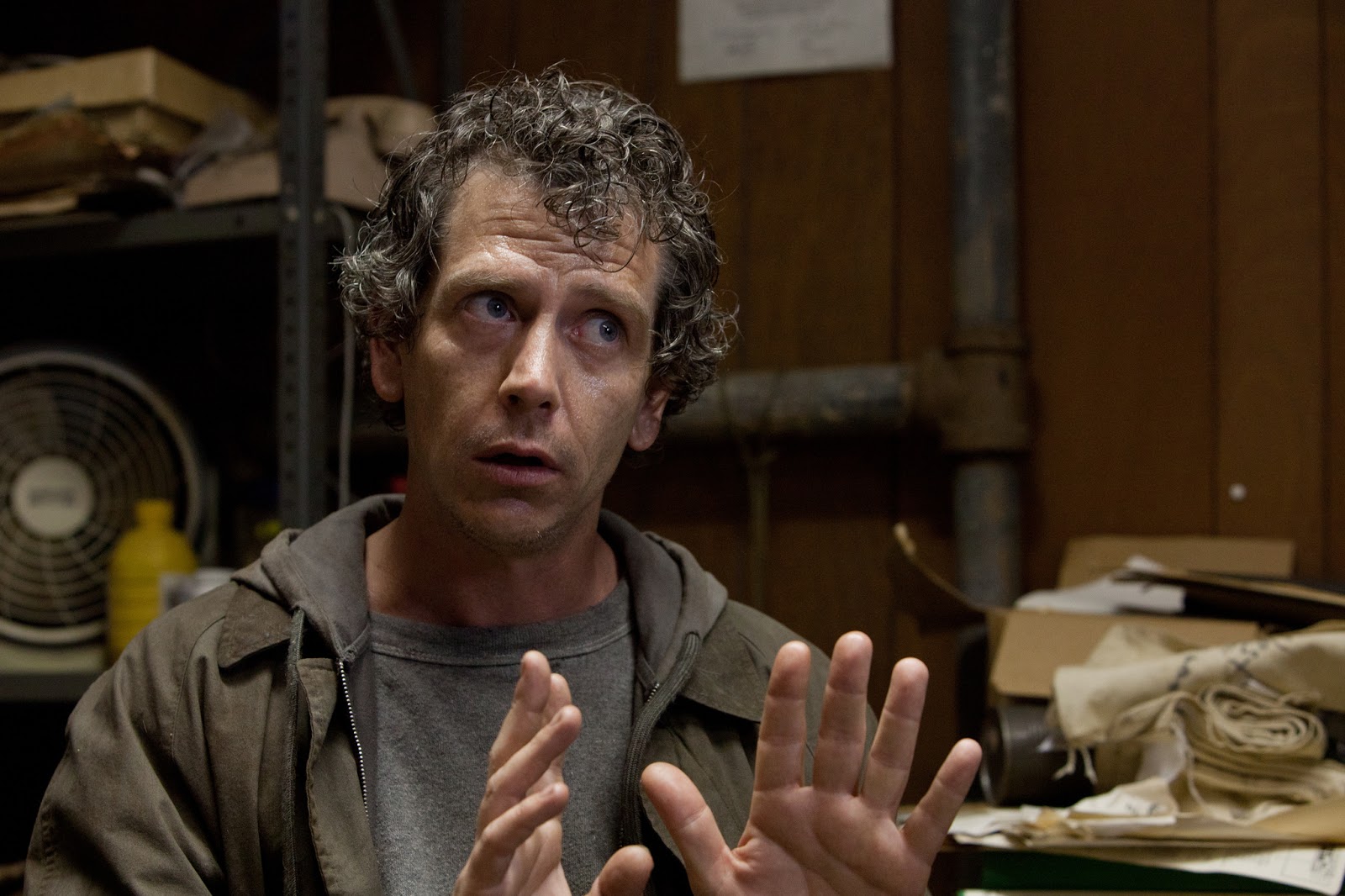
We haven't been watching too many films lately; having been absorbed by various series in our time of confinement. I'm slowly getting Tricia to appreciate the awesomeness that is Rick and Morty (Get schwifty!) by rewatching the entire series (I'm not entirely sure that I've seen all of them), since we still have HBO. However, one thing I've had in my Netflix queue for some time is Killing Them Softly, a pretty low-key release from 2012. I don't remember how it ended up in my queue, but it was probably from me reading something on Twitter about films that made some noise at Cannes and which faded without a whisper shortly thereafter. It's a crime film based on George Higgins' novel, Cogan's Trade. The novel is very much 70s crime (i.e. right down in the dirt; it was written in 1974) and screenwriter/director Andrew Dominik stays very much in that vein. Generally incompetent criminals Frankie (Scoot McNairy) and Russell (Ben Mendelsohn) are convinced to knock over a poker game run by the local mob and actually pull it off, only to suffer the consequences when said mob hires hitman Jackie Cogan (Brad Pitt) to show Frankie and Russell the downside. The film doesn't shy away from the details, as we get the sweat of their faces, the dirt of their lives, and the blood of their consequences, often in slo-mo highlights.

Dominik chooses to frame this petty crime encounter and its various tangents with the 2008 financial crisis and presidential election, as opposed to its 70s roots. While that may have been more pertinent to 2012 moviegoers, it struck me as some combination of background noise, decent undercurrent, and cinderblock-over-the-head message delivery... which, when you get down to it, kind of mirrored the execution of the film overall. Yes, a ton of people were down-and-out at that point, just like Frankie and Russell. Yes, the entire crisis was built on the gambling and criminal activities of a lot of banks and speculators... just like an illegal poker game! Yes, a lot of little people paid hard for that gambling and criminal activity, while the real bad guys (in this case, racketeers and hitmen) got away clean. So, I get it. But I'm not sure the message couldn't have been delivered just as effectively without Bush the Younger prattling away in the background every time a TV was in the scene (regularly) and finally ending with Pitt's soliloquy about how Obama's victory speech in Chicago was bullshit because America wasn't a community, it was just business. Maybe it's because that's a cynical thought that I've held in my head since I was a child and I didn't need to have it pushed in my face to understand it. Or maybe it's because the film ended on the equivalent of a philosophy exposition dump while most of the characters had been doing that in their own, more subtle way throughout the film and the ending was kind of discordant in that way.


Pitt does a decent job being Brad Pitt, which also means he's a very cynical and methodical hitman who still doesn't like emotion to enter the confines of his job. The hitman who's too sensitive to see his victims' faces? Similarly, James Gandolfini does another mob turn here as Mickey, the hitman Pitt brings in to kill a target that he knows personally (so as to save Jackie from those emotions), but whom has lost his touch and only wants to drink and get laid... which is what pretty much all of us want, so there's the America that doesn't want to know what the banks are doing? Maybe. One person that caught my eye was Mendelsohn, whom I really enjoyed in Mississippi Grind (which I wrote about here), as he was great at being the scuzziest of the guys involved. Ray Liotta is also present; still doing mob movies and still being Henry Hill. There should, however, be a law against anyone using any variation of the phrase "Fucking pay me!" in a film with Liotta (which Pitt does in this film), given Henry's legendary application of it.


Dominik heightens the gritty feel of the film with every moment of violence underscored by both close-ups and slow-motion FX so that shards of glass, spent shells, and geysers of blood are regular features throughout the film. Once, maybe twice, to get the message across works. Using it in every instance makes me think you're trying to hit me over the head with said message that violence is bad/disruptive/outlandish/messy which, y'know, I understand already. The scenes aren't done poorly and the action doesn't come across as cheap. It simply could've benefited from a little variation, especially given that the outpouring of emotion and angst from most of the characters about the lives that they're leading is already very present in almost every other scene. Dominik approached his other most well-known film The Assassination of Jesse James by the Coward Robert Ford (also a Pitt vehicle) in similar, mildly overwrought fashion, so perhaps it's just his thing.

All of that said, it held my interest and is worth the couple hours of time if you're running out of things to watch. But Mississippi Grind is also on Netflix and I'd watch that again, given an option.