Showing posts with label Netflix. Show all posts

Saturday, December 23, 2023

Directionless apocalypse


I love post-apocalypse stories. When I first started reading Harlan Ellison, one of my favorites of his work was A Boy and his Dog, which is set in America, post-nuclear disaster. One of my favorite films at a young age was John Carpenter's Escape from New York. When I first started running RPGs, my favorite setting was Gamma World. It's safe to say that I'm a child of the Cold War. So, when I heard that there was a film on Netflix that was really popular and that fit those themes, I was definitely interested. Unfortunately, that film was Leave the World Behind and it was a failure on so many levels that it's just about arcing toward the sublime.


Every science fiction premise needs some level of suspension of disbelief. You have to be willing to accept the conditions that make up the world in question, whether it be the talking plants and fusion rifles of Gamma World or the island of Manhattan as maximum security prison of Escape from New York. The basic premise of Leave is that a cyberattack has crippled the power grid of the eastern seaboard of the US and all of the problems that ensue following that, including many that have little to do with a fairly believable scenario like that one, like sonic weapons transmitted over the entirety of Long Island and herds of deer trying to send a signal about this impending doom that's approaching. I mean, those things could be part of our suspension, as well, if they weren't from a different level of sci-fi than simply Con Ed in New York being hacked. But that's where you wonder how this script might have benefitted from a firmer hand that kept it going in a coherent direction, rather than the scattershot approach that later takes hold of it and squeezes hard enough that all of its elements get splattered in random directions, to the denigration of cast and audience.


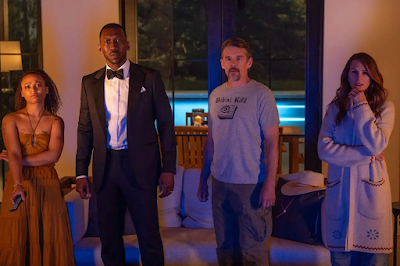
First off, if a cyberattack did take down enough of society to cause chaos, how (and why) is it that this one section of Long Island was spared? Was it because they didn't want to try to shoot all of the nighttime scenes by candlelight? Or so they could still have a functioning coffee maker in the house so that you'd know people would last two days instead of becoming instantly homicidal? I mean, part of the basis of most adventure stories is that the circumstances in front of us are just slightly different so that our heroes have a chance to do heroic stuff. So, fine. Our characters have power where all of New York City, visible across the river, does not. But then we discover that it may be beyond just power grids, in that satellite networks are down, so that planes and ships no longer have functioning navigation systems. But, of course, they still have functioning engines and ways to turn them off or keep them running, so why are ships beaching and planes crashing? And why is the latter only happening 18 hours after the initial shutdown when one of our heroes is walking on the beach? Said hero, G. H. Scott (Mahershala Ali) is an investment banker with high enough contacts to know one of the Illuminati who has offhandedly warned him that this disaster is coming. Scott, of course, dismisses the idea of the cabal that rules the world but also repeatedly reinforces the idea that such a thing exists. So, which is it? If writer/director Sam Esmail was trying to avoid the historical racist implications of that theory, he wasn't doing such a great job of it. Instead, he veers right into hitting us over the head with the overt racism of Amanda Sandford (Julia Roberts) when confronted with Scott and his daughter, Ruth (Myha'la) returning to their home which the Sandfords have rented. I mean, yes, the problem of inherent racism drives a large portion of American cultural relations and politics, so you don't really have to be that heavy-handed with said message. Amanda is borderline shrewish when conveying her distrust of the Black people in the house (their house, which she clearly doesn't believe because, you know, they're Black...) with her children.
Yeah, I can't believe how dumb this is, either.

But then we have all of the other more obvious story points that simply don't mesh with our aforementioned suspension. Why does Archie's (Charlie Evans) lyme disease take hold overnight and become worse than any version of that disease ever seen? If it is even just lyme disease, why do they think that a couple pills from local survivalist neighbor, Danny (Kevin Bacon), will solve his problem? Why do the local deer seem intent on gathering around just their house and not others? Why do flamingos show up in a Long Island swimming pool? Are these the surrealist components that are supposed to make us as confused as the characters? Why do Amanda and G. H., completely at odds over the situation and their respective identities, suddenly fall into each others' arms and consider cheating on their partners with each other in the space of 48 hours? Why would a man as wealthy as G. H. ever play ball at the local YMCA? There are so many little things detached from reality here that it's difficult to believe that one person wrote it and, if that is the case, whether that person has been outside their home to interact with actual humans anytime in the past few years. Is Esmail an isolationist/survivalist? Even the seeming in-jokes are off key. We see a trashed house with a sign of the previous owners hanging loose that says the home was owned by The Huxleys. If that's supposed to be a reference to Aldous Huxley, I'd have to ask why, given that this is a disaster film. Huxley is best known among his fiction works for Brave New World; a society under total control, not one that is falling apart. Archie walks around wearing an "OBEY" shirt from They Live, which is about the subtle control of society through subliminal advertising, not its collapse from a systemic breakdown.


All of this confusion and lack of direction is reinforced by the melodrama of both the cinematography and the score. The camera did repeated close-ups during dramatic moments, just in case we couldn't figure that out, and then wide pullbacks and spirals from above when action was happening. The score was the stereotypical orchestral crashing whenever a plot point was revealed or a realization was made by any of the characters; often multiple times in the same scene. The whole storytelling approach was amateurish, at best, and didn't convey the idea of a major production that would be carrying the heft of a film with the above listed stars, as well as Ethan Hawke. But, then, Hawke was almost insipid in his contrast to his abrasive wife, Amanda, who was presented in a thoroughly wooden performance by Roberts, which likely wasn't helped by the boilerplate dialogue she was given. Her first lines, when she wakes her husband to announce that they're taking a last-minute vacation and why are spoken like she's reading from a book of middle American homilies about modern society. And, of course, the worst thing about the whole presentation is that it reinforces the conspiracy theories that are rampant today, by suggesting that there may be some kernel of truth to them, if people would only pay attention. What those theories also carry are the racist overtones of anything similar to the Protocols of the Elders of Zion, which is kinda how this feels when you see the upper middle class White family having their vacation disrupted by all of the surrounding events (and Black people!)

It's just trash, beginning to end, and in no way worth your time or attention.

Friday, December 22, 2023

The difference between two stories we've seen before


I was looking forward to seeing Maestro, Bradley Cooper's latest film about the life of Leonard Bernstein. Larissa objected, thinking that she would find it too slow, as there's a lot to talk about in Bernstein's complicated life. Then we found out that it was a Netflix production, so we can watch it whenever, so that problem was solved. But we had already decided to see Fallen Leaves instead. The latter is a Finnish production about two average people leading fairly downtrodden lives who discover each other by chance and try to make contact, but keep stumbling over themselves, their lives, and other obstacles. It's a very simple story but it's effectively told and fairly entertaining. Indeed, it was done so well that it won the Jury Prize at Cannes this year, proving yet again that stories don't have to be complex, as long as they're well-written and well-acted and aren't predictable Hollywood boilerplate.


Ansa (Alms Pöysti), a grocery store worker and Holappa (Jussi Vatanen), a metal reclaimer, meet up at a bar on karaoke night, having been dragged there by their respective friends, Liisa (Nuppu Koivu) and Huotari (Janne Hyytiäinen.) There's a brief spark between them that they kind of grudgingly acknowledge and then make plans to meet again to see if it becomes a fire. Unfortunately, Holappa is a functioning alcoholic and Ansa isn't the surest person in social situations, so they end up missing each other in a variety of ways (mostly caused by Holappa.) The story doesn't get any more complicated than that, aside from the brief looks into Liisa and Huotari's perspective on life and relationships and the difficulties that our two leads have in remaining employed. It's basically a story about modern life and middle age. Of course, life in Helsinki is probably much different than it is in modern America, so there's not a lot of interaction with phones or the Interwebs or any of the other things that might suffuse wealthier societies and the process of people trying to hook up (My knowledge of modern Finnish culture and society is admittedly quite limited.) But the story doesn't really need all of that, either, since most of it is just an examination of how Ansa and Holappa are looking at life and whether they're willing to trust what it and each other are telling them.


There's a bit of a Coen Brothers air to the production overall, especially when it involves Huotari, who is easily the funniest character of the cast, as he tries to convince women, in general, and then Liisa in specific that, despite his gray hair, he's not actually that old and anyone who suggests that he is must be trying to pull a con. It's like Republican projection but far less sinister and far more amusing. But there's also some of the plaintiveness and resigned attitude that often pervades Coen stories, alongside the determination and willingness to keep forging ahead that is also a frequent feature of their characters. It also doesn't finish with a pat ending but leaves it open to question as to whether the relationship we've been trying to see established for the 81 minute runtime will actually be a positive one. That uncertainty, like everything else about this film, is just like life and can easily be understood and absorbed by an audience willing to see real people do real things.


That is, of course, a contrast to Maestro, which I started to watch last night. This is just the latest version of La La Land; a movie by Hollywood and for Hollywood that is solely concerned with Hollywood and the little tragedies within it that are only really relatable to those inhabiting it. In this case, the New York City musical scene stands in for Tinseltown. In the same way Ryan Gosling and Emma Stone tried to convey the horrible struggle of being an aspiring actor, Maestro takes us one step further and tries to convey the incredible anguish of being an enormously successful composer and conductor. Admittedly, Bernstein's life was more complicated by being a gay male in a period when such a thing, even among creative types, was far less acceptable than it is now and I think this is the angle that most occupied the thoughts of writer/director/star, Bradley Cooper. But the first hour of it plays out as a brief survey of how difficult Bernstein's life was on an emotional level when on every other conceivable level it clearly was not. This was not an aberrant personality like Oppenheimer trying to relate to the people around him. This was the extraordinarily popular and, again, successful Lenny Bernstein enjoying life with both his beard and the men he had on the side.


In contrast to Fallen Leaves, this film doesn't seem like life. It feels like a Hollywood depiction of life that few in the audience would ever be able to relate to. If the first hour had spent more time on the wider scope of Bernstein's life, instead of long shots on the faces of his male lovers feeling rejected when he marries Felicia Montealegre Cohn (Carey Mulligan), I might not have gotten so bored and disappointed that I turned it off. In some respects, that's a bit of improvement, since I could only make it through 15 minutes of La La Land before leaving the room. Obviously, there are a lot of ways to look at the lengthy life of an extraordinarily talented figure who had an enormous impact on 20th century music and continues to do so today (West Side Story was just remade by someone as notable as Steven Spielberg, as just one example.) But Cooper decided to take the overwrought approach that doesn't really explore the length and breadth of that impact, but instead decides to bring it all down to the emotional angle that plays up how trying Bernstein's personal life was. In a way, it's kind of like a very removed version of Fallen Leaves, but it simply has no way to make the personal connection that the latter film does because it's too preoccupied with the sense of its own tragedy. As someone who has tried to produce creative works for my entire life, I can tell you that I'd have given a lot for my life to have turned out as tragic as Bernstein's. (Obviously, I would've had to have had even a minor fraction of his talent.)


Maybe I'm wrong about the overall film, since I only made it through the first half, but I'm not sure that I'm willing to sacrifice the other hour of my far less interesting life to find out whether Cooper's vision changes. I'd rather see stuff about more relatable people. It's not that Bernstein wasn't presented as human, which is my frequent complaint about characters. He most certainly was. It's just that what he experienced is relatable to so few other humans that the message seems lost in its own attempted majesty. That's the difference between stories, even ones that we've seen a thousand times in various forms, that try to talk about life and those that imagine that their very removed life is somehow normal for the rest of us.

Saturday, November 5, 2022

Horror from the niche to the mundane

As noted before, there are many different types of horror. As one of the more flexible of modern popular genres, it's quite easy for it to be an "additional" category or subcategory of a story that would already be identified as science fiction or crime or even something that arcs toward the "literary"categorization, as Frankenstein or some works by Edgar Allan Poe now do (Nevermore!) It's with that flexibility in mind that I tried to consider the final two episodes of Guillermo del Toro's Cabinet of Curiosities. One of them worked well in a classical, albeit mundane, sensibility. The other didn't really work in any proper, constructive sense. Neither of them really turned out to be interesting.

The Viewing: I believe that director and co-writer Panos Cosmatos' intent was that you really couldn't get more 70s than what he put on the screen; from cars to cocaine. Complete with garish orange furniture, mood lighting where it wasn't needed, and a vaguely disco-riffic soundtrack, this was an attempt to depict the decade in all of its artificial glory. Of course, it felt artificial because it was, as it also lacked any of the humanistic touches which defined that era's films, but exemplified the plastic and gallons of hairspray that often defined that era's TV. I'll leave it up to you to figure out whether that was a deliberate approach for something being shown on a streaming service. But the problem I had with The Viewing was that the majority of what it depicted had neither tension nor horror. It was 40 minutes of people on a serious snorting binge while Peter Weller (most notably of RoboCop and Buckaraoo Banzai fame) told them about this cool toy he had in the back that he was going to let them be the first to see. Meanwhile, he had to expand their consciousness and "get them all on the same wavelength" with drugs because that's always a good idea in a scientific experiment. When we do finally get to something resembling a plot, we end up with what looks like an homage to the ending of Raiders of the Lost Ark (an 80s film, just by the by) and an alien/demonic force that implies some greater threat to society but which really doesn't come to any kind of natural conclusion after that. We had these stories in comics back in the day. They used to use them to fill space and didn't care if the people reading them felt cheated because they still assumed that their audience was made up exclusively of 8-year-olds. I confess to having no idea what the "story" was genuinely supposed to be about, other than the opportunity to show Paul Freeman and the departed Ronald Lacey that they're not the only ones that can have fun with disintegration. It was endless waiting for something to actually happen and then some mildly interesting moments when it finally did, but not enough to sell me on any deeper meaning.

The Murmuring: Speaking of attempted deeper meanings, we had the final episode in our series, which arced away from Cosmatos' heavily time- and culture-influenced presentation and back toward what one might consider a "classic" ghost story; akin to the aforementioned Poe and those like his creations. However, like The Viewing, this episode also contained a great deal of build-up to a payoff that was surprisingly pedestrian. With our two lead characters running away from their personal grief, it was the typical setup that found them running into the embedded past grief of an old country house. While the ornithology angle seemed to set up something that hearkened to one of the most famous works of Alfred Hitchcock or at least a deeper involvement of their field of study, the "murmurings" amounted to literal background noise in what was otherwise a routine story about a woman who's experiencing various kinds of distress with a male associate who keeps telling her that she's imagining all of it and then complaining when she doesn't appreciate his side of the story. But it's that "routine" label that causes most of the problems here because there's absolutely nothing original or unusual about anything that happens. This is a perfect example of the "seen one, you've seen them all" phenomenon. Nothing happens that isn't entirely predictable and the ending leaves the white picket fence intact, marriage saved, haunting "solved", and the birds vaguely bored onlookers to everything. This is the difference between a ghost story and a horror story. The former is generic. The latter usually has to have something that at least mildly excites the reader/viewer, even if it's as strange as a murderous orangutan with a straight razor. Now that I think of it, the color of the creature in The Viewing was orange (like everything else...)

So, yeah. That ended on a bit of a down note. Given the first six episodes, I was hoping that the last two might deliver a bit more of a punch or at least a couple moments of the unknowable that del Toro's better films have displayed. Maybe next time.

Saturday, February 27, 2021

I didn't really care enough


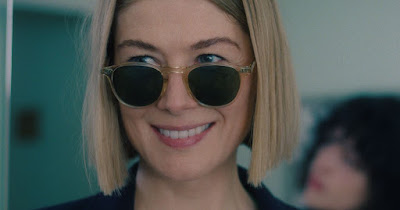
We've seen a few "new release" movies via Netflix or HBO lately and I'll probably get around to a couple more of them over the next few days, but this evening we watched I Care A Lot, which is a film written, directed, and produced by J. Blakeson, whose most notable credit prior to this was probably as the writer of Descent Part 2. That isn't an attempt to demean Blakeson. Everyone has to start somewhere. It's more like mild praise that someone can be involved with only their fourth feature film and be, essentially, running the whole show. The plot revolves around a woman, Marla Grayson (Rosamund Pike) who also runs her own show, which is basically running the lives of others. She's a professional guardian for the elderly who has a whole racket set up, from the doctor who gives false testimony about the capability of her patients to the care facility director who treats them any way Marla wants them treated to the various vendors who are eager to be involved with her selling their assets, auctioning their possessions, and draining their accounts. Marla's voiceover monologue at the start of the film eventually boils down her life's philosophy: There are predators and prey and she's a predator. That's until she steals the life of someone connected to even larger predators, which is where things get complicated, just like they do out in the wild.


Rosamund Pike is genuinely great in her role. She's completely in control and handles every situation with aplomb. She still has the icy void where human compassion and morality would be that she wielded in Gone Girl to great effect, except that in this role she's not erratic. She's just ruthless, which is every bit as threatening. Dianne Wiest is her usual capable self as one of Marla's wards (read: victims) and Peter Dinklage makes an appearance as the eventual seeming foil to Marla's business. The script is kind of funny and although the story drags a bit in the middle, we're mostly kept in a constant forward rhythm without much need to stop and consider the plausibility of all of this. There's also a small turn by Isiah Whitlock, Jr. ("Sheeeeeeit!") as the judge who's only too quick to respond to all of Marla's legal motions. So, it's a decent film, but I can't say that it's one I would've rushed to shell out $10 for at the theater.

For example, the tropes were kind of obvious. Marla's attitude about success and failure is clearly a stab at the current late-stage capitalism environment. There's nothing wrong with that, but it felt like it was delivered clumsily with lines like: "Wealthy enough to use money like a weapon. Like real rich people do. That's what I want." From most perspectives, Marla would've already appeared to be quite wealthy and using said wealth to extract even more from victims that the state had officially declared to be unable to defend themselves. She already has as large an arsenal as anyone needs. Is her obliviousness to that another example of the high six-figure salary earners who consider themselves "middle class" because they feel like they're broke after paying for the private school, the third or fourth car, and the second home? Is that the swipe that was taken here or was it even less subtle than that? If this was supposed to be about how the system takes advantage of those who aren't rich enough to manipulate it, no one in this film fit that bill, from Marla to the wealthy victims she was draining to the coterie of enablers she had nestled around herself, who were negotiating for stock options instead of a way to feed their families. It was a pretty glamorous precipice from which to be shouting about how money is the problem.


A central facet to Marla's character is not only that she's a winner, but also that she's a winner in a man's world. She points out to her girlfriend, Fran (Eiza González) that she's dealt with men like Dinklage's character before and she'll deal with him the way she does any other man. That's fine and it's a point that unfortunately still needs to be made (e.g. that women are just as capable and, apparently, just as capable of being ruthless) in modern society, but it's hammered home in that speech to Fran when it's already been made obvious when dealing with attorneys, care home directors, the relatives of her victims and pretty much anyone else that gets in her way. The point has been made. Making it again only weakens the delivery, but this film does that repeatedly with most of its themes. Also, one wonders what message is being delivered when it's shown that the vast majority of those in Marla's unethical and illegal network are, in fact, women already in positions of power.


Also, Dinklage has unfortunately become typecast. This is not a reworking of his role as Tyrion Lannister in Game of Thrones or Finbar McBride in The Station Agent or even Bolivar Trask in X-Men: Days of Future Past... but in a way it kind of is. Whenever people seem to need a somewhat moody, introspective, occasionally sensitive guy, he's first on the list. In this case, he's playing a mobster who's as capable as a Tyrion but also subject to temper tantrums that fit the character (and his usual role) not at all. We go from his quiet, measured, stare-into-your-soul contemplation to fits of pique and back again. I think that was supposed to be part of the black comedy aspect to the film, except that it wasn't really funny so much as jarring and other moments ("Is that my smoothie?") deliver that kind of absurdist veil over very dark reality much better. His direct encounters with Pike really only serve to make him one more in her endless train of victims, whether directly via the story or implicitly by their scene chemistry, and one kind of gets the feeling that we've seen this before. Is it different because she's lording it over a mobster as easily as she does a frail 80-year-old? I'm unconvinced.

So, yeah. Not a bad film. Certainly worth the couple hours to sit and watch it. But I think there was more there that could've been delivered with, perhaps, another hand on the tiller, whether writing, directing, or producing. The messages are all there and the characters are interesting enough to follow (Tricia complained at one point that "There are no good guys here!", which was, I believe, part of the point.) but the final package is just slightly off.

Sunday, December 27, 2020

The sky doesn't need framing


It's been a while since I've posted anything here. (If you're really desperate for my overly wordy writing, you can always look at Extratime.blog, but probably only if you're a Liverpool and/or Euro football fan.) Part of the reason that I haven't been present is, well, kind of obvious. Since I spent most of my time doing movie criticism here and we really haven't been to see any movies since March, 2020, there hasn't been a ton of material to work with. Like most other people, we've been watching a lot of TV, some of which has been really interesting (Boardwalk Empire!) and some of which really didn't measure up (Lovecraft Country.) But tonight I decided to sit down in front of an actual newly-released film in the form of The Midnight Sky on Netflix. It's a George Clooney effort, as he both starred in and directed it, and that's always a draw for me. I'm a Clooney fan both for most of the work he's done and his philosophy on life that he mentioned to James Lipton on Inside the Actors Studio many years ago. I recorded that episode and watched it several times (before the DVR crashed.) I often wished I had the drive and ambition that Clooney talked about in that interview but, at the very least, it made me respect his work even more than I did when I simply enjoyed it. That said, I can't say I'm entirely sure about this one.

The Midnight Sky is based on the novel Good Morning, Midnight by Lily Brooks-Dalton and I can see the novel structure in the film and its underlying screenplay. Like much modern science fiction since the advent of the New Wave in the 70s, the central focus isn't on the technology but the people caught up in the vortex that it may (or may not) be a part of. In short, it's a humanist perspective that makes most stories more interesting if you're not just interested in laser beams, global catastrophes, and spaceflight. Of course, this is a story about a global catastrophe and spaceflight... (But no lasers!) But what it's really about is one man's struggle with his humanity or lack thereof. The initial lead character is Clooney as Augustine Lofthouse, an astro-something (-physicist? -nomer? It's never mentioned but the crew of the space flight seems super indebted to him for their mission without ever having met him, which is odd in itself.) I say "initial lead" because despite our story beginning at an Arctic observatory and Augustine waving away his colleagues as the global catastrophe ensues, there's a whole other primary locale for our story, which is said spaceflight: the returning mission Æther, on the back leg from its voyage to K-23, a heretofore undiscovered moon of Jupiter which is habitable (Shades of 2010, although this takes place in 2049.)


So, the story is nominally about Augustine and his obsession with looking outwardly, to outer space and new worlds, and inability to focus on the inward: himself, his relationships, and his commitment issues. Delivered in so few words, the story sounds incredibly trite and very overused: Cold scientist (literally and figuratively) discovers human contact is right in front of him if only he'd try. It's also staged against a very grand tableau (the collapse of the old world, the discovery of a new one) that can serve as a metaphor for the need for more empathy in our society as a whole before it leads to our own destruction. I can see how this story would work in novel form, especially if the author was willing to immerse the reader in the emotions and inner thoughts of her characters. But as a film, it really doesn't or at least it doesn't in the manner in which this one is presented.

We have a story that's about the inner struggles of one man, writ large against the disasters happening around him. But we spend a lot of time on those disasters to no significant end. First off, we're skipping between the Arctic and outer space. We have two radically different settings and two completely disparate sets of characters that are nominally telling the same story but really aren't. The struggle for survival contrasted with the casual return home of the Æther is kind of jarring as we switch back and forth. Here's a man struggling with some form of lethal disease and surviving in one of the deadliest zones of a ravaged world... and then there's the spaceship crew eating cereal with holograms of their families. It changes tune a bit when the Æther suddenly veers off course and has to approach Earth through uncharted space(?), whereupon various physical disasters begin occurring off the planet, as well as on.


But if the main struggle is supposed to be one man searching for empathy in trying circumstances, why do we spend so much time with this ship's crew as they battle meteor storms on the way home? There's a ton of action involving smashed spaceships, blood, and Star Trek-style RED ALERT sirens (that are pointedly turned off in an acknowledgment of pragmatism) that really departs from what otherwise seems to be a fairly inward-looking and cerebral story. As jarring as the shift from survival to the boredom of spaceflight is, it's even more jarring to have a story about humanity dropped into bog-standard Hollywood sci-fi action. I mean, I guess the leverage of trying circumstances can explain the transformation of Augustine, but isn't survival in the Arctic enough? Couldn't we have simply had the global catastrophe teaching him how to care about other people? Being alone in the Arctic and delirious from chemo and blood transfusions should be sufficient stress to drive most people to examine their lives. We also need the (exaggerated) dangers of space travel and a new moon around Jupiter to make this happen? Because what ends up happening is that a potentially intelligent and personal story is being hoisted on the massive framing devices of global catastrophe and humanity-saving spaceflight and making both of them seem like they were half told. Did we need both frames to create the window on our story? One already seems like it may have been enough, if not too much. (Global catastrophe!)

This, of course, leads one to question how much the film departs from the book and/or how much is lost in the usual translation between the two media. There's always going to be something lost from the author's vision when you take a 400-page novel and turn it into a two-hour film. Always. Something will be lost. But the danger is also that a studio decided that a movie audience wouldn't appreciate a very cerebral tale about one man's inner self, spaceflight or not, and decided to toss in the usual rock'em, sock'em action in order to keep people watching. And that's where we usually end up in the technical issues.


Most sci-fi stories have technical issues. That's why they're science fiction. But some plot holes are bigger than others and they're only more obvious when they're as large as these two stories are (because this really is two stories that kind of touch each other in various places.) Augustine keeps talking to his young companion, Iris, about not breathing the air or when and where the air is safe. Meanwhile, the catastrophe is referenced several times as being rooted in radiation. The only way radiation would spread through the air is via dust, most of which wouldn't reach the Arctic in the manner displayed and certainly wouldn't be released in ever-growing, perfectly circular shapes as shown on his instruments. Dust travels on wind patterns which go around the globe because... you know... our world is a globe, Trump followers. When I saw the scene of Augustine examining what appeared to be mutated birds who'd suffered the effects of the catastrophe, I thought they were some kind of alien organisms and wondered just how far out (space joke!) we were going to go. Did someone bring back an alien from an earlier voyage to K23? Other than vague "radiation" and "don't breathe the air" descriptions, "The Event" isn't detailed at all; other than it apparently being an accident of some kind.

Also, Æther has to approach Earth from "the dark side" or some such thing, so it's stated that they're "flying in the dark". Other than that being another obvious space joke, there is no "dark side" to Earth. Because it rotates. Like a globe. And there are observatories and satellites on every "side" of that globe that have explored the local environment extensively. There are no clusters of ice or rocks in the vicinity that would create a threat to spacecraft that I'm aware of. It's just a plot device so that some kind of action other than the holographic kind actually happens in one half of our movie setting. Action which is, of course, kind of unnecessary to tell the story, since confronting death in space (just like on Earth!) is superfluous to the plot. This is, of course, compounded when members of the crew make the decision to confront certain death upon reaching home, for reasons that aren't especially clear other than overwhelming depression at the state of affairs (arrived at in a couple minutes of screen time) and a desire to join everyone else on the planet in the depths of that despair. This doesn't even touch on the idea of a perfectly temperate moon around Jupiter (almost five times as far from the Sun as Earth) and the awesome radiation and magnetic fields around that planet (witness Io) that would make the likelihood of said inhabitable orb extremely small.


Again, all of these strange, very human emotions and their consequential actions may be perfectly explained at a reasonable pace in a written novel, but they don't come across at all well in a two hour film. Once again, the problem of moving a story from one medium to another. Aside from all that, there aren't really any performances to speak of other than Clooney's, since he has the most range and material to work with (It's good to be the king (director)) which brings us back around to why all of this narrative was included for a story that is, in the end, comparatively small, despite a broad and well-felt message. Overall, it's not a bad film, but it simply tries too hard (and in too many large ways) to be a good one and mostly fails.

Wednesday, July 8, 2020

Killing them gritty


We haven't been watching too many films lately; having been absorbed by various series in our time of confinement. I'm slowly getting Tricia to appreciate the awesomeness that is Rick and Morty (Get schwifty!) by rewatching the entire series (I'm not entirely sure that I've seen all of them), since we still have HBO. However, one thing I've had in my Netflix queue for some time is Killing Them Softly, a pretty low-key release from 2012. I don't remember how it ended up in my queue, but it was probably from me reading something on Twitter about films that made some noise at Cannes and which faded without a whisper shortly thereafter. It's a crime film based on George Higgins' novel, Cogan's Trade. The novel is very much 70s crime (i.e. right down in the dirt; it was written in 1974) and screenwriter/director Andrew Dominik stays very much in that vein. Generally incompetent criminals Frankie (Scoot McNairy) and Russell (Ben Mendelsohn) are convinced to knock over a poker game run by the local mob and actually pull it off, only to suffer the consequences when said mob hires hitman Jackie Cogan (Brad Pitt) to show Frankie and Russell the downside. The film doesn't shy away from the details, as we get the sweat of their faces, the dirt of their lives, and the blood of their consequences, often in slo-mo highlights.

Dominik chooses to frame this petty crime encounter and its various tangents with the 2008 financial crisis and presidential election, as opposed to its 70s roots. While that may have been more pertinent to 2012 moviegoers, it struck me as some combination of background noise, decent undercurrent, and cinderblock-over-the-head message delivery... which, when you get down to it, kind of mirrored the execution of the film overall. Yes, a ton of people were down-and-out at that point, just like Frankie and Russell. Yes, the entire crisis was built on the gambling and criminal activities of a lot of banks and speculators... just like an illegal poker game! Yes, a lot of little people paid hard for that gambling and criminal activity, while the real bad guys (in this case, racketeers and hitmen) got away clean. So, I get it. But I'm not sure the message couldn't have been delivered just as effectively without Bush the Younger prattling away in the background every time a TV was in the scene (regularly) and finally ending with Pitt's soliloquy about how Obama's victory speech in Chicago was bullshit because America wasn't a community, it was just business. Maybe it's because that's a cynical thought that I've held in my head since I was a child and I didn't need to have it pushed in my face to understand it. Or maybe it's because the film ended on the equivalent of a philosophy exposition dump while most of the characters had been doing that in their own, more subtle way throughout the film and the ending was kind of discordant in that way.


Pitt does a decent job being Brad Pitt, which also means he's a very cynical and methodical hitman who still doesn't like emotion to enter the confines of his job. The hitman who's too sensitive to see his victims' faces? Similarly, James Gandolfini does another mob turn here as Mickey, the hitman Pitt brings in to kill a target that he knows personally (so as to save Jackie from those emotions), but whom has lost his touch and only wants to drink and get laid... which is what pretty much all of us want, so there's the America that doesn't want to know what the banks are doing? Maybe. One person that caught my eye was Mendelsohn, whom I really enjoyed in Mississippi Grind (which I wrote about here), as he was great at being the scuzziest of the guys involved. Ray Liotta is also present; still doing mob movies and still being Henry Hill. There should, however, be a law against anyone using any variation of the phrase "Fucking pay me!" in a film with Liotta (which Pitt does in this film), given Henry's legendary application of it.


Dominik heightens the gritty feel of the film with every moment of violence underscored by both close-ups and slow-motion FX so that shards of glass, spent shells, and geysers of blood are regular features throughout the film. Once, maybe twice, to get the message across works. Using it in every instance makes me think you're trying to hit me over the head with said message that violence is bad/disruptive/outlandish/messy which, y'know, I understand already. The scenes aren't done poorly and the action doesn't come across as cheap. It simply could've benefited from a little variation, especially given that the outpouring of emotion and angst from most of the characters about the lives that they're leading is already very present in almost every other scene. Dominik approached his other most well-known film The Assassination of Jesse James by the Coward Robert Ford (also a Pitt vehicle) in similar, mildly overwrought fashion, so perhaps it's just his thing.

All of that said, it held my interest and is worth the couple hours of time if you're running out of things to watch. But Mississippi Grind is also on Netflix and I'd watch that again, given an option.

Sunday, December 1, 2019

Same and Story


Once again, I'm doing two films in this review, largely because of the nature of them, i.e. directors doing the same thing means I don't really have that much to say. It's an interesting side note to Hollywood's obsession with IP, where everything is a sequel to something that came before (Frozen 2!), rather than an original idea/setting/character.

Right from the start, I will admit to not being much of a Pedro Almodóvar fan. I like his films because they're always well-crafted and his storytelling technique is a solid one. His characters are human, they react in very human ways, and there's always a solid foundation to build from. My detachment comes from the fact that it very often seems to be the same story, despite variations in setting and characters. Pain and Glory, his latest, is no different.


All artists draw from themselves and their own experiences. Given the semi-autobiographical nature of Pain and Glory, it probably shouldn't be that surprising that it seems like a rehash of themes that Almodóvar has used before. And, again, that doesn't mean it's bad because the final product is a good one. It's an interesting film and the story moves well and there's the usual passion from the characters that are, again, emblematic of his films. But it's also largely like the films he's done before. You know how the story is going to proceed and even the little meta twist at the end isn't anything that's particularly memorable. This is Antonia Banderas and Penélope Cruz and, especially, Asier Etxeandia doing really well with their parts and creating believable people with genuine emotion attached. Those performances alone make it a good film. But the story is still regular Almodóvar and if you've seen one you've, unfortunately, seen most of them. If you're a fan, it's definitely worth seeing. If not, it's an Amazon or Netflix choice.


Speaking of Netflix, we come to Scorsese's latest, The Irishman, which suffers from exactly the same circumstances, except worse and longer. The film is based on Frank "The Irishman" Sheeran's book, I Heard You Paint Houses. I read it years ago, around the time of its release, on someone's recommendation for an insight into "actual" mob doings. It's a good book. Unfortunately, the film is also basically a note-for-note retelling that often saps the life from the story. Sheeran wasn't trying to craft a story when he wrote it. He was just offering up an experience that he'd lived and allowing people to draw from that what they might, including the details on the Hoffa situation. Scorsese chose to highlight that moment with Hoffa by using two framing devices when telling the story: one from Sheeran's perspective waiting to die in a nursing home and one from his perspective while taking a drive to Michigan a couple days before Hoffa was sitting outside the Machus Red Fox in 1975. That turns what could have been a tight two-and-a-half hour film into an occasionally tedious three-and-a-half hour film. Scenes of the drive were repeatedly presented to try to drive home the "mob life" point that we'd already gotten and the emotional impact that Sheeran was suffering because of the nature of the task before him, which we'd also largely already gotten. That meant that they felt like filler.

What's worse is that this is the same ground that Scorsese has trod many times and with the same actors. DeNiro? Pacino? Pesci? Romano? The gang is all here and you can throw in Harvey Keitel along with them. There comes a time when a director has used an actor in the same type of role so often that all you can do when seeing the new film is be reminded of the old ones. Witness anything Clint Eastwood has done directing himself in the past 20+ years. This is what happens here, when all we think about through most of the film is how similar it is to Goodfellas or Casino. This is a Scorsese gangster film! Anyone excited?


Like Pain and Glory, the performances are somewhere between solid and excellent, although Pacino's booming voice is a marked deviation from Hoffa's which was a real problem when trying to look at him as anyone but Al Pacino. It was interesting to see the CGI effects that made them appear to be 40-year-old versions of themselves, rather than attempting a ridiculous amount of makeup. Problem is, making someone look like they're 40 doesn't affect the fact that most of them still move around the set like they're 80, because they are. So even 40-year-old Frank Sheeran made you feel like you were just seeing the same scenes that you'd watched before. And this is the root of the problem: We've all been here before. This film gives us nothing new. It's just more "mob life" stuff. They even include dates and methods of death for a lot of the minor characters, most of which had absolutely nothing to do with Sheeran's life in general or the Hoffa situation in specific, but were actually connected to the Philly mob war in the early 80s. What does that detail offer us, except "This is another Scorsese mob film"?

In a film industry that is obsessed with mining the familiar in order to guarantee ticket sales from those who seemingly never seem to tire of watching the same stuff, over and over, like sitcom reruns, these two films, despite not following that trend of "IP first, story second", actually end up doing so, anyway. It sounds incredibly ageist to suggest that these two masters of the craft should probably rest on their laurels and open up space for others if Almodóvar and Scorsese still want to work and others still want to work with them. But I'm pretty much done with the experience that they're offering and I'd much rather see something else by someone like Bong Joon-ho, if only because it won't distract me by reminding me of everything he's done before.

Monday, October 21, 2019

Half truck, half story


[There are minor spoilers, yo.]

Stories have a beginning, middle, and an end. Full stop. That's what a story is. From that rather unforgiving perspective, El Camino is not a story. It's an addendum to a story, because the beginning is in Breaking Bad and this is really all about the end. I mean, I guess you could say that this two-hour film was about not having the money, getting the money, getting more of the money, and then using the money to disappear into Alaska... and that's a story. It's not quite the level of discourse I'd expect from someone as talented as Vince Gilligan, but it's arguable.

This is starting out pretty bleak, as a lot of things have over the past few weeks. These are relatively bleak times, on a personal and public level, so that's quite possibly coloring my perspective. Furthermore, I'm still aggravated about having to scrape out a draw against the Mancs yesterday, so there's that. When it comes to sports, writing, media... I am pretty much an "excellence demander", as the saying goes. That's why I'm looking at El Camino from the perspective of the basics: Does this tell a story? Does it tell a good story? Does it serve any purpose beyond titillation of hardcore Breaking Bad fans? The answer to all of those is, largely, "No." On the other hand, most TV and most films are filed under "entertainment" for a reason. This one gives you a couple hours to watch Jesse's recurrent struggle with his sense of humanity that almost constantly gets him in trouble in the morally ambiguous world that he followed Walter into. It gives you another look at Breaking Bad fan favorites like Badger, Skinny, Mike, Todd, and even Walter himself; still in desperate schoolteacher mode and not yet having descended to the notorious Heisenberg. It also gives us one last look at clean-up guy, Robert Forster (RIP), who is his usual low-key, amiable, but still memorable self.


And that contrast raises a lot of overarching and frequently asked questions about these kinds of entertainments. How is something defined as "good" or, in the case of Breaking Bad, "universally acclaimed"? Beauty is in the eye of the beholder, right? (No. Not that kind of beholder.) If El Camino was written for Breaking Bad fans and it serves the interests of Breaking Bad fans who just want to spend more time in that world (especially with Better Call Saul having been on hiatus for a while), then that kinda makes it good by default, right? We still get Vince Gilligan's solid writing and directing, as well as Aaron Paul. Sure. It's fine. I'm a diehard Breaking Bad fan. I'll watch anything that Gilligan puts on the screen, which is why I was eager to watch El Camino.

But I'm also interested in stories that actually go somewhere. Yes, we get to see Jesse once again regret that his streak of morality prevents him from pulling a trigger that he probably should and gets him into a problem that is more complicated than it had to be, if he could just emulate some of Walter's ruthlessness. Yes, we get to see his final interaction with his naive and anguished parents. Yes, we get to see him reminiscing about the frustration of his relationship with Todd; his ironic innocence and brash youthfulness in interacting with Walter; his wistful longing for Jane. All of those are well-acted and at least somewhat poignant moments that are well written, too. Those are all entertaining.


And, in the end, just more of the same. This is an epilogue to the real story that is Breaking Bad. Unlike the prologue that is Better Call Saul, we don't get to see a character that transforms over the course of a story; in which we see key moments that we can look back to as the places where the path was laid in and the might-have-beens blew away in the breeze. El Camino is just an elaboration on Jesse's hysterical laughter as he flees Walter's murder/suicide of Jack's Aryan gang in the final episode of the series. We knew Jesse was getting away and finally escaping Walter's shadow and all the danger that had come with it, despite never being able to escape the pain that had ensued. This film was just an elaboration on how he got away, which doesn't tell us anything we didn't know already and doesn't really do much else, except entertain, which is perhaps the point.

HBO has started up a sequel series about The Watchmen. I don't have any particular interest in seeing it because, when it comes to that particular property, I tend to agree with both its artist, Dave Gibbons, and its writer, Alan Moore, both of whom expressed varying levels of confusion and dismay that anyone would want to "continue" a story that they had told and completed. It's done. As Moore has stated, it's an icon of its time and an artifact of it. There's nothing else to be done with it that doesn't diffuse or distract from the original. Who knows? It might be fantastic. But does it really do anything with the material that we haven't seen before or hadn't really been interested in seeing in the first place? Breaking Bad is kind of in that same sphere. No one wants to see HeisenBadger: Back to the Blue. We've seen the story that Gilligan wanted to tell. Now let's move on.


In the end, is El Camino worth your time? Sure. If you're a Breaking Bad fan, you could be doing a lot worse than spending a couple hours with Jesse and Vince Gilligan again. It's still entertaining, if somewhat predictable. It's just not transformative like BB was and it won't do much more than make you think you should go back and watch "Fly" again.

Sunday, December 20, 2015

Show without fear


Anyone who's read Frank Miller's and David Mazzuchelli's Batman: Year One from the late 80s would have instantly recognized the setting and atmosphere of Christopher Nolan's Batman Begins. It's inescapable. The aura of angst, shadow, and determination- the grit -is all there. It's a hallmark of Miller's storytelling. He once said that he wanted to be a crime writer who just happened to have a superhero or two hanging around. His Batman stories are essentially that, as they deal with genuine people trying to respond to unusual circumstances. The fact that they dress oddly in order to make that response begins to seem almost natural. Miller's Daredevil was where he developed that singular style that, along with Alan Moore's Watchmen and Miller's Batman: The Dark Knight Returns, became the defining oeuvre of comics in the 80s and early 90s. Appropriately, "grim and gritty" was the tag for that period and Netflix series creator, Drew Goddard, mined that same approach for Daredevil.

The obvious intent was to dial it back from the rapid explosions of the Marvel films like The Avengers to show how "regular people" get by in a world of thunder gods and narcissistic genius inventors. The fact that one of them gets by with an accidentally- and radioactively-induced radar sense that compensates for his blindness is just one of the things that seems "normal" when half of Manhattan has been laid waste by alien invaders from another dimension (and, no, Trump supporters, they weren't Mexicans or Syrians and you aren't "normal", either.) This is Miller to a tee. Daredevil's history up to the late 70s had been as a half-assed Spider-Man who regularly encountered other denizens of the Marvel Universe like Electro, Mr. Hyde, and Death-Stalker. A consequence by the late 70s was bimonthly publication and being on the verge of cancellation when Miller started drawing it and quickly convinced then editor-in-chief, Jim Shooter, to let him take over the writing duties, as well. Why would anyone read about some human guy when you could have a spider-human in the same city and fighting the same threats? Thus are the eternal woes of DC Comics laid plain for all to see...

The difference, of course, is in the humanity. Marvel's trick was always to show costumed superhumans dealing with real problems: jobs, relationships, car problems, etc. Miller took a step back even farther from that and began to focus not just on Matt Murdock, crusading attorney of downtrodden Hell's Kitchen, but on the downtrodden themselves and much of what took place in the "real world" beneath the view of Asgard and the Baxter Building. Goddard's show has done the same thing, keeping the light touch of reference to things happening in the world so that the magic of the Marvel Universe is maintained, but refusing to step past that street level so that every inch of shadow can be explored by the one man whose vision can't be affected by any of it.


What helps Goddard in this respect is the excellent cast he managed to cobble together for the show; most prominently the supremely engaging Charlie Cox, as Murdock. As a comic character, Murdock was usually distinctly second-class to his alter ego. It's as if writing a character with a significant disability kind of put Marvel's writers off their game, such that Murdock didn't stand out as a personality in the same way that, say, Peter Parker or Ben Grimm did. But Miller changed that, giving him very distinctive drives and mannerisms, based in part on the extensive background detail Miller introduced to what had been a stock origin story. It's clear that Cox has studied all of this material, as he embodies the Murdock character as well as Robert Downey, Jr. does Tony Stark. You can understand the urge to act outside the law, given the rules and failings that so constrained his father. You can see the determination in the face of someone who has overcome blindness but has also overcome the barrage of sensory input that, in some ways, inhibits normal function even more than the lack of the primary sense that most of us have access to. There's depth here and Cox uses all of that depth to create a whole image.


Likewise, Deborah Ann Woll as Karen Page and Vondie Curtis-Hall as Ben Urich are whole people. They react as real people do to ostensibly real situations; with all the hesitation, uncertainty, and outright fear that most would in those circumstances. As I've mentioned before, Sansa Stark may be the most well-rounded character in Game of Thrones because she's reacted like humans would to terrible events. Page and Urich are in that mold and, even moreso, have often overcome that reluctance to perform heroic acts which is all we should normally ask of dramatic characters. Curtis-Hall, in particular, was excellent as he played my image of Urich almost note for note; the cynical, embittered, and yet quietly outraged reporter.


Adding Vincent D'Onofrio as Wilson Fisk was kind of a coup. If you want to present a character who is enormously dangerous but still kind of a child inside, who better than Private Pyle? While still hewing to the Miller version of Fisk (and completely avoiding the character's original public title: The Kingpin), D'Onofrio presented a more sympathetic figure than the comics; one struggling with his own past and inner demons in a way that makes for a genuine "villain". Unlike Sauron, he's not acting out of pure malice or spite or ambition, but instead is performing his own drama that attempts to satisfy the circumstances that made and make up his existence. Upgrading Vanessa (Ayelet Zurer) from the somehow-innocent waif of the comics to a starkly ambitious woman was another good step forward for the series.


Having said all of that, the one down note in casting and the screenplays, in general, is Foggy (Elden Henson.) Foggy was never that crucial of a character in Daredevil, even under more lighthearted writers than Miller. The idea of the goofy sidekick is one firmly embedded in comics lore, albeit one that has thankfully been dwindling away in more recent decades. Henson isn't a bad actor. In fact, I think he plays the part well. The problem is that the part sucks. Cox doesn't need more humanizing as Murdock. He does that well enough by himself. Trying to add in Foggy to give the more human angle to some of the ongoing events just ends up laying it on too thick. What's even worse is that most of Foggy's antics aren't even that funny, since they tend to contrast most of what happens in a rather jarring fashion.


That, of course, may simply be an aftereffect of the series' presentation as a whole. Daredevil is a story on the streets. It's dark and shadowy and, most importantly, almost always dark and shadowy when the good guys are present. Daredevil operates in the shadows, obviously, but it's interesting to see that even when Matt and Karen and Foggy and Ben talk strategy or simply about life, it's always in the darkened office or a dimly lit bar or Matt's apartment that lacks lighting other than the neon display. Most of the time, our heroes are in those shadows that the primary hero depends on and has had thrust upon him since he was 10. In contrast (literally), Fisk and Vanessa are frequently depicted in the well-lit gallery or Fisk's warmly lit apartment. The good guys inhabit the darkness in this tale, while the bad guys are usually in the bright light of day. It's a smart method to demonstrate how Daredevil's extra-legal methods may be the right thing to do, if not always the right thing to do.

But the show abounds with other little touches in similar fashion:

- Elaborating upon Stick and his crucial role in Murdock's development. The character is played by Scott Glenn, who resembles David Carradine of Kung Fu fame, who was the original visual inspiration for the character in the comics.
- Namedropping Elektra, Matt's old girlfriend and antagonist in the comics, and giving other vague references to The Hand (the opposite numbers of Stick's organization) which should excite old DD fans for season 2.
- Including Rosario Dawson as Claire Temple, but who also is effectively Night Nurse from the early 70s and who makes an appearance in the Netflix series, Jessica Jones.

Again, this is all typical for the Marvel approach. Their universe is a living, breathing organism and events that take place in one part of the world will impact or at least be heard of in another.


But one of the key elements that was pointed out to me before I saw the series and which I also really appreciate is, again, that commitment to "realism". This is a man with a radar sense, sure, but this is also just a man. When they move to the action sequences, it's quite evident that it's two (or more) humans beating the crap out of each other and they're both feeling it. That's what action is like in the "real world" and that commitment colors this series moreso than most other Marvel productions because, again, the scale is reduced down to the level (or close to it) of you and me. I really hope that in season 2, even with the emergence of the devil costume, they continue to restrain the excesses of the Marvel Universe. Iron Man and Thor can have all the galaxy-spanning explosions they want, but Daredevil is not on that scale and the story will flow better if we can see that we're still simply dealing with a man without fear.

Monday, December 7, 2015

Late to the deal

Tricia and I have finally returned to Netflix and have, thus, begun watching House of Cards. My departure from the streaming service a few years ago had a little bit to do with money (when it's tight, you get rid of non-essentials, etc.) and a lot bit to do with time. There's so much good TV out there right now and so many good documentaries (two media that Netflix excels at providing) that I could easily find all of my free time consumed by watching the big, red screen. Given that I'm still trying to use at least some of said free time to create a career, that would be bad. But she decided to re-start her subscription on a free night and so here we are.

This had to be an 'Iron Throne' swipe, yes?
Overall, I like it. We've already blazed through season 1 and are two episodes into season 2. I think they've done a good job of injecting believable drama into what is ordinarily a fairly grueling and soporific process. No one likes to know how the sausage is really made and sticking a half-dozen suckers in a committee room for five days without showering is sometimes how it's made. In the same way that Veep took the driest and most pedantic of subjects and made it the funniest show on TV, House of Cards creates real tension around the process of guiding a bill through Congress and who gets sacrificed (sometimes literally) along the way. Oddly enough, they're the flip side of the same coin, in that Frank Underwood desperately wanted to be Vice-President (so far) and Selina Meyer wanted to be anything but.

What makes Veep work for me is that no matter how goofy the story gets, the characters remain largely authentic. I can still look at any given moment and say: "Yep, I knew someone on the Hill who was just like that.": Vainglorious, petty, oh-so-desperate to be seen as important but still smart, capable and ridiculously hard-working. That's essentially the consummate Congressperson and/or their aides/flacks/tools. HoC does the same thing, albeit with a bit less of the absurd as you might expect. That doesn't keep Frank from being contemptible at the same time he's being masterful in his manipulation of the world around him. Spacey's frequent moments of breaking the fourth wall as he snarls disdainfully about the inability of others to keep the proper Beltway pace don't hide the fact that what he most wants others to do is make him look good. That, in the end, is often what politics and influence are all about: ego, and Frank has plenty of it.

"I'm a good person! BWAHAHAHAHAHA!"
The one notable exception to that blanket statement of authenticity is, unfortunately, Spacey's co-star Robin Wright, as Claire. The character strikes me as a device and not much more than that. Her role is like a scriptwriter's photo album: ""Here I am ruthlessly destroying my idealistic assistant!" "Here I am enjoying my boilerplate tragic affair with the sensitive, creative man my husband can never be!" and so on. Her role apart from Frank seemed to be on shaky ground from moment one, since they've never really established why she'd be interested in running the Clean Water Initiative and why that would be crucial to their combined goals, as she repeatedly emphasized. Lots of Congresspeople have done quite well without their spouses running a charity and axing half the staff in the process. They've never stopped to say that Frank's campaign war chest was relying on the bleeding hearts of those concerned about water issues, Democrat or no, so Claire's "crucial" activity seemed to be more of an effort by the writers for her to simply have something to do other than plot to ruin people's lives and keep the window cigarette box filled. That's not to say that Wright has filled the role poorly. On the contrary, her shark's eyes stare has often been one of the more exciting performances to appear on the screen but she's not doing much other than be the female version of Frank and aspiring to far less lofty goals of her own.


OTOH, Kate Mara (when I first saw her, I was like: "I know those eyes. Is that Rooney Mara's sister?"), Michael Kelly, Corey Stoll, and Mahershala Ali have also been mostly excellent and quite textured. Kelly's Doug Stamper is kind of fascinating, in that the struggle in his eyes between his 12-step-influenced concern for others constantly loses to his absolute obedience to Frank. But the fact that the struggle is there makes him interesting to watch. You normally only get that kind of loyalty from someone who deeply believes in the person he's adhered to. Frank doesn't present as that kind of inspirational leader and it's Ali's Remy Martin who makes that most obvious, since he's been vibrating with disdain for Frank and everything he does since the moment he appeared on screen. Martin knows the truth, on both a personal level (as he points out that the first time he made it past Frank's doorstep after 8 years was when the latter actually needed something) and a policy level, but he's accepted that this is his world. I made the point more than once when I was with the Greens that to be in the game, you have to play the game, to one degree or another. Martin is clearly in the game, but his contempt for most of it constantly shines through.

Mara did some great things early on as the ambitious reporter, Zoe Barnes. Unfortunately, the writers didn't seem to give her enough room to really transition from partner-in-crime alongside Frank to seeker-of-the-truth against him. For the last couple episodes of season 1, I was regularly wondering just why she was choosing to pursue him so doggedly. Did she really perform an about-face that drastically when she decided to stop screwing him and become the daring reporter for the people? Was her pursuit just another aspect of her desire to show him who was really important in the context of their professional relationship? Or did it all boil down to her shock over Peter Russo's death? If it was just the latter, I didn't feel like it was spelled out enough for the character to make such a shift over that short span of time. Of course, I may be the victim of binge-watching, too.


Zoe was also part of my only true "WTF?" moment of the series, to date: her being ground under the tracks of a Metro train. Both Tricia and I had a "Wait... Wut?" moment when that happened. Everything that Frank had done to that point had been careful, planned, assured, even subtle. Suddenly, he was the VP of the country tossing someone in front of a train with three dozen potential witnesses nearby. That dog don't hunt. I guess it's possible that the writers had kind of cornered themselves with the Zoe storyline, knowing that she wouldn't give up and/or that her relationship with Frank was now a dead-end, since they'd never have the same level of trust. The only way out was to get rid of her. If that's the reason for it, it's clumsy, but it does leave the "crusading reporter" aspect running without the complications, since Sebastian Arcelus' Lucas will continue on in her memory and without the personal ties to Frank. That's the best way I can look at it. The worst way is to assume that they did it for shock value to kick off the second season and used the ever-more-frequent reasoning that "Game of Thrones does it!" I really hope that's not the case, especially since both Tricia and I thought that Frank's ascension(?) to the role of VP would have made a far better ending to season 1 than a beginning to season 2.

I was kinda thrilled to see Molly Parker show up, as I hadn't seen her in the last decade since Alma Garret and the rest of Deadwood fell victim to the ratings beast. Garret started slowly, but grew into a favorite of mine as the show progressed. I'm already intrigued by what Parker's Jackie Sharp could bring. I'm a little less sanguine about the storyline overall, since the essence of the show seemed to be Frank's maneuvering within the halls of Congress as a leader but not the leader. I thought there was still a lot of ore to mine in that vein. By assuming the role of VP (no one, and I mean no one, aspires to that office so this is clearly just a story step toward what Frank and Claire's "goals" have been this whole time), he's in the same quandary: he can influence the shots, but not call them. In that respect, the story dynamic hasn't markedly changed, but it's still a pretty rapid departure from what seemed to be the core of the idea. How long would people be willing to watch Frank stroke legislation in amoral fashion until HoC became a funhouse mirror version of The West Wing (all preach, no party)? I dunno. I guess we'll find out.