Showing posts with label idiots and the world they have made. Show all posts

Saturday, January 24, 2026

Unbridled outrage and the lack of conclusions

Since we're no longer members of the Michigan Theater, we've been seeing fewer films, as you might expect. So when the Oscar nominations were announced the other day, I decided I/we should try to catch up on a few things. We've seen four of the ten Best Picture nominees but had seen none of the documentary feature films, so I figured we'd start there. I'll cover the first four (The Perfect Neighbor, The Alabama Solution, Mr. Nobody Against Putin and Come See Me in the Good Light) here. The fifth, Cutting Through Rocks, is only available on the Sundance Channel so I'm not sure when we might get a chance to see that.


The Perfect Neighbor- This one was about the killing of Ajike Owens in Ocala, FL in 2023. Susan Lorincz was Owens' neighbor who complained constantly about Owens' children and the children of other neighbors playing near her apartment. Those complaints included repeated calls to the Marion County sheriff. On June 2, 2023, Lorincz allegedly assaulted some of the children by hurling objects at them and calling them names. When Owens came across the street and knocked on her door to protest that behavior, Lorincz shot her through the locked door, killing her. Lorincz later cited Florida's "stand your ground" law as an explanation for her behavior. Public protests followed swiftly and Lorincz was eventually convicted of manslaughter, among other charges, and given 25 years. The film is yet another tragic example of basic racism and the idiocy of these so-called "self-defense" laws that allow our gun-happy society to exercise their "rights" to kill other people. But the fascinating thing about the presentation is that the vast majority of the film is comprised of the sheriff's officers' bodycam footage, as well as internal cameras at their HQ. Those bodycams give us insight as to their views on the absurdity of the situation (frequently walking away from visits to the neighborhood muttering about how the only one causing problems is Lorincz) but also to how they're basically unable to do anything about a person who is clearly not stable (she's arrested during the film for destroying the gate of a local business that had been closed on the area where she'd illegally parked her truck) but isn't doing anything that would enable them to either act directly or, at the very least, find some mental health resources for her that might help her situation (if those even exist at that level in the state of Florida.) It's on Netflix.


The Alabama Solution- should leave any decent person with a fine sense of outrage (similar to what you should be feeling over events in Minnesota these days.) It's about the systematic mistreatment within and injustice of the correctional system in Alabama, which basically serves as those of many states do, which is the perpetuation of slavery under another name (i.e. unpaid labor by prisoners who are systematically denied any genuine case review for release.) What makes that worse are the number of deaths that take place in that state's system that are simply waved away by the public (there are a couple great moments when the local shock jocks are heard dismissing an inmate being beaten to death by guards with essentially: "Shouldn't'a been there in the first place!") and which leaves families no recourse as to accountability or even explanations as to why their loved ones end up never returning from behind bars. It's infuriating, but really well done, since most of the footage comes from cell phone recordings from devices smuggled into the prisons (by guards, so they can make more money, as they are also systematically underpaid and abused by the system.) Some of the best parts are in recorded conversations with Robert Earl Council and Melvin Ray, two prisoners who are the leaders of the Free Alabama Movement, which the Alabama dept. of corrections despises because it exposes their perfidy in the most basic of ways. It's on HBO. 


Mr. Nobody Against Putin- This one starts out far more lighthearted than the first two, as it's initially presented as the story of a young man, Pavel Talankin, who is the videographer and event coordinator for the largest school in Karabash, a town of 15,000 people in the Ural mountains, once solely famous for being the most polluted town in all of Russia, thanks to the local copper mining and smelting operation. (See Mark Twain's Roughing It for a detailed description of just how awful copper mining- and mining, in general -really is.) Pavel loves his job... until the invasion of Ukraine begins and his job and that of the teachers becomes one of spoon-feeding propaganda to their students to encourage them not just to support the invasion, but also to indoctrinate them to the idea of fighting for Russia being their highest possible mission in life. It becomes an hour-and-a-half excursion into the concept of "patriotism being the last refuge of a scoundrel." It's also told entirely through Pavel's equipment, both at the school and his home and reveals not only his personal misgivings, but also how he starts to translate those objections into actions at the school (At one point, where the school is now required to start each day with a march through the hallway to the Russian national anthem, he replaces it with The Star-Spangled Banner.) Eventually, his actions attract the attention of higher-ups and things begin to get really dark in this small town. Once again, the primary emotional reaction of most watching should be some level of outrage, followed by shaking one's head at the stupidity of it all. It's on Apple TV.


Come See Me in the Good Light- And, finally, what is easily the most personal of those presented and what may be the best of them, as well. This film is the story of Colorado's poet laureate, Andrea Gibson and their wife, Megan Falley, as they struggle with Andrea's cancer. It follows them through treatment, the changing tides of their progress and regression and how it changes Andrea's outlook on their work, their relationships, and their life. Having grown up in a strict Baptist household, Andrea's poetry orbits the topics of identity, gender, and self-determination (and the emotional impact of all of those) pretty regularly. In the early 00s, they began performing as a spoken word artist and became something of a rock star in the poetry scene, but retreated from all of that after their diagnosis. Neither Andrea nor Megan are inhibited by the presence of (plain, old regular) cameras and so this ends up being a surprisingly intimate depiction of two people struggling with the concepts of mortality while still trying to maintain their normally hopeful (Megan) and determined (Andrea) demeanor about life and everything in it. When it came to a close without displaying what the resolution of Andrea's struggle was, Tricia complained that we didn't find out "what happened." My response was that because this was a film about life, whether they had died or not wasn't relevant. The film had shown what they wanted and that was life and everything in it that was to be appreciated and sometimes endured. It's also on Apple TV.

Tuesday, April 22, 2025

Sound and fury


I've generally appreciated Alex Garland's films over the years. I'm not a devoted fan, in that I'll run out to see whatever he does. But he hit a high point for me with Ex Machina and adding to that writing the screenplays for 28 Days Later (the best modern rendition of the zombie genre) and Dredd (the only decent adaptation of the legendary OTT British comic series) means I'll generally at least take a look at whatever else he gets involved in. That reputation took a minor hit for me with Annihilation (just another version of The Colour Out of Space) and Men, which I talked about here and an even larger hit with Civil War, which I didn't bother to cover. That review of Men was similar to this one in that, again, it's an interesting premise but there are various flaws which make it something less than a must-see or something I'd be eager to watch again (or own, in the way that I do Ex Machina.) In all of those respects, Warfare is no different.


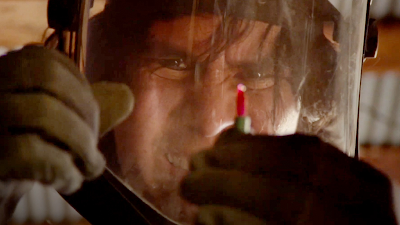
Garland co-wrote and co-directed the film with Ray Mendoza, a former Navy SEAL, based on the latter's experiences in the Iraq War; specifically, the Battle of Ramadi and a couple of hours that Mendoza and his team spent trapped in a house while resistance fighters tried to extirpate them. On a technical level it is, as Garland's films almost always are, very well done. It's told almost completely in "real time", following every movement of and moment that the squad occupied the house and uses ground-level perspective on all of the characters involved, so that we see and hear what they do, with broader looks at the scene represented only by views of the screens of spotter planes as they track enemy movements around the city. It doesn't spare any of the tactical actions or approaches to the situation (multiple "shows of force" (where an F-16 comes in low enough to make everyone want to duck for cover), proper stacking of infantry, etc.) and it also doesn't spare the effect of those tactical actions. This is one of the films that I would generally refer to as "ferociously violent", like The Northman but even moreso. And that, of course, is all well and good if you lack any empathy whatsoever for the human beings that experienced all of this and were the ones behind the blood and the screams of agony and so forth, which presents us with the real problem in all of this...


The Iraq War was one of the more contemptible and stupid actions in this nation's history (almost surely to be surpassed by the current idiot in the White House any day now, which is saying quite a lot.) It was one of the purest expressions of imperialism ("You're sitting on our oil!") and complete obliviousness to the reality infusing the region. Indeed, we had spent decades supporting Saddam Hussein, not least because he was radically opposed to just the kind of fanatical Islamic tendencies that were unleashed as soon as he was toppled. We had a president who had decided on his own "show of force" and that was to unleash the US military machine on a nation that had absolutely nothing to do with the terrorist acts carried out by Al-Qaeda but which made him feel like a tough guy and, therefore, consequences (and millions of Iraqi lives) be damned. Just like other films about the period like American Sniper, this film does nothing to express any of that political reality. It's just an action moment that ends up lionizing the people involved and which will be responded to by much of the American audience with a "Thank you for your service!" obeisance and a complete neglect of the outright crimes committed throughout that period of time. Indeed, it's just a memoir of someone involved in a terrifying moment that doesn't reflect whatsoever on, for example, the terrorizing of the two families that lived in the house that the SEALs occupied. The end of the film even shows the return of members of the unit to that same address as if all is forgiven and now it's just a curio box for former soldiers to remember "those days."


Does it show the brutality of war? Sure does. Does it show the enormous amount of pain, terror, anguish, and trauma that accompanies combat? Absolutely. Does it deliver any kind of message about why any of that should be avoided like in movies such as 1917 and All Quiet on the Western Front? No. It's just an action moment. Certainly, some humans will be spooked by being that close to stuff they've only seen as sanitized news reports before, but just as many will think it's cool to see a JTAC in action and seeing someone hit the clicker to blow the Claymores and so on. In the end, I just don't see the point, despite my appreciation of its technical merits, and my disdain for the central story of this film and the way it's presented is why I still haven't seen things like American Sniper and why my opinion of Garland is continuing to diminish, seemingly with every further step he takes these days.

Friday, February 14, 2025

Deeper and detached meanings


I've been picking up a lot of Blu-rays (and occasional DVDs) these days after I realized that things "bought" on streaming services like Amazon can be lost, not by disconnecting from the service (obvsly), but if they happen to lose the license. The only way to rewatch Gandhi a couple years ago was to buy it for your Amazon library for $8 or whatever. I wanted to see it again, so I paid my $8. A few months ago, I noticed it was missing and upon further investigation, discovered that they had lost the license for it. So, despite me "owning" the digital copy of said film, I no longer did because they no longer had access.

The other thing is that I'm not interested in being tied to someone else's service fee and, if we do end up relocating to somewhere cheaper to live for retirement, I want to be able to watch what I want to whenever I damn well feel like it and regardless of whether we have access to this or that service. My friend, Roger, who retired to Panama with his wife last summer approached things the same way. He brought along a few hundred DVDs and Blu-Rays that he'd been acquiring over the years. I'd always been a movie acquirer, too, as I once had a huge collection of VHS tapes and now have a substantial collection of discs. At the very least, said discs are more durable than the tapes, which I eventually abandoned because it was more and more difficult to find a VHS player that could connect with modern TVs. Anyway, last night I decided to rewatch my newly-acquired copy of Fear and Loathing in Las Vegas. It's not a great film, but I think it's one of Johnny Depp's (and Benicio Del Toro's) better performances and I really liked the book. (It was also on sale, having been sitting on one of my Amazon lists for some time.) When it was done, Tricia looked over and said: "What's so entertaining about a couple of drugged-out idiots?", which is a valid question in most contexts and could be leveled at the current man actually running the White House.


I told her that the point of the book wasn't just to relay all of the weird visions that Hunter Thompson had while ostensibly on assignment for Sports Illustrated (and also while finding a place away from the LAPD to talk about the latter's murder of journalist, Rubén Salazar.) It was more to make a statement about just what drugs could do to the way you perceive things and if you were able to use that perception to talk about things from a broader angle; in this case the end of an era, being the 60s and hippie culture and the idea that expressions of peace were the only answer to institutional violence, whether at home or abroad. I compared it to Jack Kerouac's On the Road in the same way that it took a snapshot of the period in time and talked about life, the culture, the zeitgeist, and how people interacted with and were affected by all of those. She'd never read either of them, so I said that the best approximation I could make was of the difference between what I post about our trips to different places in the world and what she'd expect (and has suggested, pointedly) a normal "travel report/blog" would say. 


The obvious rejoinder is that I'm not writing a "normal" travel blog any more than Fear and Loathing is a "normal" novel. The fact that it wasn't normal is why it originally garnered so much attention and has lasted down through the decades as a significant piece of American literature. In the same fashion, I don't spend much time talking about where we went and what we saw and did, but more about the people we encountered and the differences in culture and the general "feel" of the place. You can bring up 1000 different reactions on Yelp or Tripadvisor about where to go and what to see. I'm not interested in replicating that. Instead, I'm going to tell you what I was thinking about while we were there, which is more of what interests me and which is kinda what Thompson and Kerouac were doing and what ended up delivering the greater impact of both their works.


The film is a decent approximation of that story and its theme. After all, it does give some prominence to "the wave speech", which is the central moment of the novel, really. But I think director Terry Gilliam's focus on the visuals (as is logical in, y'know, a film) clouded a lot of what Thompson's words otherwise delivered in the book. It's the most common problem with translation from one medium to another (typically prose to film; "the book was better-!") and this film does not escape it. Given Gilliam's general tendencies, it's hard to imagine how he could have. But I wanted a preserved copy of it because I think it is saying a lot more with those images than I think many gave it credit for or still do. It is, of course, in part because I have an appreciation for the novel and for Thompson's approach to life, in general. Suggesting that I'm trying to do what he did is only the most facile of comparisons, as it has never really been my intent. It's just the way I do things which, in the end, is about as much respect as can be conveyed. Kinda like making sure you can hold the film in your hand when the world starts dissolving around us. And not because of the drugs.

Sunday, November 3, 2024

Two nights in Porto and one last one in Lisbon


So, yeah, Porto was generally a better experience than Lisbon, even for a day-and-a-half. Like I said, we were staying right downtown, so there was much more energy around our locale. That energy included repeated entreaties from the tchotchke shops to come in and check out the wares that were the same as any other shop that almost invariably appeared within a half-dozen storefronts, if not less (We were proudly told by one owner that he owned two other shops in that area, including one within 100 meters, so if we didn't find the size we were looking for, he'd just run over to the other shop.) It's like being on Decatur Street in the French Quarter; same shit, different door. 
The other popular locale was shoe stores. On St. Catarina Street, there were more shoe stores in a three-block stretch than I've seen in some whole towns. It was insane. Almost literally every third shop along the several blocks that we walked was a shoe store.


The big event on Tuesday was a river cruise on the Douro River, which is what runs right by Porto to the Atlantic. Porto is entirely on the north shore and the city of Gaya is on the south shore. There are a half-dozen bridges running between the two, some modern and steel, some medieval and stone, and a couple that are multi-level. But the follow-up to the cruise was a port tasting on the Gaya side. Now, as noted, our experience with port was not great, either in Portugal or outside it. The stuff we tried at the local market the night before was also not something I'd go after again (The olives, OTOH, were great.) But we had a tasting with local distiller, Calem, and this stuff was fantastic. I was mistaken when I thought that tawny port was rosé. It's just the most aged of port that changes color with the aging process, with ruby and white having less time in the barrel. That also gives tawny the most barrel character, as you might expect. After a tour of their distillery, where they tried to impress us with the size of their barrels, we tried a tawny and a white, both of which were excellent. They had balance. They weren't overly sweet. They had depth. We were immediately smitten and thought about shipping a couple bottles home... only to be brought up short by Michigan being one of the two or three states in the Union dumb enough to still forbid shipping alcohol, which I was hoping there might be a way around, but there isn't. I thought we were the only ones, but those new friends we met on the tour are from Rhode Island, which also doesn't permit mailing booze. It's just simple-minded protectionism for the local distributors; not even producers. One last, great example of legislatures (and attorney generals) that are effectively bought and paid for. That same problem is what prevents us from shipping home a bottle of ginjinha, which we'd become increasingly fond of while we were there.


We went from there to a restaurant down the street where I finally snagged a francesinha, which is a toasted sandwich of pork roast, ham, bacon, and linguica, over which is cheese melted by a super hot tomato-and-beer sauce. It sounds amazing. It was, in fact, excellent. Would gladly have again, except for the absolute calorie bomb that it is. (Even so, next time we come, I'm making room for one.)


Walking back to our hotel (A-cross the ri-ver!), uphill, in the high 70s, on cobblestone, and hauling 20 pounds of liquid (and glass) that we could get into carry-ons since each item is less than 3.5 oz... we came across a student band from the U of Porto. They were all young women and were all in uniform (white shirts, black ties, black knee-length jackets and skirts) and played a variety of instruments while also doing some mild dance routines and chants that sounded like something you'd associate with European students. I was struck again by the prevalence of traditional dress, right alongside the far more casual look that is emblematic of American students. They were great entertainment and we donated to their instrument fund. I was cramping up by the time we got back to the hotel. We definitely should've called an Uber.


Speaking of which, I forgot to mention before that the dichotomy(!) of cars we've experienced in both Lisbon and Porto is hilarious. The first three Ubers that we called were all driving white Teslas. Not just Teslas, but white Teslas. Every, single car we've had since those first three has been a standard transmission. It's like a step back in time from the modern, electric era to the 70s, since you almost never see standards in the US anymore unless they're full-sized trucks. It also highlighted once again the driving skill of most of them. We had a great dinner at 17, a restaurant on the 17th and top floor of a hotel a couple blocks from where we were staying that, as you might expect, gave us a great view of the city.


There's definitely a sense of rivalry between the capital and Porto, with the latter having a great example of that Second City sourness that Chicago exhibits towards New York. Our tour guide, a Lisbon native and resident, when confronted with the opinions of many in our group who cited how much more dynamic Porto was in comparison, were replied to with: "I am glad you like it. Porto, I am not a fan of." There was no explanation as to why. It was simply that she was on Team Lisbon.


In the morning, we got on the bus back to Lisbon, but made a stop in Aveira on the way; known as the "Venice of Portugal" for its many canals and salt pans, out of which it still produces a substantial amount of the domestic salt production of the nation and has been doing so for a couple thousand years, given the nearness of the ocean and the water that seeps into those pans. It's a pretty cool town, although we didn't see much of it. We took a boat tour of the canals and our guide was a great example of Western European language aptitude, switching easily between Portuguese with our pilot, some French tourists in the boat with us, and English for us; the latter two with no struggle and a near-perfect accent (or at least one not overwhelmed by his native Portuguese.) He was a Benfica supporter and, as I sat down in the boat in my Liverpool hat and Liverpool hoodie, asked: "So, you're a Liverpool supporter?" Me: "How could you tell?" We talked a lot about the game as the boat moved along, between his programmed descriptions of what we were passing by (including a public park with exercise machines, which was kinda cool.) It's always refreshing to find someone that really knows the game and can bring their own perspective to it.


We made it back to Lisbon and immediately set off for the Quake museum, about the 1755 earthquake (and consequent tsunami and fire) that basically destroyed Lisbon, leading to a public inquiry that was not only the first example of seismology as a science, but also modern urban planning. Of course, the most impactful result was the beginning of the Enlightenment (Why did the loving God destroy the capital and kill thousands of devout Catholics in devout Portugal on All Saints Day? "Mysterious ways", my ass.) Anyway, the museum is interesting and quite interactive. Then another solid dinner and a ride with a Bolt driver who was genuinely aggressive in his approach to traffic (and still with a stick shift), which was kind of entertaining. Still drove completely within the law, though.


2.5 hours after I wrote this, we left for the airport to catch our early morning flight to Paris and from there to Detroit. It was a really good scouting trip vacation and we even looked at home prices around Coimbra. Unlike our friend, I don't think I'd do the tour thing again. I just found it too restrictive and with too much time spent in front of things that weren't particularly compelling. We also ran into a couple Trumpers on our bus that I made a couple pointed comments to who then gave us something of a wide berth, which was fine by me. Fuck'em. In contrast, our new friends from Rhode Island were a ton of fun and we may try to arrange another meeting across the pond with them (or the other pond) at some point in the future.


Wednesday, October 9, 2024

Failure of vision


Francis Ford Coppola is a director of note mainly for the time period when he was part of the insurgent "New Hollywood" in the 70s, who were a collection of filmmakers that were lauded for breaking the studio system, such that the directors of films finally had more authority than the studio did. The studios just looked at the books and what might sell, while said directors had vision that audiences responded to. In Coppola's case, that means films like the Godfather trilogy, Apocalypse Now, and The Conversation. But he's also cited for one of the films that ended said era in One from the Heart, which led to a decade of him producing "commercial" (i.e. studio approved) films to pay back the debt he owed from that colossal failure (critically panned and earning ~$600k against a $26m budget.) Nothing he's done since the 1970s has been the type of success that you'd expect from someone who directed and co-wrote what many people regard as the greatest film ever made (The Godfather; for the record, I am not one of those people) and, in fact, he hadn't done anything for 13 years prior to the release of Megalopolis, which he wrote, directed, and produced. And when I say "produced", I mean "footed the bill for", since he'd been carrying this idea around for 40 years and could convince no one to fund it until he sold some of his businesses in order to do so, which should tell you quite a bit about why it couldn't have been done before now. That "why" is because it's a total travesty of a production and easily the worst thing I've seen since Power of the Dog.


Now, a note on that latter film. At the very least, it had a discernible plot. It wasn't a good story, but you could follow along (for two... and... a... half... hours... at... this... pace...) and at least get some great performances out of the people that were helping to tell that story. Megalopolis has none of this except the horrible pacing. The plot is supposedly based on the Catilinarian conspiracy from 1st century BC Rome. In point of fact, it has absolutely nothing to do with it. The conspiracy was about a demagogue, Lucius Sergius Catilina, who lost the election for consul and tried to instigate a populist insurrection to overthrow the then-current consuls, one of whom was Marcus Tullius Cicero. Sounds like modern times, right? We're dealing with that right now with the walking creamsicle and his collection of MAGAts. Except this film doesn't present that scenario in any way. Adam Driver, playing Cesar Catilina (Coppola was convinced to rename the character "Cesar" so that people would, y'know, get that it was a film about ancient Rome) isn't a political outsider. He's not leading a revolt. He's a visionary inventor who's created something called "megalon" which is supposedly the pathway to economic stability and prosperity for the downtrodden. Is this like the real Catilina promising to wipe out debt (albeit not just for the poor, but also the very wealthy) like the current orange idiot's obsession with tariffs? If this is the political warning that Coppola was trying to convey, then why is Cesar Catilina the hero of the film? Is it because Coppola is following the widely discarded idea that Cicero, in writing about the events, not only embellished but outright lied about what took place and that's why Lucius Catilina has gone down through history as a villain and general threat to democracy? I mean, OK, but then why do many of the opponents of Cesar Catilina, like Mayor Franklin Cicero (Giancarlo Esposito), end up endorsing the hero who has apparently saved society as we know it?


It's that kind of discordancy that is emblematic of the entire production. Apparently, Coppola would spend hours locked in his trailer, only to emerge with new scenes that had nothing to do with either the script or the day's shooting schedule, leaving everyone else to catch up to his "vision." The entire film is like that. We veer from parties that seem to be emblematic of societal decay but also seem to be made up of all of the characters shown as heroes at the end to scenes of Catilina hard at work on the MacGuffin (Meg-uffin?) that he has supposedly already invented to Wow Platinum (Aubrey Plaza) scheming about how having the world at her feet isn't good enough if she can't also have the one man who wants to do nothing but reject and also remake that world. What makes this even worse is the dialogue, which could have been plucked from the nearest 8th grader's first attempt at a novel. There's not a single line of dialogue in the film that I can recall, having seen it just last night, except the scene where Driver recites Hamlet's entire nunnery scene speech ("To be or not to be...") and the sequence where Julia Cicero (Nathalie Emmanuel) regurgitates bits of Marcus Aurelius in rapid succession. In other words, the only memorable dialogue in the entire 2.5 hour film is that written by other writers. The rest of it is boilerplate exposition and exclamation that you'd think would be used in a basic theater class as an exercise. The story from the set was that Coppola asked Driver to do the nunnery speech as a warm-up exercise and then left it in the film because it fit with... what? I have no idea.


Meanwhile, the central element of the plot- the megalon -is, as noted, a MacGuffin. It doesn't really do anything. It's just there for the rest of the non-story to revolve around. It finally makes a concerted appearance in the last 10 minutes, doing what it's claimed to be invented for (reshaping the way people live), but is mostly just visual effects that don't actually impact the story. At one point, Catilina is injured and megalon is used to seemingly save his life, but the miracle substance doesn't affect his body, his character arc, his attitude, or even his appearance in any way. It's just perfect plastic surgery and that major event in the story dissipates like everything else. That includes most of the performances. With a cast like this, you'd expect that you're going to get something interesting, at least. But with the parts they were given (or woefully miscast with; can you imagine Gustavo Freng as a confused buffoon? Because that's what Esposito is in this film.) or the lack thereof, it's not really a surprise that none of them were able to generate much. Dustin Hoffman is in this film for about 5 minutes of screen time and three lines. Like the megalon, he doesn't actually do anything except show up on the cast list, which may be the whole reason he was included, but even if his part were larger, I'm not sure what he could have done with it. Jon Voigt had a significantly greater part and still spent most of his time just being there while other people shouted monosyllabic platitudes around him. It takes real effort to make actors this good look this bad and that's even when they're doing something mildly interesting, like Shia LaBeouf as Claudio Pulcher going down on Platinum while she insists he call her "Auntie Wow." It has nothing to do with the plot and is completely incongruous with the scenes that came just before it, so it fits the definition of titillation perfectly, but at least someone was doing something.


I've really never seen anything like it and really don't care to ever again. I frequently suggest whether films are worth the time and effort of seeing them in this space and this is one in which I don't think I can mention a single, redeeming feature, unlike many others that I've not cared for. I sincerely wish I had the 2.5 hours of my life back. It's possible to see a film just so you can see something that was so bad, it's "good." But if you're going to do that, at least see something short, like The Room. This film is quite simply a mega waste of time (and money. Yours and Coppola's.)

Tuesday, May 2, 2023

How to deliver a message


There are a lotta stories and all kinds of ways to tell them. Likewise, there are lots of messages and many different ways to deliver them. The question that every author and director and transmitter and dogmatic is confronted with is: How? How do I tell my story in a way that will bring meaning to it? How do I convey my message in a way that will carry it into the hearts of its readers/listeners/viewers? This, I think, is a quandary no different with How to Blow Up a Pipeline. Inherent to its title and its basic premise, there's no doubt that that this is a message film. This isn't in the same vein as a romantic comedy or a sci-fi epic. This is a bit more down-to-earth, as it were, and wrapped up in very realistic themes that are tied around an actual situation that all of us are currently confronting. The book that it's based on is not an instruction manual as the title implies but rather a spirited defense of the idea of property destruction as a valid response to the destruction of the planet. That, too, is a debatable approach to both delivering one's message and telling the story of those who feel frustrated and powerless in front of the unstoppable tides of profit and modern demands of both industry and the energy production to drive it.


The story that writers Daniel Goldhaber (also the director) and Ariela Barer (who stars in it as Xochitl) extract from the book is a thin one. They're not trying to create elaborate drama. The backstories of all of the characters in the eco-defense/terrorist (feel free to pick your label) group are pretty standard; avenging a lost mother, defending the family land, the outrage of indigenous peoples, and the fury of a terminal disease most likely linked to the pollution that modern industry creates, especially among those not wealthy enough to escape direct exposure. None of these stories are new or particularly interesting, but all of them are either familiar or understandable to anyone who has bothered to pay attention for the last several decades. In fact, one thing that occurred to me halfway through the film was how much better it might be as a mini-series if one actually wanted to create characters that would sit with people, rather than just serve their purpose on the screen and disappear after a couple hours. But that wasn't really the point. The film wasn't created to leave you with lingering thoughts of Theo (Sasha Lane) and her terminal disease or Michael (Forrest Goodluck) and the drive that has led him to cut off most human contact. It was created to point out what the book's author and the film's creators are arguing is the only answer to the looming disaster before us. In that respect, spreading it out over three TV episodes would have drained it of both impact and the constant tension that the film employs to great effect. That tension is physical (the risk of handling homemade explosives) and emotional (the fear of failure, whether by being caught or blown up or simply not succeeding at the statement that they're trying to make) and mental (constantly questioning whether what they're doing is the right thing or even an effective thing) and it keeps the viewer interested by what is, again, pretty much only the framework of character and story. If it were intended to be a drama in prose, it would be a short story. Stretching that into a two-hour film is an accomplishment in and of itself.


But, despite it being entertaining, the one thing that kept nagging at the back of my brain the whole time was the essential inadequacy of blowing up one pipeline from one producer of the toxic sludge that keeps the lights on for many people. There's some justification attempted by Shawn (Marcus Scribner) about affecting oil prices and the response by Alisha (Jayme Lawson) that doing so hurts the poor people who depend on the gasoline to get to their jobs far more than it does the producers of that oil. These are all reasonable, intelligent people who know how the world works to at least some degree. There are a couple like Dwayne (Jake Weary) and Michael who are only interested in lashing out for their own reasons. But there are questions raised, mostly by Alisha, who is the only one committed to what book author Andreas Malm disdained as the environmental movement's commitment to non-violence, which he considers no longer effective or necessary. Most of these characters agree with him and, thus, the essential message of the film becomes that of the book and it's one that's hard to argue with even if, again, the global impact of a single pipeline is not likely to be large enough to generate the response that either Malm or these characters would like. The excellent tension of the film conveys that message better than any soliloquies on the injustice of the situation ever could. This is a problem now that needs to be dealt with now.


But for those concerned, like the whining National Review who referred to it as "sociopathic filmmaking", that this is an actual instructional manual, rest assured that you'll be no closer to constructing an actual IED than you would be trying to learn how to make crystal meth from Breaking Bad. My favorite part of Armond White's opinion in NR was that the film was being used to "enforce partisanship", which means that the GOP knows that they're on the wrong side of an issue and has to accuse someone of implicitly siding with the opposition rather than ever admit that. White and others like him should be the ones who are the first to burn when the situation that Chevron and companies like them have created comes crashing down, if only for turning the survival of the planet and everything inhabiting it into a political football. If by that you assume that I'm on the side of those willing to use violence to push back, you're absolutely right. The film didn't need to deliver its message to me, as I've long since internalized it. When I was running the Green party in Michigan, the most difficult part of the party's central philosophy that I had to continue to convey was non-violence, as some situations simply demand it. That's the story that I'd be telling, too.

Wednesday, January 4, 2023

Sending children to do the adults' job


By now, everyone has become aware of the farce that Republicans are making of the national legislature. In truth, if you've been conscious since 1994, you can't have missed it. This is what happens when you take a philosophy based on a joke- Ronald Reagan's famous line: "The nine most terrifying words in the English language are: I'm from the government and I'm here to help." -and turn it into an ideology that is a joke, in a much more deprecating fashion. This is what happens when that ideology becomes an end unto itself, in which you elect people not to govern, but to destroy the means of government. This is what happens when you send children to do the job of adults.

The Republican party is a hollow shell at this point. The fabled "party of Lincoln" no longer exists as any kind of functioning political apparatus. Most political parties want to run the government in a manner befitting their outlook on the world. The GOP is incapable of governing because they have no outlook that makes sense. Their motivating philosophy is some combination of the farcical Libertarian concept that society would be better without laws (or, at least without laws that affect wealthy White people) and whatever idiotic whim currently drives their conspiracy-obsessed base; be it a disdain for science, immigration, education, women, LGBTQ+ people, the environment, or any and all combinations thereof. Most political parties have a plan for how to run the public apparatus so that, at the very least, it serves some group of people and some purpose other than putting themselves in front of a camera to receive the adulation of the fools who keep voting for them. Instead, the GOP is currently built upon the idea that sending the least-qualified people to the largest and most complex institution in the world that affects the life of every living being on the planet is the correct path to an end which is unknown even to themselves. In short, they have no plan and they have no ideas, but that seems to be the reason for some people to keep electing them. The party has gone from Reaganism as a religion to the ultimate expression of George W. Bush's campaign that you should vote for him because he'd be a great guy to have a beer with. He wasn't capable of doing the job, either, but he at least surrounded himself with apparatchiks and Cold Warriors who would, much to the chagrin of the rest of the civilized world. The current Republican party isn't even that competent.


Instead, they've gone from trying to pretend that they have a reasonable agenda to loudly proclaiming that they don't have one because they know that anything resembling one is anathema to their Trumpanzee base. Any agenda that would satisfy that base would be rejected by the majority of reasonable people in this country (and the world.) So they stand around and recruit shysters like George Santos whose entire existence is built on lies (and, at least in Brazil, other crimes.) That doesn't make him inordinately distinct from people like Kevin McCarthy, whose only purpose for the past decade has also been to lie to people to make it seem like he's capable of governing, when he really isn't, just like the rest of his party. If he were to gain the post of Speaker of the House, he knows that the only agenda that will satisfy the Fox-crazed idiots will be one that will be utterly discarded by the Senate and ultimately vetoed by Joe Biden. As the original trigger man of the Republican transformation, Barry Goldwater, once said: "Politics and governing demand compromise." But you can't compromise if you have no functional ideas or a governing philosophy. The only philosophy that Republicans now carry is that government is broken and so their only role is to continue to prove that it's broken by not governing. It's as if a display of incompetence is a measure of competence in the eyes of their supporters.

There is no more obvious example of this than their current standard-bearer, Donald J. Trump. His career is built upon scams (Trump University, Trump Steaks, etc.) and an image of success completely belied by reality. But to his supporters, it doesn't matter because he's rich. That end justifies the means, even when said means were largely about screwing people just like themselves. Those people were "suckers" who didn't make the right choices, just like anyone who currently votes for a Republican who doesn't stand to directly benefit. That would typically be the 1%, but since the GOP is incapable of  governing, even that's not a sure thing anymore. No, it's more like the pair of lawyers so unnerved by the idea of Black people being near their house that their only response was to wave guns at them. Or the father whose first and most urgent response to the news that his son had killed five people (with guns like the two lawyers were waving) was that he'd been in a gay bar and, therefore, might be gay. Or Steve Scalise, the current front-runner to replace McCarthy, who has described himself as "David Duke without the baggage." Duke, you may recall, was an outspoken supporter of Trump's campaign, since they're both racist buffoons and, thus, would probably enjoy having a beer together. Or at least a Diet Coke.


There's no way to "both sides" this. There's no way to postulate that this could easily be the Democrats imploding in the same fashion because the Democrats haven't spent the last 30+ years trying to destroy the very institution that they're ostensibly managing. The Democrats, for all their faults (and there are many), are at least a functioning political party with an agenda to do something constructive for large segments of society, even if many of them would like to do more for that fabled 1% that pays them to be in office in the first place (and pays them even more when they get out.) The two "sides" aren't even in the same universe, since the Democrats function in one where science is accepted, history is realistic, and government is a tool to be utilized, not tossed away as if it was too complicated to be understood. Just like a child. The Republicans are the party of ignorant children that remains a relevant force because of the large number of ignorant children in the US that walk around masquerading as functioning adults and because of the careful manipulation of the system (aka gerrymandering) that prevents a more reasonable and acceptable government from being put in place by the majority of the population. There's no greater example of this than the November election in Michigan, where the new districting system may have removed Republicans from power for decades to come, unless the locals choose to begin recruiting people who have an interest in actually governing, rather than screeching at whatever new thing they don't understand like a Kari Lake.

Democracy is difficult. Democracy requires communication. Democracy requires intelligence. And debate. And consideration. And so many other things that Republicans and their supporters either lack or are unwilling to engage in. Even worse, most of them act like suggesting any of that is a personal affront. That's why I've long said that the only real solution to the current problem is civil war and it seems like most Republicans will only be satisfied with that outcome. The first choice of the person who is unwilling to think is often violence. The inability to govern is the sign of a group that is unwilling to think. Instead, they'd rather just throw a tantrum...

Tuesday, June 28, 2022

This cannot possibly be a surprise


Shocking testimony! Surprise witness! A surefire distraction from the fact that Congress has yet to take any of the plentiful actions available to them to rein in the Supreme Court-!

The first two of those read like headlines from your average supermarket scandal rag; the last one, not so much. That's because the last one is actually true and the other two are trying to create something out of nothing. Today's "shocking witness", Cassidy Hutchinson, former top aide to former Trump chief of staff, Mark Meadows, sat in front of the January 6th committee to tell everyone precisely nothing of interest outside of a soap opera script and nothing that could in any way be a surprise to anyone who has actually been paying attention. Of course, that latter category tends to include less than 10% of humanity, so perhaps I can't really find this unusual, either. Everyone knew on January 6th, 2021, that Trump had organized a mob to attack the Capitol. We knew this. It was right there in front of us and there's been a mountain of evidence piled on top of that accusation since that day. That Hutchinson, an insider to the Trump cabal, albeit one of minimal importance, was actually willing to talk about it in detail is the only mildly extraordinary event that took place.


I'm honestly baffled by the number of people reacting to this as if it's any more shocking than anything Trump has done before and what he's done for the vast majority of his life. Anyone that has paid attention to this man-child's behavior can't possibly be surprised that he would be throwing a tantrum because his attorney general followed the law; because not enough people could get through the metal detectors for his pity party at the Ellipse; that he attacked his driver who wasn't willing to let him bask in the glow of his devoted followers by leading them to sack the Capitol. This is who he is. This is who he's always been. The last six years have been daily reminders of that very fact and, yet, people are still somehow shocked that he's not only not "presidential" or anything even vaguely close to it, but is an outright criminal, as he has been for most of his life. There was a steady stream of commentary about his criminal behavior while in office and the last two years have been a constant parade of a host of other actions and events that only reinforce that perspective.


Most are assuming that nothing will come of this and they're absolutely right. Nothing will come of this because the people controlling the institutions of power are interested in only one thing: preserving those institutions of power and their place within them. That means preserving the dignity of the office of President by not prosecuting a blatant criminal who once held that office and attempted to retain it by overthrowing those very same institutions. It's why the New York Times refused to call Trump a liar when that's what he clearly is. It's why the current AG, Merrick Garland, chosen for his status as a legal non-entity that the GOP might actually go along with on the Court until McConnell decided to refuse to do even that, isn't standing outside Mar-a-Lago right now with a battalion of FBI agents. It's why Biden and Congress aren't taking the blizzard of actions they can, quite legally, take against both Trump and the corrupted Court. All these people care about is preserving the façade that is the American version of "democracy" and that means not bringing those institutions into question. Again, anyone who's been paying attention should have begun to question them decades ago. But most people don't pay attention and, thus, here we are in the Weimarican Republic with our far more threatening version of the Beer Hall Putsch resulting in prison terms for precisely no one who actually matters. And it's because, in the grand scheme of things, those people matter and we don't. To quote one of the greatest stand-up comedians of all time: "It's a big club and you ain't in it!" And all they care about is the club.

Tuesday, January 25, 2022

Just pay attention


My friend, Michael, posted recently about having read through Rick Perlstein's series of books about the transformation of American political culture from the latter half of the 20th century onward. The main thesis that Michael drew from those pages is that the Republican perspective is based almost entirely on lies that have more recently manifested in complete departures from reality like QAnon, but have never been based on anything close to reality from the very beginning. My kneejerk reaction to anyone bringing this up is that it's been that way since Barry Goldwater, who realized that the GOP needed a lever to deal with an increasingly urbanized public and a more forward-thinking youth segment of the body politic.

If you read a GOP platform from the 50s, anyone can recognize that it would get utterly shredded on Fox News as the most radical form of communism (Creation of massive federal programs (SBA, Interstate system, Dept. of Health and Welfare), affirming the right for labor to organize, free vaccines(!)) There's the usual routine about tax cuts, but Tucker Carlson would go into conniptions if half the stuff mentioned in that document were to be suggested by a Republican (or anyone) on his show today. In that way, the differences between Democrats and Republicans at the time were more about emphases, which can still be true today. But with the issue of race becoming front and center in the early 60s, Goldwater realized that the way to recruit Southern Democrats was to keep feeding them the same line that they'd gotten since Reconstruction: "It's not the rich, White guys who own all the land that are keeping you poor. It's the even poorer Black guys!", but cranked to 11. That lie became the GOP identity. It didn't work in 1964 against Johnson because he was still carrying the sympathy vote for Kennedy, but it was something to build into and that mindset has gradually infected every policy decision and platform that the GOP has produced ever since. While the Democrats have continued to try to be the "inclusive" party (which always somehow includes very wealthy corporations, typically at the expense of actual people) and fervently moderated their message in the name of doing the right thing and continuing to serve the 1% that dumps money into their campaigns, the GOP has just gotten more and more hardcore and had to continue to invent lies to sustain that narrowing focus. 


You could speculate that the Dems departing from "let's please no one most of the time" and going full bore into their more fervent supporters might have put "moderates" (e.g. people mildly interested in change unless it affects their wallets or might scare the children) on a precipice: Support the Nazis or go along with actual change. But that's speculation because it's hard to know how people will react to those choices until they're actually presented with them. The GOP lies don't just work on actual GOP voters. You can see their effect every time the New York Times prints a story about someone's burrito going up 50 cents and tacitly blames it on whichever Democrat is currently in the White House. Don't think that corporations aren't fully aware of that cultural mindset. Setting up circumstances to blame the "might think about change people" keeps them in line, garners profits, and potentially puts the "won't ever think about change" people in a better position, which is all to the utter benefit of the ownership class. People, including reporters, tend to follow programming, even if a moment's consideration will reveal that it's bullshit and you might consider actually speaking up when your coworkers continue to spread that bullshit, instead of rolling your eyes and walking away silently. Speaking up takes effort and a willingness to pay attention, which is not something people are generally inclined to do. This is the same situation that existed with the original Nazis, when people went along to get along, even if a lot of them were perfectly aware of what was happening to their neighbors. They'd been culturally trained- by the media, by their education, by many of their other neighbors -to think in a way that allowed the fascists to take power.

This is what's happening today. It's not too suspicious a thought to consider that the NYT continues to insist that the only real Americans are people in a small-town diner with opinions that favor either things remaining as they are or even reverting to what they were because the Times is one of those massive corporations that benefits from that perspective. At the very least, it generates clicks from many whom would never admit to reading the Times, as well as the regular readers motivated by outrage. That's money and the pursuit of it, not news. It's basically the plot of Broadcast News, where Holly Hunter and Albert Brooks were objecting to the presentation of their work as "infotainment", used to distract and pacify the public, rather than inform and motivate them. Every time the Times and other entities in the collective media present a story about regular people filling in for what should be a basic public service, the deception that circumstances are what they are because that's the way the world irrevocably works, rather than what the ownership class wants, is perpetuated. That, too, is a central lie to the Republican modus operandi. Witness the regular belligerence of both parties on the world stage and the government's "lethal aid" euphemism and its quick adoption by the media. That is yet another foundational lie perpetuated by the GOP ("Someone, somewhere, is out to get us!") and willingly absorbed by "the news" and, frequently, the Democrats, as well.


But all of this stuff has been present for decades. None of it is a new development. The transition of the Republican party from one obsessed with tax cuts to one determined to kill people (COVID) and return women to being second-class citizens (Texas abortion law) and exclude people based on their skin tone (voting suppression laws) is just a more overt form of the fascism that they've been promoting for decades. We're in the home stretch here and the party unable to govern and represent a majority of the public in a democracy is now unwilling to do so and their sometime opposition on the other side of the aisle is still partially made up of those whose loyalties are divided between keeping quiet and making money or speaking out for the people who need it most. All of this has been written on the wall for a very long time. All it takes to stop it are people willing to pay attention and say something. I was telling Tricia the other day that that's probably going to be the inscription on my tombstone: "Pay attention." That's all it takes to see what's happening in the world. Stop accepting the lies. Point them out. It's either that or more guns in the streets than we already have, as that will be the only way to stop them from completing their goal.

Wednesday, January 20, 2021

No unity without justice


I'm sure you're all happy to know that I'm willing to sacrifice my constant stream of entertainment embodied by The Idiot, President Donald J. Trump, for the sake of the rest of your sanity and ability to feel at least somewhat decent about the concept of America as anything but the profit center I believe it to be. We have come to end of Trumpworld, to a certain degree, and even the QAnon people are giving up. I remain constant in my opinion that the only upside to that moron occupying the Oval Office was that it forced people to pay attention. Every time he exploited the "rules" of tradition and custom that make up our mockery of a government; every time he pushed the limits, knowing that the pearl clutchers wouldn't believe he was telling them exactly what he was going to do; every time he reinforced the farce of an uneducated and often willfully ignorant public putting a con man into the highest office in the land and being supported by other elected officials (Hi, Mitch!) who definitely knew better, he showed just how outdated and inadequate our administrative system actually is for the vast majority of those subject to it. If you are part of the ownership class, the Trump era likely reinforced your status. The rest of you will have to live with actually being awakened to the reality of how the system is designed to exploit you and those with even less than you have.


And, of course, now is not the time to return to sleep. What I was afraid of with Hillary Clinton's election was that the very real systemic problems- the wealth disparity, the police state, the inability to speak outside the traditional norms of discourse without being dismissed as an extremist -would all be dutifully ignored. Trump's election changed some of that and we began to see the emergence of people like Alexandria Ocasio-Cortez and Rashida Tlaib and Ilhan Omar and Katie Porter; people that were committed to asking the questions about the power structure that had regularly been dismissed as not relevant to the goal of wealthy people making even more money. Those representatives are all still present in Congress and one assumes (hopes?) that their attitude has not and will not change. With a functioning adult in the White House, there arises the prospect of actual, positive change. But in his speech today, actual-President Joe Biden spoke of "unity", which has been a buzzword among Republicans in the last two weeks, suddenly confronted with the fact that not only had they lost control of both branches of government but had been directly threatened by the monster that they've nurtured and ridden for the past 30 years. My opinion on that is simple:

I'm not interested in "unity" without justice.


I'm especially not interested in unity with those who actively encouraged the assault on January 6th, such as Ted Cruz (R-TX), Joshua Hawley (R-MO), Mo Brooks (R-AL), Paul Gosar (R-AZ), and Andy Biggs (R-AZ.) (Rumor has it that the latter three went looking for a pardon from the Idiot in the last couple days...) I'm not interested in unity with fascists or unrepentant racists or devoted QAnon cultists. Advocating unity with people like that only encourages their crimes and makes it that much easier for them to be considered acceptable behavior the next time some con man like Trump (and there will be a next time; in Josh Hawley, there basically already is) leads a bunch of fools into declaring him the messiah. The only thing that counts right now is justice. Justice means expelling all five of those people, among others like Lauren Boebert (R-CO), from their respective bodies of the legislature as not suitable for the proper function of government. It means arresting stooges like Louis DeJoy and seizing the assets of his company for directly interfering with the function of a federal agency (in this case, the US Postal Service.) It means cracking down in the most direct and obvious ways to send the message: No more. No more profiting by damaging the function of government. No more attacking the function of that government in the name of some twisted cult based on the second amendment or some other bizarre notion (like trickle-down economics...) For once, the hope is that Democrats run the show like they're aware that they're in the director's chair and not concerned about the studio (i.e. their campaign fundraisers) threatening to pull the plug if they're spending too much money (It's pathetic how symmetrical that analogy is.) For once, they should be assured that the progressive opinions they're hearing put forth are those of the majority of the citizens of this country.


National healthcare is one of them. Climate change is another. Student debt is another. Policing is another. Economic inequality may be the most important one of all. But don't talk to me about unity with what are, in the end, actual criminals. In the modern era, the fox guarding the henhouse is perhaps a bit too quaint to draw the picture, so let's try something timely: If you invite the plaguebearers into the house, all you do is continue to spread the plague. There is no herd immunity to broken government and the widening gap between rich and poor in this nation. There is, instead, a simple dividing line: One can be on the side of facts, truth, and equality or one can be a fascist. I say again that I have no interest in unity with fascists because they have no interest in facts, truth, or equality. I'm still convinced that proper civil war is the only way to truly solve our current national problem, but it may be a case of fighting the fascists long enough for some of them to realize that the real problem is the ownership class and always has been. It's Biden's task at this point to make a statement about which way this society is going to move in the future. To his credit, the line from his speech today: "... not by the example of our power, but by the power of our example." is a good summary of what I'm talking about, since it would be starkly different from much of what the US government has stood for, in matters international and domestic, for most of its existence; from Shays' Rebellion to now.

The casualties of the non-stop rueful, cynical entertainment will probably be half a million strong by the time we reach February, and that's only talking about COVID. Millions more are already casualties of the profit machine and one con man's willingness to exploit every angle of it. Now we have a new executive whose task is to reverse course on much of what has happened over the past four years, but whose real task should be to alter course on much of what has happened over the past forty. Is he willing to do that? As the zen master once said: "We'll see."