Showing posts with label movies. Show all posts

Tuesday, July 28, 2026

Still no story 2


So here's a great example of how attempts at storytelling (and, likely, test screenings) have evolved in the past 20 years. The Devil Wears Prada was a film based on a hit piece novel that wasn't interested in anything except presenting its subject, a thinly-disguised facsimile of Vogue editor Anna Wintour, as a bestial overlord. A limp Hollywood nod toward feminism in 2006 was tacked on at the end. As I asserted in my last post, there wasn't really a story to be told there as that wasn't the point of the novel in the first place. Two decades later, the same writer and director team (Aline Brosh McKenna and David Frankel, respectively) had either fully absorbed the transition in attitudes of criticism in the modern era or realized that without even the skeletal framework of the book they really had nothing to build a film around. Consequently, The Devil Wears Prada 2 is constructed of the most obvious and turgid of plots imaginable and it makes the film not only as predictable as the original, but also lacking even the mild moments of shock humor that emerged then. If the original was a hit piece, the sequel is about as inoffensive as anything could be and still be using the word "devil" in its title.


Word on the street is that neither Meryl Streep, reprising her role as the tyrannical editor of fictional fashion magazine Runway, Miranda Priestly, nor Anne Hathaway, likewise returning as Andy Sachs, journalist stooping once again into the world of haute couture, wanted to do a sequel. What had been said in the first film had been said and that story was finished, which is always a perspective I can find myself in alliance with. What usually draws performers back in is an attempt to say something new and/or different about their characters. That was not the case here in any way so what may have led them back is not only a pile of money but also a lack of other decent projects at the moment, if not both. But that's all speculation on things I don't know about. What I do know is that the story as presented is really just the same plot from the first film, without any of the shock value and instead attempting to fill out the stick-figure characters of that film and make Priestly more human (thus, distracting from the title as anything other than a marketing slogan) and Sachs able to stand on her own, rather than solely within the shadow of Priestly. What it doesn't do is make either of them more interesting or, once again, give any justification to their characters' regular assertions that the fashion world is crucial to the existence of modern society and thus attempt to justify Priestly's absurd behavior. That world is still shallow and self-important, which is exemplified once again by multiple sequences of characters parading past or with clothing while not advancing anything even resembling a story. The scene of Priestly, Sachs and likewise-returning Stanley Tucci as Nigel Kipling entering Milan was less a scene than a reproduction of the post-breakfast walk in Reservoir Dogs (Here's our stars, walkin', lookin' cool) except that the latter at least served as the opening credit roll.


And, again, with the plot being as predictable and formulaic as it is (Sachs once again working for Runway, Priestly once again mistreating everyone while trying to keep the magazine relevant in the world of the Internet, Kipling once again being the backstop to everyone and often to his own detriment while mild crises ensue, etc.), what it can't depart from in terms of the formula established by the first one is that a) money rules the fashion world in the same way that it does most of everything else and b) much of modern society is beholden to the largesse of ridiculously wealthy people who occasionally deign to look in on the lives of the peasants. In fact, one of the opening statements of this film is how journalism has been dying because good stories (like, say, films other than this one) aren't as important as advertising clicks. Runway finds itself in the same scenario which is a laudable statement to make. The main problem is that said scenario doesn't find resolution (aka Hollywood happy ending) in the hands of the main characters of this play, but instead the largesse of yet another billionaire. What it's saying is that we've basically returned to the 18th and 19th centuries: if you're an artist, you either find an agreeable and very wealthy patron or you're out of luck because those masses can't save you (and usually won't, anyway.) Somehow this message is delivered at the end of the film as if it's a good thing, since said wealthy patron isn't an idiot Tech Bro but instead a reasonable and intelligent woman. But that still means that culture and, thus, society in the perspective of the fashion world is completely dependent upon the rich to sustain it. That's a reality that we're all living with now and it's a message that should make everyone sigh in frustration, rather than applaud for the fact that dragon lady Priestly and somehow-still-crusading journalist Sachs have won the day at the end.


I have a hard time believing that McKenna's script was written with that in mind, which is probably just another indicator that it wasn't really written to deliver a message or tell a story, but just to provide an opening to reuse the scaffolding of the first film. Just as Sachs and her circle of friends said in the first film and repeated here: Ya gotta pay the rent, so... To Hathaway's credit, her performance here shows the maturity of the last 20 years and is a significant improvement over that first effort. But the rest of them are as one-note in this film as they were in the first and even more characters are added in to give their  own contributions to parts and lives that don't seem to serve much purpose; not least Kenneth Branagh, who plays Priestly's husband who at least doesn't serve as part of the excuse for her attitude (i.e. no one would think twice about her acting that way if she was a man) but is otherwise the complete waste of one of the better actors (and directors) of the modern era. Similarly, Patrick Brammall is the boyfriend whom Andy once again feels guilty about abandoning when there's even less reason for that role to exist, since this story isn't about her supposedly ignoring her principles to make money but embracing them to do the same thing. And Emily Blunt once again serves as the snooty foil, this time not just for Andy but for everyone, but still lacks the humor that would have made her character somewhat interesting.

So, yeah, still not my thing. It was worth the time to hang out with some new friends and talk films, though, so that's something. On that note, as you've noticed, things have been sparse around here in recent times, not least because we abandoned our Michigan Theater membership a year ago and, thus, haven't seen a whole lot of new things. So I'm going to return to some previous material in the near future (Back to the Bat, as it were) and we are at least seeing The Odyssey tomorrow, so there will be that. Hopefully the lack of material hasn't lost the few of you who still sometimes pay attention.


Sunday, July 26, 2026

The Devil needs a plot


Continuing my now seemingly monthly schedule of posts (I will likely get back to Spider-Noir, but it was as uninspiring as noted), I once again was propelled by an inquiry after watching a 20-year-old film in anticipation of its just-released sequel. The film in question is The Devil Wears Prada, a David Frankel production that I had long been completely disinterested in because I knew the type of film that it was: the erroneously-named "brain candy" because it doesn't actually encourage you to use the organ in question. We sat down to watch it yesterday at a friend's place because we're planning on watching said sequel (innovatively titled "The Devil Wears Prada 2" on Monday.) In the end, my suspicions were proved accurate and the 20 year wait could have gone on much longer with no loss to be known.


The film is based on a novel by Lauren Weisberger who had once worked as a personal assistant for Vogue editor, Anna Wintour. Most people assume that the book is a roman à clef as a result and Wintour has accepted the similarity between herself and Meryl Streep's character in the film, Miranda Priestly. Priestly, the tyrannical magazine editor whose presumed focus and drive on making her magazine, Runway, the best it can be in the highly competitive fashion industry is about as stereotypical a role as I've ever seen Streep take and leaves me questioning what really interested her, not least because the rest of the story is as thin as the paper it was printed on. (This was back in 2006, when people still used paper.) To wit: Idealistic young woman looking to do "serious" work as a journalist instead demeans herself to participate in the fashion world, only to absorb all of its tenets (style over substance!), alienating her friends and lover before finally realizing that that world isn't for her. The End. Pretty bow on top included (We are talking about fashion here.) You could map out the progression of this story inside the opening five minutes of the film and precisely nothing was surprising or interesting along the way as you traveled in your straight line from A to B. The story doesn't challenge you, the characters do nothing but fill their assigned roles and most of it is a demonstration of how to take an industry which supposedly thrives on innovation and taking chances and depict it as traversing the safest, most non-controversial path possible.


The cast is no different in this respect. Outside of Streep's underplayed and restrained performance (likely to allow the other actors to more fully fit their stereotypes), Anne Hathaway, Emily Blunt and Stanley Tucci don't bring a whole lot to the picture other than walking in their assigned paths. Indeed, I thought Hathaway was really miscast in this role, since it seemed to call for someone who could emote more at the injustice of the treatment she was receiving, rather than passively endure it as either the price of paying the rent in Midtown or because she knew she only had to keep playing this part for another 60 minutes of screen time and it would all be over. You can see the little touches of casting and writing designed to both be more "inclusive" (Hathaway's character graduated from Northwestern, in the Midwest, rather than Brown as in the novel in order to make it not entirely East Coast snobbery (Fashion is global!)) and, unfortunately, less so as, with the lone exception of Tracie Thorns, everyone in the cast is not only White but also apparently straight. In the fashion industry. The fact that they're all upper middle class to upper class Yuppies and very conscious of their assumed station in life just makes it that much more repellent. I'm all about stories about characters that are not the type of person you'd like to meet on the street. I write many of them. But I also want my difficult/dangerous/nasty characters to be interesting and none of these people are. They're mostly just contemptible, not only for what they assume about their lives but how all of those assumptions make them crucial to the existence of modern culture and society. You simply don't understand. They have to be snobs because, well, that's the business!


Obviously, I am not the target audience for this kind of thing, even if I was inclined toward films that ask you to "turn your brain off and enjoy." My version of "enjoy" is a story that asks me to think about why it's happening and who these people- these humans -are. But none of these people are actual humans, despite the late, faint attempt to convince everyone that Priestly still is one, even if she can't bother to learn her assistant's names or be conscious of the fact that they have personal troubles (aka life), as well (the "humaniziing" scene being Andrea having to emotionally extend in sympathy for Priestly's impending divorce.) That attempt to make Priestly likeable is couched in the assertion that she has to be "The Devil" because she's a woman in her highly competitive industry and if she were a man, everyone would simply look up to her/him for doing what needs to be done to succeed. I have no illusions that there are many male executives who are every bit as contemptible as Priestly in any number of industries. I have no interest in getting to know them or watching a film about them, either, as they remain, just like her, terminally uninteresting.

All of that said, I will still be sitting down in front of the sequel, if only to satisfy the curiosity of whether Frankel and writer, Aline Brosh McKenna, has learned anything in the past 20 years. All of the main cast are along for the new venture, as well. One would hope that people like Streep, Hathaway and Stanley Tucci are conscious of trying to do something new and/or different but with a huge audience out there looking for "brain candy", my hopes are not high.

Tuesday, April 22, 2025

Sound and fury


I've generally appreciated Alex Garland's films over the years. I'm not a devoted fan, in that I'll run out to see whatever he does. But he hit a high point for me with Ex Machina and adding to that writing the screenplays for 28 Days Later (the best modern rendition of the zombie genre) and Dredd (the only decent adaptation of the legendary OTT British comic series) means I'll generally at least take a look at whatever else he gets involved in. That reputation took a minor hit for me with Annihilation (just another version of The Colour Out of Space) and Men, which I talked about here and an even larger hit with Civil War, which I didn't bother to cover. That review of Men was similar to this one in that, again, it's an interesting premise but there are various flaws which make it something less than a must-see or something I'd be eager to watch again (or own, in the way that I do Ex Machina.) In all of those respects, Warfare is no different.


Garland co-wrote and co-directed the film with Ray Mendoza, a former Navy SEAL, based on the latter's experiences in the Iraq War; specifically, the Battle of Ramadi and a couple of hours that Mendoza and his team spent trapped in a house while resistance fighters tried to extirpate them. On a technical level it is, as Garland's films almost always are, very well done. It's told almost completely in "real time", following every movement of and moment that the squad occupied the house and uses ground-level perspective on all of the characters involved, so that we see and hear what they do, with broader looks at the scene represented only by views of the screens of spotter planes as they track enemy movements around the city. It doesn't spare any of the tactical actions or approaches to the situation (multiple "shows of force" (where an F-16 comes in low enough to make everyone want to duck for cover), proper stacking of infantry, etc.) and it also doesn't spare the effect of those tactical actions. This is one of the films that I would generally refer to as "ferociously violent", like The Northman but even moreso. And that, of course, is all well and good if you lack any empathy whatsoever for the human beings that experienced all of this and were the ones behind the blood and the screams of agony and so forth, which presents us with the real problem in all of this...


The Iraq War was one of the more contemptible and stupid actions in this nation's history (almost surely to be surpassed by the current idiot in the White House any day now, which is saying quite a lot.) It was one of the purest expressions of imperialism ("You're sitting on our oil!") and complete obliviousness to the reality infusing the region. Indeed, we had spent decades supporting Saddam Hussein, not least because he was radically opposed to just the kind of fanatical Islamic tendencies that were unleashed as soon as he was toppled. We had a president who had decided on his own "show of force" and that was to unleash the US military machine on a nation that had absolutely nothing to do with the terrorist acts carried out by Al-Qaeda but which made him feel like a tough guy and, therefore, consequences (and millions of Iraqi lives) be damned. Just like other films about the period like American Sniper, this film does nothing to express any of that political reality. It's just an action moment that ends up lionizing the people involved and which will be responded to by much of the American audience with a "Thank you for your service!" obeisance and a complete neglect of the outright crimes committed throughout that period of time. Indeed, it's just a memoir of someone involved in a terrifying moment that doesn't reflect whatsoever on, for example, the terrorizing of the two families that lived in the house that the SEALs occupied. The end of the film even shows the return of members of the unit to that same address as if all is forgiven and now it's just a curio box for former soldiers to remember "those days."


Does it show the brutality of war? Sure does. Does it show the enormous amount of pain, terror, anguish, and trauma that accompanies combat? Absolutely. Does it deliver any kind of message about why any of that should be avoided like in movies such as 1917 and All Quiet on the Western Front? No. It's just an action moment. Certainly, some humans will be spooked by being that close to stuff they've only seen as sanitized news reports before, but just as many will think it's cool to see a JTAC in action and seeing someone hit the clicker to blow the Claymores and so on. In the end, I just don't see the point, despite my appreciation of its technical merits, and my disdain for the central story of this film and the way it's presented is why I still haven't seen things like American Sniper and why my opinion of Garland is continuing to diminish, seemingly with every further step he takes these days.

Wednesday, October 9, 2024

Failure of vision


Francis Ford Coppola is a director of note mainly for the time period when he was part of the insurgent "New Hollywood" in the 70s, who were a collection of filmmakers that were lauded for breaking the studio system, such that the directors of films finally had more authority than the studio did. The studios just looked at the books and what might sell, while said directors had vision that audiences responded to. In Coppola's case, that means films like the Godfather trilogy, Apocalypse Now, and The Conversation. But he's also cited for one of the films that ended said era in One from the Heart, which led to a decade of him producing "commercial" (i.e. studio approved) films to pay back the debt he owed from that colossal failure (critically panned and earning ~$600k against a $26m budget.) Nothing he's done since the 1970s has been the type of success that you'd expect from someone who directed and co-wrote what many people regard as the greatest film ever made (The Godfather; for the record, I am not one of those people) and, in fact, he hadn't done anything for 13 years prior to the release of Megalopolis, which he wrote, directed, and produced. And when I say "produced", I mean "footed the bill for", since he'd been carrying this idea around for 40 years and could convince no one to fund it until he sold some of his businesses in order to do so, which should tell you quite a bit about why it couldn't have been done before now. That "why" is because it's a total travesty of a production and easily the worst thing I've seen since Power of the Dog.


Now, a note on that latter film. At the very least, it had a discernible plot. It wasn't a good story, but you could follow along (for two... and... a... half... hours... at... this... pace...) and at least get some great performances out of the people that were helping to tell that story. Megalopolis has none of this except the horrible pacing. The plot is supposedly based on the Catilinarian conspiracy from 1st century BC Rome. In point of fact, it has absolutely nothing to do with it. The conspiracy was about a demagogue, Lucius Sergius Catilina, who lost the election for consul and tried to instigate a populist insurrection to overthrow the then-current consuls, one of whom was Marcus Tullius Cicero. Sounds like modern times, right? We're dealing with that right now with the walking creamsicle and his collection of MAGAts. Except this film doesn't present that scenario in any way. Adam Driver, playing Cesar Catilina (Coppola was convinced to rename the character "Cesar" so that people would, y'know, get that it was a film about ancient Rome) isn't a political outsider. He's not leading a revolt. He's a visionary inventor who's created something called "megalon" which is supposedly the pathway to economic stability and prosperity for the downtrodden. Is this like the real Catilina promising to wipe out debt (albeit not just for the poor, but also the very wealthy) like the current orange idiot's obsession with tariffs? If this is the political warning that Coppola was trying to convey, then why is Cesar Catilina the hero of the film? Is it because Coppola is following the widely discarded idea that Cicero, in writing about the events, not only embellished but outright lied about what took place and that's why Lucius Catilina has gone down through history as a villain and general threat to democracy? I mean, OK, but then why do many of the opponents of Cesar Catilina, like Mayor Franklin Cicero (Giancarlo Esposito), end up endorsing the hero who has apparently saved society as we know it?


It's that kind of discordancy that is emblematic of the entire production. Apparently, Coppola would spend hours locked in his trailer, only to emerge with new scenes that had nothing to do with either the script or the day's shooting schedule, leaving everyone else to catch up to his "vision." The entire film is like that. We veer from parties that seem to be emblematic of societal decay but also seem to be made up of all of the characters shown as heroes at the end to scenes of Catilina hard at work on the MacGuffin (Meg-uffin?) that he has supposedly already invented to Wow Platinum (Aubrey Plaza) scheming about how having the world at her feet isn't good enough if she can't also have the one man who wants to do nothing but reject and also remake that world. What makes this even worse is the dialogue, which could have been plucked from the nearest 8th grader's first attempt at a novel. There's not a single line of dialogue in the film that I can recall, having seen it just last night, except the scene where Driver recites Hamlet's entire nunnery scene speech ("To be or not to be...") and the sequence where Julia Cicero (Nathalie Emmanuel) regurgitates bits of Marcus Aurelius in rapid succession. In other words, the only memorable dialogue in the entire 2.5 hour film is that written by other writers. The rest of it is boilerplate exposition and exclamation that you'd think would be used in a basic theater class as an exercise. The story from the set was that Coppola asked Driver to do the nunnery speech as a warm-up exercise and then left it in the film because it fit with... what? I have no idea.


Meanwhile, the central element of the plot- the megalon -is, as noted, a MacGuffin. It doesn't really do anything. It's just there for the rest of the non-story to revolve around. It finally makes a concerted appearance in the last 10 minutes, doing what it's claimed to be invented for (reshaping the way people live), but is mostly just visual effects that don't actually impact the story. At one point, Catilina is injured and megalon is used to seemingly save his life, but the miracle substance doesn't affect his body, his character arc, his attitude, or even his appearance in any way. It's just perfect plastic surgery and that major event in the story dissipates like everything else. That includes most of the performances. With a cast like this, you'd expect that you're going to get something interesting, at least. But with the parts they were given (or woefully miscast with; can you imagine Gustavo Freng as a confused buffoon? Because that's what Esposito is in this film.) or the lack thereof, it's not really a surprise that none of them were able to generate much. Dustin Hoffman is in this film for about 5 minutes of screen time and three lines. Like the megalon, he doesn't actually do anything except show up on the cast list, which may be the whole reason he was included, but even if his part were larger, I'm not sure what he could have done with it. Jon Voigt had a significantly greater part and still spent most of his time just being there while other people shouted monosyllabic platitudes around him. It takes real effort to make actors this good look this bad and that's even when they're doing something mildly interesting, like Shia LaBeouf as Claudio Pulcher going down on Platinum while she insists he call her "Auntie Wow." It has nothing to do with the plot and is completely incongruous with the scenes that came just before it, so it fits the definition of titillation perfectly, but at least someone was doing something.


I've really never seen anything like it and really don't care to ever again. I frequently suggest whether films are worth the time and effort of seeing them in this space and this is one in which I don't think I can mention a single, redeeming feature, unlike many others that I've not cared for. I sincerely wish I had the 2.5 hours of my life back. It's possible to see a film just so you can see something that was so bad, it's "good." But if you're going to do that, at least see something short, like The Room. This film is quite simply a mega waste of time (and money. Yours and Coppola's.)

Tuesday, October 1, 2024

When the most innovative thing about your story is the title


So, I'm the story guy. Any of you that have read this blog more than once knows this. If I'm going to enjoy anything on any screen, it's going to have to have at least a semblance of a decent story. That is, in the end, the purpose of most creative works, be they words, pictures, or moving pictures. The old "... worth a thousand words" is a cliché for a reason. Even more importantly, if you're going to present a creative work that's just the latest in a long, long, long train of similar works because the genre has some inherent appeal to modern culture, then you really have to try just a bit more to make your efforts worthwhile. Sadly, My Old Ass does not do this. It's presented as a "coming of age" story with the twist being that the person helping guide Elliott (Maisy Stella, in her well done film debut) through that transition is the older version of herself, complete with knowledge of how their conjoined life will proceed which, of course, can't be told to the younger version, who's too insouciant to care early on in the film, anyway.


The main problem with the story presented in this film is that it lacks pathos. Nothing in it makes you think that it resembles the real life of teenagers around the world in any way, shape, or form. There is no tragedy. There is no concern. There's not even a bit of frustration outside of constructed elements that only vaguely resemble the disenchantment that most teenagers have with family life. The reason for this lack of real emotion is that none of the characters in this film are real people. They're all perfect representations of people, but they lack any hint of the trouble or problems or fears or consternation that all real humans actually have. This is a Hallmark card come to life. One brother is an expert golfer who's going to take over the family cranberry farm, not because he has to in order to save it or because his parents have demanded that he do so, but because he wants to be a farmer in 2024. The other brother is a blissful pre-teen whose only identifying trait is a serious attachment to Saoirse Ronan. Elliott makes noises about being annoyed by both of them as most teenaged girls would be with their younger brothers, but neither of them displays any behavior whatsoever that would be annoying to her. They're cardboard cutouts. Perhaps as a perfect example of how detached this script is from reality, despite this being an American film, all of the characters in it are non-threatening Canadians, since presumably no one could have this artificial an existence in Trumplandia.


Elliott is no different. Not only is she about to depart the rural enclave which is a beautiful lake house and her parents' cranberry farm for life at the University of Toronto with no baggage whatsoever, but she also has equally perfect and contented friends, the girlfriend she's always wanted, and has nothing to do but drive her boat around the picturesque lake out back. Sex with said girlfriend is stated to be fantastic and, of course, since we somehow can't see an actual coming-of-age sequence, Elliott is already eighteen when the film opens, so she's even a legal adult when it comes to sex, just in case some parts of the American audience would have conniptions about the fact that teenagers might have sex with each other. (They do. All the time.) There's absolutely nothing that would drive this film toward telling any kind of story because there's really no story to tell. There is no conflict. There is no change. There's no pathos that is a regular feature of most kids climbing through their teenage years. A perfect contrast is one of the classics of the genre, Stand By Me. In that film, Gordie's parents ignore him in favor of his deceased brother; Chris' older brother is a thug and he's regarded as one by association; Teddy's father is abusive and he bears the emotional trauma of that; and Vern is an outsider to this group of outsiders, seemingly loved and appreciated by no one, but pitied instead (Pathos!) They go through an adventure that shows them confronting these realistic problems and coming out the end of it in a more positive, reflective place. There's a story there that conveys that. My Old Ass, OTOH, shows you a complete fantasy that has to deliver the "wisdom" inherent to coming-of-age films with a boilerplate recital by Elliott telling us all to be brave enough to actually live life, rather than try to avoid its pitfalls. If there were any actual pitfalls in this film, that message might not have sounded so utterly hollow.


As we coasted along through this like Elliott in her boat, the word that kept coming to me as the best descriptor of this film is "cute." If that's all you want your film to be, OK. It rings more of a music video director (and, uh, writer) but I'm probably aiming a lot higher than most audiences, too. The other encapsulation that came to mind is that My Old Ass is the cinematic equivalent of one of those "Live, Love, Laugh" pictures that show up in people's bathrooms. I'd be a lot more interested in "Live, Sob, Glare Accusingly at Husband Over Breakfast" because at least there'd be something that comprised an actual story there and which might resemble life as all of us real humans know it, rather than in that mystical land of Perfectly No Problem Canadia. Am I being too cynical about this? Maybe. But mostly I'm just reacting to the fact that, once again, I sat in a theater for 90 minutes and no one told me a story that was worth seeing. I mean, sure, if all you want is a feel-good "story", fine. But that's why we have Hallmark cards, most of which don't take an hour-and-a-half to read before you find out they weren't worth it.

Saturday, March 9, 2024

Dolling too hard


I have been and likely always will be a Coen Brothers fan. One of my all-time favorite films is Miller's Crossing, which is a paean to the glories of noir like no other. Many critics felt that it went too far in that respect, in that it became almost a self-parody of itself and the genre as a whole. I've watched it at least a dozen times and would watch it again almost any time, especially if someone else was there and would be willing to hear me extoll its virtues while watching. I feel similarly about many of their other productions (The Big Lebowski, Fargo, No Country for Old Men, Barton Fink, O Brother Where Art Thou?, True Grit; on and on.) So when I discovered that Ethan Coen was directing a new feature that he had written with his wife, Tricia Cooke, I was instantly interested. The previews made it look even better. But the sad truth is that Drive-Away Dolls could be accused of a similar phenomenon that is leveled at Miller's Crossing: trying too hard. In the case of the latter, the assertion is that the film is TTH to be noir. My assessment of the former is that it's trying too hard to be a Coen Brothers film.


The premise is that of two women who are part of Philadelphia's lesbian community in 1999, deciding to pull up roots and change their address to Florida and, in the process, driving off with a MacGuffin in the trunk of their rental car that a pair of henchmen for a Philly crime lord are in pursuit of. Wacky hijinks ensue. Now, there's nothing wrong with that premise, in general, if the writing and the performances can back it up. It's a bit thinner than other films of the Coens' oeuvre (the complexity of Burn After Reading's plot makes it seem like a Platonic poem in comparison) but, fine. Let's just roll with it. But the problem should be obvious, in that the writing is just that step below in the same manner as the plot and there are no performances that really serve to carry it in the manner of Coen Bros. films past, although it's fair to say that Margaret Qualley comes close. But most of the film is about she, as Jamie, and Geraldine Viswanathan as Marian getting into quite predictable situations and finding not very innovative ways to get out of them. The general consensus among our group when we left the theater was that it was "cute" and that's probably about as high as you can reach in being complimentary.


Don't get me wrong. It's not a bad film. It's just not a great one like the vast majority of Coen output has tended to be. The only film that I've seen that didn't have both brothers involved was Joel's version of the tragedy of Macbeth, which I thought was excellent and this was Ethan's first solo outing that I'd been able to catch. He also did a documentary about Jerry Lee Lewis that was moderately well-received and that's about what can be said about this film. It's OK. It's quite funny in spots, but with none of the endlessly-quotable dialogue that is famous from their dual efforts. It attempts to be as bizarre as something like The Big Lebowski in moments, but never really crosses that border that would make the unbelievable believable. Instead, it depends on basic shock value, primarily around the MacGuffin which is there seemingly to serve as an excuse to get Pedro Pascal into the film for all of three minutes of screen time. Similarly, Matt Damon is also on the cast list and does well in the very brief time that he's offered, but both his and Pascal's appearances smack of them "wanting to do a Coen" in the same way it used to be a quest among SAG members to "do a Woody" (i.e. be part of a Woody Allen film in some way.) Their inclusion is name recognition and little more than that, which is not what you'd normally expect a Coen production to be involved in.


Again, Qualley does really well as the rambunctious side of the odd couple; determined to show Viswanathan that desiring and enjoying sex isn't taboo, even if segments of society at that time (25 years ago-!) and still (sigh...) declare it to be so. The film spares no efforts to show that, yes, sex is actually a good time, no matter the genders (or toys) involved and I appreciated their being that up front about the topic and the action. It's not really present for titillation (although it borders on it, at times) but instead seems to be present to normalize the idea, which is fine. It just would've been far more interesting if such an idea had been released in a film in 1999, rather than 25 years later(!) where much of the audience is ready to shrug their shoulders at the supposed novelty of it all. On top of that mundanity, the inclusion of multiple scene breaks that seemed to present a presumed acid trip that had little to do with our lead characters or the people pursuing them was a really odd inclusion. Again, it seemed to be trying too hard to be "weird" in Coen Bros. fashion, similar to The Dude's bowling vision, but not nearly as funny, interesting, or relevant to the film. Instead, they're just interludes seemingly shot through a multicolor lava lamp (which would've been relevant to and interesting in 1969, but not 30 years later) that just left the audience wondering what they were until finally getting the answer to at least whom was showing up in them at the end of the film, but not really understanding why they were ever present in the first place.

So, yeah. Is it worth seeing? If you're sitting at home one afternoon and bored, sure. But making an excursion out to the theater and paying for seats? Not really. I'd like to see more of Qualley in the future (she has another comedy coming up by the same writing/directing duo ("Honey Don't!")) but, at this point, I'd really like to see Joel doing more with Ethan to see if they still have that magic.

Saturday, December 23, 2023

Directionless apocalypse


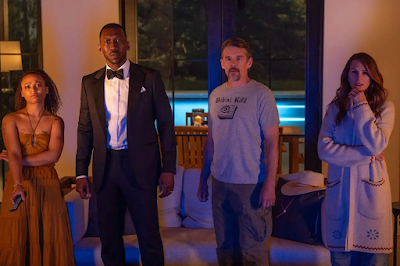
I love post-apocalypse stories. When I first started reading Harlan Ellison, one of my favorites of his work was A Boy and his Dog, which is set in America, post-nuclear disaster. One of my favorite films at a young age was John Carpenter's Escape from New York. When I first started running RPGs, my favorite setting was Gamma World. It's safe to say that I'm a child of the Cold War. So, when I heard that there was a film on Netflix that was really popular and that fit those themes, I was definitely interested. Unfortunately, that film was Leave the World Behind and it was a failure on so many levels that it's just about arcing toward the sublime.


Every science fiction premise needs some level of suspension of disbelief. You have to be willing to accept the conditions that make up the world in question, whether it be the talking plants and fusion rifles of Gamma World or the island of Manhattan as maximum security prison of Escape from New York. The basic premise of Leave is that a cyberattack has crippled the power grid of the eastern seaboard of the US and all of the problems that ensue following that, including many that have little to do with a fairly believable scenario like that one, like sonic weapons transmitted over the entirety of Long Island and herds of deer trying to send a signal about this impending doom that's approaching. I mean, those things could be part of our suspension, as well, if they weren't from a different level of sci-fi than simply Con Ed in New York being hacked. But that's where you wonder how this script might have benefitted from a firmer hand that kept it going in a coherent direction, rather than the scattershot approach that later takes hold of it and squeezes hard enough that all of its elements get splattered in random directions, to the denigration of cast and audience.


First off, if a cyberattack did take down enough of society to cause chaos, how (and why) is it that this one section of Long Island was spared? Was it because they didn't want to try to shoot all of the nighttime scenes by candlelight? Or so they could still have a functioning coffee maker in the house so that you'd know people would last two days instead of becoming instantly homicidal? I mean, part of the basis of most adventure stories is that the circumstances in front of us are just slightly different so that our heroes have a chance to do heroic stuff. So, fine. Our characters have power where all of New York City, visible across the river, does not. But then we discover that it may be beyond just power grids, in that satellite networks are down, so that planes and ships no longer have functioning navigation systems. But, of course, they still have functioning engines and ways to turn them off or keep them running, so why are ships beaching and planes crashing? And why is the latter only happening 18 hours after the initial shutdown when one of our heroes is walking on the beach? Said hero, G. H. Scott (Mahershala Ali) is an investment banker with high enough contacts to know one of the Illuminati who has offhandedly warned him that this disaster is coming. Scott, of course, dismisses the idea of the cabal that rules the world but also repeatedly reinforces the idea that such a thing exists. So, which is it? If writer/director Sam Esmail was trying to avoid the historical racist implications of that theory, he wasn't doing such a great job of it. Instead, he veers right into hitting us over the head with the overt racism of Amanda Sandford (Julia Roberts) when confronted with Scott and his daughter, Ruth (Myha'la) returning to their home which the Sandfords have rented. I mean, yes, the problem of inherent racism drives a large portion of American cultural relations and politics, so you don't really have to be that heavy-handed with said message. Amanda is borderline shrewish when conveying her distrust of the Black people in the house (their house, which she clearly doesn't believe because, you know, they're Black...) with her children.

Yeah, I can't believe how dumb this is, either.

But then we have all of the other more obvious story points that simply don't mesh with our aforementioned suspension. Why does Archie's (Charlie Evans) lyme disease take hold overnight and become worse than any version of that disease ever seen? If it is even just lyme disease, why do they think that a couple pills from local survivalist neighbor, Danny (Kevin Bacon), will solve his problem? Why do the local deer seem intent on gathering around just their house and not others? Why do flamingos show up in a Long Island swimming pool? Are these the surrealist components that are supposed to make us as confused as the characters? Why do Amanda and G. H., completely at odds over the situation and their respective identities, suddenly fall into each others' arms and consider cheating on their partners with each other in the space of 48 hours? Why would a man as wealthy as G. H. ever play ball at the local YMCA? There are so many little things detached from reality here that it's difficult to believe that one person wrote it and, if that is the case, whether that person has been outside their home to interact with actual humans anytime in the past few years. Is Esmail an isolationist/survivalist? Even the seeming in-jokes are off key. We see a trashed house with a sign of the previous owners hanging loose that says the home was owned by The Huxleys. If that's supposed to be a reference to Aldous Huxley, I'd have to ask why, given that this is a disaster film. Huxley is best known among his fiction works for Brave New World; a society under total control, not one that is falling apart. Archie walks around wearing an "OBEY" shirt from They Live, which is about the subtle control of society through subliminal advertising, not its collapse from a systemic breakdown.


All of this confusion and lack of direction is reinforced by the melodrama of both the cinematography and the score. The camera did repeated close-ups during dramatic moments, just in case we couldn't figure that out, and then wide pullbacks and spirals from above when action was happening. The score was the stereotypical orchestral crashing whenever a plot point was revealed or a realization was made by any of the characters; often multiple times in the same scene. The whole storytelling approach was amateurish, at best, and didn't convey the idea of a major production that would be carrying the heft of a film with the above listed stars, as well as Ethan Hawke. But, then, Hawke was almost insipid in his contrast to his abrasive wife, Amanda, who was presented in a thoroughly wooden performance by Roberts, which likely wasn't helped by the boilerplate dialogue she was given. Her first lines, when she wakes her husband to announce that they're taking a last-minute vacation and why are spoken like she's reading from a book of middle American homilies about modern society. And, of course, the worst thing about the whole presentation is that it reinforces the conspiracy theories that are rampant today, by suggesting that there may be some kernel of truth to them, if people would only pay attention. What those theories also carry are the racist overtones of anything similar to the Protocols of the Elders of Zion, which is kinda how this feels when you see the upper middle class White family having their vacation disrupted by all of the surrounding events (and Black people!)
It's just trash, beginning to end, and in no way worth your time or attention.

Tuesday, October 3, 2023

Trying too hard to be something different


It's been a few weeks. There hasn't been much playing at the Michigan Theater that's been particularly interesting, so we've mostly just been watching TV on Tuesdays. But there hasn't really been much of that that's particularly compelling, either. We've had the misfortune to see a film that we were hemming and hawing about seeing at the Michigan and also another Apple+ TV series that is ending up like all of the rest of them, other than Severance.

The film was Bottoms; another Emma Seligman feature that is the follow-up to her fairly-entertaining Shiva Baby, which we did see and did enjoy, but wasn't compelling enough for me to sit down and type out a couple thousand words about. It was originally a short film and then was popular enough to become a long film and didn't really benefit from the necessary padding of the script. Meanwhile, Bottoms, which stars and was co-written by Rachel Sennott (also the lead in Shiva Baby) is one part bog-standard teen sex comedy and one part parody of same. The characters are all hyper-realized stereotypes of those idiots you detested in high school, except for the main group, which is the poor nerds that somehow end up with all of the girls. At any moment, I was waiting to hear Robert Carradine's bellowing laugh erupt from one of the women that mostly occupied our time. But the problem, of course, was just that: We've seen all of this before. Many times. None of it is new. None of it is original. None of it is really that funny. The only difference here is that both leads (the other being Ayo Edebiri, best known as Sydney from the spectacular The Bear) are gay. That's a nice acknowledgement of modern viewpoints and the identities that many people had even back when you and I were in high school, but it doesn't make the tired plot or screenplay any better. It just makes it an even more obvious retread with some modern window dressing to try to sell it to new audiences (much like Bros.)


Seriously, the summary offered by Rotten Tomatoes (where the film has a 93% approval rating...) is "Propulsive and over-the-top, Bottoms is an instant high school comedy classic that feels both current and nostalgic." I can assure you that there's nothing inherently "propulsive" (whatever that actually means) about it, especially when it comes to the leaden predictable plot. That, of course, is probably what makes people feel "nostalgic" about seeing the same thing they've seen since the 1980s introduced us to Porky's. I'm sorry to say that nostalgia was not the overarching feeling I was getting. It was more like boredom. And, of course, the "current" part was, again, likely down to the fact that many reviewers seem smitten with the idea of gay people being something original in storytelling when they should just be regular people in a decent story, if one were being told. If they wanted to make a film about being LGBTQ+ in high school, then they could have written a script that fully engaged that topic, rather than simply using it as a note of "modern" difference from the almost 40-year-old Revenge of the Nerds. There really was nothing that made this film stand out- script, direction, performances -from any of the dozens of lookalikes over those past four decades, which is really disappointing after the solid films that we've seen both Sennott and Edebiri (Shiva Baby, Theater Camp(!)) in this past summer. And, yes, I should get around to writing something about The Bear.


Until then, I'll have to content myself (and you) with writing about Apple+'s attempt to be different in a similar failing fashion to Bottoms. As noted, other than Severance, the offerings on Apple+ have been pretty subpar for any number of reasons. The problem with our latest attempt to find something interesting, Invasion, is also one of trying too hard to stand out from the crowd and missing the target in the process. Just from the title, you're automatically aware that the series is about an attempt by little green men to conquer/eradicate/make aggressive contact with/something-as-long-as-it's-violent our little green world. Again, this is a plot that goes back to H.G. Wells at the end of the 19th century (War of the Worlds is 125 years old this year, in fact.) However, in this case, rather than show the snake-necked saucers of the Martians laying waste to the countryside, through the three episodes we've watched, we've seen the presumed aliens once, for about 15 seconds. In their place, we've gotten four stories about emotional and personal loss that just happened to occur during this supposed crisis.


We have the estranged former doctor who gave up her career to be the perfect housewife; the career soldier wrestling with the effects of distance from his own marriage; the fragile schoolboy dealing with bullies and absent parents; and the brilliant engineer who is enduring her first long separation from the love of her life, driven by their mutual careers. Again, all of these are themes of emotional and personal loss and all of which are completely ancillary to the ostensibly overarching theme of an alien invasion. Any of them could have happened in the midst of any other kind of disaster (pandemic, terrorist attack, worldwide forest fire) and any of them could simply have been happening on their own, no crisis required, such that the focus of the show called "Invasion" isn't any SF element at all, but simply the angst of these people going through their personal problems. But all that does is make a footnote of what is supposedly the central thrust of your story. Said invasion is a background element, at best. I think the idea was that they'd tell the story of a "war of the worlds" at the ground level, by showing what happens to these normal people facing normal problems who are suddenly thrust into extraordinary circumstances, akin to the classic Alien. But all they've done is provide a veneer of SF to a pretty standard melodrama; to the point where you wonder why it's considered speculative fiction at all.


Now, I was just complaining about seeing the same, old thing and, certainly, we've seen a few hundred alien invasion-type films and TV series that put our (human) heroes in trying times over the years, from ongoing wars like Battlestar Galactica to plain, old Earth-gets-firebombed stuff like The Tomorrow War. None of that is particularly exciting or original anymore. But none of them try to pretend they're something they're not in the hopes of approaching it from a nominally original angle, either. All of the stories and characters (and performances) in this show are interesting enough. It's not been boring. But it could have just been titled "Four Stories of Loss" with any of the premises mentioned above (jokes or not) and we would have had the same result. But we came into this with the idea that this is about an ALIEN INVASION and instead it's about a lot of longing (and appropriately plaintive looks) for when things can be "normal" again; presumably post-divorce, post-mourning, and post-getting back to primary school before someone kills you and takes the conch. Clearly, they've tried to slow play this as a different way of approaching the stereotypical assumption that many would make and that's all well and good. But it also sets up the viewer to be disappointed as we wade through the emotional debris and wonder what visitors from other worlds have to do with any of this or why they'd bother. We're probably not going to anymore, either.

Wednesday, April 12, 2023

Putting on airs


I generally like biopics. I also like most of what Ben Affleck and Matt Damon have done in their careers. So when I heard that Air was being produced by their company (Artists Equity) with Damon in the lead and Affleck supporting and directing, I expected something that was fairly high quality. And, in a lot of ways, it was. It's well-written and well-acted and funny and fairly drowns itself in 80s references contemporary to its 1984 setting, much of which I still vividly remember. But... (and there's often a "but") the downside is that it's basically a hagiography of a major corporation, not a biopic. In this story, Nike is the valiant "little guy", oppressed by the economic power of behemoths Converse and Adidas. Of course, no one with any common sense believes that that's the case and Affleck as Phil Knight and Damon as Sonny Vaccaro even mention at some point that Nike is a billion-dollar corporation. Excuse me for a moment while I search for the Davidian analogy in this supposed shepherd v giant warrior tale about the basketball shoe market because it's pretty hard to find (incidentally, the biblical David was a royal armor-bearer and one of the favorites of the king, too.) So, you're saying a billion-dollar corporation is outmuscled in one aspect of the shoe market by a couple of multi-billion dollar competitors, all the while utterly dominating an even larger facet (running shoes) of the American market? My heart bleeds. And that's the essential façade that all of the clever writing and solid acting and funny moments really can't get away from.


The basic ethical premise that the film tries to push forward is that the players were getting cheated out of value by the major shoe companies, as they were essentially free marketing for said companies by playing in the NBA, and the deal that Michael Jordan struck with Nike (that he gets a percentage of every shoe with his name/image on it) was groundbreaking and turned into a bonanza for the players. When it comes to labor being delivered the value that it creates, your friendly neighborhood Marxist is all about it, even when said labor is an elite subset of individuals on the planet. They're doing a job. Their names and likenesses are being used to push a product. They deserve a piece. The situation that the film presents in 1984 is no different than what the NCAA is trying to hide from and has hidden from since the 1950s. But the film presents all of this in the context of that "little guy" triumphing over unassailable odds with just gumption and hard work, when the truth was that Nike, given its profitability, had massive resources at its disposal. If they wanted to do a triumph of the little guy story that involved Nike, they could've done one about Phil Knight building the company by selling shoes at track meets out of the trunk of his car (which is, of course, mentioned in the film because, you know, "little guy.") If they wanted to do a story about the determination and vision and principles of Sonny Vaccaro, they could've done an actual biopic about the latter's work as a scout who created the first national high school all-star game or the creation of the ABCD camp, also to showcase high school players, or his personal drive to expose the hypocrisy of the NCAA which he's been talking about for the last 40 years. You want a story of triumphing over long odds? That sounds like a much more suitable premise.


Despite its structural failings, the film isn't actively bad. As noted, it's well-written and quite funny and Damon makes the most of the material he's given. Similarly, Jason Bateman does well as marketing exec, Rob Strasser. He's also, unfortunately, given the softball of muttering about just how important it is that he hold on to his job as one of the top executives in the billion-dollar corporation so that he can continue to bring his daughter shoes on his weekend visits. It's a sappy moment that doesn't really bring much to the overall proceedings. Speaking of which, Affleck's depiction of Knight, while decent, also doesn't bring much to the stage, as his role is to basically be Damon's constant foil, only gesturing over his shoulder at the oft-mentioned "board" and how they won't be interested in throwing away money on this basketball thing. The subtle racism of decrying the sport played by mostly Black men by the company that produces shoes for mostly suburban White people is a constant. And Viola Davis is her usual competent self as Jordan's mother, Deloris, whose steely determination to not have her son taken advantage of by these massive corporations is also everpresent. That depiction of background racism comes to the fore when Sonny visits good friend, George Raveling, who tells him about how he was not only present at Martin Luther King, Jr's speech at the Lincoln Memorial ("I have a dream"), but met King and was handed one of the original copies of said speech. Of course, when that's framed against Sonny's vision of Jordan and Nike's future, such that the film essentially compares the gamble of a talent scout on a shoe deal to the most famous speech of the American civil rights movement, you begin to see how self-important the producers' opinion of their own efforts happens to be.


Speaking of which, while I thought Affleck's direction for Argo was brilliant and thought he was unfairly robbed of at least a nomination for that work, I was left with a lot more questions in that respect with this film. He seemed to have a thing for close-ups, so that when Sonny and Rob, for example, were arguing over the budget or whether Sonny was doing his job properly, we would often be resting right on one of their shoulders or so close that we could map the pores in their faces while they half-shouted at each other. If Affleck was trying to show us how intense man-to-man defense can be in the lane, well, OK, but it left me feeling like he was engaged in what he thought was a novel technique to convey the tension of the moment but it really ended up being more distracting than anything else. And it was that kind of distraction that made me feel like all of them had kind of lost the forest for the trees. Yes, it's an amusing story, but signing a big shoe deal with an NBA star doesn't quite compare to the struggle to be treated as a human being. Similarly, when the "what happened later" captions appear on the screen, they continue to try too hard on behalf of Nike by pointing out that Phil Knight has given almost $2 billion to charity. Of course, he also ran a corporation that utilized child labor for a couple decades in Southeast Asia to ensure maximum profits on all of the products that it made, including Air Jordans. It took a lot of public pressure and an assertion of rights by workers in those countries to get that to change. So, yeah, economic rights were won for star basketball players, but not for Vietnamese kids. Hooray? And during this period, Nike went from a billion-dollar corporation to a multi-billion dollar corporation, eventually buying Converse, as the similarly self-satisfied caption details at the end of the film.


So, yeah, I don't know. Again, it's not a bad film. It's just kind of shallow on many, many levels. In a way, it's a perfect encapsulation of the decade that it spares no effort to hail and lionize. Would I rush out and hand more money to a giant corporation (Amazon) in order to see it? No. But if you want a few laughs, you could do a lot worse.

Sunday, January 23, 2022

Two mehs and an old favorite

We've watched a few things in the past couple weeks and I thought I'd cover each of them in brief here because I didn't feel like I really had enough to say about any of them in a longer post.


Starting with the good news, we saw Joel Coen's The Tragedy of Macbeth at the Michigan Theater. Macbeth is probably my favorite work of Shakespeare's, not least because I've performed it twice; once in high school and once with a tiny theater group while I was at Michigan. I was the lead in both cases (which is part of why I did it the second time, since I had the experience.) On top of that, with one half of the famous Coen Brothers manning the helm, I figured it was going to be a worthwhile effort and I wasn't disappointed. Like most modern productions, they cut some lines but still preserved the important moments and elements of the story. Unlike many modern reproductions of The Bard, they stuck to a very minimalist presentation, as if we were watching it on stage and the sets could only accommodate what "real life" allowed for. Filming in black-and-white while keeping a high level of contrast between background and foreground was smart, as the story is very much a contest between the dark and the light, albeit with shades of gray. Frances McDormand was excellent as Lady Macbeth, being cunning and scheming without being comedically so and then recognizing their failure and doom without being melodramatic about it. Denzel Washington made me question his selection early on, because he was carrying the intensity (the same that he used so well in Flight) that one is accustomed to seeing in the later, clearly dropping-to-madness Macbeth. But the role is one of Shakespeare's that is perhaps open to some of the widest interpretation and it's fair to ask whether Macbeth was actually unstable from the opening page and the encouragement of his wife was just the final straw that led him to derangement. In the later scenes, of course, Washington excelled at being the villain who still draws sympathy from the audience for the way fortune turned against him ("Out, out, brief candle!") Alex Hassell was also great as the opportunistic Ross and furthered Coen's presentation of the material as spooky and uncertain throughout. Well worth it, even if you're not really a fan of The Bard.


But then we stayed in roughly the same time period and watched The Last Duel. My dismay at the descent of Ridley Scott from storyteller to spectacle ringmaster has been mentioned here before. He's drawn back the reins a bit in recent years, but the focus of his films is still more about making a visual splash than actually telling a story or making a point. He picks a solid framework this time, based on a book about the duel between Jean Le Carrouges and Jacques Le Gris and retelling it in a style reminiscent of Akira Kurosawa's classic, Rashomon. Given that the latter is perhaps my favorite Kurosawa film, one would think that I'd be the prime audience for this one. But the truth is that the story is essentially a medieval soap opera and the entire scenario lacks the basic question presented by Rashomon, where "truth" is a matter of interpretation and perspective. In Last Duel, there is only one basic truth: Marguerite was raped as the most prominent example of the misogynistic nature of medieval French society. You've seen the basic "truth" of the matter as soon as you get through part one, the tribulations of the vainglorious Le Carrouges being just window dressing to that fact, and then you have to sit through two more versions of it which tell you the same thing. There's a bit of titillation so that people can discover the fact that, yes, society was every bit as oriented around sex and ferocious violence as it is today. And due credit has to be extended for the careful attention paid to individual fighting styles, as the fencing techniques employed in the titular duel were appropriate for the time. But the mass combat was, as usual, subject more to Hollywood tropes than reality and despite Matt Damon doing well as an egotistical knight and Ben Affleck likewise performing well as the contemptuous (and frequently contemptible) Count Pierre d'Alençon, there really isn't a whole lot here that you wouldn't have seen on Days of Our Lives with more misogyny and plate mail and certainly not something that should've lasted two-and-a-half hours.


Similarly, Bob Odenkirk's Nobody is essentially a 5-minute skit stretched out into a 90-minute film. There simply isn't enough story here to turn into a feature film. Maybe it would've been better on something like Black Mirror, except that Nobody was a film where thinking was definitely not required and, in fact, was better if you didn't try. There are so many plot holes and moments where suspension of disbelief isn't just lost but is dropped down a very deep hole, never to be found, that the whole thing becomes an exercise in topping the excess of violence that passes for today's action films and, in fact, attempts to top itself from moment to moment. The inclusion of such regular action stars as a much-heavier Michael Ironside, a much smaller Christopher Lloyd, and a not-actually-seen-until-the-last-10-minutes RZA does nothing for the film, although the latter's inclusion at least provided some much needed moments of levity amidst the barrage of angst and shell casings. That's something that Odenkirk normally would have provided, but this was clearly an attempt to "do something different" as an exception to his usual roles. Unfortunately, it didn't really do anything at all. You'd be missing nothing except the greater desire to see Better Caul Saul finally return.