Showing posts with label directors. Show all posts

Friday, June 7, 2013

The riddle of Scott

Ridley Scott was once one of my favorite directors and he's still a pretty respected name in the industry, but largely for films I consider to be nowhere near his peak. Like John Carpenter, Scott is one of those directors whom I feel lost his way somewhere along the course of his career. If one defines success as making a ton of money, he still does that and does it better than ever before. If one defines success as making memorable films, one of his most lauded, Gladiator, appeared well past the point where I had abandoned his efforts as far less than his earlier achievements. In fact, Gladiator won him the only Academy Awards that he currently holds (of course, James Cameron swept the Oscars for the execrable Titanic...) What disturbs me about most of Scott's material, post-Thelma and Louise, is his placement of spectacle over story. When explosions and hundreds of extras are a replacement for solid writing and intriguing plot, you have what Scott has largely become and what Hollywood tends to be in love with: Big Summer Blockbusters!!!... that, of course, reside in one's memory for only about a week until the next Big Summer Blockbuster!!!


His early films, on the other hand, hold a place in the audience's memory because of the enormous attention to detail that was taken and the often gripping performances by the cast whom were given miles of story and nuance to work with. The Duellists is a fine example and Scott's first major film. The plot itself seems simplistic: Gabriel Feraud (Harvey Keitel), a dedicated duellist in Napoleon's army takes offense to Armand d'Hubert's (Keith Carradine) attempt to arrest him for his activity and, of course, challenges him to exactly that proscribed activity: a duel. When they're unable to complete the first encounter, Feraud makes it his life's mission to salvage his honor by finishing a duel with d'Hubert. The essential crux of the story is that Feraud and d'Hubert's personal contest is framed against the ongoing political situation in France. In fact, their series of duels is shaped by the success and final disastrous failure of the Napoleonic regime, including being on opposite sides of the Loyalist/Bonapartist divide upon the general's return from Elba. It's a story about personal ambition as one small part of a nationalist ambition; a drilled down focus, as it were, on the life and culture of the times in the officer corps.

Indeed, the film is most often hailed for its remarkable attention to detail in costumes, hairstyles, and fencing styles. It's that detail, that sensation, that atmosphere that tends to define Scott's early works when it was clear that he was determined to give the whole broad picture, even as he was focusing on the small interactions between characters. Focus in the pacing sense is also mirrored by the cinematography, as he demonstrates what would become a Scott trademark, in showing regular action from a distance and a tendency toward broad establishment shots that help set the mood of the scene. For a film based around the idea of personal combat, the action is genuinely secondary to what is motivating the characters; most notably d'Hubert, who wants nothing to do with the entire concept and yet is inevitably drawn into it by a variety of circumstances. On the one hand, I do think it deserved the Best Debut prize at Cannes. OTOH, it does carry that veneer of angst that colored many films of the mid- to late-70s.


His next notable work, however, was an example of a filmmaker and a studio defiantly stepping away from the order of the day and producing a film that stands out as one of the finer examples of science fiction filmmaking in the modern era. This was 1979, 2 years after the emergence of Star Wars. The proliferation of laser blasters and outer space explosions had spread to every corner of the film world, including James Bond. But not here. In Alien, Scott not only presented a less hyperkinetic situation, but he did so with characters that were industrial workers in an industrial world. No one was weighed down by prophecy or besotted by privilege. These were normal people doing a normal job who just happened to run across extraordinary circumstances. Furthermore, the story didn't start and stop with the unusual situation. Their interactions were about payment shares, command issues, ship security, the food, and everything one might normally discuss in an ore trawler heading back to Earth. And, again, the attention to detail is part of what makes the story work. They acknowledge the actual science of space travel by the very tagline of the film ("In space, no one can hear you scream.") Much time is taken showing the descent to the moon to answer the distress call and the difficult conditions on that moon. Again, the broad establishment shot of the descent gives the viewer time to appreciate the magnitude of the undertaking and how it's being engaged as much as the broad shot of the interior of the alien craft allows the impact of the moment and the age of the ship itself to become noticeable to the audience. In both cases, Jerry Goldsmith's score is brilliant, as well.


Notice how Scott doesn't end the action while he pulls back. There is no orchestral crash and a camera freeze. He just lets the continuing motion of the crew crawling into the chamber and the echoes and the brief, static-shrouded comments on the radio set the tone. In other words, he lets the scene play. It's wonderfully moody stuff which is exactly what the moment calls for and which would probably be hammed into irrelevance by many other directors, desperate for a "Wow!" moment. Scott, at the time, let the story tell the tale. Just as important, he let the undercurrents of the plot (the fact that Weyland-Yutani was willing to sacrifice them all and Ash (Ian Holm) was their tool to ensure it) appear without added emphasis. The audience was allowed to absorb the lines on Mother's screen and the actors' reactions without encouragement. Likewise, even in the charged moments where characters like Ripley (Sigourney Weaver) are frantic or yelling, he doesn't let that energy overwhelm the pacing. It's a restraint that is emblematic of his direction in those earlier years and which, sadly, was later lost.

What followed was a film that Scott has declared his "most complete and personal" and is one that I think is the finest science fiction film ever made and one of the best, regardless of genre... with a caveat.
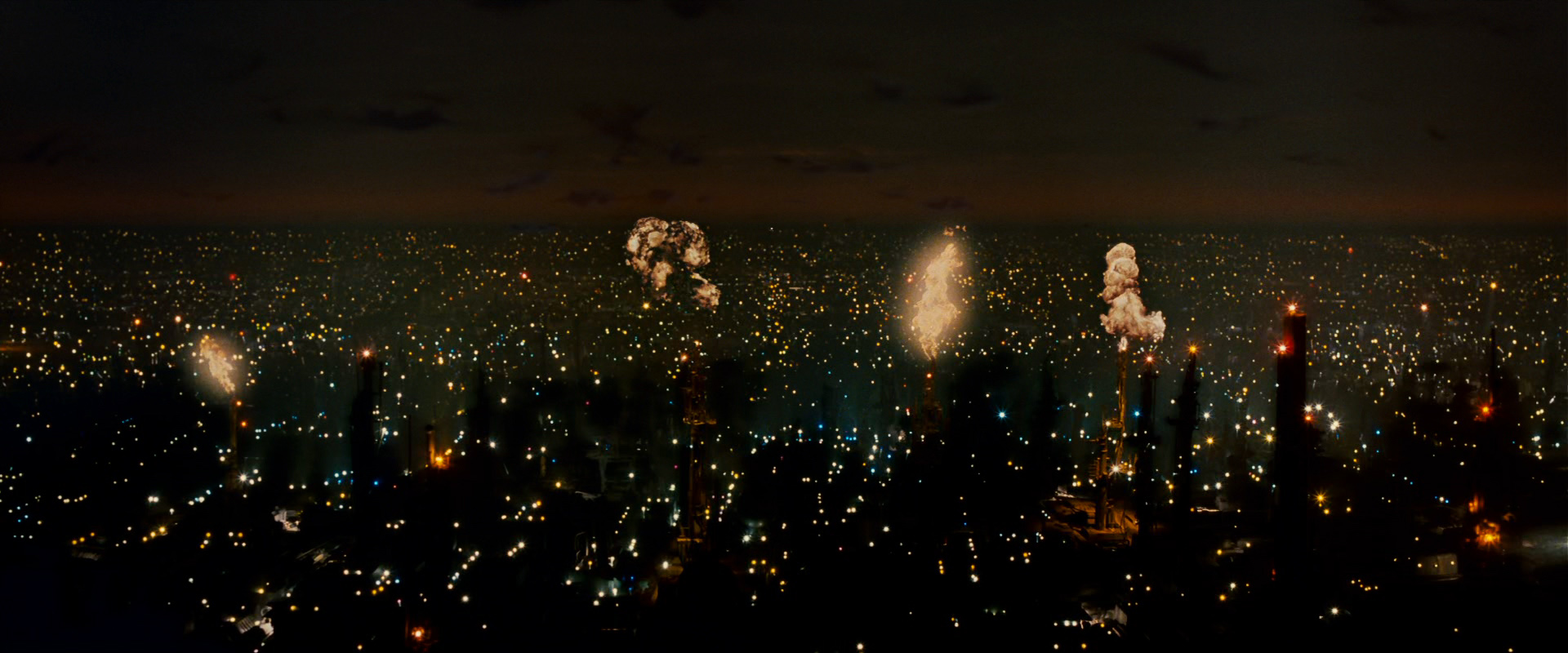

Blade Runner, based on Philip K. Dick's Do Androids Dream of Electric Sheep? broke ground in many ways. Once again, it strayed from the prevailing SF model of the time, with the armadas and the armor and the lasers. Instead, it went back to a Dashiell Hammett-model of noir and used a plot of unusual thematic complexity, not only for SF of the time, but for Hollywood in general. It also, as originally cut, spent a lot of time allowing the audience to simply absorb the visuals presented to them. As film is a visual medium, one would think this would be natural, but it's rarely the case in major cinema that what is presented on screen can go unaccompanied by someone yakking about this or that element of the plot and/or the characters' reactions to what is happening right in front of them. Have an exciting car chase? Don't forget to interrupt it every 15 seconds to show the hero yelling "Oh my God!" when something else blows up. There was none of that here. We're shown vistas of Los Angeles, the towers of the elite, and the alleyways of the downtrodden, including where those who form the foundation of the elite's wealth also live. Statements are made about the future and about now, all by only what appears on the screen (along with, of course, Vangelis' brilliant score.) And here comes the caveat...

Because the version I'm speaking of is the so-called "Director's cut" as originally presented in the early 90s. Scott originally shot the film without Deckard's (Harrison Ford) voiceover, with Deckard's dreams about the unicorn, and without the tacked on Hollywood ending where he and Rachael (Sean Young) drive off into the test audience-pleasing sunset. Instead, the original cut ends with Deckard picking up the origami unicorn in the elevator and remembering Gaff (Edward James Olmos) shouting "It's too bad she won't live! But, then again, who does?!" Just that moment leaves open the essential questions that the film asks (and which Scott lets it ask) about creation, humanity, life, and perspective. Warner Bros., in its inimitable wisdom, distorted the theatrical release because it was afraid that audiences wouldn't understand those questions, but that's precisely the point: people aren't supposed to understand them because understanding implies answering and some questions aren't meant to be answered. They're intended to be posed and left to each individual to answer in their own way. Scott let those questions be posed and the studio butchered that process. Thankfully, the directors' cut release later ameliorated this to a certain degree and there are now seven different cuts of the film, happily released by Warner Bros. to cloud the issue even further. Hooray for Hollywood.


This clip is a great example of Scott's restraint, in which Deckard callously reveals to Rachael that her existence is a lie. She digests that while he transitions from thinking of her as an object to a person that has feelings (something he often lacks and the source of the popular theory that Deckard is so good at "retiring" replicants because he actually is one.) The camera is very patient, watching the changes come over them, and not changing pace even as the facts are revealed.

This trio of films marks the high water period for me in Scott's career. The attention to story, detail, pacing, and atmosphere are brilliant examples of filmmaking. There is an argument to be made that working with good material often produces good films. In the case of The Duellists, the inspiration was a Joseph Conrad short story, The Duel, in the same manner as Blade Runner. But Alien was an original screenplay; certainly a good one, but lacking a foundation in the "higher" medium of literature. Granted, he also benefited from such things as the artistic inspiration of H. R. Giger in Alien and that of Syd Mead in Blade Runner but it was the use of those visuals to tell a complete story in both cases that shows the hand of Scott most prominently. Indeed, later in his career, his films are still celebrated for their impressive visuals and set design. They're just used to enhance the spectacle, rather than the story.

Following that trio, Scott perhaps saw a route by which he could be deemed more successful (none of the three was a major hit; Alien doing the best) and began to conform to more Hollywood-like expectations with films like Legend and Black Rain. The latter film especially begins to show signs of formula in the, by then, tried and true Dirty Harry style. But they were also only moderate successes at the box office (at best) and he really didn't hit his stride, fame-wise, until the release of Thelma and Louise.


This was Scott's last truly daring excursion in topic matter as the film took on the subject of gender politics in a rather (ahem) direct fashion. It was reviled for that by some audiences (because, you know, there ain't no justice for you if you're male (and, even better, white) in this world) but became an instant hit because of not only the controversy, but the powerful performance of the two female leads, Susan Sarandon and Geena Davis. In contrast to the aforementioned moody pacing, Thelma and Louise was a very bright and very aggressive story that Scott told in a rather hasty fashion. While it still falls into some degree of formulaic approach as a Hollywood "buddy" film, the fact that he was willing to be that aggressive on what remains a touchy topic for the hierarchy, as well as end it in a very non-Hollywood but story-justified manner makes it the last really good film that he has completed. One other element of the film is telling in Scott's career: for as fast as the story is, he takes over two hours to tell it. This became an issue in many of his later films.

The decade of the 90s produced nothing of any particular merit for Scott but what became his most famous film emerged in 2000 in the form of Gladiator.
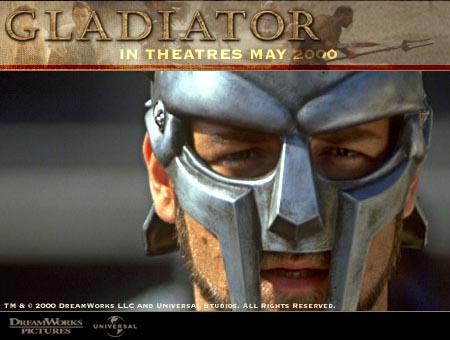

Gladiator is Scott's most-heralded film and is almost universally loved except for those of us who bemoan the lack of actual storytelling in favor of explosions (Why are there explosions in ancient warfare? Hey, watch it and try to suss that out for yourself if you have three hours to spare.) This is the primary example of what became Scott's trademark for the past decade: glitz over substance. He had a wonderful cast (Russell Crowe, Joaquin Phoenix, Connie Nielsen, Oliver Reed, Richard Harris) and a wealth of background to work from. I'm an acknowledged fan of Roman history and there are great stories to be told (and retold) and you can do it without inventing anything to go along with them. This holds true in non-fiction, as well. Want to read about the Gallic Wars? Read the book by the man who conducted them. Scott decided to take a fictionalized scenario, add historical trappings to it, and then proceed, which is all well and good. But the fact is that the story itself is completely linear and asks almost no questions about its own or our modern circumstances and can't even be used to draw parallels to modern culture. It's a cipher, used mostly to show off Crowe's talent and employ hundreds of extras (real and CGI) to create a spectacle. It unintentionally draws an object lesson about itself and the old "bread and circuses" aphorism, in which modern audiences will swallow anything completely thoughtless as long as you have big battle scenes.


But that in itself is almost a betrayal of Scott's earlier and respected tendency for detail because much of the battle scenes don't even make any sense. Unlike The Duellists, the costuming is largely wrong. No one used siege engines in a field battle. No one sane conducts a full cavalry charge through dense forest ("Hey! Your horse just tripped on that root... and you're dead.") Roman infantry tactics are completely ignored in favor of Hollywood-style single combat (among thousands of figures.) At the same time, the original script called for the gladiators to promote various products from the floor of the arena - which is what actually happened, in the same manner as former NFL stars boosting beer or razor blades during games - but Scott rejected the idea because he thought audiences would find it hard to believe. So, catapults and explosions are believable enough, but stuff that actually happened is beyond the pale. Check. This is where story (even HIstory) gets abandoned to make a bigger splash on the screen. This is where a director's previous work, now highly respected and immortalized for its subtexts and meanings, gets abandoned so millions can be made with tigers and trapdoors. In many ways, Gladiator is remarkably similar to The Duellists, in that it's about the driving obsession of one man indexed against the larger politics proceeding around him. The problem is that the later film utterly lacks the dramatic depth of the previous one, no matter how good the lead actor was and is. Furthermore, Scott took almost three hours to tell a story that could have been done in half that time. I was not entertained.

Scott also began to trend in an odd direction for a filmmaker who earlier seemed to favor projects that questioned cultural tendencies in that his work post 9/11 began to be almost a series of cheerleading escapades for US foreign policy, like Black Hawk Down, Body of Lies, and, most notably in a cultural sense, Kingdom of Heaven.


Once again, we see the travails of a lone hero in the midst of political and military activity that largely revolves around his Joseph Campbell moment, which is fine. It's bog-standard, but fine. The problem here is that, unlike Gladiator, where Scott shied away from the history to keep his story sound (the prerogative of any creative storyteller), in Kingdom he simply ignored it. What makes it even worse is that he employed a far lesser talent to try to carry the central role. If you're going to abandon history to tell your story, at least make sure you have an actor capable of telling it. Orlando Bloom is not that actor, even while surrounded by an otherwise excellent cast (Vera Green, Edward Norton, Ghassan Massoud, Jeremy Irons, Liam Neeson.) Furthermore, if you're going to take advantage of that cast's talents, you're better off doing it in your previously heralded moments of patient cinematography, rather than following the standard Hollywood route of quick cuts between mass actions, interspersed with your lead's anxious relaying of just how the battle is proceeding, which we've already seen in the five previous cuts.

Incidentally, I realize that not everyone is as interested in historical veracity as I am and, as noted, I certainly acknowledge the right of people adapting history to take liberties with it to make a story flow better (While Commodus did fight in the arena, he didn't die in it, but was instead strangled in his bath; that really would have let the air out of that scene.) But there are limits to all things. The city of Jerusalem is arrayed on a number of hills. That's part of why the city emerged as a trade and, later, cultural and religious center. It didn't sprout like a lone cactus as the only feature on the frying pan of the Negev as depicted in Kingdom. But, of course, a flat, open plain is the best way to show medieval trebuchets bashing through walls like a modern howitzer would, right? Except that said devices were never that powerful and both modern howitzers and medieval trebuchets hurl objects in a parabolic arc, so neither would function in the way the action is shown in the film. But that's OK because EXPLOSIONS! And, in direct contrast to The Duellists, the fencing techniques in the film weren't actually developed for another four hundred years.


But most damning (heh) of all is the fact that, in the end, there's no there there when it comes to the story. The film would have been far more interesting (and been carried better by its lead) if it had been about Ed Norton's role as Baldwin IV, the leper king. Instead, we got Balian, the common bastard blacksmith (he was actually one of the most powerful nobles in the Crusader kingdoms) becoming a hero for the ages and requiring a level of suspension of disbelief akin to what's required to believe in Genesis. There was no foundation to support that disbelief and, yet, Scott blamed the mediocre reception of the film on the fact that the studio had hacked it down to an hour-and-a-half adventure tale when he wanted to tell a three-and-a-half hour historical epic with the same flawed story. I've seen the director's cut. It does not rescue the film.


American Gangster has a similar problem. Here you have Russell Crowe and Denzel Washington. With those two actors, you should be able to work some real magic, right? Your basic plot is the gritty 70s (Mr. Tarantino to the white scriptwriters' phone!) and one of the most audacious drug rings ever known, in which kilos of heroin were allegedly shipped in the coffins of American soldiers coming back from Vietnam. I'd give a couple fingers to have the chance to write that story. But what comes out of it? Glitz, flash, and almost nothing else. We get a lot of scenes of Washington parading around Manhattan and Crowe doing the stereotypical 70s-broken-marriage-while-Serpico thing... but it's been done. There's no meat there. The film promises much and delivers little other than a sterling performance by Ruby Dee in a very small role. Scott spends as little time considering his characters' reactions to their respective ethical and organizational crises as he does in Black Rain, because it's simply more exciting to follow the action film formula.

Now I'm not even sure he's following any formula. I sacrificed two hours of my life to watch Prometheus because it showed up on HBO the other day. I knew it was awful. I'd been told it was awful. But I did it, anyway, because I'm still hoping for a return-to-Jesus moment even though I long since should have given up hope. It was, of course, awful. He utterly wasted the talents of people like Charlize Theron, Idriss Elba, and Guy Pearce (most people I've spoken to didn't even know he was in the film) and attempted to tell four different stories at once and told none of them decently. Once again, he blamed it on the fact that his original cut was too long for wide release, but one can only make that excuse so many times before people will begin asking why you're allowed to helm the production. I agree that the first compliment given to him for The Duellists 36 years ago remains true today: it was a pretty film. But pretty only gets you so far and eventually, it shows its age. So has Scott, unfortunately. I'm going to go watch Blade Runner for the hundredth time now.

Next: David Fincher.

Wednesday, May 23, 2012

Directors: Recent memories

So, I thought I might look at a director who's been more relevant recently. There are certain people who stick with me out of a sense of nostalgia, in that they were the first to really open my eyes to a certain style or approach in filmmaking. I haven't become as attached to many in more recent years because, in many ways, the Hollywood approach has continued to further poison the well of American cinema (get off my lawn.) There are, of course, standouts as there always have been and Christopher Nolan is one of those.


From his insider-hailed debut, Following, to his groundbreaking wide-release hit, Memento, to the blockbuster Batman films, and through to his pet project, Inception, Nolan has demonstrated again and again that he's not only willing to take risks with his stories and his audience, but to do so with an excellent sense of style.

My first exposure to Nolan was via Memento, which I saw mostly for Guy Pearce, who was great in LA Confidential (and who possesses much the same flair as Nolan; while the film, Lockout, was a rather dreadful re-imagining of Carpenter's Escape from New York, this trailer has everything that you can ask from an actor in Pearce), as I had no idea whom the director was. The story was co-written by Nolan and his brother, Jonathan, from an idea by the latter. Jonathan would go on to co-write most of Nolan's projects and Christopher's wife, Emma Thomas, would also frequently co-produce them with him through their company. Memento is a story about a man whose head injuries render him unable to form new memories, so he's forced to rely on flashbacks to events that took place prior to his injury and a series of markers and notes that he leaves to himself every time he wakes up. Consequently, the story can't be told in a normal linear progression, but has to be relayed out of sequence and, largely, backwards. This in itself requires a great deal of trust between the director and his audience. The fact that Nolan was doing so with his first major release bespeaks someone who has great confidence in his own vision; an aspect that he has continued to reinforce throughout his career.

In the following scene, we're just getting introduced to the chaos that is Lenny's life, as he acts in ways that seem familiar but which have little foundation for him. He fails to understand much of what is going on, which places him in the same boat with the audience, but the method by which it's portrayed is just intriguing enough to keep most hanging on for the ride:


The shift from black-and-white to color, the lighting changes, the isometric viewpoint; all of these are part of Nolan's style of storytelling, so that you can often tell where you are in his films without having to listen to dialogue or have any groundwork laid by exposition. They're also redolent with a comic book-esque approach, which probably explains some of his appeal to me. The importance of memories and how they can be shaped and used is also a theme that Nolan explores in great detail in his other films and, again, is a topic of some considerable interest to me.

In 2005, Nolan launched what would become a trilogy of films with Batman Begins. Obviously, the character has become archetypal in its own right and has been the subject of various media for the past half-century. Rather than overload the character with his own stylistic interpretation a la Tim Burton, Nolan decided to return to the roots of the character and expand on them. In doing so, he borrowed heavily from Frank Miller's Batman: Year One and some of the classic storylines laid down in Steve Englehart's eight issue run on Detective Comics in the mid-70s which has long been lauded as "the definitive Batman" and was used in development for Burton's first film. Nolan's determination to explore the psychological motivations of a man who, with the world at his feet, would dress up as a bat and beat people senseless in order to combat his own personal demons is another example of his willingness to depart from the standard and focus on the mind of his characters. His representation of the Scarecrow (Cillian Murphy) as more psychiatrist than super-villain is an example of that same approach:


Nothing much happens in this scene other than people standing around looking at the ceiling. Just the same, the tension is thick and we never get tired of waiting for something to happen. Nolan's grasp of the material was stronger than any director of the Batman to date, as he was willing to use some relatively arcane details from the character's past (Ra's al Ghul was, until recent years, a relatively unknown villain even to Batman readers; certainly not in the same class as the Joker, Riddler, Catwoman, etc.) Also, he demonstrated his own knowledge of the character by having others refer to him as THE Batman, which makes him more force than human, which is the whole point.

What followed was the most well-received superhero film made to date (although The Avengers may have changed the equation): The Dark Knight. The interesting thing about it is that I don't think it's quite as strong a film as Batman Begins. Christian Bale's performance is a bit on the contrived side, but that's certainly outweighed by Heath Ledger's stunning turn as The Joker. The script is actually more interesting and less linear than the first film, but we're also handed far more and larger explosions and fireworks and gadgets. So, everything is kind of ramped up and it seems like that makes the movie lose a bit of the soul that it had with Begins. But, by the same token, The Dark Knight moves in ways that Begins simply couldn't and the tight pacing and delivery of Nolan's signature style is still plainly evident, as in the opening scene:


Everything works in this scene. The mysterious and ominous music; the rapid but seamless transitions; the exposition presented as shop talk amongst the thieves; and the final, "anti-ironic" (the face behind the mask is still the mask) appearance of The Joker. This is Nolan at his best: it's an action scene for an action film, but shown with so many intriguing hooks that the audience is left wanting more and laughing at the audacity of what is, at its root, a simple bank heist. The same kind of touch holds true in the first clip that began the post; the famous "pencil trick" scene. While, again, I think Batman Begins may have been the better overall film, I think Dark Knight had the better script and the more interesting (and elaborate) story, the credit for which, of course, goes to the director. While it's often an open question as to whether an actor's performance is of his/her own creation or is inspired by the director or both, I think some credit has to go to Nolan being able to extract a performance from Ledger that I thought he was largely incapable of making before I'd seen the film. It was one of the worst moments in recent film history when we discovered that the actor would not be able to reprise this role or continue with any other.

Making a complex story function for the general audience was a hallmark of the other film Nolan released in 2006: The Prestige. While I think the performances were average for most of the cast other than Michael Caine and Bale, the intimacy of the emotional struggles between the two competing magicians was portrayed well and fell short of melodrama most of the time, even if the nominal lead, Hugh Jackman, isn't a strong enough actor to convey all of the intensity that I think his role required. The great camera work of the following scene was emblematic:


As the film audience, we're behind the scenes for much of the story, so we stay intimate with the characters via the handheld camera as Jackman and Scarlett Johanssen prepare to sell the illusion. This is different from this scene, when we're left wondering how Bale's character pulls off his new trick and are, thus, left in the audience. Bale's properly emotionless performance leaves us distant as, for his character, it's all about the mechanics. OTOH, in the Jackman trick, the response is the thing, so we spend a few seconds below the stage while he tries to drink in the applause that should be his. Again, the contrast in lighting and music for the two scenes shows off Nolan's storytelling approach, in that both could be shown almost absent of dialogue and still convey the meaning that the director wants. (It's unfortunate, of course, that the latter scene misses the prestige...)

Finally, we come to Inception. Nolan had written a treatment for the concept in 2001, but felt he needed more experience in production before approaching a project his ambitious (this from the man who presented Memento as his second film...) It's interesting to find someone with that much restraint. There are numerous stories of films that have been sitting in a drawer for years on end because the person wanting to produce them didn't have the right conditions (typically a studio willing to take the project, such as Robert Duvall's The Apostle, which he wrote in the 80s and which finally hit the screen in 1997.) But there are few films that were held back because the producer, with solid credit and support to his name (and a writer and co-producer in the family), was conscious of his own potential flaws. It resonates with me the same way that the story about Orson Scott Card's Ender series does; in which Card had the concept for the third book, Xenocide, well before considering Ender's Game. On the advice of his agent, he decided that he wasn't mature enough as a writer to do the former and, thus, wrote the latter to huge critical appraisal and success.

Inception, of course, is almost solely based on the mind and how it functions. Oneirology and its use in fiction has been a favored topic of mine in similar bent to Nolan's approach. The fact that he chose to combine it with a tense story of corporate espionage markedly similar to William Gibson's New Rose Hotel (which uses the theft of people who have the "edge" gene) but takes it one step further into ideas made it an instant draw to me. Once again, Nolan takes a complex plot and makes it easily understandable for those that are willing to listen (the question of how many appreciated the film for its story rather than its stunning action sequences is up for debate.) Even in scenes that demand exposition, the overall feeling of tension and moodiness in the film is maintained by the anguish and intensity of the lead, Leonardo DiCaprio, as in this scene:


Capable performances by DiCaprio, Ellen Page, and Tom Hardy sell a scene that is a completely foreign concept to most audiences but which feels more natural after it's explained to them (just like a dream?) Inception also had the most frequent examples of a director's conceit that Nolan displays often in previous films: a love for wide-angle establishing shots (big halls, theaters, warehouses, Batcaves, etc.) They serve this film because of the magnitude of the idea that he was trying to convey. While there is some room to criticize Inception for the rapid pace and trend toward explosions even while dealing with a very dense and cerebral (heh) topic (in the same way that the Dark Knight could be criticized for not spending even more time with the fascinating Joker and, instead, spending millions on Batpods and rocket launchers), I think Nolan made the decision to keep the action fairly frenetic for fear of losing the audience that would find a lecture on the meaning of dreams soporific, to say the least. It reminds me of Rick Veitch's venture from innovative work on titles like Swamp Thing and his own Bratpack into meandering around the meaning of his own dreams with Rare Bit Fiends. Incorporating those ideas into other stories would be great. Trying to make a story out of random symbolism and personal anecdotes relevant only to close friends is about as interesting as it sounds. While Nolan could have gone more in a Philip K. Dick direction with the story, I think he made the right choice with a story less about ethical choices than about mysteries that we're all still trying to unravel.

Needless to say, I'm excited about seeing The Dark Knight Rises in a few weeks to see if Nolan continued in the direction of more slam-bang or instead brought the trilogy to a close with a more introspective story about the impact of the character's motivation on the world around him (something which has been handled with lesser and greater acumen by writers of the Batman since the 1930s.) Regardless, I have a hard time seeing how I'll be disappointed. Nex time, I think I'll go back into the past with another "fallen hero", as it were.

Wednesday, April 25, 2012

Directors: He's all out of bubblegum

So, I thought I'd post a bit about some of my favorite directors. There are a couple that have made lasting impressions with a very wide audience over a long period (Akira Kurosawa, Stanley Kubrick), a couple that have become prominent in recent years and have made big splashes (David Fincher, Christopher Nolan), and a couple that I regard as brilliant at an early point in their careers, only to fade to obscurity (John Carpenter) or seemingly resign themselves to Hollywood spectacle (Ridley Scott.) When I write these, I'm going to skip around a bit to cover the films that I think define the director or that resonate the most with me or that perhaps represent a defining moment, either within the scope of the director's normal approach, or as a marked contrast to it. This time I'm thinking about Carpenter.


John Carpenter is one of those directors whose style is often immediately apparent when his films begin. For his first several films, his approach didn't vary overmuch and it worked well for most of the stories that he was trying to tell. It was that style that attracted me to his work and the one I most missed as he moved on to other things. Granted, not everything can be approached with the same Steadicam usage that Carpenter made standard for the horror genre. But, like any actor, it's possible that people will only see you as a "horror director" and, thus, that's all you'll get offered. Carpenter would admit in his later years that many of his lesser productions were the result of being offered nothing else and having to make a living, as it were.


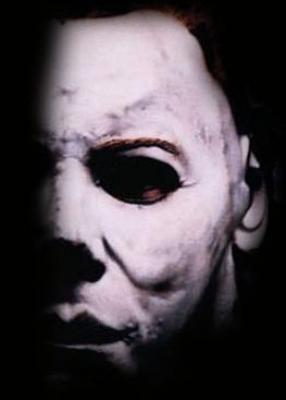
In the horror genre, few faces (well, masks, actually) are as iconic as that of Michael Myers, the implacable killer of Halloween (1978), Carpenter's first big success. While he had started his career several years before and had become a bit of a hero in Hollywood for his film, Dark Star, which has decent production values for a science fiction film produced on a budget of only $60,000, he was still stuck multi-tasking on independent productions in 1978 when Halloween hit the theaters. He directed, co-produced, co-wrote, and scored the film, making it one among his filmography that really resonates with his vision and approach from beginning to end. Halloween emphasized elements that would later become the trademarks of his better films: eerie atmospheres (whether horror or not), wide perspectives, steady and lasting shots, often ambiguous endings, and highly memorable music:


Despite the schlocky set elements (gravestone in the bed alongside the conveniently-lit jack-o'-lantern) and the cheap scares (dead boyfriend swinging into the shot from the closet), there are great moments in that scene: the long take on Laurie as she wails over the death of her friend; the appearance of Michael's face as she steps away from the bedroom and he attacks; his implacable advance down the stairs.) These are all elements that would be often missed in the widespread imitations of Halloween that followed and which created the modern slasher genre. And following it all is the ominous and eerie music, composed by Carpenter. The scene would be severely hampered without it and it's to his credit that he understood where to shift tones and keys to emphasize what was happening on screen. I'm not much of a horror fan and even less of a slasher fan, but Halloween is a great example of Carpenter's grasp of story and pacing.

What followed was one of the greatest cult movies ever made: Escape from New York (1981.)


That poster always amuses me because, in the film, Liberty Island is actually the police headquarters for the prison that Manhattan Island has become and the statue is seen standing, in perfect condition, several times. But I suppose marketers were trying to tap into the Planet of the Apes sensation.

I'm a sucker for post-apocalyptic storylines and Escape plays right into that. Carpenter's tendencies (long shots, spooky atmospheres) are on full display in this sci-fi thriller and he uses a capable supporting cast (Lee Van Cleef, Ernest Borgnine, Adrienne Barbeau) very well alongside his lead, Kurt Russell and, of course, the once-again scintillating score. He originally wrote the screenplay right after Watergate, which explains the heavily cynical attitude toward the office of president and other institutions but, given that the Cold War was still in full flower when Escape was released, it remains firmly enmeshed with the zeitgeist of the times. One quiet scene is particularly notable:


Carpenter doesn't spend too much time on dialogue exchanges in his films, as the action is usually moving faster than exposition would allow for. But there are elements that are key to this plot that need to be sorted out. It also provides a great moment for one of the Western heroes of yesteryear (Van Cleef) to square off with Russell, who was attempting to change his film image to that of action hero (and largely succeeded.) Even in an exchange scene, we can see Carpenter's love for the long shot, as Plissken presents his cuffs for release, and the love for the wide shot, as even while we're looking for Plissken's reactions to Hauk's offer, we stay pulled back from where the former is sitting. I was chagrined to see this Youtube clip end where it did because the next line from Plissken is "Why me?" Hauk's response: "You flew the Gullfire over Leningrad. You know how to get in quiet. You're all I've got."

It was that line, in addition to the commentary about special forces teams ("Black Flag", "Texas Thunder") that later inspired William Gibson to create a major plot element in Neuromancer, the foundation novel of the cyberpunk movement. As Gibson stated: "It turns out to be just a throwaway line, but for a moment it worked like the best SF where a casual reference can imply a lot." Armitage, a major character in the novel, has flashbacks at one point about his special forces unit, Omaha Thunder, running into trouble as they attempted a cyber-assault on the Soviet network (something that, incidentally, is a major element of international competition and espionage today, although less flamboyantly.) These little details are emblematic of Carpenter scripts and visuals and appear frequently in his best films. They're indicative of a director in command of his story and all the little aspects that make up the big picture.

With the major critical and commercial success of those two films, Carpenter had hit his stride and now moved on to a remake of a classic 1950s-era science fiction film: The Thing (1982.)


The Thing holds a special place in Carpenter's career, because it's the scene of what is possibly his greatest triumph and his greatest failure. The Thing has been hailed in the past two decades as one of the greatest horror films ever made but, at the time, it was criticized for being "excessive" and was vastly overshadowed at the time of its release by E. T.: The Extra-Terrestrial. Thus, it ended up being a commercial failure, as the audiences of the time seemed eager for sentimental pap, as opposed to being scared out of the theater (which, admittedly, is not an entirely illogical choice.)

All of Carpenter's usual tendencies are here, but he hired Ennio Morricone (of Man with No Name trilogy fame) to score the film; later replacing some of Morricone's orchestral work with his customary keyboards. The result was not a bad score, but certainly one that was less memorable and less instantly recognizable to fans (and many non-fans) than either the Halloween or Escape themes. Did that have an impact on the film's reception? Perhaps. This was also Carpenter's first film with a truly appropriate budget which, of course, set him up for genuine failure when the film failed to find an audience (The Fog, a film produced in 1980 had decent returns, while Escape returned 7:1 on a $6 million budget and Halloween returned $51 million on a budget of $325,000, making it one of the most successful independent films ever made.)

While Carpenter's film was more faithful to the original John W. Campbell story, Who Goes There?, than Howard Hawks' The Thing From Another World (1951) (Pedantic film titles, FTW!), I think there is validity to some of the criticism about too much emphasis on the phenomenal special effects. There was more attention paid to rubbery creatures than to pacing and atmosphere. Again, a consequence of having more money to play with? Maybe. When you can hire people to do tasks that you once did with the fire of an aspiring filmmaker and throw money at problems that you used to have to invent your way out of, does that degrade the end result?

A great example of that change in approach is in this famous scene, when the creature attacks the dog teams at the base and the crew gets its first real close encounter:


In films like Halloween, the creature would have attacked the dogs off-screen and the noise of their dismay would have alerted the rest of the crew, and not just MacReady. The only visible evidence of the creature would have been right before half of it escaped and the rest was burned. I think the suspense that was built later in the film, as paranoia grew amongst the crew, was just as effective for the story he was trying to tell here. But the opportunity to maintain the suspense of mystery was lost in order to demonstrate the basic weirdness of the creature's shapeshifting ability. It's trending more toward shock value and away from the stylistic approach he had used earlier. Again, it can be just as effective. I'm just not sure that was the case here. All that said, The Thing remains an excellent film and a continuing example of the skill of its director.

The financial failure of The Thing began to affect the kind of scripts that Carpenter was offered. He managed to sign on to Starman (1984) (which had, coincidentally, been chosen by Columbia Pictures over E. T.) and, again, changed his approach and style to a more "mainstream" shoot, as it were, to present what he perceived as a romantic comedy but which actually ran a bit deeper than that and which many critics regarded as one of the best films of 1984; earning an Oscar nomination for Jeff Bridges in the lead. The difference in shot length can be seen in this exchange between Bridges and Karen Allen in a still poignant and well-played scene:


This scene lacks the longer pauses on the speaker which allow the audience to register the play of emotion and allow the actor to fill the scene a bit, as in the conversation between Hauk and Plissken above. It's a subtle difference, but it's an atmosphere changer from what seemed to be Carpenter's intent to add weight to certain frames of dialogue and toward a shoot that requires the actor to carry it alone. Starman was critically hailed but only a modest success at the box office.

Following this was a film that engenders a broad spectrum of reaction from moviegoers and critics: Big Trouble in Little China (1986.)


Point blank, Big Trouble is an awful film. Unless viewed deliberately as a parody (which is certainly possible, although Carpenter has never declared it to be such), it barely approaches the level of B-movie. The script is clunky and linear. The acting is sophomoric. The effects are cheap and obvious. The original script was massively rewritten and the film was rushed into production to emerge before the Eddie Murphy vehicle, The Golden Child, and that sloppy development process shows in every corner and chop-socky scene of this film. Some critics found it "fun", but most found it as horrible as I did. It has, like Escape, became a huge cult hit in later years. Carpenter has said that he took the project to fulfill a dream of doing a martial arts movie but was also relatively indignant about the film's failure at the box office, saying that the studio didn't support it effectively. At that point, he decided that life as a major studio director was no longer for him and he declared that he would only do independent films from then on.

Unfortunately, most of those independent films have been bombs. From more Halloween sequels, to Memoirs of an Invisible Man to Vampires to Ghosts of Mars, none of them have really been either interesting stories on the order of Escape or interesting technique on the order of Halloween. The one exception was yet another film that has become a cult classic, know as They Live (1988):


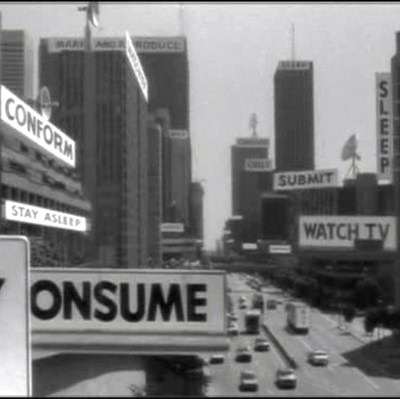
Based on both fictional sources and Carpenter's own growing distaste for the commercialization of society, They Live is halfway between a spoof and a serious science fiction drama. Hyperkinetic in the same manner as Big Trouble, it also tries to deliver a serious message about the danger of a somnolent populace and the influence of the wealthy in a very Fitzgeraldian way: the rich are really different from you and me... because they're aliens and they're still screwing us in plain sight. Carpenter had, by this time, largely discarded his attempts to build atmosphere in exchange for raw message and delivery by the actor. His unusual choice for the lead in They Live was the professional wrestler, Roddy Piper, who did a capable job, given that his role was essentially to be a ham (this is where the film arcs toward spoof) so as to attract as much attention as possible in order to get people to listen to his warnings. In this well-played scene, Carpenter establishes the threat while still maintaining the aura of camp and incredulity about it all that prevents the film from becoming a Body Snatchers-level horror film:


Of course, given his earlier track record, the film might have worked better if he had veered more toward the darker aspect of the overall threat, but those days seemed to be behind him.

Whenever I talk about favorite directors of mine, I usually bring up "early John Carpenter." That's typically code for Halloween, Escape from New York, and The Thing. I think the early part of his career was a time when he genuinely brought something to Hollywood in terms of style and approach. Frustration with the material he was being offered and his general disdain for the Hollywood system led him to bury himself in independent projects that didn't end up in the major studios because they were, by and large, awful, which is a tremendous shame for someone who was clearly so talented and innovative at the beginning of his career. In the same way that big stars are sometimes rehabilitated with modern, weighty material (think Burt Reynolds in Boogie Nights), I keep hoping that one of these days someone will offer Carpenter a project that sings to his abilities and sense of style and we'll get something moody and eerie and worthwhile that will put his legacy on a firmer foundation.