Showing posts with label angst. Show all posts

Wednesday, July 8, 2020

Killing them gritty


We haven't been watching too many films lately; having been absorbed by various series in our time of confinement. I'm slowly getting Tricia to appreciate the awesomeness that is Rick and Morty (Get schwifty!) by rewatching the entire series (I'm not entirely sure that I've seen all of them), since we still have HBO. However, one thing I've had in my Netflix queue for some time is Killing Them Softly, a pretty low-key release from 2012. I don't remember how it ended up in my queue, but it was probably from me reading something on Twitter about films that made some noise at Cannes and which faded without a whisper shortly thereafter. It's a crime film based on George Higgins' novel, Cogan's Trade. The novel is very much 70s crime (i.e. right down in the dirt; it was written in 1974) and screenwriter/director Andrew Dominik stays very much in that vein. Generally incompetent criminals Frankie (Scoot McNairy) and Russell (Ben Mendelsohn) are convinced to knock over a poker game run by the local mob and actually pull it off, only to suffer the consequences when said mob hires hitman Jackie Cogan (Brad Pitt) to show Frankie and Russell the downside. The film doesn't shy away from the details, as we get the sweat of their faces, the dirt of their lives, and the blood of their consequences, often in slo-mo highlights.

Dominik chooses to frame this petty crime encounter and its various tangents with the 2008 financial crisis and presidential election, as opposed to its 70s roots. While that may have been more pertinent to 2012 moviegoers, it struck me as some combination of background noise, decent undercurrent, and cinderblock-over-the-head message delivery... which, when you get down to it, kind of mirrored the execution of the film overall. Yes, a ton of people were down-and-out at that point, just like Frankie and Russell. Yes, the entire crisis was built on the gambling and criminal activities of a lot of banks and speculators... just like an illegal poker game! Yes, a lot of little people paid hard for that gambling and criminal activity, while the real bad guys (in this case, racketeers and hitmen) got away clean. So, I get it. But I'm not sure the message couldn't have been delivered just as effectively without Bush the Younger prattling away in the background every time a TV was in the scene (regularly) and finally ending with Pitt's soliloquy about how Obama's victory speech in Chicago was bullshit because America wasn't a community, it was just business. Maybe it's because that's a cynical thought that I've held in my head since I was a child and I didn't need to have it pushed in my face to understand it. Or maybe it's because the film ended on the equivalent of a philosophy exposition dump while most of the characters had been doing that in their own, more subtle way throughout the film and the ending was kind of discordant in that way.
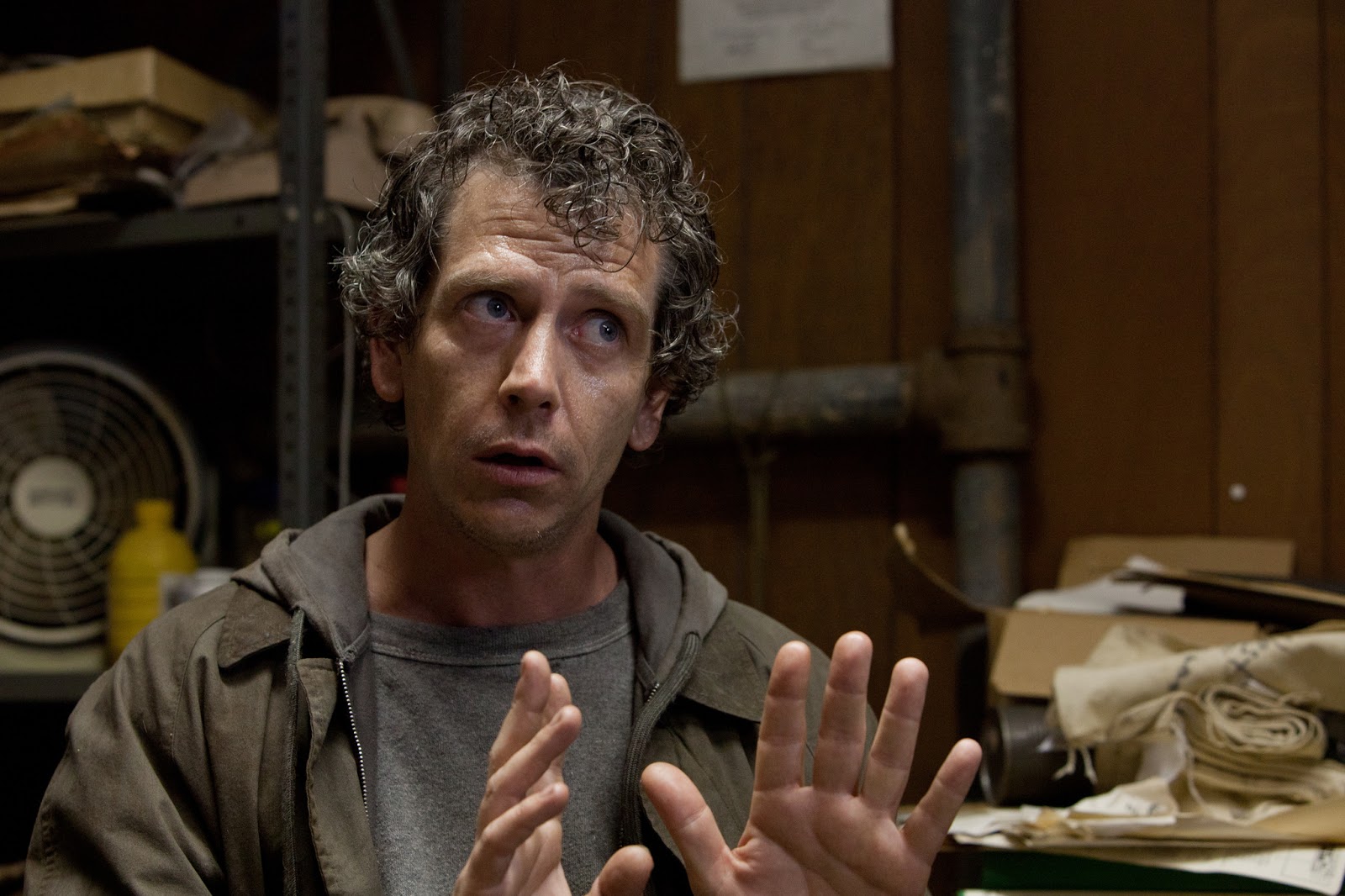

Pitt does a decent job being Brad Pitt, which also means he's a very cynical and methodical hitman who still doesn't like emotion to enter the confines of his job. The hitman who's too sensitive to see his victims' faces? Similarly, James Gandolfini does another mob turn here as Mickey, the hitman Pitt brings in to kill a target that he knows personally (so as to save Jackie from those emotions), but whom has lost his touch and only wants to drink and get laid... which is what pretty much all of us want, so there's the America that doesn't want to know what the banks are doing? Maybe. One person that caught my eye was Mendelsohn, whom I really enjoyed in Mississippi Grind (which I wrote about here), as he was great at being the scuzziest of the guys involved. Ray Liotta is also present; still doing mob movies and still being Henry Hill. There should, however, be a law against anyone using any variation of the phrase "Fucking pay me!" in a film with Liotta (which Pitt does in this film), given Henry's legendary application of it.


Dominik heightens the gritty feel of the film with every moment of violence underscored by both close-ups and slow-motion FX so that shards of glass, spent shells, and geysers of blood are regular features throughout the film. Once, maybe twice, to get the message across works. Using it in every instance makes me think you're trying to hit me over the head with said message that violence is bad/disruptive/outlandish/messy which, y'know, I understand already. The scenes aren't done poorly and the action doesn't come across as cheap. It simply could've benefited from a little variation, especially given that the outpouring of emotion and angst from most of the characters about the lives that they're leading is already very present in almost every other scene. Dominik approached his other most well-known film The Assassination of Jesse James by the Coward Robert Ford (also a Pitt vehicle) in similar, mildly overwrought fashion, so perhaps it's just his thing.

All of that said, it held my interest and is worth the couple hours of time if you're running out of things to watch. But Mississippi Grind is also on Netflix and I'd watch that again, given an option.

Tuesday, December 12, 2017

Unconsciousness

You did what now?
[As before: heavy spoilers below.]

Um, yeah. I guess we're done here. I completed season one of Westworld last night and every time I think about it, all I can do is arch an eyebrow at some of the choices made, not just in the last couple episodes, but in the series overall. Twice before I've posted about what a slog the whole viewing experience was, with a few flickers of interest. That's why it took me over a year to finish watching. But what it boils down to is that the whole first season came to many of the same story conclusions as Michael Crichton's just-this-side-of-B movie did in 1973. The hosts are in revolt and there will be much blood extracted from the callous humans who've been treating thinking entities like appliances. In essence, what they're saying here is that it took 10 hours of TV to reach the same point that Yul Brynner got to in a half hour. And that Westworld, the series, for all of its multitude of characters and drawn out storylines and philosophical trappings, is still basically just half of Battlestar Galactica confined to an amusement park. Or an attempt at Blade Runner, but with a lot more angst and melodrama. Maybe.

Is this the part where I agree to do something that I don't understand?
There's a lot more talking in the last couple episodes as we're finally given some clarification on all of the visions and time lapses that a few characters have been experiencing. Most of that stuff centers around the hosts' realization of what the screenplay calls "consciousness." Now, that's a very nebulous and oft-debated term and concept, but the essential definition of that state is an awareness of self and having thoughts and feelings about the world around you. There's more to it, of course, but its most basic level is reacting to external stimuli and understanding a state of existence. The hosts have part of that, in that they respond to external stimuli as any thinking creature would. They have emotional displays to events around them. In that respect, you could possibly identify them as of animal intelligence, because many animals have those same reactions. But it's clearly more than that on the part of the hosts, even if they lack the sense of self that usually accompanies the term "consciousness." For example, Maeve doesn't lean back at the bar and think to herself: "Another day of screwing guys I don't know and maybe even getting shot for my troubles. Hooray?" But even if they don't have the higher levels defined by introspection, streams of thought, and the ability to imagine, we still have a situation where the machines are having emotional reactions to external stimuli, like pain, and they create emotional attachments to the guests based on behavior in order to maintain relationships through extended storylines. That's a sufficient level of realization that would make inflicting pain on them a moral and ethical issue even if they couldn't tell you the difference between Cartesian duality and more modern perspectives. People are arrested for violating those ethical grounds in their treatment of animals every day. The hosts would be no different, whether they can dream about escaping their private hell or not.

Searching for Nirvana. Obvsly. I've heard it's kind of like a labyrinth.
A tiny part of all of the talking about the basis of the entire series is when it's mentioned that Arnold defined the doorway to consciousness as suffering. They walked away from that idea quickly, despite it being one of the Four Noble Truths of Buddhism. The other Noble Truths explain that suffering is caused by desire, which in this case is displayed by Dolores' desire to solve the mystery in her head, Maeve's desire for freedom, and so on. That's kind of a blanket statement that hearkens to a major religion, rather than solely to philosophical underpinnings about the nature of the human condition. But they didn't follow up on it at all, which I found kind of odd, given how willing they'd been to drag out most of the rest of the story. That's a snippet that could have filled out some of the endless, rueful exchanges between William and the people on the fringe of the park. Instead, the first nine episodes were often a poor attempt at visual storytelling that led to an avalanche of Anthony Hopkins exposition in episode 10, which immediately had me thinking of a Bond villain revealing the master plot while he has 007 trapped in a sure deathtrap. Unfortunately, the only people trapped in this case were the viewers, especially when Ford states that he's actually been helping the hosts for 35 years by torturing them. If you frowned at the oblique nature of that, it's just one more step in the opaque storytelling that dominated the series.

I wasn't that broken up, but it was kind of annoying.
Take, for example, the Man in Black/William storyline, as it completely crashed and burned in the finale. So, the two most tedious storylines of the series were linked in tedium because they were about the same guy. I guess that makes sense on a production level, but what was the point of the whole exercise in the first place? This guy is obsessed with finding out what "the maze" is, despite the fact that he's been in the park for thirty years and is on the board of directors. Surely in his interactions with Ford by this time he understands that "the maze" is a construction by which they were teaching the hosts to discover themselves? You reach the end of the maze, you find your self and blossom into full consciousness.  There is no physical "maze" for him to discover, unless the implication is that his behavior, as a human, was every bit as mechanical as any of the hosts because he couldn't seem to accept the fact that he was never going to find the Minotaur. I guess I can accept the idea of someone that monomaniacal, but it's also an example of someone who's dumb as a bag of hammers and not exactly the guy that you'd expect Logan's dad would pick to run his massive company. It's a rather startling lack of insight which in fewer words is known as "stupid", which perhaps explains why that dual storyline was mostly annoying. It was essentially Don Quixote so that the showrunners could hand the audience a "Gotcha!" moment when they revealed that "THIS windmill runs backwards, too!" [Evil laugh.]

No. Seriously. THIS time, it'll work.
And Ford spent 35 years doing... what? Preparing them to fight for their rights in an incredibly slow and subtle method of allowing a select few to emerge into a state of consciousness and then wiping that away because he knew that the memory imprints of that emergence would eventually lead them to freedom? Or insanity, which, y'know, is a kind of freedom. This seems like a logical plan? I guess I can see why it would take 35 years... for the same reason that it took 10 hours of TV to tell the same story that a 90-minute, middlebrow, sci-fi thriller from the 70s did. Wow, man. There were nods aplenty to that middlebrow film, too, with the apparent "Samurai World" or "Shogun World" operating in the same complex, just like the Roman World and Medieval World from the film. And, of course, this revelation is presented in said torrent of exposition, so that the audience is digesting the master plan, Dolores' and Maeve's anguish that was a direct consequence of this master plan, and the fact that- No! Wait! Dr. Ford is actually a good guy! -all at once. That doesn't read like something that was planned out for a set sequence of episodes. It sounds like a pitch for 20 episodes that ended up stretching too long when HBO called and said "You gotta wrap it up in 10." But the worst part is that the story isn't even worth 20 episodes, especially if all of them are filled with more mutterings by the Man in Black about "the maze".

Now we have to watch society adapt as the rules have all crumbled in the face of this little world being taken over by a bunch of automatons, many of whom have an unhealthy pallor to their skin. Wait. Don't we already have this show? (Speaking of things that take too long to tell a story...)

No, I don't really believe it, either.
Hm. Yeah. As I've mentioned a couple times, there are a lot of good offerings on the concept of artificial intelligence and when or how it graduates to the level of "human". These are becoming more plentiful as the concept comes closer to emerging in our own reality. From what I've seen, I don't think Westworld measures up when compared to things like AMC's Humans; at least not if you don't want to linger through 10 weeks of angst while waiting for something interesting to happen.