Showing posts with label vampires. Show all posts

Tuesday, April 29, 2025

A stylish cloak on a standard frame


I generally like Ryan Coogler's films. I think he has a solid visual sense and good recognition of both the space and limits of the story that he's trying to tell. On those that he's been directly involved in (Fruitvale Station, Black Panther) and indirectly (Homeroom, Jesus and the Black Messiah), I think he's a key part of the process in getting stories told that often wouldn't be otherwise. Among those is his latest, Sinners. As with Fruitvale and Black Panther, he's both writer and director on this one and his sense of style is visible all over it. It's just that when we get to some of the plot details that I feel like he could've done even more to take it in his own direction and somehow play those last few notes. (Mild spoilers below.)


That latter phrase is based on the fact that the film is largely about music and its influence, not only in African-American culture, but world culture. It takes place in one of the most vibrant and deeply-felt areas of that musical culture: the Mississippi delta. That's where Coogler, regular leading man Michael B. Jordan, and regular accompanying composer, Ludwig Göransson, build story and music together so that one never becomes separate from the other. The film itself isn't a musical, per se, but has several musical numbers that tell large portions of the story by themselves. It's a stylistic approach that worked spectacularly, without forcing us to watch another version of West Side Story. The music wasn't just the vehicle for the story. It was the story. Central to that embodiment was Miles Caton, who played Sammie Moore, aspiring guitarist and the son of a preacher man. Caton was the very embodiment of Delta blues and his powerful voice and playing (ably assisted by one of my long-time favorites, Delroy Lindo, on piano and harp) drove the story forward even more than Jordan's excellent rendition of twin brothers, Smoke (Elijah) and Stack (Elias.) Everything presented there would've made for a great story even without the supernatural elements that accompanied it.


And it's there where the river kinda dried up. Due credit to Coogler for including the local Choctaw presence, who show up in pursuit of a bad element. Unfortunately, that bad element turns out to be a bog standard vampire. That English descriptive that I'm fond of is even more appropriate in this place, as the vampire, Remmick (Jack O'Connell) is appropriately European (Irish) in his desire to dominate or destroy the non-White cultures that he encounters. Of course, given the history of the Irish in this country and back in Europe, Remmick's appeal to solidarity among the collected peoples when he tries to convince the twins and their friends to join the non-human set is yet one more valid metaphor in the story that Coogler's trying to tell. But it's also the same, tired vampire myth that we've seen before; involving garlic, wooden stakes, and sunlight. Smoke's (ex-)wife, Annie (the wonderful Wunmi Musaku) is a practitioner of traditional spiritualism and medicine down on the bayou and, between her knowledge and the presence of the Choctaw, it feels like we could've ventured into something a bit more exotic and less retreaded than the same Romanian refugees who happen to be walking around with a Gaelic accent. Why couldn't we have had people possessed by corrupted shilombish or something like that? Instead, we get typical bloodsuckers who try to trick people into inviting them in, but are powerless to do anything else until that point.


My complaint about Black Panther was that it was telling an interesting espionage and international diplomacy story until we got to the third act, where everything devolved to explosions and cyber-rhinos. I assumed at the time that that was just the necessary price of entering the Marvel Universe. But that's kinda how this story ends up, too; with a cascade of bullets, blood, and fire, even after the supernatural elements have departed the scene. We go from a deeply-invested story about the power of music suffusing culture deep into the past and far into the future and, at the end, the only music we get is the staccato of a tommy gun, which kind of wipes the mind of everything that's been told before. For the first two acts, I really thought we were going somewhere and then the third just left us at the door of typical Hollywood horror flick, like a slightly more cultured From Dusk 'til Dawn. I liked the script and the dialogue (Women talking frankly about sex! Just like, y'know, real life.) I liked most of the characters and performances. I highly appreciated the music, including the Irish jig that Remmick and Co. engage in (Rocky Road to Dublin.) But, in the end, I came out of the film thinking about all of the opportunities missed, rather than the spectacle that I'd just seen, which is really unfortunate. It's certainly worth the time to see it, but I can't point at it and suggest that it's a song that's going to stick with you.

Tuesday, January 7, 2025

Blood wasn't the only thing that sucked


The original Nosferatu has a story that's possibly even more interesting than that of the film itself. Not only is it one of the finest examples of the German expressionist era in film and a further example of the fragility of the early art form, after most copies were ordered to be destroyed until a few were later (ahem) unearthed and has since been preserved in various other forms, but it's also a shining example of copyright infringement and an attempt to not pay creators what they're owed. Prana Film, a short-lived production company, didn't want to pay for the rights to Bram Stoker's novel, Dracula, and thus ordered their screenwriter, Henrik Galeen, to change minor details (like Count Dracula becoming Count Orlok and half the story taking place in Germany, rather than England) in an attempt to claim that it was an original story. Stoker's widow, Florence Balcombe, promptly sued after its 1922 release and all copies of the film were ordered to be destroyed by the court. Thankfully, not all of them were, so we can still see the film today and appreciate F. W. Murnau's storytelling technique and innovations in the medium and with the vampire concept, in general (like suggesting that they're destroyed by sunlight, rather than just typically trying to avoid it.) So, there's a space for the film in the history of the medium, even if it was an attempted ripoff. Indeed, the story of its production is fascinating enough that Elias Merhige and Steven Katz collaborated on Shadow of the Vampire about 25 years ago, which is a fictionalized retelling of the filming of Nosferatu which involves some suspicion among the crew as to whether Max Schreck, who plays Count Orlok in the original film and is played in this reexamination by Willem Dafoe, is exactly what he says he is...


So, it was kind of exciting to learn that Robert Eggers was going to attempt a genuine remake of the F. W. Murnau film. I wasn't blown away by The Lighthouse, but I was willing to give it a chance because the latter wasn't terrible and because of my attachment to the original film, which I've seen three times, including at our Michigan Theater, accompanied by the organ to add to the eeriness of its overall tone. Well, in Eggers' new version, tone is definitely an issue because the one he was apparently aiming for was loud, overwrought, and lacking any of the subtlety of the original. You would think that, at the very least, the one upside would be the ability to take advantage of modern production techniques and technology for the visuals, but even those come across as a lesser version of the 1922 film because they're not really used to convey anything interesting. The fascination with Murnau's version was the use of the vampire's shadow to convey threat and accomplish things from a distance and Eggers duplicates that here but it lacks the jittery charm of the original, such that I found myself pining for Coppala's homage to it in his Bram Stoker's Dracula from 33 years ago, if only because it was clearly an effect and didn't look so perfectly clean and manufactured as the version employed by Eggers.


But that's kind of a minor detail because the main problem was simply how loud and abrasive everything was, from the acting to the score. It seems like the instruction given to the cast was that, since they were in a film set at the beginning of the Victorian era (1838), everyone had to act as if they needed a fainting couch at the ready because their next line might drain them of the will to live (kinda like a vampire...) The gushing and exhalation was constant. It was akin to watching an endless series of Loveswept novel covers, one after the other. I thought that it was a cute twist to have Dafoe included in the cast for this film as a seeming nod to Shadow, but I also kind of hoped that his gravitas and capacity for eeriness with just a glance or two might ground it in something akin to Murnau's version. Not so much. He was chewing as much scenery as anyone else and, in a film where the main villain is constantly biting people, that becomes more of a meta description than I care to make. And everything about this production was at that level of OTT. One of the worst parts was the score. This film can easily be summarized by the phrase "orchestral crash" because there were so many of them that the constant din became a genuine annoyance. You really don't need that many strings to announce that someone has once again rushed to a window in anguish/horror/plaintive longing/whathaveyou yet again. We've been there. You use music for atmosphere but here it might have been used as a way to keep people awake. Those of us who had no issue with that just found it irritating.


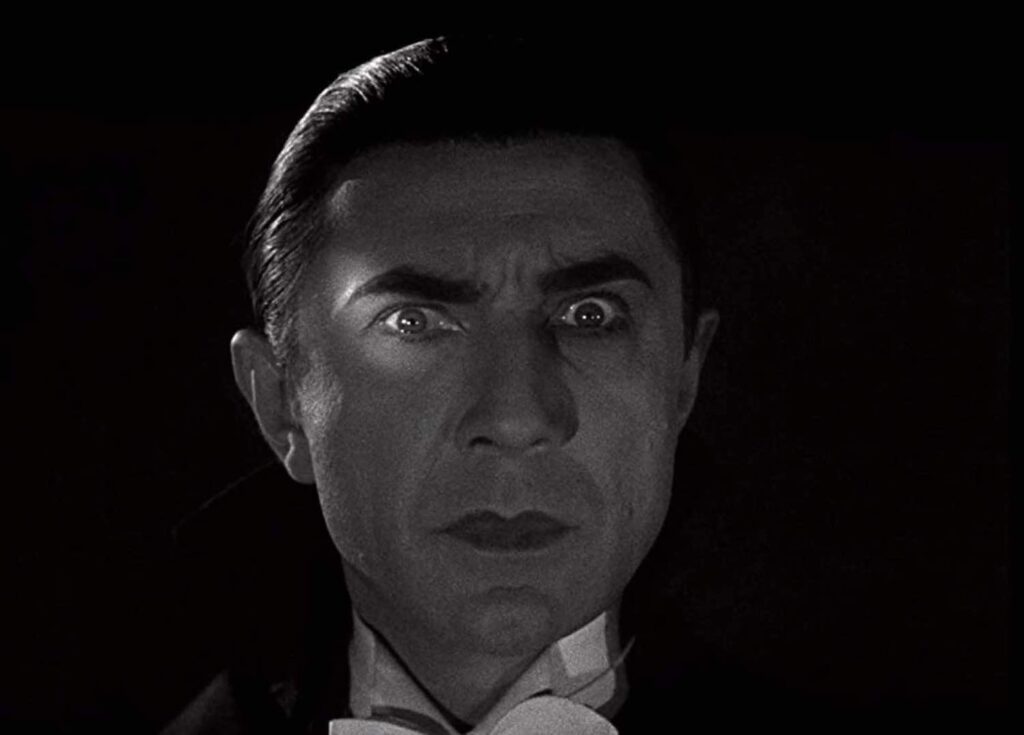
But that inability to keep people interested is a major issue, as well. I was distinctly bored about 2/3 of the way through the film and was restraining myself from checking the phone to see how much longer this might take. Part of the problem for me is certainly that I've seen this same story (and read the book) so many times I honestly can't count them. I know I've seen Murnau's version three times. I've seen Tod Browning and Bela Lugosi's version multiple times, as well. And then there's Coppola's and the Universal derivations of the Lugosi picture (often with Lugosi reprising the role) and on and on. I don't want to say that once you've seen one version, you've seen them all, but the novel has kind of been woven into the cultural fabric, such that seeing it reworked for the dozenth (and more) time isn't going to be mindblowing. With that in mind, it's fair to say that trying to do something slightly innovative with the story might not be a bad idea. But this was bog-standard vampire flick from the very outset, but made worse because it genuinely lacked any of the sense of style that the Prana film or any of the Universal films brought to the screen. There are no moments here that you would point at in the manner of Max Shreck's hand along the wall or Lugosi's penetrating stare and say that it's something that will become iconic or an instant identifier for this film. Instead, the identifier is going to be Lily-Rose Depp falling onto a bed again while we hear the orchestra telling us what's happening right in front of us. For the fifth time in the last ten minutes. So, I cannot recommend this one at all. Find the original streaming somewhere and play something like Danse Macabre in the background if you want an experience with some genuine atmosphere.