Showing posts with label post-apoc stuff. Show all posts

Saturday, December 23, 2023

Directionless apocalypse


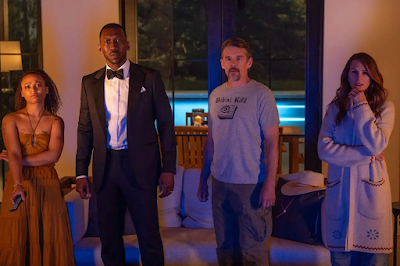
I love post-apocalypse stories. When I first started reading Harlan Ellison, one of my favorites of his work was A Boy and his Dog, which is set in America, post-nuclear disaster. One of my favorite films at a young age was John Carpenter's Escape from New York. When I first started running RPGs, my favorite setting was Gamma World. It's safe to say that I'm a child of the Cold War. So, when I heard that there was a film on Netflix that was really popular and that fit those themes, I was definitely interested. Unfortunately, that film was Leave the World Behind and it was a failure on so many levels that it's just about arcing toward the sublime.


Every science fiction premise needs some level of suspension of disbelief. You have to be willing to accept the conditions that make up the world in question, whether it be the talking plants and fusion rifles of Gamma World or the island of Manhattan as maximum security prison of Escape from New York. The basic premise of Leave is that a cyberattack has crippled the power grid of the eastern seaboard of the US and all of the problems that ensue following that, including many that have little to do with a fairly believable scenario like that one, like sonic weapons transmitted over the entirety of Long Island and herds of deer trying to send a signal about this impending doom that's approaching. I mean, those things could be part of our suspension, as well, if they weren't from a different level of sci-fi than simply Con Ed in New York being hacked. But that's where you wonder how this script might have benefitted from a firmer hand that kept it going in a coherent direction, rather than the scattershot approach that later takes hold of it and squeezes hard enough that all of its elements get splattered in random directions, to the denigration of cast and audience.


First off, if a cyberattack did take down enough of society to cause chaos, how (and why) is it that this one section of Long Island was spared? Was it because they didn't want to try to shoot all of the nighttime scenes by candlelight? Or so they could still have a functioning coffee maker in the house so that you'd know people would last two days instead of becoming instantly homicidal? I mean, part of the basis of most adventure stories is that the circumstances in front of us are just slightly different so that our heroes have a chance to do heroic stuff. So, fine. Our characters have power where all of New York City, visible across the river, does not. But then we discover that it may be beyond just power grids, in that satellite networks are down, so that planes and ships no longer have functioning navigation systems. But, of course, they still have functioning engines and ways to turn them off or keep them running, so why are ships beaching and planes crashing? And why is the latter only happening 18 hours after the initial shutdown when one of our heroes is walking on the beach? Said hero, G. H. Scott (Mahershala Ali) is an investment banker with high enough contacts to know one of the Illuminati who has offhandedly warned him that this disaster is coming. Scott, of course, dismisses the idea of the cabal that rules the world but also repeatedly reinforces the idea that such a thing exists. So, which is it? If writer/director Sam Esmail was trying to avoid the historical racist implications of that theory, he wasn't doing such a great job of it. Instead, he veers right into hitting us over the head with the overt racism of Amanda Sandford (Julia Roberts) when confronted with Scott and his daughter, Ruth (Myha'la) returning to their home which the Sandfords have rented. I mean, yes, the problem of inherent racism drives a large portion of American cultural relations and politics, so you don't really have to be that heavy-handed with said message. Amanda is borderline shrewish when conveying her distrust of the Black people in the house (their house, which she clearly doesn't believe because, you know, they're Black...) with her children.
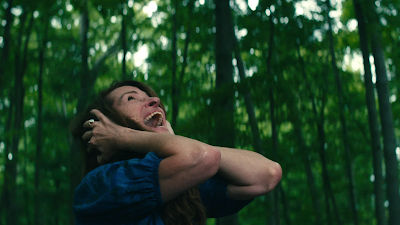
Yeah, I can't believe how dumb this is, either.

But then we have all of the other more obvious story points that simply don't mesh with our aforementioned suspension. Why does Archie's (Charlie Evans) lyme disease take hold overnight and become worse than any version of that disease ever seen? If it is even just lyme disease, why do they think that a couple pills from local survivalist neighbor, Danny (Kevin Bacon), will solve his problem? Why do the local deer seem intent on gathering around just their house and not others? Why do flamingos show up in a Long Island swimming pool? Are these the surrealist components that are supposed to make us as confused as the characters? Why do Amanda and G. H., completely at odds over the situation and their respective identities, suddenly fall into each others' arms and consider cheating on their partners with each other in the space of 48 hours? Why would a man as wealthy as G. H. ever play ball at the local YMCA? There are so many little things detached from reality here that it's difficult to believe that one person wrote it and, if that is the case, whether that person has been outside their home to interact with actual humans anytime in the past few years. Is Esmail an isolationist/survivalist? Even the seeming in-jokes are off key. We see a trashed house with a sign of the previous owners hanging loose that says the home was owned by The Huxleys. If that's supposed to be a reference to Aldous Huxley, I'd have to ask why, given that this is a disaster film. Huxley is best known among his fiction works for Brave New World; a society under total control, not one that is falling apart. Archie walks around wearing an "OBEY" shirt from They Live, which is about the subtle control of society through subliminal advertising, not its collapse from a systemic breakdown.


All of this confusion and lack of direction is reinforced by the melodrama of both the cinematography and the score. The camera did repeated close-ups during dramatic moments, just in case we couldn't figure that out, and then wide pullbacks and spirals from above when action was happening. The score was the stereotypical orchestral crashing whenever a plot point was revealed or a realization was made by any of the characters; often multiple times in the same scene. The whole storytelling approach was amateurish, at best, and didn't convey the idea of a major production that would be carrying the heft of a film with the above listed stars, as well as Ethan Hawke. But, then, Hawke was almost insipid in his contrast to his abrasive wife, Amanda, who was presented in a thoroughly wooden performance by Roberts, which likely wasn't helped by the boilerplate dialogue she was given. Her first lines, when she wakes her husband to announce that they're taking a last-minute vacation and why are spoken like she's reading from a book of middle American homilies about modern society. And, of course, the worst thing about the whole presentation is that it reinforces the conspiracy theories that are rampant today, by suggesting that there may be some kernel of truth to them, if people would only pay attention. What those theories also carry are the racist overtones of anything similar to the Protocols of the Elders of Zion, which is kinda how this feels when you see the upper middle class White family having their vacation disrupted by all of the surrounding events (and Black people!)

It's just trash, beginning to end, and in no way worth your time or attention.

Tuesday, June 6, 2017

Excursion to somewhere


I've been DVRing Into the Badlands (And Legion. And Taboo. And a couple other things. Maybe I'll get to them, at some point, but Orange is the New Black starts in a couple weeks...) ItB was something I was watching in the same way I used to watch The Walking Dead: I was interested in where they were going to take it, more in a clinical sense than from an "I'm really entertained by this!" perspective. They'd combined two relatively disparate elements: a post-apocalyptic setting and Hong Kong-style martial arts. I'm a mild fan of the latter and a huge fan of the former, so I was willing to watch the 6-episode first season... and then kinda forgot about it until the second season started appearing on the DVR a couple months ago. So I sat down and binged it over the past few days and had two reactions: 1. I'm more intrigued by the setting, as they fleshed out the world considerably. 2. I'm still not ready to plant myself in front of it every Sunday night.

On 1, as I noted in my post about the premiere episode last year, the setting was redolent of an old RPG known as Gamma World that I used to run campaigns with as a kid. The Badlands is a totally restructured society that still clings to some parts of the old technology (oil), but rejects others (guns), lacks more (computers), and treats others as something bordering on magic (the items surrounding the legendary city of Azra.) Gamma World was like that, too, in which some members of society remembered the old technology or had learned to adapt it to their world, while others would be completely mystified by it (think Donald Trump's attachment to Twitter and confusion at the concept of press releases and you'll be on the right track.)

How does that work again?
Season 2 expanded upon pretty much everything as they went along; showing the less organized world outside the Badlands (and the massive wall that separates the two), as well as the various factions present there: miners, smugglers, the monastery, etc. The mine of the first couple episodes showed some of that "past world as mystery" flavor, with people being rewarded for digging up detritus from our world. But the monastery was the big story outside of the politics and not just because MK spent a good chunk of the season effectively imprisoned there. The abbots appear to be constraining the emergence of mutations like MK's. This again hearkens back to Gamma World, where mutation among people, animals, and plants was the order of the day because of the radiation left as the aftereffect of the disaster that created the setting. There is no such radiation in the world of ItB. So is this a "natural human progression toward higher power" approach or something different?

And that question kind of leads into point 2: Why is ItB still not compelling TV? There are a number of answers to that question.

I'm not sure 'penetrating gaze' is the right phrase here.
1. Acting. I don't think anyone has done a particularly poor job, where you're wondering why the producers had to settle for this or that person. In fact, I think Madeleine Mantock did quite well as Veil in season 2 and Marton Csokas continued to be interesting to watch as Quinn, even if he was chewing the scenery a bit as his character became more desperate/deranged in the later episodes. By the same token, I don't find anyone's performance particularly gripping, either. There are no Don Drapers or Walter Whites among the cast, where you're just waiting for that person to come back on camera. Unfortunately, one of the weaker roles has been Emily Beecham as Minerva/The Widow. She has a ton of screen time, but often seems to use it to "be acting", rather than be Minerva. Of course, she's often not helped by...

Day in the life.
2. The writing. I don't have an objection to the plot, but some of the pacing and dialogue is still pretty weak. Beecham was repeatedly subject to this, as the writers seemed to think that being a strong and/or ominous presence meant her having to look into the camera and deliver a line like "They'll see what happens when *I* get involved.", accompanied by a slow pan in and rising music. It's melodrama in TV production 101 and it's pretty dated. People don't remember setup lines. They're goofy and people usually mock them. People remember lines that are delivered in the course of an action other than staring at the camera/audience. If you want ominous delivery, think: "I find your lack of faith...disturbing." or "I am the one who knocks!" Both of those instances are memorable and lacked what we used to call a posing panel in comics: where everyone stands and looks menacingly at the camera, serving no purpose to the story, but just filling pages and/or giving the artist something to sett at conventions. There are much better ways of closing a scene.

Dance, pigeon! Dance!
3. The overuse of "bullet time." That's the technique made famous by the Wachowski Brothers in The Matrix. I'm using it as a euphemism for the proliferation of slow motion backflips that seem to be present in every action scene of every episode. The producers seem to think that the only style of fighting possible is not only kung fu (normal for many HK-style films) but kung fu with as large an amount of Olympic floor exercises as can be executed. Having practiced a sword art, I can't tell if there's any particular style being employed there, as most of those combats still tend to be edge-on-edge clatterfests. There is a point where style overwhelms rationality in some of it, as well, like when Sunny meet Silver Moon and ends up walking away with his sword that has multiple gold rings drilled into the top of the blade. No sword-wielder in his right mind would do such a thing, as there's way too much chance of it catching on armor, bone, or someone else's weapon and disarming you at the worst possible moment (pretty much all of them.) That's me being pretty technical about it, but it's also a measure of a larger problem, in that the fights became so repetitive that my absorption in the story pretty much disappeared and I began tuning out of them except to notice technical details like that insane setup on that sword.

Yeah. No way, man.
And if I'm getting bored by the fight scenes, pretty soon it leads me to asking myself: Where are they going with this? I liked the semi-resolution that introduced Azra as a reality, rather than just a legend. Combine that with the image on the medallion and the book apparently matching up with a cover of n old copy of Wired and it creates a mix of possibilities, some of which may be shockingly disappointing to our characters and some of which may be interesting to us, the audience. On the other hand, Sunny's situation went from purely linear to Lone Wolf and Cub. Sunny is now the ultimate ronin, ex-regent for the most powerful baron in the Badlands, trusted by no one, and now seeking to raise his son in a gentler manner than the savage world around him would have it. That's not exactly the most original approach and it leaves me wondering if the presence of the baby is intended as a humanizing element for a man who already demonstrated a distinct streak of humanity for a killer with 404 (not found?) victims (and, honestly, many more than that by now.)

Overall, I'm not disappointed. I'm just kind of keeping my clinical distance for now. I'll definitely watch the opener next season and see what they've developed in the new production. AMC apparently has faith, since it went from 6 episodes in season one to 10 in season two and a reported 15 for the confirmed season three. AMC's shows often develop into things like Breaking Bad and The Walking Dead (even though I've parted ways with the latter.) But they also sometimes linger on without direction like Hell on Wheels. Here's hoping for more good than bad(lands.)

Monday, May 18, 2015

Furiosa Road


I loved Roger Zelazny. His work was boundlessly inspirational to me and, perhaps even more importantly, was packaged in a use of language so intricate and poetic that I used to put down books of his in the middle of a paragraph and boggle over how someone could come up with turns of phrase that creative as often as he did. One of his lesser works is a novel-that-should-have-remained-a-novella entitled Damnation Alley. It's about a post-apocalyptic setting where the lead character volunteers to make the run from formerly LA to formerly Boston and deliver a package. The passage across the nuclear wasteland that is formerly the USA is known as, of course, "damnation alley." The story was an inspiration to a number of other creators, including John Wagner, scribe of the Judge Dredd comics who used it as a spark for his first extended arc, The Cursed Earth; and Chris Avellone, lead designer of the Fallout series of games; and the band, Hawkwind, who wrote a couple of tracks based on a world like the Alley. Another was Australian director, George Miller, who wrote and directed Mad Max and The Road Warrior after seeing the rather shoddy film based on Zelazny's work. This month, after 30 years away, Miller released the latest chapter in the trials of Max Rockatansky, known as Fury Road.

I'm way behind the curve in writing this review, since the film holds an astounding rating on Rotten Tomatoes (98%(!)) I say "astounding" because Mad Max: Fury Road is "just" an action film, most of which rarely see this kind of unanimity among major critics, since most are not particularly burdened in the plot department. Fury Road is no different in this respect (protagonists are trying to get to a place; antagonists are trying to stop them) but the fact that the story is fairly linear makes a certain degree of sense in the big picture, the shortest distance between two points and all that. However, when the basis of your entire world is that it is utterly dependent on two liquids (gasoline and water; a situation not overly dissimilar from our own), it's understandable that trying to add in things like circles and triangles to your basic geometry will only slow you down and make the film lose focus. What's truly successful about Fury Road is that it does take time to add in those higher concepts but leaves them as undercurrents in a raucous display of intensity such that they can be enjoyed by those willing to pay attention (as I did) or ignored in favor of the rambunctious action (which, I think it's safe to say, the bulk of the audience to date has done.) If you went to see an action film, man, were you lucky, because you found a great one. If you went to see some slowly-revealed cultural touchstones that still have something to say about our own reality ("Who wrecked the world?"), then you were just as lucky.


The film is easily one of the more frenetic adventures I've seen in quite some time. Between the swarming Buzzards, the fanatical War Boys, the Polecats, the war rig, the war drums, and the flamethrower guitar, you couldn't get much more visually impressive while still keeping the majority of effects in real time, rather than CGI. This is a Car Wars adventure taken about as far as you can go. What I also appreciated was cinematographer John Seale's sure handling of camera angles during the chase/fight scenes. A trend over the past decade or so has been to close in on action sequences to try to simulate the chaos of a fight for the audience. What that has led to is a lot of blurred action and an inability to follow what's actually happening until they cut to "really cool move" by whomever the star is. In the comic world, we'd accuse the inker of having spilled water on the pages except for the one panel he managed to preserve. You lose the ability to follow the story with that technique and your choreography that you likely spent thousands on goes for naught. In contrast, Fury Road, with dozens of bodies flying about the screen and scrabbling across vehicles at high speed, still managed to follow a sequence of events from one point to the next so you knew exactly how dangerous the Polecats were (to their targets and themselves) and exactly how destructive the Buzzards could be (again, to targets and selves.) It was a really refreshing experience to be able to know just where everyone was on the highway of death even before they were smoking hulks left to the side.

The upside to all that excitement is that it was exactly that: exciting. Seeing Miller's imagination at full blast while he strove to make a two-hour car chase continually interesting is a phenomenon that won't soon be equaled, I think. OTOH, for those that have seen the Max films before, it's pretty easy to look at Fury Road and say "This is just the chase scene from the second half of The Road Warrior. But bigger and with more explosions." And that would be true, except for the subtext.


In the Road Warrior, the  most important liquid is "the juice", meaning gasoline. The only way the crazed road gangs can rule the wastes is with the ability to ride them (and, it has to be said, in vehicles that might get about a half mile to the gallon, if they coast a lot. (Every fantasy world has its little incongruities. Go away, science self. We're having fun here.)) In Fury Road, they've come to the realization that it's not just the juice that's necessary, but also water. Control those two fluids and you control the world. But, interestingly, what becomes the even more precious liquid to many of the characters is actually blood. Immortan Joe's War Boys, altered to be combat machines that somehow burn out their own plasma, use human blood banks to keep going. Our man, Max, has the misfortune to be one of those. But even more important to warlord Joe is the idea of  blood as heredity. The cargo being chased by him and his warriors is his harem; one of whom is pregnant with his son. As Joe is obviously in the last stages of life (needing a respirator harness to move around), it's clear that he feels the same need that many dictators do: to establish a legacy and live on through the offspring left behind. That's his self-centered contribution to reestablishing the society lost to all of the individuals in Miller's world.

The harem fled with the assistance of one of Joe's top lieutenants, Furiosa (Charlize Theron), and not because they particularly objected to being sex slaves, as they had living conditions vastly better than almost anyone else at the Citadel where Joe ruled. Instead, they objected to what people like Joe had turned the world into and how they sustained it as a place of fire, chaos, and death. By the time they disappeared, they had painted slogans around their quarters ("Who wrecked the world?" "Our babies will not be warlords!") explicitly condemning the world that Joe and those like him (such as Lord Humungus from The Road Warrior) had made and perpetuated. As many critics have pointed out, this is an intrinsically feminist message and a pointed one; specifically blaming men for having reduced society to this barbarous state and doing nothing to restore it. That's a far more complex and noteworthy message than the "tragic hero loses family" motif of Mad Max and the basic nihilism of The Road Warrior.  Of course, the clownshow that is "men's rights" groups have played right into this, objecting not only to the movie's central themes but also to the fact that Theron is every bit the action hero that Max (Tom Hardy) is and even more dynamic than he is for much of the film.


Speaking of the two stars, it's interesting to note that both of them have played far more complex roles in the past but both inhabited their rather taciturn characters fairly well. Max, as played by Mel Gibson in the three previous films, is a withdrawn, brooding, and fatalistically cynical person after he loses his family. Hardy did an excellent job playing the Gibson role and even fattened it with more expressiveness than Gibson had ever done (all three films were still relatively early in Gibson's career.) By the same token, Theron took on the role of nascent idealist and still managed to keep her realist combat approach front and center. You never doubted that she was capable of killing you, me, and everyone else in the room. At the same time, you could see the earnestness that had driven her to break away from Joe and attempt to restore some sanity, not just to the world, but her own worldview. My only regret in all of that is that I felt like the character of Furiosa didn't allow Theron to display the kind of fire that she brought to roles in films like Monster and North Country, since most of her interaction with opponents was about disposing of them as efficiently as possible, rather than meeting their rage with some of her own. Only one moment in the film gives her the opportunity to channel that rage into something other than another deathgrip with her bionic arm.

There are many style points you can laud or dispute about the film. Miller was obviously enamored of the whole skull motif approach, as they appear everywhere it's possible to put one, whether carved or real. As a long-time fan of Games Workshop's 40K and Old World settings, I have no problem with this cranial obsession but it, like the flaming guitar player, can bend things from grim to more of a circus-like atmosphere. Whether that detracts or adds to the film depends on whether you're (ahem) willing to go along for the ride. But I appreciated a lot of the other little touches that Miller and his co-writers (Brendan McCarthy and Nico Lathouris) brought to the screenplay and, especially, the dialogue. When Max asks Nux if he's a "blackthumb", they don't stop to explain what that is, but instead just leave it to the audience to figure out that it's their phrase for "mechanic" when Max tells him that he's to take care of engine #1. Likewise, their phrase for exalted action is "going chrome", like the spray paint they inhale before doing something daring/brave/insane/suicidal. I've long been fond of writers that simply dropped you into their world and let you figure it out while their characters continued living in their world as they typically would, without stopping to explain basic facts of life to people who already know them.


There were also a lot of little touches scattered throughout the film that were Easter eggs for those who'd seen the previous movies, like the fact that Hugh Keays-Byrne played lead villain, Immortan Joe, 36 years after playing lead villain, The Toecutter, in Mad Max. Or seeing Toast the Knowing (Zoë Kravitz) playing with a broken music box in the war rig, a device which virtually matched the one that so excited the Feral Boy in The Road Warrior. After seeing at least one reviewer refer to the film as a "reboot" of the Mad Max series, I was kind of thrilled to see not only the far more beaten down V8 Interceptor at the start of the film, but also the knee brace still present on Max's left leg from injuries he sustained in the first film. If the story and Max's continual flashbacks to his family didn't make it clear that this was a continuation, then those details surely did.

In the end, I can say that Fury Road is certainly worth seeing in the theater whether you're a fan of either well-done action movies or post-apocalyptic scenarios (I'm kinda the former but definitely the latter) or simply want to drive screaming across the desert into a dust hurricane for an evening. I guess time will tell whether the underlying themes of the story become more prominent in the response to it by much of the audience and, for that matter, whether Miller will be continuing that train of thought in the next two in the franchise that he's supposedly working on. You can't kill Max. You can only hope to contain him.