"Therefore, thus saith the Lord: Behold, I am bringing disaster upon them which they will not be able to escape. They will cry out to me, but I will not listen to them." - Jeremiah, 11:11
I wouldn't go quite that far in describing Jordan Peele's Us. After all, there are some solid performances and I think the camera work and the lighting and other technical aspects were really well done. But overall, I can't really say that it's a film that worked for me and there are a variety of reasons for that. The largest one seems to be what, on the famous board, we used to call TTH, or Trying Too Hard.
TTH first came up in a discussion about one cultural phenomenon or another. One of the regulars was complaining about something that struck him as being more image than reality; an event that was trying to show how "real" it was, only to make everyone understand that it was more show than substance by trying too hard. He asked for examples from the rest of the board and I remember mine distinctly: "Every Woody Allen film, post-Annie Hall." All of them have struck me as Allen trying too hard to be "Woody Allen"; to present a story and a style that most would identify as his work but without really carrying the weight and depth and whimsy that originally defined it. I think Peele's latest effort suffers from that same phenomenon but, on top of that overreach, I'm not really sure who he's trying too hard to emulate. Is it himself, following on the heels of his excellent debut, Get Out? Is it a pivot toward the Hitchcockian label that many are so eager to hang around his neck? Is it something more Serling-esque? All three and, thus, none of them? I really can't say.
What I can say is that it feels like he was attempting to set up a giant metaphor and wrapped it into a story that had a Twilight Zone-ish premise, but also wanted to keep the pace of more modern thrillers. That's a big ask for any writer or director, since any two of those are not going to cooperate with the third. (e.g. Pick any two: Fast/Good/Cheap.) Apparently, he was directly inspired by the Twilight Zone episode, Mirror Image, and that can be seen in the basic premise of the film: the vengeful doppelgangers, the Tethered, emerging to slaughter their other selves. It's also not difficult to see a lot of the metaphors that he was building into the story, like the references to Jeremiah 11:11, which was the doomsayer's warning against worshiping the wrong things; in this case, rampant consumerism demonstrated by Gabe's desire to keep up with the Tylers. Or the dichotomy of the world's wealthiest nation propped up by the existence of so many who have no chance to take part in that exercise of wealth, whether because of skin color or circumstance. The Tethered are "the other" that so many Americans are whipped into a frenzy about by our xenophobic president, even though many of those "others" are Americans themselves; thus, inciting the quote from Red early in the first confrontation: "We're Americans." That statement is equally one of defiance and condemnation, depending on one's perspective both inside and outside the film.
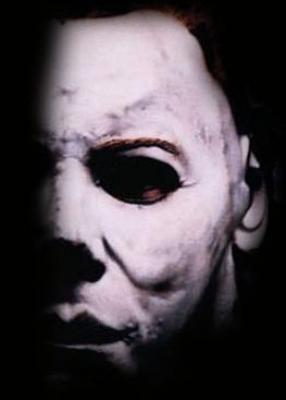
But I have to say that all of that kind of gets lost under the blood spray and screams of the routine chase sequence that takes up the latter 2/3 of the film. There's nothing particularly innovative or exciting about any of the action. I am most certainly not the audience for this kind of thing, since I find it to be a pretty pedestrian storytelling technique, most of the time. But it's especially so when the antagonists happen to be led by someone who shows regular emotion and stops to disgorge significant segments of the plot not once, but twice, when Peele could have been building tension and/or trying to relay that exposition visually, rather than make the audience sit there and wonder why both we and our protagonists are (also) sitting there listening to someone almost literally tell their life story. In the end, there is some basis for that, given that Red is not like the other Tethered, but that doesn't help me when I drop out of the story like a body hitting the floor because the tension balloon has just been punctured. The reasons the original Halloween spawned an entire genre are because Michael Myers was implacable and John Carpenter, working with a tiny budget, had to perform a lot of low-grade tricks to show things that special effects would have done for him. But that low-grade approach was storytelling and I'm not sure that modern horror films really carry that kind of atmosphere, especially if you've seen more than, say, three of them (which I have.)
Plus, I'm not entirely sure about a lot of the small touches. Why the focus on Hands Across America? Was it because it was more publicity stunt than obvious act of philanthropy; a moment for celebrities to show up on camera while great swathes of the country were excluded? Is that a statement about the artificiality of the 80s where the current consumerist culture really took hold and continues today? Were the references to Black Flag, a band of rebellion in the 80s where the film starts and a note of kitsch today, a further example of that culture? Were the rabbits a statement about the testing that still goes into the products that fuel that culture? Did we need the reference to the actual tunnel networks at the start of the film because Peele thought it would make the existence of the Tethered easier to believe? (It had zero effect.) Was I easily distracted by this stuff because the main story failed to hold my interest?
The key element to Get Out was that you weren't clobbered by those metaphors. Peele made a number of statements within that film about race and racism, culture and style, personal relationships and public ones, and they all flowed together. There were obvious statements and far more subtle ones about the social and sociopathic tendencies of modern America. In the midst of that, there was an intriguing mystery and a gradual level of horror. Us was nowhere near that progressive. We started with a scene of mystery and some tension... and then skipped right to the main event where Adelaide (Luptita Nyong'o) was already worked into a pretty good frenzy by returning to the scene of the crime. That level of discord on her part made the casual attitude by Gabe (Winston Duke) that much more unnatural. She was instantly panicked and he was instantly an idiot. The most natural character (and actor) of the whole film was Shahadi Wright Joseph as Zora, who went from bored teenager to terrified kid to practical actor in what seemed like a normal progression in a crisis (allowing for the usual Joseph Campbell journey in a fictional story.)
I think the only conclusion I can come to is that Us isn't a bad film. It's just not a very good one. Maybe if Peele tried to focus a bit more on what he was trying to say or, for that matter, simply dump the message and go with a good story. Even doomsayers have to be able to sell what they're saying or they just get ignored.
So, I thought I'd post a bit about some of my favorite directors. There are a couple that have made lasting impressions with a very wide audience over a long period (Akira Kurosawa, Stanley Kubrick), a couple that have become prominent in recent years and have made big splashes (David Fincher, Christopher Nolan), and a couple that I regard as brilliant at an early point in their careers, only to fade to obscurity (John Carpenter) or seemingly resign themselves to Hollywood spectacle (Ridley Scott.) When I write these, I'm going to skip around a bit to cover the films that I think define the director or that resonate the most with me or that perhaps represent a defining moment, either within the scope of the director's normal approach, or as a marked contrast to it. This time I'm thinking about Carpenter.
John Carpenter is one of those directors whose style is often immediately apparent when his films begin. For his first several films, his approach didn't vary overmuch and it worked well for most of the stories that he was trying to tell. It was that style that attracted me to his work and the one I most missed as he moved on to other things. Granted, not everything can be approached with the same Steadicam usage that Carpenter made standard for the horror genre. But, like any actor, it's possible that people will only see you as a "horror director" and, thus, that's all you'll get offered. Carpenter would admit in his later years that many of his lesser productions were the result of being offered nothing else and having to make a living, as it were.
In the horror genre, few faces (well, masks, actually) are as iconic as that of Michael Myers, the implacable killer of Halloween (1978), Carpenter's first big success. While he had started his career several years before and had become a bit of a hero in Hollywood for his film, Dark Star, which has decent production values for a science fiction film produced on a budget of only $60,000, he was still stuck multi-tasking on independent productions in 1978 when Halloween hit the theaters. He directed, co-produced, co-wrote, and scored the film, making it one among his filmography that really resonates with his vision and approach from beginning to end. Halloween emphasized elements that would later become the trademarks of his better films: eerie atmospheres (whether horror or not), wide perspectives, steady and lasting shots, often ambiguous endings, and highly memorable music:
Despite the schlocky set elements (gravestone in the bed alongside the conveniently-lit jack-o'-lantern) and the cheap scares (dead boyfriend swinging into the shot from the closet), there are great moments in that scene: the long take on Laurie as she wails over the death of her friend; the appearance of Michael's face as she steps away from the bedroom and he attacks; his implacable advance down the stairs.) These are all elements that would be often missed in the widespread imitations of Halloween that followed and which created the modern slasher genre. And following it all is the ominous and eerie music, composed by Carpenter. The scene would be severely hampered without it and it's to his credit that he understood where to shift tones and keys to emphasize what was happening on screen. I'm not much of a horror fan and even less of a slasher fan, but Halloween is a great example of Carpenter's grasp of story and pacing.
What followed was one of the greatest cult movies ever made: Escape from New York (1981.)
That poster always amuses me because, in the film, Liberty Island is actually the police headquarters for the prison that Manhattan Island has become and the statue is seen standing, in perfect condition, several times. But I suppose marketers were trying to tap into the Planet of the Apes sensation.
I'm a sucker for post-apocalyptic storylines and Escape plays right into that. Carpenter's tendencies (long shots, spooky atmospheres) are on full display in this sci-fi thriller and he uses a capable supporting cast (Lee Van Cleef, Ernest Borgnine, Adrienne Barbeau) very well alongside his lead, Kurt Russell and, of course, the once-again scintillating score. He originally wrote the screenplay right after Watergate, which explains the heavily cynical attitude toward the office of president and other institutions but, given that the Cold War was still in full flower when Escape was released, it remains firmly enmeshed with the zeitgeist of the times. One quiet scene is particularly notable:
Carpenter doesn't spend too much time on dialogue exchanges in his films, as the action is usually moving faster than exposition would allow for. But there are elements that are key to this plot that need to be sorted out. It also provides a great moment for one of the Western heroes of yesteryear (Van Cleef) to square off with Russell, who was attempting to change his film image to that of action hero (and largely succeeded.) Even in an exchange scene, we can see Carpenter's love for the long shot, as Plissken presents his cuffs for release, and the love for the wide shot, as even while we're looking for Plissken's reactions to Hauk's offer, we stay pulled back from where the former is sitting. I was chagrined to see this Youtube clip end where it did because the next line from Plissken is "Why me?" Hauk's response: "You flew the Gullfire over Leningrad. You know how to get in quiet. You're all I've got."
It was that line, in addition to the commentary about special forces teams ("Black Flag", "Texas Thunder") that later inspired William Gibson to create a major plot element in Neuromancer, the foundation novel of the cyberpunk movement. As Gibson stated: "It turns out to be just a throwaway line, but for a moment it worked like the best SF where a casual reference can imply a lot." Armitage, a major character in the novel, has flashbacks at one point about his special forces unit, Omaha Thunder, running into trouble as they attempted a cyber-assault on the Soviet network (something that, incidentally, is a major element of international competition and espionage today, although less flamboyantly.) These little details are emblematic of Carpenter scripts and visuals and appear frequently in his best films. They're indicative of a director in command of his story and all the little aspects that make up the big picture.
With the major critical and commercial success of those two films, Carpenter had hit his stride and now moved on to a remake of a classic 1950s-era science fiction film: The Thing (1982.)
The Thing holds a special place in Carpenter's career, because it's the scene of what is possibly his greatest triumph and his greatest failure. The Thing has been hailed in the past two decades as one of the greatest horror films ever made but, at the time, it was criticized for being "excessive" and was vastly overshadowed at the time of its release by E. T.: The Extra-Terrestrial. Thus, it ended up being a commercial failure, as the audiences of the time seemed eager for sentimental pap, as opposed to being scared out of the theater (which, admittedly, is not an entirely illogical choice.)
All of Carpenter's usual tendencies are here, but he hired Ennio Morricone (of Man with No Name trilogy fame) to score the film; later replacing some of Morricone's orchestral work with his customary keyboards. The result was not a bad score, but certainly one that was less memorable and less instantly recognizable to fans (and many non-fans) than either the Halloween or Escape themes. Did that have an impact on the film's reception? Perhaps. This was also Carpenter's first film with a truly appropriate budget which, of course, set him up for genuine failure when the film failed to find an audience (The Fog, a film produced in 1980 had decent returns, while Escape returned 7:1 on a $6 million budget and Halloween returned $51 million on a budget of $325,000, making it one of the most successful independent films ever made.)
While Carpenter's film was more faithful to the original John W. Campbell story, Who Goes There?, than Howard Hawks' The Thing From Another World (1951) (Pedantic film titles, FTW!), I think there is validity to some of the criticism about too much emphasis on the phenomenal special effects. There was more attention paid to rubbery creatures than to pacing and atmosphere. Again, a consequence of having more money to play with? Maybe. When you can hire people to do tasks that you once did with the fire of an aspiring filmmaker and throw money at problems that you used to have to invent your way out of, does that degrade the end result?
A great example of that change in approach is in this famous scene, when the creature attacks the dog teams at the base and the crew gets its first real close encounter:
In films like Halloween, the creature would have attacked the dogs off-screen and the noise of their dismay would have alerted the rest of the crew, and not just MacReady. The only visible evidence of the creature would have been right before half of it escaped and the rest was burned. I think the suspense that was built later in the film, as paranoia grew amongst the crew, was just as effective for the story he was trying to tell here. But the opportunity to maintain the suspense of mystery was lost in order to demonstrate the basic weirdness of the creature's shapeshifting ability. It's trending more toward shock value and away from the stylistic approach he had used earlier. Again, it can be just as effective. I'm just not sure that was the case here. All that said, The Thing remains an excellent film and a continuing example of the skill of its director.
The financial failure of The Thing began to affect the kind of scripts that Carpenter was offered. He managed to sign on to Starman (1984) (which had, coincidentally, been chosen by Columbia Pictures over E. T.) and, again, changed his approach and style to a more "mainstream" shoot, as it were, to present what he perceived as a romantic comedy but which actually ran a bit deeper than that and which many critics regarded as one of the best films of 1984; earning an Oscar nomination for Jeff Bridges in the lead. The difference in shot length can be seen in this exchange between Bridges and Karen Allen in a still poignant and well-played scene:
This scene lacks the longer pauses on the speaker which allow the audience to register the play of emotion and allow the actor to fill the scene a bit, as in the conversation between Hauk and Plissken above. It's a subtle difference, but it's an atmosphere changer from what seemed to be Carpenter's intent to add weight to certain frames of dialogue and toward a shoot that requires the actor to carry it alone. Starman was critically hailed but only a modest success at the box office.
Following this was a film that engenders a broad spectrum of reaction from moviegoers and critics: Big Trouble in Little China (1986.)
Point blank, Big Trouble is an awful film. Unless viewed deliberately as a parody (which is certainly possible, although Carpenter has never declared it to be such), it barely approaches the level of B-movie. The script is clunky and linear. The acting is sophomoric. The effects are cheap and obvious. The original script was massively rewritten and the film was rushed into production to emerge before the Eddie Murphy vehicle, The Golden Child, and that sloppy development process shows in every corner and chop-socky scene of this film. Some critics found it "fun", but most found it as horrible as I did. It has, like Escape, became a huge cult hit in later years. Carpenter has said that he took the project to fulfill a dream of doing a martial arts movie but was also relatively indignant about the film's failure at the box office, saying that the studio didn't support it effectively. At that point, he decided that life as a major studio director was no longer for him and he declared that he would only do independent films from then on.
Unfortunately, most of those independent films have been bombs. From more Halloween sequels, to Memoirs of an Invisible Man to Vampires to Ghosts of Mars, none of them have really been either interesting stories on the order of Escape or interesting technique on the order of Halloween. The one exception was yet another film that has become a cult classic, know as They Live (1988):
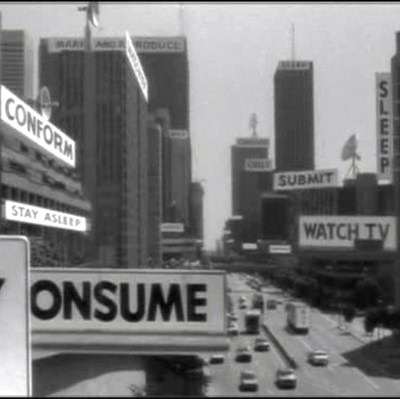
Based on both fictional sources and Carpenter's own growing distaste for the commercialization of society, They Live is halfway between a spoof and a serious science fiction drama. Hyperkinetic in the same manner as Big Trouble, it also tries to deliver a serious message about the danger of a somnolent populace and the influence of the wealthy in a very Fitzgeraldian way: the rich are really different from you and me... because they're aliens and they're still screwing us in plain sight. Carpenter had, by this time, largely discarded his attempts to build atmosphere in exchange for raw message and delivery by the actor. His unusual choice for the lead in They Live was the professional wrestler, Roddy Piper, who did a capable job, given that his role was essentially to be a ham (this is where the film arcs toward spoof) so as to attract as much attention as possible in order to get people to listen to his warnings. In this well-played scene, Carpenter establishes the threat while still maintaining the aura of camp and incredulity about it all that prevents the film from becoming a Body Snatchers-level horror film:
Of course, given his earlier track record, the film might have worked better if he had veered more toward the darker aspect of the overall threat, but those days seemed to be behind him.
Whenever I talk about favorite directors of mine, I usually bring up "early John Carpenter." That's typically code for Halloween, Escape from New York, and The Thing. I think the early part of his career was a time when he genuinely brought something to Hollywood in terms of style and approach. Frustration with the material he was being offered and his general disdain for the Hollywood system led him to bury himself in independent projects that didn't end up in the major studios because they were, by and large, awful, which is a tremendous shame for someone who was clearly so talented and innovative at the beginning of his career. In the same way that big stars are sometimes rehabilitated with modern, weighty material (think Burt Reynolds in Boogie Nights), I keep hoping that one of these days someone will offer Carpenter a project that sings to his abilities and sense of style and we'll get something moody and eerie and worthwhile that will put his legacy on a firmer foundation.