Showing posts with label The Joker. Show all posts

Friday, February 12, 2021

Batman: TAS, episode #15: The Last Laugh


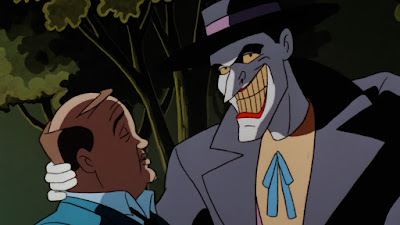
As with any behavior (and relationship), there are gradations. The version of The Joker that we saw a few episodes ago was clearly still a chaotic threat, but it was understated to some degree. If he was approached or felt threatened, you'd see more of the insanity (and danger) shine through. In this episode, The Last Laugh, we get the more "high intensity" version, where not only is his behavior erratic, but it's more demonstrative. He's a little less calculating and a little more prone to explosive moments (sometimes literally.) One would think that Harley is actually a calming influence on him... Alongside our slightly more maniacal Joker, we have the most infamous of his schemes/approaches: the laughing gas; this time widespread enough to cover a large part of Gotham and declared by the Batcave computer (Richard Moll; known for also playing Harvey Dent/Two-Face) as a permanent threat to victims' sanity. This is a classic example of the villain that everyone is familiar with, which would probably explain why it was the fourth episode broadcast in the series' original run. As noted before, the producers were expressing confidence that the bulk of the audience would be familiar enough with who and what The Batman and his closest associates are without having to do any lengthy explanations, unlike someone more obscure, like the Clock King.

This was also another chance to highlight the dichotomous nature of the relationship between our hero and his nemesis. We see that it's April Fools' Day and that people on the highway are in the grip of uproarious laughter- and then we cut to the most dour expression on Bruce Wayne's face. This is the contrast: the steely, immutable, heroic Batman with the chaotic, amorphous, villainous Joker, despite the fact that their outward appearances (menacing bat vs jovial clown) imply the opposite. Indeed, Bruce's resistance to humor even extends to his dismissal of a very out of character April Fools' joke by Alfred, while even The Joker's submarine grins as it floats under the garbage scow. The radio declares "At this hour, Gotham City is in the grip of insanity!" But not The Batman. That's the province of his opposite number, even if those not inured to it (like Alfred) are willing to give into the spirt of the day and become victims of the gas.


Technology is also displayed as a centerpiece of the action, as we see the Batboat used to steer the laughing gas trash away from town and eventually save our hero (Helluva risky shooting job with that laser on the bottom of the river, however), while Captain Clown, the implacable robot servant of the top clown, becomes the primary threat to The Batman over much of the episode. Another example of The Joker's particular mindset is revealed when he displays genuine anguish that The Batman has "killed Captain Clown!" One can be confident that he wouldn't have spared another thought for one of his quite human henchmen who suffered the same fate, but the favorite toy elicits the remonstration. That, again, serves to emphasize the idea that this episode's version of The Joker is the one farther toward the irrational edge than what we saw before. It's on display again during his flight through the waste plant, as he's completely unconcerned with the potentially fatal results of sliding down the incinerator chute as he grabs the convenient rope to swing away from a guaranteed death. Even his thugs don't appreciate his excess, as they roll their eyes at his various puns: "Look who's come to trash the place!"


What also helps reveal that this was an earlier production is that the themes are all-encompassing, both those specific to the episode ("Jewels 'R Us" is the store robbed by The Joker) and to the series as a whole (Café Noir is seen in the opening pan across the city.) Interestingly, they also tried out a more modern, funk beat behind the score at three points; all of them when The Joker (the fight and chase through the disposal plant) or his activities (the initial release of the gas) were central to the action. When you're first establishing your series and its tenets, one of them being the orchestral, Elfman-inspired score, it seems a mildly odd gesture to the Prince-written funk of the Batman film to deviate from what would otherwise be the standard throughout the series. In that same vein, the episode also takes time to reestablish the norms between the two lead characters ("Batman finally told a joke!") when the villain ends up hanging over the fire and rhetorically asks: "Wouldn't let me fry, would you?" and then the reproachful moan when the hero pretends to hesitate, as both know their relationship would never end that way.


In many ways, this is "the standard" of an encounter between The Batman and his greatest foe/opposite number: the bat vs the clown, implacable righteousness vs nebulous insanity ("Justice will be served, Joker!"), but it also never deviates from what passes for normality between the two of them. They've both been here before and they'll be here, many times, again. Hardly the last laugh, as it were. Next time, we get a return visit from one of our villains in Eternal Youth.

Wednesday, January 13, 2021

Batman: TAS, episode #7: Joker's Favor


Let's establish one thing right away: I love The Joker. He's always been endlessly entertaining to me. The concept of a homicidal maniac whose only purpose in life is to find new ways to entertain himself, usually by jousting with The Batman, seemingly has endless possibilities about where to carry a story. That's probably why I'm such a fan of Master Shake on Aqua Teen Hunger Force. Of course, the danger of those endless possibilities is what happened in the 50s, wherein said homicidal maniac became a lot less dangerous and ended up being a parody of himself (Can you parody a clown?); more noted for the increasingly tedious, 'wacky' method of challenging his opposite number than for the threat that originally motivated our hero to try to stop him. If he was just going to be a clown robbing banks with increasingly bizarre methods, you might as well just let Commissioner Gordon and the cops deal with him. But when he was restored to his glory in the early 70s under Denny O'Neill and Neal Adams, the Clown Prince of Crime genuinely returned to being the true antithesis of The Batman. No one else could ever claim to be the Darknight Detective's #1 opponent. Not Ra's. Not Bane (ugh.) The Joker. End of story.


Thankfully, the story of The Joker almost never ends. But, again, he has to be done right. That's probably why producer Paul Dini was the writer for this episode. It's like Stan Lee declaring that only he would be writing stories about The Silver Surfer. When you have someone as important as The Joker is to the mythos, you need a sure hand. By the good fortune of discovering Mark Hamill in a minor role and then Tim Curry developing bronchitis, they also lucked into the perfect voice for the role, as well. That laugh! I regularly crack up when I hear it. It has just the right touch of both the jovial and the menacing, on top of the maniacal, which is just like the character. This is on full display when he's first encountering poor Charlie Collins (in another sojourn in the studio by Ed Begley, Jr.) and first remonstrating about public courtesy ("We can't have people cursing at each other on the freeway! It's simply not polite!") before revealing the occasional short-sightedness of the master criminal when asked what favor Charlie should provide ("I don't know! I haven't thought of it yet!") Even genius occasionally has its limits, which we see with The Joker constantly serving his vanity by requiring his henchmen to applaud every other word. Not that vanity precludes genius. Even, self-centered smart guys occasionally need fans.


Which is why we have Harley! This is the first appearance (HBO order or otherwise) of The Joker's assistant neé girlfriend, who would later go on to regular status in DC Comics and has since transitioned to film. Ably voiced by Arleen Sorkin, who actually inspired the creation of the character, Harley is an excellent sidekick to The Joker, lacking his palpable menace, but almost as manic and with a certain "everyday person" vibe that probably made him more approachable by association for parents and younger children who identify clowns with 'fun' (Seriously. Some people do that.) Harley's danger is a bit more "fun" than the leering Joker's. That kind of thinking is, again, where you can see that Dini and Bruce Timm and the other producers really understood the fine line they were walking with the "dramatic cartoon" concept. It's also the first appearance of Renee Montoya, Harvey Bullock's date for Gordon's celebratory dinner who, like Harley, transitioned from the series into the comics and then later into Christopher Nolan's films.


And, despite my disdain for the 50s-era stuff, the fight scene in the remarkably-preserved Mesoamerican temple (a point of absurdity noted by The Joker) is purely from that realm and invokes the fun side to the two characters and their encounters. As with most scenes of that order, it's more like watching a video game than an actual story, but it's still entertaining seeing them go through the paces that both they and the audience know they've trod so many times before. This is part of the hidden dynamic between them, as neither would know what to do with themselves if The Joker actually succeeded in killing his nemesis; a point emphasized by Alan Moore in Batman: The Killing Joke and which Dini drew from with The Batman's rueful laughter at Charlie finally putting one over on his terrible oppressor of the last two years. A lot of people expressed distaste at not only the savagery displayed by The Joker in Killing Joke but also the idea that The Batman somewhat enjoyed their contest of wills. Those people, quite obviously, didn't get the joke. ("I'm here to give you a small token of affection, from me and all the guys doing 25-to-life!")


There's some great visual style employed here, as well. It's not a real deviation from their usual, but little things like the outrageousness of the Crazy Clown Catering truck and maintaining the extra wide smile of Harley even when she's out of her usual costume are good touches that keep the craziness going. Also, the entrance of The Batman to the dinner was a really classic approach, with the spreading cloak (like bat wings...) and the screen being filled with the Batsignal symbol on his chest. There's also a great moment when Collins stays just this side of breaking the fourth wall, when he mutters: "He's nuts!" after hearing more of The Joker's plan. Yes, he is. That's what's so glorious about it. The swinging glider in front of the window as a makeshift Batsignal was also a nice touch. Another was the key quote when The Batman's presence is detected: "I smell a bat!"

There are so many good things about this episode, I could go on and on. On the story side, it's obviously not what Heart of Ice is. The plot is just a vehicle for The Joker's insanity (and perhaps a warning against road rage) so there's nothing particularly deep or meaningful about it. But, like the encounters with Clayface, these are intended to be adventure stories before anything else, and there's almost never been a moment that involved The Joker that isn't an adventure, so I'm fine with it. There's nothing deep or meaningful about ATHF, either, and I'm a huge fan. Sometimes the absurd is good enough.


Next time, we return to Catwoman and Red Claw with The Cat and the Claw, part 2.

Wednesday, October 9, 2019

Taxi Driver with makeup kind of misses the point


When you're going to see a movie about a clown, there's only one album you should be playing on the way there. The cover is above. No, the Butthole Surfers don't really have anything to do with clowns but that's not really the point. Neither did Joker, unless you're into the whole "evil clown" thing that creates rather pointless stories like It. (Or you played Dragon Warrior 2 on the Nintendo gray box. Shut up. I'm old.)


So, yeah, I finally made it to Joker and I have many thoughts, which is in itself kind of remarkable since it was a film that was paced at a level that approached tedium but had enough style happening on the screen (helped ably by Joaquin Phoenix) to keep you watching, if occasionally impatiently. The Joker is one of the more fascinating characters in the DC stable, as he's the pinnacle of the "Batman as his own antagonist" phenomenon. Normally, you read a story for the lead character whose story it is; the protagonist. But, from the 70s forward, a lot of people read (and many writers wrote) Batman comics to see him play the straight man to his more interesting opponents. Batman was a force of nature; often one-dimensional in his approach to life (billionaire playboy who solves 'problems' with his fists.) That gets old fast. So you'd read his comics to see what unusual activities figures like The Joker and The Riddler and Scarecrow and Poison Ivy and Clayface were going to get up to. We were more interested in what was going on inside the minds of the deviants from society than the neo-fascist in the cape who claimed to be defending it (but who, in all honesty, also clearly had some mental health issues.) The most prominent among those was The Joker, who wasn't just compelled by his psychological issues, but reveled in them. The greatest Joker story ever told was Steve Engelhart's "The Laughing Fish" in 1978, where the Joker dumped chemicals into the water around Gotham to give all of the fish his maniacal face and then tried to claim a trademark on them so he'd get a percentage of every fish sale. When he didn't get it, he started climbing the chain of officials at the local patent office, murdering them until he found one that agreed with him. My girlfriend gave me a confused frown when I mentioned this story. I said: "Yes. That's exactly the way you're supposed to react. If you're not laughing." He was crazy, but there was a distorted genius in what he did. That's entertaining to watch or read.


Joker, the film, is not like this. Phoenix is entertaining enough to watch, but he's entertaining because he's Joaquin Phoenix, not The Joker. Writers Todd Phillips and Scott Silver (Phillips is also the director) decided to make an origin story for the character that's grounded in more realistic circumstances than "burglar breaks into playing card factory, falls into chemicals while fleeing police, comes out looking like Billie Joe Armstrong after bathing in bleach for a week, loses mind." Bob Kane and Bill Finger's original story was as simplistic as most comics were in those days and DC has been trying to catch up to Marvel for, oh, fifty years now by attempting to make their characters into real people. The first few DC films have largely failed at that, so they doubled down here and, in that respect, largely succeeded. This is a story about someone with mental health problems who has been ignored or discarded by society as so many people are these days. Phillips and Silver weaved in the prevailing economic mood of the time (so many with so little, so few with so much), in addition to making the statement that society isn't paying enough attention to those that need help, in both internal and external ways. In making the film more of a personal tragedy, they've essentially made it the Pagliacci joke. This is an apocryphal story about a man who goes to a doctor because he's so miserable and the doctor suggests he go see the famous clown, Pagliacci, to improve his mood, whereupon the man informs him: "But doctor, I am Pagliacci." For those of you in the comic set, this is the joke that Rorschach recites while we're watching The Comedian get tossed out a window to his death in the opening scene of The Watchmen.


Speaking of Alan Moore, Phillips and Silver clearly drew inspiration from Moore's The Killing Joke, which was a mild reworking of the Joker's origin to be a failed comedian, rather than just a small-time hood. They're also obviously big Scorcese fans because all I could think of while watching the first half of this film was that it was funny to see DeNiro doing a remake of Taxi Driver. But this is kind of where all of this begins to break down. Taxi Driver was Scorcese's statement on how some people felt that society had decayed and Travis Bickle was going to cleanse it and himself. Joker is making the same statement but from a different angle, in that the rich have allowed people to suffer in a state of decay when they shouldn't have to. The locus for that societal perspective is the very emotional tale of a man who has suffered that neglect, both in general and personally, as he discovers that his life is a lie told to him by his similarly ill mother and his gentle nature is easily abused by others. It's meant to be an emotional tale because, like the Pagliacci story, it's a tragedy. You're meant to feel sympathy for the protagonist because of what he's suffered. The problem is: That's not The Joker.

The reason that Engelhart's version was so interesting was because he held an internal logic that could be seen by others, even if it couldn't be understood. There was intelligence there. Similarly, the most obvious and direct comparison to Phillips/Silver/Phoenix's version is the one created by the Nolan brothers and Heath Ledger for The Dark Knight. Ledger's Joker is considered insane because he looks at things radically differently from most of society and then acts on that perception. His intelligence is evident in every word he speaks in the film, as is the ruthless nature behind it that drives him to make statements with both words and actions. Phoenix's Joker is the polar opposite of that. He's not a figure to be feared and marveled at. He's an object of pity until he goes about murdering people, whereupon the pity becomes mixed with revilement and a reintroduction of the disdain he's felt all his life. It's not compelling. In some ways, it's not even interesting, except for the fact that it's much closer to reality than much of what is displayed in Nolan's film. Arthur is what the Joker probably would be in the real world: a less confident, somewhat more off-kilter Travis Bickle. There's nothing wrong with a film or a story based on emotion. There are some really good ones. But, again, that's not The Joker.


Indeed, when Arthur finally does begin making pronouncements at the end of the film, there's nothing particularly innovative or interesting about them. They're simply restatements of what the film has already been telling us: society has forgotten or ignored these people and now there's a tiny bit of payback. These aren't unusual statements of philosophy. They're boilerplate repetition. There are no questions posed, as by Ledger's version, about the value that human lives hold or how some may be more valuable than others. That's implicitly what Phillips' film is saying, but that's the screenplay preaching, as the characters in his film aren't asking any of those questions or even considering them. They're already fully-formed in their opinions and don't develop at all, except in that Arthur changes from meek servant to vengeful killer. Are there layers to that character in the same way there are in other versions of it? I'm not sure.

I appreciated Phillips' approach to storytelling. It's a moody story that stays moody; even moreso than Taxi Driver. He also pointedly used a comic panel approach to several scenes. Arthur crossing the street to Arkham Asylum and the overhead shot of him curled in his bed with cigarettes and gun resting on the bedside table are both moments that could be dropped right into a comic book page. Those are establishing shots, giving you a feel for where the next several panels or couple pages are going to be and what they're going to feel like. Frank Miller must also still be feeling a little tickle from people continuing to borrow the "pearls in the air" moment when Martha Wayne is shot that he first introduced in The Dark Knight Returns. And, again, Phoenix has to be lauded for his performance, as does Zazie Beetz, as Sophie, the neighbor down the hall and object of Arthur's fantasies.


This isn't a bad film. It's just not a very good one. One aspect that drags it down is its very nature: it's yet another comic character origin story. Are we going to need a Joker reboot 10 years down the road the way they seem to be doing with Spider-Man every decade? Do we need this story told again with different actors and someone else trying to put their own shine on a piece of tin that's almost worn through from all the polishing? In contrast, you know what one of the best things about Ledger's Joker was? The Nolans didn't even bother trying to do an origin story for him. It wasn't important. Here he was in full force from the opening minutes of the film. Indeed, they kept teasing the audience with what his life story might have been. The fully formed nature of his character is what gave it and the film such dynamism. A similar phenomenon can be seen in The Silence of the Lambs. We aren't shown normal-if-somewhat-creepy psychiatrist Hannibal Lecter before he starts chowing down on people. He's already there in the, uh, flesh when the film begins. He's witheringly intelligent, dangerous, and confident. So is Heath Ledger's Joker because the origin of "an agent of chaos" really doesn't matter.

But the other weight on this film is the seeming insistence on reducing the spectacular to the mundane. Superheroes and their opposite numbers are intentionally larger than life. If DC's attempt to make its characters real humans outside of the spandex is to reduce them to people that most of us, for good or ill, would probably ignore, they're kind of missing the point. Believe you me, I'm not interested in another Marvel fireworks display, either. I haven't even seen Endgame yet and I'm not sure I'm going to bother. I've honestly had my fill of typical superhero stories, which is why I stopped reading them 30 years ago. But I'm still interested in characters that fascinate on the screen because of who they are and how they look at the world. If the only one that's offered is a meeker version of Travis Bickle, well... I've been there already; in the same way I've seen enough wild costumes and force bolts.