About halfway through yet another interminable fight scene, I knew that my prevailing thought about The Hobbit was going to be: "Oh God, make it stop." Alas, there was to be no divine intervention and I would have to wait through the whole thing. I'm seriously questioning whether I'm willing to sit through two more over the next couple years.
A suitable instrument for slow torture? Oh, yes...
When the project was first announced under the command of Guillermo del Toro, it was going to be one film. I think the idea was that del Toro would give his dark fantasy spin to what was originally intended to be a children's tale. Anyone who's seen Pan's Labyrinth would understand that such an approach is right up his proverbial demonic alley. Creative conflicts ensued and del Toro left the film. Peter Jackson, slated to be the producer, picked up the reins with his usual team of wife and friend (Fran Walsh and Philippa Boyens, respectively) and decided to make two films out of it. I understand the desire to do so, as The Hobbit is the foundation from which The Lord of the Rings and The Silmarillion (and mountains of backstory) would spring. There are brief mentions of things, like the Necromancer, in the book that wouldn't be appropriate to drop into a film, but could easily be expanded into their own segments. Hell, I wanted to see the White Council challenging the Necromancer. Why not? It sounds cool. We all know what it leads into in the later books. But I guess I still envisioned the Hobbit being a two-hour movie and then perhaps the Necromancer material being its own thing, because the book is only about 200 pages. There's not enough there to make an epic. And, of course, once some studio executive who'd never read it heard about all the footage that was shot and left in the editing room, I'm sure he immediately thought: "It'll be a SECOND trilogy just like the FIRST one!"
You guys don't look like you're enjoying the genius of this idea.
Except... well, it's not. The Hobbit was a fairy tale. Lord of the Rings was a genuinely epic story about cultural change and Christian mythology. I could sit through a trilogy of three-hour (or even four-hour) films drawn from the latter. The former is a single three-hour movie, at most. Stretching it in this fashion makes it tedious and that's exactly what this first offering was. Most of the scenes lost my interest after about a minute and they all lasted ten. I don't think Jackson realizes that while he's been off working on other projects, we've all been watching his extensive CGI and liberal use of circling helicopter shots over and over on TBS. We've been there and have the really expensive T-shirts to show for it. But The Hobbit is just more of the same; more and more and more of the same. Ian McKellen, reappearing as the constant Gandalf, actually had a little unintentional insight on the whole project early in the film when he mentions Radagast the Brown for the first time. He tells the group that the Istari are actually five wizards, including the two blue ones whose names he can't recall. He can't remember them because Tolkien didn't name them until his son collected his notes for Unfinished Tales and Jackson probably didn't want to bother explaining even more. But he really did name them in this film because I know their names: Exposition and Padding. They were the stars of the show.
First lesson of fiction writing: Avoid expository dialogue. Show your story. Don't have your characters tell it. But the meeting of the White Council in Rivendell was exactly that and this is the material that was added to the story. The four of them stand around for over five minutes of screen time, arguing over whether an evil knife means anything and giving everyone insight into how the Necromancer is really the Enemy (but maybe not really.) This scene goes nowhere and contributes nothing. It's precisely the kind of scene you'd put in if you were spoon-feeding your story to your audience because you don't know how to make it a story, rather than a Wikipedia article. People stood around and talked in Lincoln, but they were talking about big ideas that propelled the film. This was tedium disguised as backstory.
My sword actually glows blue from angst.
What makes it even worse is that the action scenes were no better. A chase through a cavern where people are falling? Sure. Moria. Been there. Running through the woods or over hills being chased by warg riders? Yep. The added scene in Two Towers. Seen it. Jackson was essentially ripping himself off for two-and-a-half hours. You could even recognize some of the same locations in New Zealand. And the action scenes not only wouldn't stop, but he had to add the extra moments of melodrama to make them even more grueling. Did we really need to see Thorin stalk off the burning tree in full righteous outrage to confront his "nemesis" that he'd met all of one time before? In the book, Azog was a detail, a snippet of Thorin's story that established him as a warrior who'd experienced some profound personal trauma (snd just as important to the story of Dain of the Iron Hills.) In the film, Azog is a cheap recurring villain with a motivation as thin as "See familiar dwarf. Kill."
By far, the best scene in the film is one of the two best scenes in the book: the riddle contest.
You were saying the director took too much time?
Andy Serkis once again does an excellent job of making the repellent and pathetic Gollum a highly entertaining character that the audience laughs with as much as they laugh at. I wrote the title of this review in that fashion because I almost fell asleep during the troll encounter, but I was wide awake and perfectly enchanted during the riddle scene, even though I know the riddles and the result by heart. This scene demonstrated that, once again, CGI doesn't have to be explosions. Even though Serkis' character is mostly generated, it was the dynamic between him and Martin Freeman that makes that scene come alive. Acting and dialogue makes a film work? Who'd'a thunk it? At the very least, I noticed that Serkis got a promotion for his efforts, as he appeared in the credits as the second unit director. And one has to at least credit Jackson for inserting the Wilhelm scream into the escape from the goblin kingdom. Freeman's Bilbo was solid for Freeman. He's an excellent actor and I love his Watson in the Sherlock TV series. But it wasn't solid for the Bilbo Baggins from the book, who is at least mildly neurotic and still quite frantic even at the end of the story during the Battle of Five Armies. Freeman just isn't a frantic person. He's too level-headed for that. So, while he makes a good lead and performs well, he's not what the story really calls for.
Perhaps the most telling moment of my experience was walking out of the film with the collection of 20-somethings around me. These are people who literally grew up with Jackson's Lord of the Rings movies so, in many ways, this is kind of their Star Wars prequels moment... with exactly the same result. They were as dismayed as I was because Jackson essentially abandoned his profound sense of story in the first trilogy for cheap melodrama and lots of explosions and blurred action in the second. This is why directors generally need to avoid material that they've mined before.
I was interested to see the film both because I love the books, I loved Jackson's LotR movies, and I honestly wanted to see the impact of the high frame rate on the audience. I didn't see the 3D version because I detest it as a marketing tool that does nothing but make people pay more for the same film and that's the version cited in the Gizmodo article as the source of the problem (and confirmed by more than one friend.) I can't say that I saw any real difference in visual quality and I certainly didn't dislike the film because my visual receptors were overloaded. I disliked it because it was bloody awful. If you want to experience the Hobbit, read the book again. You'll probably finish it before you could make it through the film (and you'll probably stay awake.)
It's becoming customary for me to spend what most regard as Christmas Eve at the movies. With no family about and all friends engaged with families of their own, I tend to drift toward the nearest Oscar contender in hopes of finding something worthwhile. Lincoln is worthwhile, but has a couple flaws that prevent me from naming it the blockbuster, extrapalooza Picture of the Year that so many are ready to christen it (My vote still rests with Argo.)
First, the undeniable: Tony Kushner's screenplay and almost all of the performances are brilliant, led (properly) by Daniel Day-Lewis as Abe himself and Sally Field as his beleaguered wife, Mary. Kushner, known far more for his plays than the two or three screenplays he's written, delivered a very play-like script. Most of the "action" is a few people in a room talking to each other. I have no objection whatsoever to films like this. I loved Asimov's books, which are mostly two people in a room discussing weighty matters and this film works in the same way that other films developed from plays (A Few Good Men, Malcolm X, Glengarry Glen Ross) tend to work. The interplay of the dialogue is sufficient action to keep the audience interested. A special emphasis here is placed on the fact that Lincoln loved to indulge in storytelling, often flavored by his supposedly bawdy sense of humor. Consequently, we are treated to repeated moments of Lincoln holding his colleagues captive to some rhetorical flourish that is relevant to the moment.
What drags this technique down is, unfortunately, Spielberg's direction. Since most of his notable recent films are powerful historical pieces, he tends to let the aforementioned weighty philosophical moments take center stage to the detriment of all else. The pace of his direction becomes bogged down as he attempts to constantly engage the audience in yet five more minutes of gravitas. Instead of the flow of his earlier, more dynamic efforts, we instead feel like we're hopping from one wet stone to the next, landing with surety every time in order to maintain our balance, but becoming exhausted as we get across the river. Indeed, after about the third or fourth time, Lincoln's storytelling moments became akin to homilies (or "pieties", as they were derided in the film) or teaching moments for a small child, as in the picture above. Lincoln's intelligence, talent with a pen, and oratory skill are well known to any student of history. It does not detract from his figure that these moments begin to feel like a second-grade classroom. The history is replete with evidence that he did, often, have moral lessons to impart to those around him. But it's easy to feel browbeaten as an audience member if you feel like you're repeatedly being lectured.
As you might expect, what saves these moments and continually energizes the film is DDL's performance. He is his usual magnetic self and you miss his presence in front of the camera every moment in which he's not there and he deserves every accolade he's getting for this role, which is probably the best he's ever done. The perfect counterpoint to the air of serenity and wisdom that Day-Lewis brings is the shrill and self-centered Mary Todd Lincoln of Field. You never get a truer sense of the stress and tribulation that Lincoln suffered than when he has to answer to his wife about any number of issues, from family to politics.
Other performances are almost as well done, although I wish that more could have been gotten from the redoubtable David Straithairn as Seward. James Spader was almost completely unrecognizable as the bumbling political operative, W. N. Bilbo (and how timely is it that another film is released in the same time frame wherein a major character is attached to the name "Bilbo"?), as was Jared Harris (Lane!) as U. S. Grant. I've seen a comment or two that suggests that having "name" actors in historical pieces tends to break the suspension of disbelief, since it's difficult to detach the actors from whom they are in order to believe that they happen to be Thaddeus Stevens. However, Tommy Lee Jones did such an excellent job portraying the latter that I had little trouble getting past that point. Again, the play-like script likely contributed, in that it was evident from the beginning that these were all people playing roles that fit them rather well, rather than attempting to convince us that they're anything but who they are. "Life's a walking shadow" and all that.
Of course, there are other little details that stick out to the historian in me. It's laughable to think of the president being interrupted to settle a toll booth dispute in some lonely corner of Mississippi, but that did, in fact, happen. As late as the early 20th century, you could stroll up to Teddy Roosevelt's White House and knock on the door and expect to be invited in to chat with the president. In contrast, the supposedly powerful scene of Robert Lincoln witnessing the discarding of limbs struck me as a little ham-handed (ow...) in that the limbs being tossed into the pit were largely whole. During 19th-century warfare, they tended to amputate when something had been shredded and/or crushed, so that scene probably should have been a lot messier than it was. Not that it stopped Spielberg from trying to club us over the head with the idea that it was a "bad moment", of course. Also, the overarching sappiness of Lincoln departing for the playhouse and all those watching him go reacting with such emotion as if they knew what was to take place that night was about as Hollywood as you can get and was one of the moments I really frowned at. It would have been enough to watch Lincoln's hunched shoulders and stovepipe hat descend the steps without also having his butler tear up as he walked out.
And, likewise, it's not possible to escape the relevance of the film to today's political situation, wherein one side is so devoted to an ideological stance (then, racism; now, stupidity) that defies reason and ethics that cooperation of any sort is seemingly not possible. I found Jones' moment as Stevens having to essentially renounce his purist approach on the floor of the House the most poignant of the film. I've been there. I've had to essentially skirt the reaches of my own views in order to make sure that something of a greater good moved forward. I detested it, but I did it. That's how you play the game sometimes. If other people had done the same, I might still be in politics. But I'll get back to that some other time.
In short, Lincoln is an excellent film and well worth seeing. But I don't think it's the best film of the year because the brilliant script and powerful performances were held back by the mediocre direction. Of course, it could be that I'm simply not sucked in by the Aesop's Fables approach to conveying ideas or too much the political cynic to believe that anyone within pissing distance of Capitol Hill ever has anyone's best interests in mind other than their own.
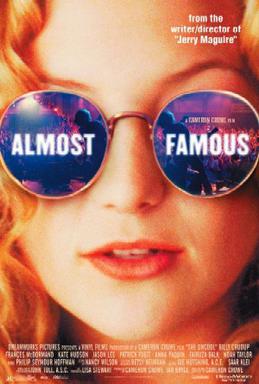
Cameron Crowe's Almost Famous is one of my favorite films. It's not a cinematic classic or something that will be remarked upon by critics or even fans a couple decades from now. It's clearly Crowe's best film (I saw his most recent, We Bought a Zoo, recently; it's preternaturally awful) and had great performances by Kate Hudson and Billy Crudup to propel it, along with the always-reliable Frances McDormand and Philip Seymour Hoffman. It was a great script because it was something that really happened to Crowe and you can see it in how natural most of the characters seem.
But I think the reasons it really appeals to me are two-fold. First, it's about music and the kind of devotion and enchantment that music can create, both among its creators and its fans. To quote Crudup: "My last words were [and mine may be]: I dig music." Jeebus, I listen to game soundtracks because of the twinges my soul gets from a nice violin piece. It's that bad.
But, secondly, it's about a bunch of creative people enjoying that process together, no matter where it took them. The comic studio was like that in many ways. We weren't reaching the big time. We never made any money. But it was never a bad time and I was committed to making it become... something. What, I'm never quite sure, but I was committed. That should be a startling shock to any of you that know me.
I met Jeff Donaldson in 1991 at the Chicago Comicon. I had already lined up my friends, Will Kliber and Wendy Law, in my quest to become a successful comic writer; nominally for DC or Marvel because they were, as they are now, the biggest kids on the block. I was shopping stuff around to other places/players (Dark Horse, Comico, Majestic) but hadn't gotten a bite and Image had just emerged on the scene. The comic world was just beginning to boom past its geeky, shadowy existence and there were a dozen hundred startups of all kinds at the big shows, where Dave Sim was lord of the small press manor. I vividly remember some kids drawing stick figures in a quartered letter-size piece of paper and selling them for $1.50 each. Hey, if Matt Feazell could do it with Cynicalman, why the hell not? The irony is thick and tendentious...
Jeff and Dave Witt and a couple other artists were making a scene in the small press area of the 1991 show and Will had met them on Saturday while I was still trying to make inroads with the bigger houses (this is where I first met up with an editor at Majestic who was more interested in sleeping with me than publishing my stuff; inroads being what they is, I kept in touch with her, show after show, for the next couple years until Majestic collapsed and died with the rest of the industry.) Will steered me over to them on Sunday and we talked about producing some stuff on an actual deadline for their studio, Fifth Panel Comics. As usual, Jeff was in no way serious about that deadline. I was deadly serious and hounded Will about the details of a 12-page neo-Gothic horror story involving a character called The Gargoyle (stunningly innovative) over the next few weeks. The kernel of that character came from a House of Mystery reprint I read in the late 70s (I forget nothing) and I had grand plans to turn it into something which it never became, while I continued to schlep even grander plans to outfits bigger than 5th Panel.
But those Grandiose Adventures never got sold and Jeff and I talked almost every day and it wasn't long before Fifth Panel started to become the focus of my comic world. This world, at least, since there are infinites, as you and I well know. However, everyone at 5PC was doing their own world and, since I was still very sold on the idea of the group thing that Almost Famous so vividly represents, I suggested making a group world that everyone else could pitch their own thing into and we could all reach that pinnacular moment that we all wanted to reach, separately AND together, and oh my wouldn't it just be so fine...
Jeff smiled and said: "Sure."
Interpreting his casual enthusiasm as a deadline of the most extreme sincerity (in this, I am Patrick Fugit), I sat down a couple days later and spewed out a couple dozen pages of outline with several dozen characters, a few hundred stories, and a few thousand possible storylines dangling off of it in an afternoon. My girlfriend came over at one point to see me, at which time I rather brusquely informed her that "I'm working." My shirtless, unshowered, fairly diffidently-gazed self probably indicated that, but I had to be sure. I couldn't be disturbed. Actually, it really wasn't that difficult or intense. I just had to be sure that she was aware that the creative process was in motion. It felt like the right thing to do at the time. Very Hunter Thompson.
That evening, I drove up to Jeff's place in White Lake and dropped the outline in front of him. He nodded, sagely (we were still kind of feeling each other out in our respective roles), and started reading. A couple pages in, he picked up the phone and called one of the studio's artists:
"Hey, you should get down here and read this cool outline that Marc wrote up for a shared world."
A couple more pages. Another call.
"Hey, you should really come over here and read this awesome outline that Marc put together."
A few more pages. Another call.
"Dude, get down here and check out this amazing stuff that Marc put together."
From that point on, Jeff and I were on the same page(s). Our lives weren't very similar. He had a career at Chrysler and was starting a family. I had a series of bullshit jobs and hung out with other political miscreants, theorizing about the revolution. But we shared a passion and conveyed it to a gaggle of artists and other comic-types who then joined us for our various road trips to locales around the Midwest and East coast. The small press scene was booming as the comic industry was booming on the fuel of speculation and we were going to ride this wave as long as we could. One day, Jeff would retire from Chrysler and become the full-time publisher, but a long time before that, I'd be writing my stuff and editing the rest of the studio's output to genuine comics glory.
At the time, we were assembling our books by hand, a group of us stalking around a table in Jeff's attic ("the studio"), drinking and swaying to Beck's Soul Suckin' Jerk, as we grabbed pages, folded, and stapled. There was no better way to spend an evening.
Our road trips were almost always excursions preceded by frenzied activity to pack all of our latest material and Jeff's latest updates to the booth into a minivan that he'd borrowed off the Chrysler lot (the really cool moments were when he borrowed a Viper to come down to Ann Arbor so we could talk studio work and then try to take it airborne on Michigan Avenue.) When we hit the shows, the object was to be as loud and obnoxious as possible to separate ourselves from the other two dozen small studios packed into the darkest and/or remotest corner of the major convention space or to be the one studio that stood out at the inexpertly-arranged small press shows. We were always the music source for our corner of the convention hall: RATM in the morning, James Brown in the afternoon, Mozart as the show came to a close. Beer and bad food and 10 people crammed into a hotel double. I loved every second of it.
Every day was a new idea. Every idea was something that someone guaranteed that they would complete. Every guarantee was a limitless promise, even if most of the ideas didn't have limitless promise or anything close to it. We were all in it together and it meant something to all of us. It was our thing and it was about the work (music), man!
Of course, I can only be so cynical and dismissive here because I would gladly turn the clock back 20 years and submerge myself in all of that again. That's why the film appeals to me so much, because I see our time in the expressions of those characters. We loved what we were doing as a supposedly upstart producer, but we yearned to be something bigger, even if we knew that being bigger would take us away from the absolute circus that we all loved and were thoroughly enjoying (and perpetuating.) It was at that time that being creative meant something. It surely didn't mean money, but that didn't matter. It surely didn't mean success, personally or otherwise. It occasionally meant sex, but Jeff was already married, so there were limits (Jeff's wife, Trish, whom I love to death, always kind of endured the studio, rather than engaged in it.) And there was a little fame. A very little. A lifetime of reading comics and a relative mastery of the English language led to me becoming a capable editor (yet one more skill that doesn't help me to land a decent job...) and I have a deep appreciation for and a decent assessment of good art, even if I don't express it that often.
Mostly it was about being with a group of like-minded people who would respond to one person's creative expression not with confusion or disdain, but with honest enthusiasm. We were fans, like Fugit's and Hudson's characters, who had a deeper appreciation for what was being shown to them than most (neither was "on drugs!" to make it a good time, as it were.) And, more than that, we were also the creators. I miss a lot of things about the studio: the people (I've only been able to keep in touch with Jeff and Dave, and then only sparingly), the road trips, the feeling of success when a project made it to print. But most of all I miss the ability to toss out an idea and have people immediately bounce one or two back. I miss bringing up a story idea and having people immediately become enthusiastic, rather than confused or hesitant. I miss walking into a space with Jeff and being able to feel like I was part of something, as I am part of so very little now.
I watch that film and I see us, even if on a much smaller scale. I'd give a lot to do that again.
Election season arrives at its two- to ten-month hiatus, depending on your status (local, state, federal) and obsession (What will Fox and Friends choose to obsess over and will the term "lame duck" begin to be used for a president's entire second term?) Last night was similar to 2008 in that I kept only vaguely in touch with the proceedings until it was all over but Karl Rove's shouting (Well, sniveling, really.) Then it was a mix of laughing uproariously at the funereal air enshrouding Fox News and nauseous disgust at a lot of the blather on Facebook and other networks where friends, associates, and colleagues of mine seemed to revel in the idea that a Democratic president had been reelected to continue to plague the nation with both action and inaction.
He doesn't even need the rock rolled away first. (H/T gamesthirst.com)
This is a man who justifies the assassination of US citizens from afar without due process or trial, who claims that the death of children in the process of these assassinations is also justified because they are of "military age", and who maintains a "kill list" of people he most desires to see in the crosshairs of the nearest unmanned drone (regardless of the nearby presence of a few dozen Pakistani villagers.) This is a man who employed Tim Geithner as his Treasury Secretary (the primary goalkeeper for the interests of the banks who nearly destroyed the global economy) and Larry Summers as his primary economic adviser. Summers is perhaps the one person about whom I could accept the concept of public lynching, as would doubtlessly happen were he to set foot in the Baltic nations or Russia anytime soon, where the people who lost savings, homes, livelihoods, and relative after relative to suicide as a direct result of Summers' "shock therapy" transformation away from communism would descend on him as soon as he appeared in public. This is a man who not only extended the duration of the most virulently anti-privacy and anti-individual rights law since 1790, but expanded upon its tenets. The Patriot Act is now even more oppressive than the previous administration had hoped for and we have liberal, socialist, Muslim Obama to thank for it. Don't you all feel safer?
I mean, to a certain degree, I'm used to this. I've been involved in electoral politics even before I could vote (1988) and it's no surprise to see the public mindlessly flock to the polls every 2 and 4 years to elect people who think of them as beneath contempt (i.e. easy targets for unmanned drones and the economic dreams of Larry Fucking Summers) and then revel in it as if this time they finally found the right guy. In this case, they found him again, even though he spent the last 4 years doing everything he could to dissuade them of their fantasies. What makes it even more galling was seeing a number of people whom I, at one time, considered political allies crowing about the reelection of a man who's done everything he can to make "Hope and change" into a punchline, rather than a mantra.
"But health care!", they say. Right. A money soak for the already wealthy insurance industry and a "solution" that does nothing to address the real problem of lack of government price controls, even in government programs, and the ever increasing costs created by medical professionals too willing to soak the system. As always, gotta protect those big donors. "But social issues!", they say. The Democrats' response to most social issues is the equivalent of someone attacking the tide with a broom. Obama's lone progressive social moment in his first term was a last-minute acknowledgment of the right of gay people to have a publicly recorded relationship with the person of their choice and he only did that when it was clear that his poll numbers were wavering. Glory fucking day. Otherwise, he essentially served out George W. Bush's third term.
Those social issues, while important in the long run, are also often seen as inevitable in that same period of time (witness Colorado and Washington's legalization of marijuana; anyone want to make a bet with me that Obama doesn't touch that issue for the next 2-3 years? The prison industry donates a lot of money to Democratic coffers.) Said issues also do absolutely nothing to alleviate the fact that those soon-to-be-happily-married gay people are just as economically screwed as the rest of us. It's the equivalent of the GOP getting angry, poor, white guys to vote for guns and against abortion while draining their wallets of anything meaningful. We've arced past the inequality of the Gilded Age. What do we call it when everything is plated in platinum?
This is the wealthiest nation in the history of human existence... but more people are going hungry now than at any time since the 1930s. This is the fabled Land of Opportunity... but social mobility is lower now than it has been in a century and getting worse. We'll have spent $707 billion on guns, planes, tanks, and soldiers in FY 2012 but somehow teachers' salaries and their pensions are the reason that our municipal, state, and federal budgets are out of whack. Progress on social issues? You mean we're finally approaching the level of devoutly Catholic Spain, which permits gay marriage and abortions as national policy? Awesome. Is that happening because of or in spite of the fact that people keep gladly electing criminals to public office and then throwing a party at their own funeral?
Hello, um, America. And goodbye.
Now, you could say that the outpouring of emotion last night and today is a product of the relief of a closely fought election but the worst part about that supposition is that all of this was easily predictable, months ago. Sure, Nate Silver is properly getting his 15 minutes because he actually paid attention to the numbers and understood what was happening, whereas the rest of the political world was still trusting its collective gut, which all too often has shit for brains. But all of this was obvious even above and beyond Silver's data. Romney was an historically bad candidate with a campaign that will be the benchmark for what not to do for decades to come. Who lets their candidate on a yacht named Cracker Bay(!) for an exclusive "thank you" dinner for big donors in the midst of economic hard times? What GOP candidate in the past century could have imagined having the CEOs of two of the biggest multinational corporations in the nation tell him that he and his ad crew were "full of shit"? Even at a private dinner, who dares to state that almost half the electorate is beneath your notice? The incompetence displayed by the Romney campaign over the past year is astonishing and I have a hard time believing that any of those who led it could possibly find another job in 2014.
Put simply: There was no doubt that Obama was going to win. There was as little doubt as in 2008 when the Alaskan Dingbat Carnival took over the McCain campaign. There was no struggle of values here; no hard-fought engagement for the future of the American people. It was two rich guys slinging crap at each other in an effort to make themselves seem less bad (as in, more attuned to people who won't make in 10 lifetimes what either of them will make next month) and betting heavily on the idea that said people are too weak-willed or defeated or distracted to ask for something better. It makes me physically ill to see people claim that their vote doesn't matter because of where they live so that they feel free to vote for what they actually want and believe in, while others bemoan the fact that their state isn't "safe" and they therefore don't feel justified in choosing the candidate that they truly desire. This is the Democrats' Boogeyman Syndrome written into stone. It's no longer used as a threat to scare people. It's now a moral obligation to heed the fact that the Dems' candidate gives better lip service to the ideals that those voters favor and that said voters must accept personal blame if their vote leads to the GOP candidate winning who, in the example laid out for us by Obama, is only slightly worse, if at all. Think GWB would have been in favor of the indiscriminate bombing of the Pakistani countryside? I'd give a lot to be able to see that interview, especially now that he's out of office.
So, yeah: Four more years. Hoo. Ray. Four more years of killing, hedging away from anything the public actually wants, and rule by the monied elite. The below picture was perhaps the best summation of the whole thing. I wonder how big the party will be in 2016 when they get elected for a third time.
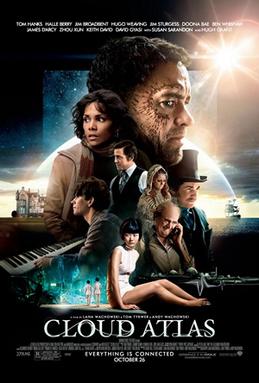
Made it to the theater today to see Cloud Atlas and really enjoyed it. I read the book years ago and found it fairly fascinating, especially for someone rooted in comics which, as a serial production, often have multiple storylines (and often multiple timelines) running simultaneously. It was an ambitious novel and Roger Ebert made a point of lauding the film in the same way, calling it "one of the most ambitious films ever made." I think there's some veracity to that, especially given a mass release to an audience that is often unprepared for this kind of complex storytelling (I still grimace when thinking of the local news media broadcasting a story about the phenomenon that was Pulp Fiction and interviewing people walking out of the theater saying: "I don't think I liked it. It was too confusing. First, John Travolta was alive and then he was dead and then he was alive again...")
Most of the performances were good, although I was kind of disappointed at Tom Hanks' lack of range. He never really escapes the Tom Hanksisms that make him who he is, which departs from the idea of all of these characters being linked across time, but still distinct people, and none of the roles were lengthy enough for him to display the depth that he can sometimes reach (as in Philadelphia.) That's a situation complicated by the "leading man" vs. "character actor" dynamic that I'll get into one day. I was pretty impressed with Hugh Grant in all of his roles (I did not expect to be) and Halle Barry as Luisa Rey, though. I do have to say that the makeup in the Sonmi-451 story, providing everyone with epicanthic folds, was a little jarring and could have been subtler.
As for the story itself, there were changes from the book (surprise!) but those were inevitable. The fact that it was made into a film, and a good one, is impressive enough. The overall pace of the film is much more frenetic than the book, which is typical of the Wachowskis' style and something likely necessary to keep a modern mass audience in their seats for three hours. However, I have to say that I felt more convinced of the emotional and cerebral impact of the story in reading the novel than I did in viewing the film. The most important of the six on a broad level is An Orison of Somni-451, while the best on a personal level is Letters from Zedelghem. I think the latter came across very well, while the philosophical underpinnings so necessary to the former weren't as well conveyed. It's very difficult to present a message of inspiration, since so many will take inspiration from different things. On a personal/character scale, Somni-451 was, like Letters, excellent. Bae Doona is another who deserves commendation for taking on a difficult and transformative role and pulling it off without traipsing in to melodrama.
I do disagree with Ebert on a very prominent point, though: I wasn't confused. There are moments when you will certainly be lost as to the relevance of what you're seeing in the overall picture and I had the advantage of having read the book, so I knew where much of it was going. But the fact that there are so many possible interpretations are what make the film good, not confusing. Looking for logical connections in the film is about as pointless as doing so in life, in general. Some things are simple to be experience and, by that experience, understood. Analysis will often get you nowhere.
So, good stuff, overall. It's Oscar season, of course, and I'm eager to see several other films, although money is a limiting factor these days. I wanted to see The Master and will hope for its rapid release on Amazon, but I've heard the raves for Argo and would like to see Lincoln, Seven Psychopaths and, of course, The Hobbit in December, although I'm still not certain how you could turn that simple story into three films without hijacking a ton of the Silmarillion. We'll see.
I have a fundamental attachment to this film. It's one of those that I've seen any number of times but would gladly watch again any time that I see it on or even toss in myself (VHS!) First off, I think Steve Martin is a creative genius and I have always been a fan of the work that he has created, like The Jerk and his stand-up material. I draw that line between what he's "created" (acknowledging that acting, in and of itself, is a creative effort) and what he's done to earn a paycheck, like the execrable comedies he's been making with people like Goldie Hawn and Queen Latifah. There was a self-assuredness that I heard in his stage routines that was really appealing to me when I was young and remains so. He's confident and so much so that much of his humor seems self-deprecating without being desperate. He doesn't make decisions out of lack of knowledge ("I played football in high school. I was the quarterback. I used to like to punt on first down.") He makes them because he's simply on a higher plane of understanding than everyone else ("You take geometry and geology in college and it's all numbers and you just forget it all. But you take just one semester of philosophy and it's enough to fuck you up for the rest of your life.")
While the tone of the film veers toward the sappy and it deftly avoids any deeper message than what the original story of Cyrano de Bergerac conveyed; and while none of the performances outside of Martin's (and Shelly Duvall's somewhat) are memorable; and while the story is simple... it's still appealing because the script is so brilliant and Martin's performance is so earnest that it dispenses with guile and cynicism even while his character is the most cynical person in town. He takes you past that and demonstrates a basic feeling that many of us (most assuredly me) are often loathe to admit: the desire to be wanted.
American individualism is an essential element of our modern culture. It's the dictum that encourages people to slough off any emotional pain and keep rolling along. If they can't "get over it", then there's something wrong with them. Martin's character attempts to turn that perspective on its philosophical head and declare that deep (and often tragic) feelings are what make people feel alive. I've known that from a very negative perspective for as long as I can remember. Rage drove me for many years and occasionally still does. But I'm attached to this simple little movie because it the character is "weak" and is plaintive and is lost in the search for something that he feels he can't have but which is actually searching for him.
And, of course, any film that presents both Strauss' Blue Danube and Mozart's divertimento in B flat Major is worthwhile viewing, IMO (I try to overlook the standard alto sax theme music and score that all 80s movies were contractually obligated to use):
Disclaimers: 1. I only read Kirkman's first story arc. It was OK. 2. I am not a zombie guy, despite being very much a post-apoc guy. 3. My standards for watchable TV are admittedly kind of high.
I'm a huge fan of some of AMC's offerings but it took me a while to get there. I watched the first episode of Mad Men when it premiered, but wasn't taken by it and never watched another until last fall, when a friend suggested that I was missing out and should take advantage of the series on Netflix (other people had suggested this before; this time, I listened.) I immediately realized that I should have been more patient with it, watched seasons 1-4 quite quickly, and was on track for season 5 this past spring. Likewise, I hadn't bothered to pay attention to Breaking Bad but had always put it on my "someday" schedule. After learning that season five would be airing this past summer, I once again hit Netflix for as much as was available and then watched the rest on DVD and the new season with a group of friends that had also caught up rapidly. Both series are brilliantly written and I haven't regretted one second of the time I've sat in front of them. I've often said that the best thing ever put on TV was The Wire, but Breaking Bad is a very close second, at this point.
Determined that I would not be left behind again, I began to watch some of AMC's more recent offerings from the beginning; specifically, The Walking Dead and Hell on Wheels. Unfortunately, both have been much more uneven than either of the aforementioned series. I wasn't even sure that I'd watch the second season of Hell on Wheels and am still uncertain about the third season, despite its steps toward improvement, script-wise, in the recently concluded episodes. I had the same issue with Walking Dead in its second season, as the storyline seemed to stagnate and the characters other than Daryl were two-dimensional in their motivation and hollow in their actions. Hell on Wheels improved because of a creative change in which the brothers Gayton were removed as the writers. Walking Dead also underwent a fairly dramatic change in the off-season, in which the tempestuous Frank Darabont left the project and a new showrunner, Glen Mazzara, stepped in. It was with that in mind that I decided I'd give it one more try.
I knew a lot about what was coming in this season as I've accumulated information from AMC's promotions, talk on the Web, and friends who are dedicated fans. I know that they're still loosely following Kirkman's story and that the events at the prison and the introduction of Michonne are key developments here. So, it was gratifying to see them dive right into it within the first few minutes of the opening. I was under the impression that, having seen the prison so nearby in season 2's finale, the story would reopen relatively soon after that close. A quick glimpse of Lori's distended belly and Herschel's thick beard put the lie to that and it was clear that we were seeing the group a few months post-season 2. With a new writing team and direction, I think that's fine. It gives the new team a chance to jump right into their versions of the characters and it's not jarring for the fans to see them moving as a coordinated unit when dealing with the walkers. It also gave rise to good character moments, such as Carol attempting to joke about screwing around with Daryl. It's left uncertain as to whether their relationship has taken that next step or whether they're still sorting it out, which is a good tease for the viewers.
On the one hand, having seen the prison so close in the season 2 finale, there's room to question how they could have failed to stumble across it for several months. Of course, one has to consider just how easy it is to run in circles in the countryside without modern communication and the activity of other humans to follow, so I have no issue with that. I think Rick's demonstration of disdain and anger with Lori is a sign of the writers having moved him past the angst-filled "nice guy" to a genuine survivalist in the Daryl mode. What made Daryl the only really decent character in the first two seasons was the fact that he actually matured in respect to his surroundings. He was still the callous survivor, but it was clear that he was also touched by the group actually desiring his presence and the fact that his particular code of ethics (concern for others' well-being not only as a survival method but also because that's how humans generally act in crisis) was particularly well-suited to the circumstances. If that's the direction that Rick is going, so much the better, as it will reduce the level of guilt/angst/general caterwauling that often brought things to a grinding halt in season 2. Obviously, Rick is also being set up to be too callous and cold, but I can live with that kind of development as long as it doesn't become rote "redemption of the hero."
There were a lot of ways that introducing Michonne could have been an abject failure. She's the most fanciful of Kirkman's characters to appear and it could easily disintegrate into the Roger Corman arena if she's not handled carefully. I think it was well done here, showing a bit more of her sword work and her pet zombies, but staying away from exposition and allowing her to retain an air of mystery for a while longer. I'm especially interested in seeing a bit more of her style with the weapon. On the one hand, there are different ways to use it. OTOH, in the picture above, she's holding it like a baseball bat, which is not the way a katana would be wielded whether you're doing iaido, kendo, or some kind of koryū. I really hope they paid attention to some of the riddles of steel, as it were. Unfortunately, there continues to be no riddle whatsoever about T-Dog, who keeps running his two season marathon of following orders and generally not contributing anything to the conversation. Likewise, it seems pretty unusual that Glenn and Maggie would still be that wooden with each other with another few months of life under their relationship belts.
That said, I think this was probably the best episode of the series so far. The script was well-paced and no one said anything glaringly stupid or annoying. The action scenes were more suspenseful, especially since the zombie action is moving back into enclosed spaces inside the prison, rather than outdoors in the sunlight where they're much less threatening. It's still not hitting the high points of Mad Men or Breaking Bad and likely never will, given the greater room for thoughtful subtlety afforded to those mostly-"real life" stories (yes, even including the blue meth.) But I felt actually intrigued by this episode and not left thinking that I shouldn't be watching so much TV. It's also the closest I'll ever get to seeing something like Gamma World, where mundane facilities like prisons are highly valued for the trove of stuff that could be inside...
I do have to say that, if AMC does much more of this mini-season split crap, where a series is shown eight episodes at a time, separated by several months, I may just give up even on things that I enjoy. It's ridiculous that we're waiting another year after only 8 episodes of Breaking Bad and having a multi-month split in between the two halves of season 3 of Walking Dead is possibly even worse. There is a point where you piss off your loyal viewers and, IMO, AMC is reaching it.