Monday, June 3, 2013

Slow realizations


If you think about it, anyone who hasn't read the books could have seen this coming. After all, what have all your book-readin' friends been raving about for the past decade? "George R. R. Martin is a favorite character killer! No one is safe!" And through three seasons, who has actually died? Ned, Robert, Drogo, Viserys, Renly. That's about it and it's a stretch to consider the latter three fan favorites. Meanwhile, the last two episodes' material with Robb have basically been a series of (ahem) pregnant pauses. You could feel something building up, given the borderline insane plans to treat with Walder Frey and then stroll off to lay siege to Casterly Rock. It's that slow realization of dramatic change that forms the real basis for this episode, as that reaction happens again and again as people discover that what they most hoped for has been dashed and what they most feared has been realized. This is Westeros (and Essos) and welcome to it.

Scene after scene is built upon or highlighted by the expressions on various characters' faces as their inner thoughts, that crucial element that is so important to the books and yet is absent from the show by nature of the medium, tell them something that they should have known but are still utterly shocked by. One of the best is in the first few moments, when Catelyn stares holes through Robb as now- now! -he comes to her for advice. You can see her searching him for an agenda, for what it might mean for their damaged relationship, for what it might mean in his entreaties to Lord Frey. There are extreme hopes and fears there and there is no one that is immune to them.


Jorah Mormont feels it when Daario first covers Dany's hand to move it across the map. The realization is there, but he quickly tries to dismiss it in the name of duty as he reaffirms his and Ser Barristan's role in this whole escapade. Later, when he and Grey Worm narrowly escape with their lives and Dany asks after only Daario, his world caves in and those attempts at dismissal are long gone.
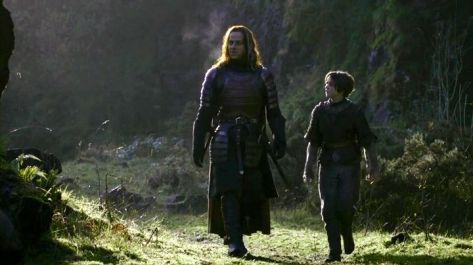


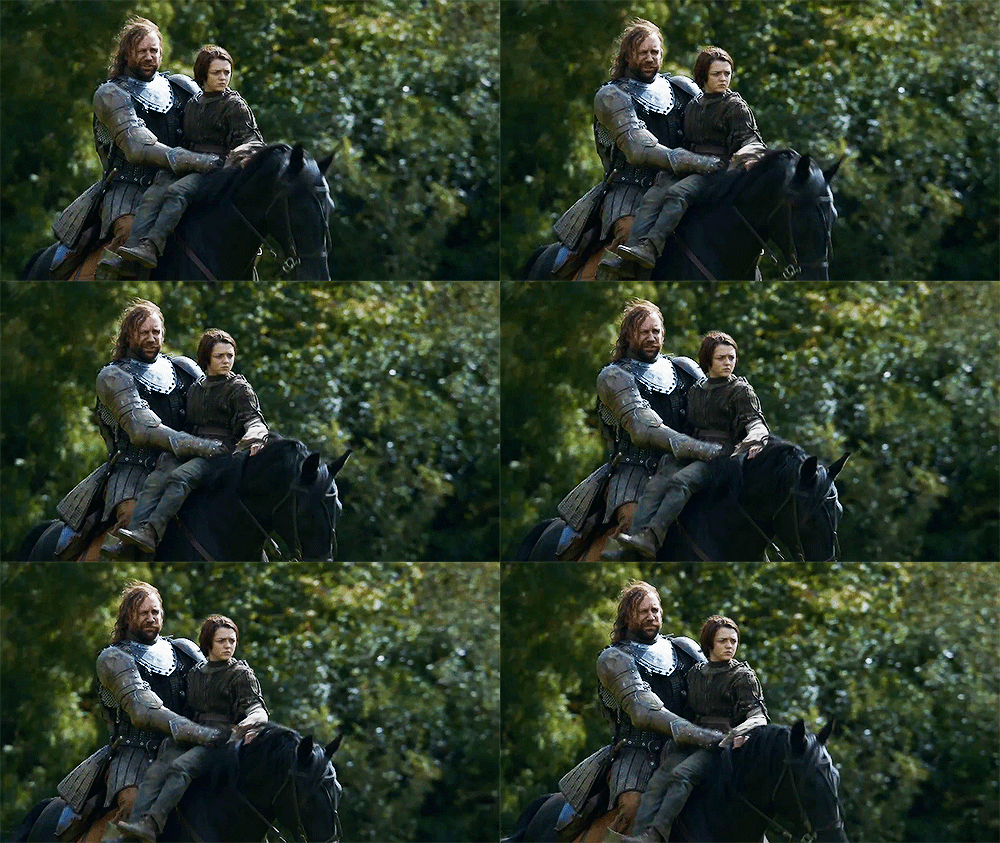
Arya feels it when she realizes that everything the Hound is telling her is true. She is afraid and it is altering her behavior, protest notwithstanding. But those fears don't come to fruition until she has to watch her brother's wolf get slaughtered and then suddenly discover that the man she hates, the murderer of her friend, is the only one who can protect her from the madhouse that the Twins has become.

Again and again: Gilly discovering that the man who rescued her knows about an entirely different world... The Hound realizing just how grim and dedicated this tiny woman is when she clocks the farmer to keep him alive... Osha's resigned disgust at hearing her little charges spit back the old wives' (Nans'?) tales about the evil Wildlings... Edmure discovering that at least one daughter of Walder Frey is pretty hot... Ygritte's anguished dismay as she watches her lover leave her behind, a traitor to her people... The creepy discomfort on Talisa's face as she watches tradition take Edmure and his new bride up the stairs and violate the intimacy of their first physical moments. This episode was a study of faces, a study of expression, and most of it, at its root, was about fear.


Fear is everything here. Jon fears what the Wildlings will do and how he'll feel responsible for letting them do it. Ygritte fears that her suspicions about Jon are real and how she'll still want to let him fulfill them. Arya fears missing out on finally reuniting with her family, even though she knows that she's forever changed and may never feel the same about them while she's driven by vengeance. Jorah fears Daario's betrayal inside Yunkai as that's what Jorah, an opportunist of the first order, would probably do. But even moreso, he fears having to confront his own realization that Dany is lost to him as a lover and Daario is the walking proof. And nothing was more obvious than the trepidation that Robb and everyone in his party were swimming in from the moment they set foot in the Twins. The first bars of the Rains of Castamere only served to bring that home to Catelyn before the knives started falling.

On the technical side, I think most of it came off pretty well. The fight in Yunkai was a pretty basdass scene, even if the editing and choreography were a little clunky. It's difficult to coordinate that many people in a dance of death that's supposed to look natural, but there were one too many "And... action!" moments to really feel like any of them actually had a knowledge of their weapons and how to use them.


As for the famed Red Wedding, I was kind of up and down through the whole thing. I liked that they included the bread and salt bit, but I thought they could have taken a few seconds to clarify just what it was. Seeing them all eating in the Frey hall probably wasn't enough for show watchers to realize just how big a violation Frey's betrayal was, not just in the political sense, but in the cultural and spiritual senses, as well. I thought it was excellent direction, however, to incorporate that incredibly tender scene between Talisa and Robb, discussing the naming of their future child, only to have everything literally torn apart a few moments later. The stabbing of Talisa's womb was a bit of a shock to me and something I didn't expect. On the other hand, the slaying of Grey Wind was much tamer than I expected and certainly less so than presented in the book. Acknowledging that it was still a pretty heart-wrenching scene watching a defenseless animal get cut down leads to the common sense understanding that, even on nights like this, HBO is only willing to go so far (and it's probably a good thing.)

Also, for as much as I've already seen people raving about Michelle Fairley's performance, I thought she kind of let the air out of the room in her final confrontation with Lord Frey. It's certainly very tough to convey that kind of anguish and desperation and rage, but I just wasn't sold, unfortunately. Of course, the logistics once again let them down, in that Catelyn's moment is supposed to be surrounded by the chaos still taking place in the feast hall, with combat and slaughter and screams and turmoil encircling her as she attempts to bargain with the lives of others. When you have a constrained budget, you can't do the kind of scene that the original depicts and which the event deserves. In the same way that the Hand's tournament was a letdown for lack of an audience, the wedding scene was a bit underwhelming for lack of victims (quantity, if not quality.) But them's the breaks.

Have to say that the credits without music was a very nice touch.

Lines of the night:

Honestly not that many, since most of the delivery tonight was written on the faces of the actors and not needing the script writers to help them perform it.

"Show them how it feels to lose what they love." - Check.


"Your king says he betrayed me for love. I say he betrayed me for firm tits and a nice fit. And I can understand that. At his age, I would have broken fifty vows to get into that without a second thought." - Blunt man, Walder Frey...

"The wine will flow red." - ...but not without his fair measure of subtlety.

"A man cannot make love to property." - Here's a segue right into a dom/sub discussion and... Nevermind.

"You know all that from staring at marks on paper. You're like... a wizard." The greatest moment of Sam's young life.

"I know a real killer. He'd kill you with his little finger."
"That him?"
"No."
"Good." - No one is more pragmatic than the Hound. Forever my favorite character.

"You're very kind. It'll get you killed." - I say again...

"We can drink some blood while we wait. I don't need much." - Osha getting a jab in.

"Someday, I'm gonna put a sword through your eye and out the back of your skull." - But that might leave him faceless.

"The gods love to reward a fool." - The Blackfish, wiser than he knows, because the fool wasn't Edmure.


And, finally, a short note about Bran. This was, interestingly enough, the best Bran scene in quite a while and it was completely overshadowed by the wedding. But finally demonstrating the expansion of his abilities and the heartfelt departure of Osha and Rickon was some excellent material for a storyline that's basically been running in place all season. There is, of course, only one more episode to go so I'll be interested to see how they wrap it up for the year.

Thursday, May 30, 2013

The Iron Fist rule

There's a creative problem that comes up most often in serial productions like comics and in movies (which comics are closer to than prose) that are destined for sequels (and, aren't they all if they make serious money?), but which also emerges in prose. It's a tendency that I've always referred to as the "Iron First rule."


Iron Fist is a Marvel Comics character that was created in the 70s during the height of the Bruce Lee-led martial arts explosion. As with most one-note and/or fad creations, the series only lasted for 15 issues because the fad flamed out fairly quickly, as well. (You can see this phenomenon in all kinds of Marvel efforts in the 70s and 80s, including a series based around a trucker, but I digress...) But part of what propelled the series' demise is that the character itself, despite having an interesting backstory that could have led to all kinds of creative discursions, was part of the Marvel Universe™ and had to have some way to compete with the guys who could punch through walls or shoot down aircraft with their eyes or whatever. He had to be, in short, a superhero and not simply a badass martial artist. Whither Batman, you cry? Sure, but he also couldn't just be another badass martial artist who also happened to be filthy rich enough to drive tanks down the street in order to take on the guy made of living flame.

Consequently, Danny Rand also had a superpower: his fist could become unto a thing of IRON!! That's how you beat the guys who could brush off your jeet kune do. That's how you're Iron Fist. And that's how you beat them and be Iron Fist. Every. Single. Time. Every issue involved becoming the thing of iron, perhaps even multiple times. Now, you're thinking that I've just described the average porno (in detail, even.) You're not wrong. But putting aside the implications of getting your readers off with every issue (not passing judgment here; everybody has their thing), you also can't keep doing it the same way every issue (unless you're talking about actual porn. Sometimes. I'm leaving this metaphor.) If every fight is solved by hauling out the iron fist, why not just do it in the first three pages of the issue and deal with the latest super-villain right away? (Just like porn has become 3 minute clips instead of 90 minute films. I'm leaving it. For real.)

Not only do you have to come up with a good reason to not use the ultimate power right away, you have to come up with guys that aren't affected by it unless it's used in new and exotic ways AND you have to convince the audience that all of this is credulous. Granted, baseline credulity and superheroes do not often mix. Your audience is already often predisposed to the fantastical or not really concerned about a shaky premise because they've just decided to plop down and read one issue of your continuing series. But if you do have a regular readership, they're going to get tired of that routine at about the same pace as the writer. No one wants to keep distracting themselves with justifying their story while they're trying to write it. But if your character is more self-contained, you don't have that problem.


Shang-chi also existed in the Marvel Universe™ and was also an outgrowth of the 70s martial arts explosion. However, while Iron Fist lasted 15 issues, Shang-Chi lasted for 125; a success story by almost any measure in the comics world. Shang-Chi was simply a kung fu guy, walking the earth, and his book remained in that sphere. There was no ultimate power because there were very rarely opponents of the standard super-villain style. He did encounter other characters in Marvel's stable, but almost always in their books. His story continued to be largely his story because it was about the character and not about his supreme ability. But that Iron First rule can work against more established and well-rounded characters, as well.


Most people remember this famous scene:


(among others.) "Dude! He can kill people just by looking at them! And holding his hand in the kung fu grip!" OK, fine. Then why does he have to throw down in risky lightsaber battles with his real enemies? Because if Vader could just snuff out everyone he ran across by frowning, there would be no story. "But wait!", you say. "The reason he can't just reach out and treat Luke's head like a water balloon is because Luke is also strong with the Force!" Sure. That's plausible. But what about the next time they meet up? And the next time? And the next time? Eventually, it all comes crashing in, which is why one of the few things Lucas did properly post-Empire was to let Vader die. Once you've presented an irresistible force, it either lays waste to everything or it ends. That, of course, isn't possible if the character in question, like Iron Fist, is the franchise. But that also results in the inherent problem of many sequels in movies.


The first Iron Man film was a good film. Not just a good superhero film, but a good film overall. Well acted, tightly-paced, tightly-written, and with a decent resolution. Tony Stark has created the world's ultimate weapon in the name of defending it and does so successfully. The End. Enter Iron Man 2. What now? "Well... Let's blow more stuff up!" This is the Iron Fist rule again (perhaps it is now just "the rule of Iron"?) You're still a man in a suit of armor and there have to be an increasing number of more spectacular ways of displaying that if you want to keep (some) audiences entertained. Hollywood's shortcut these days is usually CGI explosions, plus 3D, IMAX, and whatever else they can tack on to keep people from simply waiting to watch it on their 50" flatscreens at home. Iron Mans 2 and 3 are not horrible films. Robert Downey, Jr. is the lifeline in both of them, as he was seemingly born to play this role (and Ben Kingsley was a hoot in 3.) Furthermore, Tony Stark has always been one of Marvel's more interesting characters because of his implicit moral quandary (weapons manufacturer wanting to protect people), personal issues (alcoholism), and heavy load of responsibility for his company and the people whose lives are affected by it. The movies portray most of this very well, so it's not as if the films were entirely bogged down by the rule. But there can be little argument that the first film was the best because it simply told a story and didn't concern itself with having 15 Iron Men flying about in one of the most appropriately-labeled deus ex machina moments I can remember:


How do you do better than Iron Man? "Have more! And blow more stuff up!" I'm all about heightening the excitement and trying to top yourself. But there comes a time when the ordnance and the one-note superpower tends to overwhelm the story. At that point, you're just a gimmick and gimmicks, like fads, neither last long (Cue Twilight fans in 3... 2... 1...) nor are remembered very fondly. This rule does stretch into prose, as well, and sometimes very good prose.


I just finished Joe Abercrombie's First Law trilogy. It was excellent. It was a very restrained take on the fantasy genre combined with a rather brutal depiction of medieval mores, all functioning under the relatively obvious veneer of modern political corruption. His characters are great and they speak and act like real people, which is always my first hope in reading or watching a story. One of the most prominent is Logen Ninefingers. Logen is a Northman who can speak to spirits; something he does precisely twice in the ~2000 pages of story. Logen also has an alter ego that resembles the famed Viking battle frenzy, wherein he becomes what people around him refer to as "the Bloody Nine" and proceeds to slaughter everything within reach: friend, foe, and innocent alike. He does this several times in the series and almost always at a crisis point (very Hulk-like, since we're talking about comics.) By the third book, it becomes mildly predictable and a bit tedious, but what restrains it from being a completely Iron Fist situation is that there are implications to his actions beyond simply defeating the enemy. As noted, he kills everything, including characters of some prominence in the story and then is left with nothing but the guilt of having saved some and slain others that he was trying to save. It doesn't rescue the situation completely, but it at least provides tension for the reader, knowing that wanting Logen to go off won't always have the best results for the story if you've become fond of one of his incidental victims. I mention it here largely to demonstrate that the rule isn't a complete death knell to either character or story and can be contextualized successfully. However, the standard note about length must be included. Abercrombie has written three more books in the same world as the First Law series. Logen is not present in them. When his story was done, it was done.

What has occurred to me over the years is simple: If you want to have good characters, they can't be one-dimensional and you can't cover up that lack of depth with any success if you want to do something credible. Granted, it also depends on your readers' willingness to follow along.

Monday, May 20, 2013

Emotional conviction


There are a couple broad methods of storytelling. One of them is plot-driven. The story itself is the main focus and the characters are there largely to enact it. Isaac Asimov's writing is a good example of that. Asimov had grand ideas. All he needed was a couple people in a room to elaborate upon them and occasionally he'd throw in robots and a starship or two. The other method is character-driven. The story is essentially about a person or people and how they interact with the world around them. Typical superhero comic books (and their associated films) are the most obvious example of that method. The story surrounding the Incredible Hulk is the story of how he interacts with the world in both his Banner/Jekyll and Hulk/Hyde forms and how that creates problems for himself and those around him.

A Song of Ice and Fire, like many epic works, moves past that separation and has created a story that is both beyond the control of its many characters and almost wholly driven by them. In that sense, while it may be a good example of both a plot-driven and character-driven story, it still trends toward the latter, as much time is spent showing just what kind of impact world events have on the various people involved and the emotional consequences thereof. This episode was a prime example of just that.
 

From the opening scene, where we see that Arya's occasional loss of control of her emotions may actually have made her situation worse if she were able to kill the Hound, to the episode's centerpiece, the wedding of Tyrion and Sansa and the tangle of emotions that flows throughout the palace, we see that emotional responses not only continue to define these characters but also tend to drive the story itself, outside of seemingly emotionless entities like the Other. There are forces at work that don't depend on either our cast or their response to the good and bad things that happen to them, like the Walkers, but lust, desire, honor, and anger tend to drive most things that are taking place here, whether it's for power, money, or sex, or some combination thereof.


Daenerys' drive for power places her in a situation where she feels compelled to try to make deals with the Second Sons mercenary company. At the same time, Daario Naharis is overcome with lust for Daenerys herself and uses that to take control of the company (although why the Stormcrows became the Second Sons here, I'm not quite sure, especially given the final scene of the episode, where crows figure quite prominently.) Melisandre uses lust to gain the blood of Gendry for Stannis' own lust for power, but Stannis feels honor-bound to the Onion Knight to free him and keep him on as an advisor that might serve as a brake to the Red Woman's love for her god which is doing nothing but serving Stannis. Are these events part of the overall plan that Martin had for the story or are they natural outgrowths of the characters themselves (e.g. the author acting as interpreter and conveyor of the way these wholly formed people would act)?


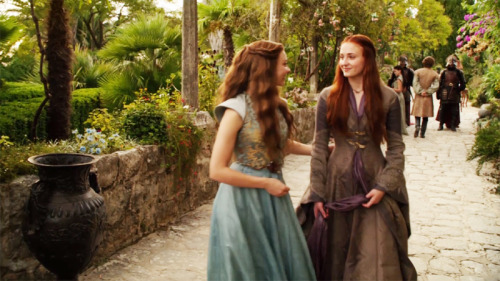
Again, the centerpiece is the wedding and its aftermath. While Tyrion and Sansa's scenes may have been poignant and/or served as the backdrop to emphasize things like Joffrey's pettiness and Tywin's frustration, I think the best scene of any of those assembled around the proceedings was that of Cersei and Margery walking through the Great Sept arm-in-arm while they threatened each other or reacted to said threats as they kept up the public mask the whole way. This is a great example of a scene that doesn't have a great deal of story attached (not like discovering the effect dragonglass has on an Other, for example) but which has an enormous amount of weight hanging off of it as you observe the players maneuvering around the board of the game. This is to not even mention the blizzard of emotions going through Lena Headey and Natalie Dormer's eyes as they move along.


To draw a direct contrast with another series and another new episode tonight, the latest offering for Mad Men had me thinking that it was just 60 minutes of watching characters (mostly Don) gyrate through their emotions and basically leave any sense of story behind. The drugs, the weird introduction of the thief, the flashbacks to his first time; all of that didn't really tell a story but spent a lot of time wringing emotions out of a character that hasn't been famous for them. The episode was conflicted and not the best that they've done. On the other hand, "Second Sons" drove the story forward even as the screenplay focused on the emotional turmoil and the reactions of these characters to that turmoil. I think GoT was better served in that respect and why it remains the stronger story (and better series) overall at this point.

Lines of the night:

"So quit trying to bash my skull in and we might make it there in time for the wedding!" - The Hound, always the pragmatist.

"It's hard to collect wages from a corpse." "A man who fights for gold can't afford to lose to a girl." -
Daenerys picks up strategy as quickly as she does languages.

"Mothers and fathers made up the gods because they wanted their children to sleep through the night." - Ser Davos with the essentially Hegelian philosophy (i.e. man created god in his own image.) Watching Liam Cunningham deliver lines with Davos' customary restraint, especially in the face of the man to whom he's devoted his life, is great fun.

"You won't be a prisoner after tonight. You'll be my wife." - There's a softball for many married couples, right over the plate...

"Of course, ambitious climbers don't want to stop on that second rung." - A great scene and why Lena Headey makes a better Cersei than many expected. And, of course, probably the best line of the episode: "If you ever call me 'sister' again, I'll have you strangled in your sleep." BAM!


A couple side notes here: Diana Rigg was once again knocking it out of the park, as she attempted to detail the complex relationships between the soon-to-be-married brothers and sisters of Houses Tyrell and Lannister. Playing the doddering old woman while carefully watching Cersei's reaction is just priceless. Also, while there have been many mentions over the past few years about the necessarily smaller crowds and events than the story originally called for (i.e. the tournament of the Hand in season 1 should have had thousands in attendance for the joust) as a consequence of cost and logistics, it's interesting to note that, in the books, Tyrion and Sansa's wedding is lightly attended and by a very unenthusiastic crowd. So, for once the practical matters actually served the interests of the story. We finally get to see the High Septon, too.

"I don't understand. This doesn't seem very religious." - Gendry, trying to understand the strange practices from across the Narrow Sea. Martin's knowledge of history perhaps betrays him here, as sexual mores in the east from Roman times forward were far more flexible and accepted as part of life than they were in the west.

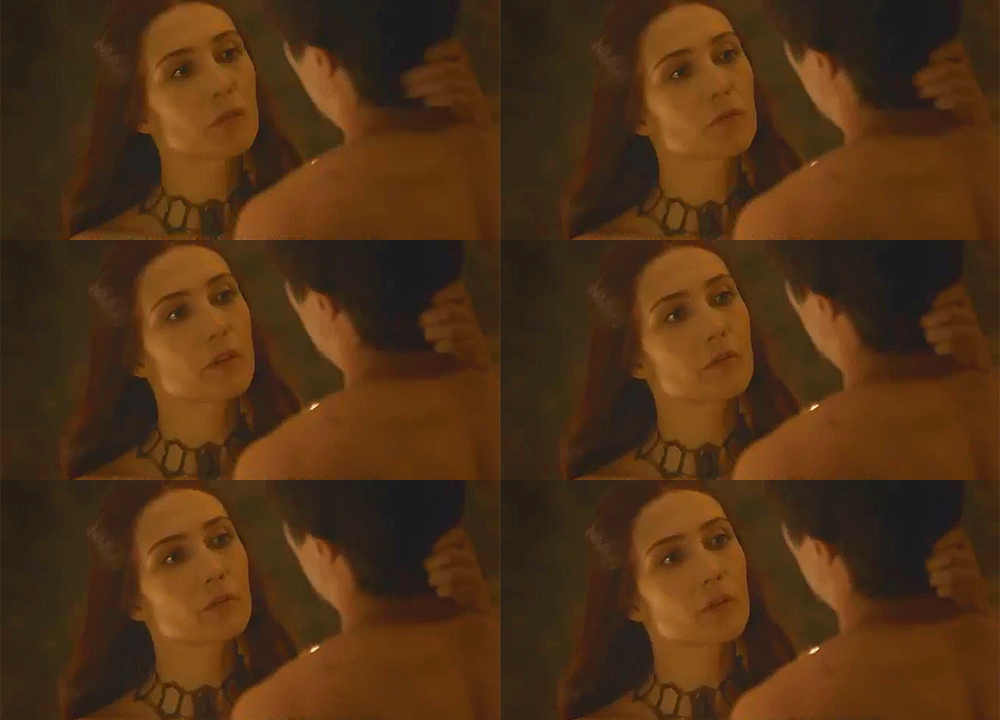
"Come fight death with me." - Melisandre with the double entendre (alliteration joke!) Next time a woman drops her cloak and tells me to fight death, I am so there. Has to be said, though, that it's weird even in a situation like this that full frontal on the men is still not permitted, but the women can drop their kit at any moment. Why, for that matter, is full male nudity OK in the scene with Loras, but not with a woman? Speaking of sexuality being constrained...

Tyrion:
"Drinking and lust. No man can match me in these things. I am the god of tits and wine!"
"I vomited on a girl once in the middle of the act. Not proud of it. But I think honesty is important between a man and his wife, don't you agree?"
"If my father wants someone to get fucked, I know where he can start!"
"And so my watch begins..."
Still one of the best characters in the story, even when things are supposed to be mildly tragic, and the toast to Loras in the balcony, as trapped in circumstance as Tyrion is, was excellent. Also, Shae's expression at the unspoilt bedsheets was great.

"I'm the simplest man you'll ever meet. I only do what I want to do." - Daario Naharis, the Epicurean; the perfect new character for an episode driven by emotion.


"Sometimes do you talk fancy on purpose to confuse me?" - Gilly exploring a whole new world.  This scene, while somewhat overlong, was well done from a dialogue standpoint, as Sam elaborates upon naming conventions and their personal weight. We also finally get to see another weirwood tree.

Sunday, May 12, 2013

Everybody likes that song


We begin with the obligatory shot of the author who also wrote the screenplay for The Bear and The Maiden Fair. Interestingly, he steps back a bit from the seemingly more momentous episodes that he wrote in the first two seasons (eighth and ninth, respectively) but still confronts a host of issues in the increasingly tangled plot (That's a segue...) This episode also continues the extreme departure of Melisandre abducting Gendry, which most might think would create an interesting thought process for the writer: How do I re-write my own story from 13 years ago? But that's what writers do all the time, anyway. In point of fact, the fourth book that became Feast and Dance was half-written in a time setting several years removed from Storm before he decided he didn't like that approach and scrapped it. My bet would be that he enjoyed indulging in the ability to tell the story in a different manner.

Of course, it's interesting to try and second-guess where GRRM's heart really lies in the whole picture. The story started with him envisioning the finding of the wolf pups and it's clear that the North is key to the whole epic and Martin spends a lot of time on the Wildling excursion to the south in this episode; not that that's a bad thing, as it means a lot more time with Rose Leslie and her continual output of memorable lines. But it is interesting to speculate on whether Martin had any input on which episode he'd be writing and whether it involved so much Jon and Ygritte action. Speaking of action...


I wouldn't have been especially traumatized if we'd spent the whole hour watching Oona Chaplin's ass, either. If there's one thing a king needs, it's awareness of what his people want. Robb repeatedly states what he wants and it's pretty much what a lot of us want, as well, so there you go. The larger context of Talisa's refusal to clothe herself is, of course, the fact that she has been distracting Robb's larger purpose (My special purpose!) from the moment they met and that has had consequences and will continue to do so.


Staying on topic, Natalie Dormer continues to do great things as Margaery, even if all it does is draw a focus to the innocence of Sansa... which is the setup to both of Tyrion's scenes, as he gets the reproving common sense of Bronn, seemingly understanding how to be a nobleman with a wife and a mistress better than Tyrion does, and the later anguished argument with Shae, who also knows how the world will put her in her place, even though she seemingly hooked up with one of the few who can deny that placement. She just didn't know about his father. The dialogue between Shae and Tyrion was a standout moment of this episode and was as heartfelt and sad as it was funny, which is true talent from a writer, I think.


Meanwhile, never was it more evident that the true power behind the throne is the man who ostensibly serves it. The scene between Joffrey and Tywin, including the elevated camera perspective showing Tywin standing ominously over his grandson, was excellent. The phrase is "The king shits and the Hand wipes." but, in this case, I think it's more "The Hand spanks." as Tywin again outmaneuvers the opposition at every turn (no great effort needed here, of course.) And we shift immediately from there to another outmaneuvering which is a bit more overt and involves ever-larger lizards.


In a way, it was absolutely appropriate for George to be writing this episode, since it kicks off the conquest of Slaver's Bay which led to the famed "Meereenese Knot" and the long delay to the completion of Dance with Dragons. Nothing like revisiting the scene of one's greatest struggles to gain wisdom, one supposes. It was also a nice counterpoint to one of the earlier moments, wherein Ygritte claims that the Wildlings don't march to the beat of a single drummer, whereas the Yunkai delegation, markedly representing the "Old World", distinctly does. It's now going to have to respect a different beat that it hasn't heard for hundreds of years; that of wings. There was solid CGI work with the dragons here. They definitely were prominent, but didn't render stiff anyone else in the tent, which is often the effect of greenscreening (see: the dragons' first appearance in the last episode of season 1 for a good example.)


Another nice tie-in was the confirmation of both Syrio's and Jaqen's lessons in Arya's brain as she reveals the only god she follows and lays the groundwork for both her immediate future and the long-term. This becomes a greater bonus for me as we proceed, because I was not especially fond of Arya's character in the books until Storm and then her path became fascinating, as her attitude began to resemble a character of mine that I've spent many years with in fits and starts. It only gets better from here and that's not just because the Hound has a very prominent role in her life from here on out.

An amusing side note of audience reaction week-by-week is the seeming dearth of nudity in this season compared to the previous two. Sexposition has been kept to a minimum. Well, leave it to GRRM to bring it back with a vengeance, as we were warned of not only nudity but "strong sexual content" and Theon's elaborate torture was the centerpiece for both. Martin said he wanted to do a fantasy with sex and, dammit, he's gonna do it. Book readers, of course, know where all of this is going, but Theon's story has become so obvious by now that even non-readers can predict virtually everything that's going to happen to him from moment to moment. The 'joy' is in watching the non-payoff, I guess. It was interesting to note the precise grooming habits of certain ladies in the North. I suppose it is kind of pointless to tell someone "You're doing a skin scene. Start growing it back." or waste time on a merkin. For all we know, Ramsay told her to present things as enticingly as possible, if only to make it that much worse for the Lord Greyjoy (and it is very grey joy, at this point.) Had to note that Theon was feeling weak at the start. Or was it meek...?


The Bran scene once again had the veneer of "busy work" but it did have a fine moment for Osha and an elaboration of the danger that they're walking into past the Wall, which no one but the Night's Watch and the Wildlings have yet encountered. But some of the finest acting work was once again the scenes surrounding the title of the episode, as Brienne makes a point of displaying her respect for "Ser Jaime" in taking him at his word and Jaime does the right thing as a knight and retrieves his friend from the clutches of Locke/Vargo. The whole encounter, of course, highlights the absolutely ignoble scrabbling of a maimed nobleman and a defenseless noblewoman fleeing the most(?) bestial character of the evening. Everyone is just human, in the end.

Lines of the night:

"Are you gonna share it with me? The deep wisdom you found inside the head of a bird?" - Jon's curse is to be an outsider everywhere he goes.

"I have your little prince or princess inside me."
"Maybe one of each."
"Don't get greedy." - Too late.

"Your cock shouldn't go near 'til she's as slick as a baby seal." - Something about clubbing baby seals was my first reaction to the lesson of technique by Tormund Giantsbane but... we'll stop there.

"He's rather good-looking, even with the scar.  Especially with the scar."
"We're very complicated, you know. Pleasing us takes practice." - Margaery with the facts of life for everyone.

"You waste time trying to get people to love you, you'll end up the most popular dead man in town." - The redoubtable Bronn knows the heart of the common man.

"You are being counseled at this very moment." - Yet another Charles Dance "Now shut up and like it." instance.

"The Yunkish are a proud people. They will not bend."
"And what happens to things that don't bend?" - Against dragons? They burn, probably.

"Golden chains." - Shae keeping it simple.


"I'm a Lannister of Casterly Rock!"
"And I'm Shae, the funny whore." - And still keeping their collective feet on the ground, as much as Tyrion would like to escape it. Martin has spoken often about how ASoIaF is a study of class and gender roles and how they confine us. This episode, drawing the contrasts between Wildlings and Southerners, women and men, nobles and commoners, slaves and those who would free them, was clearly an attempt by him to emphasize that aspect. The story is replete with examples no matter who's doing the scripting, but this was especially highlighted this week.

"He's not my one true god."
"No? Who's yours?"
"Death." - Not today. But soon.

"Not all girls are like you."
"All girls see more blood than boys." - It's always a challenge to pick just one of Ygritte's lines.

"If you attack the Wall, you'll die! All of you!"
"All of us." - This struggle between Jon and Ygritte in the books was an interesting spectacle, as she was clearly too smart to be fooled by Jon's act but loved him, anyway, and you could see her wavering between going with him and abandoning her people and trying to woo him to their way of thinking. It's the mirror image of Jon's own struggle, given his outsider status, and provided for a really memorable dynamic that, thankfully, both Harrington and Leslie have perfectly captured.

"What's the purpose of an arm with no hand?" - Jaime, acknowledging circumstances and trying to remain philosophical.

"How many have you killed, milord? 50? 100? Countless?"
"'Countless' has a nice ring to it." - Coster-Waldau's expressions as he attempted to hide his pride in his former skill in battle while ruefully acknowledging the lives he'd taken were priceless. Without doubt, this is his finest season and it's fascinating to watch his performance grow in the same manner that the character did in the books.

Unfortunately, we still haven't heard a complete rendition of The Bear and The Maiden Fair (other than the proto-punk one from a couple episodes ago.) Perhaps at the wedding...

Monday, May 6, 2013

"If you think this has a happy ending"

"you haven't been paying attention." Well, I have been paying attention and I was a bit put off by this week's episode. It's not the only reason I'm late this week but it had a bit to do with it. Put simply, the tension and excitement of the past two weeks was missing as there was a dearth of action and a great deal of introspection and contemplation. Those scenes often turn out to be some of the best, but it was a drastic change of pace and the episode felt like little more than setup for later events. Of course, if you're imagining TV seasons in the context of the books that they're derived from, there's a lot to set up in Storm of Swords, so it makes sense to start early. In that respect, the opening scene was understandable.


Sam and Gilly is a storyline that I know many book readers are fond of largely for Sam's pronounced humanity. In a world full of political vermin, Sam is one of the most earnest and genuine characters at hand. While I tend toward the more cynical approach (Sandor Clegane, FTW!), I can certainly see Samwell's appeal to the SoIaF audience and, of course, John Bradley's near perfect take on the role. The point where he and Gilly strike out on their own is a new beginning for Sam in a fairly Joseph Campbell-ish way and it will be interesting to see how elaborate their trek becomes. In one way, their journey south is relatively monotonous. In another, there are some key events that occur which will require more explanation than the remaining episodes may be capable of.


In the same manner, not much happens for long stretches of Bran and Co.'s journey north, but key moments have huge implications to the overall storyline. Part of the challenge of this adaptation is how much material to club the audience over the head with and keep your actors onscreen long enough to make it worth their while. Do we have 4 more episodes of vague references to Jojen's powers and Bran's symbolic dreams or do D&D begin to get worried about how much the audience is willing to take before it gets bored (speaking of viewer-only fans)? Last night's setup of a fight over rabbit skinning while demonstrating that the implications of being in touch with the dormant forces of magic in Westeros aren't always as fun as being a neo-lycanthrope didn't do a whole lot for the episode as a whole. It felt more like busy work.

OTOH, there's nothing even close to being work in the scenes with Jon and Ygritte (but a lot of busy, or at least references to it.) In truth, the scenes by the Wall were the only real "action" in this episode and, while they were exciting enough, this was one of the two instances where just watching Ygritte tease Jon may have been more interesting. Almost everything Rose Leslie said was a memorable line.


And then we come to the first real crash-and-burn moment for me in the series. I've noted several times that I'm fine with changes. It is an adaptation because the logistical challenges of filming a TV series of such size and over several seasons will require it to be. I'm OK with that and, of course, in some cases the added material to fill gaps and/or change some aspects of the story has often been truly great stuff. But Melisandre appearing to abduct Gendry from the Brotherhood was not in any way, shape, or form. I'm fine with the blood of kings angle and, in truth, her appearance reinforces the renewed fervor that Thoros discovered as he continued to revive Beric Dondarrion. But the point of the Brotherhood in the first place was that it was the protector of the smallfolk. Giving up one of them to the Red Woman is something that none of the characters would countenance, especially Thoros. Claiming that it was done for money, weapons, and food is even worse, because it suggests that the inherent idealism of the Brotherhood is not only subject to pragmatism but subservient to it. It makes the entire group simply another pawn in the game and a rather callous gathering of brigands, which only becomes more true with the later arrival of a certain (other, more gray) woman. This group has barely had a chance to demonstrate to the audience that they're "the good guys" before they sacrifice one of their own number to the machinations of the fire god. I'm all about the religious war angle and that comes into play quite prominently in Feast and Dance, but its acceleration here really threw me off and colored the entire episode (as is probably clear by now.)


My concern about this offering continued with the scene at Riverrun. Robb's moments last episode were his best of the season and it felt like they were really giving Richard Madden some great stuff to work with. This time, it wasn't there. It certainly could have been a factor of what he's asked to do in this script, since he has to be congenial and apologetic, but still exercise the divine right of kings, as it were. And, of course, they do have to slow play the build-up to one of the bigger events of the season, so it's fair to think that they might have deliberately downplayed this scene as just another development in the political struggle. I'll forgive everything as long as they ask for bread and salt.


But the real "meat" of the episode turned out to be three conversations, beginning with Brienne and Jaime being entertained by Roose Bolton. This was the first moment in three seasons when I began to imagine McElhenny as Bolton. He finally produced the penetrating stare and the facial mannerisms that GRRM so vividly describes. Granted, he does achieve the height of his strangeness in the books while he's lording it over the corpse of Harrenhal, but I've been wanting at least a glimmer of this in the previous two seasons. Everyone knows the people of the Dreadfort are weird, even Robb. It wouldn't have been that difficult to present some of that before now.

The second, of course, is the masterful confrontation between Tywin Lannister and Olenna Redwyne, as they fenced over a "discreet bit of buggery." Speaking of added scenes that turn out to be brilliant, this is definitely one of them and one of the best scenes of the season; watching two masters of the game test each others limits. Charles Dance's look of pure indignation when Olenna inquires about him having a go at a stableboy was priceless. As this whole sequence is set up, in part, by the absence of Willas from the series, I'm really looking forward to the angle they take to keep Cersei from having to marry again. I have a couple theories, but I'll cash them in when/if they happen.


And, finally, the anguished ruminations of brother and sister as father plans to marry them off to two of the most attractive people in the Seven Kingdoms. There seems to be one scene per season that shows Cersei and Tyrion sharing their respective miseries and still utterly unable to get past their mutual contempt; from the whimsical breakfast in Winterfell to the Imp failing to be the consoling brother to now, when they can only sit and stew about the lack of control that they, two of the most powerful people in the world, have over their own lives. It's excellent, especially as Cersei struggles mightily with her inability to confirm Tyrion's theories about Joffrey. It would give her brother some degree of peace knowing that he's right and she won't give it up. The whole scene is brilliant and the continuation to Tyrion having to spill the news to Sansa in the presence of the woman he really loves only made it that much better. Sibel Kekili managed to keep a straight face while also staring daggers through Tyrion's head, almost as if she knew what was coming before he said it.

The final stroke was the return of The Littlefinger and Spider Show. While the montage didn't allow them to show Conleth Hill's great expressions, it was a fitting end to a great deal of conversation and was probably a highlight for certain members of the reading audience who can't stand any changes, as they revealed the passing of Ros at the hands of the ever-gentle king. So, an episode full of setup still had some degree of denoument; however bloody.


Lines of the week:

"You got a big mouth, girl. And too many teeth." - Osha, genuine pugilist.

"Your flock gets smaller every year." - Somehow, you'd figure that Orell, being a warg who makes contact with the minds of animals, would know that it's called a "murder" of crows. But, then again, maybe the beasts don't care what we call them. How appropriate, though.

"He didn't do that thing you do with your tongue..." "You're a proper lover, Jon Snow." "But I'm your woman now, Jon Snow. You're going to be loyal to your woman." - Ygritte. What more needs be said?

"Face, tits, balls. I hit'em right where I wanted to." - Arya, prepping for the next step in life and knowing where to aim.

"I knelt by his cold body and said the old words, not because I believed in them, but because... he was my friend." - Thoros giving a testament to the failure of dogma in the face of simple humanity.


"Let's play a game! Which body part do you need the least?"
"Please...!"
"'Please' isn't a body part." - Ramsay Snow's headgames involve proper grammar. And, of course:


"You say 'please' again and you'll wish you hadn't." - "Say 'what' again! I dare you! I double-dare you, motherfucker! Say 'what' one more goddamn time!"

"You're paying for my sins, uncle. It's not fair or right. I'll remember it." - Robb acknowledging the foolishness of all of this.

"I should send you back to Robb Stark."
"You should. Instead you're sitting here, watching me fail at dinner." - The simple chemistry between Gwendolyn Christie and Nikolai Coster-Waldau is fantastic here. Her frustrated stab of the fork combined with his gentle grip on her hand as she grabs the knife really highlights the complexity of their relationship. And:

"I would have hoped you'd learned your lesson about overplaying your... position." - Roose with the hand pun! Coster-Waldau's look in response is awesome.


"Do you deny it?"
"Oh, not at all. A sword swallower, through and through." - The real queen and the real king discussing the Knight of Flowers. The modern subtext is present, of course, but there's also Olenna's obvious amusement at the whole deadly exchange. I could have watched another hour of the two of them.

"Though Loras will certainly come to know a deep and singular misery." - Tyrion with the truth about Cersei and his other sibling: "When Jaime gets back, Ser Loras may come down with a terrible case of sword-through-bowels."

"Chaos isn't a pit. Chaos is a ladder." - Great, great line because it sums up Littlefinger in every way possible. The funny thing is that non-readers probably have no idea of the depth of this statement.

Sunday, April 28, 2013

Tough choices


The consistent theme of this episode is the difficult choices facing almost all of the characters, from small ones like deciding to get laid for the first time to huge ones like deciding to execute one of your foremost bannermen; from choices with impact in the next few minutes to those that took place almost two decades before. This was an ideal theme for the first halfway point of the season, as it functions as the end of the bridge presented in episode four and we now launch out into the aftereffects that will determine the rest of the road(s). The end of one of those roads was, of course, very heavily foreshadowed and book readers are probably equally anticipating and dreading the moment... but we'll get to that when it happens.

Yunkai made its appearance in the opening credits for the first time. I believe it's also the first time that a city has appeared without the characters actually reaching it. Dany's location was marked by Vaes Dothrak no matter how far away from that place they were for much of season 1, but ordinarily we've only seen a new locale when someone has shown up at the door. Again, great touches by the producers in showing the extent of Valyrian culture throughout the Slaver's Bay communities, as we saw the harpy of Astapor now matched by that of Yunkai, simply with different wings.


The fight scene was everything I'd hoped for and presented the first of those tough choices; always happening when you're letting some god make decisions that affect the real world ("for good people to do bad things takes religion" and all that.) Arya's anguish was evident and only furthered when Gendry later informs her that he's staying with the Brotherhood. One thing that occurred to me as they focused upon Arya's observing the duel was whether she was so intent out of her desire to see her preferred outcome or if she was actually watching (and critiquing) the swordplay, hearkening back to her training with Syrio. It's what I was doing... But when you've sworn a vow to kill someone, that will usually override the finer points.


However, making a promise or a vow is often easy. Maintaining it is the trick. That was never more obvious than in the two most poignant scenes of the episode, involving Jon with Ygritte and Jaime with Brienne (The two most poignant scenes also involved naked people, allowing the Interwebs to continue to serve their main functions: Twitter and pr0n.)

A vow of celibacy is easy to declare, but priests throughout the ages are a testament as to how difficult it is to keep. In the case of being a young man who's already disappointed with the outcome of his life to date and is confronted with a blazing hot redhead dropping her kit, it's basically impossible for any human and there are few more human characters in the story than one Jon Snow. The interesting thing about that union is the fact that Ygritte is still technically the enemy for a member of the Watch attempting to be the inside man. On the other hand, Jon has been discarded by the Southerners simply because of the conditions of his birth. In a way, he's as much a Wildling as any of the people he's supposedly working against. But it's certainly something that has to wander through his mind as soon as the blood flows back from one head to the other and it's something that plays out in the books fairly prominently in the character's thoughts. It will be interesting to see how Kit Harrington plays it.


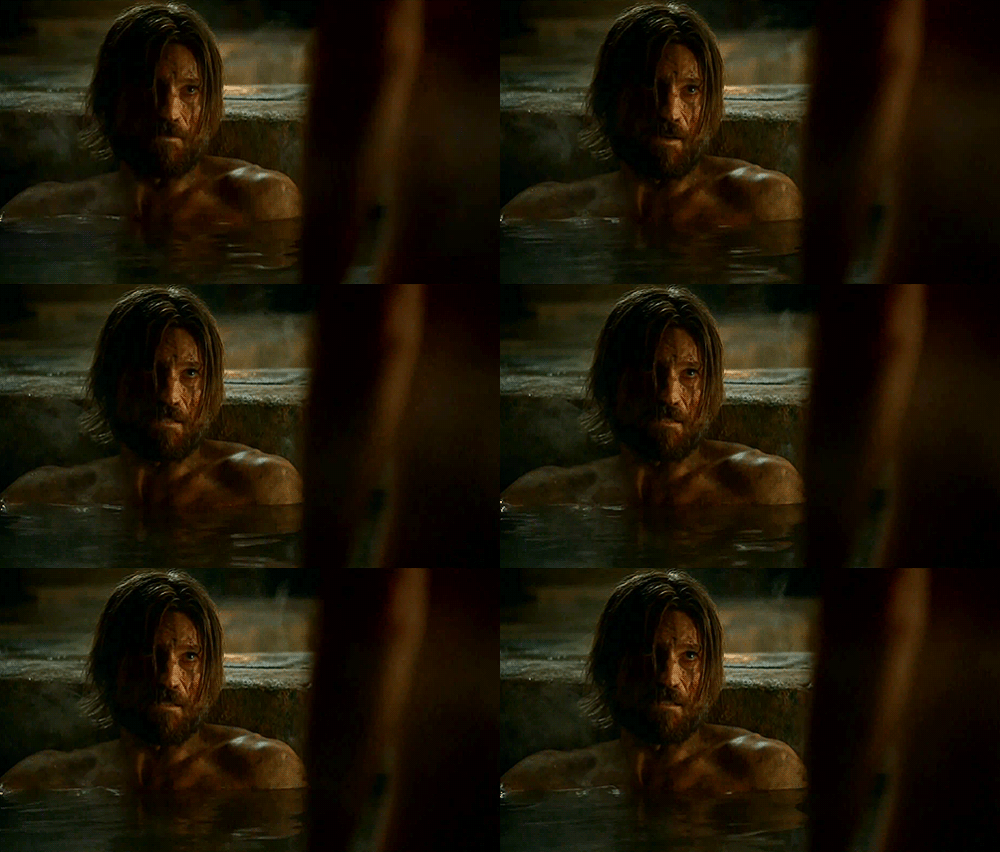
But the best scene by far and one which should earn Nikolai Coster-Waldau much award consideration is Jaime's soliloquy in the bathtub about the choices he made 17 years ago that earned him the scorn of an entire continent for being an oathbreaker. The Kingsguard are obligated to serve for life and to follow every command of the king. As the only member of the guard privy to Aerys' mad ramblings about vengeance and arson, Jaime was placed in a unique situation. By any common assessment of ethics, the choice was to stop the deaths of thousands (and his own father.) This is the same assessment made at Nuremberg, in which claiming that one was simply following orders was deemed insufficient. Drawing the contrast with Ned Stark, who is widely considered one of the few "good guys" in the story but whom also saw things in a very black-and-white perspective, is the key element to Jaime's confession. He was judged by one of the heroes of the revolt and was tarred with the actions of his family (the sack of Kings' Landing and the murder of the Targaryen children), despite the fact that his choices saved not only Lannisters but thousands of smallfolk.


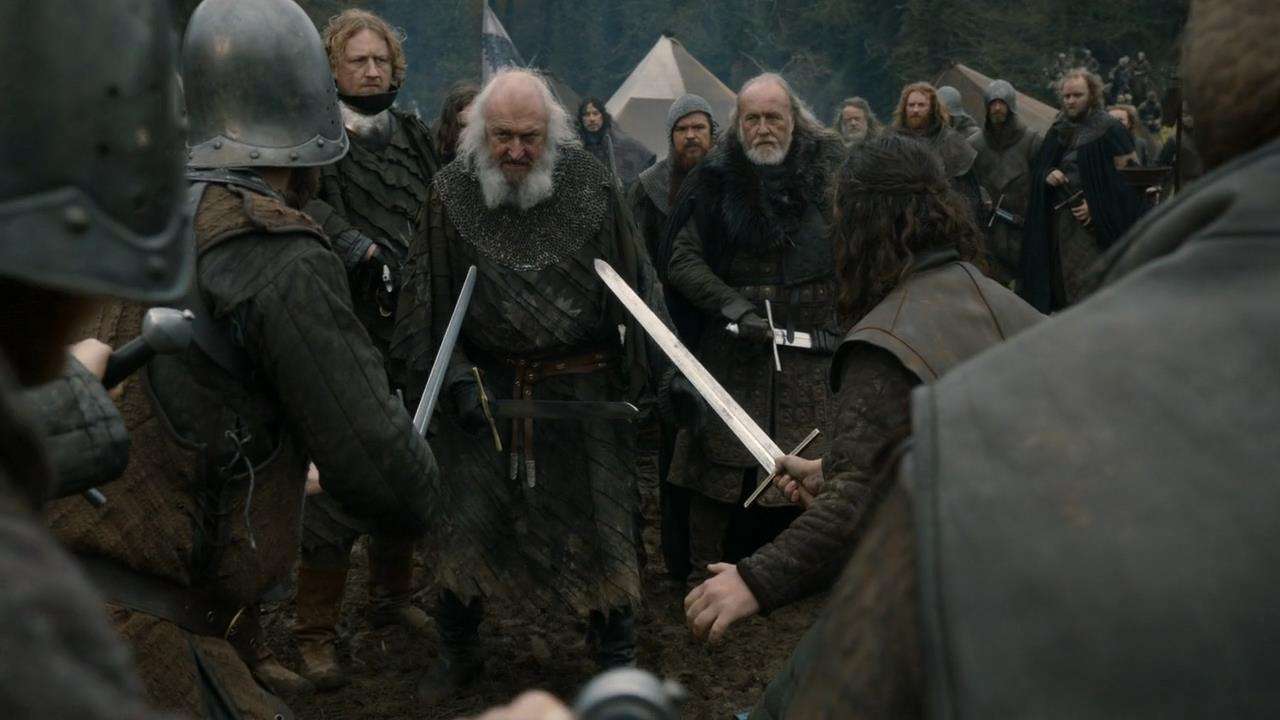
Just as interesting is Robb's struggle with those same ethics that his father handed down to him and which put him in as difficult a situation as his father often faced: Justice says that Rickard Karstark needed to die for betraying his king. Strategy says that you shouldn't alienate half your army. What's different about Robb's moment is that he had multiple advisers (unlike his father), from his intelligent wife to his impulsive uncle, telling him to do the 'right' thing for the war and not for rules that people will tend to abandon in wartime. Ned Stark, of course, never would have.


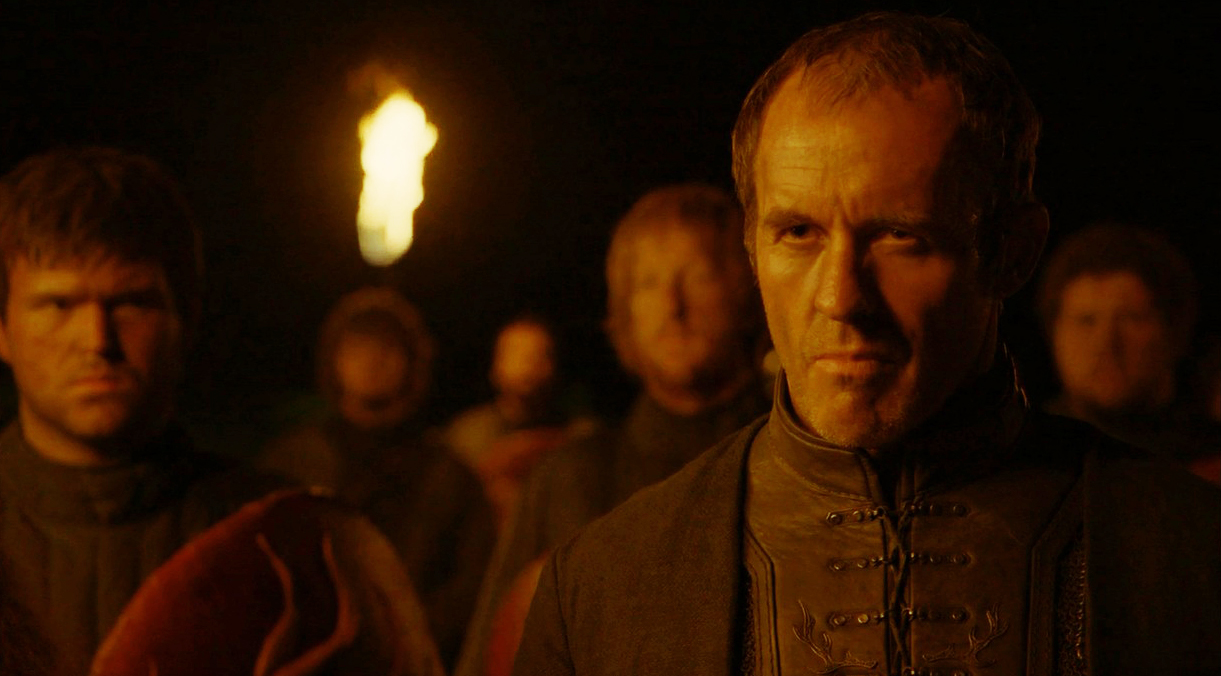
Sometimes those difficult choices extend to script writers and actors, too. As I've mentioned before, I'm not particularly thrilled with Stephen Dillane's depiction of Stannis this season. While he becomes surly and even more irascible after the defeat at Blackwater in the books, he remains implacable Stannis. Dillane is showing the anguish of the character in dealing with his wife and daughter locked in the tower at Dragonstone, which certainly humanizes Stannis and probably enables more people to relate to him... but the point of the character is that he's essentially not human and lives life by being driven by his goals. (This is the same reason the V for Vendetta film failed; the cipher isn't supposed to have individual motivations.) But, of course, playing Stannis from the books wouldn't allow Dillane to do much, even though his performance as Thomas Jefferson in John Adams was rather diffident and that was what made it really brilliant. In that same vein, in the best moment in the series for Michael McElhatton as Roose Bolton, he again simply doesn't convey the eerieness that makes the character what he is. I'm still hoping for a Leech Lord scene, but honestly wouldn't be surprised if they simply did away with that aspect at this point.


And while Davos looked way too good for a man who'd been confined to a cell on what is essentially a volcanic island, it has to be said that the scene of Shireen attempting to teach him how to read was really sweet. Daenerys' material this week was a bit of an afterthought, except to again carry the theme of difficult choices in the discussion between Mormont and Selmy about whom was the real loyal servant and whom was the past traitor and so on. Dany's object lesson in what names mean was more of a learning exercise in leadership than anything else and continues her development as a queen while taking a moment to introduce Grey Worm.


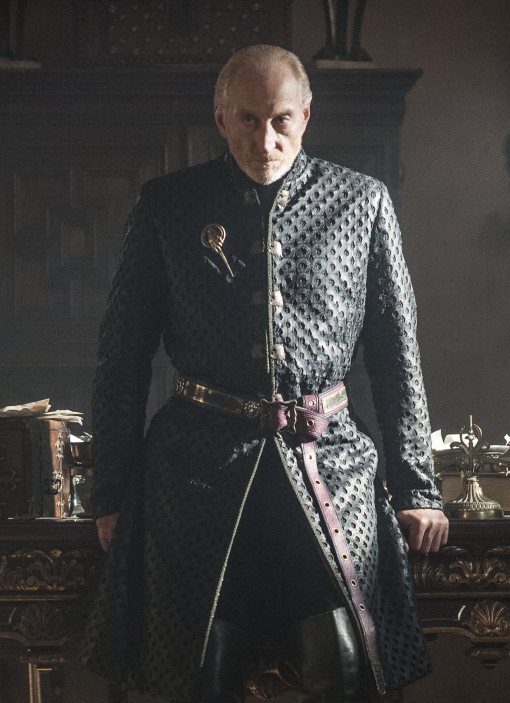
But we come right back around to theme in the final scene, when Tywin lays the law down to the kids as to how he's going to reorganize Westeros for the supremacy of the family and the security of the kingdom. Charles Dance kills it in this scene and Cersei is once again switched from queen to pawn before she can even think of a defense. So, now the choice for both her and Tyrion becomes: Do I do what daddy said or risk his wrath?

Lines of the week:

"What happens to your eagle after I kill you? Does he drift away like a kite with its strings cut or does he just flop on the ground?" Jon with a decent question about wargs while trying to show his false(?) loyalty.

"You swore some vows. I want you to break'em."
"We shouldn't."
"We should."
Jon and Ygritte, doing what comes naturally, unhindered by this whole "civilization" thing.

"There will be pain."
"I'll scream."
"Quite a bit of pain."
"I'll scream loudly."
Jaime, the bitter warrior, and Qyburn, the fallen maester, discussing the reality of medieval medicine.

"The people crave more than just food. They crave distractions." Olenna Tyrell, with Tyrion, in a great dialogue scene (reminiscent of Tyrion's encounters with Varys) as she spells out the facts of keeping the peasants under control; a philosophy (bread and circuses) as old as the Romans. This was quickly followed with: "I was told you were drunk and totally debauched. You can imagine my disappointment at finding nothing but a browbeaten bookkeeper." The smallfolk aren't the only people in need of distractions... As expected, Olenna is the best new character of the season.


"This one was the watcher. Hang him last so he can watch the others." Robb doing it Solomon-style.

"There's the look. I've seen it for 17 years. You all despise me. Kingslayer. Oathbreaker." This was the opening to Jaime's fantastic speech. The ending moment was even better when Brienne, seeming to understand and sympathize, still cries out for help for "The Kingslayer!" and he responds: "Jaime. My name's Jaime."

Tuesday, April 23, 2013

I'm trying to like Defiance


It's not like I need more TV to watch, given that I'm already watching GoT, Mad Men, and Veep and just finished watching the latest seasons of Walking Dead and Archer. As with most forms of entertainment, most TV is crap and I'm not particularly interested in sitting in front of a different screen for hours at a time. But it'd be nice to find a decent SF show out there that didn't make me pine for Firefly and I was kinda hoping that Defiance would be it.

Since AMC began its tear, other cable networks have clearly been trying to step up their respective games with original series that are more "edgy". That's all well and good, as I think that productions like Watchmen (comic, not movie) and Pulp Fiction (movie, not comic) that had transformative effects on their respective industries were good things overall, even if it took a couple years of everyone trying to ape them before their real impact was felt. Game of Thrones has obviously legitimized fantasy in the television arena and it'd be great to see something do the same for science fiction. However, I'm getting the feeling that Defiance will not be that thing.


First off, while a great deal of money has obviously been poured into set design and concept development, not nearly as much has gone into recruiting solid writers. 7 alien races have come to Earth in now-demolished arks that occasionally fragment into the atmosphere? OK. Cool. One of those alien races seems to be a mindless force of destruction with no motivation other than being evil with the tactical acumen of a hamster? Yeah, not OK. Lead actor Grant Bowler seems to have some ethical texture and a history to explain it? Cool. Everyone else is a cipher that speaks in exclamations or exposition? Yeah, not cool. Graham Greene is no superstar, but I've seen the guy do good work when he's given decent material (Dances with Wolves, Thunderheart, Maverick.) What he's given in Defiance makes him look like the most short-sighted man at the LASIK festival.


I watched the pilot and I was ready to be patient. Most SF pilots are an exercise in vomiting info while providing enough laser blasts for the easily amused. But having just watched the second episode, I can feel my patience already wearing thin. We've had 144 minutes of screen time and 1/10 of that has already been taken up by demonstrating to us that the female Castithan (Stahma Tarr, played by Jaime Murray) is clearly the schemer behind her husband's aggression and will doubtlessly be the single most malevolent force with a brain that the rest of the cast encounters. Yes. We get it. We could have had one scene of her machinations, rather than 5. One more and I'll start feeling concussed. Meanwhile, we still know very little about why the Votans (An invading alien race starting with the letter 'V'? Seriously?) even arrived here or what encouraged them to reface the planet once they did. I don't mind being kept in the dark to a certain degree and letting the story build, but give me something more interesting to watch than people plotting about how the story is going to get much more intriguing later in the season.


What fuels some of my concern is the fact that the show is coordinated with a video game and that a good chunk of the development budget obviously went into said game. Consequently, just like the Star Wars prequels which were developed with merchandizing in mind (such as games), Defiance often feels like a video game, i.e. less plot than an Aesop's fable but plenty of linear tasks for the characters (players?) to carry out.

What made Firefly work was a cast of genuine characters with human motivations and real speech patterns. Defiance has about 1 of those people so far and if I can't find another by the end of episode 3, I'm turning it off.