Monday, February 3, 2014

Coke and a smile, people

So, one of the resident conservative iconoclasts put this on the board today in response to Coke's ad during the Super Bowl:

You know what? I actually think the adverse reaction (which seems to have been pretty minimal) is more than anything else a case of people being annoyed at being told what to think.


There are a lot of social signals that one has to conform to certain ideals. Diversity is good. Gay people deserve equal treatment. Bullying is bad. The rich don't pay their fair share. Poor people deserve a leg up. Prejudice is bad. Burning carbon is bad.

I think people at some point just resent being "herded" by broad, mass media social signals into viewpoints that are selected to be good by some collective agreement by some opinion makers. I think it is actually okay for some people to think, yes, America is the product of immigration, and is an example of diverse people from diverse cultures with diverse languages forming a new society--and continually adding diversity through immigration. But a cherished paean to America should preferably be sung in America's language--which necessarily is English even if plenty of Americans speak a different language as their first language.

In this case, I think I find the reaction to the reaction (calling people neanderthals etc.) more troubling than the reaction.

(Oh, and sometimes bullying is good. Some people deserve to have their ass kicked. And carbon energy has been a great boon to people in general, and has really improved the quality of the lives of billions of people. The doctrinaire attitude on some topics is sometimes worth questioning.)
There's so much ammunition there that it almost brought me to the point of immobility... but nah. I did sit there for a moment trying to decide whether it was more disingenuous or fatuous (definitely something with an "ous") but, in the end, it's like playing Tee ball.

The central theme is the usual pseudo-Libertarian horseshit that essentially states that people who aren't tolerant of intolerance are hypocrites. Coke, instead of presenting the song "America the Beautiful" in its proper language of English (how offended must the English be that their language has been abducted by idiots?), has done all independent thinkers (read: racists, super-patriots... oh, and idiots) a disservice by encouraging the social mores that state that diversity and respect for cultures and languages that are not explicitly whitebread 'Murrican are, in fact, a good thing.

First off, it certainly is trying to "tell you what to think." It's an advertisement. It's telling you to think about buying Coke. That's how they do. But you're saying the rest of society is telling you how to think about non-whites and gays and the environments and bullies? Who's telling you? The people that object to all of that anti-social behavior? Yeah. Life is rough that way. Most decent people will tell you that it shouldn't matter what color someone is or what language they speak (aka "Diversity is good.") And they'll tell you that gay people should be treated equally since they're, you know... people; that treating people poorly ("Bullying") is wrong; that poor people could use your help; that prejudice is bad... What intelligent person doesn't think those things? Certainly is a helluva lot easier to get along with your neighbors if you don't hold preconceptions about them before you even get to know them. Fer reals. It's, like, been proved and stuff.

Secondly, what could honestly be so offensive about singing a song in another language? Would you shout down a chorus in France if they dared to sing "America the Beautiful"? Are you saying that people who can't speak English aren't allowed to sing that song about their home (because that's quite a few residents of this nation)? I mean, that's what these people are saying:

(H/T Midtown blogger for the list.) I bet you're really discouraged that you didn't hop on Twitter last night and number yourself among Mensa candidates like that. Such a lost opportunity. I especially like the last guy, since Coke has not only told him what to think but drinking too much of that crap has clearly corrupted his memory of his own national anthem.

What a number of people likely failed to remember is that Coke was bouncing off of their own 40-year legacy of having produced this commercial:


which explicitly and implicitly called for unity and goodwill among races and nations (albeit from the foremost front for the CIA in destabilizing and disrupting many of them...) Given that and the current rather divided status of these United States, what message would you have preferred to hear? "America is beautiful as long as it's sung by and filled with white, hetero, sometime bullies who don't want to be reminded that they're racist, homophobic assholes?" I mean, I'm sure there's a song out there like that but probably not from any composer this side of the Aryan Nation.

Now, of course, I'm being facetious (another "ous") because there's no way you'd (publicly) admit to thinking that because it would be stupid and make you look and sound every inch the Neanderthal that those fools did on Twitter last night. If one is so weak-willed as to object to being "told how to think" by a commercial or is objecting to the broad-based message of inclusion despite difference that said commercial is presenting then, yeah, I think you deserve every epithet being tossed your way, especially if you're willing to do so in a public forum like Twitter.

And, again, suggesting that people be tolerant of your obnoxious attitudes for fear of hypocrisy is perhaps the most asinine idea put forth in that post. Contradiction is not intelligent refutation (thank you, Michael Palin.) What you see as heavy-handed social engineering, the rest of us see as simple common sense. There's all kinds of people. Getting along with them should be the first order of the day, every day.

Sunday, January 26, 2014

Bad winds

Clara Paget as Anne Bonny
Pirates are alluring. There's no doubt about it. It's a recurrent theme in adventure fiction and a geek standby as notable as ninjas. Everyone likes pirates (unless you happen to be sailing the Red Sea these days.) So when Starz began advertising their new series, Black Sails, last year, a lot of people sat up and took notice.

Unlike HBO, Starz and Showtime tend to be noticed for pseudo-porn: nominally adult themes that are basically just excuses to show tits and a certain level of gratuitous gore. Spartacus is perhaps their most successful offering in that respect and no one (that I know of) watched it for the acting or the history. It was with that reluctant mindset that I sat down to give Black Sails as much of the benefit of the doubt as I possibly could. Acknowledging that most first episodes are a little rocky, it still sorely needs that benefit to get through an hour of the show and it may not be enough to convince me to watch any more.

Give it up for Z-Man

I'm a geek. I like pirates and ninjas and zombies and Martians and the whole nine yards (I'm even more fascinated by the mysterious etymology of the phrase "the whole nine yards" but that's just me.) I love Merchants and Marauders, a boardgame based on precisely the historical era presented in Black Sails (it's honestly much easier to win as a merchant, as any drug dealer will tell you; putting aside the coolness factor, would you rather try to make a living as Omar or Avon?) This is the deck I'm currently tooling around the Hearthstone beta with. Pirates. Pirates everywhere.

And I honestly appreciate the fact that the producers put in serious effort to not only draw from the most famous fictional work about pirates in the English-speaking world, Treasure Island (a book I probably read a dozen times as a kid) in Captain Flint, Billy Bones, and John Silver, but also are presenting characters based on actual people from that time in John Rackham (Calico Jack) and Anne Bonny. There is some attention to detail in plain sight. The costuming seems relatively appropriate. They clearly dropped some coin on the ship sets and the CGI-renderings of same.

Don't raise your heels when parrying

But having just finished watching the debut episode within the last hour, I can state that not a single line of the screenplay comes to memory. Not one. Nothing that anyone said ventured outside of boilerplate drama and/or blatant exposition. Even worse, the show is clearly trying to step outside the standard "heroic" dramatic structure in that Captain Flint seems to be the hero of the piece and the one that audiences should sympathize with, but when you're dealing with an entire cast of fairly self-centered people, it's more difficult to develop those attachments. Flint is kind of a cipher, just as he is in Treasure Island. He's legendary only because people say he is; just as in the show he appears to be a leader who inspires his men only because people say he is. The other potential audience attachment, John Silver (not quite "Long" yet), has an additional hurdle to overcome in that not only is he as grasping and opportunistic as anyone else, but he's also one of the more contemptible figures in Robert Louis Stevenson's work, so that anyone who is familiar with the book can pretty much instantly identify him with the concept of "schmuck."

Or if you wanna go there...

This isn't to say that there's anything unique about Black Sails' structure (regrettably.) After all, TV series casts made up of repellent or dark figures have been around since the Sopranos, at the very least. Boardwalk Empire has no trouble proceeding in that fashion. However, both of those shows also have solid writing that makes otherwise non-heroic figures into someone the audience appreciates for their intelligence and wit and unusual responses, if nothing else. Black Sails' cast presented none of that in the first episode. Indeed, the most interesting person to me was Hakeem Kae-Kazim, playing Mr. Scott (not that Mr. Scott...) because I recognized him from his notorious role as George Rutaganda in Hotel Rwanda, which will forever be burned into my brain. I recognized no one else and they did nothing to make me want to come back and see them again.

OK, admittedly, Paget's eyes are kinda fascinating
The usual caveat is attached ("it's just the first episode") but I have severe doubts (benefit gone!) that the show can become significantly less hollow soon enough for me to want to continue. I never saw Spartacus because I'm touchy about Roman history (speaking of boardgames, that one is excellent) but I tried watching Starz's Da Vinci's Demons and just couldn't get past the shallowness of the performances and the vanilla scriptwriting. By the same token, given my attachment to Westerns, I've given Hell on Wheels three seasons to try to keep me and Black Sails may be suffering under the weight of that commitment. I'm just not interested in taking the time to watch something that I'm quite confident will be completely disappointing.

I'd rather win another game of M&M

Thursday, January 2, 2014

Calcification

Some of you are Michigan fans who had the temerity to endure the most recent season of a fairly-talented team looking about as inept as any produced by Michigan in the history of the program, including the disaster-laden Rodriguez years. The dreary minor-league bowl game produced a suitable performance and came within a final drive of being the fifth game under Brady Hoke in which Michigan produced less than 200 yards of offense and the sixth to fail to score a touchdown (Number of such games under Rodriguez? Zero.) Even so, it became the 11th under Hoke to produce less than 300 yards of offense. In the modern game, 300 yards is a pretty pedestrian number, even against solid defenses. But the key phrase in that sentence is the first: "In the modern game" because that's precisely what Hoke and his offensive coordinator, Al Borges, are seemingly doing their best to avoid.

Bill O'Brien recently left his job at Penn State after two years to become the new head coach of the Houston Texans (Only the NFL could produce a team name that's essentially a tautology: "We're the Texans. From Houston." It's like going to Europe and telling people that you're Americans. From, you know, 'Murica!) While few had high hopes for O'Brien, taking over the presumed crater that would be the whole of Penn St. football for the next decade, he actually did remarkably well there and one would assume that the fanbase would be more than appreciative for what he was able to accomplish with a team full of no-one-wants and walk-ons.


But O'Brien was saddled with the expectations of a segment of the PSU fanbase who had grown so long in the tooth with their former coach that they apparently have a hard time imagining anyone else doing as well as the old man. O'Brien went 8-4 and 7-5 in his two years there. Paterno went 7-6 and 8-4 in his last two years. But it's not so much about the records as it is the preservation or calcification of "the way things are done around here." (I'm not even going to get into the Sandusky scandal. This is just about football and institutional blindness, thanks.) So, when he left, O'Brien allowed some derogatory comments about "the Paterno people" to be printed:
“You can print this: You can print that I don’t really give a (expletive) what the ‘Paterno people’ think about what I do with this program. I’ve done everything I can to show respect to Coach Paterno. Everything in my power. So I could really care less about what the Paterno faction of people, or whatever you call them, think about what I do with the program. I’m tired of it,”
This was apparently in response to fans complaining about the departure of Ron Vanderlinden, Paterno's last hire, from O'Brien's staff. So, you're giving grief to the guy who has done a better job with your undermanned team than anyone else could expect, because he didn't keep an assistant that the old man hired? Is it because Vanderlinden was, by fiat, a "Penn State man" and O'Brien somehow wasn't? Where have I heard that before?


Oh. Right.

Michigan has a similar problem in that there's a fairly large segment of the fanbase, alumni and, most notoriously, former players and the athletic director, who live in the fantasy of the "Michigan Man." Spencer Hall at EDSBS has turned the "Michigan Man" concept into a favorite punchline because that's really what fantasies are often suited for. The idea is that no one can truly understand what it takes to lead Michigan football to success if he isn't a "Michigan Man", mostly because they think that Bo Schembechler, the man who revived Michigan football from its dolor of the 60s, was a "Michigan Man."

Except that he wasn't.

Bo had been an assistant at Ohio State(!) and the head coach at Miami (not that Miami) of Ohio, a rather pronounced unMichigan Man. So was Fritz Crisler, who came from Princeton. And Fielding Yost, who came from West Virginia. There were no "Michigan Men" until Bo inadvertently popularized the term before the 1989 NCAA basketball tournament. Bill Frieder had announced his departure to Arizona State and Bo appointed Steve Fisher as interim coach, saying he wanted a "Michigan man" to lead a Michigan team. It was only later that it became like a religion, mostly promoted by Lloyd Carr and his sycophants, such that "Michigan Men" became very like the "Paterno people"; both quite pod-like and equally disturbed by those who were not like them (read: everyone.)


The casual reference becomes tradition and then ironclad law. When Rich Rodriguez became the head coach at Michigan, he was immediately treated with outright disdain, with several of Carr's former players openly stating that he was not welcome until he had earned his way in and that the program was "theirs".

And so we come to the present day, where former Carr assistant, Brady Hoke, is now the coach and the cheerleading athletic director and former Bo benchwarmer, Dave Brandon™, is busy making excuses for his rather lackluster performance. That performance is largely based on a perception of what Michigan football should be and, of course, really never was. The modern game moves faster. The modern game incorporates new ideas on an almost monthly basis. The modern game learns and adapts and realizes that opponents will be doing the same on a weekly basis. Michigan football currently does none of those things but instead plunges ahead as only a stalwart "Michigan Man" can.

Just like water pipes, too much time doing the same thing in the same way leads to a slowing down of the flow of information, a buildup of detritus that inhibits the overall structure from functioning. The "Paterno people" are wedded to a distorted ideal of a coach who created their program 60 years ago and have driven out a capable coach in the process. The "Michigan Men" are wedded to a distorted ideal they've created around the coach who revived the program 45 years ago and they're helping to retain a coach who should have never been given the job in the first place and wouldn't have if he was not numbered among the carriers of pods.

The Rose Bowl kind of brought that problem to the fore again in an oblique manner, won as it was by the former Little Brother of football in the state of Michigan. I say "former" because it's highly unlikely that Michigan will be able to regain its former status under Hoke, whether nationally, in the conference, or in its own state. But the problem was brought into sharpest focus by watching the offense of MSU's opponent, Stanford. Stanford was brought to its recent run of glory by one Jim Harbaugh, former quarterback for Bo and latterly-heralded "Michigan Man." Harbaugh, who actually played for Bo (unlike most currently outspoken "Michigan Men"), installed a power running game at Stanford with a rather complicated system of checks and blocking, just like the old man. David Shaw, his successor, has reverted to the style seemingly favored by Hoke and Borges; that of "manball", often cited by ignorant football fans as a way to "impose your will on the defense" by hammering away at the line even when the defense is clearly lined up to stop just that kind of play. It's more like "imposing your willingness (to give up and die)" on the defense than anything else. Shaw tried it, MSU ate it alive (just like they did to us this season!) and Stanford lost. Michigan tried that, too, and gave up more plays for negative yardage than any other team in the nation.

Oh, but they were "Michigan Man" plays and that, for some, makes all the difference.

Thursday, November 28, 2013

Chaleur bleue


Blue is the Warmest Color is the film directed by Abellatif Kechiche, based on the graphic novel of the same name by Julie Maroh. I saw it last night at the State theater in Ann Arbor and was basically completely enthralled by it. While it has some questionable moments that may be style choices, overall it was an amazing portrayal of a rather simple story that many (if not all) viewers have gone through: the process of self-discovery and sexual awakening.

The main stylistic aspect of the film is the use of constant close-ups. Most of the time, the camera focus is mere inches from the actors' faces. I think Kechiche went in that direction because of the extreme intimacy of the story, but also because most of the action that you really want to see is happening on those faces. Adèle (played by Adèle Exarchopoulos) and Emma (Léa Seydoux) reveal vast amounts of their thought processes simply with their eyes and the quirks of their lips. Nothing could be more revelatory than watching Adèle's eyes after her unsatisfying sexual encounter with a man. No dialogue or action could fill that moment better than the emptiness and longing in her gaze and Kechiche was smart enough to use that. Being so close to the actors makes it easier for the audience to both empathize and sympathize with their situations, since we've all been there; all faced those moments of passion, confusion, frustration, loss, bliss, and contentment. This is a technique that was used with the idea that the audience would be an active participant in the events on the screen, whether they know it or not.


It's fortunate, as well, that Kechiche found the actors that he did, as this movie is completely driven by their performances. Exarchopoulos and Seydoux are magnetic, although I'll give the edge to Exarchopoulos, as the film's version of the story is more Adèle's tale than Emma's. Again, the story is relatively simple and the movie runs for over three hours. But there were only two moments in that span of time that I felt like we could move on and that only lightly. Otherwise, I was pretty much enraptured with events and constantly wanting to see what would happen next even when I knew what was coming. Again, I think what helped was the seeming familiarity of much of what was taking place on the screen. Having been in the moment when I was dumped or having had to tell someone that I was no longer interested, I could watch those emotions play out on their faces with the feeling that what I was seeing was real and not just a performance. I'd been there. I knew those feelings and they were occurring as if I was watching a friend go through it and not just an actor hitting her cue.

What makes it even more extraordinary is that Exarchopoulos is only 20 years old with a pretty thin body of work. Kechiche has to get some credit for extracting that performance from his two leads, but it apparently came at some cost, as both cast and crew objected to the extremely long hours that he required on set and both actors said that they would no longer work with him. Was it worth the pain and frustration for both of them to receive the Palm d'Or at Cannes, in addition to the director, for the first time ever? That's up to them to decide, but it's certainly a demonstration of just how heavily the film relies upon their excellent work. What makes Adèle stand out is the constant passion emerging from her. While Emma is the older character and plays her cards a little closer to the vest vis-a-vis her feelings, Adèle is on constant display all the time, even when she desperately tries to contain it later in the film. In that way, she plays a late-teens girl perfectly. But even later, as she matures, her intensity doesn't lessen and the love, confusion, and agony she feels blares from the screen. I'm not a huge fan of French cinema, as I find it relatively self-indulgent in a lot of ways (i.e. the director has a fetish that he's playing out, regardless of audience expectations or the needs of the story) but one thing that tends to emerge in most French films is passion and this film has that at every step.


No moment makes that more obvious than the scene in the park, shortly after the two have met. The sexual and personal tension present is enormous, as Adèle so obviously desires this woman and wants to fulfill this inner question that's been nagging at her for some time. Meanwhile, Emma, still a little cagey, wants to respond but is restrained by her natural reluctance and the fact that she's currently involved with someone else. And, yet again, we've all been there so this moment feels not only perfectly natural but like a reliving of moments in the past. That's great storytelling.

Interestingly, the story for the film is an extremely stripped-down version of that of the graphic novel. The latter is a kind of re-telling, in that Emma begins to read the diary of her partner, Clementine, after the latter has died. The events described by the diary are far more jarring and tragic than what happens in the film and, indeed, Maroh has said that she considers the film to be "another version... of the same story." Maroh also objected to the blue elephant in the room: the sex. The film is rated NC-17 in the US, which isn't surprising given the starkly different attitudes toward sex in American and French cultures. Consequently, you have American reviewers agog about the film itself, for the most part, but also cringing in true, Puritanical fashion over the lengthy scenes of two women making love. But Maroh also objected, comparing the scenes to porn and suggesting that the gay community in France found them "ridiculous" but later suggesting that it was a personal stance and that she would be interested to see how other women reacted.

Clearly, if you're making a film about sexual awakening and modern, sexual relationships, you're going to have sex on the screen, full stop. And, granted, hetero male here so watching two gorgeous women on screen, clearly enjoying themselves, is far from the worst way I could be spending my time. OTOH, one of my two questionable moments as an audience member was during one of those scenes because it was so lengthy (10 minutes.) Again, a movie about passion needs passion in it and the latter is an emotion best savored for as long as possible. I think this film does that. I just remember drifting a bit during that scene and thinking that it could have been curtailed just a bit given how much emotion and evidence of same had already been built up. It occurred to me at a couple other moments during the film that Hechiche might be a bit more pointed in his exposure of the audience to the story's overarching sexuality when he showed Adèle asleep or otherwise lying on her bed with her ass directly toward the camera. It's an open question whether this was an attempt at titillation or a constant reminder about the type of awakening taking place. In those respects, I can see where Maroh's comparison to porn comes from: it's seemingly gratuitous because it's not providing anything that the story needs that hasn't already been given. Or is it?


However, sex is also an expression of intimacy and part of the film's underpinning is not only the awakening of the desire to fulfill that intimacy in Adèle, but also how she shifts that into an essential part of her relationship with Emma. Despite viscerally objecting to her high school classmates' suspicion of her as a lesbian and being as guarded with her feelings and body as many other teen girls, she later takes to posing repeatedly for Emma's paintings, which will be publicly displayed and likely sold to other people. That's part of Adèle engaging herself to fulfill what her partner needs on a creative level and also her blossoming into someone that treats the human form and its physical activities as part of the natural world (i.e. very unAmerican.)

Unfortunately for her, that engagement also opens the door to a source of friction in their relationship, in that Adèle's feeling of fulfillment in simply being with Emma conflicts with the latter's more creative nature. Adèle only writes for herself and only in her diary but she has clearly shared this writing with Emma, who insists that it declares potential for Adèle to do something more. Her insistence is perceived as a slight and it creates a rift in their relationship because one has found fulfillment and the other is constantly striving for more and tends to lose respect for those around her that don't. I've been there. I've exposed people to that kind of remonstration and it had the predictable results, which is yet another point upon which I was really able to identify with this film. One opens oneself only to receive the barbs. Which is better: the turbulence of truth or the placidity of the illusion? Is it an illusion to simply be happy with what you have or is it an example of two people not truly in touch with each other?

The other slightly off moment was during the scene where Adèle has prepared a party for Emma's first show. There is a classic black-and-white film flickering by on a screen in the background, which uses brilliant juxtaposition for moments when Adèle's frustration and jealousy work in concert with the surprise and dismay of the nameless actress on the screen. But this scene was rather lengthy for what it conveyed, as well, and after a few minutes of driving home the negative impressions that Adèle was getting, I felt the urge to move on to something new. But those are two isolated moments in a 180-minute film that many people may not even notice. I do because I'm the damndest critic.


Of course, in a story of of self-discovery, you're almost naturally going to have hiccups. That's part of the process. There's an interesting moment where Adèle is striving to contain her emotions while on the job as a schoolteacher for very young children that you realize that this is still a somewhat-child teaching other children and it makes you realize just how traumatic her current circumstances are, as she went from confusion and feelings of isolation to bliss and then back to confusion and isolation. That's a difficult circumstance for anyone, but even moreso for one who can't rely on friends or family to understand her emotional problems if she feels that she can't reveal their source. The film does an excellent job of portraying the fact that, despite French society's more relaxed attitudes toward sex, its relationship with homosexuality is as complicated as that of many others.

Clearly, I loved it. It's one of the best films I've seen in many, many years and completely in spite of the story being so outwardly simple. I can't recommend it enough.

Friday, November 15, 2013

Questions from the past


Going to be looking for work again soon, as the current employer apparently doesn't want to make it a permanent thing. Temping is the closest I've come to the experience of being a pro in my life. I've never partaken of one's services, although I've been approached. But working for a temp agency must be akin to being pimped, since the majority of the money you make goes to someone else and they have no real interest in your success or progression or even whether you do the job poorly. It's like wage slavery, but even further from a worthwhile living.

It got me to thinkin', though. I spent some time a few months back with a friend I hadn't seen in many years. I met him shortly after I graduated from Michigan and he was still a student at the time. Back then, I was still running RPGs (Nerd moment: Role-playing games aka Dungeons and Dragons, but not), most of which I designed myself, because it let me experiment with story and character and gave me an outlet for the acting gland, since I wasn't part of a regular theater group at that point. As the GM ("Gamemaster"), you have to play all the characters that the other players are interacting with, so it takes a bit of creativity and mental agility, both of which I used to have considerable amounts of. Anyway, there were 5 regular players in this group and me. My friend, Todd, was one of them.

Todd graduated from Michigan with a degree in accounting. Like many in the early 90s, he promptly went into programming, which he had been doing a fair amount of on the side, and has been a very successful programmer for many years now. He and his wife, Carolyn (an accountant for a car dealership chain in Canada) have a massive house on a lake out in Onsted and Todd works from home 4 days a week and is otherwise surrounded by house, cars, boat, side business of karting, and a trio of miniature Dobermans

Another member of that group was Adoni, who is currently a tenured professor of classics at Ohio State with multiple published volumes under his belt. He was hired by OSU with the mandate of building their classics department into something of renown and has done an admirable job of it from all the sources I've seen. He lives in Columbus with his wife, Carolina (also tenured at OSU), her son and their daughter.

Third was Greg, a successful architect in Ann Arbor (he was finishing his master's while we were haunting bars for a couple years) who lives in town with his wife, Terri, their two children, and a rambling red brick house.

Gamer #4 was Wendy. Unlike the rest, I knew Wendy while I was actually in school and we had stayed together after I graduated and I'd become pretty close with her sizable family (she has five siblings.) Wendy finished her undergrad, wobbled around for a year, and then returned to school for a master's in library science. She eventually became head librarian at the Texas Wesleyan School of Law and acquired a J. D. in the process.

Last was Kevin, Wendy's brother-in-law, who was married to Wendy's sister, Michelle, and had two kids with her while climbing to an executive position at a New Orleans chemical and plastics firm.

I remember stopping to think about all of that while hanging out with Todd because it kind of surprised me that the respective lifepaths of those 5 and I had gone in such different directions. All of them achieved model success in most or all of the measures that people use to assess modern life: money, career, family, property. Out of the whole group, the only one who hadn't succeeded in those respects was the leader: me.

So, I started to wonder: What was it that separated me from all of them? Ambition? Work ethic? Inherent talent? There's little doubt that all of them were talented in some way, if not multiple ways, and Adoni is easily the most intelligent person I've ever met in my life. I think I shared the ambition and work ethic that they displayed in trying to keep an independent comic studio running for years and then building a political party from the ground up and chairing it for some time; all of that while holding down a full-time job. I like to think that both of those require some degree of talent and, yet, all of them had found success and here I was, two steps removed from a drifter.

Was it bad choices? Clearly, venturing into the creative field and the political field outside of the major players could easily be seen as dead ends from the moment they've begun. And I had been married with a house at one point, but neither of them particularly resonated with me, as it were, and I abandoned them both while also walking away from the secure job that I'd had for years primarily because I had to pay the damn mortgage. Does staying in a dead marriage and a house you can't afford alone count as success?

So, after 43 years, I basically have nothing to show for it in the conventional estimations of society. Granted, my path hasn't been very conventional but that makes me very, very far from unique. Interestingly, shortly thereafter I got back together with another friend, Jeff, whom I'd seen briefly only twice in the past decade and who had been my partner in the comic studio. I spent a day over the weekend of the 4th of July with him and his family and it was easily the best day I'd had in years. Jeff and I finally had a chance to sit down and talk at length and I mentioned this comparison that I had been mulling over and he said a funny thing: "You know, I respect you more than anyone else I know. You've spent your life doing things that you're passionate about, no matter the material cost or sometimes the personal cost. I don't know anyone else like that."

I'm still not sure how to take that. Jeff is one of the few people in the world that I implicitly trust but I look back at the last decade and realize that I haven't done anything with passion for the vast majority of it. Indeed, my sole societal accomplishment, my marriage, failed because of a lack of passion, mostly on my part. I had tons of it for the studio, which failed, and the party, which failed, and I used to be a determined writer, which has yet to produce anything but failure. He reminded me of the time I drove to his home in White Lake from Ann Arbor in an ice storm because "it was Tuesday and that was the day we said we'd work." I suppose I'd still do that today if I thought I'd have someone at the end of that drive to welcome me in and pursue a dream with me.

I finished a book recently, Stay Awhile and Listen, which is about the development of Condor Studios, which developed the game, Diablo, in partnership with Blizzard (Yes, I know. It always comes back to games. Maybe that's why I never get anywhere...) The company had emerged in the early 90s, right around the time we were building the comic studio, and reading this account of it was so emotionally familiar it was almost painful. They talked about not thinking about money or success or pretty much anything else except making the coolest game they could come up with. They were doing it all with ad hoc approaches and technology and code that they were dreaming up on the spot because the video game industry was still in its infancy and no one was telling them that they couldn't. They didn't think of the conventional idea of success, either (except as much as they'd like to be able to pay the bills while still making games.) They had ambition, work ethic, and talent. That was us, 20+ years ago. That was me when things still seemed like they held promise, no matter how long I or we had to search for it.

That all went away as people moved into real life, as it were. Except me. I'm still here on the fringes and wondering how the so-called leader of so many things fell behind everyone else.

Sunday, October 13, 2013

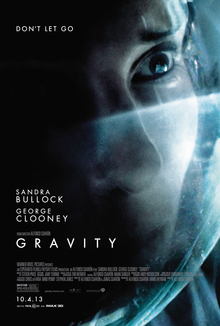
Gravitas. Not quite.


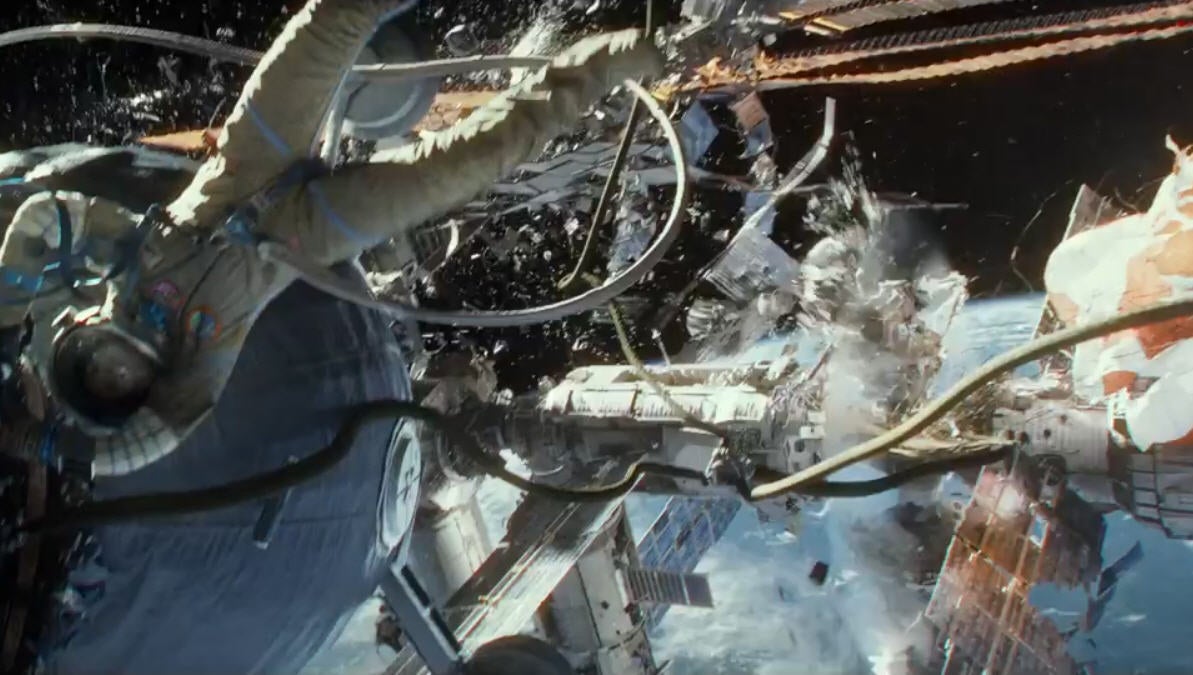
I went to see Gravity today and, for once, didn't feel ripped off by doing the whole 3-D, IMAX, extravapalooza. Multiple sources had insisted on this approach for the full effect and I'm glad to say that they were right. The immersion created by the enhanced formats made what is already a solid film more of a visual experience, which I believe was the intention of director, Alfonso Cuaròn; best known as the creator of the brilliant Children of Men. The basic premise of the film is that an accident has taken place in orbit around the Earth and George Clooney and Sandra Bullock are the unfortunate recipients of the results which makes both staying alive and figuring out how to get back down from 230 miles above the surface quite the pair of challenges.

Good things first: the visuals are amazing, which you kind of hope for in a film like this. The vistas of the planet and the stars and horizon shots can leave you sitting there in awe no matter what else is happening. It's the kind of thing you'd normally expect to see in a more typical IMAX film, generally on the order of National Geographic programming. I could have spent a lot more time just watching the lights of Cairo and the Nile Valley go past the camera and there are moments where that kind of thing happens. I think Cuaròn did an excellent job in transitioning between moments of intensive action and dead, ominous silence, which is the normal condition of outer space. Since this is intended to be a contemporary film, there are no science fiction elements added and the activity of humans in space is reminiscent of one of my favorite Ridley Scott films, Alien. This is work. It's scientific and industrial and often the most important piece of equipment is a power ratchet.


The pace is tense. Even during the "quiet" moments, the awareness that the characters are in the most lethal environment known to humanity is everpresent. Scientific principles of the film's title are at the forefront of what occurs and it's obvious that great care was taken to convey that detail. This is a film about what could actually happen and no amount of reconfiguring the main deflector dish will fix it. Both Clooney and Bullock help this sense of pace by generally reacting in a genuine fashion to their extraordinary circumstances. Clooney's role is the old-hand space veteran and you never doubt that. Bullock is the rookie brought up to make specific alterations to the Hubble Space Telescope and she tends to panic over the environment far more than the veteran, as you'd expect.

OTOH, I don't think Cuaròn was able to get all that you might expect out of these two excellent actors because of one main problem: the story is pretty thin. There's an accident in space and these two have to figure out how to get out of it. That's it. Most people tend to believe that novels make films. In other words, you have a story that has x amount of depth to it and the film will absorb all of that depth, turning half the 60K words into visuals and the other half into dialogue and action. Of course, film history is filled with examples of how a 2-hour film can't possibly convey the complexity of the novel that it's based upon. The issue with Gravity is that its central premise wouldn't even be that compelling of a short story because there simply isn't enough depth to it. It's a very linear equation and there aren't too many ways to explore the personal dynamics of the characters involved because the movie isn't about them so much as it is about the event. If you're OK with that, then it's all good. But I'm normally swayed by story, not how much eye candy you can show me, and Gravity largely doesn't have it.

What it does have at certain points seems either contrived or tacked on. Bullock's character's personal history becomes a primary motivator at a certain point and that was interesting as she struggles with issues that have nothing to do with her current circumstances. But when she comes through that, her newly-resolute attitude and decision to make everything work struck me as very, very Hollywood and not really convincing. Of course, the very limited amount of dialogue in the script outside of official announcements or panicked gasps certainly doesn't help with this and I think Cuaròn was aware of these collective weaknesses and wisely kept the film to a fairly brisk 91 minutes. You can barely get children's movies that are that short these days.


For those of you among the science-inclined, you should have no trouble with suspension of disbelief for the vast majority of the film... except for one key moment which is unfortunately huge in the story and the two characters' presence in it (when momentum is arrested, it stays that way unless other forces are active...) Even my relatively shallow knowledge of astrophysics could pick that out, but sometimes you need to make a story work and Cuaròn did very little papering over such that most viewers should be fine with events as they happen.

So, is it a classic of Oscarian proportions? Eh. No. It was good and, as noted, it's an accomplishment for me to say that I didn't mind throwing down the extra cash to see it in as visually-enhanced a manner as possible. But I also wouldn't say it was "Absolutely cannot miss!" in stature. I saw it mostly because I'm a fan of the director and Clooney and the rave reviews were enough to push me into the theater and, certainly, it will be far more impressive on a 3-story screen than it will even on your 60" plasma, but it ain't like escaping an event horizon.

Monday, September 23, 2013

Daunted?


So I've had two books sitting on my shelf for a while that I finally got around to reading in the past couple weeks. Both are by authors I hold in pretty high regard: Neal Stephenson and William Gibson. Both came out of the "cyberpunk" movement, Gibson with the seminal Neuromancer and Stephenson with Snow Crash. Both have since moved on.


Stephenson's book is called Anathem. He finished it a couple years ago (he's since written another called Reamde, which I haven't read yet) and it was a high concept story about communication (how language changes), knowledge and its conveyance (how it affects society and the perceptions both of those who have it and those who don't), and world-realization (particle theory about conjoined but different universes and how observation makes them split.) Most of his books have been like that. He's always thinking in a very large manner. The trick is that he does that with characters that are still human, with a pace that keeps you turning the pages (albeit occasionally bogged down in theory), and with some memorable turns of phrase. He's had problems with endings before, in that his grandiose ideas resist being succinctly ended, but I think he pulled it off well in this one.


Gibson's is called Pattern Recognition. It's been out for a decade and many critics regard it as his finest work (he's written two more, Spook Country and Zero History, which I also have yet to get to.) It's explicitly about modern society and how technology and advertising tends to shift cultural tides before people are even aware that they're in the water. It's told in Gibson's hyper-cynical and bleak tone, but his writing, unlike Stephenson's, isn't about conveying a grand idea(s) so much as it is a slow presentation of said ideas while every sentence becomes an expression unto itself. His writing is the closest I've ever seen to the idea of "lyrical." The story is an exercise in description of the environs surrounding his characters and how they interact with them and how they interact with the emotions generated by them.

They're (obviously) very different approaches and, as much as I am forever indebted to Gibson for blowing my mind in 1984 with Case, Molly, and Wintermute, I've come to appreciate Stephenson's style more; likely because I'm another one of those "grand idea" guys, but also possibly because I don't see myself ever being able to accomplish the type of rhythm that Gibson pulls off. Have I tried? Occasionally. But that kind of texture seems to be the province of writers superior to me. Is it because most of what I turn out is generally crap? Quite possible.

On that note, I was out with the trivia team last week and the guy running the session was playing some solid music. One track was Tom Waits' Goin' Out West and it got me into listening to Bone Machine again over the past few days. Hearing Earth Died Screaming for the first time in a few years dovetailed nicely with a neo-concept I've had in my head for a while and I put down the first few hundred words of it but, as with all things that I start, I'm not quite sure it will be worth the effort of finishing (i.e. it's all crap.) I think it lacks both the grand idea and the textural lyricism. At this point, it's safe to wonder whether I'll finish anything simply because I'll hold it to a standard that I may never be able to achieve.

Why did I wait so long to read these two books by two of my favorite authors? I'd like to say that's just how things turn out sometimes, but I've read many, many other books in the intervening years. Is it because I didn't want to be confronted again with work that I can't even approach, much less match? That certainly wasn't foremost on my mind, but it would make me into a typical Gibson character...