Wednesday, October 27, 2021

Creative detachment


I'm not an Ingmar Bergman fan. I appreciate his work and I understand why his admirers are legion, but much of what he produced simply never spoke to me in the same way as, say, Akira Kurosawa, whose themes actually frequently intersect with Bergman's. Both were fond of questioning the human condition and, in this respect, the film Bergman Island is no different.

The plot is a very Bergman-esque tale about unpredictable human emotions, the bowels of creativity, and the loneliness that often comes with that. It's set on Bergman's home of Fårö and is populated by characters who are great fans of his and the main two of which also happen to be filmmakers. In the course of the story, we're introduced to two more characters who are part of a story that one of our main characters is working on while on the island, so it's all very meta and self-referencing the whole way through. There is no breaking of the fourth wall, but you get the feeling that the audience is very much supposed to be in on the central joke, as it were. For as convoluted as that sounds, the plot is actually quite simple and, amusingly enough, led me to echo the question of Chris (Vicky Krieps) as she regularly wonders whether there's enough to her story to make a film. Perhaps that was the joke?


What initially attracted me to the idea of seeing this film were two things: 1. It has Tim Roth, of whom I've been a fan since Reservoir Dogs and have never been disappointed in whenever he's been on the screen. 2. The trailer presented the situation in a much more dynamic fashion, such that Chris' concerns seemed to be far more of a conflict arc that would need to be resolved. But it's actually much more of a Bergman approach (surprise!) in that the conflict is mostly within Chris as she struggles with certain elements of their living situation that don't have much to do with whether or not she's trying to write a screenplay. Indeed, Roth's role as Tony basically ends up being a sounding board for Chris and little else. He's supposedly the motivator for them being there, but he ends up being almost incidental to the story, as everything revolves around Krieps' character and the characters that she, in turn, creates who are then brought to life in the film. So, I didn't get much conflict and I didn't get much Roth, either.


There's nothing wrong with a story being simple. Some of the best films ever made have been quite small stories that the director explored with enough depth and feeling that they had much more impact than one might expect. As I mentioned Kurosawa, Rashomon is a perfect example of this approach. It's also a perfect contrast to much more complex (and in some cases, overwrought) stories like, say, Dune (just to pull a name from a hat.) 'Simple' doesn't mean 'simplistic.' Most of Bergman's stories were, on their face, fairly simple but it was his willingness to explore the deeper meanings of his themes and emotions of his characters that made them work. Director Mia Hansen-Løve, as you might expect, takes a similar approach here and ends it as soon as the emotional arc of Chris' experience is fulfilled. But the film's slow pace and length of two hours left me doing perhaps too much examination of those emotional themes and wondering if there was anything else to accompany them.

It's a well-made film and certainly something that Bergman fans will probably revel in. I just don't happen to be one of them and I think it kind of missed the mark for me, as a result.

Friday, October 22, 2021

Arrakis revisited


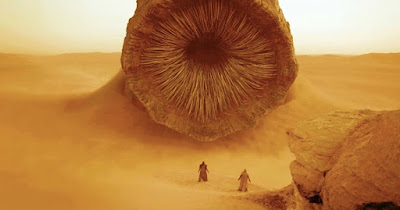
Dune is something of a landmark in the science fiction world. Most SF fans are aware of it even if they haven't read it or haven't sat through one of the film versions prior to Denis Villeneuve's 2021 effort. Consequently, almost everyone will have some kind of predisposition when they watch this version. Mine is colored by all four of the original novels (Dune, Dune Messiah, Children of Dune, God-Emperor of Dune), David Lynch's 1984 film, the Sci-Fi Channel's limited series of 2000, and multiple sessions of the legendary board game from Avalon Hill (I even own an original copy. Woo! Nerd credit!) So, uh, the story is familiar to me. But one of my key departures from much of Dune fandom is that, despite it sharing the 1965 Hugo award for Best Novel, I've never been really impressed with Dune as a story. (In that respect, I think the book it shared the award with, Roger Zelazny's This Immortal, is better.) The writing is somewhat pedantic. The pace is slow. Character development that isn't demanded by the plot (e.g. Paul Atreides) is basically non-existent. But what made Dune into a landmark (and a franchise) is the exercise in world-building, which is phenomenal. Just like Tolkien's Middle-Earth, Frank Herbert drew heavily from history and the cultures of the Middle East to create a universe with an enormous backstory, languages, customs, traditions, and intricate political machinations that few others have matched and which certainly exceeded almost everything to that point in the SF genre. The Dune franchise exists because of the data dump that is the original novel. What makes it intriguing is that sensation of vast fields of unexplored territory that is only hinted at in most of the film and TV productions. Someone recently referred to this most recent film as "this generation's Star Wars", which is understandable because George Lucas did the same thing; creating a whole galaxy of history and peoples surrounding his B-movie Western about Luke Skywalker and a couple droids. But what that writer misses with that comparison is that Dune has been its own thing for over 50 years now, in the same way that Star Wars is still a thing for this new generation as it has been for the last couple. Yes, a whole new group of people will now be immersed in the concept of the kwisatz haderach, but it's been around for a while and, of course, given that it's basically a prophet/messiah concept, it's been around a long time before Frank Herbert, too.


First off, I think the decision to split the film into two parts was a wise one (Everyone is forewarned when the initial title comes onscreen as "Dune: Part One.") The novel is too long and too dense to be properly conveyed in two hours. Lynch argued furiously with Universal Pictures to include more of the tremendous amount of material that he had filmed so that the story wouldn't seem shallow. When they refused, thinking that SF audiences were too stupid to handle anything over two hours, he eventually took his name off the film, leaving the credit to the legendary Alan Smithee. But just as importantly, Villeneuve instead embraces the aesthetic and atmosphere of the novel; avoiding the 80s shine and glitz which distorted Lynch's work. While there are laser weapons in this film, the director heeds the book's insistence that they're quite rare and dangerous for the users, so we see a lot more visceral, hand-to-hand combat, which Lynch tried to sidestep with the ridiculous "sound weapons." And you can see right away that this is a Villeneuve film when he quickly demonstrates his trademark dialogue close-ups with very hazy backgrounds. It's a highlighting technique that shows up regularly in his films and which serves this story well because, in truth, most of the action is in the dialogue and personal interactions. Dune is a highly political story and that's not something that's normally explained at the end of a sword. If you really want to understand what's going on, you have to pay attention to who these people are and what they're saying.


Of course, what that often means is that the pace of the film gets a little laborious and the atmosphere is one of angst, especially in the scenes involving Paul. I never got to the point where I was doing the "move along" hand motion but Villeneuve takes his time with the emotion and drama of a number of different scenes. That's not a bad thing, per se, because the book is that way, too (and, really, much slower and more laborious) and if you're going to do the book justice, then you have to take your time. In truth, he still skips over a lot, as he doesn't bother to explain who the mentats (Thufir Hawat and Piter De Vries) are or why they exist or how Dr. Yueh circumvented his Imperial conditioning. One of my mild disappointments was actually how little screen time Piter (David Dastmalchian) gets as, even though his role wasn't large in the novel, one of the little pleasures of Lynch's film is Brad Dourif in that same role ("It is by will alone I set my mind in motion.") Also, one of the key moments of the novel is Duke Leto (Oscar Isaac) interacting with the Shadout Mapes and learning about Fremen culture and, of course, first discovering the betrayal occurring within his house. That's almost completely glossed over here and Stilgar (an almost-unrecognizable Javier Bardem) is given a more prominent moment to suggest that he feels a connection with the duke, which seems like a place where something hit the cutting room floor that might've been important for story coherence.


Visually, it's spectacular, as you might expect from both a 2021 sci-fi film and one by Villeneuve (Arrival being his most notable other example.) The sandworms are impressive, the shield fights are exciting (although I question just how slow a lot of the lethal strikes were moving in most of them), and the depictions of things as functional as the ornithopters are really well done. The dramatic moments of the landing ramps and various groups' arrival; the massive presence and implicit threat of the Guild transport ships; the overview of the sprawling Arrakeen; all great stuff. However, I will say that I was disappointed to not see a scene similar to the one Lynch opened his film with: the arrival of a navigator to talk about the Guild's involvement in the overall plot. (That element is replaced by Gaius Helen Mohiam (Charlotte Rampling) coordinating with Baron Harkonnen (the eversteady Stellan Skarsgård) on Giedi Prime.) The appearance of a navigator in Lynch's film was both a great representation of how they'd been described in the books and a reinforcement of how important the spice was to the empire and what it did to its constant users. It's a very visceral element of the working mechanisms behind the empire and it helped make the spice into something more than a MacGuffin. It escapes that here because of the time they spend showing its effect on Paul as he breathes it in out in the desert, but for all of this film, the emperor, the Guild, and pretty much every element of that political life outside the catfight between the Atreides and the Harkonnens is just background noise. Again, it's a data dump and some things are going to get sidelined for the sake of a two-hour (presumably four-hour, if the expected Part Two is ever announced) production, but there are certain things that make the Dune universe what it is and I've always felt that the Guild is a big part of that. All of those visual elements are underwritten by an excellent score by Hans Zimmer, which is another notch in his impressive track record. He keeps the majesty and mystery of what's happening foremost in your mind and weaves in plenty of sounds that many would identify with musical styles that touch on the cultures that are part of the story. On a technical level, the film is really well done.


Overall, I'd say it's a better version of the story than either the 1984 or 2000 productions; in part because of Villeneuve's style, which incorporates enough spiritual atmosphere to really let that part of the novel shine through. Herbert wasn't shy about mining cultures for inspiration. The term mahdi, used by the Fremen to label (and often dismiss) Paul comes right from the Arabic term, meaning "the savior" or "the guided one" and whom is an expected unifier of the world before the end times in Shia and Baha'i traditions. The novel is draped in a number of Islamic motifs and Villeneuve doesn't shy away from those spiritual trappings, even if he doesn't call them out as starkly as Herbert did. In the end, it's a worthwhile effort to try to deliver a new version of the story. I wouldn't consider it groundbreaking or compelling, as there are no performances that really stand out and I am irretrievably jaded as far as the story is concerned, but it's definitely worth your while if you're a Dune fan. Keep in mind, of course, that it's also only half the story, so perhaps my assessment will improve when (if) Part Two is released.

Tuesday, October 5, 2021

The song remains the same


As I've mentioned here a couple times before, one of my all-time favorite films is the director's cut of Blade Runner (no voiceover, ends in the elevator.) Among the many things that make it a favorite are: 1. It leaves unanswerable questions unanswered, rather than trying to resolve everything with a happy ending. 2. It asks those questions in a subtle fashion, rather than beating you over the head with them. The film we saw tonight, I'm Your Man, takes a similar approach to a very broad topic. Whereas Blade Runner posed the question of what it actually means to be human, I'm Your Man asked its protagonist (and, in turn, its audience) what it means to love and be loved. As most who've been in and out of serious relationships can tell you, there's no simple answer to that question or even why it often is asked, internally or externally, directly or obliquely, by other people and by oneself.

The premise isn't hugely innovative. A driven, mostly isolated anthropologist studying Sumerian cuneiform is asked to participate in a company's test run of androids that they're marketing as the "perfect companions." Her task from her superior at her university is to spend three weeks with one and then write a report about the experience. As Jaime noted tonight, it's pretty similar to any of a number of TV shows and films that have preceded it, including an episode of Black Mirror. But the screenplay is very clever and the performances of the two leads, Maren Eggert as the anthropologist and Dan Stevens as the android, are excellent, as they maintain a very light touch on a very heavy question, even in the more emotional moments of the film. In some ways, it's not too dissimilar from Blade Runner, in that the detached, seemingly machine-like person is often contrasted with the more warm and sociable machine who is programmed to do everything he can to make her happy; an emotion that she doesn't always find herself willing or able to embrace.


It is, of course, often difficult to define exactly what makes one happy, in the same way that it's difficult to define what love is. Alma (Eggert) is immersed in her work, in part because that's who she is and in part because she's been burned by some personal circumstances that make it more comfortable for her to approach life in a very defined, professional, and mechanical fashion. Those circumstances don't make her "happy", per se, but she's accepted them as comfortable, as opposed to the uncertainty which could be even worse. Tom (Stevens) is programmed to be her perfect man and to do everything that his algorithm dictates that would make her life better emotionally, but that's not necessarily the kind of love or relationship that she's looking for. Indeed, at one point, she tries to test his ability to take her emotional abuse because she feels like she needs the friction, the personal give-and-take, that many people define as the essential energy of their relationships. But Tom's only feedback is positive, no matter how much pressure she applies, which leaves her with an emptiness that no amount of tenderness and concern can fill.

Now, a lot of people would probably recoil at the idea of a "perfect" companion who exists solely to make one happy. But Alma runs into someone who's also been paired with an android and whom has never had a good experience interacting with other humans on an intimate level and that person is overjoyed at the prospect of staying with his companion. Is that person's sense of love any less valid than Alma's? Part of what she recoils from is Tom's irreducible good nature because it reminds her that he's a machine and not what she considers to be "human." But many people confronted with poor matches or unceasing stress and conflict might be happy to indulge in the continual support and care that comes from having a companion like Tom. In some ways, it's like having a pet who is always thrilled to see you and be in your company. Is that kind of love any less genuine than that with another human who typically has more complex wants, needs, and emotional states?


Again, these are deep questions and it would have been easy to slip into a maudlin story about missed chances or the failure of some people to appreciate what they have. But director Maria Schrader kept the film moving at a steady pace; not lingering on moments of dramatic import, but instead continuing to push us forward, even when Tom stops to spell out the underlying reasons for Alma's reactions like a physician diagnosing a broken bone. Many would probably react poorly to this, thinking that the machine's lack of a lighter touch to those moments demonstrated a lack of feeling, both on its part and the storytellers'. But I found it to be perfectly in tune with the story being told, not least because Alma's whole career was about trying to show the underlying beauty of functional script in clay from 5000 years ago. The message there was not only that humans from ancient times had emotions and conveyed them in writing, but also that the past is, in many ways, just like the future. The human condition doesn't stray too far from its origins, whether you're communicating with shaped mud or AI. In the end, as with most relationships, there are no simple solutions and everyone has to find their own answers for how they define them. Along the way, the film remains very funny and leaves us always eager to see what's next; kind of like a good relationship. Highly recommended.

Thursday, August 12, 2021

Pacing and rhythm


I don't like musicals. Despite my distaste for them, I did sit down and try to watch 2016s "greatest movie evah", La La Land a few months after it had been declared the best movie of the year by a bunch of people in the business only too eager to tell us about how great it was to be in the business. I lasted about 15 minutes before walking out of the room. I was mildly reassured by a friend whose wife LOVES musicals who also couldn't stand it that I wasn't completely biased. I know my bias isn't omnipresent because I actually enjoy classical opera and have seen a few. Certainly, I'm drawn to the productions of composers I already like, such as Mozart, but the aspects that tend to annoy me about musicals don't have the same effect when it comes to the original art form, as it were. And that's what makes my reaction to Annette a little more unusual, since it's essentially a modern opera. Moreso than things like La La Land or West Side Story, there are no dialogue segues between the singing. It's all singing, all the time, just as in opera. Unfortunately, like most musical performances of whatever stripe, part of the entertainment is watching said performers actually singing, which means the storytelling is at a somewhat slower pace than most films. That means that you really need to be interested in the story and the emotional underpinnings that it rides upon... and I simply wasn't.

In the same way that I wasn't impressed by the trauma of life as an actor in La La Land, I wasn't particularly intrigued by the contrast between Henry McHenry (Adam Driver), abrasive stand-up comedian, and Ann Defrasnoux (Marion Cotillard), soprano. It seemed obvious that Henry's cynicism and general distaste for society wasn't going to mix well with Ann's prominent joie de vivre. Creating a child between the two was the Frankenstein's monster in the mix and she was smartly displayed as an automaton in that respect for most of the film, who exhibits the voice and innocence of her mother which only further contributes to Henry's discomfort and inability to understand others' desire to embrace life, rather than scorn it. In that way, the titular Annette becomes both the motivating factor and the quandary of the film, which is all very operatic.


But that basic, primal story isn't powerful enough to escape the turgid pace that the performances require. Instead of the reaction that I normally have to something like The Magic Flute, where the orchestral intro to another aria builds up excitement, I found myself frequently sighing in frustration at the fact that Henry was, once again, singing about his worldly disdain for everything that was happening around him. Driver is a capable singer, but not a compelling one, which doesn't help when he's the central figure in the film who has to constantly do that. Similarly, Cotillard, whom I almost always enjoy on screen, isn't generating thrills when she's carrying a tune and, because of the more dynamic role that Driver inhabits, she ends up being kind of a sideshow in the larger picture. The "pure" characters are Ann and Annette. But they're almost never the interesting ones, since the tragedy (and the crimes associated with that) center around Henry, who's played by the largely-less-interesting-to-watch-onscreen Driver.


Perhaps I was setting myself up to fail when it comes to appreciating the picture, because I did almost no research on it before we saw it. The trailer involves the most amusing bits and doesn't really indicate that this is a musical of any sort, other than Ann being a singer of some kind and their daughter following in her footsteps. So when the film opened and the cast did a Greek chorus thing, by immediately breaking into song and giving a meta look at the story as a whole, I was intrigued. That quickly changed to frustration when the next scene made clear that it was going to be this way throughout and I began to lose patience with the film's pace. I think the visuals were smart in that every scene was lit and staged in such a way that it was clear that they were all studio sets; presenting the "all of life's a stage" idea by demonstrating how this might be possible in the theater that was home to both main characters. In the end, I don't think there was any particular failing that stood out to me. It's just really not my song to sing.

Wednesday, August 11, 2021

The verdigris of choices


There's a genre of late Medieval literature known as the "chivalric romance." It was a way to tell what in modern times we would refer to as "fantasy"; colored with the transition from the legends of ancient times that once carried the weight of the word of god(s) while still emphasizing the mystery of the wilderness and the unknown, even as Western society lurched toward a greater understanding of the world around us with the advent of the Enlightenment and so forth. Sir Gawain and The Green Knight is one of those chivalric romances, as it incorporates a member of King Arthur's coterie of knights (understood to be myths even then) and plays on the idea that if you ride far enough into the hinterlands, there's no telling whom you'll meet and what might happen to you, even if it means meeting the person (headless or not) that you were intending to find in the first place. It's a pretty simple plot about honor, chivalry, and especially chastity, since even in medieval poetry, there's an acknowledgment that sex sells and always has.

The Green Knight is a modern retelling of the poem that veers away from that simple tale and expands it into an even broader examination of what it means to be honorable and to keep one's obligations and to know thyself, to paraphrase a certain writer. It's clear that writer/director David Lowery wanted to keep that air of the unknown, as most of the lighting (moody, shadowed), visual effects (mists, close-ups that leave the rest of the screen in a haze), and the pacing of the film lean heavily in that direction. If you've ever seen the last third of the film, Excalibur, where the land is in dire straits and the knights struggle against the darkness and the evil sorcery and fog of Morgan le Fay are extant in every corner, you'll know what I mean.


But there's a lot more going on here on a personal level than there was in Excalibur, which attempted to condense the Arthurian legends as a whole into a two hour film. We meet Gawain (Dev Patel) early on and are given the impression that he's kind of a wastrel who spends a lot of his time in a brothel, but one who knows that he should be aiming higher in life. His mother (Sarita Choudhury; credited only as Mother) is of the same mind and starts casting spells to guide her son, King Arthur's nephew, to that greater destiny. In this respect, I think they were making reference to Margause, Gawain's mother from the legends, who was Arthur's sister, but whom is often mixed up with Morgan (as in Excalibur) as a more menacing figure in the story. There are a couple tales that say that Gawain was the product of accidental incest between king and sister, so more son than nephew, but the film stops at basically identifying him as Arthur's favorite. Said favorite is the first to stand up and accept the challenge of the titular Green Knight, who takes his own beheading by Gawain with aplomb and saunters out, reminding him that the same blow will be returned in a year and a day.

From there we see that Gawain largely returns to wastrel mode before finally deciding that he better stand up and take his beheading like an honorable knight if he wants anyone to look him in the eye again. From there, we roughly follow the path of the poem, albeit with several side jaunts along the way, involving restoring a dead woman's body to her bed at the behest of her ghost, a talking fox, and a parade of female giants. We do eventually get to the strange castle with the test of honesty between Gawain, the hunting lord, and the horny wife, but it ends up having little to do with the Green Knight or the future that Gawain sees for himself if he fails his test of bravery.


In one respect, it's true that Lowery's story is more elaborate and, to some degree, more interesting than the original romance, which is a pretty simple lesson about the qualities that knights are supposed to value most. But the downside of that increased elaboration is that it kind of loses the thread of Gawain's famous green sash along the way. The story feels like it's being mysterious for the sake of being so. Certainly, the lesson carried by keeping one's word to the ghost of a woman whose house and bed you take advantage of is obvious. But also obvious is the suggestion to not trust anyone on the road when Gawain is ambushed by common thieves and loses the Green Knight's axe and the sash until they're mysteriously returned to him later. If Lowery's intent was to play up the "Lord works in mysterious ways" theme that inhabits the original poem and similar examples of the time, OK. But it might've been better served by excluding things like the giant parade and the animal Gawain has selflessly protected to that point suddenly reminding us of a very different film altogether. I don't mind ambiguity in the stories that I'm told. Having people develop their own perspectives on the story can be a really appealing thing, rather than having it spoon fed to you. But the best examples of that approach are those stories that draw into question what our hero should be doing at any given moment, rather than either presenting the obvious choice and simply making it strange or leaving the audience in the dark as to what the choice is in the first place.

In the end, the primary choice facing Gawain remains with him to the end: he is himself, whether he's trying to be a knight or imagining himself as king. There's a certain level of required honesty in that which gives the film its central appeal and makes Patel's character worthy of following the whole way through. (In other words, it's worth watching.) I just thought that some of the fantastical elements actually clouded that central lesson and a leaner, less-mystical story might have been the better way to approach it.


Wednesday, July 7, 2021

A lot of moves, but most of them brilliant


I'm a huge Steven Soderbergh fan and I know I'm far from alone. In fact, I get the feeling that many of his recent pictures have been made up of actors whom are also Soderbergh fans, not only because of the quirky, seemingly-insouciant way that he produces and directs his films, but also because he tends to focus on screenplays that give them a lot to work with. No Sudden Move is no different in this respect, as it boasts a star-studded cast in larger roles (Don Cheadle, Benicio Del Toro, Brendan Fraser, Jon Hamm) and smaller ones (Amy Seimetz, Ray Liotta, Bill Duke, Frankie Shaw), and has the twisting story that gives all of them their moment(s) in the spotlight. In brief, the film is about a bunch of gangsters trying to make some money while eagerly double-crossing each other at every turn and sweeping a bunch of "normal" people into their cloud, while the real gangsters that run everything from above simply wait for the dust to settle. That really doesn't do the story justice, but it's difficult to go into detail without revealing what should be experienced firsthand by anyone reading this.


Given my childhood origins, the setting of mid-50s Detroit is appealing to me from the outset. The fact that the story centers around people trying to press every lever they can to get ahead in a society described by one character as "You think you have power. You think you have influence. But you don't." As it turns out, that character is basically right because history tells us that he's right. But those characters don't know that and they play every scene like they have the world by the short hairs or are ready with a backup plan (or two or three) if their grip happens to slip. The script also weaves in the sordid history of Detroit's "urban renewal" (Black Bottom, etc.) and the rampant corporate corruption that still rules the nation (and soils the air.) This is a regular feature of Soderbergh's films, as he's never far away from dropping a statement or two into the otherwise fictional stories that he delivers. This one also carries little allusions to America's racial politics and their constant presence in the automotive industry (Big Corp's attraction to fascism springs to mind these days), as well as subtle hints to the sexuality that so many kept hidden at that time.


Another aspect that's been a regular feature of his career is the use of unusual equipment. Having shot films with only a Super 8 camera or with only an Iphone, this time he doesn't go quite that far, but does use a recurring format for most of the scenes around and inside the homes of the few "regular" Detroit inhabitants, which I can only call a "peephole cam", as it shades the corners of the screen and enlarges the center, just like it would if you were looking through a peephole in a door. I'm not sure if the intent was to represent the audience peeping into the lives of regular folk, while we were part of the vast conspiracy that the otherwise criminal element (both street and corporate) pursues throughout the story, but that's the closest I can come to figuring out what the purpose of that particular mechanic was. I have to say that it was kind of a distraction to the film overall, but it didn't quite reach the level of an annoyance. Maybe it's just because I wasn't in on the joke. But a lot of the characters could say that, too.

Don Cheadle does well as a man just trying to catch a break after a life gone wrong. Likewise, Del Toro handles his role as the unreliable gangster with aplomb, although I feel like he's become a bit typecast, as his role resembled something of a fusion of his parts in Traffic (another Soderbergh production) and Snatch. It's always good to be thought of whenever the right casting is needed for a specific role, but it becomes less so when those roles start looking and sounding the same. Similarly, Jon Hamm seems locked into "straight man" roles, whether they're genuinely straight/heroic/law-abiding or not. In contrast, David Harbour (of Stranger Things fame) is a semi-surprising joy as an imposed-upon accountant who's living the typical American, middle class home life, while carrying on an affair at the office and, when pressed to confront his boss for a document that will keep his family alive, announces every punch that he's about to throw with: "This is a punch." It's as effective a declaration as one might expect from a man who's never thrown one and who later reveals just how much of a lack of control he has over what's going on around him, especially in an excellent motel room scene with the partner of his affair, played by Frankie Shaw, who simply shines in her few minutes of screen time. Bill Duke also has several excellent moments with his usual penetrating-stare-above-lowered-glasses move.


I thought the production was really well done on a visual level. Those homes looked like they came right out of a lot of Detroit neighborhoods that are still standing today. Also, many of the city's landmark buildings looked appropriately spiffy as they were at that time. I wondered a bit about a couple details, such as the regular references to the "Big Four" of the auto industry. I've never heard anyone refer to anything but the "Big Three" (aka GM, Ford, Chrysler) and I'm pretty sure Packard-Studebaker was never large enough to be in that grouping. (Similarly, 1954 was the year that AMC was created and they were still never considered to be in the top tier.) I appreciated the mentions of the unjust removal of the Black Bottom and Paradise Valley neighborhoods, but wondered that they didn't cite the highway construction that was the official reason (removal of Black residents and businesses being the primary one.) But a tip of the hat to writer, Ed Solomon, for also being cognizant of Detroit's mob history, with the mention of The Purple Gang, although 1954 was long after they had any presence in the city.

But all of that detail can add to a perception that there's simply too much going on at any one moment. While I'm always interested in a complex story or one with multiple angles, there is a limit to all things. While it's a measure of respect for the intelligence of many of the characters that they can see multiple angles and seem prepared for most of what befalls them and have already mapped the routes around the bad spots (Soderbergh takes care to show Curt Goynes (Cheadle) setting up his backup plans, rather than using them as deus ex machina-style surprises), one occasionally has to wonder at the ability of any one person to cover that many angles and not be completely paranoid. I think Soderbergh does a good job in representing Goynes and Russo (Del Toro) as essentially friendless because of the lives they've chosen to lead, but I think it's fair to wonder just how much off-the-cuff scheming can go so right. Until it doesn't. So, I can't say this was Soderbergh's best crime/heist film (Out of Sight still probably takes that title) but it's definitely a solid example of his craft and well worth seeing.

Saturday, May 29, 2021

Internal echoes


I went through something of a transformation about a decade ago. I got divorced, moved out of the house I'd never wanted, and spent a large part of a year mostly isolated. I still went to my dojo fairly often, but unless someone contacted me or showed up at the door, there were times when I could go for days without seeing or hearing another human. It was me and the cats. As you might expect, that led to a fair amount of introspection in the depths of a very, very low period. What came out the other end was largely positive (I think.) It allowed me to grow up in some respects. (You'd like to think a 40-year-old wouldn't have that much growing up to do, but we all know that's rarely the case.) Watching The Sound of Metal this evening brought some vivid memories of that period back to me and now I wonder, a decade later, if I might have forgotten some of the lessons that slowly dawned on me in the darkness.

The film is about a nomadic heavy metal drummer in a two-person band with his girlfriend. They live in an RV and simply move from gig to gig. The music is, almost literally, their life as Ruben (Riz Ahmed) uses it to give his life purpose away from drugs and Lou (Olivia Cooke) seemingly does the same to escape her inner demons. But then Ruben begins to lose his hearing. What is it like when you have the whole focus of your life removed, whether by your own hand or something you can't control? I've been there. What is it like when you feel like you're failing simply by existing without that focus? I've been there. What is it like when you desperately want to fight back against something which can't be fought, because it's an essential part of you? I've been there, too. This is Ruben's entire existence being disrupted, not by a mistake that he's made, but a bodily function that can only possibly be repaired. In the making of himself into the whole person that keeps him from addiction, he suddenly finds himself feeling like less of a person in a way that's more mundane, but every bit as crucial.


Director and co-writer, Darius Marder, does a sterling job of keeping us immersed in Ruben's experience and allowing all of the emotions to progress naturally. It's almost documentary-like, but delivered with a deep grasp of the story being told, without deviation. Ahmed handles the textured and difficult role without becoming maudlin, which is a feat in itself. It would've been easy to overemote into the tragedy of the situation, but he keeps himself tied to what Ruben's reality should be even through the scenes where the character pulses with rancor. The actor has had a fairly regular career on large and small screen (plus an intriguing moment as The Corinthian in an audiobook presentation of Sandman), but mostly on the other side of the pond. But his performance here was so good that I'm kind of eager to seek out his larger roles and see what he could do with screenplays perhaps not quite as grounded. Paul Raci, as Joe, the director of the deaf addicts shelter that Ruben is convinced to stay with, is another standout. It's during their most emotional conversation in the film that Joe points out that the stillness of their condition is where he finds the most peace; not simply that he's been able to accept what has happened to him, but has embraced it as something that makes him a whole person and which he was using alcohol to avoid.


When I was staring into the darkness alone, my outlet at the dojo was something that allowed me to find that same kind of stillness. The motion, the interaction with others without speaking, the absorption of form and ritual, the actual stillness of zazen; all of these things contributed to that introspection that led to a similar kind of change that Ruben experiences. He had created a life that was driven forward to keep him from slipping backward into a lesser state. He had to constantly be doing something. When deafness initially robbed him of that, he felt lost. I'm still often in that frame of mind. If I'm not doing something, learning something, conveying something, I still feel as if I'm wasting time; as if I'm failing. In that respect, this film was a small reminder that learning to be comfortable with one's own existence, no matter the physical requirements or hurdles, can occasionally be all the accomplishment that any one person needs. I'm still not certain of that and, thankfully, the film avoids a pat ending, as well. We're simply left with an understanding that this, too, is part of the journey to whatever end.

Highly, highly recommended.