Thursday, January 25, 2024

American Truth


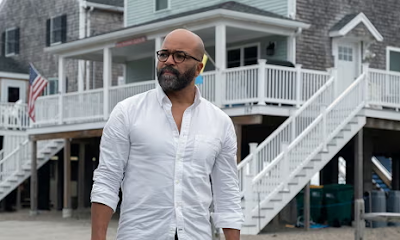
There are moments when various forms of media feel like they're speaking directly to you. The characters react the way that you'd react and the storyline follows something that's, to one degree or another, intimately familiar to you. That was the reaction that I had when watching American Fiction. It's not just that the main character Thelonious "Monk" Ellison (an excellent Jeffrey Wright) is a writer who can't seem to find his audience (been there, my whole life) or that the material that's produced around him seems like it's just serving the base interests of the public [waves hand in general direction of world] or that he thinks he knows better about what's actually worthwhile (ahem.) It's also that those perspectives make him feel separated from much of the world at large. That's an instinct that I've worked hard to curb in the last 15 years of my life, having recognized that you can't tell people what to like, so I think I'm a bit more social and a bit less judgmental than Monk is as presented in this story. But, man, did that story sing to me.


Monk is a novelist and instructor at a small college in California who objects to the success of the fiction written by African-Americans and lauded by White reviewers and publishers as emblematic of the "Black experience." To Monk, the Black experience is the American experience and he finds no value in feeding the preconceptions of the White audience, whether sympathetic or otherwise, with material like a competitor's "We's Lives in the Ghetto." Monk is in what is often referred to as "literary fiction" (which, y'know, excludes any of that petty "genre" stuff) but his work is so elevated that it ends up getting classified as Afro-American studies in local bookstores. When he gets encouraged to take a leave of absence and go visit his dysfunctional family (which he largely detests and avoids) in Boston, he begins running headlong into those antisocial tendencies and begins to discover the people he dismisses as beneath him as having intelligent opinions and perspectives of their own which inform their own "Black experience" that happens to be quite different from his.


From the very beginning, the characters felt genuine, which is always a key aspect of any film to me. If I'm watching roles that feel like they were solely aimed to push the message, rather than be real people who incidentally drove the theme of the film, I'm generally going to feel cheated (see: Don't Look Up and Leave the World Behind as pristine examples.) Even the side characters that are clearly there to be foils for Monk feel like they have the reactions of real people that are wholly believable (White angst and guilt, artificial salesmanship, etc.) Lorraine (Myra Lucretia Taylor), Monk's mother's housekeeper, is one of his grounding points in the general goodness of humanity. Despite all of the "family melodrama" (as Monk refers to it) surrounding his circumstances in Boston, when she decides to get married, it's a sign that life keeps proceeding, no matter how much you may think the world revolves around you and your problems. Those problems include his mother, Agnes (Leslie Uggams), losing her awareness of the surrounding world, but never quite losing awareness of what makes her children, especially Monk, special.
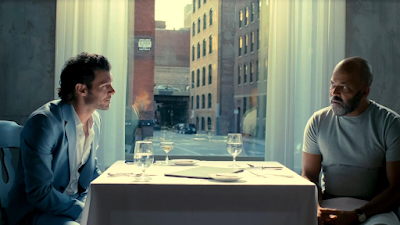

Part of that specialness is Wright, who is perfectly cast in the role. I can't think of another actor who could have presented the frustration, weariness, and biting intelligence of the character better than he did. It's appropriate that Percival Everett, who wrote the book Erasure, that the film is based upon chose the last name "Ellison" for the main character and his family based on other people that also bore that name: Harlan Ellison, famously caustic SF writer and essayist; Ralph Ellison, who wrote about social issues faced by Black people in America; and Sheila Ellison, who writes about parenting and familial relationships. All of those elements inhabit this character and the circumstances he's forced to confront and Wright excels at presenting a typically human reaction to them, while still driven by who and what the character is. He's nicely counterbalanced by his sister, Lisa (Tracee Ellis Ross), his brother Cliff (Sterling K. Brown), and the neighbor across the street, Coraline (Erika Alexander); all of whom present different perspectives on those circumstances, but also on their approach in trying to connect with Monk who, as with many driven people, often instinctively distrusts their attempts to do so (um... yeah.) There's a great moment when Agnes, fading in and out of awareness, mentions that she thinks the reason Monk is so miserable most of the time is that "Geniuses are lonely because they can't connect with the rest of us." I'm not going to be so arrogant as to label myself a "genius", but I've certainly felt that distance where most people just don't seem to see what I do.


Also, I absolutely loved the way they handled the ending. The alternate approaches not only mirror the difficulty of the writing process, but also showed just how people will often react to the conclusion of a story they're being told and whether they'll feel that it's appropriate (Hollywood happy ending!) or closer to reality (the final choice, which had me doubled over in laughter) or simply indeterminate; a lot like life ends up. That difference in perspective suffuses the film, especially in one key exchange between Monk and that rival, successful writer, Sintara Golden (Issa Rae.) When he bemoans the fact that the public and publishers "... aren't acknowledging our potential!", Sintara replies that "Potential is what people see when what's in front of them isn't good enough." It's a salient point about perspective, but it doesn't apply to this film, as it's more than good enough. It's the best thing I've seen this (Oscar) year.

Saturday, December 23, 2023

Directionless apocalypse


I love post-apocalypse stories. When I first started reading Harlan Ellison, one of my favorites of his work was A Boy and his Dog, which is set in America, post-nuclear disaster. One of my favorite films at a young age was John Carpenter's Escape from New York. When I first started running RPGs, my favorite setting was Gamma World. It's safe to say that I'm a child of the Cold War. So, when I heard that there was a film on Netflix that was really popular and that fit those themes, I was definitely interested. Unfortunately, that film was Leave the World Behind and it was a failure on so many levels that it's just about arcing toward the sublime.


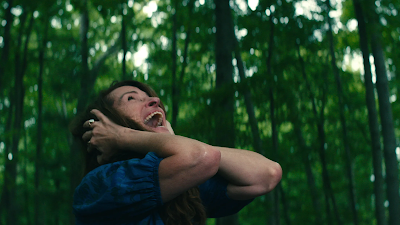
Every science fiction premise needs some level of suspension of disbelief. You have to be willing to accept the conditions that make up the world in question, whether it be the talking plants and fusion rifles of Gamma World or the island of Manhattan as maximum security prison of Escape from New York. The basic premise of Leave is that a cyberattack has crippled the power grid of the eastern seaboard of the US and all of the problems that ensue following that, including many that have little to do with a fairly believable scenario like that one, like sonic weapons transmitted over the entirety of Long Island and herds of deer trying to send a signal about this impending doom that's approaching. I mean, those things could be part of our suspension, as well, if they weren't from a different level of sci-fi than simply Con Ed in New York being hacked. But that's where you wonder how this script might have benefitted from a firmer hand that kept it going in a coherent direction, rather than the scattershot approach that later takes hold of it and squeezes hard enough that all of its elements get splattered in random directions, to the denigration of cast and audience.


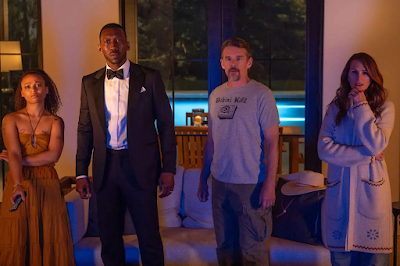
First off, if a cyberattack did take down enough of society to cause chaos, how (and why) is it that this one section of Long Island was spared? Was it because they didn't want to try to shoot all of the nighttime scenes by candlelight? Or so they could still have a functioning coffee maker in the house so that you'd know people would last two days instead of becoming instantly homicidal? I mean, part of the basis of most adventure stories is that the circumstances in front of us are just slightly different so that our heroes have a chance to do heroic stuff. So, fine. Our characters have power where all of New York City, visible across the river, does not. But then we discover that it may be beyond just power grids, in that satellite networks are down, so that planes and ships no longer have functioning navigation systems. But, of course, they still have functioning engines and ways to turn them off or keep them running, so why are ships beaching and planes crashing? And why is the latter only happening 18 hours after the initial shutdown when one of our heroes is walking on the beach? Said hero, G. H. Scott (Mahershala Ali) is an investment banker with high enough contacts to know one of the Illuminati who has offhandedly warned him that this disaster is coming. Scott, of course, dismisses the idea of the cabal that rules the world but also repeatedly reinforces the idea that such a thing exists. So, which is it? If writer/director Sam Esmail was trying to avoid the historical racist implications of that theory, he wasn't doing such a great job of it. Instead, he veers right into hitting us over the head with the overt racism of Amanda Sandford (Julia Roberts) when confronted with Scott and his daughter, Ruth (Myha'la) returning to their home which the Sandfords have rented. I mean, yes, the problem of inherent racism drives a large portion of American cultural relations and politics, so you don't really have to be that heavy-handed with said message. Amanda is borderline shrewish when conveying her distrust of the Black people in the house (their house, which she clearly doesn't believe because, you know, they're Black...) with her children.

Yeah, I can't believe how dumb this is, either.

But then we have all of the other more obvious story points that simply don't mesh with our aforementioned suspension. Why does Archie's (Charlie Evans) lyme disease take hold overnight and become worse than any version of that disease ever seen? If it is even just lyme disease, why do they think that a couple pills from local survivalist neighbor, Danny (Kevin Bacon), will solve his problem? Why do the local deer seem intent on gathering around just their house and not others? Why do flamingos show up in a Long Island swimming pool? Are these the surrealist components that are supposed to make us as confused as the characters? Why do Amanda and G. H., completely at odds over the situation and their respective identities, suddenly fall into each others' arms and consider cheating on their partners with each other in the space of 48 hours? Why would a man as wealthy as G. H. ever play ball at the local YMCA? There are so many little things detached from reality here that it's difficult to believe that one person wrote it and, if that is the case, whether that person has been outside their home to interact with actual humans anytime in the past few years. Is Esmail an isolationist/survivalist? Even the seeming in-jokes are off key. We see a trashed house with a sign of the previous owners hanging loose that says the home was owned by The Huxleys. If that's supposed to be a reference to Aldous Huxley, I'd have to ask why, given that this is a disaster film. Huxley is best known among his fiction works for Brave New World; a society under total control, not one that is falling apart. Archie walks around wearing an "OBEY" shirt from They Live, which is about the subtle control of society through subliminal advertising, not its collapse from a systemic breakdown.


All of this confusion and lack of direction is reinforced by the melodrama of both the cinematography and the score. The camera did repeated close-ups during dramatic moments, just in case we couldn't figure that out, and then wide pullbacks and spirals from above when action was happening. The score was the stereotypical orchestral crashing whenever a plot point was revealed or a realization was made by any of the characters; often multiple times in the same scene. The whole storytelling approach was amateurish, at best, and didn't convey the idea of a major production that would be carrying the heft of a film with the above listed stars, as well as Ethan Hawke. But, then, Hawke was almost insipid in his contrast to his abrasive wife, Amanda, who was presented in a thoroughly wooden performance by Roberts, which likely wasn't helped by the boilerplate dialogue she was given. Her first lines, when she wakes her husband to announce that they're taking a last-minute vacation and why are spoken like she's reading from a book of middle American homilies about modern society. And, of course, the worst thing about the whole presentation is that it reinforces the conspiracy theories that are rampant today, by suggesting that there may be some kernel of truth to them, if people would only pay attention. What those theories also carry are the racist overtones of anything similar to the Protocols of the Elders of Zion, which is kinda how this feels when you see the upper middle class White family having their vacation disrupted by all of the surrounding events (and Black people!)

It's just trash, beginning to end, and in no way worth your time or attention.

Friday, December 22, 2023

The difference between two stories we've seen before


I was looking forward to seeing Maestro, Bradley Cooper's latest film about the life of Leonard Bernstein. Larissa objected, thinking that she would find it too slow, as there's a lot to talk about in Bernstein's complicated life. Then we found out that it was a Netflix production, so we can watch it whenever, so that problem was solved. But we had already decided to see Fallen Leaves instead. The latter is a Finnish production about two average people leading fairly downtrodden lives who discover each other by chance and try to make contact, but keep stumbling over themselves, their lives, and other obstacles. It's a very simple story but it's effectively told and fairly entertaining. Indeed, it was done so well that it won the Jury Prize at Cannes this year, proving yet again that stories don't have to be complex, as long as they're well-written and well-acted and aren't predictable Hollywood boilerplate.


Ansa (Alms Pöysti), a grocery store worker and Holappa (Jussi Vatanen), a metal reclaimer, meet up at a bar on karaoke night, having been dragged there by their respective friends, Liisa (Nuppu Koivu) and Huotari (Janne Hyytiäinen.) There's a brief spark between them that they kind of grudgingly acknowledge and then make plans to meet again to see if it becomes a fire. Unfortunately, Holappa is a functioning alcoholic and Ansa isn't the surest person in social situations, so they end up missing each other in a variety of ways (mostly caused by Holappa.) The story doesn't get any more complicated than that, aside from the brief looks into Liisa and Huotari's perspective on life and relationships and the difficulties that our two leads have in remaining employed. It's basically a story about modern life and middle age. Of course, life in Helsinki is probably much different than it is in modern America, so there's not a lot of interaction with phones or the Interwebs or any of the other things that might suffuse wealthier societies and the process of people trying to hook up (My knowledge of modern Finnish culture and society is admittedly quite limited.) But the story doesn't really need all of that, either, since most of it is just an examination of how Ansa and Holappa are looking at life and whether they're willing to trust what it and each other are telling them.


There's a bit of a Coen Brothers air to the production overall, especially when it involves Huotari, who is easily the funniest character of the cast, as he tries to convince women, in general, and then Liisa in specific that, despite his gray hair, he's not actually that old and anyone who suggests that he is must be trying to pull a con. It's like Republican projection but far less sinister and far more amusing. But there's also some of the plaintiveness and resigned attitude that often pervades Coen stories, alongside the determination and willingness to keep forging ahead that is also a frequent feature of their characters. It also doesn't finish with a pat ending but leaves it open to question as to whether the relationship we've been trying to see established for the 81 minute runtime will actually be a positive one. That uncertainty, like everything else about this film, is just like life and can easily be understood and absorbed by an audience willing to see real people do real things.


That is, of course, a contrast to Maestro, which I started to watch last night. This is just the latest version of La La Land; a movie by Hollywood and for Hollywood that is solely concerned with Hollywood and the little tragedies within it that are only really relatable to those inhabiting it. In this case, the New York City musical scene stands in for Tinseltown. In the same way Ryan Gosling and Emma Stone tried to convey the horrible struggle of being an aspiring actor, Maestro takes us one step further and tries to convey the incredible anguish of being an enormously successful composer and conductor. Admittedly, Bernstein's life was more complicated by being a gay male in a period when such a thing, even among creative types, was far less acceptable than it is now and I think this is the angle that most occupied the thoughts of writer/director/star, Bradley Cooper. But the first hour of it plays out as a brief survey of how difficult Bernstein's life was on an emotional level when on every other conceivable level it clearly was not. This was not an aberrant personality like Oppenheimer trying to relate to the people around him. This was the extraordinarily popular and, again, successful Lenny Bernstein enjoying life with both his beard and the men he had on the side.


In contrast to Fallen Leaves, this film doesn't seem like life. It feels like a Hollywood depiction of life that few in the audience would ever be able to relate to. If the first hour had spent more time on the wider scope of Bernstein's life, instead of long shots on the faces of his male lovers feeling rejected when he marries Felicia Montealegre Cohn (Carey Mulligan), I might not have gotten so bored and disappointed that I turned it off. In some respects, that's a bit of improvement, since I could only make it through 15 minutes of La La Land before leaving the room. Obviously, there are a lot of ways to look at the lengthy life of an extraordinarily talented figure who had an enormous impact on 20th century music and continues to do so today (West Side Story was just remade by someone as notable as Steven Spielberg, as just one example.) But Cooper decided to take the overwrought approach that doesn't really explore the length and breadth of that impact, but instead decides to bring it all down to the emotional angle that plays up how trying Bernstein's personal life was. In a way, it's kind of like a very removed version of Fallen Leaves, but it simply has no way to make the personal connection that the latter film does because it's too preoccupied with the sense of its own tragedy. As someone who has tried to produce creative works for my entire life, I can tell you that I'd have given a lot for my life to have turned out as tragic as Bernstein's. (Obviously, I would've had to have had even a minor fraction of his talent.)


Maybe I'm wrong about the overall film, since I only made it through the first half, but I'm not sure that I'm willing to sacrifice the other hour of my far less interesting life to find out whether Cooper's vision changes. I'd rather see stuff about more relatable people. It's not that Bernstein wasn't presented as human, which is my frequent complaint about characters. He most certainly was. It's just that what he experienced is relatable to so few other humans that the message seems lost in its own attempted majesty. That's the difference between stories, even ones that we've seen a thousand times in various forms, that try to talk about life and those that imagine that their very removed life is somehow normal for the rest of us.

Thursday, December 7, 2023

Searching for meaning


I'm not a Nicholas Cage fan. My favorite film of his is the one where he's drinking himself to death (Leaving Las Vegas.) The rest of his work is somewhere between competent (The Color Out of Space) and higher-end trash (Gone in 60 Seconds, etc.) So hearing Dream Scenario described in the trailer as "Nic Cage at his very best!" was not exactly a selling point for me, unless we were talking about something akin to LLV. Dream Scenario kinda gets there at points, but still not with enough tragedy or emotion to really hit that level. Or, in all honesty, to sell its own story in the first place.
Nominally, it's about Paul (Cage), underachieving science teacher (That's your cue Breaking Bad fans) who suddenly becomes a bystander in thousands (millions?) of people's dreams. Given the nature of our interconnected society, he instantly becomes famous when his story is released to the Interwebs, courtesy an old girlfriend looking for subject matter for her blog. Life begins to go awry from there, but we never really depart the stiflingly mundane life that Paul has built for himself and which he sees no route to proceed from except via his long-unwritten book. Paul is not an appealing character, lacking even the basic sympathy or mild wit that someone like Walter White exhibits in the beginning of his story. Instead, Paul's utter lack of ambition and inability to self-examine is used as a lever by which to portray the sudden rise of "normal" people to fame through modern social media and all of the downfalls that can accompany that status when your life is suddenly exposed to the attention of millions of people who would otherwise have ignored you. Paul, of course, is the most ignorable of people, appreciated by no one but the dean of his small college (Brett (Tim Meadows)) and his wife, Janet (Julianne Nicholson) and then only reluctantly, it seems.


There's nothing to engender sympathy about Paul's situation, which is the usual approach in situations like this and perhaps that was writer-director, Kristoffer Borgli's, intent to escape that typical angle; a move that I would normally applaud, especially when trying to tell a story that delivers a message about modern circumstances. But the message ends up being muddled because we find ourselves why we're bothering to watch this at all given that, again, Paul is so uninteresting as to be basically repellent to not only everyone around him in the film, but those watching it, too. There's some interest generated by the phenomenon itself (Jung was right-!) and why it's only happening to Paul, but pretty soon that's kind of shuffled to the side in the interest of delivering the "deeper" message about fame and all of its foibles. There are, quiet honestly, better ways to go about this and with far more interesting characters to do it with. Do you really want your audience to reach the point of disdain for your main character by the end of the film without him having done one interesting thing the whole time? I could watch any reality TV trash for two hours and get the same result. Even the almost-but-not-quite sex scene, set up to be a flashpoint which predictably fizzles, doesn't engender anything in the viewer except a question as to why they're still sitting there watching this.


Suffice it to say that I didn't "get it." I mean, I understand the point that Borgli was trying to make and sympathize with the idea, but it didn't sell me at all. I basically felt nothing but contempt for everyone in the film, to one degree or another, and not just because the person onscreen most often is an actor that I don't particularly appreciate. Maybe you could take the time to watch this on some streaming service if you're interested in oneiromancy about the world as a whole, but I wouldn't blame you at all if you didn't bother. 

Wednesday, November 22, 2023

Satisfyingly clichéd


I'm an Alexander Payne fan. Ever since Election, I've made sure to see everything that he's directed because there's something about his pacing and storytelling rhythm that simply sings to me. It's a comforting thing when you can begin watching a film and instantly know that it's a particular director's work. I've had that feeling with people from Christopher Nolan to John Carpenter and Payne is no exception to that. In that respect, even if I hadn't known that The Holdovers was his latest release, I would've been able to tell you that it was about five minutes into seeing the interchanges between irascible history teacher, Paul Hunham (Paul Giamatti), and student, Angus Tully (Dominic Sessa) along with the lighting, the camera angles, and the slow pans through the early 70s New England winter. All of that said, it's fair to say that the film doesn't really show anything new or exciting that deviates from that style and it's an open question as to whether it benefits or suffers from that.


Now, as Story Guy™, I'm usually the first one to criticize someone presenting a story that's immediately predictable or just a retread of others that we've seen before. By the same token, what I'm asking for more often than not isn't necessarily something new, but instead something good and The Holdovers does not fail in that respect. The embittered teacher who thought he'd achieve something more is no more new than the mother grieving for her lost son or the kid whose parents shipped him off to boarding school to get him out of their lives (How well do I know that story...) But the combination here is familiar enough to accept, but also written and performed well enough to hold the attention. It was probably even more entrancing for me than most of the rest of the audience because I attended a school a lot like the fictional Burton Academy for a couple years when my parents shipped me off there, ostensibly to get a better education, but mostly to just get me out. Giamatti's character speaks to that when he bemoans the fact that most of the students he has are unprepared for both the material he's teaching and the style with which he does it. And, just like my own experience, by far the most congenial character is Mary (Da'Vine Joy Randolph), the head cook in the school's kitchen, as adrift from human companionship as either of the other two leads and, like them, forced to put up with what she can get.


Interestingly, the concept for the film was initially Payne's but he decided to hand it off to writer, David Hemingson, after deciding that the TV pilot he originally had in mind didn't have enough to carry it. I think he was correct in that respect, in that the film's plot is comfortably familiar, but probably so much so that a TV series would have become repetitive quite soon and dwindled off into indifference. Hemingson's script is matched perfectly with Payne's approach and is easily among the highlights of the film. I think Randolph's line: "Don't fuck it up for the little asshole!" is among my favorites that I've heard uttered this year. But you have to give a nod to the performances, from the star in Giamatti to the veteran in Randolph to the newcomer in Sessa, who was not only in his first credit of any kind but was also attending one of the locations used to shoot the film (Deerfield Academy) just over a year ago. Giamatti carries a role much like he did in his previous collaboration with Payne (Sideways), but remains as magnetic a presence as ever, even in the cloak of the familiar. Sessa, on the other hand, switches nicely from the perpetually bored and insouciant teenager to the wounded child, longing for his father, and back again. Randolph, meanwhile, is the most consistently moving of them all and with the deepest well of emotion in most of her scenes.


And all of those positives have to be the shining stars in this firmament because, again, the story is nothing innovative and is entirely predictable from opening to ending credits. (I certainly appreciated the 70s-era MPAA screen notifying us of the 'R' rating.) It's not wowing us with anything. It's simply delivering a solid story and good performances in the same heartfelt way that Payne films like Nebraska or The Descendants did, if not quite so elevated in its look into the human condition as the latter. Or perhaps it simply felt that way because, again, we've seen this before; in my case, even moreso than others for reasons noted but not least because Hunham is as fond of Marcus Aurelieus' Meditations as I am ("This book, for me, is a combination of Christianity, Judaism, and Buddhism all in one and without a single mention of 'God'!") That book has been a touchstone for me since I was roughly the same age as Angus and holds a lot of advice about life which seems obvious only after you've read it; in many ways, like The Holdovers, which is comfortably clichéd, but something that you don't mind, and even look forward to, seeing again.

Monday, November 6, 2023

Focusing on the pedestal


We saw Killers of the Flower Moon almost a week ago and it's taken me this long to get around to writing something about it because, in the end, it was all very mechanical and technical writing is not really my strong suit. That's a forward statement that would prepare most readers with the idea that I didn't like the film. That's actually not entirely the case. I like most Martin Scorsese films to one degree or another. But the problem I've had with his output for the latter half of his career (basically anything post-Goodfellas) is that he's taking the "favored actor" concept to the nth degree. Instead of telling a story, he's just signing the actors that he likes working with and building a production around them which is mostly just an opportunity for them to show off. So, yeah, I have a bit of a critique in mind.


Now, there's nothing wrong with actors "showing off." That's kinda what acting is in the first place. Sometimes, it can even be a great thing. Gangs of New York was completely carried by Daniel Day-Lewis' performance as Bill the Butcher. Indeed, the entire story is centered on him and his experience, despite Leonardo DiCaprio's presence as the nominal lead. It's a fun time watching DDL do his thing for two hours because, as with many of his roles, he's magnetic every time the camera is on him. But it only took one viewing to recognize that the film was basically all about his performance. The story is weak. There is precisely zero character development, as everyone knows what Amsterdam's motivations are from the outset and they don't change and neither does anyone else. It's just a showcase to demonstrate what a great actor Day-Lewis is. And that's fine. Some films are like that. It's what's normally referred to as a "vehicle" for whomever the star is. But even most vehicles have a story that goes somewhere at least mildly interesting and too many Scorsese movies in the latter half of his career really don't. Killers is no exception.


The basis of the story is excellent. It's about the discovery of oil on Osage land in Oklahoma in the early part of the 20th century and how the tribe became the richest people per capita in the world. It's also about how White people then moved in and scammed, stole, and literally murdered many Osage for their land rights and that money flowing from it. This is, as all of you know, something of a repetitive theme when it comes to US interaction with the native tribes of this continent. In this case, it was simply among the most blatant. That sounds like a situation that not only is unfamiliar to many, which can often lead to a good story full of tension, but is also loaded with potential for personal drama, as well. And the film has both of those elements to varying degrees... except that it begins with a documentary approach that essentially wholly describes the circumstances that precede and extend through the entire film. It basically gives the audience all of the dramatic cues before we even reach a moment where said cues would've provided that tension. It's as if Scorsese decided that he didn't want to be questioned as to the idea of scoring cheap emotional points, so he told us all of the bad things that would be happening, rather than letting us discover them through the story. This extends to most of the action in the film, where we see all of the crimes happening in plain sight; most notably those committed by DiCaprio, as the male lead, Ernest Burkhart. There are no faces hidden in shadow or behind masks (for very long) that would create any kind of dramatic effect later in the story where we discover the dastardly Burkhart being involved in these activities against his wife's people and, of course, his wife. We're just shown in documentary fashion everything that's happening.


Now, there's nothing wrong with this if we were watching an actual documentary. Likewise, it might be a little more tolerable if we were watching a more typical 90- to 120-minute film. It would still be disappointing, but wouldn't have brought me to the point where I was questioning what the point of the entire last third of the film was. But it's because that last third of the film is DiCaprio's opportunity to step on the pedestal that Scorsese has given him and emote to his heart's content. Part of the problem may be that, if we're going to see a star vehicle, we generally want that character to be entertaining. That's why it's a vehicle, because you want to see this person, whether it be the actor or the character, if not both, on the screen. But Burkhart is an emotionally-stunted and largely unintelligent person. And, yet, the last hour of the three-and-a-half hours that make up this "epic" is mostly just DiCaprio reenacting everything that we'd already seen for the first two-and-a-half hours. The entire courtroom and jail sequences are him simply admitting to and retelling the events of everything we'd already seen happen. It's like we were given access to the rehearsal and immediately after were shuffled into a room to watch a script reading. We're getting the same information, none of which is new or surprising or particularly compelling. Instead, it's just an opportunity for DiCaprio to demonstrate his evident talent (something we're also already aware of; The Revenant is one of my favorite American films of recent years.) That's not unentertaining, to a point. Watching Burkhart struggle to admit his guilt with his wife (Lily Gladstone), Molly's, eyes boring into him is a fine piece of acting on both their parts. But it also just retells the story that we'd already had explained to us even before we saw it the first time.


If we were going to be shown an acting tour de force in lieu of an actual story, I'd probably have been more entertained by seeing one from Gladstone, who was delightful as the smartest person in the room from the moment she first appears. And she does get plenty of screen time, but simply not as much as old Scorsese favorites DiCaprio and Robert De Niro, who these days doesn't often play a character so much as he plays Robert De Niro playing a character. And, of course, there's any number of cameos of big names from John Lithgow to Jesse Plemons to a scenery-chewing Brendan Fraser to Jason Isbell, a country music star whom I follow on Twitter who's highly entertaining as he interacts with people who probably think the White folks in this film are either Heroes of Progress or being persecuted by the mythical CRT zealots. Those people probably didn't want to see this, anyway, because it's presenting a story that might force them to question their star-spangled (White stars, mind you) version of American history. It's a story that needed to be told because, again, most are probably completely oblivious to it. It's an interesting story, even if macabre. But it's presented here as an excuse to showcase DiCaprio, which isn't at all what this story should have been about. Indeed, the fact that all of the Osage roles other than Molly are often stereotypical stand-ins makes one wonder if it was written from the ground-up as a star vehicle, rather than just adapted to one when it came into Scorsese's field of vision. But apparently he rewrote it to insure that it wasn't just a White Man's Burden thing. I'm, uh, not sure that worked the way he wanted it to.


Scorsese isn't a bad director any more than DiCaprio is a bad actor. But you look at the first half of the former's oeuvre and you see things like Mean Streets, Taxi Driver, Raging Bull, After Hours, and the aforementioned Goodfellas. Then you look at the latter half and you see things like Casino, Gangs, The Departed, The Wolf of Wall Street, and The Irishman. There are high points to all of them. They're not bad films. But they're also not great films because they don't try to tell a story. They're mostly just settings for his favorite actors to do their thing and all of which you either know of because you watch the news (Wolf), have seen many times before especially from Scorsese (Casino), or get explained to you before the drama even begins (The Irishman which, honestly, is probably the exception to this group, in that it's really not a good film, overall.) I didn't actively dislike Killers. I think it's worth seeing if you don't know anything about the story of the Osage. Do I think it's worth sitting in a theater for three-and-a-half hours to watch the same events be relayed to you twice? No. No, I do not. Watch it via Amazon over a couple evenings or something like that and do it mostly for Gladstone's performance. But if you were expecting to see another Scorsese classic on the order of Goodfellas, I'm afraid you're not going to be able to see past the pedestal.

Tuesday, October 17, 2023

Mastery of tension


We wanted to see Past Lives when we saw the trailer at the Michigan Theater, but it didn't end up meeting our usual schedule. I don't recall if it was because it simply wasn't showing on Tuesdays or if showtimes were too early for us to make it. I remember thinking that it looked at first glance like a standard "long lost relationship" story, but there was something subversively attractive about it that elevated it beyond what I would have normally dismissed as boilerplate. With the recent dearth of interesting films at the two theaters, we decided to take a chance on this one on Apple TV+ and I'm really glad we did, because it was anything but bog standard and is one of the better films we've seen this year.


There's an art to cinematic romance that goes beyond the dreamy quality that many people associate with it. It's not just about living out fantasies. Sometimes it's about dealing with the emotions that are known to all of us and inherent to the human condition. The ability to display that is an art in and of itself because many will associate those presentations with sappiness or "chick flicks", but when you can convey real anguish and uncertainty and restraint, it creates a tension on the screen that is the essential hallmark of storytelling. It's what keeps your viewer glued to the screen. They want to find out what happens next, whether it's the predictable (Love conquers all!) or the not so much (Real life...) This film has that tension from beginning to end. From the moment we first see 12-year-old Nora (Greta Lee) and Hae Sung (Teo Yoo), we can feel the bond between them and their desire to immerse themselves completely in it. But we can also feel the restraint (the uncertainty of youth; the conflicting paths of life; the attachments to others) that they have to exercise to keep themselves from engaging in that deepest desire. It's a difficult task to sell that tension without overselling it to the point of melodrama and both Lee and Yoo, as well as writer-director, Celine Song, pull it off with aplomb.


Indeed, some of the best moments of the film are those without dialogue or obvious action, but which are instead simply studies of the two leads as their faces betray everything they want and everything they're containing as they try to navigate their changing circumstances from 12 to 24 to 36. I've often said that visual storytelling is often a lost art in modern filmmaking but Song's pacing and direction have it down. That extends to the sets and costuming, as well. There's nothing overly remarkable about any of the backgrounds or apartments or restaurants. They all seem everyday and normal because this situation is also everyday and normal, but no less important for being so. Nothing that you see detracts from the focus on the characters and the emotions that they're alternately struggling to contain and desperate to express. It's an extraordinary feeling when you can understand why it would be gratifying to some degree to see these two people finally get to interact in the way that they both want, but would also be a hindrance to the telling of a genuinely good story if they tipped over that edge. Again, that tension is what separates the film from the bog standard and it had to be maintained. The fact that much of the story was drawn from Song's own life probably made it that much easier to tell.


Some mention also has to go to Nora's husband, Arthur, played by John Magaro, who some might consider the truly tragic character in this drama, as he's the innocent bystander in this drawn out collision. He cogently identifies himself as the "White bad guy" in this romantic scenario when all he's trying to do is continue to love the woman that he's been married to for a decade. You feel for him at least as much as the two leads for knowing that his wife may still be bonded at the soul, as it were, to another person. But she also points out that she made the choice to have this life and she's choosing to spend it with him. It's that choice that kept Nora and Hae Sung apart the first time they rediscovered each other, so he's a conscious inclusion. But, of course, the genuine desire is written on Nora's face through the final third of the film, whether Arthur is present or not. In the end, it's a great film in the path of favorites of mine like Blue is the Warmest Color, because it's a film about humans and how we react to the world and the people around us. Highly recommended for a watch and a re-watch, for that matter.